History of the Great Lakes
Vol. 2 by J.B. Mansfield
Published Chicago: J.H. Beers & Co. 1899
[ A ][ B ][ C ][ D ][ E ][ F ][ G ][ H ][ I ][ J ]
[ K ][ L ][ M ][ N ][ O ][ P ][ Q ]
[ R ][ S ][ T ][ U ][ V ][ W ][ X Y Z ]

ADAM G. BOHLAND
Source: History of the Great Lakes, Vol. 1 by J.B. Mansfield
Adam G. Bohland, marine engineer, has been engaged in his vocations for comparatively few years, but he has come rapidly to the front. He was born January 3, 1863, at Cleveland, Ohio, attended the parochial schools in his native city until he was fourteen years of age, and subsequently served an apprenticeship to the model and die business in the shops of H. O. Hartz, where he remained some years, perfecting himself in his trade. He then went to work as a machinist in the employ of the Excelsior Machine Works, continuing with that firm some three years, after which he worked for the Globe Iron Works Company one year. In the spring of 1889 he turned his attention to marine engineering, shipping as oiler on the steamer Specular, owned by the Republic Iron Company, and the following season he received a license and went as first assistant on the steamer Germanic. He remained ashore in 1891, engaging as an employee in the Excelsior Machine Shops, until the spring of 1893, when he shipped as first assistant engineer on the iron steamer Onoko, holding that berth until September, 1895, when he was appointed chief of the same steamer. He was retained in that position during the season of 1896, laying her up at the close of navigation in Buffalo harbor. This record shows that Mr. Bohland attained to the position of chief engineer on a good steamer in less than five years' service in subordinate positions on steamboats, and it is evident that his shop experience was of much value to him. He is a member of the Marine Engineers Beneficial Association. Mr. Bohland was united in marriage with Miss Catherine M. Haefele in 1887.
CAPTAIN GEORGE BOHN
Source: History of the Great Lakes, Vol. 1 by J.B. Mansfield
Captain George Bohn, master of the Governor Morton, more familiarly known as the "Police Patrol Tug," is of French extraction, having been born in Paris, France, April 17, 1855. His father, Joseph Bohn (now deceased), who was on the police force of Buffalo for a period of ten years, emigrated to America in the year 1856, when the son George was eighteen months old.
Our subject received his education in the public schools of Buffalo, and began his first sailing as fireman of the P. J. Ripont, a steamyacht owned by Edward Dahlke, formerly of Black Rock, but latterly of Cleveland, Ohio. He was employed upon this yacht two seasons, but the following season, that of 1872, he was fireman on the tug Monitor. The three years following he was employed at various occupations on railroads, and in 1878 returned again to the water for a livelihood, becoming engineer of the James Hays, a steamyacht, upon which he remained three seasons in succession. From 1881 to 1883 he was engineer of the James Hays, a steamyacht, and for the succeeding seven seasons he was engineer of the steamyacht A. T. Kerr, and for the succeeding seven seasons he was engineer of the Glance, finally, in 1890, becoming her pilot and master, and he was with her the whole season in that capacity. The next season he was on the steamyacht Waller, in 1892 returning to the Glance for a couple of seasons, and for the season of 1894 he was master of the Ideal. In 1895 Mr. Bohn was made pilot of the police patrol tug Governor Morton, and was still acting as such at the close of the season in 1896. The work of the Morton is patterned after that of the police patrol tugs of New York harbor, and her duties comprise a constant close inspection and watch over the harbor of Buffalo and also Buffalo and Niagara rivers day and night, she having two crews. During the season of 1896 her respective crews made about eight hundred arrests, mostly of vagabonds and tramps, some of persons stealing from vessels, and the balance for being drunk and disorderly. The idea embraced within the duties of the Morton is a valuable one and could be carried to other lake ports with profit. For the season of 1897 he was on several boat tugs, mostly on the Annie M. Pierce, and for the most of the time on the Glance as her engineer.
Mr. Bohn was married February 14, 1875, at Buffalo, to Annie Gorman, of Cleveland, Ohio. They have three children, namely: George, now (1898) aged fifteen; Laura, aged twenty, and Joseph, aged eighteen. Mr. Bohn has been a member of the Masters and Pilots Association, Harbor No. 41, since August, 1896.
GEORGE M. BOHNERT
Source: History of the Great Lakes, Vol. 1 by J.B. Mansfield
George M. Bohnert was born May 21, 1862, in Buffalo, N. Y., where he acquired his education, in the public schools, and where he still continues to make his home. The birth of his father, John B. Bohnert, occurred in the north of France, near the Belgian frontier, whence when four years old he was brought to America by his parents, who located in Buffalo, making their home there for some years. The father spent the greater part of his life on the lakes, retiring in 1844, and he is still living in Buffalo, a police pensioned officer. During his youth George M. Bohnert learned the machinist's trade. At the age of nineteen, however, he went on the Winslow, of the Anchor line, as oiler, in which position he remained only a part of one season, being obliged to return home on account of sickness in the family. He spend the next season as oiler on the Idaho, of the Western Transportation Company, and the following three years as first assistant engineer on the Colorado. He was then on the Wyoming as second engineer for two years, and after seven seasons spent upon the Florida as first assistant, he returned to the Wyoming in 1895 as chief engineer, which position he is still acceptably filling.
Mr. Bohnert was married May 15, 1893, to Miss Agnes L. Percy, of Buffalo, and they now have a pleasant home in that city at No. 130 Sage avenue. Fraternally he is a member of the Marine Engineers Beneficial Association of Buffalo, and of Buffalo Encampment No. 46, I. O. O. F.
CAPTAIN DAVID BORDEAUX
Source: History of the Great Lakes, Vol. 1 by J.B. Mansfield
Captain David Bordeaux, captain of the propeller John V. Moran, is one of the most widely known masters in the merchant marine of the Great Lakes. He was born in Clinton county, N. Y., in 1841, and was educated in the academy at Malone, N. Y., and at Nicolette College, Quebec, taking a three-years' course of study in the last-named institution. At the age of fourteen years he commenced life on his own account as tar-boy on the schooner Courtland, sailing between Detroit and Ogdensburg, and after two months was earning a man's wages as a sailor before the mast. He was then employed as watchman on the side-screw steamer Baltic, running from Buffalo to Chicago; and in 1860 he became wheelsman on the propeller Racine, of the People's line, and later in the same year sailing in the same capacity in the propeller Forest Queen, plying between the same points. In the fall of this year he shipped as wheelsman on the propeller Union, belonging to the American Transportation Company, and toward the end of the season sailed as wheelsman on the propeller Potomac, running between Milwaukee and Grand Haven, remaining on her until January 15, 1861. In the spring he was given the same berth on the propeller S. D. Caldwell, and then shipped on the propeller Gov. Cushman, plying between Buffalo and Toledo, after which he served as wheelsman on the Badger State. In 1862 he was wheelsman on the propeller Buffalo, and in August of that year he shipped on the propeller Saginaw, plying between Buffalo and Sandusky. In 1863 he became wheelsman on the propeller Equator, going between Buffalo and Toledo, and in September of the same year sailed in the same capacity on the steamer Michigan, which ran from Buffalo to Green Bay, Wis. The following year he shipped as wheelsman on the propeller Cuyahoga, plying between Buffalo and Detroit, and then on the propeller Guiding Star, as second mate. While in the Cuyahoga, he received his papers as second-class pilot, and finished the season of 1864 as second mate on the propeller Kentucky. In the season of 1865 he shipped as second mate on the propeller Orontes, sailing from Buffalo to Toledo, and in the spring of 1866 he became first mate of that vessel, on which he sailed for five years. In the early season of 1870 he became second mate of the propeller Newburg, of the Union Steamboat line, and finished the rest of the season as first mate on the propeller Passaic. In 1871 he sailed as first mate on the Colorado, and in 1872 acted in the same capacity on the Jay Gould.
The following year he was chosen first mate on the propeller Newburg, belonging to the Union Steamboat line, and in 1874 he served in the same capacity on board the Portage. In 1875 he was made first mate of the Anchor line steamship Conestoga, then belonging to the Erie Transportation Company, and in 1876, in the same capacity, he sailed in the propeller Jewett. In 1877 he shipped as first mate on the steel steamer Tioga, and in September of that year became captain of the Nebraska. During the season of 1878 he sailed as master of the propeller Portage, and in 1879 was transferred to the captaincy of the steamer New York. For six years he was captain of the steel steamer H. J. Jewett, and in 1896 sailed between Buffalo and Duluth as master of the propeller John V. Moran.
The Captain was married, in 1866, to Miss L. C. Keeley, of Buffalo, and they have one child, who is the wife of Capt. Samuel Golden. Captain Bordeaux resides at No. 386 Fourteenth street, Buffalo, New York.
HENRY BORN
Source: History of the Great Lakes, Vol. 1 by J.B. Mansfield
Henry Born, as general manager and treasurer of the Born Steel Range & Manufacturing Co., conducts one of the largest and most modern equipped plants in the United States for the manufacture of steel ranges. Their lines of goods have been in the market longer than those produced by any other competing firm, and it is the aim of the company to maintain the high standard of excellence these ranges have won. At the World's Columbian International Exposition, held in Chicago, Ill., in 1893, medals were awarded the Born Steel Range Company for various specific merits and excellence of construction.
Their marine trade, in which they have been prominent for nineteen years, is not confined to ranges, however, as it is their custom to fit entire the steward's galley with whatever entered into that very necessary department in the outfit of a boat, be it a steamer or sailing vessel. There are, perhaps, not many new vessels launched from shipyards about the lakes that do not enter in the outfit specifications a Born steel range and the other articles in that line furnished by this house. The manufacturing works of the company are located at Cleveland, Ohio, and the offices and salesrooms are at Nos. 122 to 126 Superior street, Cleveland. The ranges are not only in great favor on steamships and sailing vessels on the lakes, but are in general demand on both the Atlantic and Pacific ocean-going vessels, and but recently large orders have been shipped to Delano Brothers, San Francisco, and to firms in New York City, Philadelphia, Baltimore, Washington, New Orleans, and all United States seaports. The United States navy has also adopted the Born steel range for use on war vessels. Thousands of testimonials on file in the offices of the company show that this make of range is in almost universal demand in private dwellings, restaurants and hotels, and that they have found place in almost every public house in Cleveland, and in public houses throughout the United States, as new and improved facilities are required in the kitchen.
CAPTAIN WILLIAM A. BOSWELL
Source: History of the Great Lakes, Vol. 1 by J.B. Mansfield
Captain William A. Boswell, a well-known and justly popular master of passenger steamers sailing out of Chicago for many years, was born on the banks of St. Joseph river, near the city of that name, in Berrien county, Mich., and is the son of Ezra and Sarah (Connelley) Boswell, natives of Scotland, many of the sterling characteristics of the Scotch people being inherited by our subject. The father was born in Edinburgh, May 5, 1823, the mother on the 6th of June of the same year.
With their respective parents they came to America, and after living in Richmond, Va., for a time, they moved to Columbus, Ohio, where they were married. In 1848 they took up their residence in Berrien county, Mich., where they made a permanent home. The father was a man of fine physique, being six feet four inches in height, but did not appear so tall on account of being so well proportioned. In the early days of steamboating he sailed on the St. Joseph river, and became a pilot on that river. He is now residing at Greenfield, Tenn. Our subject's paternal grandfather died in Scotland. Allen Connelley, his maternal grandfather, was an old salt-water sailor of the British merchant marine; was a well-educated man and a thorough navigator, who had sailed the water in the different latitudes, as master of ships. He died of pneumonia at St. Joseph, Mich., in the fall of 1859. Henry T. Boswell, a brother of our subject, is a marine engineer, and as such has held a good position for many years.
It may with truth be said that Captain Boswell is a born sailor, for when a small boy he was always about the water, having doubtless inherited a love for the same from his maternal grandfather. Given a knife and a block of wood, he would make a boat and go down to the river and sail it. The district schools possessed no attraction for him, and he began his career as a sailor, when quite young, on the side-wheel steamer St. Joseph on the St. Joseph river with his father, after which he shipped with Capt. Thomas Richardson on the double topsail scow Addie, on which he remained two seasons, transferring to the schooner Gertrude, owned by the same party, and remained on her, filling all subordinate berths until he was appointed master, and he was also master of the schooners Gertrude, Flora Temple, Ella Teal, Souvenir, Evergreen and Regulator.
Captain Boswell then turned his attention to steam vessels, and entered the employ of the Goodrich Transportation Company, as wheelsman on the side-wheel steamers Seabird, and Orion. In 1870 he applied for and received pilot's papers, being recommended by Capt. Thomas Butlin, A. E. Goodrich and Nelson Napier, and was appointed second mate of the passenger steamer Ottawa, and while in that employ transferred to the steamers Seabird, Orion, G. J. Truesdell (now the John Otis) and Comet. He then resigned to take charge of the tug Ellen M. O'Brien, operating out of Pentwater, and sailed her one season. The next season he sailed the tug Sport, at Ludington, for Capt. Eber Ward, after which he took charge of the passenger steamer Fannie Schriver, plying between Pentwater and Ludington, then the terminus of the railroads in the North, and he was next transferred to the steamers Magnet and Grace Dormer as master. In the spring of 1880 the Captain went to St. Joseph, and entered the employ of Mr. Graham as mate of the propeller Lora, with Capt. Cal. Barlett. This was followed by a season as master of the Skylark. That winter the company built the steamer St. Joseph, and Captain Boswell came out in her as mate, with Alex Elton. The next season he became master of the ferry boat Belle, operating about Benton Harbor and St. Joseph, Mich. When she was sold he entered the United States service as master of the General Gilmour. He then purchased an interest in the tug and ferry line operating between Benton Harbor and St. Joseph, but after two years sold his stock, and again entered the employ of the Graham & Morton Transportation Co., as mate of the winter boat Petoskey, after which they chartered the steamer Lawrence, and he went as mate on her. When she laid up at the end of the season he again went as mate on the Petoskey, thus alternating between those steamers and the City of Charlevoix, until the City of Louisville was added to the line, when he came out on her as mate, and on July 31, 1895, when Capt. John Griffin resigned, our subject was appointed master, and has sailed her daily between Chicago, St. Joseph and Benton Harbor for many seasons, including the winter months.
Captain Boswell was made a Master Mason in Oceana Lodge No. 200, of Pentwater, in 1870, but now affiliates with Lake Shore Lodge No. 28, F. & A. M., of Benton Harbor. He is a member of the Independent Order of Odd Fellows; a charter member of the Knights of Pythias, and of the Puritan Lodge and Uniformed Rank of Burton, Tenn., and also belongs to the Knights of the Maccabees.
On November 13, 1873, Captain Boswell wedded Miss Ettie, daughter of Perry and Annie Brooks, of St. Joseph, Mich., and the children born to this union are Claude William and Walter Leo. The family enjoy the comforts and luxuries of a handsome home at No. 120 Belleview avenue, Benton Harbor, Michigan.
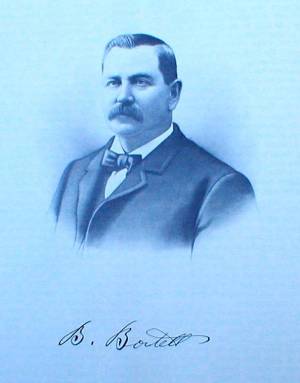
CAPTAIN BENJAMIN BOUTELL
Source: History of the Great Lakes, Vol. 1 by J.B. Mansfield
Captain Benjamin Boutell stands as a just and upright man, and has ever lived and walked as such. He has hosts of friends, and is acknowledged to be one of the most deservedly popular citizens of Bay City, Mich. By good business methods, united with untiring industry, he has acquired an abundance of this world's goods, but does not set his heart upon them, as his courtesy and humanity to man are wide, though unostentatious.
The Captain is a son of Daniel and Betsey (Adams) Boutell, his mother being grand-niece of John Q. Adams. She was born in Syracuse, N.Y., in 1808, a daughter of Benjamin Adams, while her husband was a native of New Hampshire, born in 1800, and a son of Henry Boutell. When quite a small boy Daniel Boutell removed with his parents to Syracuse, N.Y., where he met and married Miss Betsey Adams, in 1824, after which they lived for some years in that city, Mr. Boutell being engaged in building and selling canal boats. Then, anticipating Horace Greeley's advice to "go West," he went to Deerfield township, Livingston Co., Mich., making the entire journey in his own conveyance - a covered emigrant wagon - being seven weeks upon the way. He purchased a large farm, redeemed it from the virgin forest, and erected upon it a residence. It was here that Benjamin Boutell, the subject of this article, was born August 17, 1844. The family remained on this farm and worked it to the best advantage until 1857, when they removed to Birch Run, Mich., where the father erected a hotel which he designated "The Half-Way House," it being equi-distant between the towns of Flint and Saginaw. After conducting this hostelry successfully for two years he removed to Bay City where he purchased the old "Sherman House," which stood on the southeast corner of Water and Third streets, and rebuilt it, changing the name to "Boutell House." He again established himself in the hotel business which he carried on until June, 1865, when the structure was destroyed by fire. During the progress of the conflagration Mr. Boutell contracted a severe cold, which settled on his lungs, and he died from the effects of the same in the spring of 1866. He had lived a busy and useful life, and had made friends in every quarter. The wife and mother was laid to rest in 1880, aged seventy-two years.
Capt. Ben Boutell, as he is familiarly known, has also lived a busy and useful life. In his boyhood he helped his father on the farm and in the hotel, attending the public schools as he had opportunity until the spring of 1865, when he adopted the life of a sailor, shipping as wheelsman on the steam tug Wave. The next year he was promoted to the position of mate in the same boat. In the spring of 1867 he took out his first government papers, and was appointed master of the steamer Ajax, the amount of his salary to be governed by the net cash he cleared. The Ajax was a small side-wheel tug, and was owned by a Bay City bank, but she was tied up for debt, the creditors having a keeper aboard. It devolved upon the Captain to free his boat from the clutches of the law before he could sail her. Preliminary to this act he shipped an engineer, Samuel Jones, whose salary, like the Captain's, was conditional; and a colored cook, known as Aunt Kittie, who weighed about 240 pounds. They formed a combination for strategy to rid themselves of the keeper. The heavy line by which the steamer was attached to the dock was replaced by one half an inch thick, and the Captain had a sharp knife. The engineer got up plenty of steam, and when all was ready Captain Boutell advised the keeper, who was a big man, to get off the boat as he was going to sail. The man demurred, and the Captain, who had not yet gained the fine physical proportions which he has since developed, was somewhat afraid to tackle him; but finally, when the man was not observing he stepped up and after some mysterious moves the big keeper was overboard into the river. The Captain then cut the slight line that held the Ajax and she steamed away. The keeper swam to the dock and crawled out of the water. Captain Boutell, the engineer and the cook ran the tug that fall, sawing the wood she burned, and performing all the other work, clearing for the owners $6,000.
In the spring of 1868 he took command of the side-wheel steamer Runnels, sailing her until June in the passenger trade between Bay City and Oscoda. This steamer he left on account of illness, but closed the season as mate with Capt. William Mitchell in the tug Union. In 1869 he entered into partnership with Mr. Mitchell, under the firm name of Mitchell & Boutell, doing general towing business. They started with the Union, and purchased the tug Annie Moiles, Captain Boutell sailing the former, Captain Mitchell the latter. These conditions existed until December, 1870, when the Union was destroyed by fire on Saginaw bay the crew escaping in the yawl boat. The next spring the Captain took charge of the Annie Moiles, and sailed her until the fall of 1876. They then built the steamer Westover, and Captain Boutell sailed her five seasons. In the meantime the firm had purchased the tugs Laketon and Music. It was in 1875 that they commenced to buy barges, and when the firm dissolved in 1887 they owned quite a fleet, consisting of the Nelson, Favorite, Emma L. Mayes, Roscius, Seminole and others, besides the tugs. In the division Captain Boutell took the tugs and raft-towing business, and Captain Mitchell the lake barges. During that winter the steamer Folsom was built to the order of Captain Boutell.
In the spring of 1888 the Captain associated with P.C. Smith in the raft-towing business under the firm name of Boutell & Smith, which continues in force at this writing, and during the past ten years the industry of raft-towing under his management has been revolutionized to so great a degree as to keep pace with any other branch of traffic on the Great Lakes. The first year the Captain confined himself to towing on the rivers tributary to the Saginaw, but since then his field of operations has been greatly enlarged. The firm has steadily added to their fleet of large tugs, which now consists of the powerful tugs Traveler, Niagara, Boscobel, Winslow, Sweepstakes, Charlton, Peter Smith, Ella M. Smith, Charlie O. Smith, Annie Moiles, R.H. Weidemann, Robert Emmet, Luther Westover, Sea Gull, Lulu Eddy, Mary E. Pierce, Sarah Smith and Florence. This business is conducted by Captain Boutell under the title of the Saginaw Bay Towing Company, and the fleet is the finest afloat for towing and wrecking purposes, many of the tugs being built especially for the business. It is difficult to realize the magnitude of this enterprise in log-towing, but an idea may be gained from the statement that the average business of the company has been 150,000,000 feet in big rafts and timber during the last ten years, two seasons it being as high as 300,000,000 feet. In addition to the above vessel property, Captain Boutell owns, individually, the steamers Charles A. Eddy, whose registered tonnage is 2,075, and Hiram W. Sibley, of 1,418 tons, and also the schooner Twin Sisters.
Captain Boutell founded the Marine Iron Works in Bay City in 1892, and five years later bought the coal business of C.H. Clump, in which he established his two sons, Frederick E. and William H., under the firm name of Boutell Brothers & Co., a nephew of the Captain representing the company. In 1897 he also organized the Excelsior Foundry Company, which makes all the heavy casting used in F.W. Wheeler's shipyard. Among the other branches of business with which he is identified is the Commercial Bank of Bay City, in which he is a stockholder and director; is president of the Boutell Transportation Company; president of the Hampton Transportation Company; president of the Marine Iron Company; president of the Excelsior Iron Company; president of the Saginaw Bay Towing Company; and vice-president of the Business Men's Association. He is also a heavy owner and dealer in real estate in and around Bay City. Every enterprise with which he is connected evidences in some degree the vigor and force of his character.
On December 22, 1869, Captain Boutell was united in marriage with Miss Amelia C. Dudtlenger, of Arenac, Mich., and three sons - Frederick E., William H. and Benny - were born of this union; the last named died when four years old. The family residence, which is in accord with the excellent taste of the wife and mother, is situated at the corner of Madison and Fifth streets, Bay City, Michigan.
CAPTAIN THOMAS T. BOYD
Source: History of the Great Lakes, Vol. 1 by J.B. Mansfield
Captain Thomas T. Boyd, master of the tug W. L. Scott, and part owner of the Erie Tug line since the year 1890, is known by every marine man running into the port of Erie, at which place he has been a tug man since 1868.
The Captain is a son of Jeffrey and Marie (Cummings) Boyd, who were natives of Ireland, where he was born April 14, 1848, and a year after the family emigrated to this country, locating at Erie, Penn. Here he was brought up and attended school. When about sixteen years of age he shipped as boy on the schooner Citizen, on which boat he remained three years, his next employment being at the coal docks in Erie, where his father was and had been engaged ever since settling at that place. In 1869, after spending about three years in the employ of General Reed, who owned the docks, he began tugging on the Tillinghast, and subsequently was master of the tugs Mary A. Green, Dragon, Tom Dole, Annie P. Dorr and Thomas Thompson. This service extended up to the year 1890, when he purchased the aforementioned interest in the Erie Tug line, and took command of the W. L. Scott, which he has run ever since. He has had twenty-four issues of license. It will be noticed that Captain Boyd is what is commonly termed a self-made man, working himself up from a humble position to the prominent place he now holds. Associated with him in the tug line are William H. Hill of Erie, and Captain Thompson and James Ash of Buffalo.
Captain Boyd was married, at Erie, in 1871, to Miss Mary G. Golden, of that place, and they have eight children, four sons and four daughters, one of the sons, Thomas J. Jr., being the father's engineer on the W. L. Scott. They reside at No. 364 Short street, corner of Chestnut, Erie, Pennsylvania. Socially, the Captain is a member of the M. E. B. A., Branch No. 25, of Erie.
CAPTAIN P. BOYLAN
Source: History of the Great Lakes, Vol. 1 by J.B. Mansfield
Captain P. Boylan, of Cleveland, Ohio, was born in Baltray, County Louth, Ireland, about the year 1833. His father and grandfather, Christopher and Nicholas Boylan, respectively, were first branch pilots of the port and harbor of Drogheda, on the river Boyne. They owned a pilot boat called the Gazelle of sixty-five tons, the only pilot boat of that port.
Capt. P. Boylan first went to sea with his father in the Gazelle, in 1845, remaining thereon until 1847. From the Gazelle he went to serve his apprenticeship in the full-rigged brig. Lady Florence, with Capt. Edward Bishop, serving part of his time in the schooner Lord Byron, with Captain Owens. From the Byron he was sent on board the bark Jeanette, Captain Moore, in 1848, loading railroad iron in Cardiff, Wales, for Boston, Mass., from which place he went to St. Andrews and loaded lumber for Drogheda, Ireland, when he returned to the brig Lady Florence, remaining thereon until 1850. He next went on the brigantine Isabella with Captain Kelly, and loaded railroad iron in Newport, Wales, for New York, arriving there in June, 1850. At Brooklyn, N. Y., he helped load a cargo of Indian corn for Belfast, Ireland, arriving in Belfast October 10, 1850, going back to the brig Lady Florence, where he finished his apprenticeship in 1851. He was then made mate of the same brig, remaining there until January 3, 1852, after which he was made mate of the schooner Monkey, Captain Moore. He shipped at Liverpool March 15, 1852, in the full-rigged ship Joseph Walker with Captain Oxley, for New York, the vessel carrying six hundred and fifty (650) passengers to America. Leaving the Walker at New York he went to Oswego where he shipped before the mast in the schooner Oregon, Captain Thompson. Then he went to the schooner Mary Frances, Captain McGann, and to the brig Halifax, Captain Graham, in the same year, becoming mate of the schooner Elizabeth with Capt. R. H. Hudson, in 1853. In the year 1834, he sailed as mate of the brig Arabian with Capt. Daniel McLaughlin, leaving her in July, to become master of the schooner Elizabeth. This vessel was lost the same year through springing a leak off Long Point, Lake Erie, went down December 5, with a cargo consisting partly of coal and partly of a traveling museum of stuffed birds and animals, which was on its way to Toronto. The museum, which was valued at $25,000 belonged to a man named Davis, of Cape Horn, and but $9,000 worth of it was recovered.
Captain Boylan sailed the schooner Albion in 1855, and the brig Arabian in 1856, purchasing the vessel three years later and sailing her for eight years. Then he sold her and bought the schooner E. P. Ryerse, spending the next eight years on board that vessel. The Ryerse collided with the schooner Bahama, of Dunkirk, and was lost in September, 1874. Captain Boylan libeled the Bahama for the loss of his own vessel and won the suit, receiving the Bahama in return. He sailed the Bahama until the fall of 1879, when she went ashore in a storm at Sand Beach, Lake Huron with a cargo of coal for Racine. He abandoned the vessel to the underwriters as a total loss, receiving the insurance of $7,500, and in 1882 he purchased one-half of the schooner Orantes, disposing of his interest that fall, and purchasing the schooner Arcturus until 1888, when he sold her and retired.
On January 29, 1855, he was married to Miss Julia Curran, of Cleveland. Their children are: Margaret J., wife of Joseph Meehan; Annie, wife of Manly Tello; Nicholas J. and Thomas E., coal merchants; Mary Frances; and Christopher, who is an oil merchant in Cincinnati, Ohio, Mrs. Boyland died in 1866, and in 1884 Captain Boylan married Miss Mary Prendergast, who was born in Cleveland.
GEORGE A. BRABANT
Source: History of the Great Lakes, Vol. 1 by J.B. Mansfield
George A. Brabant is a worthy member of that band of fearless men who form Chicago's fire department, and has for the past seven years had charge of Engine No. 3. Prior to that time he had sailed successfully upon the lakes. He was born in Marine City, Mich., in 1857, a son of John and Sarah (Kennedy) Brabant, the former a native of Canada, the latter of Ireland. The father, who was a ship carpenter by trade, was one of the early settlers of Marine City, but spent his last days at Otter Lake, Mich., where his death occurred in 1885. The mother died in Marine City, in 1857.
George A. Brabant was reared in Marine City, and from that port commenced sailing, in 1874, as stoker on the V. H. Ketchum, remaining on her one season. He was then stoker for one year on the William Cowie, and had a similar berth on the Aberdeen. For two years he was on the Bay City, and, after a time spent on the N. K. Fairbanks, he came to Chicago, where he engaged in tugging for the Chicago Towing Company, being on the tug Tarrant one year as stoker and four years as engineer. He was then engineer of the J. H. Hackley for two years, and later was engineer on the A. Miller and F. Crane, after which he quit the lakes, in 1888, and entered the employ of the city. At first he was engineer on Engine No. 32, later on Engine No. 43 and Engine No. 30 and since then has been on Engine No. 3, located at No. 86 West Erie street. Fraternally, he is a member of the M. E. B. A. No. 4, and of the United Order of Engineers. Since 1878 Mr. Brabant has made his home in Chicago, and there he was married, in 1882, to Miss Emma Faerber, and the children born of this union are: Jennie and Gifford. The family residence is at No. 321 Noble street, Chicago, Illinois.
GEORGE L. BRACKETT
Source: History of the Great Lakes, Vol. 1 by J.B. Mansfield
George L. Brackett was born in a pinery ten miles from Flint, Genesee Co., Mich., March 14, 1860, son of Solon and Mary (Shatto) Brackett, who are still living on their farm, of which they have made a good property. George assisted his father on the home place, attending the district school in the winter, until he reached the age of fourteen years, when he went to work for a neighboring farmer. He remained with him two years and succeeded in saving the sum of fourteen dollars in cash, taking a cow in payment for the balance of his wages; he drove the animal home and presented it to his mother, who warmly appreciated the handsome present, as it was the first cow she had ever possessed, and George was the proudest boy in the county. Soon afterward he removed with his parents to Saginaw, Mich., where his father opened a flour and feed store, George helping him in the store and going to school. After remaining here eighteen months he went to Port Huron and entered the employ of his uncle, G. R. Shatto, as clerk in his dry goods store. Mr. Shatto, who was a wealthy and enterprising man, went to California and purchased the Island of Catalona(sic), in the Pacific Ocean, twenty miles off the shore, which he improved and of which he made a popular summer resort, some years later selling the island to an English syndicate for $600,000. On his way to Michigan he was killed in a railroad accident in California.
During the six years that Mr. Brackett remained in the employ of his uncle he purchased an interest in the barge Antelope. He then went to work for Mr. Fitzgerald, in the Dry Dock Iron Works, where he remained two years, to learn the steam-fitting trade, and in the spring of 1887 he was appointed chief engineer of the tug George Hand, operating on the St. Clair River. His next charge was the tug Mollie Spencer, and following this he spent a season in the Alfred J. Wright. In the spring of 1889 he was appointed chief engineer of the passenger steamer Remora, owned by the River Navigation Company. In 1890 he went to Detroit and worked as steam-fitter for Messrs. Hinckle & Sharrar, closing the season on the passenger steamer Mary, plying on the St. Clair River. In 1891 he removed to Cleveland and shipped on the steamer William Chisholm as second engineer. In the spring of 1892 he was appointed chief engineer of the steamer George T. Hope, remaining on her two seasons, and he opened the season of 1894 on the tug Excelsior, of Oscoda, finishing on the steamer Marquette. In the spring of 1895 he went as second engineer on the Monitor steamer Choctaw; during one trip on this boat the crew had a thrilling experience in a northeast gale and the boat was reported lost for two days, but she finally found shelter under Grand island, where she went aground. In the spring of 1896 Mr. Brackett was appointed chief engineer of the steamer George Presley, which he laid up at the close of navigation.
Mr. Brackett married Miss Clara Pace, daughter of Dr. S. D. and Lizzie Pace, of Port Huron, Mich., and one daughter, Bessie, was born to their union in 1888. Dr. Pace was United States consul to Sarnia, Ontario, for three years. He died in the fall of 1886, and Mrs. Pace lives with her daughter in Cleveland, Ohio.
CAPTAIN THOMAS J. BRADY
Source: History of the Great Lakes, Vol. 1 by J.B. Mansfield
Captain Thomas J. Brady, of Detroit, Mich., who is at present first pilot of Harbor No. 47, of the American Association of Masters and Pilots of Steam Vessels, was born in Detroit in the year 1858. His father was a shipbuilder, and Captain Brady was naturally inclined toward sailing. He was educated in Detroit, and went on the lakes when still a boy as deckhand on the steamer Gen. Burnside, working his way up until in a short time he became mate, in which capacity he sailed for about ten years. Until he became master of his own boat he was always employed on steamers. Captain Brady's first command, which he secured some five or six years ago, was the Whaleback No. 126, a flour boat, upon which he remained but a short time, afterwards securing the command of the schooner Mary N. Burt, of which he was master during four or five seasons. Captain Brady has spent nearly twenty years in all on the lakes, and his success is fully evidenced by the position he holds in the branch of the Masters and Pilots Association to which he belongs, viz., first pilot, the second highest position the association can offer. He is well known to many of the vessel men on the lakes, both personally and in his official capacity. The Captain is married, but has no children.
FRED A. BRADLEY
Source: History of the Great Lakes, Vol. 1 by J.B. Mansfield
Fred A. Bradley, a young officer of good report, resides at No. 125 Swan street, Buffalo. He was born December 21, 1861, in Innisville, Canada, and in 1864 removed with his parents to Au Gres, Mich., where he lived for twenty-six years. He has since been a resident of Buffalo.
During his boyhood Mr. Bradley attended the public schools, and in the spring of 1882, soon after leaving school, he commenced sailing. He was deckhand on the tug Emerald ten days, on the steamer Siberia four days, and then commenced wheeling on the tug Williams, receiving $1.50 per day; later in the same season he was on the river tug P. Smith. In 1883 he shipped as wheelsman on the tug Mockingbird, finishing the season as lookout and wheelsman on the propeller Philadelphia. In 1884 he was engaged in wheeling on the steamers W. R. Stafford, D. C. Whitney and C. F. Curtis, and in 1885 he served in the same capacity on the steamers P. H. Birckhead, J. F. Eddy and Hecla. During 1886 he was wheelsman on the steamer W. A. Avery, tug E. M. Smith and steamer Roumania, respectively. In the following season (1887) he was employed as watchman on the steamers Kalyuga, R. P. Flower and J. C. Gilchrist. In 1888 and 1889 he remained ashore as agent for John McLennon & Son, of Bay City, Mich., looking after logs, and in 1890 again became wheelsman, spending the season on the tug Seagull and the steamers John Mitchell and Matoa. During 1891 he was acting second mate, in the early part of the season, on the steamer F. R. Buell, afterward worked for a time as wheelsman on the steamer Helena, and in the latter part of the season got out his papers and became second mate of the steamer Oceanica. In 1892 he was second mate on the steamers Oceanica, Saranac and Tom Adams, finishing the season as mate of the Saranac. He was engaged as such until 1897. In 1893 he was on the steamer M. T. Green; in 1894 on the steamers Idlehour, Caledonia, and Mahoning; in 1895 on the Mahoning, closing the season as pilot of the steam yacht Sapphire; in 1896 he went as mate of the steamers Sacramento and Pasadena. In 1897 he was captain of the steamer St. Joseph, from Oswego to Toronto, until the 30th of June, and then took position of mate of steamer Henry Chisholm, finishing the season. A more temperate man than Mr. Bradley would be hard to find. He has never drunk a drop of liquor, nor used tobacco in any form, and it is needless to dwell upon the value of such habits, especially for one in his vocation.
Mr. Bradley is a member of Hiram Lodge No. 105, F. & A. M., of Buffalo, and of Buffalo Chapter No. 71, R. A. M., and of Buffalo Council No. 17, R. S. M..
WILLIAM E. BRADLEY
Source: History of the Great Lakes, Vol. 1 by J.B. Mansfield
The subject of this sketch was born February 22, 1866, in Port Colborne, Ont., and completed his literary education in the public schools of that city in 1882. In the spring of 1883 he commenced tugging on the Sylvester Neelon as cook. In 1884 he went as fireman and deckhand on the tug Mary, and in 1885 shipped as fireman on the tug Hector, closing the season on the tug Inez.
In the spring of 1886 Mr. Bradley came to Buffalo and shipped as watchman on the steamer Grand Traverse, working that winter in M. Riter's boiler shop. In 1887 he fired on the tugs Dimmick, B. F. Bruce and Samson, and the following season was engaged in the same capacity on the tug E. C. Maytham when she went ashore at Dunkirk and sunk. During the winter he worked in the Union Shipyard on the steamer America. In 1889 he shipped on the tug S. W. Gee, and during the winter was occupied in transferring the boiler from the steamer Aurora into the Newburgh. The following season he fired on the tug James Adams, passing the winter months in the machine shop of Whitman & Co., and in 1891 opened the season on the tug O. W. Cheney, finishing as oiler on the passenger steamer Pilgrim. That fall he was appointed chief engineer on the steamyacht Vision, which he took to New York City by way of the Erie canal. In the spring of 1892 he was appointed chief engineer of the excursion Oclemena of Sodus Point, finishing the season on the Alexander H. Sloan, and in the winter he again took the Vision to New York City. Returning to Buffalo in the spring of 1893, he was appointed chief engineer of the excursion steamer Pilgrim, remaining on her also for the following season. In 1895 he took the tug F. L. Bapst, the first compound tug in Buffalo, owned by Carroll Bros., and in the fall he went on the steamer E. P. Wilbur, of the Lehigh Valley Railroad Company, as third engineer. During the season of 1896 he took the tug E. C. Shafer, and during the winter months ran a pumping engine for the Donnelly Contracting Company, who were engaged in lowering the bed of the Erie canal. Mr. Bradley is a member of the Buffalo Harbor Tug Pilots Association, and has seven issues of engineer's license.
On November 28, 1893, Mr. Bradley was wedded to Miss Mary A. Flynn, of Buffalo, and three children, George, Mary and Loretta, have been born to their union. The family residence is at No. 331 Oak street, Buffalo, New York.
M. E. BRADY
Source: History of the Great Lakes, Vol. 1 by J.B. Mansfield
M.E. Brady was born at Sanduskuy(sic), Ohio, in 1852. At an early age he removed to Cleveland, where he learned the machinist's trade in the Lake Shore shops, later entering the Cuyahoga Works, on Detroit street, and there remaining two years as finishing machinist. He then went to work as oiler on the Anchor line of steamers, serving five months in that capacity and finishing the season as second engineer. The following season he shipped as chief engineer on the steamer Gordon Campbell, after which he returned to Cleveland and for one year was engaged in the Globe Iron Works. He then accepted an appointment from Capt. C.E. Benham to run the tug Samson for one year, following this service by a year on the steamer Wokoken. Mr. Brady then brought out new the steamer John Harper, of Fairport, which he engineered one season, and the following year he was placed in charge of the machinery of the new Gilchrist. After remaining on her three months he came ashore and for some time was employed in the Brush Electric Light Works and the Cleveland Machine Screw Works. In 1895 he was appointed to the charge of the machinery in the convent at the corner of Wilson and Scovill avenues, this building and machinery being perhaps among the finest in the City of Cleveland, Ohio. He is now assistant engineer in the large new building owned by M.A. Bradley, the Vulcan, on St. Clair street.
Mr. Brady was united in marriage to Miss Johanna Brady, of Wilmington, Ill., and to them four children have been born: Mary A., Theresa, Elizabeth and Edward.
WILLIAM BRAKE
Source: History of the Great Lakes, Vol. 1 by J.B. Mansfield
William Brake, a marine engineer sailing out of Marine City, of which place he has been a popular and esteemed citizen about forty years, is in demand at the opening of every season to take command of the machinery of a good steamboat. He is the son of Jonathan L. and Mary A. (Locke) Brake, and was born in England, May 29, 1846. His parents took passage for the United States about the year 1844, first locating in Buffalo, going thence to Detroit, where the father entered the employ of E. B. Ward as foreman of his shipsmith shop, remaining in that position four years. He then removed to Marine City, where he started in business for himself as shipsmith, conducting it successfully up to the time of his death, which occurred in 1874, his wife having preceded him across the silent river. William Brake acquired his education in the public schools of Buffalo and Marine City. After working with his father two years, and becoming a skillful artisan, he went to Buffalo and entered the employ of J. O. Robison, a gunmaker in business on Main street. Mr. Brake learned this trade thoroughly, devoting two years to it, and is able to make and finish a gun in the most approved style. On his return to Marine City he again worked in his father's shop.
It was in the year 1867 that Mr. Brake first conceived the desire to become a marine engineer, and he shipped as fireman on the steamer Bay City, which came out new that spring. This was followed by two seasons as second engineer on the steamer J.S. Estabrook, owned by the Toledo and Saginaw Transportation Company. In the spring of 1870 he was appointed chief engineer of the Trader. This was the first of that class of vessels since known as steambarges. He remained chief of her two seasons. His next steamer was the Robert Holland, which he brought out new in the spring of 1872, and engineered five consecutive seasons.
In 1877 he took the steamer Salina as chief, and ran her two and a half years, then transferred to the P. H. Birckhead, and was chief on her for the three following seasons. The steamer C. F. Curtis came out new in 1883, and Mr. Brake joined her as chief engineer, going onto the Robert Holland the next year. In 1885 he put in the machinery, and brought out new the steamer J. W. Westcott, engineering her three years. His next new steamer was the Robert F. Freyer, into which he put the machinery and ran her five seasons. In the spring of 1891 he was appointed chief engineer of the F. W. Fletcher, bringing her out new and running her five seasons. His next berth was as chief engineer on the steamer Katahdin, followed by a season in the E. M. Peck, and was retained on her in this position for the season of 1898. During the thirty years since Mr. Brake obtained his first berth as second engineer he has not lost a season, and by mechanical skill and good judgment has steadily advanced in his profession. Socially, he is a Master Mason and a member of the Marine Engineers Beneficial Association.
Mr. Brake was united in marriage to Miss Nellie F., daughter of George Beal, of East China, Mich. Their children are Forrest B., Mollie B. and Russell. The family homestead is located on St. Clair street, Marine City, Michigan.
HENRY BRAUND
Source: History of the Great Lakes, Vol. 1 by J.B. Mansfield
Henry Braund, although not engaged in marine work at the present time, has spent many years of his life in that employment, and during his more active years was well known as an engineer thoroughly competent in all the different branches of his work. He was born, September 15, 1838, at Plymouth, England, son of Samuel and Mary Ann (Lucome) Braund who died in 1871 and 1842, respectively. Henry Braund spent the first five years of his life in his native place, and came to America with the rest of the family, who settled in Dunnville, Ont., for two seasons. They then removed to Whitby, Ont., and there lived for ten years. Henry, meanwhile beginning work by going on a farm. Not being adapted to this occupation he did not remain long and soon entered a shop at St. Catharines, where he served four years to the machinist's trade. Upon leaving this place he entered the railroad shops and, after two and a half years employment there, returned to Yale's foundry, where he had first been, to remain, however, only a short time. He then entered G. N. Ollie's Marine Engine Works, where for five year he was engaged in building engines for the Ontario, Quebec, Manitoba, City of London, Dominion, Sir L. Tilley, Prussia, Europe, Argyle, Ocean, Scotia and several others. He spent the season 1862 on lake tugs running on all the lakes but Superior, and the next year acted as engineer of the steamer Dominion. During the seasons closely following he served as engineer on the Europe, Florence, Sovereign, Alma Munro and Armenia, remained on shore one year, and then returned for one season to the Dominion. The following year he entered the shop and built the engines for the steamer Sir L. Tilley, upon which he sailed from 1883 until 1894, and he has not sailed since he came off this boat, having found other employment in Detroit. Mr. Braund was married, December 18, 1860, to Miss Martha Hastings, of St. Catherines, and they have six children: Samuel, a marine engineer; William, who also follows marine life; Jane, the wife of Alfred Mann, of Detroit; Thomas, who is a marine man; James, a machinist, and Clara, who is attending school. Mr. Braund is a member of the Masonic Order and the Ancient Order of United Workmen.
SAMUEL H. BRAUND
Source: History of the Great Lakes, Vol. 1 by J.B. Mansfield
Samuel H. Braund first saw the light of day in St. Catharines, Ont., October 29, 1861, and he is a son of Henry B. and Martha (Hastings) Braund, the former of whom is a machinist and marine engineer. Mr. Braund has three brothers, Thomas, William and James, and two sisters, Sarah Jane and Clara. Samuel H. Braund began to learn the machinist's trade in his native place at the age of fourteen years. In 1880 he began steamboating on the tug William Hall, on the Detroit river; in 1881 he ran the steamyacht Louise, of St. Catharines, and in 1882 he was in the tug Gardner in the Chicago creek. During 1883 he worked as a machinist and in 1884 he ran the tug Jessie; in 1885 he was second engineer on the Sir L. Tilley, and during 1886-87-88 he held the position of chief engineer of the propeller Dominion. In the fall of 1888 he entered the machine shops of S. F. Hodge & Co., where he has since been engaged in the winters as a machinist and erector, with the exception of the winter of 1892, when he had charge of the carferry boat Ann Arbor. During the season of 1893 he ran the Charles A. Street and for the subsequent seasons he has had charge of the engines of the City of Berlin.
Mr. Braund was married, in Detroit, on February 4, 1895, to Miss Ella French, whose father is a stationary engineer in Grand Rapids, Michigan.
PATRICK BRENNAN
Source: History of the Great Lakes, Vol. 1 by J.B. Mansfield
Patrick Brennan, who for the past fourteen years has been the efficient chief engineer of the Buffalo Water Works, was born in Ireland, May 1, 1837, and ws brought to America at about the age of one year. His father, Andrew Brennan, worked as a teamster after coming to Buffalo; he died about twenty years ago. The mother's maiden name was Elizabeth McNely.
At the age of seventeen Patrick Brennan began learning the machinist's trade at the Buffalo Steam Engine Works, where he served four years. During the year 1858 he placed a Corliss engine in the steamer Chicago, of the American Transportation line, and was made her engineer. He continued in the employ of this company two years, part of the time as engineer on their steamer Mohawk. About this time he also served a couple of seasons with the Dole line, on the steamer St. Louis, and a year in the New York Central line, on the steamer Idaho. He was also chief engineer on the steamer Missouri, in all acting about ten years as chief engineer in the merchant service on the lakes. On June 20, 1866, he was appointed, by President Andrew Johnson, chief engineer of the Revenue service of the United States, and for six successive years following this appointment was in charge of the machinery of the steamer Commodore Perry, stationed at Erie, Penn. He superintended the building of the government steamer Gallatin, also acting as her chief engineer, and in 1872 was engineer of the United States steamer Hamilton, stationed at New York, Boston and Philadelphia, respectively. In 1873 he resigned from government service to take charge of the tug line at Erie, Penn., for a couple of years, and later, in 1875, was made inspector of hulls at Buffalo for the Phoenix Insurance Company of New York. In 1876-77 he was chief engineer of the Detroit river and harbor tugs, while the following two years he was master and pilot of Buffalo harbor tugs belonging to the Hand & Johnson and Maytham's lines. In addition to the service above mentioned Mr. Brennan has superintended the construction of machinery of several government and merchant vessels.
In February 1883, Mr. Brennan was appointed chief engineer of the Buffalo Water Works, and still retains that responsible position. When he assumed charge the water works had one ten and two fifteen million-gallon engines, making a pumping capacity of forty million gallons of water daily. At the beginning of the year 1897 they had ten million, three fifteen million and one thirty million-gallon engines, making a pumping capacity of one hundred and forty-five million gallons of water daily. The last mentioned engine is one of the largest in the country. The pumping plant is the largest combined capacity in the world, and has a capacity of one hundred and eighty-seven million gallons per day.
CAPTAIN JULIUS BRETT
Source: History of the Great Lakes, Vol. 1 by J.B. Mansfield
The life of a sailor in its varied aspects, on the ocean, on the large rivers of the United States, and on the Great Lakes, is an old story to Captain Brett, of Cleveland. His experience, extending over a period of nearly fifty years of active sailing, has been full of change and variety, and he is able to relate many interesting narratives connected with his seafaring life. The Captain was born in Liverpool, England, October 1, 1816, and at the early age of ten years he made his first voyage with his uncle, Captain Julius Brett, who had taken a great fancy to him. He commenced life as a sailor in November, 1830, leaving Liverpool on the ship Lady Gordon for the East Indies, Cape of Good Hope, Batavia and Singapore, and his position on the ship being that of apprentice. He made three voyages from Liverpool to Bombay, and then, shipping on the brig Gypsy, of New Castle, he made two voyages to Bordeaux. In March, 1837, Captain Brett left Liverpool for Charleston, S. C., on the Nimrod, which was a ten-gun brig, originally belonging to the English navy. At one time that vessel was wrecked off Holyhead, and when raised it was converted into a merchantman. On arriving at Charleston our subject left the Nimrod and walked to Georgetown, where he shipped on a coasting vessel engaged in carrying timber to New York. He made several trips between New York and Charleston on that vessel, and then on the ship Groshus made a voyage to Havre, France. Returning to the United States on the ship Ganges, of Richmond, Va., he later made one trip on the schooner engaged in carrying slaves from Norfolk, where they were raised, to market in New Orleans. Captain Brett spent one winter on the Ohio and Mississippi rivers, and on leaving the Ohio Valley, at Wellsville, in the spring of 1838, he proceeded overland to the lakes, where he shipped on the hermaphrodite brig Rocky Mountain, taking a load of flour and corn to Green Bay, Wis. Later in the same year he spent some time on the brig Virginia, returning to the Ohio river in the fall and remaining there during the winter. In the spring he went overland from Peoria, Ill., to Chicago with a companion named Burton and took a steamer for Cleveland, where he again shipped on the Rocky Mountain for one season.
Captain Brett was a wheelsman on the steamer Constellation, a vessel carrying a cargo of one thousand barrels of flour. In 1841 was second mate on the ship Milwaukee, in 1842 and 1843 was mate on the brig Robert Hunter, and in 1844 was made master of the latter vessel, retaining command for two seasons. During the next season he sailed the brig Hoosier, and for two years was master of the schooner Lewis Cass. In 1849 he sailed the schooner Hope, and later in the season was mate of the latter vessel. During the two seasons following he sailed the steamer Minnesota, but spent the greater part of 1853 on a farm. In the fall of 1854 he took the steamer Illinois for one trip, and was mate on the propeller Oriental for the remainder of the season. He commanded that vessel in 1855, was master of the propeller Cuyahoga during the greater part of the next year, and then had command of the propeller Racine for the remainder of the sesaon and for the five following years. He sailed the Empire State for two years, the Oneida for one season, the Dean Richmond for two seasons and the Colorado for five years. His last vessel was the propeller Java, which he sailed for one season, retiring in the fall of 1872 to his beautiful home at 532 Woodland avenue, Cleveland, where he is now living, retired. He is held in high regard by all who know him, and his circle of friends and acquaintances is extensive. On December 17, 1842, Captain Brett was married to Miss Eunice Musson, of Cleveland, by whom he had three children: William Dixon Brett and Mrs. Bell Delphine Donaldson live in Buffalo, N. Y.; Stephen Julius Brett was drowned in 1855, at the age of seven years, off the propeller Oriental, at Buffalo.
HIRAM PHILIP R. BREY
Source: History of the Great Lakes, Vol. 1 by J.B. Mansfield
Hiram Philip R. Brey, a marine engineer of good report sailing out of the port of Buffalo, is possessed of many of the sturdy characteristics of his German ancestors, although his parents, Conrad and Elizabeth (Royer) Brey, and his grand-parents were born in the United States, Hiram was born in Green Lane, a village in Montgomery county, Penn., on July 31, 1861, where he attended school until he reached the age of thirteen years. After working on the farm until he was sixteen, he became tired of the independent farmer's life, so he ran away from home and sought a panacea for all the ills that mother earth imposes on a farmer boy, by the adoption of a life on the lakes.
It was in the summer of 1882 that Mr. Brey made this momentous step, shipping as a deck hand on the steamer Japan, and when the steamer reached Duluth he transferred to the fire-hold. The next spring he joined the steamer Arctic as fireman, and with the purpose of becoming an engineer he remained in that berth three seasons, followed by two in the steamer A. Weston. In the spring of 1888 Mr. Brey transferred to the D. W. Powers, and after eighteen months he shipped in the steamer Calumet. It was in the spring of 1890 that he received engineer's license in Buffalo, and was appointed second in the steamer A. Weston, followed by a season in the Manistique in the same capacity. In the spring of 1892 he was made second assistant in the steamer Chemung, being promoted to the office of first assistant the next year. In 1894 Mr. Brey was appointed chief engineer of the tug Annie Moiles, going as first assistant in the steamer Pascal P. Pratt the next season. In 1896 he became second engineer in the steamer John Harper, and after a year employed ashore he was appointed chief engineer of the steamer Inter Ocean, in which position he gave eminent satisfaction.
Socially he is a member of the Marine Engineers Beneficial Association No. 1, of Buffalo.
Mr. Brey was united by marriage to Miss Catherine, daughter of Martin and Catherine Nicholas, of Buffalo, N. Y., the ceremony being performed on January 6, 1889. One daughter, Elizabeth Ethel Brey, has been born to this union. The family homestead is at No. 13 Edson street, Buffalo, New York.
CAPTAIN JOHN BRIDGE
Source: History of the Great Lakes, Vol. 1 by J.B. Mansfield
Captain John Bridge, a popular and well-known master of vessels, was born in Lorrain, Ohio, in the year 1854, a son of Alanson and Caroline (Emmons) Bridge. He acquired a good education in the public schools of Lorain, after which he commenced the life of a sailor on the scow Growler, remaining an entire season.
In the spring of 1870 he shipped in the scow Sutler Girl, retaining that berth two seasons. The year following he went west, visiting Leadville, Cheyenne and other mining towns and doing some work in the mines. He remained in the western country several years, returning home in 1881. He then shipped before the mast in the schooner Southwest, with Capt. Ed. Porter, who was lost on the steamer Gilcher. He sailed in different vessels until the spring of 1888, when he was appointed master of the schooner George G. Houghton. This was followed by a season as master of the schooner Monticello. In the spring of 1892 he was appointed master of the schooner S.H. Kimball, which he sailed successfully three seasons, turning in good freights. On one trip, while passing through the Sault he rescued the lightkeeper of the ranges near Raine's dock. The man had accidentally shot himself in the thigh while hunting, and had fallen into the river. He died two or three days later. In the spring of 1895 Captain Bridge was appointed master of the schooner D.P. Rhodes, and has sailed her three seasons. He is a member of the honorable order of the Maccabees.
Captain Bridge was united by marriage to Miss Martha A. Flynn, of Freeport, Ill. Three sons, Ellis John, William Hamar and Alanson Emmons, have been born to this union. The family residence is at No. 107 Colgate street, Cleveland, Ohio.
THOMAS W. BRISTOW
Source: History of the Great Lakes, Vol. 1 by J.B. Mansfield
Thomas W. Bristow was born in England, March 15, 1848, and came to America in the spring when he had attained his tenth year. His father, William Bristow, was for many years a shipbuilder, being employed by the Detroit Dry Dock Company, and he still resided in Michigan.
Our subject was apprenticed, in 1861, to the shipbuilder's trade, and served seven years at wood and iron building. He then went on the ocean as ship's carpenter, and remained five years, during which time he visited South and Central America, South Africa and Australia. Finally returning to the United States, he settled at Wyandotte, Mich., and was employed by the Detroit Dry Dock Company for nine years as assistant superintendent. During his stay in Detroit he had charge of the building of twenty vessels. In 1887 he came to Cleveland and took the position of superintendent of construction in the Cleveland Ship Building Company, which position he held until September, 1898. At this place he has superintended the building of twenty-six vessels, some which are the James Watt, Queen City, Lackawanna, Scranton, Yale, Nicolas and the Michigan Central ferry Transfer. In all, he has launched fifty-three boats, a record which is of great credit to any man, and which is probably equalled by few, if any, at the present time.
The Cleveland Ship Building Company removed its plant to Lorain, Ohio, in 1897, that being the largest shipyard on the lakes, and in September, 1898, Mr. Bristow retired from the company, going into business for himself as marine surveyor and consulting shipbuilder, with offices in the Western Reserve Building, at Cleveland, Ohio.
ENGINEER PETER BRITZ
Source: History of the Great Lakes, Vol. 1 by J.B. Mansfield
Engineer Peter Britz, a prominent marine engineer sailing out of Marine City, has by virtue of ability come rapidly to the front in his calling. He is a son of John J. and Mary Christina (Sicken) Britz, and was born July 24, 1870. His parents are natives of Cologne, Germany, and came to the United States about the year 1852, first locating in Detroit, afterward purchasing a farm of 120 acres on the St. Clair river, upon which they settled. The mother is a sister of Capt. M. Sicken, a wealthy and prominent vessel owner of Marine City. Peter Britz, the subject of this sketch, is the youngest of nine children, and remained on the farm until he was eighteen years of age, acquiring a liberal public-school education in the meanwhile.
In the spring of 1888 Mr. Britz went to Buffalo and entered the employ of Samuel McCutcheon as an apprentice to the steam-fitting and machinist's trade, remaining two years. It was on June 26, 1890, that he commenced sailing as water-tender on the steamer Susquehanna, soon becoming oiler, closing the season on the steamer Matoa in the same capacity. The next two years he shipped as oiler on the steamers Charles A. Eddy, William H. Gilbert, City of London, and the Seneca, a Lehigh Valley steamer, working during the winter months as steamfitter. In the spring of 1893 he joined the steamer Seneca as third engineer, and when she laid up in ordinary, he went as fireman on the M. Sicken with his brother, in order that he might get in his time, and was granted an engineer's license the next spring by Mr. Schumacker, of Buffalo, for 900-ton boats, and was appointed second engineer of the steamer Wotan, holding that berth two seasons. In the spring of 1896 he received first-class papers, and joined the steamer Katahdin as second engineer, with William Brake. The next season he was second on the steamer E. M. Peck. It was in 1898 that he was appointed chief engineer on the steamer Edward H. Jencks, running her until August, and closing the season on the steamer Wotan as chief.
Socially he is a member of the Marine Engineers Beneficial Association, and the National Life, a beneficial insurance company.
On February 9, 1896, Mr. Britz was wedded to Miss Mary Helen, daughter of Joseph and Margaret (Meyers) Bammel, the former of whom is retired farmer of Marine City. One son, Urban A. B. Britz, was born to this union. The family homestead is in Marine City.
JOHN BRODERICK
Source: History of the Great Lakes, Vol. 1 by J.B. Mansfield
John Broderick was born at Black Rock, Buffalo, N. Y., in 1849, and acquired his education in the public schools. He entered on his lakefaring life in 1863 as cabinboy on the passenger steamer May Queen, plying betweeen Cleveland and Detroit, finishing the season on the B. F. Wade. In 1864 he shipped as oiler on the same boat and held the berth two seasons, in the spring of 1866 going as oiler on the propeller Illinois. In 1867 he took out engineer's papers and was appointed second engineer of the river tug Stranger, following this service by two years on the tug Masters and one year on the tug Kate Moffat in that same capacity. In the spring of 1871 he was appointed chief engineer of the tug Gladstone, retaining that position two years, and in 1873 transferring to the tug Thomas Quayle, which he also ran for two seasons. In 1875 he was made chief engineer of the wrecking tug Prince Albert. In 1876 he took charge of the machinery of the steamer Jarvis Lord, but finished the season as chief of the propeller Fairbanks, taking her out again the next season. In the spring of 1879 Mr. Broderick brought out new the steamer Samuel Mather, the following season, transferring to the Horace B. Tuttle, and in 1881 he was made chief engineer of the steamer Harry Chisholm. In 1882 he entered the employ of the American Boiler Insurance Company as inspector of boilers, and continued with them two years. In the spring of 1884 he took out the John Gregory; in 1885 he took the steamer Henry Chisholm as chief engineer, remaining on her three seasons; in 1888 he wsa chief engineer of the propeller Oregon; in 1889-90 chief engineer of the steamer J. C. Gilchrist; in 1891 chief of the V. Swain; in 1892-93 chief on the steamer St. Paul; in 1894-95 chief of the Rhoda Emily; in 1896 chief of the St. Paul, laying up this boat at the close of the season.
In 1872, at Marine City, Mich., Mr. Broderick was wedded to Miss Flora McDougall, of Wallaceburg, Ont., and one son, Laughlin Bernard, was born to this union.
J. P. BROGAN
Source: History of the Great Lakes, Vol. 1 by J.B. Mansfield
J.P. Brogan was born in Cleveland in March, 1858, and attended the parochial schools until he was fifteen years of age. His father died when he was three years old and his mother about twelve years ago.
After leaving school Mr. Brogan entered the employ of C. Barry, grocer, on Pearl street, and continued with him nine years, by which time he had thoroughly mastered all the details of that intricate business. In 1883 he started in business for himself and by diligence and close application soon secured a very extensive trade, both marine and city. His establishment occupied three stories and a basement of the brick block Nos. 239 to 243 Pearl street, with a large warehouse at Nos. 153 and 155 Detroit street as supplementary, and does trade both wholesale and retail. Mr. Brogan's steam launch enables him to deliver groceries and vessel supplies of all kinds in his line with promptness, wherever the vessel may be lying. As an evidence of the prosperity which has come to him since he embarked in business in 1883 we may mention the fact that he possesses a large interest in the Pratt, Annie M. Ash and W. D. Becker, forming the Lake Erie Transportation Company; holds stock in the State National Bank, the Forest City Savings Bank, Detroit Street Savings and Loan Company, and is a large stock owner in the Union Dairy Company, which was recently organized for the purpose of making butter on an extensive scale, in Brooklyn, Ohio. Mr. Brogan is a man of quiet habits, courteous and obliging by nature, which no doubt accounts in a great measure for his success in life.
CAPTAIN CHARLES T. BRONSON
Source: History of the Great Lakes, Vol. 1 by J.B. Mansfield
Captain Charles T. Bronson is a descendent of two very noted families, whose names are so familiar to students of lake history, his grandfather on his maternal side being Henry Navarre, named for Henry IV, King of France and Navarre, while his grandmother was Mary LaSalle, a relative of the great explorer and discoverer of that name, who built the first two vessels to navigate the lakes below the falls of Niagara, one being the Griffin, while the other, which was wrecked on her first voyage, was not named.
Captain Bronson was born at Monroe, Mich., in the pier lighthouse, Lake Erie, on February 25, 1858, his father being the keeper of the light at that time. He is the son of William E. and Clara (Navarre) Bronson, and a grandson of Edward Bronson and wife, both natives of Scotland, and the latter a member of the MacLaren Clan. They came to the Unites States and located in Seneca, N.Y., when that city was a very small hamlet. The Captain's father, who was a well-known maters of steamers on the lakes, was born in Cleveland, Ohio, in 1823, which was very early in the history of that great lake port. The mother's birth occurred in a cottage near Monroe, Mich., which was owned by her father at that time. There Gen. Anthony Wayne, the great Indian fighter, known in history as "Mad Anthony," made his headquarters during the time he was waging an aggressive war again the "noble red man," then the allies of the French. Mrs. Bronson is now sixty-eight years of age, and makes her home in Chicago. Notable among the steamers which her husband sailed were the City of Toledo, Dart, Clematis, Kate Williams, Bonnie Boat, his last command being the Joseph Barber. He died in Monroe, Mich., in 1873.
Capt. Charles T. Bronson and his sisters secured their primary education at Sandusky, Ohio, at which time the father was sailing the Bonnie Boat between Fremont and Sandusky on the Fremont river. They would take their lunch baskets and go to school by boat in the morning, and return in the same way in the evening. The Captain afterward attended school in Detroit, and finished his education at South Bend (Ind.) Academy, where he studied for several winters. He commenced his marine career at an early age, going first with his father as wheelsman in the Clematis and transferring to the schooner Erastus Corning, Bridgewater and St. Paul as the years passed. In 1873 he went to New York harbor and shipped in the bark James L. Prendergast, bound for Rio Janeiro, where he contracted yellow fever and was left in the hospital. Being strong in vitality and having a good constitution, he recovered after two months, and shipped as second mate in the brig John Shay, returning to New York by way of St. Thomas. He then went to Louisville, Ky., where he was appointed master of the small steamer Corinne and sailed her two seasons on Green river, between Bowling Green, Ky., and Evansville, Ind. Returning to New York, he shipped in the bark Fannie H. Loring, and made a voyage to the Mediterranean Sea, touching at Gibraltar, Alexandria, Malaga and other seaports, the round trip occupying about eighteen months. His next voyage was to Rio Janeiro, Brazil, as second mate in the James L. Prendergast, being absent nine months. Leaving his ship at Baltimore, Md., he joined the schooner James M. Riley, going before the mast at Liverpool, thence to Cadiz, Spain, and returning to Philadelphia with a cargo of merchandise.
In the spring of 1881, Captain Bronson went to Buffalo, N.Y., and shipped in the steamer Maine, one of the old Northern Transportation Company's boats, as wheelsman. This was followed by a season as second mate in the schooner J.C. Masten, going thence in the same capacity in the Michifian, a smart schooner. He stopped ashore in 1884 and entered the employ of the Pullman Car Company as time keeper, and steadily advanced until he became assistant superintendent. In 1887 the company purchased the steamer May A. Minter and he took charge, sailing her three years, when he was transferred to the Leo. It was in the spring of 1891 that he first entered the employ of the Goodrich Transportation Company, as mate of the passenger steamer Indiana, the next two seasons holding a like berth in the steamer City of Racine. In the spring of 1894 Captain Bronson was appointed sailing master of the United States revenue cutter Calumet, at the same time being invested with the office of custom inspector. At the breaking out of hostilities between the United States and Spain he was directed to take the Calumet to Cleveland and deliver her to the navy department, which he did on April 15, 1898, and returning to Chicago he was appointed to the captaincy of the passenger steamer Chicago, of the Goodrich Steamship line, plying between Chicago and Lake Michigan ports. Although he resigned his office as inspector of customs at the time he returned over to the government the cutter Calumet, his tender has not yet been accepted. Captain Bronson lived in Detroit a number of years, but removed to Chicago in 1872, and now makes his home at 454 Fifty-fifth street, that city. He was married on October 4, 1878, to Miss Zeppa Curtis, and and to them have been born two children: Ada had just graduated with honors from the Hyde Park high school, and her essay on Patriotism, which was the subject announced by the faculty, received the highest commendation. She chose for her theme "Mad Anthony," and handled it with rare ability, originality and pathos; Charles C., the son, is a pupil of great promise.
CAPTAIN GEORGE E. BROOKS
Source: History of the Great Lakes, Vol. 1 by J.B. Mansfield
Captain George E. Brooks, who has had unqualified success of all the boats of which he has been master, is the son of George W. and Susan E. (Heath) Brooks, both natives of Portland, Maine, but who became pioneers of Huron county, Mich., where they purchased a farm and upon which they settled in 1853. The father built a sawmill, was a manufacturer of shingles, and an Indian trader, and during the time he was in the shingle business employed Indians to shave them. After years of profitable business life he retired with a comfortable competency, removing to Saginaw, Mich., where he now lives.
Capt. George E. Brooks was born in Port Austin, Mich., on July 12, 1862, acquiring his education in his native town, attending school until he reached the age of seventeen, in the meantime assisting his father in his store and sawmill. He was led to adopt his life on the lakes by sailing occasionally on the schooner Finette Anne, which his father owned and employed in carrying the shingles which the Indians had shaved to Detroit, and which his grandfather, Jonah Heath, one of the California '49ers, sailed. He remained with her two years, and then stopped ashore to assist his father. In the spring of 1881 he shipped before the mast on the schooner Chappel. This was followed by three seasons in the steamer City of Concord as wheelsman. In the spring of 1885 Captain Brooks entered the employ of Capt. S. B. Grummond as wheelsmanon the passenger steamers Flora, Atlantic, Pearl, Keweenaw, and in 1888 he received license and was appointed second mate of the steamer Flora, holding that office two seasons. He was then promoted to the office of mate with Captain Rice in the steamer Mackinaw, and in 1891 was appointed master of the same boat, sailing her two seasons. In 1893 he entered the employ of Gilchrist & Fletcher, of Alpena, as master of the tug Ralph, sailing her three seasons, she being engaged in towing logs from Georgian Bay. In the spring of 1896 the Captain went to Duluth and entered the employ of the Inman Tug line, remaining with them until this date, 1898, during which time he sailed the tugs, Joe Dudley, Edward Fiske, Jr., Buffalo and M. D. Carrington. He has ten issues of license. Socially he is a member of the Royal Arcanum.
On April 25, 1885, Captain Brooks was united in marriage to Miss Edie Nelson, of Port Huron, Mich., daughter of Capt. W. H. and Louise Nelson. Captain Nelson was a lifelong master of sailing vessels out of Chicago, his last boat being the schooner Georger; he died in Port Huron, in the fall of 1896. The children born to this union are: Frank Nelson, Florence Berenice, Susan Maud and Jay. The family homestead is in Port Austin, Mich., although the Captain lives in Duluth, Minnesota.
JAMES WILLIAM BROOKS
Source: History of the Great Lakes, Vol. 1 by J.B. Mansfield
James William Brooks, one of the most prominent maritime engineers sailings out of the port of Buffalo, was born in Cambridgeport, Mass., September 7, 1851. he is a son of Amos and Martha (Cook) Brooks, and traces his genealogy through a long line of American pioneers, in both Vermont and Massachusetts. He attended the public schools of his native city, after which he engaged in various occupations suitable a boy of his age.
In the spring of 1878 Mr. Brooks came to Buffalo, N.Y., and shipped as fireman on the steamer Badger State, this beginning a career on the lakes which he has continued for many years. He worked hard, attending closely to his business, and this course, combined with a fund of native qualification, insured for him rapid advancement. In the spring of 1879 he shipped as oiler on the steamer Commodore, transferring to the Montana the following season in the same capacity. In the spring of 1881 he was appointed second engineer of the Badge State, and in 1882 he went as second engineer of the City of Rome. In the spring of 1883 he again entered the employ of the Western Transit line as second engineer of the Badger State, which position he held until the fall of 1886, being appointed chief engineer of the steamer Fountain City in the spring of 1887, and remaining in charge of her machinery until the winter of 1890. The spring of 1891 found him chief engineer of his old steamer, the Badger State, which he ran two seasons. In 1893 he was transferred to the Commodore as chief, holding the berth until August, 1895, and finishing the season on the steamer Mohawk of the same line. In the spring of 1896 he again took the steamer Commodore, which he laid up at the close of navigation in Buffalo harbor, thus rounding out a period of eighteen years, with a break of but one year, in one employ. It will be observed that Mr. Brooks advanced from the humble place of fireman to be chief engineer of the largest boat of the line for which he worked. He has seventeen issues of marine engineer's license. Socially he is a Master Mason, being a member of DeMolay Lodge No. 398, Buffalo; he is also an ardent and active member of the Marine Engineers Beneficial association, and was presiding officer of Buffalo lodge for the years 1889, 1894 and 1895. He is also a charter member of the Association, and has taken more than an ordinary interest in matters pertaining to the marine engineers of Buffalo.
In 1866 Mr. Brooks was wedded to Miss Laura E. Duley, of Buffalo, and there were born to this union three sons: William H., Frederick and Nelson M. The family residence is at No. 144 Sidway street, Buffalo, New York.
CAPTAIN R. H. BROOKS
Source: History of the Great Lakes, Vol. 1 by J.B. Mansfield
Captain R.H. Brooks began his marine life when he was twenty-two years of age, and since then has been engaged for the most part in that occupation. He was born September 1, 1859, at Brighton, Ontario, where he attended school until he was fifteen years of age, after which he went to Michigan and was employed in the lumber forests and other business until he went on the lakes. His first trip was made on the schooner Mary, in the capacity of seaman, on which he spent one season, subsequently going before the mast on the Paragon, running out of Toronto. In the same position he served on the Erie, Stewart and Hartford, afterward shipping on the Iron Chief, Newburgh, and Kasota, as wheelsman. The following season he acted as second mate on the Missoula, and held the same berth on the Robert Mills, of Buffalo, and on the Thomas Wilson, from which he went on the Artic as mate. He spent two seasons on the E. B. Bartlett as mate, and in 1896 went on barge No. 155, as master.
Captain Brooks is a member of the Knights of the Maccabees and the I.O.O.F., at Rochester and Buffalo, respectively. He was married, on February 7, 1892, to Miss Jessie Coursom, of Brighton, daughter of Adolphus Coursom, who is a vessel master and owner, having an interest in the Wave Crest, of Port Hope.
The Captain's brother, Thomas J. Brooks, was steward on the Olympia during the season of 1897, having been on the lakes for the past fifteen years. John Brooks, father of our subject, is still living at Brighton, Ontario; he has been engaged during the greater part of his life in the United States in the meat business.
CAPTAIN A. J. BROWN
Source: History of the Great Lakes, Vol. 1 by J.B. Mansfield
Captain A.J. Brown, one of the early and prominent lake captains and vessel owners of Chicago, was born in Aberdeen Scotland, a son of George and Isabella (Hair) Brown, the former a native of Aberdeen, the latter of Glasgow, Scotland. The father, who was a manufacturer of brass goods, came to the United States and located in New York City, where his death occurred; the mother passed away at Liverpool, England.
Choosing a sea-faring life, Captain Brown went before the mast from Liverpool, and for some time sailed on salt water. At the age of sixteen he came to New York, and in 1849 took up his residence in Chicago, out of which port he sailed in April of that year, on the schooner Mint, engaged in the lumber trade, remaining on her as a common sailor until August. His next vessel was the brig Iroquois, plying between Chicago and Green Bay, but the following season he made a trip to Liverpool, England, and on his return to New York City, shipped on the Atlantic to Antwerp. Again returning to New York, he shipped on the Buena Vista to Savannah, thence to Liverpool, returning by way of New Orleans, after which he spent some time in the coasting trade on the Gulf of Mexico in the schooner Octavia. In April, 1851, he shipped on the Oswego, bound for New York. From there he shipped on the brig Castalia for Buffalo, remaining on this boat from May to September. He then went to Chicago, from which he shipped on the schooner Edith Henderson, engaged in the lumber trade, but finished the season on the schooner Levant, just launched. The following season he was on the brig Castalia, from Buffalo, and in August transferred to the brig Chicago, but finished the season as mate on the Levant. That fall he went to New Orleans and engaged in the coasting trade as master on the schooner Pompodore, after which he shipped as second mate on the bark Aquillo to Boston. From that city he went to Malaga, Spain, and on his return to Boston went to New Orleans as mate on the bark Yarmouth, where he engaged in coasting as master on the schooner Locust. Later he returned to Boston on the bark Aquilla as second mate, and from there proceeded to Buffalo, N.Y., where he joined the brig Harman and came to Chicago, remaining on that vessel until August, when he transferred to the Brig Bell and finished the season on her. He then went to New Orleans, where he again engaged in the coasting trade as master on the schooner Locust; but in the spring returned to Chicago and shipped as mate on the schooner Levant, engaged in the lumber trade. After one season on her he returned to New Orleans, and after coasting as master on the schooner R. T. Moore, through the winter, returned in the spring to Chicago, where he shipped as mate on the Palo Alto, of Oswego, N.Y., engaged in the lumber trade, remaining on her until August, when he transferred to the Lady Jane, holding the same position. After another winter spent in the coasting trade from New Orleans as master on the schooner R. T. Moore, he returned to Chicago and shipped on the schooner Caledonia as mate, remaining on her through the season of 1857, and fitting her out the following spring; but after making one trip on her as master, transferred to the schooner Odin, where as mate he finished the season. In 1859 he was on the barque Cleveland in the capacity of mate, in the lumber trade; in 1861 on the schooner Convoy as second mate, plying between Chicago and Buffalo; the latter part of 1861, as second mate, on the schooner Egan, engaged in the grain trade; in 1862 was first mate of the same vessel; and in 1863 was mate of the Plover.
In that year he enlisted at Chicago in Company A, 57th Ill. Vol. Inf., and was mustered in at that place. With the Army of the Tennessee, under Gen. Sherman, he participated in a number of important engagements; the march to the sea; was in the Carolina campaign; and took part in the Grand Review at Washington, D.C. At Chicago he was honorably discharged in July, 1865, and again engaged in steamboating out of that port. In 1868 he was made captain of the schooner Erie, engaged in the lumber trade; the following three years was mate of the propeller Favorite, of Houghton, Mich., belonging to the Chicago & Northwestern railroad, and remained on her a part of the season of 1870, finishing it, however, as master on the Hilton. Quitting the lakes, he was a member of the Chicago police force for five years, but in 1876 returned to the water, as mate of the Gertrude for one season. He was derrickman of the new custom house in 1877 and 1878, but the following year sailed as mate on the Marinette Barge line, engaged in the lumber trade. In 1880 he joined the Delos DeWolf in the same position, in the lumber and grain trade between Chicago and Buffalo; from 1881 to 1891 he served as her master. The following year he purchased the schooner Adirondack, which he used in the grain and general freight trade for three seasons, but in 1893 was taken seriously ill, and his vessel was lost in Lake Michigan, since which time he has practically retired. He at one time was a member of the Ship Masters and Vessel Owners Associations. No man is more entitled to, or receives more fully the respect and esteem of all who know him.
On October 26, 1865, in Chicago, Captain Brown was united in marriage with Miss Mary Jane Henderson; a native of Toronto, Canada, and a daughter of Angus Henderson, who was born in Scotland, and as a sailor shipped out of Chicago in early days. He died of cholera in 1854, and Mrs. Brown passed away August 18, 1894. The children born to this union are as follows: Anna D., now Mrs. Killham, of Chicago; George S., a sailor; William T., Alexander B. and Charles, all clerks; Harry M.; Grant and Harvey. The family residence is at No. 2823 Bonfield street, Chicago.
ALEXANDER A. BROWN
Source: History of the Great Lakes, Vol. 1 by J.B. Mansfield
Alexander A. Brown is a young man who has won for himself an excellent reputation in marine circles. He was born in Wood Haven, Long Island, October 2, 1867, but lived at that place only three years, his parents moving to Buffalo, where he has since made his home. There he attended school some years, and subsequently served several years at the machinist's trade in shops of the John T. Noye Manufacturing Company. At this time (1890) he began the active marine life, going on the Northern Star as oiler, and there he remained six months, finishing the season in the same capacity on the John Craig. The next season (1891) he spent as oiler on the P.D. Armour and the Lehigh, and the following season (1892) on the D.M. Wilson as second engineer. Upon the Northern King he also spent a season (1893) as second engineer, and then came to the North West as first assistant for the year 1894, and was promoted to the position of chief engineer of the boat in 1895. In 1896 he was made chief engineer of the Pioneer; for season of 1897 was first assistant of the Owego, and in 1898 was made chief.
Mr. Brown is a single man. Socially our subject is a member of the M.E.B.A. No. 1, of Buffalo. He has been very successful in his line of work, and is one of the self-made men in this branch of marine life.
CAPT. C. W. BROWN
Source: History of the Great Lakes, Vol. 1 by J.B. Mansfield
Capt. C.W. Brown, of Cleveland, Ohio, was born February 19, 1847, in Beloit, Wis., the son of Eli Porter and Louisa (Howard) Brown. The father was a saddler by occupation, but the mother belonged to a family of sailors, and thus the Captain comes naturally by his inclinations for a seafaring life. He has spent over 30 years upon the Great Lakes, identified with service in screw-propeller vessels only, and commenced his lake experience on the Wabash, of the Erie Railway line, as lookout for two years. He spent the same length of time on the Owega, Olean, Elmira, Blanchard and Jay Gould; one year on the Glidden; and five years each on the Vienna and the Columbia, at the close of his service on the last named vessel having served as mate for seventeen years. For the next three years and a half he was master of the Northern King, and the following season sailed the Globe. During the period when the steamships North West and North Land were being built by the Globe Iron Works Company he was super-intendent of construction for that firm and personally supervised the building of both vessels. In Buffalo, N.Y., in 1870, was celebrated the marriage of Captain Brown and Miss Lena Diebold, and they have become the parents of three children - Harrison W., Hattie M. and Lena L.
CAPTAIN CHARLES T. BROWN
Source: History of the Great Lakes, Vol. 1 by J.B. Mansfield
Captain Charles T. Brown, the ever popular captain of the steamer Alvin A. Turner, with residence at West Bay City, Mich., and who has for forty or more years been connected with the Great Lakes as a mariner, was born in Michigan November 29, 1840, and is a son of James D. and Emily Brown. The former, a native of Michigan, was for many years a well-to-do farmer in that State, and the mother was formerly of Ohio.
The Captain was reared on the home farm and received his education in the schools of his native place. Having made up his mind to follow the lakes for a livelihood in preference to agriculture, at the age of seventeen he went on a propeller as cabin boy; next was cook on the tug Armstrong, after which he sailed on the schooner Traveler, following this as wheelsman on the Chicago; was second mate of the Dubuque; then joined the propeller Antelope as mate for two and a half years. His next vessel was the ship Susquehanna, transferring to the propeller Prindiville, which he left to become master of the steamer Emma E. Thompson. Purchasing a half-interest in the steamer Stephen C. Hall, he sailed her as master, and later became interested as part owner of the schooner White & Friant, of which he was in command. He then became master of the City of New York, and soon after bought the schooner Gebhardt, after which he was recognized as part owner and master of the steamer Alvin A. Turner, his present charge.
CHARLES W. BROWN
Source: History of the Great Lakes, Vol. 1 by J.B. Mansfield
Charles W. Brown, chief engineer of the Armour & Co., Glue, Soap, Felt and Curled Hair Works, Chicago, has full control of the management of the construction of these various plants. He also serves the firm as consulting engineer for their elevators, which position he has filled during the past seven years.
Mr. Brown was born in Essex, Clinton Co., Mich., April 16, 1859, and at the age of thirteen years he went to work in the machine shops of the Detroit Dry Dock Company. Later he went into the machine shops of the Chicago & West Michigan Railway Co., at Muskegon, Mich., and in 1879 he commenced on the lakes, serving in the capacity of engineer, following continuously until 1889. In that year he entered the employ of the Muskegon Street Railway Company, installing their electric equipment, and operating the same until May, 1892, when he resigned this position to go back on the lakes, where he remained until September, at which time he accepted the position of chief engineer and master mechanic with Armour & Co., Chicago, which he still holds. The following letter speaks for itself: MESSRS. J.H. BEERS & CO., Publishers, Chicago.
GENTLEMEN: Your valued favor of the 13th inst. duly received, and it affords us much gratification to supplement the very commendable record of the services of our Mr. Charles W. Brown as a marine engineer, alluded to by you, by our own unqualified endorsement of him as a mechanical engineer.
Mr. Brown has given conclusive evidence of his eminent professional ability during the past six years, in which period he has been continuously connected with this firm in the capacity of chief engineer. He has had exclusive charge in this capacity of our Glue, Soap, Curled Hair, Felt, Glycerine, Ammonia and Fertilizer establishments, and has recently shown conspicuous ability in the construction of our new Felt Works, the modern mechanical equipment of which, under his superintendence, excels anything of its kind in this country or, indeed, in the world.
Very truly yours, September 15, 1898 ARMOUR & CO.
CAPTAIN FRANK H. BROWN
Source: History of the Great Lakes, Vol. 1 by J.B. Mansfield
Captain Frank H. Brown spent forty-four years of active sailing on the Great Lakes before he retired to the comforts of life on shore. He was born at Conneaut, Ohio, February 22, 1834, and after receiving such education as the schools of that section afforded at the time, he went on the lakes at the age of seventeen. The schooner Pilgrim knew him for one season, and the schooner North Star for an equal period. Then he spent two seasons on the schooner J. W. Brown, and another on the propeller Charter. He was with the propeller Milwaukee four years, and for three years following he served on various vessels of the American Transportation Company, which was the first organized company of lake propellers. He was mate of the propeller New York, with Captain John Kirby, and became master of the propeller Owego in 1862, this being his first vessel. Later he commanded the Elmira, Olean, Jay Gould, Dean Richmond, and the steamer Vienna, the last of which he sailed for eight years for M. A. Hanna & Co. Then he quit sailing long enough to build the steamer Robert Wallace, which he owned in company with vessel men of Lorain, and after sailing for two years, built the schooner David Wallace to run as consort. Eight years later he built the steam propeller Vulcan, and after sailing her four years built the steel steamer Vega, closing his lake career by sailing the last named vessel four years.
Captain Brown was fortunate in meeting with but one disaster of any consequence during his entire experience on the Great Lakes. In the early morning of November 17, 1886, he was driven ashore at Marquette with the Robert and David Wallace in a heavy northeaster and snowstorm. Owing to his careful management no one was lost or injured, and both vessels were pulled off without harm.
Captain Brown took up his residence in Cleveland about the year 1860. On December 28, 1863, he was married to Miss Frances Seward, of that city, and they have four children: One married daughter, Mrs. Jessie Kinney; their two daughters, Edna and Fannie, and a son, Frank, who still live under the parental roof. During the fall of 1896, Captain Brown built a beautiful home on Franklin avenue, in the west end of Cleveland.
CAPTAIN GEORGE H. BROWN
Source: History of the Great Lakes, Vol. 1 by J.B. Mansfield
Captain George H. Brown, at the present time mate of the schooner E. H. Rutherford, of Toronto, Canada, is a native of the Province of Ontario, having been born in 1844, in the town of Cobourg. When he was three years old his parents removed with their family to Colborne, a few miles farther down the lake, and there he was reared and educated. While yet a lad he went on a fishing smack, and was fishing out of Colborne for a short time, and when sixteen years of age he shipped before the mast on the schooner Octavia, on which he passed a portion of the season, his next service being on the Sevilla, a large schooner trading to the upper lakes. Subsequently he was mate for four seasons on the Paragon; for two seasons on the Thistle; six seasons on the Blanche; two seasons on the Katie Eccles; one season on the Herbert Dudley; several years on the Robert McDonald; one season on the Octavia; and for the past nine years he has been chief mate of the E. H. Rutherford, under different captains; he has sailed altogether on schooners. During his long career on the Great Lakes, Captain Brown has twice been on vessels that were driven ashore; was once capsized out of a yawl-boat, and has fallen overboard several times, but he has survived all dangers and to-day is as hale and robust as many a younger man.
In March, 1877, the Captain was married to Miss Mary Redfern, of Colborne, Ontario, who also comes from a family of sailors, one of her brothers at the present time serving as captain of the schooner Keewatin, sailing out of Toronto. Captain and Mrs. Brown have a neat and comfortable home at Lakeport, near Colborne, Ontario, on the lake shore. To their union have been born four sons and two daughters, namely: Mary Louisa (Mrs. Mounger, of Brockville, Ontario); Edward, Helen, Robert, Harold and Henry. They have all received the best possible advantages for education. In his political preferences Captain Brown is a Liberal, and takes great interest in election campaigns, doing good work in the party's cause. In religious faith he is an Episcopalian.
CAPTAIN JAMES E. BROWN
Source: History of the Great Lakes, Vol. 1 by J.B. Mansfield
Captain James E. Brown was born at Ashtabula Harbor, Ohio, September 12, 1857, son of Capt. James W. and Rebecca (Woodward) Brown. His father is a well-known lake master and engineer, and is at this writing (1898) sailing the passenger steamer City of Grand Rapids. James E. Brown attended the public schools of Ashtabula, and when eighteen years of age graduated from the Normal school at Geneva. In the meantime he sailed during the summer months, beginning in the spring of 1868 as boy in the schooner Oneida with his father, and following this service with a season in the tug Ballentine, of Bay City. He then worked in fishing boats about Ashtabula Harbor until 1872, when he shipped in the tug John Prindiville for a season. The next season he engaged as seaman in the schooner Perry White, and in 1874-75 in the Jessie, Wend-the-Wave and Snow Drop, closing the last season as fireman in the tug Dragon. He passed the season of 1876 before the mast in the schooner J.B. Sawyer. He opened the season of 1877 as fireman in the lake tug Sweepstakes, and the two succeeding seasons served in the Dragon. In 1880 he was granted pilot's papers and appointed master of the tug Bradley, of Cheboygan, Mich., sailing her three seasons. During the seasons of 1883-84 he was mate of the passenger steamer Van Raalte, plying between Cheboygan and Sault Ste. Marie, and in 1885 mate of the steamer Messenger, closing the season in the Thomas Friant.
After stopping ashore one season Captain Brown came out as master of the tug Clayt, of Cheboygan. In the spring of 1888 he brought out the tug Cygnet, as master, but closed the season as mate and pilot of the tug Ella Smith, the following season commanding the tug Jennie King. In the spring of 1890 he joined the tug Denis Brothers, at Menominee, as master, but resigned her to go in the tug Favorite, of the Swain Wrecking Company. He was master of the tug B.W. Aldrich in 1891 and mate of the wrecking tug Favorite again in 1892-93. The next spring he was appointed master of the tug Violet H. Raber, and in 1895 he entered the employ of Commodore B.B. Inman, of Duluth, as master of the tug Pathfinder. On September 1, while towing the steamer Joliet on St. Louis bay, he had a collision with the tug Medina and his line got under the bow of the steamer, capsizing the Pathfinder, whose fireman was drowned. His license, of which he then had sixteen issues, was revoked, as was also that of the master of the Medina; in a suit brought for damages judgment was rendered, on July 12, 1898, against the Medina. During the time Captain Brown's license was suspended he was engaged in wrecking with the tug Favorite. On October 7, 1897, he was again granted papers, and appointed master of the tug A.C. Adams, of the B.B. Inman line. In the spring of 1898 he brought out the tug Edward Fisk, sailing her until July 1, when he was transferred to the J.L. Williams, his present command. In 1885 Captain Brown wedded Miss Jennie Palmer, daughter of George Palmer, of Cheboygan, Mich., and one son, James L., has been born to this union. They reside on Ninth avenue, Duluth, Minn. Socially, the Captain belongs to the Knights of Pythias.
CAPTAIN JOHN BROWN
Source: History of the Great Lakes, Vol. 1 by J.B. Mansfield
Captain John Brown, perhaps in the employ of the old Northern Transportation Company, a longer time than any other skipper on the lakes, and one of the very few pioneer steam-boat masters now living, was born near Brockville, Ont., in 1826, and having what may be termed an iron constitution, tall and robust, of great vigor and strong vitality, he is still in active employment in the shops of Adams Bagnal Electric Company, of Cleveland. He is the son of John and Mary (Robbins) Brown, his mother being the daughter of Robert Robbins, of Perth, Canada. Shortly after his birth John's parents removed to the United States, landing at Waddington, afterward going to Lewisville, St. Lawrence county, then to Canton, and finally locating at Ogdensburg, N.Y., in March 1839.
It was out of that city that Capt. John Brown first shipped, in the fall of 1839, on the topsail schooner Ontario, this berth lasting but two months, and it seems to have answered the purpose for a time, as it was a very boisterous fall, and we find him working ashore the next four years, one year in a foundry, and three years at the coopering trade in Ogdensburg. The season following he shipped on various vessels, closing on the brig Wabash; the season of 1847 being passed in much the same way, but closing with young Brown as mate on the schooner J.B. Collins. In the spring of 1848 he was appointed mate on the schooner Young Leopard, with Capt. George Rogers.
The next season Captain Brown turned his attention to steamboats, and entered the employ of the St. Lawrence and Lake Ontario Steamship Company, as wheelsman on the steamer Northerner, holding that position two seasons, followed by a like berth on the steamer Niagara the next year, and in the spring of 1852 was made second mate on the Niagara. In 1853 he entered the employ of the Northern Transportation Company as second mate of the steamer Granite State, but after two months on this boat he was made mate and pilot of the propeller Michigan, serving on her three months, then became master of the J.W. Brooks, and after twelve days, the boiler giving out, he transferred the cargo to the propeller Cleveland, laying her up in the fall, after which he made a trip to Dunkirk and Buffalo with the Granite State, laying her up in Cleveland. In 1854 he joined the Wisconsin as mate, with Capt. Luke Hickey, and during the Captain's absence sailed her two trips.
In 1855 he came out with Captain Rosman as mate of the Lady of the Lakes, but did not make the round trip, as he was appointed master of the Bay State, which propeller he sailed the next season, and was in Cleveland with her on the day of Mr. Buchanan's election to the Presidency. In the month of August, 1856, while Captain Brown was in command of the Bay State, a beautiful and unusual mirage presented itself on Lake Ontario, and was seen by those on board the propeller, while on the passage from Niagara to Genesee river. It took place just as the sun was setting - twelve vessels were seen reflected on the horizon in an inverted position, with a clearness truly surprising. The sky was overcast with a thick haze, such as is seen before a storm, and of a color favorable to represent, upon a darkened background, clearly the outlines of the rigging and sails as perfectly as if the vessels were themselves actually transferred to the clouds. This unusual phenomenon lasted until darkness threw a veil over the picture.
Late in December, 1856, while sailing the Bay State from Port Dalhousie to Ogdensburg, when off "Devil's Nose," the valve stem broke. Captain Brown asked his engineer if a substitute could be made on board; he said "no," that he would have to go to a shop and have a new one made. Being about ten miles off shore, the Captain manned a boat, and sent the clerk and engineer ashore; they landed fifteen miles above Genesee, where they hired their boat hauled to Charlotte, and then went by stage to Rochester to shop. In the meantime Captain Brown tried to sail into Genesee river, but failed, bringing up nine miles below, on account of drifting in a southwest wind, dropping anchor in ten fathoms of water. About midnight the wind shifted to the northwest, turning severely cold, it blowing about a half gale. He then "let go" his second anchor, his boat by this time being so "iced up" that she was "down by the head" some eighteen inches. Next day at noon, Captain Brown started to make a substitute for a valve stem, which he accomplished by using a "rolling brace," and substituting the kitchen stove for a forge. It was at this point when Pat Laughlin said, "By gob, Captain, if you make her go I'll spind fifty cints to get your name put in the paper." But "make her go" he did, and though the gland was let off, which necessitated a delay of some hours to let steam go down, he finally started the engines and steamed into Genesee river. The engineer from the shore concluded, from the sparks which were thrown in profusion in getting under way, that the Bay State was on fire, and reported to the authorities that she had burned and sunk with all hands. Captain Brown went on shore, and hiring a carriage, went "post haste" to Rochester, and telegraphed to the agent at Oswego that all was well and the Bay State in port. His message arrived just as the wrecking tug was casting off her line to go to his assistance. During the gale the propeller Ogdensburg had tried to go to his assistance, but was compelled to put back. Captain Brown remained on the Bay State until the close of navigation in 1857.
In the spring of 1858 he sailed the propeller Vermont, and the next three seasons was master of the Bay State until September 23, 1862, when he left her in charge of Capt. William Marshall, went to Cleveland, and took charge of the propeller Maine, sailing her until the close of the season of 1862, having moved with his family to Cleveland in May of that year.
In the fall of 1862 he was censured on account of a slight accident on the Maine, and in 1863 was offered the captaincy of the Vermont, which he promptly refused and went as mate on the Tioga, and on her second trip her boiler gave out, scalding and killing four men. During the repairing of this boat he took charge of the City of Boston, making the trip from Cleveland to Chicago and back to Detroit, during the illness of her master, Capt. John Condwell. In 1864 he sailed the Susquehanna, chartered by the Erie line, from the W.T. Co. In 1865 he was mate on the Granite State, with Capt. Ira Bishop, three trips, when he was transferred to the propeller Wisconsin, finishing that and the next season on her. In 1867 he was captain of the propeller Akron, and the next season mate of the propeller Norman, with Capt. John McKay, making two trips to Lake Superior, after which he went to Cleveland and worked in Stevens & Presley's shipyard, having been appointed by Superintendent Keating to take charge of the construction of the new boats building for the Northern Transportation Company, which were the City of Concord, Nashua, St. Albans and Lawrence.
After the completion of this work, in the fall of 1868, Captain Brown went to Detroit and took command of the propeller Young America, and sailed her the three following seasons. About November 20, 1871, an interesting feat, which resulted in the liberation of an ice-bound fleet in the Welland canal, was performed by Captain Brown while in command of the propeller Young American. He took the back track far enough to wind about, and then came down past the fleet stern first, breaking the ice with the current from his wheel all the way through, for which act he got a good-sized check from his company. In the spring of 1872 he brought out the propeller City of Boston, and sailed her in the passenger trade from Cleveland to Duluth, until July 9, 1873, when he returned to the Cleveland shipyard work. His next berth that season was mate with Capt. Peter July on the propeller Glasgow, making three trips, after which he was engaged as wrecking master for the Mercantile Insurance Company. In 1874 he went to Port Huron as mate and pilot on the wrecking tug Rescue. He raised the S.D.R. Watson, and the schooner Chicago Board of Trade was raised, but they had to let her sink again on account of rough weather. They then went to work on the John Dunn, but did not get her. Captain Brown then took command of the wrecking tug, Captain Garrison being called home.
In 1875 he again raised the Chicago Board of Trade and took her to Buffalo, and continued his wrecking operations through the season of 1876. In 1877 he joined the steamer D.M. Wilson as mate, holding that berth through the next season. On one trip coming down the boat stopped at Wilson's dock to take some merchandise, when a stranger, in the shape of a black bear, came on board and treed the lookout. Captain Brown took an ax to do up bruin, driving the ax to the helve in bruin's back, and, after having several hand-to-hand encounters with him, finally came off victor, the bear being found nearly dead on shore next morning. In 1879 he was still mate of the D.M. Wilson. In 1880 he was appointed captain of the Main street bridge. In June, 1882, he went to work in Stevens & Presley's shipyard, in Cleveland. In 1886-87-88 he was again captain of the Main street bridge, and during Mayors Gardner and Rose's terms was captain of the Seneca street bridge. In 1893-94 he worked in the shipyard and took Mark Hanna's yacht Comanche to Prescott, Ont. In 1895 he stopped ashore and enjoyed a well-earned rest, during the winter acting as watchman in the New England block. In 1896 he went to work for the Brush Electric Company, and during the winter entered the employ of the Adams Bagnal Electric Company. During the year of 1898 Captain Brown again took the Comanche to Prescott, and later the Algonquin and Onondaga, all three being for government use in the late Spanish-American war. The two latter he took to Ogdensburg to be cut in two in order to get them to the coast.
Socially, Captain Brown is a member of the Odd Fellows, having joined the order in Ogdensburg in 1855.
On December 31, 1846, Captain Brown was wedded to Miss Ann Jane Richardson, of Ogdensburg. Seven children were born to this union: Mary Agnes, the widow of J.F. Pennrich; Frances Esther, the widow of A.L. Pennrich; George Erastus; Capt. John F., a lake ship master; and Amos Douglass, chief electrician for the Adams Bagnal Electric Company, and for six and a half years prior to this was in Shanghai, China, in the employ of the Brush Electric Company, being the first man to introduce the incandescent lights in China and Japan; and Alice Theodocia, now Mrs. W.E. Kelly. One son died at Ogdensburg, aged five years. Captain and Mrs. Brown celebrated their golden wedding on New Year's eve, 1896. The members of the family present on the happy occasion were three daughters, three sons, seven grandsons, seven granddaughters and five great grandsons. The family residence is at No. 24 Geneva street, Cleveland, Ohio.
NELSON BROWN
Source: History of the Great Lakes, Vol. 1 by J.B. Mansfield
Nelson Brown, who is a son of William H. and Ursula (Irons) Brown, was born in Wallaceburg, Ontario, March 12, 1867. His father, an old-time lake captain, retired twenty-eight years ago. Nelson Brown received a good common-school education, continuing his attendance winters until he was twenty-two years of age. He commenced sailing in the spring of 1886, on the steamer J. P. Donaldson, as deckhand, remaining about three months, closing the season on the steamer Cleveland as watchman. The following season he sailed as wheelsman on the tug Oswego, until May 30, when this tug was sunk in collision with the May Richards, near Colchester Light, on Lake Erie. When he came off watch that night he went to his room, and shortly after 1 A. M. the jibboom of the May Richards entered it and came near passing through him; his hand was crushed, and a ring on his finger was bent out of shape. The sustaining rods that pass through the cabin were bent so that he could not get out, and he had to call for help. When he was released from his perilous position the crew, numbering twelve persons, took him to the yawl boat, and after a hard pull landed on the Canadian shore about three miles from Kingsville at 3:30 A. M. The Oswego sank in about five minutes in six fathoms of water. He next shipped on the tug Admiral D. D. Porter, as watchman, until the close of the season.
In the spring of 1888 Mr. Brown shipped on the schooner H. D. Root, of Cleveland, before the mast. The next spring he sailed as watchman on the tug H. Howard, being engaged in towing rafts from Hammond's Bay to Sandusky, finishing the season on the Ogemaw, as wheelsman. In the spring of 1890 he shipped as watchman on the steamer Gladstone, and the following season on the Argonaut, in the Chicago and Ogdensburg trade, and after three months he contracted typhoid fever and was forced to go into the hospital at Buffalo. In 1892 he sailed as wheelsman of the steamer Fayette Brown; in 1893 as second mate of the steamer Russia, second mate of the Scranton, and second mate of the W. B. Morley, respectively; in 1894, second mate of the Fayette Brown; 1895, wheelsman on the steamer Selwin Eddy; 1896, second mate on the Fayette Brown, and 1897, mate of the steamer J. S. Fay. In the spring of 1898 he went as mate of the steamer Colonial, and had a rough time on Lake Huron on the morning of October 22, about twenty miles south of Duck Isle, but found shelter in Thunder bay. This was the same storm in which the steamer L. R. Doty was lost on Lake Michigan. They laid up the Colonial at Tonawanda, N. Y., December 15, 1898. He has seven issues of first-class pilot's papers. He is a member of the Royal Arcanum.
In 1895 Mr. Brown was united by marriage to Miss Grace Crane, of Bathgate, North Dakota. The family residence is at No. 150 Buchanan street, Detroit, Michigan.
WILLIS BROWN
Source: History of the Great Lakes, Vol. 1 by J.B. Mansfield
Willis Brown was born October 5, 1866, at Cherry Valley, Ashtabula Co., Ohio, and attended the district schools until he reached the age of seventeen years. He then went to work in a cheese factory in his native town, where he remained two years, acquiring a good idea of this business, and then proceeding to Linesville, Crawford Co., Penn., engaged in the same occupation for the next two years. At the end of this time he began to work on a farm, and followed the life of a farmer for three years. In the fall of 1887 he went to Cleveland and entered the employ of S. Kennard & Sons, shoe manufacturers, with whom he remained two and a half years.
In the spring of 1890 Mr. Brown commenced his career as a sailor by shipping on the tug Chamberlin, of the Vessel Owners Towing line, as fireman, and he has since fired on almost every tug owned by that line. In 1893 he received his license as engineer, and was appointed engineer on the tug C.E. Curtiss in the spring, finishing the season on the Allie May, and the next season returning to the Curtiss. In 1896 he brought out the tug Tom Maytham, but was transferred to the tug Chris Grover on November 1, finishing the season on her.
Mr. Brown wedded Miss Nettie E. Pennrich, of Cleveland, and they have two children, Arlie Lyman and Norman Edgar Brown.
HUGH BUCHANAN
Source: History of the Great Lakes, Vol. 1 by J.B. Mansfield
Hugh Buchanan is the son of Alexander and Jeanette (McLachlan) Buchanan, natives of Glasgow, Scotland, and was born June 1, 1861, at Mount Forest, Ont., where he attended school for several years, and resided until the spring of 1882, when he came to Detroit, from which city he began his marine life, to which he has ever since given his attention, first going on the tug Balize as fireman, where he served two years, then spending two years on the William A. Moore, in a like position; the following season served in the same capacity on the Tacoma and Northern Light. After spending one season on the Continental as second engineer, he came to the Nebraska and B. W. Blanchard, acting in the same capacity, and the following season found him serving as second engineer on the Roswell P. Flower, transferring from this vessel to the Fayette Brown, on which he remained three years. Upon the Newsboy he next acted as chief engineer for two years, and in 1896 came on to the Ira H. Owen to the position of chief engineer, holding it up to and including the season of 1898.
On January 12, 1893, Mr. Buchanan was married to Miss Anna M. Fox, of Detroit, and they have one child, Hugh L. Buchanan. Mr. Buchanan is a member of the M. E. B. A. No. 3, of Detroit, and the Knights of the Maccabees, Michigan Tent No. 112.
JAMES BUCHANAN
Source: History of the Great Lakes, Vol. 1 by J.B. Mansfield
James Buchanan is a native of England, where he was born in 1870, a son of George and Susan (Wilson) Buchanan, who came to America when he was but four months old, locating in London, Canada. There were eleven children in the family, the four now living besides James being Frank, who is a sailor; George, a farmer at Elton, Mich., Mary, married and living at Erie, Penn., and Annie, at home with her parents, who reside at Sand Beach, Michigan.
James Buchanan obtained his education at London, Canada. He began the practical work of life January 4, 1883, in the lumber regions of Michigan, where he not only passed that winter but several succeeding ones, and the springs following driving the logs that were taken out. During the summer of 1883 he was fireman on tugs on the Sauble river. The summer of 1884 he went as deckhand on the steambarge Burlington for one trip, and then became her watchman for the rest of that season. In 1885 he was watchman and wheelsman respectively of the steambarge Maine, and in 1886, from July on, he was at home on the farm. In 1887 he wheeled the steamer Birckhead out of Buffalo, and during 1888 he was similarly engaged on the steamer Aurora, passing the following winter in the Pennsylvania woods and oil country. For the season of 1889 he was wheelsman of the steambarge Oneida, having for her consorts the Horld and Peck. One evening in the month of October, about six o'clock, the fleet left Buffalo coal-laden for Fort William. The wind being south, they coasted along that shore of the lake, but on nearing Erie the wind came around to the north and stirred up such a big sea that they started for the north shore. The wind then shifted to the northwest and blew a gale. The Peck was making such bad weather that at five o'clock the next morning she showed a torch of distress, and at the same time the Oneida was leaking freely and had her pumps at work. At daylight the latter let go her tow-line to the Horld, rounded, and rescued the crew of the Peck just before she sank, twenty miles northwest of Erie, Penn., a total loss. The Oneida succeeded in regaining the tow-line of the Horld, proceeding on her way, and later closed the season at Buffalo. In trying to get inside the breakwater at Buffalo on her last trip, in a big sea, she broke her rudder and wrecked her stern so much that she sank at the dock in the Erie basin. She was raised, but sank again at the dry dock; was afterward repaired, and later, in 1894, was burned off northeast Pennsylvania and became a total loss.
During the season of 1890 Mr. Buchanan was wheelsman of the Maine until September and then of the Alfred P. Wright until the close of navigation. In 1891 he was wheels-man of the steambarge Jim Sherriff until August and for the rest of the season of the R.P. Fitzgerald. In 1892 he was wheelsman of the steambarge Aurora and in 1893 of the steambarge Missoula, having in tow the whaleback No. 103. In the month of May, while in the Straits in a fog on one of her trips, the Missoula checked down, and probably because of the carelessness of the crew of the whaleback, the latter ran into the stern of the barge, knocking her rudder out of place, tearing out her stern generally, and making her way nearly into the engine room, the barge meanwhile going on the reef at Cheboygan light. She was repaired at Duncan City, and while there received a new rudder from Cleveland; obtained more repairs at Chicago, and then proceeded to Erie, where Mr. Buchanan left her to act as wheelsman of the iron steamer Republic for the remainder of the season. In 1894 he was second mate of the Nyanza, owned by McBrier, of Erie, Penn., of which he was also shipkeeper during the following winter at Chicago. In 1895 he made the first trip of the season as second mate of the Nyanza to Erie, and then left her to engage in the grocery business at that city, continuing to carry on same until September 17, of that year, when he sold out. In 1896 he was second mate of the Emily P. Weed until August, mate the rest of the season, and kept ship on her during the winter of 1896-97. The season of 1897 he was mate of the Savonia (late Emily P. Weed) with Capt. D.S. McDonald, under whom he has already held this berth for five seasons.
On October 19, 1893, Mr. Buchanan was married, at Erie, Penn., to Miss Theresa Lynch, by whom he has two children, James Henry and Joseph. They reside at Erie.
DANIEL BUIE
Source: History of the Great Lakes, Vol. 1 by J.B. Mansfield
Daniel Buie is a lake steamboat man, who has followed the business almost from childhood. He has had command, since 1874, of various steamers with more or less success. For a number of years just past he has been master of different steamers in the Wilson Transit Company, of Cleveland. When at home Capt. Buie lives at No. 535 60th street, Englewood, Illinois.
CAPTAIN DUGALD BUIE
Source: History of the Great Lakes, Vol. 1 by J.B. Mansfield
Captain Dugald Buie is a native of Renfrewshire, Scotland, and was born in 1838, the son of Archibald and Sarah (McDougall) Buie, who had eight children in all, the others being named, respectively, Duncan (now deceased, who was for about sixteen years a navigator on the Great Lakes), John, Archie, Angus, Hugh, Sarah and Flora. The father, who was a farmer by occupation, came to Canada in 1848. He died in 1885, and the mother passed away a year later.
Dugald Buie obtained a little schooling at his birthplace, and came to Canada with his father, locating near Collingwood, on Georgian Bay. His first experience on the lakes was as a boy before the mast of the Canadian schooner Mary, of Port Dover, on which he remained one season. During the succeeding seasons until 1860 he rose to second mate, and in that year shipped out of Quebec before the mast in an ocean vessel engaged in the trade between that port and the West Indies. In 1862 he returned to the lakes, and after wheeling a trip in the propeller Sun went before the mast in the schooner San Jacinto for the remainder of the season. In 1863 he went on salt water again, shipping in the East India and South American trade. In 1867 Captain Buie went to Buffalo and shipped as second mate on the schooner J.V. Taylor for the season; for that of 1868 he was second mate on the propeller Sun; in 1869 of the Montgomery, and in 1870 of the Annie Young. In the latter year he was also second mate of the Orient, and about October 20 left Grand Haven, Mich., for Chicago; experiencing a gale of wind, they ran back for the port of Grand Haven, but they struck a bar outside of the pier and were wrecked, the vessel breaking in two fifteen minutes after striking the bar. In 1871 the Captain shipped as second mate of the Sun, and in 1872 of the Empire State. For the seasons of 1873-74-75-76 he was mate respectively of the Chicago, Plymouth, Mohawk and Colorado; for those of 1877 to 1880, inclusive, held the same berth on the Montana, and in 1881 became master of the Plymouth. For the next four seasons he was mate respectively of the Oneida, Vanderbilt and Syracuse, and in 1886 he commanded the Huron City. The following season he was mate of the Merker for a couple of trips, and from the spring of 1888 to the close of navigation in 1892 he commanded the steamer Buffalo, of the Western Transport-ation Company's line. During the succeeding seasons up to and including 1896 Captain Buie had charge of the steamer Boston, of the same line. In all his long experience on the lakes he never was in serious trouble but once, in 1890, when he put out of Milwaukee harbor with the Buffalo and grounded about one hundred and fifty feet from the pier, losing his shoe, rudder and wheel. The steamer drifted ashore in the wind and sea, and she was scuttled to keep her from pounding. In thirty-six hours she was pulled off and inside of the harbor unloading her cargo of general merchandise, and was later towed to Chicago and laid up, as it was the last trip in December.
Captain Buie was married, in 1872, at Buffalo, to Miss Catherine Grant, and they reside at No. 262 Grant Street, in that city.
HENRY BULLARD
Source: History of the Great Lakes, Vol. 1 by J.B. Mansfield
Henry Bullard, son of Joseph and Agnes Bullard, was born in 1856, in Toronto, Ontario, and removed with his parents to Buffalo in 1861. His father was a volunteer during the Civil war, enlisting at Buffalo in 1861 in a New York regiment, and serving four years. He took an honorable part in all the battles in which his regiment was engaged, including the great and hotly contested struggles at Gettysburg, the Wilderness and Petersburg. His brother was also a member of the same regiment.
The subject of this sketch, after receiving a fair public-school education, traveled to some extent in the West, passing through Kansas, Omaha (Neb.) and Colorado, and locating in a hunting camp near Dodge City. He enjoyed all the pleasures of the life of a hunter for a number of years, and on his return to Buffalo shipped with Captain Pratt on the propeller Waverly as porter for the season. In the spring of 1880 he shipped as watch on the steamer Starrucca; in 1881-82 was fireman for engineer Beatty on the tug Compound; in 1883 was fireman on the A.J. Wright, and in the spring of 1884 was appointed engineer on the steamyacht Baby, finishing that season and going the next one on the tug Mary E. Pierce as chief engineer, with Capt. P. Linn. In 1886 he engineered the tug Lorenzo Dimick with Capt. J. McDowell, and shipped on the same tug the following season with Capt. James Doyle. In the fall the steamer Avon was outside in a storm, dragging her anchor and in danger of becoming a total loss; the Dimick ran out to her and got the line aboard, which parted three times, yet the tug succeeded in getting her under the breakwater, where she went ashore. Mr. Bullard finished the season on the steamer Siberia, and in the winter was appointed engineer and janitor of the public-school building on Delaware avenue, where he remained until the spring of 1887, at that time being appointed engineer of the steamer Hecla for the season. That winter he again took charge of the Delaware avenue school building. In 1889 he entered the employ of John Johnson's Tug line, and took the John Johnson as chief engineer, holding that berth three seasons. In 1892 he had charge of the tug Townsend Davis until May, and finished the season in the Gazelle. In 1893 he went to Toledo and engaged in the fruit business. The following season he went as chief engineer of the tug John Johnson, remaining on her until May, when he took the excursion steamer Gazelle, and finished the year in the Johnson. In 1895 he shipped in the tug Conneaut, until the excursion season opened, then went in the Gazelle, and finished the year in the tug; and in 1896 he opened the season in the tug Townsend Davis, again engineered the Gazelle through the excursion season, and finished in the tug Davis.
Mr. Bullard has nineteen issues of license. During the winter months he usually works in the shops, and has been employed at Mr. Trout's shop, putting machinery up for the steamer J.H. Jewett. He also worked for Mr. Whitman two winters, and in Howard & Robert's shop, chipping and caulking boilers. During the winter of 1896-97, he worked for Capt. William Smith, overhauling the pumps and steam windlass on his steamboat. Mr. Bullard has been a member of the Select Knights seven years, and is a Knight of Pythias. He is married and has two sons, William Edward and Joseph Francis.
WILLIAM BULLOCK
Source: History of the Great Lakes, Vol. 1 by J.B. Mansfield
William Bullock, chief engineer of the Garfield building in Cleveland, was a silk weaver in early days. While following this occupation he studied the science of mechanical and ornamental draughting, and later followed that pursuit, and this led to his becoming a marine engineer. Mr. Bullock was born in Macclesfield, England, in 1860, his father, who bore the same name being a prosperous silk weaver. For some years he worked with his father, but not being satisfied with this calling, he entered an evening school to learn mechanical draughting. He removed to the United States in 1879, and pursued his studies on this side of the water, becoming decorative designer and draughtsman for the wall-paper house of William Campbell, 41st street and 42nd street, and later for the Smith Wall Paper Company, 10th avenue, both in New York. He was in the employ of these two firms for three years, removing west in September, 1882. For four years he was employed in shops at various places, and as fireman on a number of different vessels, among the latter being the Peck, the Mystic of the Sault, and the Seymour. During two winters he was assistant deputy clerk of the courts at the Sault, and during another winter had charge of the boats. Then he secured an engineer's license and in 1886 went as second engineer on the Minnie M. During the next two seasons he was engineer of the tug Seymour, lighter M.S. Trempe, and second engineer of passenger steam Ossifrage.
In the fall of 1888 he removed to Cleveland and accepted a position as draughtsman at the Variety Iron Works No. 2, and in the spring of 1889 fitted out the famous Doan Baths and Natatorium, afterwards resigning in order to accept a position as engineer at the Cleveland Water Works. He retained this position until 1891, when he became second engineer of the steamer Norman of the Menominee Transfer Company, assuming a position in the machine shop as engineer for the Walker Manufacturing Company, Cleveland, Ohio, during that winter. The next two seasons he was chief engineer of the steamers Saxon and German, putting in the winters at the works of the Walker and the Globe Manufacturing Companies. In the spring of 1894 he fitted out the wall-paper factory of William Bailey & Sons in Cleveland, expecting to become draughtsman and engineer in charge. Shortly after taking charge here, however, he resigned in order to accept a position as chief engineer of the Garfield building, which position he still holds. In 1889, at Cleveland, Ohio, Mr. Bullock was married to Miss Louisa Moseley, daughter of Editor S.S. Moseley, of the Cleveland Examiner. They have one daughter living, Laura, born October, 1892. Their first daughter, Lillian Irene, died in 1891.
CAPTAIN THADDEUS F. BURBANK
Source: History of the Great Lakes, Vol. 1 by J.B. Mansfield
Captain Thaddeus F. Burbank was born September 13, 1841, at Collins Center, Erie County, N.Y., and is the son of Daniel and Lucinda (Stuart) Burbank, natives of New York and Massachusetts, respectively. Daniel Burbank spent the greater part of his days as a dyer, and departed this life June 29, 1870, being survived by his wife, who died January 2, 1897. At his native place Captain Burbank lived only two years, when his parents removed to Willoughby, Ohio, where he attended school until his twelfth year. At this time he began the marine work to which he has since devoted so much attention, and shipped on the Rover, sailing out of Cleveland. From this boat he came on the scow Helen, engaged in the stave and wood trade, and soon afterward sailed on the George Worthington, City of the Straits, and sailed the Louisa, Sunny Sides and several others. A part of the following season he spent on the Otsego as her master, and later in that year he acted in a minor position on the City of the Straits. After a time spent on the E.C. Roberts and Grace Murray, he sailed the Lula and Louise, and in the winter went into the forests of Michigan, when a falling tree so injured him that he has since been unable to engage in manual labor of any kind. On April 24, 1861, he enlisted in the Seventh Ohio Regiment, and was soon after transferred to Battalion U.S. Engineers, where he served until March 28, 1867.
On October 21, 1865, Captain Burbank was married to Miss Albertenia A. Sanford, daughter of Capt. George E. Sanford, of Portland, Maine, who was a salt-water sailor many years, and with whom Captain Burbank sailed considerably. On June 29, 1869 he was married to Miss Ada M. Manly, of Kirtland, Ohio, and on November 29, 1893, he wedded Mrs. Mary Ann Eslick, of Cleveland, Ohio. The Captain is the father of the following children: Albertenia, deceased; Thaddeus F., Jr.; Mabel, deceased; Gertrude A.; Rosie; Ethel, deceased; Mertie, deceased, and Pearl. He is a member of the Union Veteran Legion and the Union Veterans League.
HENRY B. BURGER
Source: History of the Great Lakes, Vol. 1 by J.B. Mansfield
Henry B. Burger, the senior member and founder of the firm of noted shipbuilders, is a man who, early in life, attained to the technical and practical knowledge of his trade. He is considered one of the best shipbuilders on the lakes, and has the reputation of building the staunchest and finest fitted steamers afloat. It is from his yard that almost all of those well-built steamers, sailing under the flag of the Goodrich line, comes.
Mr. Burger is a son of Simon and Margaret Burger, and was born in Germany December 30, 1839. His parents came to the United States in 1847, and first located on a farm in Sullivan County, N. Y., where they remained until 1857, and where Henry was reared and attended the district school. Soon after that date he left home and went to Milwaukee, where he entered the employ of Wolf & Davidson, remaining in their shipyard for three years as an apprentice, attending school as occasion would permit. In 1866 he went to Menominee, Mich., to build the scow Menominee, and the years 1867 and 1868 found him at Manitowoc building the schooners Fleetwing and S. A. Wood, after which he worked on various vessels as carpenter, then under construction by that firm until 1872 in Milwaukee, and other places as foreman and boss builder for some time. He then returned to Manitowoc and built the schooner City of Manitowoc to the order of Jonah Richards, working under contract by the day as boss builder, which he followed by building the Blazing Star the same year. The next year, he built the tug William Richards and the schooner Henry C. Richards, and that winter he closed a contract and built the schooner C. C. Barnes, but to retrograde, during the winters, of 1872 and 1873 he entered into partnership, under the firm name of Rand & Burger, a combination which continued in force until 1885, when Mr. Rand died. The firm was then reorganized, Mr. Burger taking into partnership a nephew, George B. Burger, the business then being carried on under the firm name of H. B. & G. B. Burger, which firm is still in existence.
The vessels built by these firms and the dates of construction are as follows: Rand & Co. - schooner George Murray, 1873; schooner Thistle, 1873. Rand & Burger -schooner J. I. Case, 1874; schooner Lydia, 1874; schooner Jos. Duval, 1874; Lucia A. Simpson, 1875; John V. Jones, 1875; H. B. Burger, 1875; tug Frank Canfield, 1875; schooner Lottie Cooper, 1876; steamer Imperial, 1877; tug Nora Wheeler, 1877; barge Isaac Stephenson, 1879; barge H. Whitbeck, 1880; schooner Penobscot, 1880; tug F. M. Knapp, 1880; barge Sam Stephenson, 1881; barge A. A. Carpenter, 1881; schooner Olga, 1881; schooner Alice, 1881; steamer Thos. H. Smith, 1881; tug George Pankratz, 1882; tug C. M. Charnly, 1882; schooner Bert Barnes, 1882; schooner W. O. Goodman, 1882; schooner Government Dredge No. 2, 1883; schooner G. J. Boyce, 1884; tug Marinette, 1885; tug Richard Endress, 1885; tug J. C. Perrett, 1881; tug Minnie, 1877. H. B. & G. B. Burger - steamer Rand, 1886; steamer Haywood, 1877; schooner Lizzie Metzner, 1888; steamer Petoskey, 1888; steamer Fanny Hart, 1888; steamer City of Racine, 1889; schooner Cora A., 1889; steamer Isabella J. Boyce, 1889; steamer City of Manitowoc, 1890; steamer Indiana, 1890; steamer Eugene Hart, 1890; tug Harrison Ludington, 1890; tug George Cooper, 1891; steamer Emma Buckley, 1891; tug Violet H. Raber, 1891; tug Annabelle, 1892; tug Alice E. Shipman, 1892; tug Fearless, 1892; tug R. M. Cooper, 1893; tug Julia C. Hammel, 1893; steamer Lotus, 1893; steamer Sidney O. Neff, 1890; steamer Sydney T. Smith, 1895; tug Sedonie, 1897; steamer Iowa, 1897; rebuilt; steamer Georgia, 1898, rebuilt; tug C. W. Endress, 1898; tug Bradwell, 1898; tug Arctic, 1898, rebuilt.
On November 4, 1863, Henry Burger was wedded to Miss Mary Esslinger, daughter of Charles and Sophia Esslinger, of Manitowoc, Wis. Mr. Esslinger was appointed postmaster of that city by President Lincoln, and filled the office for twenty-four years, and is yet living and has attained to the ripe old age of eighty-nine. He was a lawyer and merchant and became a resident of Manitowoc in 1848.
George B. Burger, the junior member of the firm of H. B. & G. B. Burger, was born in Sullivan County, N. Y., on October 1, 1853. He is a son of John and Caroline Burger, natives of Germany. Early in life it was his good fortune to attract the attention of his Uncle Henry, and since then their interests have been identical. He has had the honor of being elected alderman of Manitowoc for two terms. Both members of the firm are highly respected in Manitowoc, and by their integrity and enterprise are considered to be among the best residents of that old shipbuilding city.
JAMES V. BURKE
Source: History of the Great Lakes, Vol. 1 by J.B. Mansfield
James V. Burke, a leading and representative business man of Chicago, was a marine engineer for a number of years, but is now successfully engaged in a business at No. 51 South Canal street, as a dealer in machinery and supplies, and also as a manufacturer of Burke's smokeless furnace, Burke's shaking grates and oil filters. Although the business is comparatively new he has already built up an excellent trade. Mr. Burke was born in Grand Haven, Mich., in 1854, a son of John and Catharine (Furlong) Burke, natives of Ireland. During early life the father was a sailor on salt water, and after coming to the New World located at Grand Haven, Mich., and engaged in sailing on the lakes, principally from Chicago to Michigan ports. He owned two vessels, the Ithaca and the Illinois, both engaged in the lumber trade. He was one of the well-known and prominent lake men for several years. His death occurred in Chicago, in 1893, and his wife died in the same city in 1890.
Coming with his parents to Chicago in early life James V. Burke was reared and educated in that city, and there learned engineering, and also the machinist's trade, on Canal street. In 1873 he commenced sailing from that port as engineer on the New Era, and for seven years was engineer on the Gen. Payne, which belonged to the Michigan Barge Company, and was engaged in towing lumber barges from Chicago to all Michigan ports. One year he spent on the Chicago river as engineer of the tug Constitution; the following two years was chief engineer of the city of Rome; and for the same length of time was engineer of the Roanoke, which was engaged in carrying general merchandise and grain to Ogdensburg, N. Y. Quitting the lakes in 1886, he was chief engineer of the city hall for two winters, and then had charge of the Michael Reese hospital one winter. His next position was as chief engineer of the Charles Counselman building at the corner of Jackson boulevard and LaSalle street, where he remained eighteen months, and on the completion of the Home Insurance building, was appointed chief engineer of it, holding that position for six years. He then began the manufacture of the Burke smokeless furnace, which patented in 1891, and he since successfully engaged in business along his present line.
Mr. Burke is one of the leading and influential members of the M. E. B. A., No. 4, of which he was president in 1890; and he also belongs to the Stationary Engineers Association, No. 1; the Engineers Club; the Royal Arcanum, of which he is vice-regent; and the Independent Order of Foresters, of which he has been presiding officer. In 1891, in Chicago, he was married to Miss Catharine Miller, and to them have been born three children: Vincent, Frances and Mary Margaret.
CAPTAIN WILLIAM C. BURNETT
Source: History of the Great Lakes, Vol. 1 by J.B. Mansfield
Captain William C. Burnett, a well-known master of the lake craft, the principal part of whose marine life has been spent in the difficult task of handling tugs successfully, has many of the characteristics of his sturdy Scotch ancestors. He was born on the island of St. Vincent, one of the British West Indies, a son of John and Jeannette (Jackson) Burnett, the former a native of Aberdeenshire, Scotland, the latter born in St. Vincent and a descendant of the Jacksons, of Bristol, England. The parents became acquainted and were married, however, on St. Vincent, the father being overseer of an extensive sugar plantation there. Six years after that marriage, and when our subject was but six months of age, they removed to Bradford, Ontario, Canada, where they resided about twenty years, and where the father became station master for the Northern railroad, and it was here that the son, William C., acquired his public-school education.
When he was but ten years of age he ran away from home, and being a sturdy well-grown lad, he found employment as a ferry boy on Buffalo creek, his boat plying between the foot of Main street and the Richmond elevator, the scene of the earlier efforts of many of the lake captains. During the entire season of 1867 he was engaged as lineman on the tug Bryant. That winter he returned home and entered the employ of Thompson Smith & Sons, lumber dealers, and during the next seven years was engaged in different capacities on various tugs owned by that firm, towing and rafting on Lake Simcoe. During this period he acted as master or engineer, as occasion required, on the tugs S.H. Hathaway, Simcoe, Isabella and Victoria, all Canadian bottoms.
In the spring of 1877 Captain Burnett came to the United States, located at Cheboygan, Mich., and being still in the employ of Thompson Smith & Sons, accepted an engineer's berth on the tug Charles L. Decunick, a light-draft boat of peculiar construction, somewhat after the style of river steamers, but a good rafting boat. On receiving his American license he assumed command of the Decunick, and sailed her seven consecutive seasons. In the spring of 1885 he was appointed master of the tug George W. Wood, doing harbor tugging. During the winter of 1882-83 he superintended the construction of the tug Duncan City, brought her out new in the spring and sailed her seven years, doing a profitable business, and in the fall of 1890 he went to Cleveland, having been appointed mate on the schooner Wadena, on which he closed the season.
In the spring of 1891 Captain Burnett was made chief engineer of the lake tug Constitution, owned and sailed by Capt. John Lundy, passing two years towing on the Sault river. It was in the spring of 1893 that the Captain went to Duluth, where he entered the employ of Commodore B.B. Inman, as master of the tug Pearl Campbell, which, it will be remembered, was lost some time later, with all hands, off Keweenaw Point, Lake Superior. In 1894 he was transferred to the tug Joe Dudley as master, and sailed her two years. He then sailed the tug M.D. Carrington two seasons, and in the spring of 1898 was appointed master of the tug L.L. Lyon, remaining on her the entire season. He has seventeen issues of master's license, and fourteen of engineer's.
Fraternally, Captain Burnett is a Master Mason, belonging to the Blue Lodge, No. 283, Cheboygan, Mich.: a member of the Independent Order of Odd Fellows, and the Independent Order of Foresters. He makes his home when off duty at Cheboygan.
WILLIAM RITCHIE BURNETT
Source: History of the Great Lakes, Vol. 1 by J.B. Mansfield
William Ritchie Burnett, assistant engineer on the car-ferry Ontario, of Windsor, was born in Aberdeenshire, Scotland, the son of George and Annie (Porter) Burnett, natives of the same country, where his father is still living; the mother died in August, 1881. Mr. Burnett attended the schools of his native place during his early years, and then after working at farming for a short time began sailing, his first employment in that line being on the City of Dundee, running from Aberdeen to Dundee, upon which boat he acted as fireman for two years. Following this he spent two years in Aberdeen in different employments, and then went upon a stock farm, where he worked six years, at the end of that time coming to America. His first home here was at Owen Sound, Ontario, where he lived for seven years. Mr. Burnett's first experience on the lakes was as fireman on the Magnet, and after one season on her he went on the Meteor, where he remained four years as assistant. He acted as engineer part of a season upon the Heatherbell, and then took the position of greaser on the Athabasca, on which boat he remained two years in that capacity and one year as fireman. He then came to Detroit and entered the car-ferry Ontario, where he has now been assistant engineer four years. Mr. Burnett was married in June 1893, to Miss Isabella McKenzie, of Teeswater, Ontario, and they have one child, Kathleen, who was born in September, 1894. Mr. Burnett is a member of the A.O.U.W. Sons of Scotland, and Masonic Order, being well known in fraternal circles, and he enjoys a wide acquaintance. He resides with his family at No. 11 Salter Avenue, Windsor.
DAVID BURNS
Source: History of the Great Lakes, Vol. 1 by J.B. Mansfield
David Burns may be ranked among the most prominent and successful marine engineers on the lakes, and he is always in demand to handle the best class of machinery. He is conscientious and industrious, and he busies himself constantly around his machinery in order to keep it in first-class condition. Mr. Burns was born in Marine City, Mich., on April 14, 1858, son of Thomas and Susan (McCarran) Burns. After acquiring his education in the public schools, which he attended until he was about sixteen years of age, he occupied some time in experiments as to the vocation which he was to follow for a livelihood, and finally determined to become a mariner, in common with many of his townsmen. In the spring of 1878 he became a sailor before the mast in the barge Charles Weeks, following with a season in the schooner Sol. Gardner in a like capacity. In the spring of 1880 he was advanced to the position of wheelsman in the steamer Salina, which he retained until June, changing into the steamer Abercorn as fireman, and thus making the first step towards the responsible position he now holds. He remained in the firehold of the Abercorn the two succeeding sesaons, and in 1883 shipped in the Morley, whose name was afterward changed to Grand Traverse. In the spring of 1884 Mr. Burns, having applied for and received an engineer's license, was appointed second on the Morley. His next berth was in the Kate Buttironi as second engineer, an office which he retained six seasons, transferring from her to the steamer Samoa as second. In 1892 he was engaged on the Sauber until September, when he was given his first boat as chief, the steamer Waldo Avery, running her during the season of 1893 also. In the spring of 1894 Mr. Burns was appointed chief of the steamer Neosho, which went ashore on Spectacle reef, Lake Huron, that fall. As the storm was fierce and the steamer in bad shape it was deemed advisable to go ashore, and a tug took off the crew. After forty-eight hours the waves subsided, and all hands returned to the vessel, got her off and worked her into port. The next year Mr. Burns again shipped as second in the steamer Kate Buttironi. In the spring of 1896 he joined the steamer John B. Ketcham, closing the season as chief of the steamer Joseph L. Colby, operated by the American Steel Barge Company. In the spring of 1897 he entered the employ of the Minnesota Steamship Company as chief engineer of the steel steamer Manola, in 1898 transferring, in the same capacity, to the Mariska, which he laid up at the close of the season.
Socially Mr. Burns is a member of the Marine Engineers Beneficial Association, John Ericsson Lodge No. 53, Marine City, Mich., of the Knights of the Maccabees and the Independent Order of Foresters. On February 9, 1887, Mr. Burns was united in marriage to Miss Mary Shields, daughter of John and Annie (Linch) Shields of Durand, Mich., and the following named children have been born to this union: Florence Lillian, William James and George Francis. They make their home in Marine City, Michigan.
CAPTAIN GEORGE C. BURNS
Source: History of the Great Lakes, Vol. 1 by J.B. Mansfield
Captain George C. Burns, the efficient master of the Venezuela, has been closely connected with the marine of the Great Lakes for many years. In early boyhood his desire was to become a sailor and as time advanced it increased instead of diminishing, so that at the age of seventeen he began his marine career. His father, John C. Burns, was a captain for many years, having been in command of the Pembroke, Poland, William Wallace, Rob. Anderson, and C.N. Pratt, and is now living a retired life in Amherstburg, Ont., near the place of his birth. He is a son of Cornelius Burns, who was a soldier in the Canadian Army at the time John was born.
Captain Burns, subject of this sketch, began his earthly career November 12, 1860, in Amherstburg, Ont., where he spent the days of his boyhood and youth attending the public schools. His first season as a sailor was spent on the John Owen as watchman, and later he was before the mast on the Hattie Wells, Mary Lyon, Columbian and Polly M. Rogers. He was then wheelsman on the tugs Winslow and the William A. Moore for one season each, and served in the same capacity on the Crusader for four years; then served as mate on the same vessel for one season. This was followed by a like service on the Mary Pringle, Gettysburg, New Orleans, C.F. Curtiss and Louis Palhow, when, during the following season, he was given command of the Washburn, on which he remained for two years, going as captain of the propeller Toledo for the same length of time, after which he became master of the J. H. Pauly, and in April, 1897, brought the steamer Venezuela out new, which he is still in command of.
On January 7, 1884, Captain Burns married Miss Loretto Mahon, who has four brothers on the lakes: Albert, master of the steamer Amazonas; Walter, first mate of the steamer Marida; Joseph, second mate of the steamer Amazonas; and Michael, wheelsman on the steamer Marida. The Captain and his wife have two children: Miner J. and Loretto M., both at school.
M. J. BURNS
Source: History of the Great Lakes, Vol. 1 by J.B. Mansfield
M.J. Burns, of Cleveland, was born at Troy, N. Y., in 1860. His parents moved to Cleveland while he was quite young, and he attended the parochial schools in that city for eight years, commencing work in the Lake Erie Iron Works, where he remained seven years, thoroughly learning the business, and leaving off as heater. In 1881 he shipped as fireman on one of the tugs out of Cleveland harbor, and it is safe to say that he fired on every tug operating in that harbor up to 1889, when he took out papers and shipped as engineer on the tug Ida Sims. During the seasons following he served in the same capacity on the tugs Dennis Crowley, L. P. Smith, American Eagle, C. G. Curtis, Allie May, W. D. Cushing and Joe Harris, in the order named. He then engineered the tug J. J. Richardson to Port Huron, she having been sold to J. H. Kendall, and remained in that port about four months as her engineer. Returning to Cleveland he was in 1896 appointed engineer of the tug C. G. Curtiss, which he laid up in the winter of that year.
CAPTAIN RILEY M. BURRINGTON
Source: History of the Great Lakes, Vol. 1 by J.B. Mansfield
Captain Riley M. Burrington, it would seem, was predestined to become a lake sailor, and since reaching the age of ten years he has devoted himself to that avocation, rounding out a period of half a century in active duty on shipboard, filling all berths, from the humble place of boy cook to that of owner and master. He was born at Painted Post, N. Y., December 22, 1838, and is the son of Leander and Laura (Walker) Burrington. His mother comes of a sailor family, being a sister of Captain Walker, so frequently mentioned in marine historical reminiscences as master of the notable steamer Great Western, and to whom the honor of building the first upper cabins on lake passenger steamers belongs.
Captain Burrington's school days were limited, and his first experience as cook was on the little sloop-rigged scow Eagle, with Captain Ames, after which he found employment, in different capacities, on various tugs, plying on the St. Clair River, notably the Romeo, until the spring of 1855, when he became master of the side-wheel tug Undine, he being but seventeen years of age at the time. It should be mentioned that this was before the government required that masters of steam tugs should be in possession of license. Had the Captain taken out his license at this time in his career, and kept taking it up regularly, he would have now his forty-second issue, as it is, he has thirty-eight, perhaps the highest number on record.
In the spring of 1856 the Captain came out as master of the steamer Columbia, but closed the season as second mate of the steamer Sam Ward, with Captain Fish. The next two seasons he sailed as mate on the steamer Magnet with Capt. George Stewart and Capt. M. Smith, respectively. From this time Captain Burrington prospered. In the spring of 1859 he was made mate of the propeller Buckeye; 1860 mate of the James Eagle, but before the close of the season he purchased the schooner Island City and sailed her; 1861 he rebuilt the steamer Ocean, transferring her into a barge, and sailed her.
In 1862 Captain Burrington purchased the side-wheel steamer Union, and operated her as a tug on St. Clair River, selling her to P. J. Ralph at the close of the season. In 1863 he bought the steamer Wave and sailed her two seasons, and after selling her he bought the tug H. B. Clinton. His next boat was the passenger steamer Lake Breeze, which he put on the shore route, and sailed her one season, when he sold out and was appointed master of the passenger steamer Eighth Ohio, which was operated on the same line. He then purchased the tug Relief and sailed her. During the season of 1872-73 he was master of the propeller Evergreen. In the spring of 1874 the Captain went to Bay City and entered the employ of Mitchell & Boutell as master of the tug Annie Moiles; transferring to the tug Music the next spring, and operating her three seasons, followed by two on the tug Emerald. In the spring of 1879 he was appointed master of the passenger steamer Cora Lock, but closed the year as captain of the tug L.P. Johnson. His next venture was the purchase of the schooner Georgia, which he sailed that season and sold in the winter. In 1882 he again assumed command of the tug L.P. Johnson. In 1883 he bought the barge Sylvia Morton and sailed her, followed by a season as master of the propeller Almira, with the Sylvia Morton as consort. In the spring of 1885 he again took command of the Sylvia Morton and that fall disposed of her, taking the propeller Dunkirk the next spring. He then chartered a steam yacht and operated her on the Saginaw river as a tug, doing a good business. The schooner Lookout was his next purchase, which he put into the old iron trade on the Saginaw river.
In the spring of 1890 Captain Burrington purchased the schooner Ida Robinson, and after a good season's work he sold her and went to work for Mr. Reed at Sault Ste. Marie as master of the steam wrecking scow Ida Burton. In the spring of 1892 he entered the employ of Capt. B. Boutell as master of the rafting tug Ella Smith, trans-ferring into the Peter Smith and C.O. Smith, as occasion required, during the five years he remained with that owner. During the year 1898 he entered the employ of the Michigan Log Towing Company as master of the lake tug Howard. He is a member of the Beneficial Order of Maccabees.
Captain Burrington was united in marriage to Miss Esther Rogers, daughter of Thomas Rogers, of Bay City, Mich., August 9, 1859. The children born to this union are Elizabeth; Ralph R., who is a lumber inspector; and Laura B. The family homestead is near Bay City, Michigan.
CAPTAIN F. O. BURROWS
Source: History of the Great Lakes, Vol. 1 by J.B. Mansfield
Few names are connected more closely with the marine work of the lakes than that of Captain Burrows, who has been shipmaster and also engineer for many years, holding papers for either duty, and serving in either as the opportunity presented itself. He was born March 24, 1838, at Olmstead, Ohio, and is a son of Orlando and Abigail (Ames) Burrows, both natives of Massachusetts. Orlando Burrows spent the greater part of his life as a millwright, coming to Ohio in 1834, and dying in Cleveland in 1886. Captain Burrows is a member of a family of five children; the others being: O. B., E. C., Ellen Elizabeth (wife of H. Larkin), and Marie P. (unmarried), all of whom reside in Cleveland.
At his native place Captain Burrows lived but four years when his parents removed to Dover, and then, in 1853, moved to Cleveland, where he has since made his home. In 1856 he sailed out of Cleveland on the D. P. Rhodes, as fireman, and soon afterward served in the same capacity on the propeller Manhattan. He then came off the water for a period of three years and was employed by Orsemas Sherwood, who was engaged in pile driving and dock work in Cleveland. At this time he built the steamer Ella Burrows, and upon it acted as engineer, four years, operating in freight trade on Lake Erie, then going on the same as master, and running on Grand Traverse Bay in the passenger service. He later took the machinery out of this boat and made a barge of her, and put the machinery in a new boat called the H. C. Schnoor. On this he sailed twelve years and then sold her, after which he entered the employ of the Republic Iron Company. Upon the steamer Specular he spent two seasons as engineer and then came to the J. C. Lockwood in the same capacity one season, after which he came off the lakes and was employed as engineer of the Merchants Bank & Storage Company. On returning to the lakes, he was chief engineer of the steamer A. L. Hopkins for one season. In the employ of the Cleveland Athletic Club he acted as engineer for a short time, and remained two years as superintendent, and in 1896 resumed the marine occupation by going on the steamer Marquette as engineer.
On March 19, 1872, Captain Burrows was married to Miss Ella Rushmore, of Michigan. They have one child, Jay H., who is a dentist, and resides in Cleveland.
A. E. BURY (Albert E. Bury)
Source: History of the Great Lakes, Vol. 1 by J.B. Mansfield
A.E. Bury, marine engineer on the Great Lakes, was born July 18, 1855, at Sombra, Ont., and lived at that place until he reached his seventeenth year. He then went to Detroit, Mich., where he served a four-years' apprenticeship to the machinist's trade, afterward beginning his marine life by shipping as oiler on the Colorado, on which he was employed a part of two seasons. In the fall of 1879 he took out papers and went on the tug Wilcox as second engineer, and then transferred to the Sweepstakes for one season in the same capacity. During the spring of 1882 he came to Cleveland and shipped on the Hiawatha as second engineer in the fall of the same year going on the steamer Ranney for a short time. He was subsequently engaged as second engineer, on the Columbia, Colonial, Egyptian and Wallula, and as chief on the Robert Wallace, R. P. Flower and Cumberland. After this he remained ashore for a time, employed by the Globe Iron Works and the Cleveland Ship Building Company, and in 1891 he came to the Specular, upon which he has remained to the present time. Mr. Bury is devoted to his life occupation, in which he has thus far met with such gratifying success, and he has always won and retained the confidence of his employers by his ability and trustworthiness.
Mr. Bury was married December 4, 1882, to Miss Florentina Caster, of Cleveland, and they have two children: Edward, born August 4, 1883; and Charles, born August 17, 1884, both of whom are at school at the present time.
Albert is the second in from the right next to the tall guy with what looks like a cowboy hat.
CAPTAIN THOMAS BURY
Source: History of the Great Lakes, Vol. 1 by J.B. Mansfield
Captain Thomas Bury, who died October 14, 1887, at Sombra, Ont., was for a number of years connected with sailing interests on the Great Lakes. He was the son of William and Margaret (Houten) Bury, natives of Ireland and was one of a family of ten children, of whom John died May 24, 1894 (he was a farmer all his life); Dorothy married Alfred P. Toulmin and resides in Detroit, Mich.; Margaret married William Knight and resides in Chatham, Ont.; Jane, the wife of James Johnson and died in 1884; Hester married Arthur Watson and died in 1869; Philip is engaged in the insurance business in Decatur, Ill.; Henry was drowned from the steamer Eclipse in the fall of 1883; Mary, married to Captain Martin Swain, is residing in Port Huron, Michigan.
Capt. Thomas Bury spent his early life in farming and kept a wood dock at Sombra many years, during which time he began sailing. He served as pilot and later as master on the St. Clair river, thus spending the greater part of his life, and he owned the T. B. Dole, the Hero and the J. C. Clark, which he sailed at different times. On November 2, 1849, the Captain was married to Miss Lucinda Jane Roberts, and they became the parents of eight children: Margaret, who resides at Sarnia, unmarried; Alfred, who is married and resides in Toledo, Ohio; A. E., a resident of Cleveland who follows marine life in the capacity of engineer; James, who married Rachel Young, and was drowned February 4, 1890 (he left a family of two children); Isabel, who died in infancy; Jane, Mrs. Charles Holland, residing in Marine City, Mich.; Annie, who married Jacob Legear and resides in Glenville; and Nellie, the wife of William Young, who resides in London, Ontario.
CHARLES W. BUTLER
Source: History of the Great Lakes, Vol. 1 by J.B. Mansfield
Charles W. Butler is a distant relative of the famous lawyer, statesman, soldier and politican familiarly known in history as Gen. Ben Butler. He is the son of Gerald Butler, a resident of Ogdensburg, N. Y., foreman of a sash and door factory.
Gerald Butler's grandfather was a brother of Benjamin, who was a grandson of Ann Butler. Charles Butler has some long-lived relatives on the maternal side. His mother's name was Sally Olmstead, and she hailed from Vermont, where she died in 1861. Moses Olmstead, her great-uncle is still believed to be living about seven miles from Potsdam, N. Y. at the great age of one hundred and six years, and two of his sons, Luman and Oren, are still living at the same place, the former ninety and the latter eighty years of age. At the age of sixty-nine Moses Olmstead by an unfortunate fire lost all he possessed, with the exception, perhaps, of his apple and potato crops, in the way of personal property located upon his farm near Potsdam, which embraced between four and five hundred acres. He saved also some bonds of the Ogdensburg & Lake Champlain railroad, which he obtained by the sale of rights of way through land purchased by him in his neighborhood and sold to the railroad company. Being left substantially penniless, he sacrificed his railroad bonds at the rate of forty cents on the dollar, and so successfully extricated himself from his embarrassment that he afterward established several of his children in business by presenting them each with a goodly number of acres of farm land.
Charles W. Butler, the subject of this sketch, was born in Ogdensburg, New York, in 1857, and obtained a limited amount of common-school education at Public School No. 4 of that city. His first employment in life was in the flourmill of Rhody & Bill, at Ogdensburg, where he worked for about a year. He was next employed in the shinglemill of Chapman & Son, at Morristown, N. Y., for a period of two years, and at the age of sixteen he returned to Ogdensburg to run an engine in a sash and door factory for his father for about two years, and then to work in the shop of John Glass about the same length of time. After that he went to work in Canada and worked in Black Brothers' shops at Brockville about six months, and at various times he has been employed in other shops. In the spring of 1874, Mr. Butler shipped out of Morristown, N. Y., on the steamer John Harris, upon which he remained about five successive seasons, three as fireman and greaser, and two as engineer. For the season of 1881, which was only six months long, he was chief engineer of the steamer Armstrong, a carferry between Morristown and Brockville in connection with the Utica & Black River and Canadian Pacific railroads. The following season he was chief engineer of the steamer Cygnet, carrying passengers between Alexandria Bay and Ogdensburg, and for the three succeeding seasons he was chief of the Stranger, in the same trade. While on the Stranger in 1855 she went to the assistance of the steamer Oneida, wrecked between Alexandria Bay and Clayton, and while engaged in relieving her of her cargo of corn the side-wheel steamer Concord went ashore about two miles above the Oneida. The Stranger rendered valuable services in the efforts made to raise the latter steamer, finishing the undertaking successfully December 3.
The next year Mr. Butler operated a stationary engine at the Sidney Brown flour mill at Ogdensburg, and the two succeeding years he was employed erecting engines in different parts of the country for the Cummer Engine Company, of Cleveland, Ohio. In the spring of 1889 he shipped as second engineer of the steambarge Heckler, laying her up at Chicago, at which place he shipped as chief engineer of the steamer Germania, on Dec. 13, for Buffalo, and thus closed that season. The Germanic brought down a cargo of corn, the freight upon which was seven cents per bushel. During a part of the season of 1890 he was chief engineer of the steamer Oneida, and closed it as second of the H. E. packer (under Henry Rocker as chief), which was laid up in Chicago. The following seasons he was second engineer of the H. E. Packer and Cayuga respectively, and in 1892 of the steamer Seneca, which was laid up at Buffalo. Mr. Butler brought her down on the last trip because the chief left and went home. In the spring of 1893 Mr. Butler fitted out the steamer Robert A. Packer and intended to act as her chief engineer for that season, but was unable to do so because of illness which set in April 10 and lasted until July 18. About the date last mentioned he shipped as second engineer of the William Edwards, remaining only two months, however. He then became second of the Buffalo of the Western Transportation line, upon which he remained in that capacity until the close of the season of 1894 at Chicago. During the fore part of the season of 1895 he was still second of the Buffalo, but changed to the Edwards again in the capacity of chief, laying her up at Chicago. For the season of 1896 Mr. Butler was chief engineer of the excursion steamer Shrewsbury until September 6, after which he was second of the Thomas Davidson until she was laid up at the end of the season at Buffalo. For seasons of 1897-98 he was engineer for Urban Milling Company. In all his experience on the lakes he has had no mishaps of any importance, and he never was in an accident or collision.
Mr. Butler was married in 1879 at Morristown, N. Y., to Jennie Blackmer, by whom he had eleven children, only one of whom survives. Harry, now (1898) aged eight years. They reside at No. 389 Elk street, Buffalo. Our subject has been a member of the Ancient Order of United Workmen for about five years, and he is a member of the National Engineers Beneficial Association, Keystone No. 50.
E. D. BUTLER
Source: History of the Great Lakes, Vol. 1 by J.B. Mansfield
E.D. Butler, of Cleveland, who is at present chief engineer on the Oregon, was born October 19, 1864, in Mishawaka, Ind., in early childhood removing with the family to Willoughby, Ohio, where they lived for some years, later taking up residence in Kalamazoo, Mich. The father, R.O. Butler, was a native of Perry, Ohio, and previous to his marriage was engaged for some time on the lakes as ship-carpenter, but the greater part of his life was passed on shore. His death occurred in 1878. E.D. Butler attended school at Kalamazoo, where he also served seven years at the machinist's trade in the shops of Lawrence & Chapin. After one year's employment in the shops of the Union Iron Works of San Francisco, Cal., he located in Ostego(sic), Mich., and there worked in a tool shop until 1887, when he went upon the lakes as fireman of the F.& P.M. No. 1. For a time he served in the same capacity on the George M. Brady, and after serving a season on the Northern King, as oiler, he was employed on the Chemung, as oiler and fireman. During the winter of the same year Mr. Butler was third engineer on the Teutonic, running between New York and Liverpool, and returning to the lakes in the spring, he became assistant engineer on the James Fisk, Jr.; he has since been engineer on the R.E. Schuck and the Oregon. His brother, R.O. Butler, was second engineer on the Oregon during the season of 1896.
On April 1, 1885, Mr. Butler married Miss Ida M. Rose, of Otsego, Mich., who died May 14, 1893, leaving one child, Bessie E. Mr. Butler holds membership with the Masonic order and the Marine Engineers Beneficial Association No. 3, of Detroit.
CAPTAIN F. G. BUTLIN
Source: History of the Great Lakes, Vol. 1 by J.B. Mansfield
Captain F.G. Butlin has been one of those master spirits whose energies and enterprises have assisted in developing the present enormous commerce of the Great Lakes. From boyhood he has been associated with the traffic of the lakes, and his boyhood days were spent upon the shores of the beautiful St. Clair river, where daily during the season of navigation he saw sailing by the fleets of white-winged freighters. It was his fortune to become associated with a man whose interests upon the lakes a half century ago were rising into commanding prominence, and his tastes and efforts were turned to marine channels.
Capt. Butlin was born about seven miles from London, England in 1824. When ten years of age he migrated to the New World with his father, who was a farmer by trade and who settled in St. Clair, Mich., in 1834, when that State was yet a territory of undeveloped resources. The education of our subject was such as was afforded by the common schools in the neighborhood of his father's farm, supplemented by several terms in the village schools at St. Clair. An omnivorous reader, and possessed of a strong and inquiring mind, the young man made strides in mental attainments, far beyond the educational opportunities. In 1842 when eighteen years of age, he came to Chicago and entered upon service of the Great Lakes, as cabin boy on Ward's line between that city and St. Joseph. He was soon after wheelsman. In 1845 he was running to the Sault carrying supplies. In 1846 he became mate and pilot of the steamer Detroit, then running to Sault Ste. Marie, and in that year he saw the first iron ore come down from Lake Superior. In the fall of 1847 he became master of the Detroit, and in the spring of 1848 he left the Sault route and came back to Lake Michigan trade, the steamer Detroit being the morning boat between Chicago and New Buffalo. In the spring of 1849, Captain Butlin went to Detroit and brought up the Canada, and sailed her for two seasons. In 1851 he brought up the steamer Arctic, and commanded her until the railroad came around the lakes. During the latter part of 1852 he sailed the E. K. Collins and during the season of 1853 he again sailed the Arctic. He had purchased an interest in the Ward's line, but disposed of it in 1854 when Captain Ward sold out. Captain Butlin then turned his attention to the lumber business at Forestville, Mich., which he followed during the years of 1856 and 1857. In 1858 he resumed relations with the Ward's line, and handled iron for it on Lake Superior. In 1863 he built the propeller Antelope, and sailed her for two seasons. Selling the propeller in 1865, he developed some pine lumber interests in Michigan for several years.
In 1868 he purchased an interest in the Goodrich Transportation Company, and was elected to the position of general superintendent, which he held until 1889. On the death of Joseph Goodrich he was elected vice-president. He became president in 1885, and from that year to 1889 served as president and general manager.
Captain Butlin has been very successful in his business affairs. His motto has been "Eternal vigilance is the price of success," and his observance has brought ample reward. He is one of the prominent self-made men of Chicago. The family of Captain Butlin consists of two children, a son and a daughter, namely: T. G. Butlin, a commission merchant of Denver, and Minerva, now Mrs. Leonard.
JOHN BUTTERWORTH
Source: History of the Great Lakes, Vol. 1 by J.B. Mansfield
John Butterworth, chief engineer of the Chicago Northwestern Railroad power house in Chicago, is a native of England, having been born in Lancashire in 1852, a son of James and Ann (Holt) Butterworth, also natives of England, where they passed their entire lives, and are now deceased.
John Butterworth received his education in the schools of his native place, and at the age of eighteen years emigrated to this country, landing at New York, thence proceeding to Scranton, Penn., where he worked in the railroad shops for a time. From Scranton he removed to Buffalo, and from this city commenced sailing, and after two seasons' lake experience at Buffalo, he came to Chicago in 1872 and went as fireman on the Rocket, Captain Gaynor, engaged in the grain and general merchandise trade, and touching all lake ports. After a couple seasons on her he went on the Garnet in the same capacity, out from Buffalo, and was on her for some time, and then entered the machine shops in Cleveland, Ohio, where he worked for a time, after which he took a position with the Bridge Works, located in the same city, as machinist. Leaving these works he went to Cincinnati, Ohio, and found employment in Hall's Safe Lock Works, remaining there until his permanent removal to Chicago in 1882. In that city he became engineer for the Norton Milling Company, after which he was in the employ of Frazer & Chalmers, also of Chicago, with whom he remained until 1891, when he accepted his present position with the Chicago & Northwestern Railroad Co., prior to which he was employed for a time in Murray's coal yards of Chicago.
Mr. Butterworth returned to England and married Miss Josie Stanford, of that country. On the return voyage to America the vessel on which they had taken passage, the Oregon, was wrecked twenty-one miles off Fire Island, but Mr. and Mrs. Butterworth arrived safely at their Chicago home. Three children have been born to them: Helen M., Charles Edward and Robert Holt.
While sailing the lakes our subject was a member of the M.E.B.A., and at the present time is a member of the Amalgamated Society of Engineers and Engine Builders.
COREY H. BUZZARD
Source: History of the Great Lakes, Vol. 1 by J.B. Mansfield
Corey H. Buzzard, a marine engineer well acquainted with the lakes and all work pertaining thereto, is the son of Capt. John and Electa P. (Arnold) Buzzard, the former of whom is still living at Port Huron, a well-known vesselmaster of the earlier days. Mrs. Buzzard was a daughter of Capt. Joseph Arnold, who was a prominent shipbuilder some years ago, and at one time owned all the land which is now included in the town of Marysville. She died January 10, 1896 at the age of sixty years. Capt. Edward J. and Walter H. Buzzard, sons of Capt. John Buzzard, who now reside in Port Huron, have both spent several years of their lives on the lakes.
Corey H. Buzzard was born August 20, 1864 at Port Huron, Mich., and received his education in the public schools of that place, later entering the Phoenix Iron Works, where he spent four years. He was subsequently employed for three years in the Port Huron & Northwestern railroad shops. At the end of this time he was given the position of gang boss in the Industrial works at Bay City, engaged in constructing wrecking implements for railroads, and upon leaving this employ he came to Detroit, where he now has his home. Some time previous, on June 25, 1886, he had received a license for engineering at Port Huron, this being the first license issued under the new law and the last one issued by Asa Cole, who was for many years well-known at Port Huron, especially in marine circles. Mr. Buzzard carries a first-class license, his last one time unlimited, having passed examination in 1892, under inspector Daily, of Detroit. His first employment in the city was in the Detroit & Milwaukee car shops, after which he came to the Dry Dock Engine Works, where he was engaged during the winter season for about five years.
Mr. Buzzard's life on the water really began when he was fourteen years of age and he sailed with his father during the summer season. He shipped first on the Alice B. Norris as boy and for six years following this was on different schooners much of the time. For a short time he served upon the J. Ruby, running out of Mt. Clemens, as second engineer, and then went on the R.C. Briton for the remainder of the season, from this boat transferring to the steamyacht Louisa, as chief engineer. He next spent part of a season on the Fred McBrier and Westford as second and chief engineer, respectively, and he was also on the Thomas W. Palmer for a short time as second engineer. The following spring he brought out the George N. Brady as chief engineer and acted as such for the Howard Tug line, afterward bringing out the yacht Lily owned by A. E. Brush. For a time after leaving this boat he served on the police force, but he soon returned to the water and spent part of a season on the Belle Cross. The next season he was on the George W. Johnson, and in 1895 he acted as foreman for the Citizens Street Railroad Company during the erection of their new electric power house. His next berth was on the tug Arthur Jones, being employed by the Riverside Iron Works to fit her out, and in the early part of 1896, after fitting out the tug Maxwell A., of Alpena, he entered the employ of the Detroit Boat & Yacht Works, where he spent the season.
In October, 1884, Mr. Buzzard was married to Miss Hulda Richards, of Port Huron. Their only child, Henry Eugene, is in school at the present time.
IRVIN G. BUZZARD
Source: History of the Great Lakes, Vol. 1 by J.B. Mansfield
Irvin G. Buzzard, chief engineer on the Maggie Duncan, was born in Oakland county, Mich., May 28, 1856, and is a son of George W. Buzzard, who spent thirty years on the Great Lakes as master of the schooners, but is now living retired in Port Huron, Mich. To that place the family removed when our subject was only nine years of age, and there he has since made his home.
On starting out in life for himself, Mr. Buzzard entered the Phoenix Iron Works, where he served a four-years' apprenticeship, and then worked in the shops until 1888, when he began his marine career. He was first employed as second engineer on the steambarge Cleveland for one year, and the following year served in the same position on the Colorado. After a season as second engineer on the Caledonia and one on the Cleveland as chief, he went upon the Maggie Duncan, where he is still serving as chief engineer.
On November 17, 1881, Mr. Buzzard was married to Miss Agnes C. Gleason, of Port Huron, by whom he has two children, G. Harold, who is now attending school; and Gleason M., who was born in 1898. Fraternally, Mr. Buzzard is a member of the Knights of Pythias, Knights of the Maccabees and the Marine Engineers Beneficial Association, having been financial secretary of the last named order for some time.
CAPTAIN ROBERT L. BYERS
Source: History of the Great Lakes, Vol. 1 by J.B. Mansfield
Captain Robert L. Byers was born in Ireland in April, 1836, and came to the United States with his parents when quite young. They located in Buffalo, where the family has long since remained. Our subject commenced sailing when fourteen years of age, after a brief attendance at the common schools at Buffalo. His first marine experience was on the various tugs out of Buffalo Harbor, and having much mechanical skill he soon attained the position of engineer on the Tug Eagle, afterward taking out pilot's papers and sailing her as master. He also sailed the Jennison and the Samuel Whalen. He then purchased the tug Brooks, and in 1861, at the breaking out of the civil war, he took her down to the coast by way of the Welland canal, thence to the James river. The Northern army being at that time deficient in light craft steamers, and the Brooks being quite a powerful tug, with two eighteens, the general in command realized what a valuable acquisition she would be to the army operating on the James, and suggested to Captain Byers that he make an effort to run past the batteries on the Virginia side of the river, which the Captain agreed to. After making all necessary preparations by protecting the boilers and engines with sand-bags, the boat was started up the river one dark night, but she was discovered, and the batteries opened fire upon her, seriously wounding the Captain. However, she made good the passage, and Captain Byers had the satisfaction of knowing that he had done a courageous and meritorious act, which was appreciated by the commanding general. He served his country with his tug as a dispatch boat until the close of the war.
In the summer of 1865 he returned to his home in Buffalo, and after sailing the tug Franklin for Williams & Co., who had contract work on the flats, he with his brother James and Mr. James Ash bought out the line and went into the tug business, Captain Byers taking the tug Sarah E. Bryant, and sailing her for many years. This organization formed the nucleus of the present tug line of Hand & Johnson. Captain Byers also sailed excursion steamers out of Buffalo to Chippewa, Sour Spring Grove and Niagara Hills, and the Falls. He held both master's and engineer's papers. Capt. Robert L. Byers was united in marriage, in 1860, to Miss Nellie Hines, of Buffalo. Their children are James T., a sketch of whom follows; Robert L.; Rosa M., now Mrs. H. C. Peter; Helen K., William D. and Mary F. The family residence is on School Street at the corner of Fargo Avenue, Buffalo, N. Y. Capt. Robert L. Byers died in September, 1885. He and his brother James were among the best known men of Buffalo harbor.
CAPTAIN JAMES BYERS
Source: History of the Great Lakes, Vol. 1 by J.B. Mansfield
Captain James Byers was born in Ireland in 1834, and removed to the United States with his parents at an early age, the family settling in Buffalo.
In 1862 he was the hero of a daring exploit which saved a vast amount of government property, and won for him the hearty thanks of President Lincoln. A short time before the Civil war opened he went to Virginia with the little steamer J.P. White to fill a contract he had made with ex-Mayor Barton, of Buffalo. While he was in Norfolk, Va., the struggle commenced in earnest, and the Captain's vessel was seized, he being suspected as a Northern sympathizer. In 1861, therefore, he was not permitted to sail his steamer, but early in 1862 the Confederacy was in need of his services, and he was again placed in charge of the White. The Rebels, who were preparing to evacuate Norfolk and Portsmouth, Va., had mined all the government buildings, preparatory to blowing them up. The navy yard, as well as the government hospital at Portsmouth was to be burned at the same time, and Captain Byers, learning this, determined to make the attempt to save this property by running the forts and batteries and informing the authorities of the Northern army stationed at Newport News under the command of General Mansfield. He took into his confidence two trusty friends, George W. Griggs and John Nolen, and on May 6, 1862, the three men took possession of the steamer, and flying the Confederate flag, steamed down the river past the Rebel forts and batteries and landed at Newport News, where they surrendered the White to General Mansfield. President Lincoln, Secretary Stanton and General Wool were at Old Point Comfort, a few miles away, and thither Captain Byers was directed, that he might impart his startling information in person. A letter from President Lincoln to Congress tells the rest of the story: "On the morning of May 7, 1862, I was at Fortress Monroe, Va., when two or three men came there and said that they had just come from Norfolk, and that Norfolk was being evacuated by the enemy. This information proved true, and to a great extent led to the movements which resulted in our occupation of that city and the destruction of the Merrimac. It was said, and I believe truly, that they came on a tug, which they surrendered to the United States authorities." The unexpected descent of the Union troops had defeated the plan of blowing up and burning the government property at Norfolk, and enabled the government forces to blow up and ram Merrimac. The steamer J.P. White, which had been brought over from the enemy by Captain Byers and his comrades, was used in the Federal service until again captured by the enemy and destroyed. It would seem that according to the usage of war these men were entitled to the price of the vessel thus surrendered to the government, and also compensation for the value of the intelligence given. They at one time had a bill before Congress asking for some recognition of these claims, and it was in support of this measure that President Lincoln wrote the letter above quoted; but Captain Byers, not being an expert in the art of "lobbying," never realized the money value of his steamer or recompense for his courageous action. He served all through the war, and was honorably discharged in 1865. Before taking the steamer J.P. White down to Virginia Captain Byers had thoroughly learned the duties of pilot and master of lake craft, having sailed the George W. Tift and F. L. Danforth, and was a captain on the lakes before he was twenty years old. After his discharge from the Navy he returned to Buffalo, and, with his brother, Robert L. Byers and James Ash, engaged in the tug and vessel business. He sailed the tug L.P. Dayton, and did the towing for the water-works crib for the contractor, John Heckles. This tug was purchased and put into the association. He also sailed the tug Compound. In 1886 he took the tug International, and sailed her for the International Bridge Company, until he was prostrated by a stroke of paralysis which terminated in his death on April 8, 1894. He left a widow, Mrs. Rosa M. (Stevens) Byers, who resides on Fargo Avenue, Buffalo, New York.
JAMES T. BYERS
Source: History of the Great Lakes, Vol. 1 by J.B. Mansfield
James T. Byers, son of Capt. R. L. and Nellie (Hines) Byers, was born in Buffalo N.Y., September 14, 1864. He attended the Buffalo schools until he was fifteen years of age, and in 1880 west to learn the machinist's trade in Mr. Tift's shops.
In 1882 he shipped as assistant engineer on the steamyacht General Wetzel, on the Sault Ste. Marie river, in the employ of J. Heckler, who had a contract to dig a new channel into the Neebish; he remained on this yacht five months. In the spring of 1883 he shipped as oiler on the steamer Nyack for the season; in 1884-85 he sailed on the Dean Richmond and Russia, respectively, in the same capacity, remaining a season on each boat; in the spring of 1886 he again shipped on the steamer Russia, this time as second engineer, holding the berth three years. In September, 1888, he went with Captain Henry Murphy on the Grand Traverse as chief engineer, continuing in that position for two years. In September, 1890, he entered the employ of the Hand & Johnson's Tug line, in Buffalo, and was appointed chief engineer of the tug R. H. Hebard with the night crew. In 1891 he went as chief of the tug Danforth, and the following season he was returned to the Hebard, in which he remained two seasons. In 1893 he again took the Danforth, holding this berth two years. During the winter of 1896-97, he engineered the winter boat with Capt. Patrick Linn as master, and in the season of 1807-98 was engineer on the Grace Danforth. Mr. Byers inherited his father's interest in the Hand & Johnson's Tug line, which has been increased somewhat by good management and better business, and during the years of his service with the line he has given universal satisfaction. He has eleven issues of license. In 1890 Mr. Byers was married to Miss Nellie G. Sullivan of Buffalo, and two children have been born to them, Irene F. and James Irving.