History of the Great Lakes
Vol. 2 by J.B. Mansfield
Published Chicago: J.H. Beers & Co. 1899
[ A ][ B ][ C ][ D ][ E ][ F ][ G ][ H ][ I ][ J ]
[ K ][ L ][ M ][ N ][ O ][ P ][ Q ]
[ R ][ S ][ T ][ U ][ V ][ W ][ X Y Z ]

JAMES FALCONER
James Falconer, of Cleveland, Ohio, the chief engineer of the propeller A. A. Parker during the seasons 1895 and 1896, has been a lake engineer for twenty years. Mr. Falconer was born in Huron county, Mich., in 1852, the son of Robert Falconer, a farmer. His first sailing was in 1876, when he served in the capacity of fireman on the tug Home, at the harbor of refuge, Sand Beach, Mich., previous to which he had been employed two years as stationary engineer. Then he became second engineer of the steambarge Porter Chamberlain for one season, and of the Anna Smith for three seasons, following which he was chief of the last named vessel for four seasons, of the Minneapolis two seasons, and of the John Odes four seasons. The next year he spent ashore, engaged in the grocery business in Cleveland, after which he took charge of the engine room of the Parker. He has been in the employ of A. A. Parker, of Detroit, for sixteen years.
In 1885 Mr. Falconer married Miss Nellie Perry, of Carsonville, Mich. Their children are Mabel E., Laura E., Ira James, Robert T. and Frederick C. Falconer.
JOHN T. FARNHAM
John T. Farnham, now chief engineer of the Armour Elevator, Chicago, was born in Oswego, N. Y., in 1855, a son of L. B. and Delia (Hunt) Farnham, the former a native of New York, the latter of Ireland. The father was also an engineer, and as such was on a dredge for some time, and later became a tug owner. In 1878 he removed to Grand Haven, Mich., where he still continues to make his home, and there his wife died in 1885.
John T. Farnham, until fourteen yers of age, lived in Fulton, Oswego Co., N. Y., and after the removal of the family to Grand Haven, Mich., learned engineering at that place in the machine works. He now has twenty-one issues of license, having received the first in 1876. He commenced his lakefaring life in 1870, sailing out of Grand Haven as engineer on the tugs St. Mary and Shepard for one season; the next season was engineer on the tugs Jerome and Claude; was then on the yacht Minnie Sutton, the tugs Miranda and Waukazoo, and the yacht Centennial, all from Grand Haven. During the season of 1880 he was second engineer on the steamer Tempest, engaged in the lumber trade, and was chief engineer on the same vessel for two seasons. He was then chief engineer of the M. D. Neff, also engaged in the lumber trade, and the following year was engineer of the steamer Charles A. Street, engaged in the general carrying trade. His next berth was as engineer on the steamer Ionia, engaged in the iron and grain trade, and after spending two seasons on her was for a part of a season on the Mary H. Boyce, which was also engaged in general trade. For one season he was engineer on the steamer Pentland, followed by a season as engineer on the government dredge at St. Joseph, Mich., after which, in 1895, he accepted his present position - that of chief engineer at the Armour Elevator, and has since made his home in Chicago, his present place of abode being at No. 204 Seminary avenue. Socially, he is a member of the Marine Engineers Beneficial Association, No. 76, of Grand Haven.
At Chicago, in 1884, Mr. Farnham was united in marriage with Miss Catharine A. Furlong, by whom he has four children: Mary Delia, John Furlong, Rose Van Patten and W. Vincent. Mrs. Farnham is a native of Grand Haven, Mich., and a daughter of Capt. John and Mary (Walsh) Furlong. Her father was a lake captain for many years, and also sailed on salt water to nearly all the important ports; he was a member of the well-known firm of Kirby, Furlong & Co., the "Co." being Senator Ferry. Their vessel property consisted of seventeen barges, two lake tugs and two harbor tugs. Mr. Furlong died in Chicago in 1884 and his wife in 1890.
HERBERT HAMILTON FARR
Herbert Hamilton Farr, of Cleveland, formerly engaged in marine engineering, is a young man who has attained to a position of high responsibility in the employ of a great establishment, being chief engineer of the Cleveland Electric Illuminating Company. He was born at Portsmouth, Va., August 15, 1869, the son of Jacob W. Farr, a prosperous farmer, and obtained his education in the schools of Canada and the United States. He began sailing the lakes at the age of sixteen, having previously spent two years in a machine shop in Lockport, N.Y., in the spring of 1885 shipping as fireman on the steamer Avon, of the Erie line. The season of 1886 he spent on the laketug Onaping, and the following year he was oiler on the steamer Gogebic. The seasons of 1888 and 1889 he was employed in a similar capacity on the steamer Owego. He was fireman and oiler on the steamer Annie Young during the season of 1890 up to October 20, the day she burned and sank in Lake Huron; nine of her men were lost at this time, Mr. Farr and a few others being rescued by the steamer Edward Smith, after a very narrow escape. Mr. Farr completed that season laying up vessels for the Anchor line at Buffalo, opening the season of 1891 as oiler on the steamer Boston, of the Western Transit line, and finishing that year as second assistant engineer on the steamer Cayuga, of the Lehigh Valley line. In 1892 he was assistant engineer on the steamer Continental for a time, finishing the season as assistant on the side-wheel steamer Corona, of Buffalo. During the season of 1893 he was second engineer of the steamer Marquette, and the Corona commanded his services during the following season with the exception of a few trips made in the steamer John W. Moore. This marked his retirement from active sailing, and on December 14, 1894, he commenced the work of helping to install the plant of the Cleveland Electric Illuminating Company, on Canal street. On March 15, 1895, he became chief engineer of this great establishment, retaining this position up to the present time.
On April 29, 1896, Mr. Farr was married to Miss Jane May McAnley, of Cleveland, who was born in Lawton, Mich. Her father was a lake captain during his early manhood, and one of her brothers, H.T. McAnley is well known among the engineers along the lakes.
HENRY C. FARRELL
Henry C. Farrell, although young, has had wide experience in the handling of engines on the Great Lakes. Personally, he is possessed of indomitable pluck and energy, coupled with the determination to stand up to the last in critical moments, and in addition to his ability as an engineer has good business qualifications. Had he the necessary means to carry out his idea regarding the shipment of freight, he would be manager of the freight line instead of engineer.
Mr. Farrell is of Irish parentage, his father, Michael J. Farrell, a watchman by occupation, having been born in Ireland, whence he came to America in 1862. He married Ellen Mooney, and they now reside on Smith street, Buffalo. Henry C. was born in Buffalo May 27, 1864, and obtained his education in the public schools of that city. After a period of five years spent in mastering the machinist's trade at the respective shops of the King Iron Works, Farrar & Trefts, and Paul Sands, and a couple of months in the oil country, he began an eventful career on the lakes as oiler on the steamer Gordon Campbell, where he remained the full season of 1883. In the spring of 1884 he fitted out the Campbell, went with her one month as oiler, and then became second engineer of the Iron Duke, which had for a consort the Iron Cliff. The chief of the Duke was John Caddick, who had at that time been on the lake about forty years; Thomas Honer was her master. In the fall of that season the crew on the Duke had a narrow escape from a watery grave in Lake Superior, on the up trip from Sault Ste. Marie to Duluth with a cargo of coal. On the 21st of October, when about eighty miles from White Fish Point, the Duke encountered a fierce gale; in the height of it the tow-line parted, and she put out to run for shelter under Grand island. The velocity of the wind can be imagined when it is stated that the Iron Cliff not only lost all her canvas but had her name washed off. Aboard the Duke matters were so serious that the Captain gave up all hopes, and gave orders that if he blew three blasts of the whistle all hands were to seek safety in the boats. The chief engineer abandoned the engine-room to the care of the second engineer, Mr. Farrell. There were about five feet of water in the firehold, and as there was only about forty pounds of steam on, the stokers were compelled to abandon trying to burn coal picked out of water, and old clothes and buckets of oil were used for fuel instead. The second engineer was compelled to oil up with the teapot, the oilcans not being within reach, and he was at the most critical time very much fatigued from his steady watch of about forty-eight hours without food of any kind. The water from the hold worked into the engine-room and into the crank-pits, and while in this apparently hopeless condition and anxiety they managed to get under Grand island, and very fortunately, too, for the locality was entirely new to Captain Honer, he never having been in there before. They hove to and dropped anchor in safety, and this escape was all due to Mr. Farrell, the plucky man in the engine-room, to whom the Captain gave permission to sleep a week if necessary. However, they got away in a couple of days, and shortly afterward laid up at Duluth without further mishap.
Beginning with 1885 Mr. Farrell was second engineer of the Commodore for three seasons, and he was chief engineer of the Robert A. Packer for the year 1888, during which season he had a second narrow escape from death. In July, when the steamer left Buffalo to begin her trip she was found to be on fire while still in the harbor; this was put out with the pumps and the aid of the fireboat George R. Potter. A hose was kept in readiness lest she might catch fire again, but all went well until she reached Chicago, when another fire started; this was also quenched in time to prevent damage; but on one of the trips down during the month of September, about one o'clock in the morning, when off Skillagalee light, fire again burst out, this time in the engine-room, and in such a way that Mr. Farrell who was on watch at the time was entirely cut off from the stairway. He managed to escape from the deck by getting out under the boiler; not, however, without being severely burned about the face and hands and with the loss of his hair. The steamers R. P. Fitzgerald and the H. E. Packer, which were within hailing distance at the time, were signaled, and aided in putting out the fire, but not until the woodwork of the unfortunate craft, from forward of the boilers clear aft, was burned off. In that condition, astonishing as it may seem, she was towed to Buffalo with her engines working continually to keep her afloat, and when she was unloaded it was discovered that her cargo of grain was not damaged in the least, a very remarkable circumstance. Mr. Farrell was kept under pay during the repair of the Packer, and acted as her chief engineer for the last trip that season.
During the year 1890-1891 he was engaged in the grocery business on Ferry street and Woodlawn avenue, Buffalo. In 1892 he fitted out the steamer H. E. Packer at Chicago, and was her chief engineer for the season. On one of her trips, in September, while coal laden, she went ashore on Middle Island reef. On her last trip that season she started out of Buffalo so heavily laden with coal that she had a draft of fifteen feet, two inches forward, and fifteen feet aft; but she had a good run until in sight of South Manitou island, Lake Michigan, where she passed twenty-five vessels at anchor. When about ten miles from Little Point au Sable the wind came around from the northwest and blew what seafaring men called a living gale, into which she was compelled to head and take the consequences, which proved only to be too serious. The large seas came over her and carried away the front of her boilerhouse, filling the firehold with water, cooling the boiler and causing the steam to drop materially. As in the case of the Iron Duke, old clothes and oil were used for fuel, and she was finally carried through the gale but succeeded in making only sixty miles in about seventy-two hours. She reached Grosse Point in safety, and from there went in to Chicago harbor and was laid up.
In 1893 Mr. Farrell was night engineer for Thornton & Chester, on Erie street, and during the season of 1884 was chief engineer on the propeller Avon, of the United Transportation line. In 1894 he founded the Lake Superior & Lake Erie line of freight boats from Buffalo to Duluth, and started it in motion by buying an interest in the steamer Samuel B. Hodge, with his mother, Mrs. Michael Farrell, and Michael G. Garen. He was made manager, and through his ingenuity in making contracts he landed freight at every railroad dock at Buffalo, and also received it from nearly all of them. The line was compelled to take up two more steamers, the J. C. Ford and the Saginaw Valley, in order to handle the enormous amount of merchandise they had contracts for. The Hodge was a very unfortunate steamer. She was considerably in debt, was ashore several times during the season, and forty-two days in dry dock, but in spite of all she did well and paid $3,500 on her mortgage debt. The Ford cleared $7,000 and the Saginaw Valley about $12,000 that season, and the success of the line was due entirely to the good management of Mr. Farrell. The following year he drew out of the line, and it has since been succeeded by another which is still in operation. During the season of 1896 Mr. Farrell was manager of the Hodge until July, when she was lost by fire on Lake Ontario, with a cargo of steel wire, while on her way from Cleveland to Prescott. She went down abreast of Cobourg. All of the crew were rescued but one man, a lookout, whose name is not known. Mr. Farrell had a narrow escape, being compelled to make his exit on short notice after being aroused from his sleep by the crackling of burning timbers. He went out of the window of his stateroom to the deck, jumped from the rail with a life preserver on, and was picked up by the boat's crew after he had been in the water some time. He did very little sailing the remainder of that season, only acting as chief engineer of the excursion steamer Shrewsbury for the month of August. He has had fourteen issues of papers, and has had considerable experience for a young man.
Mr. Farrell was married February 14, 1888, at Buffalo to Miss Annie G. Murphy. They have three children living: Mary, John and Eleanor; one child, Harry, died in 1890.
WILLIAM M. FARRELL
William M. Farrell, one of the self made young men of the Great Lakes, is a son of Michael Farrell, who for many years was freight-house watchman at Buffalo. Our subject was born at Buffalo October 28, 1868, obtained his education in the public schools of that city, and began his seafaring life with a couple of trips as oiler on the steamer Rochester during the 1887, finishing the season in the same capacity in the E. P. Wilbur. For the season of 1888 he was oiler on the steamer North Star. During the first six months of the season of 1889 he was engaged as second engineer of the Alexander Nimick, and for the remainder was second engineer of the Charles Stewart Parnell, occupying the same position on the side-wheel steamer Pearl for the season of 1890. This steamer was formerly owned by the late John P. Clark, of Detroit, and for many years plied between Cleveland and Put-in-Bay, under the command of John Edwards, who was master of the new steamer City of Buffalo, for the season of 1896.
In 1893, Mr. Farrell purchased an interest in the United States Laundry, No. 66 to 70 Broadway, Buffalo, which he still owns, and to which he gave his attention during the year 1893. The United States Laundry is a firm consisting of E. Farrell and Wm. M. Farrell. In 1891 he was made chief engineer of the steamer Gazelle, which preceded the Pearl on the route to Crystal Beach; but he remained on this steamer only half the season, transferring to the steamer Corona, running to Woodlawn Beach and back. In the same capacity on this boat he spent part of that season, and with the exception of 1893, continued to serve on same, during the succeeding years up to and including 1895. From August 1896 to the end of that season, he was chief engineer of the incline side wheel steamer Shrewsbury, which was run on excursions from Buffalo to Niagara Falls, connecting with the trolly (sic) route at Slater Point, running to Queenston and connecting there with the fine Toronto steamer Chicora. During the season of 1897, Mr. Farrell gave his attention exclusively to the laundry business and has been very successful. The United States Laundry is one of the largest in the city, and is the product of the push and energy of the two brothers just named.
CHARLES K. FARMER
Charles K. Farmer, of Benton Harbor, and purser of the steamer City of Chicago, was born in the city of Brooklyn, N. Y., November 25, 1861. His parents were Francis V. and Sarah (Van Ness) Farmer, natives of New Jersey, the father of New Brunswick and the mother of Pompton. The father is now a retired businessman of New York City, having been in his earlier life a wholesale grocer, and later a manufacturer. The mother has been dead some ten years.
Our subject's boyhood was passed in his native city, where he was graduated at the public schools at the age of sixteen years. After his graduation he went into the employ of the Butterick Publishing Company, of New York City, and remained in their employ two years. He next went with the Anchor Line Steamship Company; first as bill of lading clerk, having in charge the rate department, and quoting rates all over the world. Later he was made custom house clerk and boarding officer in the same company's employ. After having served in these positions for a period of seven years, he was compelled, owing to ill health, to sever his connection with the company, and he then began traveling on the road for the firm of Courtenay & Trull, of New York, City, selling railroad, electric light and telegraph supplies. He remained with this company three years, when he was placed in charge of the New York office of the Leatheroid Manufacturing Company, which position he very acceptably filled for three years, but on account of ill-health he was again forced to make a change in business, and he decided to leave the city and go west, and so moved to the State of Michigan, locating at Hartman, where he opened a general store, and through an agreement previously made with the Cincinnati, Wabash & Michigan Railroad Co. (now the Michigan division of the Big Four railroad), by which they were to erect a depot at that point (there being none), and he to act as their agent one year without compensation. He, in connection with his own business, served in the capacity of agent five years.
During his residence here he was not only instrumental in establishing a station, but through his efforts a post office was given to Hartman, and the second year of his residence in the place Mr. Farmer was chosen township clerk, and for two terms he served the people as supervisor of the township.
Our subject, in 1892, removed to Indianapolis, Ind., where, for one year, he was engaged in the fruit and produce commission business. He withdrew from this to accept the position as editor and manager of the National and State League News published in that city, and after conducting the paper for nearly a year, resigned and accepted a position on special work on the Indianapolis Journal. During the Grand Army Encampment in that city he was detailed to write up a special naval matter (the Naval Veterans Association holding their encampment there at the same time), and had his headquarters on a full-sized model of the old man-of-war Kearsarge, which was erected on the Statehouse grounds, Mr. Farmer having been selected to do the work, owing to the experience he had had and acquaintance with marine and naval matters while in New York City. Possessed of a delicate constitution, and from thorough overwork at the encampment, he was taken sick with nervous exhaustion, and was confined to his room for three months. After again getting out and about he thought best to make a change, and so, in the year 1893, he removed to Benton Harbor, Mich. In the following spring (1894) he accepted the position as agent of the Seymour Transportation Company, which ran a line of steamers between Chicago, St. Joseph and Benton Harbor. The following year he was made superintendent of the line, and continued in that position until the line was discontinued. In March, 1896, he was engaged by the Graham & Morton Transportation Co., for special work, but, they not having any one to fill the position of purser, he was pressed into the service.
On September 25, 1883, our subject was married to Miss Athenaise Mitchell, of Brooklyn, N. Y., a daughter of William Mitchell, of Wilmington, N. C., whose wife is Mary (La Grave) Mitchell, of Rochelle, France. To our subject and wife have been born three children-one daughter that died in infancy; Marie, aged ten years; and Louisa, born August 25, 1897. There was one period in Mr. Farmer's life when his ill health was a blessing in disguise, for he had made application, which was accepted, for the Jeneatte Expedition to the North Pole, but owing to his physical condition he had to withdraw his name. Mr. Farmer is a bright and capable business man, and a most genial and accommodating purser.
LOUIS FEESLER
Louis Feesler was born in 1862 at Wickliffe, Ohio, and attended the common schools of his native town for eight years. In 1878 he went to Cleveland, where he was employed in a brass foundry two years, after which he worked for Mr. Lohman, on Long Street, at carriage painting. The next two years he spent in Toledo, Ohio, at the end of that time returning to Cleveland, and obtaining employment in the wholesale and retail boot and shoe trade with Adams & Ford, on Bank street, with whom he continued four years.
In 1886 Mr. Feesler shipped as fireman on the tug American Eagle, with Capt. Dahlke, continuing on her two and a half seasons, and was then on the tug Dreadnaught one season. In 1890 he received his license as engineer and shipped on the tug Warswick for three seasons, after which service he took the same berth on the tug Jessie Enos, trading between Cleveland and Vermillion in the fish business. He then went with the Enos to Fairport, where he left her, and returning to Cleveland engaged the following season as engineer on the tug Seawing, which he took to Erie, Penn., finishing the season there. Returning to Cleveland, he received the appointment in the spring of 1896 of engineer on the tug C. G. Castle, of the Vessel Owners Towing line, transferring from her to the J. R. Sprankle, on which boat he closed the season.
Mr. Feesler was united in marriage, with Miss Ella Harrington, of Toledo, Ohio, in 1884.
A. FELL
A. Fell is the best-posted freight man in Buffalo, for two reasons - he wields the most authority, and he has seen more service than his contemporaries, having served continuously in the business for fifty years, so that he is ready to declare himself fairly immersed in freight matters, and thinks on those lines from force of habit.
Mr. Fell was born in Yorkshire, England, October 10, 1832, and early commenced railroad service. In 1846 he was connected with the London & Northwestern, and was sent to Liverpool in its interests in 1852. In 1858 he accepted a position from the Buffalo & Lake Huron railroad (formerly known as the Buffalo, Brantford & Goderich), and on arriving here found the headquarters at Brantford, Canada. His experience, however, pointed to Buffalo as the more desirable place, and accordingly he removed the headquarters to the Erie Street depot, in that city. The Buffalo & Lake Huron road appeared not to have flourished at first, but Mr. Fell soon gave it new life. The road put a lake line on from Goderich to Chicago, and covered Lake Ontario in the same way from Port Dalhousie to Kingston and Oswego. Some exchange of freight was made with the Erie & Buffalo, but the business was not large by that route. All the Buffalo elevators were without anything except canal connection, but Mr. Fell accomplished something by inducing David S. Bennett to connect the old Dart elevator with the road, and this appears to be the first move made toward shipping grain in bulk to and from elevators by rail, as up to that time the trade was monopolized by lake and canal. Mr. Fell lived at Buffalo and maintained his headquarters there, but the official headquarters were at Brantford, where he spent an hour or two every week. In 1864 the road was leased for ninety-nine years to Grand Trunk. Mr. Fell thought seriously of going out of the railroad business, but he was invited back to London and asked to go first to Demerara and then to the East Indies in the interest of English capital invested in railroads. He declined all these offers, however, and returned to America. In Buffalo he met William G. Fargo, and was soon in charge of the Merchants Despatch Freight line (then owned by the American Express Company), which he built up, and continued it after changing it into a stock company. Afterward he went to New York and arranged for the shipment of imported goods west, in bond, which greatly facilitated business. Later he went to Detroit as agent for the Detroit & Milwaukee road, and in 1873 was made general agent for the Michigan Central and Great Western railroads at Rochester, where he remained until he took hold of the Blue line, and built it up, going to Philadelphia in 1878 to do the work. From there he moved to Scranton in 1879, and was there until the Lackawanna road was extended to Buffalo in 1882, when he was made Western freight manager of the D.L. & W. railroad, with headquarters at Buffalo, in which position he remains at the present time.
Though Buffalo is the western terminus of the Delaware, Lackawanna & Western, its influence extends directly to the other side of Lake Michigan. Mr. Fell was the pioneer of the car-ferry plan of carrying freight across Lake Michigan, and the two big Ann Arbor boats were built on his recommendation. Together with President Sloan, of the Lackawanna, and Mr. Cargill, of Green Bay, Mr. Fell was instrumental in building the road from Green Bay to Kewaunee, on Lake Michigan, whence a line was run across to Frankfort, and a strong competition was set up with all routes via Chicago. The Lackawanna is interested in several cross-lake lines that run all winter. The car ferry is a popular institution and the winter route a fixture, though the Kewaunee-Frankfort line was not set up until about 1890. It would be a long story to give everything but the nearest outline of these forty years of acquiring such an intimate and far-reaching knowledge of the freight business. That the Lackawanna authorities give Mr. Fell free rein in all freight matters, and place him at the head of all such business, is shown by his being made general manager of the Lackawanna Transportation Company, the lake line of the road, when it was organized in 1889. He is also manager of the Wabash fast freight line. No man stands higher than he in any matters pertaining to the intricacies of the transportation business.
Since the above was written, the Railway and Engineering Review, Chicago, under date of April 17, 1897, gives the following:
"Mr. A. Fell, one of the oldest and ablest traffic managers in the country, owing to ill health, has resigned as Western freight traffic manager of the Lackawanna lines. He began his railroad career in 1846, and since 1879 has been on the Lackawanna road."
WILLIAM G. FELL
William G. Fell is one of those marine engineers best known among Milwaukee men as a man with an open hand, and an enthusiast in the choice of his calling. He was born in Chicago, Ill., July 9, 1845, and is the son of William and Jennie (Turnbull) Fell, natives of Scotland, the father from Clyde, where he learned the machinist's trade, and worked in shops where many of the notable marine engines of that day were constructed. He came to the United States in 1845, locating in Chicago, near which city he purchased a farm, and eventually became quite wealthy. He died in 1856, leaving a widow and twelve children. The mother passed to her reward in 1892. The children all became farmers, except William, the subject of this sketch, who, after leaving school, learned the machinist's trade in the shops of Burlington & Quincy railroad, serving an apprenticeship for four years.
In the spring of 1867 William G. Fell engaged as a fireman on a dredge, and soon became engineer, holding this berth about five years. He then entered the employ of Carkin, Stickney & Cram as engineer of the tug Carkin, which he ran two years, transferring to the Stickney, bringing her out new and engineering her two seasons. The two years following he was engineer of the tugs P.L. Johnson and Relief, the latter of Tonawanda. In 1879 he was appointed chief engineer on the passenger steamer American Eagle, plying the year round between Sandusky and Put-in-Bay, and on one occasion he put a propeller wheel on the steamer while she stuck in the ice in midlake. After two years on this steamer he became engineer on the lake tug Samson, with Capt. J. McNiff, engaged in wrecking and towing, a position which he held two seasons, after which he purchased an interest in the tug Gregory; took her to Cleveland and ran her at that port part of two seasons, when he transferred to the tug Brady.
In the spring of 1887 Mr. Fell entered the employ of R.P. Fitzgerald & Co., of Milwaukee, as chief engineer of the steamer W.M. Eagan, and after two seasons on her transferred to the steamer John Plankinton, Capt. Lewis H. Powell, as chief, a position he has held nine years, giving at all times close attention to his duties, which gained for him the confidence of his employers. He has twenty-four issues of license, and is happy in the knowledge that he had not had any serious mishap to his machinery.
Socially, he is a member of the Marine Engineers Beneficial Association, Branch No. 9, of Milwaukee, and had held every office within the gift of that body. He also belongs to the Knights of Pythias.
On March 15, 1889, Mr. Fell was united in marriage to Miss Jennie, daughter of Andrew and Mary Ann Hooper, of Glamorganshire, South Wales. The family residence is at No. 406 Greenwich street, Milwaukee, Wisconsin.
HARRISON A. FELLOWS
Harrison A. Fellows, one of the best known and most enterprising among the younger businessmen of the city of Racine, belongs to a family which has been closely identified with the interests of the place for over a half century, and is himself "native here," born August 22, 1865.
Mr. Fellows comes of good old New England stock; his grandfather, George Fellows, and great-grandfather, Adolphus Fellows, were from Vermont, where his father Capt. Harrison Fellows, was born, and in 1844 the father and grandfather migrated was to Wisconsin, settling in Racine. George Fellows had vessel interests on the lakes, and was also the owner of a sawmill. Capt. Harrison Fellows was one of the most widely known men in this section of Wisconsin, and followed the lakes until 1876, when he retired to enter the coal business in Racine. However, he still retained his interests on the lakes, and in addition to his coal business owned and ran three vessels up to the time of his death, in 1886. He left a fine property, acquired by his own efforts, for he was a self-made man in the fullest sense of the term, and started in life with no capital but his own energy and perseverance, which, combined with good management in his affairs, brought him well-deserved prosperity. He left a widow and three children - Harrison A., Viola and Plennie. Fraternally he was a member of the I. O. O. F.
Harrison A. Fellows received his education in the public-schools of Racine, which he attended until about eighteen years of age, and acquired a thorough knowledge of the common English branches. After leaving school he entered his father's office and assisted him until his death, since which time he has assumed full charge of the business. Mr. Fellows owns one vessel, the Rob Roy, a sailor, which is engaged in the wood trade, and in the summer of 1897 he was made agent of the Hurson Trans-portation Company, in all his interests giving constant employment to from six to twelve men. Although he was only in his twenty-second year at the time of his father's death the management of the estate was entrusted to him, and he has proved his ability and judgment in financial matters by the skill with which he has discharged the duties connected with this responsibility. He is numbered among the rising young men in commercial circles in Racine, where he is regarded as a worthy successor to his father. He has also at times been quite active in political circles as a stanch member of the Republican party, but he is not a politician in the ordinary sense of the word. In social connection he belongs to the Royal Arcanum.
Mr. Fellows was married to Miss Augusta Majewski, and they have had four children -Alice, Edith, Harrison and Gladys.
JAMES S. FELT
James S. Felt was born December 13, 1847, a son of James Madison and Rhody (Hubbard) Felt. The other children of the family were Samuel and Harriet. The father was an extensive stock dealer and trader in furs, and formerly resided in Watertown, N.Y., from which place he removed to Monroe, Mich., and thence to Maumee, Ohio.
James S. Felt, to whom this article is dedicated, received a public-school education, and is a graduate from high school of his native town. At the tender age of sixteen years he enlisted in the Fourteenth Ohio Infantry in November, 1863 and was immediately sent to the front. He joined his regiment at Bridgeport, Tenn., just after the battle of Stone River, General Steadman being at that time colonel of the regiment. After reaching his command Mr. Felt participated with his regiment in all of the battles of the Atlanta campaign, the last of which was the hot engagement at Jonesboro, Ga. He was then, with others, detailed for guard duty at Gen. Steadman's headquarters, Chattanooga, but on the arrival of Gen. Sherman's army in Savannah, and after the opening of communications with the fleet, he again joined his regiment, and marched with it through the Carolinas until he reached Smithsville, where they had an engagement with Johnson, which is known in history as the battle of Buck Horn Creek. After the declaration of peace he marched with his regiment to Richmond, thence to Washington, stopping at Alexandria, Va., on the way. The regiment entered Washington the next day in time to take its place in the grand review. The Fourteenth Ohio then went by rail to Louisville, Ky., where the men were mustered out, and sent to Cleveland, Ohio, for discharge, which was completed July 29, 1865. He then entered the employ of Dewey & Co., of Maumee, to learn the baker's trade, spending three years with that firm.
In 1872 he opened a retail meat market in Maumee, in which trade he continued three years, and after that he went into the wholesale butcher business. In the spring of 1874 he shipped as fireman on the tug Dexter, but finished the season on the tug Rose. During the spring of 1875 he took out marine engineer's papers, and was appointed engineer of the tug Rose, which he took to Vermilion, Ohio, where she was put in the fishing business. The next season he fitted out the tug McCormick, which had been purchased by Nagle & Hadley, of Toledo, and on which he remained for some years.
In 1867 Mr. Felt was united in marriage to Miss Mary Sharples, of Lancaster county, England. The children born to this union are Charles, Aleta B., Mamie and Grace. The family homestead is at No. 1718 Ontario street, Toledo, Ohio, which property is owned by him.
Mr. Felt is a member of the Marine Engineers Beneficial Association, and is an ardent member of the Grand Army of the Republic.
FRANK FERGUSON
Frank Ferguson is a member of what may appropriately be called a marine family, some of whose sons have lost their lives on the lakes while in the performance of their duties. He was born in Ashtabula, Ohio, October 7, 1862, and is the son of Capt. Israel and Marcia (Whelpley) Ferguson. The father sailed out of Buffalo, Ashtabula and Chicago for many years as master and mate of vessels, among which were the ancient schooners Atlas, Plymouth, Plow Boy, New Lisbon, Snow Drop and Zouave. In 1861 Captain Ferguson answered the call of the President by enlisting in the United States Navy, and on reaching the seaboard was assigned to duty on one of the gunboats of the blockading squadron, afterward transferring to the gallant little Monitor, in which he had the honor of serving in the historic struggle with the terrible Confederate ram Merrimac. He remained in the Monitor until the close of his term of service, when he received an honorable discharge, and on returning home he took up his old line of life as master of the schooner Industry, then owned by Capt. W.M. Humphrey. Some years later he retired from active life on the lakes, and settled on his homestead farm near Ashtabula harbor, where he still lives in the enjoyment of a ripe old age full of the honors due to a well-spent life. His oldest son, William, who followed the lakes, met his death by accident near Conneaut, Ohio, while mate with Capt. Stephen Lampoh on the schooner Alva Bradley, in 1884; Joseph, the third son, who was a marine engineer, was drowned from a yacht off Ashtabula harbor in September, 1888; George, the youngest son, follows the lakes in the capacity of fireman, with the promise of becoming an engineer of ability.
Frank Ferguson, the second son, received a liberal education in the public schools of Ashtabula. After working some time in the machine shops of McKinnon & Co., of that village, and in Mr. Nagle's boiler shops, at Erie, Penn., he shipped in the steamer Nebraska, remaining one season. In 1881 he joined the tug Fred & Will as fireman, and the next spring took a similar berth in the tug Tillinghast, operating out of Erie, Penn, following with a season in the tug Dexter, with Capt. George Fields. In the spring of 1884 he joined the tug Dragon, but closed the season in the C.M. Green. After firing the Cleveland tug N. B. Gates one season, he received engineer's license and was appointed to the steam lighter Youghiogheny, at Erie. His next berth was in the tug Janie Smith, as engineer, and for a season following he was in the tug Kunkle Bros., after that stopping ashore for about seven years, having been placed in charge of a hoisting engine on the dock at Ashtabula harbor. In the spring of 1896 he went to Fairport and took engineer's berth on the busy tug George R. Paige, which office he holds at this writing, in the employ of the American Transportation Company. He has ten issues of marine engineer's license. Socially Mr. Ferguson is a member of the Independent Order of Foresters.
CAPTAIN JAMES FERGUSON
Captain James Ferguson, who retired from active life on shipboard many years ago, keeps in touch with the marine fraternity as selling agent for the supply firm of T. M. Sullivan. He was an old saltwater sailor, spending many years on the Atlantic Ocean. He was born in Bangor, near Belfast, County Down, Ireland, June 16, 1833, a son of George and Bell (Cardey) Ferguson. The father was an old sea captain, his last voyage across the Atlantic being on the schooner Louise, bound from Quebec, in 1840. On the return passage from Quebec to London he was wrecked on or near Prince Edward Island, the crew all being saved. He then purchased the Louise, above mentioned, and set out for home, touching at Belfast. After reaching London, and discharging his cargo, he shipped as master of the schooner Kittie, in the coasting trade, and was thus engaged until one sad day when a small boat capsized with him and he was drowned, being at that time seventy years of age.
It was on the Kittie that James Ferguson, the subject of this article, began sailing with his father, remaining on her but three months, when he was bound as an apprentice for four years in the brig Undine. After remaining half of the specified time he ran away from his ship at Liverpool, and joined a ship bound for ports in the Black Sea. His next berth was on the brig Peru, on a voyage of the Danube river to the Black Sea ports, touching at Gibraltar and Constantinople, and returning to Sligo, Ireland, after an absence of thirteen months.
In 1851 Captain Ferguson shipped out of Donegal, Ireland, on the brig Dispatch, in the passenger trade to New York. On his arrival in that city he joined the packet ship Isaac Webb, bound for Liverpool, and carrying passengers to attend the great exhibition at London that year. His next voyage was in the full-rigged ship Adept, followed by a season in the Corea in the passenger trade between Liverpool and Charleston, S. C.; then on the schooner Sarah Louise, after which he was on the steamer Southerner, that being his last vessel in the ocean trade.
It was in the spring of 1852 that he went on the lakes, shipping out of Oswego, N. Y., in the square-rigged brig Algoma, after which he joined the schooner Henry Wheaton, closing the season in the brig Sizer, with Capt. G. Vickery. The next season he shipped in the new schooner Belle Sheridan, of the Red Bird line, all of the vessels of this line being painted a bright red. He was also on the bark Indiana that year, and on the Grace Greenwood. Capt. Joseph Kimball, to which vessel he helped to fit the rigging. In 1854 he was seaman on the brig Pilgrim, with Capt. Jack Gorham, that vessel being the first to carry a cargo of stone for the canal at the Sault. He then transferred to the schooner H. Spencer, with Captain Peterson; was on the bark Merrimac a short time, and closed the season on the Grace Greenwood. He passed the next season on the schooners Avery and Morey.
In the spring of 1856 Captain Ferguson was appointed mate on the schooner Dreadnaught, closing the season as mate of the Merrimac. The next six years he sailed as mate on the schooner George Steel, after which he joined the schooner McGill, with Capt. Robert Kerr. In 1866 he was made master of the schooner Cuyahoga, and sailed her three seasons. In 1869 he sailed as mate of the schooner Henry Fitzhugh, and as master of the Alvin Bronson; 1870 was master of the schooner George Foote; in 1871 was mate of the Corsican and Senator; in 1872 was mate of the schooner Dreadnaught, and the next three seasons he was master of the schooner Hoboken. The season of 1876 he passed as mate on the schooners Frank Crawford and Ada Medora, owned by Captain Martin, and he then transferred to the Frank Crawford as master. During the same season he was mate on the Ada Medora and Sam Cook. In that fall he removed to Chicago and worked in Miller Brothers' shipyard. During the next two years Captain Ferguson was mate of the Canadian schooner Hyderabad; of the Groton, which was in the Lake Superior ore trade; and of the Floretta, working winters in Miller Brothers' shipyard.
In the spring of 1880 Captain Ferguson began work for John Ford, in Chicago, soliciting orders for groceries and meats, remaining in their employ five years. In 1885 he engaged in the same business with Magner & Winslow, greatly increasing their trade during the twelve years he was with them. In 1897 he transferred his services to the Chicago Packing Company's meat market, Mr. Roland being manager. In August of that year he took a vacation, going on the steamer Cuba to the St. Lawrence river ports. On his return to Chicago he again worked for Magner & Winslow, after which he was with Degan & Sullivan until 1898, when Mr. Degan withdrew from the firm, Mr. Sullivan still continuing the business.
On October 11, 1853, Captain Ferguson was united in marriage to Miss Eliza, daughter of George and Eliza (Curry) Hillock, of Oswego, N. Y., the ceremony being performed by Mason Gallagher, an Episcopal clergyman, who was afterward chaplain of the Twenty-Fourth New York Volunteer Infantry during the Civil war. The children born of this union are George Henry, now in the commission business on Water street, Chicago; James W., a printer, who married Minnie Linn; Joseph Curry, who died in May 1896, leaving a widow; John, who has been with the purchasing agent of the Rock Island Railroad Company for fifteen years; Belle, widow of William Strouts; and Olive E., all of whom were born in Oswego, N. Y. The grandchildren are Sylvester J. Ferguson and William and Warren J. Strouts. The family residence is on Indiana avenue, Chicago, Illinois.
JOHN FERGUSON
John Ferguson is the son of Niel and Catherine (Taylor) Ferguson, and was born September 1, 1859, in Argyleshire, Scotland. Niel Ferguson was employed during the greater part of his life in the Clyde shipyards; he is now deceased, and his wife, who still survives, makes her home in Canada.
Mr. Ferguson lived in Scotland until he was ten years of age, and on first coming to Canada lived in Hillsburg, Ontario, for four years, removing thence to Collingwood and afterward to Detroit. There he entered the employ of the Detroit Tug & Transit Co., with which he remained three years, and during that time he was employed on the wrecked City of St. Catharines (now the Otego); the Russell, which was sunk in the Sault Ste. Marie; the Jewett, at Sand Beach; the Manitoba, at Southhampton, and the Spinner, at Wilson's Channel. At the close of his service with this concern, he came to Cleveland and commenced sailing, shipping on the Fred Kelley as fireman for one season, and afterward serving for the same length of time on the Charlton as second engineer. He then went in the same capacity on the George Spencer, Aurora, City of Glasgow (new) and Henry J. Johnson, in 1892 transferring to the Republic to fill the position which he still holds. Mr. Ferguson's brother, Dugald, has been on the lakes for several years, and holds the position of second engineer on the Selwyn Eddy at the present time.
Mr. Ferguson was married, March 11, 1886, to Miss Jessie Currie, of Detroit, a sister of L. L. Currie, who was a sailor for several years, but is now in the employ of the Wells Fargo Company. They have three children: Niel G., Flossie and John, the two elder now attending school. Mr. Ferguson is connected with the I. O. O. F., holding membership in a Detroit lodge, and with the M. E. B. A. No. 2, of Cleveland.
CHARLES FERO
Charles Fero is descended on the maternal side from ancestors who were patriots of the American Revolution, and his grandfather served throughout the war of 1812 with distinction. Mr. Fero was born in Grand Rapids, Mich., August 22, 1840, the son of Abraham and Laura Ann (Frazier) Fero. His father, who was born in Germany, came to the United States when a young man and located in Battle Creek, Mich., where he met and married Miss Frazier, who was but fourteen years of age at that time. While great-grandfather Frazier was with the American army his field of operation was about Detroit, Grand Traverse Bay and Mackinaw, and he was considered one of the greatest Indian fighters of that day. After the close of the war he settled in Mackinaw, where he died, and a modest tombstone marks his grave. Mr. Fero's grandfather, William Frazier, after the war of 1812, in which he was actively engaged, settled among the Indians at Grand Traverse, his being the only white family in the locality. After the recapture of Detroit by the American troops he was appointed by the President as Indian agent and paymaster, having previously had some experience as a missionary. He had under his jurisdiction all the Indian tribes living on reservations between Elk Rapids and Cheboygan, making his home at the former place, which he named in honor of an elk that met its death by a shot from his rifle; this was believed to be the only elk which had made its way into that region. Mr. Frazier enjoyed the confidence of the Interior Department as Indian agent up to the time of his death, which occurred at Elk Rapids; he passed peacefully away at the advanced age of ninety-three years. He was the owner of tracts of land measuring twelve miles about Elk lake and other smaller lakes in the region, which his children (of whom Mr. Fero's mother is one) inherited. Mr. Frazier was succeeded as Indian agent by Albert Miller.
During his infancy Charles Fero was taken from Grand Rapids to Elk Rapids, on Grand Traverse Bay. At the age of seven years he took boy's berth in the little schooner Poland, remaining on her until she was wrecked three years later on the south end of Manitou Island, with the loss of three lives. His next berth was in the full-rigged brig Robert Burns, on which he continued for four seasons. In the spring of 1854 he went to Milwaukee and made one trip in the schooner Traverse to Grand Haven, where he left this vessel and entered the employ of Squire & White, dredging and pier building contractors, as fireman on the tug Waukawzoo. After serving thus for some years he took out pilot's license and sailed her, and some time later took out engineer's papers. Thus fortified Mr. Fero was enabled to take charge of either end of the several tugs and other boats operated by the company and became one of their valuable men transferring as occasion required; he remained with them about twelve years. He was also in the St. Mary, one of the first iron tugs owned by E.B. Ward. Mr. Fero went to Petoskey to take charge as engineer of the passenger steamer Lady May, which was sold at the close of the season. In 1877 he built the passenger steamer Fanny Hazelton, the company for which he sailed the previous year backing him for the sum of $4,500, and put her on the route between Petoskey, Little Traverse and Harbor Springs, sailing her successfully with an Indian crew for nearly two seasons, carrying passengers and towing telegraph poles for the Grand Rapids & Indian railroad. This steamer was wrecked in the fall of 1879, the night that the Alpena went down, one of his Indians drowning. The railroad company had the steamer Gazelle chartered for the same business and Mr. Fero was appointed engineer in her the next season, running her to Detroit, where he laid her up. The following spring her came out as chief engineer of the steamer Oswegatchie, that year removing his family to Bay City, where he purchased a home. In the spring of 1882 he put in the machinery and brought out new the steamer Siberia as chief engineer, and two years later he was chief engineer of the steamer Australasia, subsequently engaging in that capacity on the steamers Lowell and Loretta, the tug O.W. Cheney and the steamer Glasgow. He then entered the employ of Capt. S.B. Grummond as chief engineer in the passenger steamer Flora, lake and wrecking tugs Oswego, William A. Moore, Champion and Sweepstakes, passenger steamer Atlantic, tug John Owen, and steamer Mary Pringle. There were sixteen steam-propelled vessels in the line and he was chief engineer in each as occasion required. During the time he was in Captain Grummond's employ, in which he continued up to the time of that gentleman's death, he perfected himself in the profession of diver, which was perhaps the best feature in the engagement, and he was successful in many notable wrecking jobs. Some time after the Captain's decease, Mr. Fero went to work again for Mr. Sharp, as engineer of the Witch of the West, O.W. Cheney, Louise, and steamer J.P. Donaldson. On September 22, 1897, he entered the employ of the Bay Port Fish Company, and he has charge of all their machinery ashore and in the boats, comprising that in the elevators, gristmill, quarry, mine, etc. He erected the engine and brought out the new steamer the company built in 1898.
On Christmas day, 1867, Mr. Fero wedded Miss Augusta Scott, daughter of Morgan and Hannah Scott, of Ada, Kent Co., Mich., and four children were born to this union, but one of whom survives. William was drowned at Wheeler's slip when eleven years of age; Roy died when nine years old; Augusta died in infancy. Charles Morgan, the first-born, has adopted the vocaton of a marine engineer, and is second in the steamer Stevens. The family residence is at No. 204 Hill street, corner of John, West Bay City, Mich. Mr. Fero also owns the homestead of eighty-seven acres at Elk Rapids, left by his mother.
ENGINEER WILLIAM FETTING
Engineer William Fetting is one of the most prominent marine engineers on the lakes, and has rapidly attained a position in the front rank of his profession. Although a young man he is chief of one of the larger class of lake steamers, with a variety of complicated machinery. He was born in Marine City, Mich., on May 27, 1868, and is the son of August and Augusta (Rouvel) Fetting both of whom were born near Berlin, Germany. The father came to the United States when he was thirty-two years of age, and the mother who was much younger (seven years old), coming over with her parents, both locating in Detroit. After marriage they settled on a farm near Marine City, and some years later removed to Adair, Mich. It was there that William attended school until he was fourteen years of age, when he again went to Marine City, and had the advantage of the schools there three winters, working in the brickyard for Capt. John Mitchell during the summer.
It was in 1884 that he began his marine life, sailing with Capt. John Mitchell on the steamers John C. Pringle and William H. Gratwick three seasons, serving in various capacities. In the spring of 1887 he shipped on the William H. Gratwick No. 1 as watchman, and during 1888 he was lookout, and then fireman for six months, on the steamer F.L. Freyer. This was followed by two seasons, 1889-90, as oiler on the new steamer John Mitchell. In the spring of 1891 he was appointed second engineer on the steamer Lansing. He then passed three seasons on the steamer Robert L. Freyer, on which he had previously served as lookout, the first as second engineer, and the last two as chief, and during the winters of 1892-93 he attended the Spencerian Business College, at Cleveland, Ohio, realizing that a deeper knowledge of business methods would prove beneficial to him. In 1895 Mr. Fetting transferred to the steamer William F. Sauber, and the following spring was appointed chief engineer of the large steel steamer John J. McWilliams, at Buffalo retaining that office till the close of navigation, November 27, 1898. It is notable that during his entire marine life, with the exception of the season he was on the Lansing, he has been in the employ of Capt. John Mitchell, his machinery always giving the best results.
On March 25, 1896, Mr. Fetting was wedded to Miss Annie, daughter of Fred Hoffman of Cash, Mich. The family homestead is situated in Cash, Sanilac Co., Michigan. Socially, our subject is a Master Mason of Custer Lodge No. 393, at Sanilac Center, Mich., a member of the Marine City Arbiters, and the Marine Engineers Beneficial Association No. 54, of Marine City, Michigan.
CAPTAIN H. M. FICK
Captain H.M. Fick was born September 11, 1856, at Trenton, Mich., and spent the first fifteen years of his life at that place, removing thence to Battle Creek with his parents, E. and Caroline (Bronson) Fick, both of whom were also natives of the State of Michigan. At an early age Henry shipped on the scow William Parks as boy, with his father, who was captain. He also spent several seasons with his father in the scows Union Star and C. L. Fick, and then went with his uncle, Capt. Peter H. Fick, in the J. D. Morton, as seaman. Later he was in the schooner McDougall, and acted as wheelsman in the propeller Antelope, returning to the McDougall in the same capacity. After two years' service in the Little Jake as mate, he spent one season on the C. L. Fick, and the scow Louise, subsequently engaging as seaman upon the Criss Grover, of which he became mate the latter part of the year. He then shipped on the Belle Hanscomb, German and Louise, spent part of a season on the John Wesley, and afterward was employed for a time at the Union Depot dock. Following this he acted as mate of the Lyman Casey, Maize and Adventure, being then given command of the Gerritt Smith, and he commanded the Maize three seasons, and spent a year each on the Delta, Brooklyn and William Ogden, as master. During 1895 and 1896 he acted as mate on the Ogarita and the Abyssinia.
Captain Fick was married, May 11, 1884, to Miss Margaret Clifford, a sister of Captain Alexander Clifford of Detroit. They reside at No. 222 Townsend avenue, in that city.
ROBERT H. FIELD
Robert H. Field, of Cleveland, who has sailed for more than twenty-five years, is one of the successful marine engineers employed upon the Great Lakes. He was born in Cleveland in 1859, the son of Capt. Robert S. Field, one of the best known of the earlier lake navigators, and commenced sailing at the age of twelve years as fireman on the tug Abe Nelson. This position he retained for six years, at the end of which period, having secured an engineer's license, he went in that capacity on the tug Forence. Later he had charge of the engine rooms on the steambarges William Rudolph and Wetford in turn, and he subsequently spent one year in Alpena as engineer of the tug C. D. McKinnon, for the firm of Fletcher, Pack & Co., and two years in the same port as engineer of the tug Black Ball No. 2 of the Vessel Owners Towing Company. This tug was sunk in a collision with the steamer Maggie Marshall while Mr. Field was employed on her, and some of the crew narrowly escaped drowning. After this Mr. Field came to Cleveland, and in 1887 entered the employ of J. W. Averill as engineer of the tug Helene, whence he was shortly afterward transferred to the tug Black Ball in the same employ; he has continued in this position up to the present time.
Mr. Field was married January 17, 1881, to Miss Sophia Grebe, of Cleveland, and they have three children, Robert, Rose and Lille.
CAPTAIN ROBERT S. FIELD
Captain Robert S. Field, who began sailing sixty years ago, has had a long and varied nautical experience on ocean, lakes and rivers. His father, Robert S. Field, Sr., clung to the land as tenaciously as the son followed the water, and during his whole life, as is related, never set foot on a ship unless she was fast at a pier.
Captain Field was born in Wells, Somersetshire, England, July 11, 1825. At eleven years of age he joined a collier called the Mutual, and sailed in her as boy for five years between Sunderland and London. On completing his apprenticeship, shipped on the Talisman for a voyage to New York and Charleston, and then went with the ship Cairo, of London, to Quebec, with passengers, from that port proceeding to Montreal, where he left her and joined the lake schooner Scotia, on which he sailed three years. Following this he spent some time on the J. W. Bolton, of Toronto, and, at the time of his marriage, in 1850, he was sailing on the schooner Evin, of Kingston, on which he remained two years. He then went to Cleveland on the brig Mayflower, and spent the following winter on the Ohio and Mississippi rivers, plying between Pittsburgh and New Orleans; after this he spent the winters on the rivers for a number of years. The Captain saw service on the schooner Middlesex, the steamer Cleveland, the propeller Globe and the scow Elmira, and during 1860 and 1861 he worked in a rolling mill in Cleveland, after which he sailed in the schooner Consuelo, helped build the schooner S. V. R. Watson, on which he sailed as second mate, and was employed in other vessels as seaman, second mate and mate. In the winter of 1863 he joined the gunboat Black Hawk on the Mississippi River, remaining in her until she was burned, and then going as quarter gunner on the gunboat Tempest, upon which he continued until some time after the war closed. Returning to the lakes he was in the Henry L. Lansing and other vessels until 1869, when he purchased the tug A. B. Nelson and ran her on the Cuyahoga river for eleven years. Then he became owner of the tug Florence, and did a large amount of the towing necessary in the construction of the breakwater at Cleveland. Since that time Captain Field has remained for the most part on shore, engaged as stationary engineer. He was employed in this capacity in the Cleveland Water Works tunnel for two years, while it was in course of construction, and he has now been employed five years as engineer in the works of the Lake Erie Iron Company.
Captain Field was married, in 1850 to Miss Mary Murphy, of Oswego, and their family consists of four children Jane, Rose, Kate, and Robert H. The son is a successful marine engineer.
CAPTAIN KENNETH FINLAYSON
Captain Kenneth Finlayson, of Detroit, was born in the county of Ross, Scotland, June 29, 1838, a son of Daniel Finlayson, with whom he came to the United States in 1853. The father being a sailor, assisted upon the vessel in which he was bringing his family to America. The mother died during the voyage, and the family, after locating on the St. Clair river became broken up, each one seeking his own destiny. Daniel Finlayson was a sailor on the lakes for many years, serving on the Detroit & Cleveland line as master at one time, and met his death by suffocation on the St. Paul.
Kenneth Finlayson went on the lakes in 1854 as deckhand on the Ruby, and was engaged thus for two seasons. Later he was on the Huron and John Owen, and then on the Magnet as wheelsman, and in the years following he served on the Dunkirk, Forest Queen, Ocean, Buffalo, Kenosha, and Equator, sailed on the St. Lawrence river in the mail service during the years of 1864 and 1865, and was master of the W. R. Clinton in 1871. He has been also master of the Galena, the Adriatic, the Idlewild, and the Metropolis. In 1871 the Captain purchased the schooner St. Stevens, sailing her until 1873, when she was lost.
Captain Finlayson was married on August 14, 1870, to Miss Catherine McCrea, a member of the family of sailors of the old-time class. The only child of this union now living is Mary Bell, who was born August 16, 1874; four children, Katie, Margaret, and two sons, died in infancy. Captain Finlayson has had an exceedingly fortunate career in his chosen lifework. He is well-known to the lakefaring class as a man of character and ability, and is highly esteemed by all his friends and associates.
JOHN FINLEY
John Finley, at present assistant engineer at the Buffalo Water Works, was born at Buffalo October 7, 1856, and received his education in the public schools of that city. He is a son of John and Anne (Martin) Finley, the former of whom, a a(sic) millwright by trade, was at one time in the elevator business in Buffalo. Mr. Finley has an uncle, James Finley, who is superintendent of the Dakota and Sturges elevators.
John Finley, the subject of this sketch learned the trade as machinist at the King Iron Works, where he was employed continuously for five years after he left school. In 1877 he began life on the lakes as second engineer of the steamer Juniata, of the Anchor line, remaining on her at that capacity two consecutive seasons. The season of 1879 he was second engineer on the India, of the same line, and in 1880 he was promoted to the position of chief engineer on the propeller China, taking the place of John Wise. The first part of the season of 1881 Mr. Finley worked in the King Iron Works, and in June was made chief engineer of the steamer John B. Lyon, remaining with her to the end. For the seasons of 1884-85-86 he was second and chief, respectively, on the Nyack, Russell Sage and Parnell, one season each. For the following three seasons he was chief of the John B. Lyon, and for the years 1890 and 1891 he was assistant chief engineer of the Thompson & Houston electric light plant at Buffalo. From 1892 until March, 1895, inclusive, he was chief engineer of the steamer North Wind, of the Northern Steamship Company, and then became chief engineer of the "Niagara Hotel," on Porter avenue, Buffalo. On June 3, 1896, Mr. Finley was appointed assistant engineer at the Buffalo Water Works, and still retains that position.
Mr. Finley was married, in December, 1891, to Ida Hitschue, and they reside at No. 60 Compton street. He has been a member of the Marine Engineers Beneficial Association about fifteen years.
Thomas Finley, an only brother of John Finley, was on the lakes in various capacities up to second engineer for about fifteen years, and at the age of thirty-five years was lost by the foundering of the steamer W. A. Gilcher in Lake Michigan, near the North Manitou islands, October 18, 1892, on her second trip out. John Finley was in all probability within thirty miles of the Gilcher when she went down, but did not learn of her loss until his arrival in Buffalo. He immediately left his steamer and took a train at midnight for the immediate vicinity of the wreck, arriving there about four o'clock in the afternoon of the following day, which was Saturday. He was carried to North Manitou island by the life-saving crew, and there found some of the upper works of the Gilcher and quantities of the wreckage on the shore. He also found fifteen life preservers with the straps broken and the bodies of Greene, the steward, and Williams, the fireman, which had drifted ashore buoyed by the life preservers, and that of another member of the crew so black that it was not recognizable. This body had a life preserver on with the initials W. H. G. upon it, and it was subsequently buried on the island. Mr. Finley learned while there that Charles Rowe, of Harbor Springs, Mich., while sailing in the vicinity of the wreck, had picked up the midship spar of the Gilcher about twelve miles northeast from South Fox Island light, and towed it to that island. This spar was split, undoubtedly because the vessel broke in two before going down, it being evident from the appearance of the spar that it had been held by the stays. Another evidence that the vessel was lost in that manner was furnished by the fact that No. 6 (center) hatch cover was also broken across the middle. This was also seen by Mr. Finley. He spent about fifteen days in the hopeless search for his brother's remains, and finally had to abandon it. Before leaving, however, he learned that about twenty-four hours before the loss of the Gilcher the crew of a small schooner, while on her course, had passed the Gilcher so closely that they signaled to her to change her direction, but no attention was paid to them. When passing they were near enough to observe that no man was to be seen above decks, and that the wheel of the Gilcher was turning very slowly, something evidently being wrong at the time. Sidney B. Jones, of Marine City, was chief engineer of the Gilcher, and she was mastered by Captain Wick, of Huron, Michigan.
CAPTAIN PATRICK FINN SHIELDS, Catherine (wife of Captain Patrick Finn)
Captain Patrick Finn, who is one of the patriarchs to the younger generation of shipmasters and men interested in maritime affairs, and a successful one, has, by a lifetime of right living, commanded the respect and admiration of his business associates and others who come within the circle of his acquaintance.
Although he is approaching closely to the allotted age of man, he has a strong and sturdy bearing and the vigor and energy of younger vitality. He was born in Newtown Barry, County Wexford, Ireland in December 1832, a son of Richard and Margaret Finn. After his father's death he came to the United States with his mother and other members of the family, locating in Oswego, N. Y., in 1846. He attended school and worked on a farm alternately until 1850, when he shipped with Capt. Nate Hamilton on the schooner Pulaski. The next spring he joined the schooner Hudson, commanded by Captain Taylor, transferred to the schooner Texas, which was sailed by Capt. Joseph Kimball, and finished the season on the schooner Cherokee with Capt. George Vickery. He joined the Cherokee again in 1852, Capt. Robert Nicholson having succeeded to the command. The next season he shipped on the notable schooner Plymouth Rock, with his old captain, Joseph Kimball, who always designated young Finn as his boy. He remained on that schooner until April, when he transferred to the Queen of the West, sailed by Captain Moore. In the spring of 1854 he joined the Cherokee, with Capt. Robert Hayes, but closed the season on the brig Champlain, with Capt. J. Higson, of Chicago.
Captain Finn obtained his first office in 1855, having been appointed mate of the brig Buffalo by Capt. John T. Davidson, sailing the next season as mate of the brig John T. Harmon. In 1857 when the new schooner Eli Bates went into commission, he was appointed mate of her, with John T. Davidson as master, followed by a season on the schooner Emen with Capt. R. Nicholson remaining on her until 1860, when he was made master of the schooner North Star, which he sailed two seasons. The Captain then purchased an interest in the schooner Theodore Perry, and sailed her until the close of navigation of 1864. The Willard Johnson was his next command, he owning a third-interest in her. She was lost on Point au Rock, the first season. At this time, his vessel property began to multiply. It was in 1867 that he purchased the schooner Rising Star, which he sailed with good success financially for five seasons, and in the spring of 1872 added the schooners Trinidad and Kate Kelley to his fleet by purchase. He sailed the Trinidad two seasons, and then bought the schooners H. W. Sage and Lew Elsworth. He assumed command of the former, still retaining his other interests. After four years as master of the H. W. Sage the Captain retired from active life on the lakes and engaged in the vessel and insurance agency business, in which he has continued for some time with marked success. In connection with his marine affairs, the Captain is owner of real estate to which he devotes a portion of his time.
In December, 1850, Captain Finn married Miss Catherine Shields, and the children born to their union are the Rev. Thomas B., who is professor of rhetoric at Creighton University, Omaha, Neb., Maggie E., who is now Mother Esperance, in charge of the Sisters of St. Joseph convent in Hastings, Minn.; the Rev. James T., a member of the faculty of Woodstock University, Maryland; Nicholas R., of the Chicago Bar; John T. employed as a general salesman by John V. Farwell & Co.; William P., of the Chicago water office; and Joseph H., of the Chicago Chronicle's staff. The family met with a sad bereavement in the death of Mrs. Finn, in June 1898. The Finn homestead is a fine modern structure at No. 622 Jackson boulevard, Chicago, on the site of which the Captain has resided for twenty years.
CAPTAIN JAMES FINEGAN
Captain James Finegan is a salt-water sailor of fourteen years' experience, ten of which have been spent in service on the Atlantic Ocean and four on the Pacific, also one of the early lake mariners, some twenty-one years of his sailing life having been passed upon the Great Lakes. He was born in 1829, in County Wexford, Ireland, a son of John and Mary (Doyle) Finegan, also natives of the Emerald Isle. The father came to New York State, and died in Utica in 1863, the mother having passed away in Ireland.
Our subject was reared and educated at the place of his nativity, and at the age of fifteen began a four-years' apprenticeship on the bark Margaret, sailing out of New Ross, County Wexford, and on this boat saw six months' service as second mate. This same bark Margaret was one of the vessels which carried seven cargoes of passengers across the ocean during 1847, her starting point being New Ross, her destination Quebec, and her cargo 670 people, including crew; the time in making this voyage as thirty-five days. While out at sea ship cholera visited the ship, and 350 passengers and six sailors succumbed to it and were consigned to the deep. His next berth was before the mast on the vessel bound from Baltimore to Liverpool, England. On his arrival to the latter place he shipped on an English vessel and returned to New York. Leaving her at this port, he put in three months on coasters. He was also before the mast on ocean vessels during this transporting of two cargoes of passengers to Quebec, one to New York, one to New Orleans, and one to Baltimore.
Proceeding to New Orleans, he there shipped on the ship Peter Marcy, bound for Havre, France, making two voyages in that trade; then sailed to Mobile on cotton vessels. After a time she shipped on the clipper Young America that sailed round the Horn to San Francisco, reaching that port some time in 1851; from there he went on her to Mendocino, Cal., where he left her, securing a position as overseer of scows for a lumber company of that place. Returning to San Francisco he shipped from that port as first mate on the brig Glencoe, in the Puget Sound trade, with which he was connected three years, sailing between 'Frisco and the Sound. Then he sailed for Honolulu, where he left the vessel, and made his way to Nicaragua, then proceeding to Panama, and from there to New York, thence to Chicago, arriving in that city about 1856, being then twenty-seven years old. The Captain put in some eighteen years ashore, acting as a stevedore about the docks of New Orleans and Mobile.
In 1856 Captain Finegan began sailing out of Chicago, his first voyage being on the schooner Abigail, engaged in the lumber and wood trade. He shipped on her as an able seaman, but at the end of two months bought the schooner 76, sailed her, and had her nearly all paid for when the party from whom he had bought her failed, and she was sold on a mortgage, Captain Finegan know nothing of it. He then returned to the Abigail, and sailed on her as mate one and a half seasons, at the end of which time he sailed the schooner Dresden for one year; then bought a quarter-interest in her, his partner being a Mr. Buckley, the firm being known as Buckley & Finegan. After two years the firm purchased the schooner Syracuse, which our subject sailed for six months, her career ending by foundering in Saginaw bay. After that the firm bought the schooner Sam Robinson, and Captain Finegan sailed her for two seasons in the grain trade. The next vessel in which our subject was interested was the topsail schooner Dan Tyndall, bought by Buckley, Finegan & Roach, and our subject sailed her for three seasons, when she was wrecked in 1871, in lake Michigan, becoming a total loss. He then sailed the Sam Robinson again, bound for Oswego with grain, which, however, at the end of about four months was run down in a fog. His next vessel was the barkentine Winona, which he sailed some five years, having fitted her out for ocean voyages. At Michigan City he loaded her with lumber, took her to Liverpool, England, put her in dock there, had her coppered, and when ready sailed her to Buenos Ayres, South America, with a cargo of coal. He then loaded her with grain up to Paraguay River, unloaded her and returned empty. While there he did considerable business in the grain trade, in connection with an English steamship, our subject agreeing to furnish ship and crew for $800 per month, the steamship people to furnish pilot. On one trip he went up the river some 1,500 miles (the voyage occupying forty days), but she was tied up on account of low water. He then sold the vessel and began contracting at Buenos Ayres, a business he followed twelve years, putting up windmills, etc. After a residence of sixteen years in that city, he returned to Chicago in 1895, since when he has lived retired. In 1858 Captain Finegan was married to Miss Mary O'Connor who was born in Ireland, and by this union there are two children living: John H. and Marie Catherine, both in Chicago. The Captain owns a couple of good residences on Carroll Avenue. Socially, our subject is a member of the U.O.T.
PETER FINNEY
Peter Finney is a marine engineer who enjoys great popularity among the members of the Marine Engineers Beneficial Association and at this time is president of the Port Huron Lodge No. 43, elected to serve during the term of 1898. He is a man of fine physique, over six feet tall and quite portly. Mr. Finney is a native of Scotland, having been born in Edinburg on December 24, 1858, son of Peter and Margaret Finney, who were taken home to join the silent band when he was but a young child, leaving him to the care of kinsmen. He acquired a liberal education in the schools of Edinburgh, and in 1870 took passage on a steamer for America, landing at St. John, N. B. He passed a year in travel, visiting different members of his father's family in Boston, Mass., Rutland, Vt., Albany, N.Y., and Buffalo. In the spring of 1871 he found employment on one of the steamers of the Union Steamboat Company. The next year, being a tall, well-grown lad, he shipped as fireman on the steamer Kearsarge, closing the season in the same capacity on the George L. Dunlap. In 1873 he shipped on the steamer Milton D. Ward, remaining three seasons, and followed with a season on the lake tug Quayle. In the spring of 1877 he entered the employ of the Moffat Tug line, and fired on the lake tug Mocking Bird two seasons, transferring to the Frank Moffat in 1879. That fall he took out a marine engineer's license and joined the big tug W. B. Castle, owned by B. B. Inman, as second engineer, soon receiving advancement to the position of chief, which berth he has held eighteen years all told. The Castle is stationed at Duluth harbor and is principally engaged in wrecking and raft towing. She was rebuilt in 1897 at considerable cost, and Engineer Finney is well pleased with her machinery. Besides serving as president of the Marine Engineers Beneficial Association at Port Huron, Mr. Finney has held the office of chaplain for about ten years. He is also a Master Mason and a member of the Knights of the Maccabees. Mr. Finney was united by marriage on April 2, 1884, to Miss Minnie Ross, daughter of Henry Ross, of Chatham, Ontario. They reside at No. 724 Pine Street, Port Huron, Michigan.
CAPTAIN WILLIAM FIRBY
Captain William Firby, commander of the Landsdowne, is a shipmaster well known in Detroit and vicinity, having been employed upon boats in that region for many years, during which time he has come in contact with a large number of lakefaring men, among whom he has many warm friends.
Captain Firby was born October 11, 1846, at Windsor, Ont., and at that place and neighboring towns he has made his residence the greater part of his life. He attended the Detroit schools until his fourteenth year, when he began the life of a sailor, in 1860 shipping on the Gem as Wheelsman, in which position he remained part of a season. The following year he went on the Mohawk Chief in the same capacity, and he also served as wheelsman upon the L. L. Lyon for two seasons, after which he took command of the propeller Belle Stockton, owned by himself and father. He sailed this boat until August, 1865, when she was burned at Bear Creek, and then went on the steamer Canada, continuing with her until she went ashore in the fall. In the spring he came out in the Windsor, which was burned in April, the Captain thus suffering shipwreck and fire three times within nine months. He then began tugging on the Detroit river, engaging in that business until 1870, when he was given command of the steambarge Minnie, for the Peninsular Iron Company. In 1871 he acted as mate on the ferry Hope, and then held the same berth on the Victoria for three years, spending the season of 1875 on the D. R. Van Allen, and the two following seasons on the George L. Dunlap and Dove, running between Bay City and Alpena in the Mail line. He spent one season as mate upon the St. Paul, running between Cleveland and Mackinaw, and afterward went on the Saginaw Valley as mate for one year, in 1881 becoming mate on the Sanilac with Capt. Angus E. Keith. His next employment was with the Detroit, Belle Isle & Windsor Ferry Co., and he served several years on the Sappho and Excelsior, and three years on the Ariel, running between Detroit and Walkerville. In the spring of 1890 the Captain went on the Great Western, of the Grand Trunk line, on which he remained in command until May 1, 1892, when he accepted the position of master on the Landsdowne, which he still retains.
On January 20, 1870, Captain Firby was married to Miss Mary Church, of Philadelphia, who is a daughter of Capt. Henry Church, formerly a salt-water sailor. They have four children; Henry William, who is in the grocery business in Detroit; Lydia F., who is married to W. G. Trafton and resides in San Jose, Cal.; and Elizabeth and Thomas, who still reside at home. Captain Firby belongs to the Select Knights of Canada, holding membership with Beaver Lodge at Windsor.
CAPTAIN WILLIAM FISHER
Captain William Fisher, of Detroit, was born in Sault Ste. Marie, that state, in the year 1861, and was brought up in his native town. His father sailed on the lakes for a time, and was mate of the Meteor. Captain Fisher began his lake career as deckhand on the steam barge D. M. Wilson, and remained three years on that boat, as deck-hand and wheelsman, after which he began firing, working for eight years wheeling and firing on the St. Mary, the Messenger, the City of Marquette, and a few others. He then began wheeling again on the Continental, belonging to the Republic Iron Mines, and remaining on her one year, the next season wheeling on the Cleveland tug Constitution, in the Soo river. He then rose to command, and six years ago became master of the tug Tom Dowling, which he sailed three seasons, later commanding the tug Jim Pullar, for the R. J. Cramm Dredge Company, for one season and sailing the tug Arthur Jones, of Detroit, for a year. During the season of 1896 Captain Fisher had charge of the tug Blazer, owned by Breymann Bros. Besides his sixteen years' experience on Lake boats, and four years during the Rebellion, the Captain served four years as surfman at United States Life-Saving Station No. 12.
Captain Fisher has lived in Detroit, his present home, for the last three years. He was married in August, 1891, in Garden River, Ontario, to Miss Nancy Rickly, of Hilton, Ontario, and they have one son, Edward.
CAPTAIN JOHN C. FISK
Captain John C. Fisk, a well-known citizen of Cleveland is one whose interests have many years been connected with the lake marine, and he occupies a prominent position among those of his own calling. He was born June 9, 1832, in Richland, N.Y., and is a son of Ephraim Fisk, a native of Connecticut, who died in the Empire State during the childhood of our subject. He was then taken by his mother to Geauga county, Ohio, where he received a good common-school education.
At the age of thirteen the Captain went upon the lakes as a member of the Swallow's crew, running out of Fairport, Ohio. After serving as cook on that boat for a short time, he went on the General Worth, and the following season was on the Chicago, being among her crew when she capsized off Chicago, in 1850. He was then before the mast on the Bell, of Milwaukee, the Herald, John Irwin and Concord, and was mate on the Twin Brothers, H.N. Gates, Pilgrim, Messenger, Delos Dewolf and Brunswick. Before he had attained his majority he was appointed master of the Pulaski, of Oswego, N.Y., and was later captain on the Rocky Mountain and the S.J. Hawley. Retiring from the lakes in 1859, he obtained employment as a ship carpenter, first in Chicago, and subsequently in the Quayle & Martin, the La Frenier and other shipyards in Cleveland. He also worked for Stephens & Presley, and since has connected at different times with Murphy & Miller. In 1863 he enlisted in the Union army, becoming a member of the 43d O.V.I., and serving until the close of the war.
On March 28, 1859, Captain Fisk married Miss Hattie Stafford, of Erie county, Penn., who died in 1860, and the following year he wedded Miss Emma A. Butcher, a native of Suffolk, England. His children are as follows: Bertha, now the wife of John Evenleigh; Lincoln, who has for many years been connected with marine service, and has crossed the ocean several times; Maynard, who has sailed on the lakes for fourteen years, and is now captain of a river tug; Charles, who was on salt water for two years, and is now employed on the Erie canal; and Ruby J., at home. The Captain is an honored member of the Masonic fraternity and of the American Mechanics.
CAPTAIN AMZA L. FITCH
Captain Amza L. Fitch, a patriot and soldier of the war of the Rebellion, retired from active life on shipboard in 1888, and is now in business in Chicago as vessel and insurance agent. He was born on April 12, 1839 in Edinburgh, Ohio, and is a son of Hooker M. and Abbie (Lewis) Fitch. The father kept a country store up to the time of his death, which occurred in 1846, when Amza was seven years of age. In 1849 the mother moved to Chicago with her children where she passed to the better world some years later.
In the spring of 1852 Amza L. Fitch began his career on the lakes, shipping on the brig Banner, as boy with Captain Hayes. The next spring Capt. C. J. McGill succeeded to the command of the Banner, and our subject sailed with him all season, a period which Captain Fitch still remembers with pleasure. In 1854 he joined the brig Sarah C. Walbridge, Capt. Scott Hutchinson being in command. The brig was taken to Collinscove island, when the crew recovered the cargo of iron from the wreck of the schooner Star, which had been sunk there about two years previous. During the two months during which this work was being accomplished, Amza kept ship at Collins Harbor island. The next spring he went to Oswego, and joined the new schooner Thomas Y. Avery, then the largest vessel trading through the Welland canal, remaining before the mast in her for two seasons. In the spring of 1857 he was appointed mate of the schooner Augusta, whose history has been somewhat like that assigned to the Wandering Jew, since her collision with the steamer Lady Elgin, September 7, 1860. In 1858 Captain Fitch, when but nineteen years old, got his first boat, the schooner Arabella, to sail. She was owned by Judge Fuller, of Chicago. The next two seasons he sailed as mate of vessels, changing his berth several times.
In April 1861, the Captain, in connection with Mr. Landfair, organized a company of volunteers under President Lincoln's call for 75,000 men to put down the rebellion. This comany was called the Cicero Volunteers, and was tendered to the Governor, but the quota being full it was not accepted, and was disbanded in consequence. Captain Fitch then joined the United States navy as a seaman, and reported on board the receiving ship North Carolina at the Brooklyn navy yard. He was assigned to the sloop-of-war Connecticut, commanded by Lieut.-Commander Maxwell Woodhall. The Connecticut was commissioned to supply the blockading squadron with provisions and ammunition. She was also sent to Bermuda Hundred in pursuit of Southern emissaries, Mason and Slidell, but it did not fall to her lot to capture them. Some days after the notable conflict between the Monitor and the Merrimac the sloop reached Fortress Monroe, and Captain Fitch, who was acting quartermaster, was discharged by reason of expiration of term of service, July 1862. He then went to Buffalo and passed the rest of the season as seaman in schooner Supply. During the winter he assisted Captain Howard (afterward colonel) of the revenue service in recruiting the Thirteenth New York Heavy Artillery, which was intended for marine work in cooperation with the army. As soon as one battery had been mustered and equipped it was ordered to report to Gen. C. K. Graham, commanding the naval brigade on the James river. To Captain Fitch was assigned the duty of fitting out four army gunboats at Green Point, with the rank of captain of Company L, Thirteenth Heavy Artillery, and in February was appointed to the army gunboat General Parke, at Norfolk, Virginia, and led the van up the James river when General Butler made his advance on City Point early in May.
We cannot better express the zeal and courage of Captain Fitch in this ardorous campaign than by quoting from a letter written by Brev. Maj.-Gen. Charles K. Graham to Hon. E. M. Stanton, Secretary of War, with a request that he be made a lieutenant-colonel by brevet: "On the 9th of May, 1864, immediately after the occupation of Bermuda Hundred by the troops under the command of Major-General Butler, I was ordered to steam up the Appomattox river with the two vessels from the navy furnished by Admiral Lee, as far as Petersburg if possible, if not until attacked by a superior force. Believing the enemy had placed torpedoes above the Point of Rocks, I directed Captain Fitch, at that time not mustered into the service and then in command of the army gunboat Parke, to lead the way on account of the light draft of his vessel. Attaching dredges to hawsers placed over the stern of his boat, Captain Fitch steamed up the river under a heavy fire from Fort Clifton, until one of the vessels of the squadron was sunk. Captain Fitch's vessel was struck by a fifty-pound rifle shot just above the water line. After this the vessels were ordered back in consequence of information communicated to me by Brig.-General Hinks that he was unable to advance farther because the guns of the enemy, which commanded the river, like-wise commanded the road by which he was advancing.
"During the winter of 1864 Captain Fitch obtained information from the negroes on the banks of the James, occupied by the enemy, that a powerful party under the command of Lieutenant Davidson of the Rebel navy had left Richmond for the purpose of placing torpedoes on Harrison bar, was directed by me to intercept the party and capture the torpedoes. This he did after a spirited skirmish, capturing all the boats with twelve large-sized torpedoes and anchors, and implements required in placing them. For this exploit Major-General Butler, commanding the Army of the James, highly complimented Captain Fitch in general orders. Had these torpedoes been placed on the bar all communication would have been cut with Fortress Monroe and Washington, and many serious results would have followed."
Captain Fitch accompanied the first expedition to Fort Fisher, and with the boats of the naval brigade assisted in debarking the troops, and landing the only two pieces of artillery that reached the shore. In re-embarking the troops, after the surf became so high that it was impossible to use his own boats or those of the navy, Captain Fitch steamed in with the Chamberlin, and turning her head to the sea kept her paddles in motion, while her hawser extended from the stern of the vessel to the shore, serving as a bridge to rescue upward of three hundred of our troops, who otherwise would have been captured by the enemy. For this important service Captain Fitch, and the other officers of the naval brigade assisting him, were handsomely mentioned in the official reports by Brig.-General Ames and Brig.-General Curtis.
In addition to these exploits, Captain Fitch performed many others both in North Carolina and Virginia, and to his untiring industry, bravery and vigilance the army before Richmond was indebted in a great measure for the preservation of the uninter-rupted communication with the bases from which supplies were derived, to the seizure of many important mails, to the capture of various signal parties, and to the capture of various signal parties, and to the procuring of much highly valuable information. He also acted as convoy for all vessels running between Newbern and Kingston on the river Neuse. He opened the mail route between Newbern and Norfolk, Va., through Chesapeake and Albemarle Sound, with the army gunboat Shrapnel, and furnished information which effectually put down smuggling and blockade-running. It was early in October, 1864, that Captain Fitch was ordered to Newbern, N. C., to take charge of the gunboat Rena, to relieve Captain Gordon, who was killed by the enemy a few days later on the river Neuse, while on an expedition up the river with Captain Fitch. After performing the duties assigned him, he turned the Reno over to the proper officer, assumed command of the gunboat Shrapnel, and fulfilled the duties above related. After performing these difficult tasks to the satisfaction of the commanding general, he again took command of the gunboat Parke, on the river Neuse, and in April, 1865, recaptured the schooner Telescope, which was partially burned by the Rebels, and the barge James R. Gould, slightly burned, and laden with oats.
On returning to the seat of war after a short furlough, Captain Fitch reported to Major-General Scofield, who had just effected a junction with General Sherman's army of invasion, and was ordered to take command of the army gunboat squadron at Newbern, N. C., and co-operate with the Western army, which position he retained until the close of the war in August, doing effectual work at all times. After receiving honorable discharge from the government, the Captain, full of honors, returned to the lakes, and with innate modesty accepted an appointment as mate on the schooner Emeu, as if no higher aspiration had ever possessed him.
In the spring of 1866 he was appointed master of the schooner Japan, owned by Capt. C.J. McGill, a veteran lake master. During the season of 1867-68 he sailed the schooner Star of the North, and the two following seasons he was master of the bark Lotus. In the winter of 1870 he went to Clinton, Iowa, and opened a wholesale and retail grocery store, which was destroyed by fire in the spring of 1873, when he went to Buffalo, purchased a one-third interest in the schooner John Kelderhouse and sailed her three seasons. In 1876 he sailed the schooner Reed Case; 1877-78, the Annie Vought; 1879, the Thomas H. Howland; and in the winter built the schooner Thomas L. Parker in company with Capt. C.W. Elphicke, and sailed her seven seasons, and in 1887 he sailed the steamer Josephine. In the spring of 1888 Captain Fitch formed a partnership with P. H. Fleming in the vessel insurance business, the association remaining in force until 1890, when he associated with C. W. Elphicke in the same line of business, which they continued six years, dissolving by mutual consent. In 1896 he opened a like business on his own account, in which he is now engaged.
Fraternally, Captain Fitch is a life member of Kilwinning Masonic Lodge, and of Corinthian Chapter, Chicago; a charter member of the Siloam Commandery, Knights Templar, of Oak Park; a comrade of the Phil Sheridan Post, G. A. R., and a member of the Oak Park Club.
In September, 1868, Capt. Amza Fitch was wedded to Miss Ella J., daughter of George and Maria (Taylor) Veazie, and one daughter, Ella Maude, has been born to this union. The family homestead is charmingly located at Oak Park, Ill. The Captain's business office is at No. 12 Sherman street, Chicago.
CHARLES A. FITTS
Charles A. Fitts, one of the most reliable pilots of the beautiful Maumee, was born in Toledo, Ohio, in 1872, son of Capt. Albert S. and Lizzie (McDonald) Fitts. He is a young man of magnificent physique, a little above the average height, a pleasant speaker and a good companion. His muscles are like iron, and he is a strong swimmer and an athlete in every sense of the word. Mr. Fitts acquired his education in the public schools of Toledo and made good use of his time, although he was constantly dreaming of the life on the lakes which he proposed to follow. In the spring of 1886, after leaving school, he shipped on the steamer Monohansett, as wheelsman, and after serving one season in this capacity he joined the United States revenue steamer Commodore Perry, as able seaman, remaining on her eighteen months, during this time he acquired a good nautical experience. In the summer of 1889 he shipped as pilot on the steamer Pastime, which his father sailed out of Toledo to Presque Isle and other resorts, continuing in this berth two years, and in 1891 he went on the powerful tug Schenck as pilot. After a service of two years on that boat he returned to his old berth on the Pastime, which he is still piloting between Toledo and Presque Isle at this writing.
Mr. Fitts has had many interesting adventures in his lifetime, and it will not be out of place to mention some of them here. In the fall of 1888 while he was filling the berth of wheelsman on the steamer Wokoken, at Ashland, Wis., a squall capsized a small boat and spilled a young man and woman into the lake, the accident occurring about two hundred yards away from his propeller. The young man made every effort to save himself and left the girl to perish but Mr. Fitts jumped overboard and rescued her. Later, while on the hurricane deck of the steamer Pastime, passing down the river, he saw a boy fall off the dock into the stream. He jumped overboard in a moment, swam to the young fellow, who was near his last breath, and conveyed him ashore, where he was resuscitated. His next effort in the life-saving line occurred shortly after at the foot of Jefferson street, Toledo. Three young men were out on a small yacht, and on trying to round to, the boom swung and swept one of them overboard. As none of the men were practical sailors they did not know how to come to, and the yacht, therefore, kept on its course, leaving the unfortunate struggling helplessly in the water. Mr. Fitts swam out to the young fellow and succeeded in landing him on the deck of the Pastime, where the pump was applied and he recovered.
In the fall of 1896, after laying up his boat, Mr. Fitts made a pleasure trip to Madison, Ind. One day while hunting in the woods about seven miles from town, he heard cries for help, and on looking out over the Ohio river he saw a skiff capsize with two girls. Realizing their danger he threw off his clothing and swam out to their rescue, reaching them just as one of the girls was going down for the last time, to death; he dived for her, and succeeded in reaching the boat; her companion had supported herself by taking hold of the skiff, and they all floated down the river with it. In the meantime Mr. Fitts' friend, who was with him in the woods, ran down the river and procured the boat, with which he intercepted the unfortunates, but there was so much sea on that they could not get the girls on the boat for danger of capsizing, and Mr. Fitts acted as a link between the two boats while his companion rowed ashore, landing on the Kentucky side of the river, where all were cared for. He is a strong swimmer and these episodes have served to make the Toledo people think highly of him. He is considered the strongest man in that city, and he has had many friendly contests in bouts of strength. He plays with bar dumb bells weighing 210 pounds and can use some weighing 95 pounds, one in each hand, putting them up for fifteen minutes. He is also a champion jumper at five and one-half feet high, and at twelve and one-half feet for a flat jump.
Mr. Fitts wedded Miss Dollie Mullinix, daughter of G. W. Mullinix, of Toledo, and they have one son, Lester Roy. The family residence is at No. 623 Oliver street, Toledo, Ohio.
MARTIN J. FLEMING
Martin J. Fleming, an engineer of wide experience and well qualified for the responsible position of engineer of passenger steamers, is a citizen of Manistee, Mich. He is a native of Cleveland, Ohio, however, born February 24, 1846, son of Watson P. and Harriet (Whitmore) Fleming, the father born in 1821 near Quebec, Canada, of Scotch parentage, and the mother in Essex county, N.Y., in 1823, of English descent. The grandfather, James Fleming, came to America in 1807 and served in the war of 1812.
Watson P. Fleming was an expert machinist and engineer, and for some time was foreman at the old Cuyahoga furnace in Cleveland. He afterward embarked in business at Grand Rapids, Mich., at the time of the Civil war, going thence to Mound City, Ill., to join the United States navy, the date of his enlistment being October 3, 1862. He was appointed chief engineer of the gunboat Chilicothe, operating on the Mississippi, Yazoo and Red rivers, and was with his boat in many hotly contested engagements, participating in the running of the Confederate batteries at Vicksburg and Island No. 10, and with General Banks in his expedition up the Red river. While engaged at close quarters with a Confederate fort a shell from the enemy struck the muzzle of one of the guns on the Chilicothe and exploded the piece, killing fourteen of his shipmates. Mr. Fleming was honorably discharged in the fall of 1864, and after his return home entered the employ of Leitelt Brothers as foreman of their machine shops, remaining eleven years. He also had charge of the engine and machinery of the Michigan Barrel Works in Grand Rapids, and held other first-class positions. He sailed on the lakes as chief engineer in the passenger steamers Alabama, North American and a number of others of that class.
After attending the public schools in Cleveland and Grand Rapids, Martin J. Fleming worked in his father's machine and blacksmith shop in the latter place until his enlistment in the Union service, October 7, 1862, four days after his father responded to the call for volunteers. He cast his lot with Company M, Sixth Michigan Cavalry, as bugler in General Custer's famous brigade, and participated in all of the engagements in which his regiment took part through the valley of the Shenandoah, the stubborn fight at Winchester, where defeat was turned into victory, and the gallant charge at Gettysburg, where the cavalry under General Custer defeated Stewart's experienced troopers and helped to win the most decisive battles of the war. Bugler Fleming has in his possession letters of high commendation from officers of his regiment for the intrepid manner in which he sounded his calls on this great day. He was honorably discharged October 20, 1865, at Washington D.C., his term of service having expired. While in Washington he was chief bugler at the Soldiers' Rest, which was the main depot, and witnessed the Grand Review in that city, when 600,000 of the best soldiers that ever took part in battle came marching home.
On his return to Grand Rapids, Mr. Fleming settled down to work in the shops of Leitelt Brothers, and ran the first engine at the first State fair ever held in that city, his father having charge of machinery hall. He remained with that company five years, and had charge of other stationary engines until the spring of 1877, when he purchased the passenger steamer Minnie, running her on Grand river between Grand Rapids and Grand Haven. In 1878 he put the machinery into the steamer Twilight and sailed her, going as chief engineer of her the two following seasons. From that time he was engaged in chief engineer's berth as follows: In 1881 on the steamer W.H. Barrett; 1882, on the Messenger, plying between Sheboygan and Manistique; 1883, on the Duncan City; 1884, on the George D. Sanford; 1885, on the John D. Dewar; 1886, on the Duncan City; and 1887, on the boats of the Canfield Tug Line at Manistee, consisting of the Irma L. Wheeler, Frank Canfield, Jerry Osgood and Charles Gnewuch, holding that position three years. In the spring of 1890 Mr. Fleming entered the employ of the Seymour line, which was composed of the Skater, Puritan and Petoskey, engineering the Skater two seasons and the others one season each. During the seasons of 1893-94 he was supernumerary engineer in the F. & P. M. steamers Nos. 2 and 3, and in 1895 he was appointed chief engineer of the steamer Minnie M., closing that season in the Charles West. He subsequently took charge of the machine shop of the Mackinaw Lumber Company's mills at St. Ignace, and that winter overhauled the machinery of the steamer Myrtle M. Ross at Manistee. In the spring of 1898 he fitted out the passenger steamer City of Grand Rapids, putting in new pipes, etc., and engineered her that season. He has twenty-three issues of engineer's and two of master's license. Socially Mr. Fleming is a Knight of the Maccabees, a member of the Marine Engineers Beneficial Association at Manistee, which he serves as chairman of the examining committee, and an active member of the Grand Army of the Republic, in which he has held several offices.
On September 2, 1866, Mr. Fleming wedded Miss Annie, daughter of John E. and Cordelia (Swartout) Spees, of Grand Rapids, formerly of New York State, and they reside in Manistee, Mich. To this union was born one son, Charles J., who commenced to follow the lakes in 1879 with his father in the steamer Twilight and in due time secured engineer's license. After running the tug Frank Canfield for a time he went to Duluth and joined the tug Estelle as chief, transferring to the B.B. Inman, Islander, Miner, Sailor Boy, Columbia, St. Ignace, Alva, Ossifrage, and now serving as chief engineer of the pleasure yacht Mina, owned by Mrs. Margaret Free. He has seven issues of license. He was married to Miss Blanche Hagar, of Chicago, on December 31, 1897.
ROBERT FLEMMING
Robert Flemming (deceased), who, during his lifetime, was a well-known engineer, was born in Buffalo, N. Y., February 22, 1838. He was a son of John and Mary Flemming, also of Buffalo, the former of whom for many years kept a wholesale supply store at the foot of Commercial Street.
After completing his school education our subject worked at the trade of machinist until his twenty-first year, when, being seized by a sudden desire to try a nautical life, he took a position as oiler on the side-wheel steamer Crescent City, plying between Buffalo and Cleveland, and remained on her two seasons. In 1856 he was transferred to the City of Buffalo in the same capacity, the following year being promoted to the position of second engineer of the propeller Esquimaux, owned by the New York Central Railroad Company, and holding same for two seasons, remaining one year after obtaining his full papers. In 1859 he took charge of the engines of the Cuyahoga, plying between Buffalo and Green Bay, on which he served one season, the two years following being on the Rocket. He soon made another change, shipping aboard the Free State, owned by the Western Transit Company, and continuing on her for several seasons. In the year 1863 he was given the position of assistant engineer on the steamer Canubra, belonging to the U. S. Navy aud(sic) commanded by Commodore F. H. Behm, and was also with the fleet at the capture of Mobile by Farragut's division in the same year. Later on, however, Mr. Flemming meet with a serious accident, the same being a rupture, which necessitated his return to Buffalo, and he subsequently took the position as second engineer on the steamer Cuba, owned by Ensign Holt.
In 1873 Mr. Flemming entered the Buffalo Fire Department, remaining till 1879, when he shipped as first engineer aboard the Clyde, owned by Danforth Ash & Co., and built at Bay City, Mich. The following year the boat passed into the hands of the Lehigh Valley Transportation Company, who retained Mr. Flemming in his old position, and he remained with them until he laid up his boat in the fall of 1897. However, he never returned to her, for he died August 20, 1898.
In 1865 he was married to Elizabeth Holmes, of Buffalo, a widow with one son. There were two children born to this marriage, both daughters: Mary, now (1898) aged twenty-five, and Ida, aged twenty-three. All three children are living.
RAY FLINT
Ray Flint, one of the most prominent and best qualified engineers on the lakes, is a popular companion, a man of equable disposition and of kindly nature. He is a son of Willard N. and Eliza (Raymond) Flint, and was born in Montpelier, Vt., on March 30, 1841. The father was a mechanical engineer, and possessed great talent in that direction, which has been inherited by the sons and grandsons. He removed from the Green Mountain State to Racine, Wis., in 1843, where he went into busines, Ray attending the public school in that place.
In 1870 Mr. Flint took up his lakefaring life, which has continued uninterrupted to this date. His first berth was in the tug Kittie Smoke as fireman, serving in that capacity but two seasons, the second being in the tug William Richards. In the spring of 1872 he applied for and received marine engineer's license, and shipped in the steamer Menominee as second engineer, closing the season in the steamer Chicago. The secret of this rapid advancement consists in his mechanical skill acquired under the teaching of his father. In the spring of 1873 he was appointed second engineer in the passenger steamer Oconto, plying between Chicago and Green Bay, holding a like berth in the steamer Cheboygan the following season.
In the spring of 1875 Mr. Flint was appointed chief engineer on the passenger steamer Oconto, in the employ of the Goodrich Transportation Company, retaining that office three years. He was then transferred to the side-wheel passenger steamer Corona as chief, running her two seasons. In 1880 he assumed charge of the machinery of the City of Ludington, engineering her nine consecutive seasons, seven of which the steamer plied on the Milwaukee and Manistee route and two between Milwaukee and Grand Haven. It was in the spring of 1887 that Mr. Flint was appointed chief engineer of the passenger steamer Indiana, also of the Goodrich Transportation Company, plying between Milwaukee and Chicago daily, holding that office eight consecutive years, being retained in her at this writing, thus rounding a period of over a quarter of a century on the lakes as engineer, without any serious mishap to himself or machinery.
Socially he is a member of the Marine Engineers Beneficial Association, No. 77, of Manitowoc, of the Independent Order of Odd Fellows, and the Ancient Order of United Workmen.
In November, 1858, Mr. Flint was wedded to Miss Fredericka R., daughter of John and Catherine Rath, of Manitowoc. Six sons were born to this union: (1) Seneca became a marine engineer, and after receiving his license sailed with his father in the steamer Corona and Menominee, afterward being appointed chief of the steamer City of Fremont, of the Herson Transportation Company; he then accepted a position of the Wisconsin State prison at Waupun, and later was made traveling engineer and expert for the State of Wisconsin, a responsible position which he is well qualified to fill. (2) John A., the second son, was second engineer with his father in the steamer City of Ludington one season, after which he shipped as second in the steamer Atlanta, remaining eight seasons; he the corresponding secretary of the Marine Engineers Beneficial Association No. 77. (3) George is a stationary engineer now employed in the Rookery building in Chicago. (4) William was granted a master's license soon after attending his majority, and was drowned at South Chicago while mate of the tug Fisher, of the Pestigo Car Ferry Company. (5) Ray is purchasing agent for Matthews & Keith, railroad contractors. (6) Charles, the youngest son, is employed in a canning factory at Sheboygan, Wis. The family homestead is in Manitowoc, Wisconsin.
GEORGE FOGG
George Fogg, chief engineer for the Bradley Manufacturing Company, was for several years identified with the lake navigation, and since retiring from the water has been employed as stationary engineer in Chicago. He was born in England in 1846, and when quite young was brought to the United States by his parents, Robert and Mary (Fallowfield) Fogg, also natives of England. They first located in Providence, R. I. but at an early day removed to Milwaukee, Wis., where the father worked at the machinist's trade until his death, which occurred in 1877. The mother died in the same city in 1856.
George Fogg was reared and educated in Milwaukee, and in early life learned the machinist's trade in the Queen City shops. He commenced his marine career in 1866, sailing out of Milwaukee on the Canadian steamer Colonist, which was engaged in the passenger and freight trade. Going to New Orleans in 1869, he sailed from that port for two seasons, but in 1871 returned to Milwaukee, where he shipped the following year as assistant engineer on the Susquehanna, belonging in Buffalo. He remained on her for nearly five seasons. From Milwaukee he went to Traverse City, Mich., where for two years he was engaged as engineer on the tugs. He came to Chicago in 1874 and entered the employ of the Goodrich line, as chief engineer, remaining with them three years. He was engineer on the Menominee, now the Iowa, engaged in the passenger trade, and held a similar position on the Bismarck, of the Marinette Barge line, sailing on her out of Chicago for five years. For three years or more he was then engineer of the J. C. Perrett, but in 1887 he retired from the lakes and became engineer of the Chicago Avenue Water Works, being twice employed as chief engineer at that place. Since then he has held his present position with the Bradley Manu-facturing Company.
Socially, he is a member of the M. E. B. A., No. 4, and the Progressive Engineers Association, No. 3, of Chicago.
CAPTAIN M. FOLAN
Captain M. Folan, who for the past eleven years has been in the employ of the Western Transportation line, sailed on almost every other body of water previous to coming on the Great Lakes, and is a sailor in every sense which that word implies. He is the son of Miles and Margaret (Mulhearn) Folan, and was born at Dunbar, Scotland, on October 16, 1851.
At the age of fourteen, after attending school in his native town, the Captain began his long and eventful sailing career as boy on the First Borwin, around the north of England, and after two seasons on her shipped as ordinary seaman aboard the clipper North Fleet to Hong Kong, London, Waupa and Liverpool, the voyage covering a period of about eleven months. He next went on the City of Benares, as ordinary seaman, March 2, 1868, to November 3, 1868, and was then before the mast on the City of Glasgow, to Calcutta, November 24, 1868, to March 3, 1870. For the balance of the year 1870 and until December 27, 1872, he was before the mast on the clipper City of Bombay and County of Elgin. During the early part of 1873 he was on the steamship Victoria, of the Anchor line, also the Cortez, after which he began to navigate the lakes, where he has since been engaged, with both credit and honor to himself. In 1873 he was before the mast on the W. S. Crosthwaite, Kate Richmond, Bridgewater and Favorite; in 1874 shipped as second mate on the Queen City and W. S. Crosthwaite, and for the next twelve seasons was either mate or second mate on a number of boats, among them the Meers, Porter, D. A. Valkenburg, Moonlight, George M. Davis, Palmyra, Brooklyn, Nicholson, Queen City, Jamaica, Hartford, Martha, Saveland, G.I. Case, Pathfinder, Red, White & Blue, Erastus Corning and John M. Hutchinson. In 1886 he went as mate on the Montana, and the succeeding seasons of 1887-88-89-90-91 was mate on the Boston, and also master of the Hudson for several trips, during the illness of her captain. From 1892 to 1897, inclusive, he held captain's berth on the Milwaukee. Captain Folan has been wrecked several times, but never while he was in command of a boat has there been any damage done her. He was on the W. S. Crosthwaite in 1873 when she was wrecked at Bull Beach; also at Point Abino in 1874, when he was for twenty-one days laid up on her; on the Sunnyside, wrecked off North Point; and the Queen City, at Wagochance, Lake Michigan.
On April 14, 1884, Captain Folan wedded Miss Catherine Wright, and three children have blessed their union, two of whom, Thomas Stedman and Francis John, are now living. The family residence is at No. 134 Vandalia street, Buffalo, N. Y. Socially Captain Folan is a member of the American Association of Masters & Pilots, and also of the Royal Arcanum and Red Men.
CAPTAIN JOHN FOLEY
Since his thirteenth year, Capt. John Foley has been identified with marine workers on the Great Lakes. He was born at Hamburg, N. Y., June 24, 1842, and was one of six children born to Patrick and Anna (Crongham) Foley, who were natives of Ireland and China, respectively. The latter was a daughter of an English general, who fought and was wounded in the Crimean War. Patrick Foley and wife, deceased, were survived by their children: Mary, who is married to Captain Bradley, a sailor of wide experience who has visited Africa, China, South America and the West Indies, and now resides in Buffalo; Frank, formerly a marine-man, resides in Buffalo; Elizabeth, unmarried, also resides in Buffalo; Maggie M., who was married to George Plumley, and died August 7, 1895; and Annie S., who is married to James Pixley, a marine engineer of Buffalo.
When Captain Foley first went sailing, he shipped with James McKee, a marine engineer of Hamburg. Before the first season closed he was in a shipwreck near Buffalo, and had a narrow escape from drowning, being carried to shore by a Newfoundland dog. He returned to the water the following spring, however, and sailed in minor positions until the age of nineteen years, when he was given command of the schooner Aldbaren, remaining on her several years, after which he sailed the New York. His next boat was the schooner A. B. Morris, following this with service as mate on the Huron City, H. D. Coffinberry, Monitor and Wild Helden. He then came on the J. S. Shrigley as mate, and in that capacity served until 1893, when he was made master, a position which he filled for some seasons.
On November 15, 1878, he was married to Miss Sarah Ann Mitchell, daughter of Henry and Mary (Taylor) Mitchell, natives of England, and residing in Buffalo. Captain and Mrs. Foley have had three children: William, born December 10, 1879, who died in infancy; John, born in December, 1880, and died in infancy; and Charles John, born February 20, 1881, who is attending school at the present time.
CAPTAIN JOHN FOLEY
Captain John Foley, who resides at No. 149 Waverly street, Buffalo, N. Y., was born in that city in 1841. His parents, Patrick and Annie Foley, were natives of Ireland, and soon after their marriage came to the United States; they were buried at Hamburg, New York.
Captain Foley commenced his seafaring life at the age of fourteen as an apprentice on the bark Morgan, owned by Mr. Cobb of Buffalo (long since deceased), and he remained on her for two seasons. In 1858 he shipped as seaman on the schooner Shook, owned by L. F. & S. Burgess, of Cleveland, Ohio, continuing on her until promoted to the position of first mate in 1861. During the Civil war, in 1862, he was promoted to the rank of captain, and took command of the schooner Albaran, when barely twenty-one years of age, holding this position of responsibility successfully and faithfully for nine successive years. In 1871 Captain Foley took charge of the schooner Moselle, owned by Mr. Francis, of Buffalo, carrying grain and coal between that port and Chicago. The following season he was captain of the bark Oneonta, then owned by C. Winslow, of Buffalo. From 1874 to 1879 he successfully sailed the tug Stannard, owned by Captain Gebhard, of Buffalo, and in 1880 became first mate of the steamboat New York, owned by Captain Galvin and George Farthing, of that city, remaining on her in that capacity until October 10, 1883, when she sprang a leak during a heavy northwest gale in Saginaw bay and foundered in thirty fathoms of water. The crew of seventeen were picked up by a Canadian schooner after suffering much from exposure and want of nourishment; one of the firemen, Frank Watson, was drowned. A pleasing incident connected with this shipwreck was the presentation by President Grant, to the captain of the unknown vessel, of a valuable gold medal, in recognition of his conduct and bravery. The mayor of Port Huron showed his appreciation by rebuilding his barge.
In 1884 Captain Foley sailed the schooner A. G. Morey, owned by John J. Griffin, of Buffalo, remaining with her until 1886, and the following year he shipped as first mate aboard the steamer Alpine, owned by W. W. Taylor, of that city, retaining that position until 1891. During 1892 he obtained the post of chief mate aboard the Oscar I. Huit, named after its owner, afterward shipping in the same capacity in the large steamboat Thomas Davidson, owned by Mr. Wolf, of Milwaukee, Wis., and from that time on he has had command of the James H. Shrigley, carrying grain between Buffalo and Duluth. In connection with the Stannard, Captain Foley surpassed all previous records for sailing craft of his class, making the distance between Chicago and Buffalo in three days and twelve hours. The Captain has had a most successful and remarkable career; following his course from boyhood to maturity it will be seen that he became mate while a mere boy, and was captain before he attained his majority, establishing by industry, honesty and ability, a name for himself among his employers and associates of which he has just cause to be proud.
Captain Foley was married, at the age of thirty-eight, to Sarah A. Mitchell, of Buffalo, and they had three sons, only one, however, now living.
CAPTAIN FRANK FORBES
Captain Frank Forbes a well-known seaman, and whose marine life is worthy of mention in this work, was born in Algonac, Mich., March 29, 1856, a son of Thomas F. and Hortense (La Croyx) Forbes, the former of whom was a soldier in the Civil War and of good repute.
Young Forbes attended the public schools of Algonac until 1867, when he shipped on the scow Ida and Mary, joining the schooner Seaman the following season, and subsequently handled the wheel on the tug Satellite. In the spring of 1870 he shipped on the schooner Wanderer. On April 11 this schooner was wrecked during the prevailing of a northeast gale on Kelley's island. The crew was rescued by fishermen, and he then transferred to the Tawas. In 1871-72 he was wheelsman on the tug Kate Moffat. His next boat was the propeller Robert Holland, on which he remained two seasons. In 1875 he shipped on the propeller St. Joe; in 1876 as wheelsman on the steamer J. S. Fay; in 1877 as master of the Canadian tug Colin Munroe; 1878 as mate on the W. R. Clinton, and in 1879 on the steamyacht May Lilly, on which he remained three years. In the spring of 1882 he was appointed master of the steamyacht George B. Hill, of Detroit, closing the season on the May Lilly, now the Grace, of which he was owner, as her master, holding the berth until the close of the following season. In the spring of 1883 he joined the tug Allie May as master, sailing her two seasons. During the next four seasons Captain Forbes was mate of the barge Maxwell, and was with Capt. D. Geraw, when he was killed in Port Huron, and in 1890 he was mate of the propeller, Araxes.
In the spring of 1891 Captain Forbes was appointed master of the barge American Giant, and, while in town(sic), of the propeller Araxes, both vessels being wrecked at Point aux Barques. The next season he sailed Mark Hopkin's yacht Bointa. In the spring of 1893 he shipped as mate on the barge City of the Straits, transferred to the Montgomery, and closed the season with Captain Ludington on the bark Monitor, remaining with him on that boat until the fall of 1894, when they were both transferred to the propeller Westford, occupying their respective positions until the close of navigation of 1897.
Captain Forbes was wedded to Miss Josephine Genaw, of Algonac, Mich., February 22, 1877. Their children are Lilly (now Mrs. Frank Bassitte), Harvey and Maud. The family homestead is at Algonac, Michigan.
CAPTAIN GEORGE FORD
Captain George Ford, who was prominent among the old-time lake masters (many of whom make Ashtabula their home) but has long since retired from active duty on shipboard, is a native of New York State, born in August, 1830, son of George and Mary (Cooley) Ford. He removed to Ashtabula with his parents in 1835, thus becoming a pioneer of that now prosperous lake port. Captain Ford attended the schools of Ashtabula and acquired such learning as they afforded in those primitive days, at times working with his father in the harness shop until he reached the age of seventeen years. It is said that when his father set for him the task of making a halter he would content himself by whittling out a boat and rigging it. In the spring of 1847 this inclination was made apparent, as he shipped on the brig Alert with Captain Scoville, and demonstrated that he possessed the qualities which go far toward the making of a good master mariner. The next season he joined the brig Banner, the largest vessel afloat on the lakes at that time, and remained on her two seasons with Captain Scoville, transferring to the George W. Roberts. In 1850 he shipped on the schooner Signal with Captain Harvey Hall and was advanced to the position of mate. In the spring of 1852 he was appointed mate of the schooner Excelsior, passing the next three years in that capacity on different vessels.
In the spring of 1855 Captain Ford was given his first vessel, the schooner Benjamin F. Wade, to sail. The next season he sailed the schooner Carrington, and the spring of 1857 he entered the employ of the Lake Navigation Company as master of the schooner Hurricane. He then purchased an interest in the schooner Sioux, and sailed her with good profit three seasons. In the spring of 1862 he bought an interest in the Bay State, which he also sailed three seasons, in 1865 purchasing the schooner Yankee and sailing her until 1873, when he sold her and retired with sufficient competency to purchase handsome real-estate property and engage in trade, associating himself in the harness and saddlery business with his brother P. C. Ford, under the firm name of P. C. Ford & Brother. The business had originally been established in 1860, and has been conducted successfully ever since. By good business methods the brothers Ford have acquired many valuable blocks of land in and around Ashtabula and the harbor and they carry on a profitable real-estate business. They also own considerable vessel property, being largely interested in the steamers J. H. Outhwaite and Roumania and the schooner John J. Barlum. Captain Ford devotes a portion of his time with his brother in the harness and saddlery business, paying necessary attention, however, to outside interests.
In 1858 the Captain was united in marriage to Miss Amelia Bebee, of Ashtabula, and four children were born to this union: Mary, Hugh, Elizabeth (Mrs. A. Gregory) and Ruth L. The mother died in 1892, and three years later Mr. Ford wedded Mrs. Julia Heath. The family homestead is at No. 13 Park street, Ashtabula. Socially the Captain is a Master Mason of long time standing. He has a genial and hearty disposition, taking pleasure in recalling the episodes of his old life on the lakes with his shipmates.
JOHN FORD
John Ford, a mariner of many years service on the lakes, was born in Greenock, Scotland, in the year 1841, and went to sea when very young, first shipping as boy, and later sailed before the mast, serving a full apprenticeship. Mr. Ford spent 15 years in all at sea, and left for the Great Lakes while still rating as an able seaman.
He has been on the lakes over thirty years, and in the employ of the government all that time. He first shipped on the U.S. schooner, Belle Stevens as second mate and later with the Surveyor for a short time.
Mr. Ford has held positions on the lighthouse tender boats of the Ninth, Tenth and Eleventh districts, and has sailed on nearly all the boats connected to the lighthouse service, serving at different times as mate of the Haze, the Warrington, the Surveyor, the Amaranth, and the Dahlia, being transferred from one to another by those in charge of the service. Several years ago he commanded the Dahlia for nine months, but was again transferred to the Warrington, where he remained for two years, and for the last four years has held the position of first mate on the Amaranth.
Mr. Ford is married and has lived in Detroit, Mich., since coming to the lakes. He has seven children: Mary, John, Frank, Louis, Robert, Maurice and Eugene.
CAPTAIN ALFRED FORREST
Captain Alfred Forrest, who for the last twenty years has been engaged in sailing large raft-towing tugs, is acknowledged to be one of the most successful of masters in handling millions of feet of logs, which are annually taken into the Saginaw River from Georgian Bay and lake ports.
Captain Forrest is the son of Capt. James and Mary A. (Field) Forrest, and was born in Sandwich, Ont., June 6, 1851. His father was a captain of lake vessels, although his first experience as a sailor was acquired on the Atlantic Ocean, he having served an apprenticeship in ship sailing out of London, England, making several voyages across the Atlantic Ocean. His first duties on the lake-going boats were before the mast and mate of vessels hailing from Kingston, Ont., among which was a passenger schooner. He also owned and sailed the schooner Gladstone, and was mate of the schooners Sweetheart, Hibbard, Comet, and bark Alice. He was also mate or master of many other vessels. He owned and sailed the topsail schooner Elm Parks, which he lost at the mouth of the Chatham River. After retiring from active life on shipboard he was appointed keeper of the Colchester reef lightship, and when the boat went to pieces in a gale in November, 1882, he was drowned while bravely fulfilling his duties. His body was not recovered until June, 1883. He was sixty-two years of age at the time of his death. The grandfather, who was James Bond Forrest, came to America soon after his son, James S.; he was an officer of the British government, and during the Canadian rebellion of 1837 he was commissary and paymaster, with the rank of captain, and was stationed at Amherstburg, dying in Ottawa, Canada, in 1880, leaving his family in good circumstances. The grandmother, whose maiden name was Skelton, died about a year later.
Capt. Alfred Forrest has two sisters and four brothers: Eleanor G. is now the widow of Joseph A. Ouellette; James B. is a lake captain, and has sailed the Lurline for ten years (his wife was Miss Grace Sibley, of Sandwich, Ont.); Charles was wheelsman on the steamer St. Clair, and lost his life when she was burned off Houghton, Mich., in 1876 (there were but four saved out of the thirty-two people on board the steamer); Fred D. is a lake captain and master of the steamer J.H. Pauley in 1898; Albert H., also a lake captain, sailed the yacht Sultana for Parks, Davis & Co., of Detroit, and F.W. Wheeler's yacht Contaluta during the season of 1897; Matilda A., the youngest sister, is the wife of Roderick McKenzie, who is connected with Dunn's Mercantile Agency at Pittsburg.
After attending the public schools at Sandwich, Ontario, until he reached the age of seventeen years, Capt. Alfred Forrest shipped in the tug George N. Brady with Captain Slyfield, as wheelsman, closing the season in the tug Mayflower. He had, however, previous to this, sailed with his father in various vessels. The next three years he passed in the lake tugs Frank Moffatt, Samson, J.P. Clarke and M.I. Mills, and the Michigan Central car-ferry steamer Transit. In the spring of 1872 he was appointed second mate in the new steambarge Tecumseh, retaining that office two seasons. The next spring he shipped as mate of the Van Allen, plying between Toledo and Montreal, but in July he joined the steamer Nelson Mills, closing the season in her. In the spring of 1875 he shipped before the mast of the schooner Mary Hattie, but was soon promoted to be mate, followed by two seasons as mate of the steamer Yosemite. In the spring of 1878 Captain Forrest returned to West Bay City, and was appointed mate of the lake tug Peter Smith, engaged in raft-towing business for Capt. P.C. Smith. The next spring he was appointed master of the lake tug Sol S. Rumage, and sailed her three seasons, after which he again transferred to the Peter Smith as master, holding that office two seasons. In 1884 he took command of the lake tug Laketon. He then entered the employ of Captain Boutell as master of the tug Annie Moiles, finishing the second season in the Ella Smith. He then entered the employ of Boutell & Smith, and, after sailing the tug Niagara one season, he was appointed, in 1888, master of the large lake tug Traveler, which he has sailed ten successive seasons. He put a new engine and boiler in her during the winter of 1897 and 1898, and gave her a thorough overhauling, making her one of the finest tugs on the lakes for log-towing purposes. He is generally employed during the winter months doing repair work to the different tugs of the fleet.
Fraternally he is a member of the Association of Masters and Pilots of Steam Vessels, and of the Knights of the Maccabees.
On February 15, 1877, Captain Forrest was wedded to Miss Sarah, daughter of George and Agnes (Mears) Jessup, of Sandwich, Ontario. The father is an alderman of that place. One son, George Frederick, was born to this union; he was wheelsman on the steamer City of Venice in 1897, and in the S.J. Murphy in 1898. The family homestead is at no. 604 North Center Street, West Bay City, Michigan.
J. H. FORRESTER
J.H. Forrester, an engineer who has attained both prominence and popularity among marine men in general, is a comparatively young man, although he has already twelve issues of license.
Mr. Forrester was born at Buffalo, October 27, 1863, son of Henry Forrester, who was a plasterer by occupation. He attended Public School No. 18, and after serving his time in David Bell's shop, where he acquired a thorough knowledge of the machinist's trade, he worked as a journeyman at the old King Iron Works. He began his sailing career in the year 1885 by shipping as oiler on the steamer Gordon Campbell, of the Anchor line, on which he remained a season and a half, finishing the season of 1886 as second engineer in the steamer Conemaugh, of the same line. After two seasons and a half on the latter steamer, he was made chief engineer on his first boat, the Gordon Campbell, continuing in that berth during the seasons of 1889-90-91 and the early part of the season of 1892, when he transferred to the same berth on the Juniata. He has held this position continuously since, until the close of 1898, and very much to his credit be it said, for it is a fact which speaks highly for his competence. It will be noted that Mr. Forrester has been in the employ of the Anchor line ever since he began marine life, and his advancement has been both rapid and permanent. He is a member of the Marine Engineers Beneficial Association, Local Harbor No. 1, of Buffalo.
Mr. Forrester was married, in 1887, to Miss Alice Skinner, of Oswego, N. Y., by whom he has three children, namely: George, John and Harold. The mother died July 4, 1897. The family reside at No. 78 Pooley Place, in a very pleasant home.
F. FORY
F. Fory, the second officer of the fine side-wheel steamer Empress of India, was born in Clinton, Ohio, in 1874. His father and mother are both natives of Germany. Mr. Fory attended school in Toronto until he was eighteen years of age, and a year later began his career as a sailor on the lakes, his first employment in this line being on the old Turner Ferry Company's steamers Luella, Prowett Byer and Ada Alice, he being the first to run the Luella after she was launched. He was also on the ferry steamer St. Jean Baptiste, afterward called Sadie, and now known as the Shamrock. Mr. Fory subsequently went to the upper lakes to fit out two small propellers, the Butcher Boy and the Butcher Maid, which were used to carry provisions to the men engaged in the construction of the Canadian Pacific railway, and was engaged one long season on these boats, from March to Christmas. Returning to Toronto he shipped on the fine side-wheel steamer Lady Rupert, which ran between that port and Charlotte, and also carried excursion parties to Long Branch, a pleasure resort near Toronto. This boat was owned by W. E. Cornell, of Toronto, and still exists as an old hulk, being now utilized as a boathouse on the eastern water front. After leaving the Lady Rupert Mr. Fory went on the side-wheel steamer Carmona, which had formerly been known on the upper lakes as the Northern Belle, and at that time ran between Toronto and Charlotte, and also on excursion service to different points. She is at present running on the upper lakes. His next service was with the Hamilton Steamboat Company, on the fine twin-screw passenger steamer Macassa, which plies between Toronto and Hamilton, calling at the half-way port of Oakville, and Mr. Fory remained one season on that boat. The season following he went aboard the paddle-wheel steamer Hastings, formerly known as the Rochester and now called the Eurydice, which at one time ran between Cobourg and Charlotte, but has of late years been engaged in the excursion business between Toronto, Charlotte and Montreal, and various other ports for which she has been chartered. Then the Niagara Navigation Company built a new boat to run with the Chicora, called the Cibola, and Mr. Fory was on her the first four seasons that she was in service. Unfortunately she was burned at the dock at Lewiston, N. Y., in 1895, her hull and engines being so badly damaged that they were rendered unfit for reconstruction, and this necessitated the building of a brand new boat which was christened the Corona. Mr. Fory was also on the Canadian Pacific railway's palatial steamer Alberta, which with the Athabasca runs from Owen Sound to Port Arthur. After leaving the Cibola, he shipped again on the Carmona, which has become an excursion boat between Toronto and Lorne Park. On June 8, 1896, Mr. Fory became second officer on the Empress of India, and has been retained on that boat ever since.
Mr. Fory is married, and has a pleasant home at No. 145 Gerard street, Toronto, Ontario. He is a brother of the late Mr. Chauncey Fory, well-known as the chief bartender in the "Queen's Royal Hotel", Niagara-on-the-Lake, and who has been sadly missed by his family and friends. He was quite an athlete and a splendid swimmer, and on a wager he dived from the cross-trees of Mr. George Gooderham's yacht, the Oriole, into the swirling current of the Niagara River. He never recovered from the effects; concussion of the brain followed, and after suffering great agony for several days he passed quietly away in his brother's arms.
CAPTAIN AMOS P. FOSTER
The excommander of the lighthouse ship Warrington, Capt. Amos P. Foster, of Detroit, Mich., has had a long and eventful sailing career.
Born in Brooklyn, N. Y., in the year 1834, he attended school in his native town, and later was a pupil at the North River Military Academy. He passed examination for admission to the Naval Academy at Annapolis, but remained there only a short time. Captain Foster began to sail as a boy on a ship in the China trade. In a few years he worked his way up, until he was given command of the Horatio, a full-rigged ship, which sailed between New York and China. When the war of the Rebellion broke out he enlisted in the United States navy, and served throughout the entire period of the war as master and lieutenant commanding. He had command during that time of the gunboats Delaware and Commodore Perry, and saw much active service, being himself twice wounded. On October 11, 1861, he destroyed a Rebel schooner, having on board guns for a Confederate battery, that had sailed up the Potomac river and entered a creek. Captain Foster volunteered to go and destroy her, and he did so that very day. The official result was that Senator Cowan, of Pennsylvania, offered a resolution tendering a vote of thanks of Congress to Captain Foster.
The gunboat Commodore Perry was the first to enter Richmond at the fall of that city, and Captain Foster still has in his possession the flag they carried on that memorable day. The following incident, in connection with this, in which Capt. Amos P. Foster figured as a leading character will be found of interest: Early in April, 1865, the Commodore Perry, commanded by Captain Foster, was lying in the James river, about half a mile above the Dutch Gap canal. The lines surrounding Lee's army were being drawn tighter and closer, and the final blow was about to be struck. Suddenly the sound of heavy firing was heard from the direction of Richmond, upon which Captain Foster at once went ashore in his gig and climbed to the top of the "Old Crow Nest" signal tower, from which he could have an excellent view for miles around. In about an hour he returned, and in a few minutes the flagship signalled the Perry "Get under way. Take the lead to Richmond. Be very careful of torpedoes." Consequently, anchor being weighed, the Perry commenced to steam up the river and a fine job the crew had destroying torpedoes, no less than fifty-one of these infernal machines being demolished, so that the rest of the fleet was enabled to proceed up the river with comparatively little danger. When the Perry reached Fort Darling she ran aground on the obstructions placed across the river. Orders were given the chief engineer to pay no attention to the engine bells, but to force the vessel forward and backward as hard as possible until she was worked off. While this was going on the United States steamship Malvern, Admiral Porter's flagship, with President Lincoln on board, came up astern of the Perry. As it was impossible for the Admiral's vessel to pass the Perry, owing to the narrowness of the river at that point, the President and Admiral had to be conveyed to Richmond in the latter's barge. In attempting to force the barge through the narrow passage that boat was caught close to the steamer's immense paddle-wheel and the engineer, not being aware of that fact, commenced turning the wheel over. The President, Admiral and crew of the barge shouted, and Captain Foster, remembering his instructions to his engineer, ran to the engine-room hatch and called to that officer to stop. The immense wheel was stopped none too soon, for had it made one more half-turn it undoubtedly would have resulted in the injury (if not the death of) the whole party. Then the Admiral, rising up in his barge, and in no very good humor, shouted: "Where is the captain of this vessel?" "Here I am," replied Captain Foster, leaning over the ship's rail. "Well, sir," said the Admiral indignantly, "when you back off from here, don't you go to Richmond, but anchor down below and allow the other vessels to go up before you." Without a moment's hesitation, Captain Foster, in his usual tone of voice, responded: "Aye, aye, sir," and in a moment more the barge and boats went on.
By the aid of tugs the Perry was dragged with a crash head first through the obstructions and continued on its journey up the James towards Richmond, the Commodore Perry being actually the first ship bearing national colors to drop anchor before that city. A few hours after the Malvern dropped anchor near them, and during the evening President Lincoln and Admiral Porter went on board of her. The greatest ordeal of the whole campaign was now before Captain Foster, as he was obliged to go on board the flagship and report to the Admiral the presence of his vessel. But it had to be done. Rowing over to the Malvern, and entering her cabin, he found the President and Admiral seated there. Saluting, the Captain announced: "Admiral, I have the honor to report the arrival of the United States steamship Commodore Perry at Richmond." The Admiral, in a very stern voice, replied: "Captain Foster, I thought I told you not to come to Richmond." "Sir, I did not understand you so," replied Captain Foster: "I thought you told me that when I backed off not to attempt to come up here." "Well, returned the Admiral in the same stern voice, "what of it?" "Sir, said the Captain, in the same measured accents that characterized the entire conversation, "I did not back off, I ran over her bow first." The Admiral turned all shades of red but before he could utter a word "Old Abe," seeing the joke, laughingly arose and offered his hearty congratulations to Captain Foster. The Admiral immediately cooled off and, rising, said: "Sir, you can now go on board your vessel; I will see you concerning this matter in the morning." That was, however, the last that ever came of it.
Captain Foster resigned from the navy after the war and devoted himself to different mercantile pursuits until 1891, in which year he again entered the government employ as captain of the lighthouse steamer Dahlia, which was his first experience on the lakes. >From 1891 to 1895 he remained in the lighthouse engineer's office, and in 1895 was in command of the lighthouse boat Warrington. He is still connected with the lighthouse engineer's office, an institution that is indispensible to lake vesselmen.
Captain Foster married and has one son (who is also married and is now in business in Chicago) and two married daughters. The Captain had two brothers who were shipmasters in the Liverpool and China trade, and who served in the U. S. Navy during the Civil war.
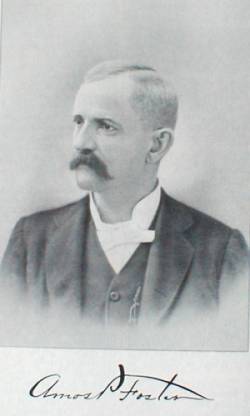
CAPTAIN JOHN FOSTER
Captain John Foster was born at Windsor, Ont., June 17, 1858, and at that place and Detroit he has resided all his life. He attended school in his native place, and before completing his education began marine work during the summer season on the ferry line operating between Detroit and Windsor. He first went on the side-wheeler Essex as deckhand, but soon afterward acted in that capacity and as wheelsman and mate on the Fortune. Upon the Hope he acted as mate for some time, and then went on the Victoria as mate, at the time she was running between Detroit and Belle Isle. He returned to the Hope, however, and acted as mate for several years, transferring to the Excelsior as master in 1895. Upon this boat he remained in command until January 6, 1896, when she was laid up for the winter. He then transferred to the Victoria, where he is still to be found.
In December, 1884, he was married to Miss Annie Mayberry, of Windsor, who died June 17, 1895. This union was blessed with two pairs of twins. James and William, and Annie and John, the last named being deceased, and the others in school at the present.
Captain Foster is the son of James and Mary (Dun) Foster, natives of Canada. James Foster has been connected with that line of boats for twenty-five years and is still in the same employ; also having another son, James, Jr., whose life was closely connected with the history of the ferry line when the side-wheeler steamers were in operations.
CAPTAIN F. FOUNTAIN
Captain F. Fountain, captain of the old Chicago life station, located at Central Pier, No. 1, at the mouth of the Chicago River, has been in charge of this important station since 1894. The work during the summer months is confined chiefly to small craft, while in the spring and fall larger wrecks frequently occur.
The station was established many years ago and was remodeled about 1875. For many years it was in charge of Captain St. Peter, and during that time over 700 lives were saved. During the regime of Captain Fountain about 200 have been rescued. The station is well equipped, the crew consists of eight men, and the season lasts for eight months and ten days. There are two lifeboats, two sailboats and one Whitehall boat, eighteen feet in length, and used for short runs; and an English lifeboat, which was received at the station in the fall of 1898. It is one of the finest boats in the service, and is longer by eight feet than the English boats formally used, has more metal in her keel, and is therefore harder to capsize; it is equipped with a centerboard and has superior sailing qualities.
Captain Fountain has been in the life saving service for over ten years. He was born in Two Rivers, Wis., in 1869, and is the son of Adolph Fountain and Alid Gauthier Fountain. Adolph Fountain is a native of Canada, and came to Two Rivers, Wis., in 1847. He is a cooper by trade, but also engaged extensively in fishing. He is at present a resident of Sheboygan, Wis. The Captain was reared and educated at Two Rivers, and busied himself in his youth with fishing.
In 1888, while yet a boy of nineteen years, he entered the life saving service as a surfman at the Racine station. He was thence transferred to Milwaukee, and thence to Grand Haven. In 1892 he became a member of Captain St. Peter's crew at Jackson Park, Chicago, and in 1893 went with Captain St. Peter to Ludington, Mich., returning to Jackson Park in 1894. In September of that year he was appointed to his present charge.
In 1895, in Ludington, Mich., he was married to Miss Louisa Hutt, and to them has been born one child, George. Captain Fountain has won his promotion by faithfulness and ability, and is one of the well- known life-saving service men in the lakes.
ALOYSIUS R. FOX
Aloysius R. Fox, a machinist and engineer by trade, is a son of Charles Thomas Fox, who was a bank clerk by occupation in London, England.
Our subject was born in London, England, September 26, 1830, and obtained his education in part at Shetley Park College, Somertown, in that city. In 1850 he came to America, settling in Buffalo, and here accepted employment as a machinist on what was then known as the Buffalo & Rochester railroad, now the New York Central railroad, working part of the time in the shops and also running the engine on the road. He was under David Upton, master mechanic. In 1853 Mr. Fox became second engineer on the steamer Michigan, owned by Owen Newberry, on which he remained one season. The following season he was second engineer and chief, respectively, of the propeller Ogontz, and in 1855 he became third engineer on the side-wheel steamer Crescent City, running between Buffalo and Cleveland. During the same season he was second engineer of the side-wheel steamer Mississippi, which was the largest passenger boat on the lakes at the time, and ran between Buffalo and Monroe, Mich.; she was about three hundred feet over all. The passenger traffic that year was rather light because of the prevalence of cholera, and on one of her trips to Buffalo she carried one passenger only. For the season of 1856 Mr. Fox was second and chief engineer, respectively, of the propeller Queen of the Lakes, and during the winter following he worked for the Kirby Agricultural Works for one dollar per day for a portion of the time, and the remainder for store pay. For three years beginning with the spring of 1857 he was chief engineer of the Buffalo Commercial Advertiser, and during the three following years he was engaged in a machine shop on Washington Street, where he built oil engines.
For the first two months of the year 1863 Mr. Fox worked in the Erie Railway Company's shops, and then fitted out the steamer Grace Dormer with her machinery and boiler. In March of that year he was made second engineer of the Buffalo Water Works, which was then owned by a stock company, but in 1866 the city purchased the plant, and subsequently, in the year 1875, he was made chief engineer, continuing there in that capacity until 1880, when he resigned. During the three succeeding years he traveled and established plants for the C. J. Hamlin Sugar Works, while during the two succeeding years he was employed by the Holly Manufacturing Company, setting up pumps and steam plants. From 1885 until the present time Mr. Fox has been engaged as a machinist, repairing steam engines, printing presses, distillery pumps, beer pumps, etc., and also in tannery work at No. 86 Maryland Street, Buffalo, N. Y., where he resides.
On August 16, 1860, Mr. Fox was married at Buffalo to Ellen Eliza Kilpeck, and they have the following children: Eliza, now (1898) aged thirty-three years, wife of George R. Steers, of Chicago, a chief engineer; Charles J., aged thirty-one, who was chief engineer of the steamer Nahoning, of the Anchor line, during the season of 1896; Mary, aged twenty-seven, wife of Charles Wehser, a carriage painter, residing at Buffalo; and Ellen T. Fox, aged twenty-four.
CAPTAIN WILLIAM G. FOX
Captain William G. Fox was born at Titusville, Penn., September 25, 1873, one of three children, two sons and a daughter, of William and Louise (Musson) Fox. When about seven years of age he moved with his parents to Buffalo, N. Y., where he attended public school, and during two seasons of that time, also worked on and around the docks as errand boy, etc., for the old Cotter Tug line. Subsequently, when the line changed its name to Cotter & Schriver, he went into the office, and practically assumed the management thereof, acting in that capacity until the spring of 1895, when the Game Cock Tug line was organized by Eli Schriver, John Killelia, both old-time tug men and masters, and himself, their docks and offices being located at the foot of Commercial street.
Captain Fox, not being contented with the mere theoretical ideas of tugging, took up the practical end as well, and during the last year of his employment with Cotter & Schriver, also the season of 1895-96, served his apprenticeship on various tugs of the lines mentioned so successfully that pilot's papers were issued to him in the season of 1897. It must be admitted that the record enumerated is a remarkably successful one, and shows what pluck and perseverance can accomplish if directed in its proper course.
Captain Fox is an unmarried man, and resides with his parents and one brother, Charles W., and a sister, Daisy L., at No. 756 Washington street, Buffalo, N. Y. He is a member of the Buffalo Harbor Tugs Pilot Association.
IRVIN A. FRANCOMBE
Irvin A. Francombe is the youngest chief engineer on the lakes, and although by twenty-four years of age at this writing, is in charge of the machinery of the Lagonda, one of the largest type of freight steamers. It is therefore presumable that he is a born engineer and mechanic, inheriting from his forefathers the ingenious qualifications so necessary in his profession. The Francombes, as is well known, have been engineers for many years, and our subject is a worthy representative in the third generation. He is the son of John and Matilda (Bell) Francombe, and was born May 7, 1874, and the day that he reached the legal age required by steamboat inspector service of the United States, he applied for and received his license. He is a young man of splendid physique, well educated, and an accomplished engineer and mechanic. His first experience on the lakes in a regular capacity was as oiler in the steamer W. R. Stafford, his father being chief engineer at the time. Previous to this, however, he had been around steamboats from his boyhood, taking advantage of every occasion to learn something. At the end of the season he went to work in the Frontier Iron Works, in which concern his father was a stockholder, to qualify himself for the position of chief engineer. He remained with that firm six years, during which time he was engaged in constructing and erecting engines, among which are the steamers W. H. Gilbert, Merida, C. F. Bielman, Pathfinder, Samuel Mather and Appomattox. In the spring of 1896, Mr. Francombe entered the employ of John Mitchell as first assistant engineer in the new steamer Lagonda, holding that office two seasons, and in 1898 he was promoted to the position of chief of the same, thus giving evidence of the confidence reposed in him.
He is a member of the Marine Engineers Beneficial Association, and makes his home with his parents at 653 Congress street, East Detroit, Michigan.
JOHN A. FRANCOMBE
John A. Francomb was born at Bristol, England, a son of the late John Francombe and Ursula (Shearn) Francombe, also natives of England. John Francombe, Sr. was a native of England and came to the United States in 1847, locating in Detroit, and filled the position of chief engineer on the Michigan Central & Great Western car ferry steamers, the Union and others. His last steamer was the Brunswick, the first iron steamer on the lakes and the largest at that time. He lost his life on the steamer Brunswick, which collided with the schooner Carlingford, November 12, 1881, and was a total wreck. His body was found ten days after near Black Rock, and taken to Windsor, Ont., for interment. Mrs. Francombe survived her husband only one year and died at Windsor, Ont., 1882.
To the same department of marine industry John A. Francombe has devoted the great part of his life, and at the present time stands high in the estimation of his associates. At the age of fifteen years John A. Francombe entered the shops of the Detroit Locomotive Works, and there served an apprenticeship of four years. While there he ran a night ferry, known as the old rowboat ferry. After this time he went sailing on the steamer Mary Pringle, where he remained two years as second engineer, upon the tug Constitution he spent two years, and then went on the Colin Campbell as chief engineer. After sailing as chief engineer on the B. W. Jenness eight seasons, he went on the Excelsior, of the ferry line between Detroit and Windsor, and then entered the employ of the Bay City & Cleveland Transportation Co., which is now changed to the Hope Transportation Company. He spent two and one-half years on the Alpena and two years on the Alcona, afterward going to the steamer Thomas S. Christie, of which he is part owner. At the present time Mr. Francombe is manager of the Hope Transportation Company, and owns considerable interest in the steamer W. R. Stafford, schooners John A. Francombe and Ed McWilliams, all of which were built under his instructions and management.
On March 4, 1872, he was married to Miss Matilda Bell, of Ogdensburg N. Y. Their children were: Irvin A., employed as chief engineer of the steamer Lagonda; Alice, Anna, Agnes, and John A., Jr., who are in school; and Nelson, who died in 1891 at the age of three years. Mr. Francombe is a member of the M. E. B. A., I. O. O. F. and A. O. U. W. at Detroit. He is a brother of George Francombe, Jr., and cousin of Charles and Thomas and nephew of George Francombe, Sr., all of whom are marine engineers, well-known along the chain of lakes at different points.
REV. BENJAMIN FRANKLAND
While to all thinking minds there must ever come a recognition and appreciation of the leading part religion has taken in advancing civilization and conserving the higher interests of the human race, yet not to all comes an equal understanding of the burdens borne, the trials endured, the anxious responsibility maintained, and the self abnegation practiced by those who give up their lives to their Master's cause, merging their very identity into the good work. Sacrifices there must be; ambition in a worldly sense must be forsworn, and in all the work of preparation and execution there must be a devotion of spirit to the uplifting of fellow men into the brighter refulgence of the higher light, the light perpetual, zealous in all good works, and worthy to be known as the follower of the one great Shepherd of all, the one who quells the raging storm with a word, and says, "be still." It is thus most consonant that the Rev. Mr. Frankland should be accorded an honorable position in a work whose aim is to leave a permanent memorial of those individuals who have lived and labored among the brave and hardy men who go down to the sea in ships. In the life work of the Rev. Benjamin Frankland is to be found an amount of good accomplished, equalled only by his earnest desire to do as much more. The field in which he has been working since 1860 as general superintendent of the Western Seamen's Friend Society is a broad one.
Mr. Frankland was born in Liverpool, England, March 31, 1832. His early years were spent in that city, Manchester, and at the school of the Society of Friends at Ackworth, in Yorkshire. He came to the United States in 1846, his father and the family becoming residents of Cincinnati, Ohio, in the fall of that year. As apprentice, foreman and owner he was connected with the printing business from 1847 to 1860, when, having been interested and engaged as a volunteer Christian worker with the Cincinnati Bethel, he, in the spring of 1861, retired from secular business and was appointed, by the Western Seamen's Friend Society, chaplain and superintendent of the Cincinnati Bethel. His first connection with the institution was in 1859, and continued until 1869. During that period and under his supervising care, from a small mission occupying a floating structure on the Ohio river, its work increased until it became one of the largest mission churches and schools in the country. Mr. Frankland during the later years of his work and residence in Cincinnati, being also president of the Hamilton County Sunday School Association and Secretary of the Ohio State Sunday School Union.
In the year 1868, while still chaplain-in-charge of the Cincinnati Bethel, he was chosen by the Western Seamen's Friend Society general superintendent of Western Bethel work, and in the spring of 1869 removed to Cleveland, Ohio, the official headquarters of that society, his resignation of local position in Cincinnati to enter upon his new duties taking effect in April of the latter year. His election and service was coincident with a complete reorganization of work and methods, and the adoption of the present federal system of the society's operations, and the connection of the more secular appliances of Seamen's and Boatmen's Homes and cheap eating rooms with the instructional and religious departments formerly carried on. He has, during the succeeding years, given his entire time to these interests, and has been directly connected with the organization or reorganization and the incorporation of societies, covering the entire series of institutions in the interior and the West which are a part of the international seamen's cause, the promotion and supervising care of institutions and missions of this character upon our interior waterways having been committed to the society of which he is the general superintendent.
In 1864, at Cincinnati, Ohio, Rev. Benjamin Frankland was united by marriage to Miss Margaret C. Wolff, a resident of that city. He has five children living, and the family residence is at Mr. Washington, Hamilton county, Ohio.
CAPTAIN WILLIAM ELLSWORTH FRANKLIN
Captain William Ellsworth Franklin, of the "Ellsworth Zouaves," who was prominent in the Civil war, was born January 11, 1865, at Elk Rapids, Michigan.
William H. Franklin, father of our subject, was born in Rochester, N.Y., who was a son of Elisha Franklin, who was a grandson of Col. John Franklin, of Wyoming massacre fame. He moved from Rochester, N.Y. to Hillsdale county, Mich., when he was yet young, later making his home on Mackinaw Island. In his earlier years he was a fisherman, and afterward officiated for several years, as master of the little schooner Shoe Pack, engaged in the freight and passenger trade. Some time prior to 1865 he retired from the lakes, and conducted a hotel in Elk Rapids, remaining in that business until 1870; in that year he moved to Northport, in the same State, where he also followed the hotel business until about 1891, when he retired.
Capt. W.E. Franklin, whose name introduces this sketch, received the better part of his education at the public schools of Northport, Mich. Laying aside his books at the age of fourteen, he went on the lakes, his first position on a vessel being the Cecelia. After one season on her, he went "before the mast" for three years on various vessels, and then in the spring of 1881 became wheelsman of the City of Grand Rapids for a season. In the fall of 1881 he went to Colorado, where, for the next ten months, he was employed as bookkeeper at Blackhawk, after which, in the fall of 1882, he returned to the lakes, and shipped on the T.S. Faxton, of Traverse City, remaining on her some three years, first as wheelsman, and later as mate. In 1886 he went as mate of the Grand Rapids, and sailed on her until 1891; in that year identifying himself with the North Michigan line, serving as mate of the Charlevoix until June 1st. same year. He then went to Detroit, and shipped on the Gazelle, a passenger steamer, plying between Traverse City and Mackinaw, being master of her during the balance of the season. In the spring of 1892 he was appointed master of the City of Grand Rapids, and sailed her two seasons - 1892-93; then in 1894 shipped as mate on the J.W. Westcott, a boat engaged in the iron ore trade, and remained on her one season. In 1895 he went again as mate on the Charlevoix, and in that capacity sailed on her until she was tied up. In 1896 he was made master of the Alice M. Gill, owned by William Gill & Sons, of Northport, Mich., and has remained with that vessel and in that same capacity ever since.
The Captain is proverbial for his carefulness, sagacity, and success as a mariner, never having met with an accident of any kind since he became master. He has made his own way upward, and well merits the confidence reposed in him.
On July 30, 1894, Captain Franklin was married to Miss Lillie Baldwin, daughter of Capt. George Baldwin, who was with the Hannah Lay Company some twenty-three years, and was one of the oldest and best captains on the lakes. Two children have been born to this union: Margaret and Baldwin. Socially, our subject is a member of the F. & A.M., affiliating with the Blue Lodge No. 265, Suttons Bay, Mich., and with the Chapter No. 102 Traverse City, Michigan.
A. B. FRASER
A.B. Fraser is the youngest of five sons and one daughter, children of William and Isabella (Cameron) Fraser, who were natives of Inverness, Scotland. They emigrated to the United States in the early 'sixties, settling in New York State. Those of the children now living are James A., a miner in Alaska; D. R., a carpenter at Gainesville, N. Y.; and a son, an engineer in Texas; and the subject of this sketch.
The latter was born at York, Livingston Co., N.Y., and when about sixteen years of age went to El Paso, Texas, where he entered the L. P. C. railroad machine shops as an apprentice. Here he remained nearly three years, and then returned home on account of illness. After recovering, in 1890, he came to Buffalo and secured employment in the New York, Lake Erie & Western railroad machine shops, leaving there in the spring of 1891 to begin steamboating as oiler on the Philadelphia. In September he went onto the Alaska, where he finished that season. Owing to injuries from which he did not recover until October, he did not secure a berth the next season until the 4th of that month, at which time he went on the Mahoning as oiler, and remained on this vessel and in this position until 1895, when he was promoted to second engineer, and officiated in that capacity during the season of 1897.
Mr. Fraser is a single man, and resides at Gainesville, N.Y. He is a member of Local Harbor No. 1, Marine Engineers Beneficial Association, Buffalo.
JOSEPH FRAWLEY
Joseph Frawley was born in Buffalo, N. Y., April 27, 1856. His first employment was as rivet-heater in the Shepard Iron Works, in his native city. Preferring the freer life of a sailor, however, he shipped on the schooner Frank Perew in July, 1871, with Capt. Charles Gale, of Sonora, Ontario. Alternating between steam and sailing craft on the lakes until 1878, he sailed in that year for the west coast of Africa on the bark Fantee, returning to Buffalo nineteen months afterward, and serving in the fire department of the city during the years of 1881-82-83. From 1884 to 1890 Mr. Frawley was successively wheelsman, second mate, and mate of the boats of the Western Steamship Company and first mate on the Owego. In 1894 he was made captain of the New York, but returned as first mate of the Owego in 1896, and in same year went as master of the H. J. Jewett.
Shipwreck for him occurred but twice in his career - once when the schooner Chamberlain was blown ashore two miles east of Cleveland piers, December 1, 1874, and again while he was mate of the Buffalo at the time she went ashore at Milwaukee in 1889. On this occasion he went ashore in the breeches-buoy to carry the report to the company's agent.
In 1890 Mr. Frawley was married to Miss Mary Carroll, of Buffalo, and their home is blessed with two bright children: Alice and Joseph. The family residence is at No. 382 Perry Street, Buffalo, New York.
FRANK D. FREDERICKS
Frank D. Fredericks is one of nine children born to David F. and Katharine (Deavendorf) Fredericks, both of whom were natives of New York State. The father was a farmer and large cattle dealer at both Watertown and Alexandria, New York.
Frank D., the subject of this sketch, was born at Watertown, N.Y., January 10, 1860, and received his education in the schools of that town and Alexandria. He assisted his father at farming until about seventeen years of age, at which time he began steamboating, firing, etc., on the pleasure steamer Island Rambler, on the St. Lawrence River. In the following year he went to Iowa and engaged as engineer in a sawmill, remaining there six months, at the end of that time going to Milwaukee, where he spent three years learning his trade in the Chicago, Milwaukee & St. Paul railroad machine shops. Coming east, he shipped as oiler on the Commodore for three seasons, leaving her to go as second engineer in the Lackawanna's steel steamer Scranton, in which berth he has continued ever since, serving nine consecutive seasons. Mr. Fredericks is also a boilermaker, and during the winters is engaged in some such shop, having been in Riter's shop at Buffalo, N. Y., during the past seven years.
Mr. Fredericks was married, in 1878, to Miss Minnie Johnson, of Alexandria, N. Y., by whom he has three children. The family home is at Buffalo, N. Y. Mr. Fredericks is a steady and temperate mechanic, and has eight issues of license, three of them being chief's papers. Socially, he is a member of Local Harbor No. 4, Marine Engineers Beneficial Association, of Chicago.
WILLIAM AND ROBERT FREELAND
These brothers are the owners of that valuable property on the water front at the foot of Yonge street, known as "Milloy Wharf", or as it is put officially in the surveys and other documents, "Younge Street Wharf". Both of these gentleman rightly pride themselves of their holdings, which include some of the finest wharves in Canada, where the best of the Lake Ontario and St. Lawrence river steamboats make their landings.
Peter Freeland, the father of these gentleman, came to New York City, in 1819, from Glasgow, Scotland; but not being pleased with his location, he moved to Montreal, in the Province of Quebec, at that time called Lower Canada. There the son William was born in 1831. Still dissatisfied with his location, Mr. Freeland continued to travel westward, coming to York (now Toronto), in 1832. In that year Robert was born, so that there is little disparity in the ages of the brothers. Shortly after his arrival in York, Peter Freeland purchased, from the late Judge Sherwood and the late Peter McDougall, the water lot and water front, which in after years were destined to become so valuable in the hands of his two enterprising sons, and which at that time, land and water included, covered an area of but one acre. During his lifetime the property acquired considerable value, and eventually it passed into the hands of his two sons at his death, which occurred in 1861. It continued to grow in value and size, through later additions by Crown grants and purchase, until it was 1,400 feet in depth; 400 feet of this north of the Esplanade, was sold; on this portion there are extensive warehouses and the old Grand Trunk railway station. The wharf property extends 1,000 feet from the Esplanade to what is called the "New Windmill Line," or outer limit of the water lots, and has a width of 300 feet from Yonge street to Scott street. Including land and water, the area of the holdings south of the Esplanade is seven acres. There are 1,800 feet of wharf frontage for the mooring of vessels, and 40,000 square feet of ground floor in the warehouses.
Some of the more important vessels which regularly land at the Freeland wharves are the Chippewa, Corona, and Chicora, of the Niagara Navigation Company; the Corsican, Caspian, Hamilton, Algerian, Spartan, Corinthian and several others of the Richelieu & Ontario Navigation Co; the Lakeside, of the St. Catharines Navigation Company, and the Greyhound, of the Oakville service, etc. Besides these are a number of coal and other freight vessels which discharge their cargoes at the Scott street wharf, where there is an extensive coal yard, also part of the Freeland property, for many years past leased to Messrs. P. Burns & Co. In one of the large warehouses on the Yonge street wharf an immense wholesale fruit business is carried on, to facilitate the operations of which the Canadian Pacific railway has put in a first-class railroad siding, extending 400 feet down the wharf, for the loading and unloading of fruit and other freight directly from the boats and cars. The large and increasing traffic in fruit has become a chief feature of the Yonge street wharf, enormous quantities coming in daily, in season, from the Niagara peninsula, from New York State, the Grimsby district, the Oakville district, the Oakville district, and Essex.
Recently a new pier was extended by Messrs. Freeland into the bay a distance of 400 feet, more particularly for the accommodation of the Niagara Navigation Company's steamboats, and first-class waiting rooms and lavatories have been provided for the convenience of passengers. There is not any comparison between the present modernly constructed quay and the Young street wharf, which was originally built in 1841 by a joint-stock company of Toronto merchants, and which the late Peter Freeland and the present owners, extended from time to time.
The Richelieu and Ontario Navigation Company's Montreal steamers occupy the outer end of the old wharf, having been established here for the last thirty years; they also have the use of the large warehouse adjoining. This building is 165 feet long by 70 feet wide, with overhanging eaves 10 feet, loading platforms and yard in rear, and is most conveniently arranged for the heavy freight business of this line. An ornamental entrance to the wharf, with towers, arches and gates, faces the foot of Yonge street. Further down the wharf is an office, a substantial two-story building, with a tower. Gas, electric light and city water are laid on the premises, from the Esplanade to the rear end of the new pier.
Capt. Donald Milloy, one of the best known men in the wharfing business, had leased the Freeland wharves for many years hence the origin of the name "Milloy Wharf". The Freeland brothers were educated in Upper Canada College. They are really strong party men, though they favor Liberalism.
GEORGE F. FREITAS
George F. Freitas was born in Buffalo, N. Y., in 1868, and attended the public schools of his native city until he was sixteen years of age. His career as a sailor opened on the tug Johnson, on which he served as fireman out of Buffalo harbor. He was employed in the same capacity on the tug Beyeas for two seasons, then joined the tug Hebard for one season. In 1889 he entered the employ of Capt. Thomas Maytham, going on the tug E. C. Maytham, finishing the season as engineer on the James Ash. In the spring of 1890 he was appointed engineer of the tug Kelderhouse, and in 1891 of the tug Cheney, and in 1892 served in like capacity on the S. W. Gee. That season he took out pilot's papers, of which he has four issues.
In the spring of 1893 he acted as engineer on the tug Acme, remaining with her two seasons, and in 1895 was on the tug Excelsior, and in 1896 on the tug Fabian. The company by whom he is employed has the utmost confidence in his ability as a tug man. Mr. Freitas did the winter work of 1896-97 on the tug Acme, and in the spring of 1898 was appointed captain of the tug John Kelderhouse, of the Maytham line, a position he still holds. He is a member of the American Masters and Pilots Association.
In 1889 Mr. Freitas was united in marriage to Miss Emma Knight, of Buffalo and four children have been born to them: John, Maggie, Mary and Alice. The family reside at No. 292 Elk Street, Buffalo, New York.
GEORGE FRITSCHE
George Fritsche, chief engineer of the elegant steel steamer Chemung for the seasons of 1896-97, is a son of Ferdinand and Sussanna (Cook) Fritsche, Germans, the former a native of Saxony, the latter of Bavaria.
Ferdinand Fritsche was by trade a tailor; emigrating to America in 1853, he located at Tonawanda, N.Y., where he still resides. Besides the subject of this sketch, he has three children, Ferdinand W., in the grain business in Minnesota; John E., on the board of trade at Minneapolis, Minn., and August, in the employ of the Indiana Natural Gas and Oil Company at Chicago.
George Fritsche was born at Tonawanda in 1859 and there attended school. Like many other marine engineers, he never regularly learned his trade at any one machine shop, but brought himself to his present position by his own industry and energy. He worked in various shops about the country, and in 1880 he entered the lake service, becoming engineer of the tug Rambler at Duluth, and after two seasons on her served for three seasons in the same berth on the tugs Pacific and Oneida, also of Duluth. During the season of 1884 he was second engineer of the D. M. Wilson, and in 1885 of the John B. Lyon and Dean Richmond. He continued on the latter boat through the season, and was also with her in the same capacity during the winter of 1886-87, making trips between Milwaukee and Grand Haven. In 1887 he accepted second engineer's berth on the steamer Starrucca, remaining thereon until, in November, 1888, she went ashore in a snowstorm near Grand Marie, Lake Superior, where she became a total loss.
During the season of 1889 Mr. Fritsche was second engineer of the Rochester, and chief of the propeller Avon; in 1890 he was chief of the Portage; 1891-92 of the H. J. Jewett; 1893-94-95 of the Tioga, and during the seasons of 1896-97 of the Chemung.
Mr. Fritsche is a member of the Marine Engineers Beneficial Association. He is a single man and resides with his parents at Tonawanda, New York.
GEORGE J. FUHRMANN
George J. Fuhrmann was born in 1863 in Bucyrus, Crawford Co., Ohio, son of Thomas W. Fuhrmann, a stationary engineer, whose native land was Germany. The parents removed to Erie, Penn., in 1872.
At the age of thirteen Mr. Fuhrmann was placed in charge of an engine, and he continued to follow stationary engineering until he was eighteen years old, when he commenced sailing. His first experience on the lakes was as fireman on the steambarge Frederick McBrier. After five months service on her he became fireman of the tug Thomas Thompson, and the next year held the same berth on the propeller Wissahickon for three months, finishing the season as watchman on a dredge. The next season he was fireman and then engineer on the steamyacht T. H. Welch, since which time he has been employed as second engineer of steamboats and as tug engineer. He has been first-assistant engineer of the propellers Horace B. Tuttle, Ohio, Walter A. Avery, Sitka, Manola, Matoa, Mesaba, Italia, German, J. H. Devereux and Merida. Mr. Fuhrmann was with the last-named vessel when her engines raced to pieces on May 28, 1896, due to the propeller wheel becoming lost from the end of the shaft. The engines were of the triple-expansion type, of 3,000 horse-power, and were turning at the rate of eighty-two revolutions per minute under 168 pounds of steam, when the accident happened. In some manner the propeller wheel slipped off the shaft and the engines, under the terrific pressure and relieved of the resistance of the water to the screw, began to turn with frightful rapidity. Although one of the engineroom employees was standing at the throttle at the moment, he could not shut off the steam quickly enough, and in an instant the high pressure and the low pressure engines flew into a thousand pieces, one mass of metal weighing two tons being thrown directly over the engineer's head. Mr. Fuhrmann was not on duty at the time, but was alseep in his bunk at the side of the engine-room. The flying metal escaped him, as it did everyone else on board, no one being injured except the engineer, who fell into the hold of the vessel while running to escape the blinding steam. While the Merida was receiving a new engine Mr. Fuhrmann acted as engineer of the tug Gregory, remaining with same to the close of the season. Mr. Fuhrmann has been in two other accidents during his sailing career. While he was engineer of the Thomas Thompson, that tug was driven under the jib boom of the schooner David Vance, off Erie, and her upper works were crushed in; this occurred while the Thompson and another tug were racing to the Vance. He was also in the steamer German when she went ashore on the rocks on Big Sand Point, Lake Michigan.
Mr. Furhmann was married January 28, 1891, to Miss Emma D. Carlton, of Macomb county, Mich. They have one son, Harry Fuhrmann.