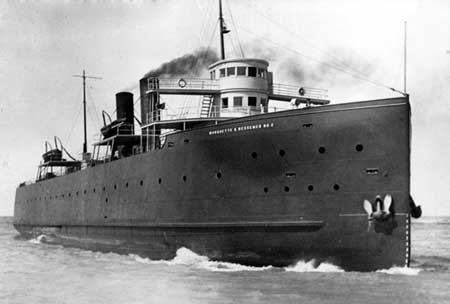
History of the Great Lakes
Vol. 2 by J.B. Mansfield
Published Chicago: J.H. Beers & Co. 1899
[ A ][ B ][ C ][ D ][ E ][ F ][ G ][ H ][ I ][ J ]
[ K ][ L ][ M ][ N ][ O ][ P ][ Q ]
[ R ][ S ][ T ][ U ][ V ][ W ][ X Y Z ]

J. L. GABRIAN
J.L. Gabrian was born in Worcester, Mass., in 1863, a son of Theodore and Philopene (Bisnea) Gabrian, both of whom are still living at Worcester. The father is a carpenter by trade. Mr. Gabrian finished his school education in his native place at the age of thirteen, and then moved to Detroit, Mich., from which city he began sailing as deckhand on the old City of Detroit, now the City of the Straits, belonging to the Detroit & Cleveland line. His next berth was in the passenger steamer Saginaw Valley, running between Cleveland and Saginaw, and later he was wheelsman in several steamers, among them being the D. C. Whitney, C. Tower, Passaic and Mineral Rock. He was also wheelsman of the lake tugs Peter Smith, Chief Justice Fields and Torrent. During the season of 1895 he filled second mate's berth on the steamer H. E. Packer, of the Lehigh Valley line, and during that of 1896 on the steamers Tuscarora and Saranac, of the same line. While in the lake service he has been employed by the Union Steamboat Company, Anchor line, Western Transit Company and Lehigh Valley line. Mr. Gabrian is an interested member of Local Harbor No. 41, of the American Association of Masters and Pilots.
CAPTAIN ANTHONY G. GALLAGHER
Captain Anthony G. Gallagher, who is one of the old-time lake pilots, and who passed many years of his sailor life in the employ of the old Northern Transportation Steamboat line in the best days of its usefulness and pride and, although now sixty-four years of age, is strong and active, both in body and mind. He has a very retentive memory and discourses interestingly about the steamboats and skippers of that famous line, and the fate of each.
Captain Gallagher is a son of Patrick and Ann (Maloy) and was born in 1834 in County Mayo, Ireland. In 1842, after the death of his father, he removed with his mother and two sisters to America, locating in a locality in Canada where he found employment carrying water for a gang of canal laborers at twenty-five cents a day. Two years passed in this way, after which he drove a team for Richard Oxford, receiving for this service $4.00 per month and board.
After passing a number of years in various occupations, Captain Gallagher went to Ogdensburg, N.Y., and in the spring of 1860 entered the employ of the Northern Trans-portation Steamboat Company as porter on the fast side-wheel steamer New York, and running between St. John, New Brunswick and New York, and one of the speediest boats on that line. In 1861 he made four round trips as lookout and wheelsman on the propeller Vermont, with Capt. Alva Shaver to Montreal. His next boat was the propeller Ontario, on which he remained three seasons as wheelsman. The machinery and boiler of the Ontario were then put into the propeller Lowell and he became her wheelsman, then sailed on the propellers Prairie State with Capt. H. Williams; the Louisville and Granite State with Captain Caldwell, and the Ontario in various capacities from wheelsman to mate. When the Northern Transportation Company discontinued business Captain Gallagher went to Cleveland and found employment as oiler in the roundhouse of the Cleveland & Mahoning Railroad Co., where he remained until the spring of 1867, when he shipped as mate with Captain Jones on the schooner Wild Rover for the season. In 1868 he made one trip on the bark Maria Martin, with Captain Trotter, transferring to the schooner Correspondence, with Captain Jeffers, and was on her part of the next two seasons. In 1870 he entered the employ of Capt. Patrick Smith as master of the tug James Amadeus (afterward sunk off Point Pelee), operating out of Cleveland harbor, remaining with her three seasons. In 1873 Captain Gallagher retired from active service as a sailor to enter the employ of the Lake Shore Railroad Company, with which he remained twelve years as brakeman and yard conductor. He then went to work for the Valley Railroad Company as brakeman, yard conductor and assistant yardmaster, and later was placed in charge of the Valley railroad bridge at the West river steel crossing. During these many years of active life on lake and rail Captain Gallagher has given the utmost satisfaction, and has always been considered a steady and trustworthy man. He has been a devotee to total abstinence from intoxicants for twenty years.
The following incidents are quoted as some of the many experiences which befell the Captain during his life as sailor: He was in the employ of Captain Caldwell, master of the ill-fated propeller Louisville, when she burned to the water's edge in the St. Lawrence river opposite a point on the Canadian shore. She was rebuilt in Ogdensburg, N.Y., the next season, loaded with a cargo of broom-corn, placed again in charge of Captain Caldwell, who had for his chief engineer James Lord, an old-time engineer on the lakes and railroads (and to him is credited the fastest time ever made on a trip out from Louisburg), and when between Chicago and St. Joe the propeller again took fire and was completely destroyed. He recalls the City of Superior when she went to pieces at the head of Lake Superior. Her engines were brought to New York by the Northern Transportation Company, and one placed in the City of Boston, one of their line, and which was afterward sunk in a collision with one of their own boats in the Straits, opposite Mackinaw. She was raised and brought to Cleveland and rebuilt and finally went ashore on the south shore of Point Bertschy, a total loss. The other engine was put into the Empire, also belonging to the N.T. Co. Some years prior to the above mentioned events he was witness to the loss of the J.W. Brooks, another of this company's boats. She was lost round about the False Duck and other islands at the entrance to Lake Ontario, and all on board went down. The body of her captain was afterward picked up in a lifeboat between Sacket's Harbor and Stony Point. The hull of the Brooks came up a few years after, when she was repaired, and the engines of the old William the Fourth placed in her, and she is now running to Hamilton and other lake ports. He saw the Maniken make her first trip from the Soo into Lake Superior, before the canal was built, and it was a novel sight. The boat was placed upon wooden rails and rollers, somewhat after the fashion of house-moving of the present day, and with the assistance of ropes and two horses was conveyed to its home upon the waves. The steamboats North Star, propeller Iron City and Northern Light were the next boats to pass into Lake Superior within the Captain's recollection. The propellers S.D. Caldwell, Ontonagon, Penack (the latter sunk in a collision with the propeller Meter between Thunder Bay and Detour). Likely Belle and Ironsides were among the Lake Superior boats in the Captain's younger days. Another reminiscence of his early days is the colliding of the side-wheel steamer Atlantic (commanded by Captain Shadrick) with the propeller Ogdensburg. The suicide of Captain Case (master of the propeller Michigan of the N.T. Co.) who hung himself to the outer end of the yardarm of the bark Mariner, one of the coldest nights ever felt, is another one of the eventful happenings in the Captain's sailing life.
He was united in marriage in 1857, to Miss Rose Anne Judg, of Toledo, Ontario, a daughter of James Judg. They reside at No. 31 State street, Cleveland, Ohio.
CAPTAIN ALEXANDER P. GALLINO
Captain Alexander P. Gallino is a master mariner of long experience on the lakes, never having lost a man or a vessel; and during the many years he has followed the lakes he has never been ashore but three months during any season of navigation. He was born in Courtright, township of Moore, Lambton Co., Ont., on April 5, 1848. His parents, Peter and Elizabeth (Frazier) Gallino, were of French descent, spelling the name Gallarneau, but natives of Canada, the father being born in Montreal and his mother in Penetanguishene. His father was a captain in the British army, and during the latter part of his service was stationed in Penetanguishene. He served through the Indian wars and during the war of 1812, and reached the rank of major in the regular army.
Capt. Alexander Gallino, the subject of this sketch, who moved to the States, and located in St. Clair, in 1863, adopted his lakefaring life that same year as second porter on the steamer Susan Ward, remaining on her in that capacity till August 11, 1863, when he joined the steamer Meteor as decksweep, which position he held until the close of the season. During 1864 he filled a like position on the side-wheel steamer Cleveland under Capt. J. Hallaran, till the 3rd of July, when he went as wheelsman on the Dispatch with S. R. Grummond master and owner, and served under him till the close of that season. In 1865 he operated the entire season as wheelsman on the steamer Comet, running between Hancock, Houghton and Marquette, and the following three seasons was on tugs plying the St. Clair and Detroit rivers; while in 1869 he acted as mate on the schooner Liberty, with Capt. T. Lemay, and the following season, 1870, accepted the office of mate on the propeller Burlington, running between Buffalo and Saginaw.
In 1871 Captain Gallino, or Captain Pet, as he was more familiarly known to the lake craft, having been dubbed this epithet ever since babyhood, shipped again as mate on the schooner Liberty, and in 1872 acted as second mate on the propeller Wenona, filling this position till September 1873, when he served as mate on the same vessel till the close of the season. During the seasons given below he shipped as mate on the following named vessels: 1874-75, steamer Concord; 1876-77, on the Emma E. Thompson; 1878, steamer St. Paul, and in 1879 on the Salina, on which he sailed as her master during the season of 1880; and in 1881 again assumed the office of mate on the Porter Chamberlain, officiating in like capacity on the C. H. Green in 1882; filling in 1883 the same berth on the B. W. Jenness. In 1884 he sailed, as her master, the tug John Martin, engaged in towing barges between Saginaw and Buffalo; joining the Huron City as mate during the season of 1885; while those of 1886-87 saw him acting as mate and pilot on the A. A. Turner.
In the spring of 1888 the Captain was appointed master of the Don M. Dickinson, and during the seasons of 1889 and 1890 he sailed successively as mate and pilot on the steamers Lowell and Belle P. Cross. The spring of 1891 found the Captain in charge of the steamer P. H. Birckhead as her master, and which he sailed between Chicago, Oswego and Duluth the following seasons of 1892 and 1893. In 1894 he became master of the steamer Charles A. Street, retaining this command for four consecutive seasons - from 1894 to that of 1897. On December 12, 1898, at the close of navigation, Captain Gallino was acting as master of the W. R. Stafford, having assumed this position at the beginning of the season. He has twenty-eight issues of first-class papers, granting him the privilege of operating as master and pilot on boats plying between Ogdensburg, Chicago and Duluth, and on all connecting waters. He is a man of many friends, and has always enjoyed the respect and confidence of the owners of the vessels that have been under his command.
Socially he is a member of the Ship Masters Association, and carried Pennant No. 986.
On April 8, 1875, Captain Gallino was wedded to Miss Susan St. Bernard, of St. Clair, daughter of Alexander St. Bernard, who was one of the old-time lake masters and pilots of the United States gunboat Michigan many years. He also sailed for John Jacob Astor, in the interests of the Hudson Bay Fur Company. The children born to this marriage are Bernard A., who is boatswain's mate on the steamer North Land; Florence F. and Hugh H. The family homestead, which they have occupied since 1863, is located in St. Clair, Michigan.
WILLIAM GALT
William Galt, the present manager of the Toronto Ferry Company, is a gentleman whose natural ability and conscientious performance of duty made his services in constant demand. He was born at Kilmarnock, county of Ayr, Scotland, in 1861, a son of Capt. Alexander Galt, who served as chief of police at Kilmarnock, and passed away in 1868.
The early education of William Galt, was acquired in his native town, where he displayed the close application of the "reasoning Scott," and laid the foundation for the thorough training he afterward secured in the schools at Glasgow. His naturally keen perceptive faculties were strengthened by his out-door sports, and he soon rose to the front rank in the athletic world. He took an active part in the Association football, being for several years a member of the Champion county team, and has played against all the principal teams in England and Ireland, where he won the highest praise from the devotees of the great game for his strength, alertness, and his rigid conformity to the established rules. He is a proud possessor of several gold medals won in open competition, and in all the contests in which he took part he never had the misfortune to win less than the first prize.
His brother, John Galt, who has won fame as an engineer and waterworks expert, in the Dominion, urged his younger brother to cross the Atlantic and lend his youth and strength to the New World. Accordingly in 1884, William Galt bade farewell to the familiar hills and waving heather, and turned his face westward. After his arrival in Canada he was for two and a half years local manager at Montreal for the Boiler Inspection & Insurance Co., of Canada. In 1887 he resigned that position to go to Toronto, where until April, 1898, he was a member of the reportorial and editorial staff of the Toronto Mail and Empire. On April 15, 1898, he was appointed manager of the Toronto Ferry Company and entered at once upon the actual discharge of the duties pertaining to that position.
That Manager William Galt has by his methodical way of doing business, done good work for the Toronto Ferry Company, there can be no doubt. He has convinced the public that they could depend on a regular service to Toronto Island, regardless of the weather, and the result is an increase in the popularity of Hanlan's Point as a summer resort. The point has undergone remarkable changes for the better, one of the greatest improvements being the construction of the magnificent bicycle race track and baseball and lacrosse oval; that quarter-mile track is noted all over the continent, and has been the scene of some of the fastest racing ever done. The enlarging and refitting in modern style of the "Hotel Hanlan," as well as the exquisite landscape gardening, have lent an additional charm. Messrs. M. A. and Fred Thomas, managers of the hotel, father and son, are two well-known hotel men in Canada, and enjoy the patronage of many Americans, who spend their summers at the Hotel Hanlan, one of the garden spot of the world.
CAPTAIN CHARLES B. GALTON
Captain Charles B. Galton is a self-made man in the true sense of the term. His career on the lakes was begun as a poor boy, without money, influence or friends. Although still a young man he has taken high rank among steamboat masters, and attained to the command of one of our largest and finest steel freight steamers afloat. He is an officer of quick decision and force of character, and has won the confidence and respect of the firm for which he sails, and enjoys the honor of being invested with the command of the new steam-boats which come out under that management. He was born in February, 1860, in St. Clair county, Mich., a son of James and Margaret (Buck) Galton, and acquired his education in the public school, which he attended until he was seventeen years of age.
It was in 1877 that Captain Galton first adopted a lake-faring life as wheelsman on the tug George B. McClellan, with Captain Hiram Ames, going with the same captain on the lake tug Mocking Bird the next season. In the spring of 1879 he shipped as wheelsman on the steamer Empire State, with Capt. G.H. McQueen, being advanced to the office of second mate the following season, and remained with the same captain as second mate on the steamer James Davidson throughout the season of 1881 and 1882, being advanced to the berth of mate the next year. On September 28, 1884, the Davidson went ashore on Thunder Bay island in a heavy southeast gale, and went to pieces. After two nights peril the crew reached shore in the yawl boats. The next three seasons he sailed as mate of the steamer J.R. Whiting.
In the spring of 1887 Captain Galton entered the employ of Capt. John Mitchell, as mate on the steamer William H. Gratwick, and the next season was promoted to the position as master, and sailed her three seasons. On November 25, while on Lake Superior, he was caught in a fierce northeast gale, accompanied by a heavy snowstorm, known in the records as the great Thanksgiving storm which destroyed the breakwater at Marquette and washed away the lighthouse, and in which many vessels were lost. Notwithstanding that his vessel had lost her shoe and disabled her boiler, he made harbor at Marquette without further disaster, a feat requiring great skill and presence of mind. While master of the Gratwick, in 1890, he had the pleasure of rescuing the crew and schooner Hattie Estelle. In the spring of 1891 Captain Galton was appointed master of the steamer William F. Sauber, in which he owns an interest, and sailed her four successive seasons. In 1895 he brought out the new steel steamer John J. McWilliams, 3,400 tons register, for Mitchell & Co. In October he picked up the crew of the steamer Comstock, she being in a sinking condition. The crew consisted of five men and two women, who had taken to the yawl boat. As it was impossible for the boat to get alongside of the steamer, which had rounded to on account of the heavy sea running, the crew of the McWilliams had to lasso the unfortunates, and had them aboard with two lines, one by one. Captain McCarty, of the Comstock, had a leg and some ribs broken at the time. While this humane work was going on the schooner sank alongside.
In the spring of 1896 Captain Galton assumed command of the new steel steamer Lagonda, 3,647 tons, and sailed her three seasons or until he took charge of the new boat completed at the yard of the Globe Ship Building Company in 1898. For ten years he has been in the employ of the Mitchell Steamship Company, and in which he owns stock. He received his first license when he was twenty-one years of age, and has now his seventeenth issue. Since he has become an officer he has always had first-class steamboats, has never lost a day ashore, never lost a man or vessel, and never involved owners or insurance companies in loss.
On December 17, 1886, Capt. Charles B. Galton was wedded to Miss Maggie J., daughter of John and Margaret (Holland) Ritchie. The children born to this union are: John, Charles W., Edmonds and Edna, and the wife is a typical American mother. The family homestead is a fine modern structure on Water street in Algonac, beautifully situated and commanding an unobstructed view of the traffic on the St. Clair river.
CAPTAIN FRED D. GALTON
Captain Fred D. Galton, is perhaps one of the youngest shipmasters on the lakes, who has attained to so important command as the ones with which he has been invested with during the past few years. His success, in being granted government license the second season he sailed, arises doubtless from the fact that he has been an amateur craftsman during his boyhood days on the St. Clair river, and being a descendant of a lakefaring family had acquired much nautical knowledge before the end of his school days, which were passed in Algonac, Mich., where he graduated from the high school. He is the third son of Captain James and Margaret A. (Buck) Galton, and was born on Hansen's island, in September, 1864.
Capt. Fred D. Galton adopted the life of a sailor in the spring of 1884, when he shipped as wheelsman in the steamer James P. Davidson with Capt. H. McQueen, and remained in her until she was wrecked on Thunder Bay island. The crew reached shore in the yawl boat. The next spring he shipped with Captain McArthur as wheelsman in the steamer J.R. Whiting, and in 1887 transferred with the same captain in the steamer Hiawatha as mate, holding that berth three seasons. In the spring of 1890 he was appointed mate with Capt. C. Chamberlin in the steamer John Mitchell, followed by a season as mate in the steamer John M. Glidden. It was in the spring of 1892 that Captain Galton attained his first command, being appointed master of the schooner George L. Warmington, and the next season he sailed the schooner Sophia Minch. In 1894 he joined the steamer Onoko as mate, holding that berth two seasons. In the spring of 1896 Captain Galton was placed in command of the steamer William H. Gratwick, and has sailed her successfully three consecutive seasons, and is at present commanding the steamer John Mitchell. He has thirteen issues of license.
Fraternally Captain Galton is a Master Mason, a member of the Independent Order of Odd Fellows, and of the Ancient Order of United Workmen. He wedded March 14, 1894, to Miss Lizzie J., daughter of James Muir, St. Clair Flats, Mich. The children born to this union are: Marion Charlotte and Florence Grace.
JOHN H. GALWEY
John H. Galwey, past national president of the Marine Engineers Association, ex-supervising inspector of steam vessels, and present United States local inspector of steam vessels at Detroit, was born in that city, August 27, 1848. A graduate of SS. Peter and Paul's Academy, he began work at the age of seventeen in the employ of an uncle, a merchant in the Lake Superior region. Being of a mechanical turn of mind he preferred the business of steam-engineering, and accordingly obtained employment in the Chicago and Northwestern railroad shops at Escanaba, Wis. After serving time as apprentice to the machinist's trade, he became a fireman on the road, and in a few months was promoted to the engineer's position. Later, in 1869, he returned to Detroit where he began his first experience as oiler in engineer's department, on the then very popular steamer Jay Cooke. After one season in that capacity he procured license as assistant engineer, and served as such the season of 1870 on the same steamer, after acting as assistant engineer for several years on various lake steamers, in 1880, he was appointed chief engineer of the passenger steamer Alaska, running between Detroit, Sandusky and the islands, where he remained until he retired from active service, in 1890, being elected to the office of national president of the Marine Engineers Association. Having been an active member of that organization from its infancy, he took a strong interest in its growth and improvement and much of the credit must be given to Mr. Galwey, and a few others who, like him, devoted their best energies and untiring efforts in its interest for the high position among labor organizations the M.E.B.A. holds at the present day. Having served two terms as president of the Local Association No. 3, he was sent to represent his association at the annual convention, in 1885, at Cincinnati, Ohio, and again at Buffalo, in 1886, where he was elected national treasurer, serving as such and representative to the several succeeding annual conventions held at New York City, Milwaukee, Baltimore, and Charleston, S.C., where at the last named city he was elected to the position of national president. He was the first national president to be salaried, and was expected to devote his whole time and service for the benefit of the association. The salary was a liberal one, being $2,000 a year and expenses, and much good was expected to accrue by having a competent man who would traverse the coast of the United States wherever there were engineers engaged on boats, explain to them the objects of the organization and institute subordinate branches. The work of Mr. Galwey during the three years he served as head of the M.E.B.A. was very creditable to himself and beneficial to the order. The change of administration brought about in 1892, by the election of Mr. Cleveland, awakened the ambitions of Mr. Galwey again, and he entered the field as candidate for the office of supervising inspector of steam vessels for the eighth district. He secured without question the united support of the numerous marine associations on the lakes, and also had strong backing from the national organization; but his active work as leader in the M.E.B.A. was also the means of arraying against his candidacy an organization more powerful on the lakes than all others - the Lake Carriers Association. This association was prejudiced against him for the part he had taken, when president of the M.E.B.A., in a strike of the engineers of Cleveland against a reduction of wages. Every possible influence was brought to bear on Mr. Cleveland to prevent his appointment, but after about a year and a half delay his name was sent to the Senate in July, 1894, but was not confirmed before adjournment of Senate. He was, however, appointed temporarily during the recess, and entered upon the duties of the office of supervising inspector, October 2, 1894, and unanimously confirmed later by the Senate. The long contested and hard struggle made by Mr. Galwey for a place for which he was well qualified, secured for him many friends, and, when it was over, many of those who opposed him were pleased to congratulate him on his success, and gave him assurance of continued good will during his term of office. After serving three and one-half years as supervising inspector, Mr. Galwey tendered his resignation to accept the position of local inspector at Detroit, where a vacancy occurred through the retirement of Mr. Thomas Daly, who had held said position for fourteen years. The latter appointment was made after a civil service examination, at which Mr. Galwey stood first on the list.
Mr. Galwey is very comfortably and happily situated in his home on Leverette street, Detroit, which is presided over by his wife, a very pleasing and cultured lady, and one daughter, a bright young miss of fifteen years. In his home his friends are ever sure of a warm welcome. Mr. Galwey has the happy faculty of making friends and keeping them, to which in a large degree is due his success in life.
HON. GEORGE W. GARDNER
A business man who has been identified with the commercial life of the Great Lakes for a long period, and who was more concerned, probably, than any one else in the building up of the grain trade of Cleveland, is Hon. George W. Gardner, the vice-president of the Cleveland & Buffalo Transit Co., and president of the Saegertown Mineral Springs Company.
Mr. Gardner was born in Pittsfield, Mass., in 1834, his parents removing to Cleveland three years later. He commenced sailing at the age of nine years, running away from home to make his first trip in a little schooner engaged in the flour trade between Cleveland and Buffalo. His father was a furniture dealer, a member of the firm of Gardner & Vincent, one of the two oldest firms at that time in the city. Both the young man's parents died in 1861, and he was thrown upon his own resources. Beginning in 1848, and for five years he sailed on the steamers, Ogontz, Alleghany and DeWitt Clinton, and then in the vessels of the line that later became the Northern Transportation Company. He was head clerk of the line, and was in the habit of going from one boat to another at the ports where the vessels met, to straighten the boat's books. He spent some time on the passenger steamer DeWitt Clinton, which sailed between Toledo and Buffalo. This was a first-class passenger steamer in those days and could make a speed of eight miles an hour. Passengers were carried on the upper decks, and a frequent cargo on the lower deck was a consignment of live hogs. He then entered the bank of Wick, Otis & Brownell, and remained in their employ five years. During this time he kept up his interest in lake shipping, purchasing a half-interest in the first two tugs that plied the Cuyahoga river, one of these being the stern-wheel canal boat Niagara, and the other the vessel built expressly for tugging purposes, called the Dan P. Rhodes.
Mr. Gardner was captain of the first boat club in the city, the members of which afterward became prominent business men. A mile and a half rowing race on the Cuyahoga river was held between this club and the Sandusky boat club, in 1856, which aroused an intense interest, ten thousand people witnessing the race, which was won by the Cleveland crew.
At the expiration of his term of service in the bank, Mr. Gardner went into the grain and produce business on the river, becoming a member of the firm of Otis, Brownell & Co. This firm did a large business until 1859 when Mr. Gardner, in company with J.D. Rockefeller and Maurice B. Clark, organized the firm of Clark, Gardner & Co., which, during its existence, did the largest business in grain in the city. In 1861 Mr. Gardner entered the firm of Thatcher, Burt & McNairy, and built the Union elevator, the largest elevator in Cleveland. This firm became known as Thatcher, Gardner, Burt & Co., Gardner, Burt & Oviatt, Gardner, Burt & Harkness, Gardner, Burt & Clark, Gardner, Clark & York and Gardner & Clark, and for about thirty years, altogether, did a business of about ten million bushels of grain per year, making Cleveland one of the important grain markets on the lakes. Mr. Gardner has been all over the country purchasing and selling grain, at one time buying a cargo of barley in San Francisco and chartering the clipper ship Young America, which sailed around Cape Horn to New York in four months and there the barley was transferred to cars and shipped to Cleveland by rail. Mr. Gardner purchased and shipped the first cargo of wheat sent from Duluth. He has been largely interested in lake vessels at different times, owning a considerable fleet of commercial and pleasure crafts. Mr. Gardner helped to organize the Cleveland and Buffalo Transit line of side-wheel steamers, including the new steamers City of Buffalo and the City of Erie, the largest, finest and fastest side-wheel steamers on the inland seas in the world, which venture has proven a great success.
He was one of the early members of the Cleveland yacht club, holding the office as commodore in that society for many years, and in 1894 was elected honorary commodore for life, a unique honor. He purchased the yacht Wasp, in Chicago a number of years ago, this being at the time the largest sloop yacht on the lakes, which later was transformed into a schooner yacht, and proved a very fast boat. He brought the first fin keel to Cleveland, naming her the Mott B., after M.A. Bradley, a prominent vessel owner, this being a pleasure yacht only twenty-five feet long over all, but a very stanch craft, having once weathered a sixty-four-mile gale for several hours in the open lake. He was also one of the party who brought the big schooner yacht Priscilla from New York to Cleveland, via the St. Lawrence, in 1895, which was built to be a defender of the American cup. He also brought the sloop yacht Rowena from Long Island Sound to Cleveland, via the gulf, in 1861, this yacht being at that time the finest, largest and fastest on the lakes.
In 1857 he was married to Miss Rosaline L. Oviatt, daughter of Gen. O.M. Oviatt, one of the earliest pork packers in Cleveland. Their children are Ellen, now Mrs. C.R. Gilmore, of Columbus; G. Harry, who is president of the Iron Trade Review Company, and secretary and treasurer of the Cleveland Printing & Publishing Co.; Burt, who lives in Chicago, and is western editor of the Iron Trade Review; James, who is secretary of the Saegertown Mineral Springs Company, Saegertown, Penn; Anna, now Mrs. H.T. Schladermundt, of New York City; Kirtland, who recently made a trip to Cape Horn from New York on board a sailing yacht; and Ethel.
Mr. Gardner is one of the best known men in Cleveland, having been mayor of the city two terms, 1885-86 and 1889-90, and has filled other municipal, State and individual corporation offices of trust, serving his city as a member of its council for about ten years, the last three of which he was its president, and it was during his public career that he was the trusted president of the board of trade.
He owned the steamyacht Rosaline, in 1876, and for several years she was the handsomest and fastest vessel on the lakes, of her class, making a record of a little more than sixteen miles an hour in a race of twenty-four miles off Cleveland, beating the yacht Myrtle, of Detroit. This vessel has made a number of long cruises, one of 3,500 miles. The Rosaline is a steel hull, only eighty-five feet long and ten feet beam, with a draft of five feet six inches. She is now owned in Chicago. Mr. Gardner has taken a great deal of interest in canoeing, having been first commodore of the Cleveland Canoe Association, and first commodore of the Western Canoe Association. He once made a cruise of 1,500 miles from Cincinnati to New Orleans in a canoe fourteen feet long and twenty-eight inches deep, which drew three inches when light and six inches when loaded. He jumped the falls at Louisville in this craft, this being the first time this feat was accomplished in a boat of this size. He has also made other long cruises in a canoe through lakes George, Champlain, and Richelieu and St. Lawrence rivers, and from Cleveland to Port Huron and other places. He was the first commodore of the Inter-Lake Yachting Association, which was formed a few years ago, and is now a life member of the Cleveland Yacht Club.
CAPTAIN THOMAS GARNER
Captain Thomas Garner, mate of the schooner Antelope, of Toronto, a thoroughly experienced mariner and shipwright, is a native of England, born in 1847, in Milborne, son of Capt. Loup Garner. In 1853 the family emigrated to Canada, settling in St. Catharines, Ont., where the father followed the trade of ship-carpenter when not engaged in sailing on the lakes, for he was an efficient sailor as well as a competent tradesman.
In St. Catharines Thomas Garner received a liberal education at the common schools, and worked with his father as ship-carpenter until he was twenty years of age, becoming thoroughly skilled at that trade. In 1867 he commenced sailing the lakes, shipping before the mast on the brig Niagara, trading from Kingston, Ont., to ports on Lake Erie, on which he served during the last three months of that season. In the following spring (1868) he went on the brig Cavalier, and was on her five months finishing the season on the schooner Fanny Campbell. During 1869 he sailed on the schooner St. Lawrence as second mate; in 1870-71 remained on shore and worked at his trade of shipwright in the yards of L. Shickluna and Simpson, of St. Catharines. For a short time he was on the schooner Cecelia Jeffery, belonging to the Mitchell Coal Company, of St. Catharines, and afterward sailed as quartermaster of the American merchant schooner Anglo Saxon, going from her to the schooners Cheney Ames and William Home, both also American. Subsequently he returned to Canadian vessels and sailed as mate of the schooners Gleniffer and Vienna, remaining on the last named two seasons. He sailed part of the season on the schooner Trade Wind; then was on the schooners Mary Ann Lydon, of Port Hope, and Sir Oliver Mowat, and also on several other vessels until the spring of 1897, at which time he went, as mate, on the schooner Antelope, Capt. William R. Wakely, plying chiefly in the coal and lumber trade between ports on the south shore of Lake Ontario and Toronto. The only occurrence in Captain Garner's sailing career that may be said to have been fraught with imminent danger was when the schooner St. Andrews, of which he was mate, was driven ashore some eight miles below Niagara, on the south shore of Lake Ontario. Fortunately no one was drowned, and after three days the vessel was lightened off, only slightly damaged.
In 1867 Captain Garner was married to Miss Louisa Johnson, of St. Catharines, Ont., and six children, five daughters and one son, have been born to this union. Since 1890 the home of the family has been in Toronto. In politics the Captain is independent, always casting his ballot for the candidate he considers best qualified to represent his constituency in national, county and city affairs, for the good of the country and community at large. In religious faith and family adheres to the Church of England.
HIRAM GARRETSON
Hiram Garretson was one of the pioneers of the Lake Superior shipping trade, who made his first appearance in the commercial life of the Great Lakes in 1852. He was the son of Quaker parents, and was born in York county, Penn., July 5, 1817. The family removed to New Lisbon, Columbiana county, Ohio, while he was very young. His father opened a general store in that place, and young Hiram attended the country schools, obtaining as good an education as was possible there. He then became a clerk in his father's store, where he remained until he was nineteen years of age. His commercial instincts were strong, and about this time he perceived the advantages of the trading life on the Ohio and Mississippi rivers. This commerce was carried on at that time in rudely constructed boats that dropped down the rivers with cargoes consisting of a general assortment of needful commodities, stopping at each town or village and remaining as long as it is profitable to do so. As there were few stores along the route, this form of commerce prospered greatly. At the end of the trip, the boats were sold in New Orleans for what they would bring, and the owners returned to their homes to prepare for another voyage. Mr. Garretson continued in this venture for some time, after which he returned to New Lisbon and succeeded to his father's business there, remaining until 1851 when he disposed of his interests, and in 1852 he removed to Cleveland. He was accompanied by two fellow townsmen, Dr. Leonard Hanna and Robert Hanna, brothers, also residents of New Lisbon, and the three upon reaching Cleveland set out in business together, under the firm name of Hanna, Garretson & Co. They acted as forwarding commission merchants, shipping supplies of various kinds for the copper and iron mines in the Lake Superior regions, and bringing down the mass copper that was mined there to be shipped to the East for smelting. At the time they began business, there was but one vessel of importance in the Lake Superior trade, and against the advice of others they began the construction of a steamer for their own use. This vessel, the City of Superior, proved a complete success, but it was lost after a few trips. Nothing dismayed, the firm at once commenced another vessel, the Northern Light, which was in service for a long period.
On the death of Dr. Leonard Hanna, the firm was dissolved. Mr. Garretson withdrew and founded the house of H. Garretson & Co., on Water street, with a shipping house on the river. There he carried on business similar to that of the former establishment, having in time a line of fine steamers, running to the Lake Superior region. He was also agent for the Union Steamboat Company with vessels plying on Lake Erie, on which the mass copper was received from the Lake Superior region and reshipped to the East. He built up a very large business, which stood in the first rank at the close of the year 1867, in the amount of annual sales. In that year he sold out the business and organized the Cleveland Banking Company, which was opened for business, with Mr. Garretson as president, February 1, 1868, with a capital of $350,000. This became one of the most important financial institutions of the city. In 1869 the Cleveland Banking Company was merged in the Second National Bank, upon the reorganization of the latter. Mr. Garretson became cashier of the new institution, holding that position for five years, when he was elected president. He retained the latter office until his death, which occurred May 7, 1876. Mr. Garretson was interested in various enterprises during his long business career, and was one of the most prominent characters of his time in Cleveland. He took a keen interest in current events, and was patriotic and public spirited.
Mr. Garretson was twice married. He was first united with Miss Margaret K. Armstrong, whose death occurred in 1852. They had three children, of whom one son, Gen. George A. Garretson, is living. He is president of the National Bank of Commerce, which bank is the outgrowth of the old Second National Bank. Afterwards, Mr. Garretson was married to Mrs. Ellen M. Howe, by whom he had three children, a daughter, Ellen, now Mrs. J.H. Wade, being the only one living.
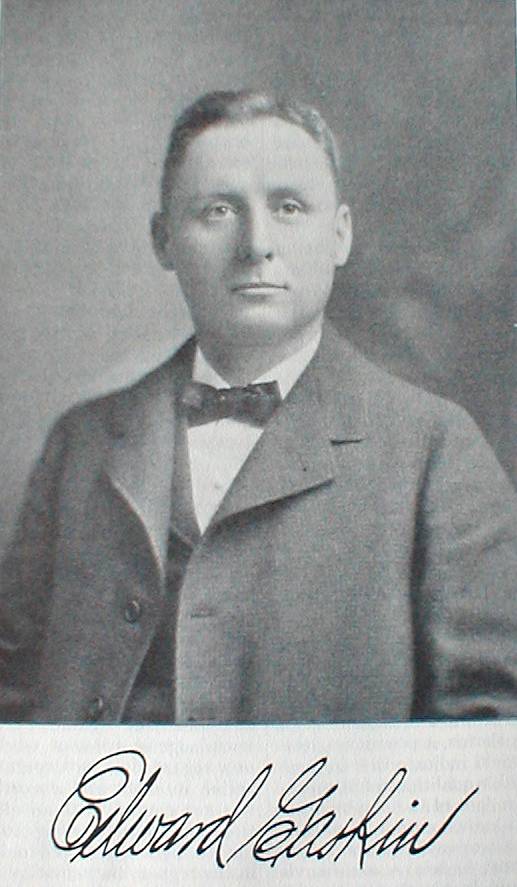
EDWARD F. W. GASKIN
Energy and enterprise, directed by sound judgment, make a combination which will command success in any line of life and the career of the subject of this sketch, a prominent resident of Buffalo, would indicate that he possesses these admirable qualities in full measure. As superintendent of the shipbuilding plants of two well-known corporations, the Union Dry Dock Company and the Union Steamboat Company, he has won an enviable reputation, and in his chosen line of work he may safely be said to have few equals and no superiors. His success reflects the more credit upon him because of the fact that he has gained it through his own merits, having begun at the very "foot of the ladder" as a journeyman ship carpenter, and the history of his gradual rise to positions of responsibility will, for the same reason, afford encouragement to many an ambitious youth in time to come.
A student of heredity might find in Mr. Gaskin's life an apt illustration of that theory, as his forefathers in both paternal and maternal lines were for generations interested in maritime matters as ship owners and builders. His ancestry is an honorable one, the Gaskins tracing their descent from the time of William the Conqueror. The late John F. Gaskin, our subject's father, was born in 1830, in the county of Kent, England, and became a successful shipwright, following that occupation throughout his life. He married Miss Sarah Hook, also a native of Kent, and in 1870 he brought his family to the United States, locating in Buffalo, where he was engaged in the shipyards of Gibson & Craig on the first iron boats built on the lakes. The children of John F. Gaskin and Sarah (Hook) Gaskin are as follows: Edward F. W. Gaskin (our subject); John R., of Buffalo; George (died in infancy); Alfred George (in the navy yards at Portsmouth, Va.); Walter Thomas, in Buffalo; Mary, married to Albert Clerry, of Portsmouth, Virginia.
Our subject first saw the light December 4, 1855, in London, England, where he remained until he reached the age of fifteen, his education being begun in the schools of that city. In 1870 he accompanied his parents to their new home in Buffalo, and while assisting his father in the shipyards he gained valuable practical knowledge of a line of work in which he is now regarded as an expert. Possessing an active intellect and worthy ambition, he was not content with an elementary education, and after coming to Buffalo he attended night school and took private lessons in the higher mathematics and mechanical drawing. Later he pursued a special course in bookkeeping, thus laying a foundation for the wide and accurate knowledge of business methods. He has always been fond of reading, being specially interested in mechanics, and he has kept well informed upon the various topics which attract current notice. At the age of sixteen he began to learn the machinist's trade with David Bell, of Buffalo, and after spending some time in this shop he found employment with different boatyards on the Erie Canal, at Buffalo, where he worked for about a year. In 1873 he entered upon a regular apprenticeship with the Union Dry Dock Company, the plant being then under the control of M. M. Drake, with Mr. John Lennon as foreman. During Mr. Gaskin's term of four years, the latter position was also held for a time by Mr. William Reed, and then by Mr. Frank Williams. At the completion of his apprenticeship, Mr. Gaskin worked for a few months as a journeyman, but his skill and ability had not escaped the attention of his employers, and he was soon promoted to the post of sub-foreman, although he was at that time only twenty-two years of age. In 1880 the company began to construct a plant for building steel or metal ships, and Mr. Gaskin spent a year as assistant with the engineer in charge. He then went into the draughting office, of which he was later appointed chief, and a year later he was made general foreman of the iron yard, still retaining his position in the draughting office. After two years he was appointed assistant superintendent of both the wood and iron yards, and in 1887, when Capt. M. M. Drake resigned, Mr. Gaskin continued in the same position under W. L. Babcock, as superintendent. In September, 1889, on the resignation of Mr. Babcock, our subject became superintendent of the whole plant, being then only thirty-four years of age, and he has ever since filled the position with marked ability and efficiency, the success of their enterprises being largely due to him. The company is the oldest of the kind on the lakes, and since Mr. Gaskin was made superintendent the plant has been thoroughly rebuilt and arranged with new buildings and new machinery of the most modern kind, until at present it is fully equipped for building and constructing vessels of the largest and most economical type. Under Mr. Gaskin's administration they have constructed many first-class vessels, including the Brazil, the S. C. Reynolds, the George J. Gould, the steamers Ramapo, Starrucca, Oswego and Chemung, Viking, and a large number of steel and wood tugs and passenger boats. They also built the yacht Enquirer, the fastest yacht on the lakes, and this was not only built under Mr. Gaskin's direction, but it was designed by him. At the present time the company is building two large dredges for use on salt water. In September, 1896, he was appointed superintendent of the Union Steamboat Company, and although most men would think the duties of one position sufficient, he looks after the interests of both companies satisfactorily.
In February, 1879, Mr. Gaskin was married to Miss Rosabelle McNeal, daughter of Rev. Benjamin McNeal, of Buffalo. He and his wife are active in social life, and he is identified with various clubs, among them the Buffalo, the Ellicott, and the Acacia Clubs. He attained the thirty-second degree in the Masonic order and is a member of the Washington Lodge, F. & A. M.; Keystone Chapter; Lake Erie Commandery, K. T.; Ismailia Temple, Nobles of the Mystic Shrine, and the Buffalo Consistory of the Ancient and Accepted Scottish Rite. He is also prominent in several societies composed of men who are interested in mechanical science, being a leading member of the Engineers Society of Western New York; the American Society of Mechanical Engineers, of which he became a member November 30, 1892, and the Society of Naval Architects and Marine Engineers, his membership in the later dating from May 10, 1893.
FRANK R. GEBHARD
Frank R. Gebhard, born September 24, 1856 at Buffalo, N.Y., received his education at parochial schools and at the Niagara University, Niagara Falls, N.Y. He did his first sailing in 1872 as porter on the propellers Cuba and Roanoke; in 1873 was boy before the mast the entire season on the brig N. M. Standard; in 1874 was able seaman of the schooners Schuylkill and Levi Rawson; in 1875 and 1876 was helmsman of the propeller Cuba; in 1877 was second mate of the propeller Java part of the season, and the balance as first mate of the propeller Alaska, of the Anchor line. In 1880 he was mate of the propellers Colorado and Roanoke, of the Commercial line; in 1881-82-83 and part of 1884 was master of the steamer Australasia, of Bay City. In 1885 he retired from sailing to engage in other business ashore, and was so occupied until 1890, since which time he has been occupied partly sailing and part of the time ashore, being mate during this time on several boats -- the Saginaw Valley, Tioga, Russia, and George Spencer. In 1881 he married Matilda Porcher; they have no issue.
LAWRENCE G. GEBHARD
Lawrence G. Gebhard, the present chief engineer of the Spaulding Machine Screw Company, on Kensington avenue, Buffalo, N.Y., is a son of Capt. Nicholas Gebhard, whose biography appears above.
Our subject was born at Buffalo, October 6, 1860, and received his education at the public schools and at Canissius College, Washington street, Buffalo. For a short period in his younger days he was employed as clerk in a grocery store, and then spent about five years learning the machinist's trade at the King Iron Works, Buffalo. For three months during the season of 1880 he was oiler on the steamer Boston. During the first two months of 1881 he was oiler on the steamer Montana, and finishing that season and the succeeding one as second engineer of the same steamer. His next position was that of second engineer of the steamer Milwaukee, on which he sailed for a couple of seasons. In the spring of 1885 he fitted on the steamer Colorado and was her chief engineer for that season. He was then second on the steamer Commodore for a season and a half, and remained ashore the next two years, being engaged in the grocery business. In 1889-1890 he was chief engineer of the Empire State, which later sank off Point Sauble, loaded with 875 tons of copper. During the seasons of 1892-1893 he was chief engineer of the steamers Milwaukee and Northern Light, respectively, and for about three months in 1894 he was employed as foreman in John Mahar's machine shop. >From there he went to the King Iron Works and remained until April 1895, when he became chief engineer for the Spaulding Machine Screw Company, a position he has held up to the present time. Mr. Gebhard has been a member of the M.E.B.A., No. 1, fifteen years, and was a charter member of Keystone Lodge No. 50, and National Association of Stationary Engineers.
Mr. Gebhard was married in Buffalo, January 17, 1884, to Cecelia Logel, and they have two children: Gertrude, now (1898) aged twelve years, and Edith aged eight years. The family residence is at No. 259 Riley street, Buffalo, New York.
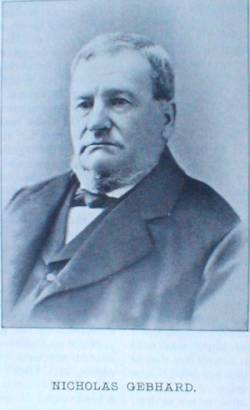
CAPTAIN NICHOLAS GEBHARD
Captain Nicholas Gebhard (deceased) was one of the oldest, most skillful and successful navigators of the Great Lakes. He was the son of Lorenz and Catherine Gebhard, who emigrated to America from France in 1831, coming direct to Buffalo, of which city Lorenz Gebhard was the first street paver.
Nicholas Gebhard was born in Alsace-Lorraine in 1824. He began his life work as cabin boy at the age of ten years, in this country, with Captain Standard, with whom he remained one season, and then went in the same capacity with Captain Webster. Just previous to his embarkation on the lakes, however, he engaged in the sale of peanuts and oranges on the wharf at Buffalo. He was subsequently, during the early years of his career, second mate with Captain Baxter in 1848, and first mate three seasons with Captain Anderson during the years 1849-50-51. In 1852 he bought the schooner Congress of Ira Cobb, and was her master during that season. In 1853-54 he was master of the Charter Oak, following this service with two seasons in the propeller Sun, and one season in the propeller Niagara, as master also. From the Niagara he transferred to the Potomac, which he commanded three seasons, and for two seasons was master of the Badger State, and next went on the Nebraska, in which he owned an interest. In 1872 the propeller Cuba was built by Charles Ensign, and Captain Gebhard, who owned an interest in her, commanded her until his demise in 1885. In 1836 he was with Capt. Webster on Lake Superior, the vessel they were on being the property of the American Fur Company. In those days the crew wintered wherever they happened to be frozen in. There were no locks at the Sault St.(sic) Marie canal at that time, and the vessel alluded to was built at Port Huron, taken to Detour, carried overland on wagons beyond Sault St. Marie on the river, put together there and launched on Lake Superior.
The death of Captain Gebhard, which occurred at his residence on South Division street, Buffalo, on June 26, 1885, caused unusual sorrow in the circles where he was known, especially among the old-time friends and acquaintances connected with the lake traffic. About four weeks previous to the day of his death, when he arrived at Buffalo on the propeller Cuba, of which he was master, he complained of being ill. Despite the advice of physicians and friends he remained at his post, but on the trip was hardly able to be about and attend to his duties. When the propeller reached her destination he was taken home a very sick man, and paralysis, setting in a couple of days later, soon brought him to the end of his earthly career. Captain Gebhard had frequently remarked that he would never leave the Cuba until he was carried off, and it so happened. He was thoroughly devoted to his calling, which, by native ability, good judgment and industry, he had made a successful one. Always of an enthusiastic disposition and good-natured, he readily made friends of those he was brought into contact with, and in the dullest, hardest tmes he was always cheerful and hopeful. He was a man of the strictest integrity, and was never known to impose on any one in the slightest degree. Should any of the large number who served under him be disposed to give their estimation of him, it could only be to say that he was a competent master and careful sailor.
Captain Gebhard was in his sixty-second year at the time of his death. He left a widow, Mrs. Caroline (Ottene) Gebhard, to whom he was married at Buffalo in 1848. A brief record of their children, all of whom were born in Buffalo, is as follows: George Gebhard, born October 28, 1848, married Delia Wayland, of Rochester, N.Y., and by her had four children, named respectively - Edwin, Bertha, Minnie and Albert. Caroline Gebhard, born September 18, 1850, married William J. Miller, a grocer; they have one child - Wilbert. Catherine Gebhard, born September 20, 1852, married George W. Richert, an agent; their children are named as follows: Leo George, Beatrice Eugene, Edwina and George W, Frank R. Gebhard, a sketch of whom follows. Lawrence G. Gebhard, a sketch of whom follows. Edward Gebhard, born September 5, 1862, is unmarried. William A. Gebhard, a restaurant keeper, born March 3, 1866, married Elizabeth Kibler; their children are Genevieve and William.
WILLIAM GEISLER
William Geisler, a young engineer of good report who has passed the greater part of his marine life on southern rivers and bayous, came to the lakes in 1897, with Capt. C. W. Moore, of Saugatuck, Mich. He is the son of William A. and Matilda Geisler, and was born October 16, 1871, in the city of Berwick, La., where he acquired his public school education. In the spring of 1887 he shipped as fireman on the steamer Louisa Storm, plying between Berwick and Morgan City, on Vermilion Bay, holding that berth two years. After passing a year before the mast on the schooner Lydia, trading to Galveston, Texas, he returned to steamboat life, serving on the stern-wheel steamers Lone Star, Bernie Holmes and Oscar G., until 1894, when he took out marine engineer's license at New Orleans and was appointed to the Millie L., a former lake craft, then plying on the Atchafalia river between Morgan City and Catawaba, La. He retained that berth two years, and in 1896 became engineer of the tug Leah, which he ran until she foundered, the following season. In June, 1898, Mr. Geisler came to Saugatuck, Mich., and was made second engineer of the new steamer J. S. Crouse, plying in the fruit trade between Saugatuck, Douglas and Milwaukee. He has four issues of marine engineer's license.
Mr. Geisler makes his home with his mother, who is still living in Berwick, La. His father died when he was seven years of age.
CAPTAIN VINCENT GERARD
Captain Vincent Gerard, a master mariner whose first experience on the Great Lakes dates back to 1850, was born March 30, 1838, in Detroit, Mich., to which city his parents, Alexander and Mary (Sweeney) Gerard, removed in about 1835. They were both natives of Montreal, Canada, and the father was of French descent. Alexander Gerard, who was an old-time sailor, owned the sloop Salina, on which Vincent sailed two years as boy with his father and uncle until the vessel was wrecked. He then sailed in sand scows until 1856, when he shipped before the mast in the schooner Kenosha, closing that season in the George Steel with Capt. C. Barker. In the spring of 1857 Captain Gerard joined the scow Hannah Salina, going with her to Chicago, where she was sold, and having been made master of her by the new owner he sailed her until the close of 1858. After a year as mate on a vessel he was appointed master of the Northern Light, plying as a steam ferry between Hancock and Houghton, and later sailed in various vessels in different capacities until 1870, when he was appointed mate in the tug Stranger. In 1871 he was mate of the tug Satellite; in 1872, mate of the lake tug Champion; in 1873, mate of the I.U. Masters; and in 1874, master of the tug Resolute, the following two seasons serving as mate of the Douglas and Uranus, respectively. In 1877 he joined the steamer Inter Ocean as mate, and the next year was appointed master of the J.W. Bennett, sailing her two seasons, after which he became master of the Nat Stickney. In 1881 he was mate of the steamer Middlesex; 1882-83, mate and pilot of the steamer Michigan; 1884, mate and pilot of the steamer Missouri; 1885, mate of the J.P. Donaldson; 1886, mate and pilot of the Passaic; and the following seasons master of the Carkin, Stickney and Cram.
In the spring of 1889 Captain Gerard entered the employ of the Bay City Dredge Company, with which he remained seven years, during that time acting as master of the tugs Edgar Haight, G.R. Hand and Fashion. In 1896 he went to Copper Harbor and took command of the tug Silver Spray. His next boat was the lake tug Gladiator, of which he was mate and pilot three months, after which he took the tug G.R. Hand to Tawas and operated her out of that port. In the spring of 1898 he came out as master of the tug Fashion, transferring, however, as pilot to the tug Industry, of which C.J. King is master. With her he went to Duluth, where she engaged in towing the vessels of James Davidson, who owns her. Captain Gerard has twenty-eight issues of master's papers, covering all the lakes from Ogdensburg to Chicago and Duluth. He has been instrumental in saving several lives, on one occasion jumping overboard in the Saginaw river to rescue a boy, and again in the Detroit river, below Mamajuda light. While master of the Salina he picked up the crew of a water-logged vessel in Lake Michigan, twenty-five miles from Chicago.
Captain Gerard was first married in August, 1861, to Miss Nettie Cowles, daughter of John Cowles, of Batavia, N.Y., and after her death he was married, on August 10, 1886, to Miss Mary Lenzal, daughter of Constant Lenzal, of New Baltimore, Mich. The family residence is at No. 301 Mosher street, West Bay City, Mich. Socially the Captain is a member of the Ancient Order of United Workmen and of the United States Benevolent Association.
WILLIAM J. GERVIN
William J. Gervin was born near Perth, county of Lanark, Ontario, March 18, 1849. His father was William Gervin, and his mother before marriage was Elizabeth Brooks. He had one brother, George Gervin, and in 1860, his parents having previously died, he went to Syracuse, N. Y., to live with his uncle, Thomas Gervin. He learned the trade of machinist, and in 1870 shipped as engineer of the tug Gates, of Oswego. For the next three years he was second engineer on the Northern Transportation Company's steamers Granite State, Young American and Cleveland.
He went to Detroit in March, 1874, and put in that and the next two seasons on the Winona as assistant engineer. For the next three years he was chief engineer of the Gazelle, and then worked one season as chief engineer of the Riversides, next becoming chief engineer of the Rhoda Stewart, on which he remained three seasons. Then he ran the engines of the Saginaw Valley for two seasons, and for the following two seasons he went on the Minneapolis as engineer. In 1887 he took charge of the engine room of the Smith Moore, and was with her that season and the next until she sank July 13, back of Grand island in Lake Superior. He then went out as chief of the Waldo Avery, and finished the season on her. For the next six years he was chief engineer of the Frank L. Vance, after which he transferred his services to the steamship Globe. >From July 11 to December 24, 1897, he was chief engineer on the steamer Crescent City, and in 1898 was chief engineer of the steamer Henry Cort of the Bessemer Steamship Company.
On December 17, 1872, Mr. Gervin was married to Elizabeth Mills, a daughter of Richard Mills, of Ogdensburg, N. Y., and has one child, William F. Gervin.
A. C. GETCHELL
A.C. Getchell, whose death occurred November 7, 1888, is still fresh in the minds of many of his friends and associates, in Cleveland, and was one of the pioneer residents of that city and one of her most public spirited citizens. Into the vast fabric of the past enters the individuality, the effort, the accomplishment of each man, be his station most lowly or one of power and intellect, and within its textile folds may be traced the lines of each characteristic, be it one that lends the sheen of honest worth and honest endeavor, or one that is dark and eccentric, finding its way through warp and woof, marrying the composite symmetry by its baleful threads, ever in evidence of a shadowed and unprolific life, or winning forth by congenial companionship, joy and hope. Into the great aggregate of the past each individuality is merged, and yet the memory of each is never lost, especially if the scope of its influence is wide-spreading and grateful, and it is a pleasure in this memoir to follow up such a life history, seeking ever to do justice to a good and generous man.
Mr. Getchell was born in Waterville, Maine, March 8, 1818. His father dying when he was but twelve years old, he left home and went to Boston, Mass., where he shipped as a cabin boy on a merchant vessel trading to European ports, England, India, China, Japan, and across the Pacific ocean to the west coast of America, returning to Boston by way of Cape Horn. This and other voyages occupied about eight years of his early life, and it is safe to say here that young Getchell visited, in his humble capacity of cabin boy and seaman, more points of interest than even many a well-traveled person sees. On his return to Boston he went into a shop as an apprentice to the machinist's trade, in which he became unusually proficient, and on this was founded the avocation of his successful after-life. Upon completing his trade he went to Bangor, Maine, where he found employment. In 1848 he met Miss Caroline E. Norton, and they were united in marriage that year, shortly afterward removing to Portland, Maine, where he shipped as engineer on a coasting steamer, plying between that port and Boston and touching at intermediate ports, retaining this position one year. He then stopped ashore and engaged as engineer of a locomotive on the Atlantic & St. Lawrence railroad, and after some experience on the road he resigned this position and entered the machine shop of the same company, in order that he might acquaint himself more thoroughly with the mechanism and working of the locomotive engine, which was a comparatively new piece of machinery in those days.
In 1852 Mr. Getchell went west as master mechanic in charge of locomotives consigned to a company then laying down a new railroad in Kentucky, and after putting these engines in proper running order he accepted the position of master mechanic of the Cincinnati, Hamilton & Dayton road. He continued in this incumbency until the spring of 1854, when he removed to Cleveland, Ohio, and accepted the position as engineer on the Cleveland & Pittsburgh railroad, with which he remained nearly four years, subsequently engaging for several years with the Lake Shore railroad. He then turned his attention to stationary engineering, and was soon afterward appointed chief boiler inspector for the Hartford Steam Boiler Inspection & Insurance Co., operating out of Cleveland, which position he held up to the time of his death on September 7, 1888. He was a man of recognized intellectual power, wrote many able papers treating on engineering subjects, and was eminently qualified for the responsible positions he occupied.
Mr. Getchell left a widow, a lady of rare intellectual attainments, and two children - A. William, who now occupies the position which his father's death left vacant, and Carrie Augusta, the wife of Quincy Miller, the superintendent of the Cleveland Ship Building Company's boiler shops. The family residence is on Franklin avenue, Cleveland, Ohio.
A. W. GETCHELL
A.W. Getchell, is the son of A. C. and Caroline Getchell, and was born in 1850, at Portland, Maine, in 1852 removing with his parents to Cleveland, Ohio, where he attended the public schools. At the end of his school years he entered the Lake Shore railroad shops to finish the machinist's trade, remaining one year, and he next turned his attention to stationary engines, running both high and low pressure engines for a number of years. In 1876 he commenced sailing as second engineer on the steamer H. B. Tuttle for one season, and the following spring he shipped as chief engineer on the wrecking boat J. K. White, operating out of Grand Island, following this by a season on the steamer Cormorant as second engineer. In the spring of 1879 Mr. Getchell was appointed chief engineer on the steamer City of Concord, plying between Chicago and Ogdensburg, and continued in that employ three years, after which he stopped ashore and entered the employ of the Hartford Steam Boiler Inspection & Insurance Company, as inspector and consulting engineer; he still retains that position.
Mr. Getchell has occupied his leisure hours in experimenting with machinery, and being a thorough mechanic and possessed of a fund of inventive genius, he has produced some novel, and at the same time practical, mechanism, on which he has secured letters patent. Among others we may mention an improved tumbling barrel, a new design of the hull of a steamboat, and a spiral screw steamboat designed for high speed and light traffic. This invention relates more especially to buoyant screw propellers for water craft, and consists of buoyant screws constructed to float and bear the body of the craft above the surface of the water. The object of the invention is to provide against the displacement of water, common to all water craft, by providing buoyant screws, which take the place of the hull and are practically the hull of the boat - the screw being of proportionately large dimensions, capable of supporting a good sized vessel-like superstructure above the water - and which may be rapidly rotated for propulsion on the water, speedily carrying the boat or vessel with the least amount of resistance in and by the water, the screws working in same in like manner to screws in their nuts. In ordinary steam and sailing vessels the displacement of water becomes a strong resistance to their propulsion, and requires great power to overcome, consequently retarding their progress, whereas, in this device, the only displacement is by the screws, and in rotating them in the water the resistance is available for carrying them forward instead of retarding them, for the rotation of the screws tends to move them forward. The screws also roll over very easily in the water, like the rolling of logs. The bearing down on one side of the axis of the screw is aided by the tendency of the other side to be lifted by the water, so that a minimum of power will serve to turn them. The buoyancy relied upon in this device is contained in the spiral blades of the screws, and not in air chambers or in the hollow or tubular shafts, as the shafts are entirely open so that the water may pass through them, and thus prevent the least resistance to the passage of the screws through the water. The main deck of the boat, or the superstructure, is carried along almost entirely above water, and may be for either freight or passengers. Beneath the main deck no hull is provided, but in substitution therefore are constructed and applied floating buoyant screws, which support and carry said superstructure above the surface of the water. These buoyant screws are attached one to each side of the vessel and run the entire length, from stem to stern, thus holding the upper deck as steady in the cradle as a railroad locomotive in the roadbed.
Mr. Getchell was united in marriage on December 5, 1883, to Miss Rosa L. Maxon, of Cleveland, and to them have been born two children; Theodore W. and Kate R. The family residence is on Franklin Avenue, Cleveland.
GEORGE GIBSON
George Gibson, son of Jacob and Katharine (Peters) Gibson, of Bergen, Norway, was born at that place on September 8, 1859. After attending school there, he began, at the age of fourteen, a seafaring life, which he has followed ever since. His cruising has been on both salt and fresh waters, and has carried him all over the globe. Mr. Gibson's first berth was as deck boy on the ship Amelia, of his native place and after remaining on her for over two years he engaged as ordinary seaman aboard the bark Alida, being on her nine months. Following this he served four months in the same capacity on the bark Eugenia, which he left on her arrival in New York. This was in 1877. He now went for nine months as able seaman on the American bark Peter, plying between New York, Richmond (Va.) and the Rio Grande, leaving her at Boston to go on the ship Brown Brothers, on which he made a trip as able seaman for Boston to San Francisco, the voyage covering a period of 163 days. At the latter port he engaged as able seaman on the Pactoles, which made a fast trip of 118 days to Mexico and Liverpool, England, where he left her, shipping on the Guisan to New York City. There he embarked on the steamship Hedgie, on which he remained eleven months, going to the islands of Jamaica and Porto Rico and back to New York.
At this time Mr. Gibson began shipping on the lakes, engaging as man before the mast on the schooner Queen City, on which he was engaged for two seasons, the last five months acting as her second mate. He was next on the schooners Stampede and Nellie Wellington, and during the winter of those two seasons went to New York and shipped to the West Indies on the Ella M. Watch, and to Kingston and Jamaica on the John C. Gregory. In 1884 he went on the Anchor line boats, commencing as wheelsman on the Conestoga and serving in that capacity for two seasons; the first three months of the ensuing season he was on the Susquehanna as wheelsman, finishing on the India, in the same berth. In 1887, the following season, he was second mate of the Gordon Campbell, and back to the India as second mate in 1888, the next season becoming her mate. In 1890 he was given mate's berth on the Juniata, serving in all six seasons with the Anchor line. For the seasons of 1891-92 he was mate of the John M. Nicol, of the Crescent line, of Detroit, and then of the Northern King for two months, the E. P. Wilbur two trips and the H. E. Packer for the balance of the season. Later he was mate of the John V. Moran, of the Union Transit line, and for the season of 1897 served with the Lehigh line.
Mr. Gibson was married at Buffalo in January, 1896, to Miss Katherine Jansen, of Denmark, and they have one child, Annie Katrina. They reside at No. 9 Sylvan street, Buffalo, N. Y. Fraternally Mr. Gibson is a member of the Northern Star Lodge, I. O. O. F., and the American Association of Masters & Pilots, belonging to Local Harbor No. 41.
CAPTAIN JAMES GIBSON
Captain James Gibson, the well known vessel master, was born at Port Williams, in the south of Scotland, May 1, 1834, and there he attended a parish school. He came of a family noted in marine circles, being a distant relative of Sir John Ross, the Arctic explorer. His father, Peter Gibson, was the owner of several coasting and fishing vessels in Scotland. All the male members of the family were mariners, his brother Robert for many years commanding one of the mail steamers running from Liverpool to the Isle of Man. His brother William is harbor-master at Port William, Scotland.
Captain Gibson located at Cleveland in 1853, and assisted in the survey of part of the head of Lake Erie, under Captain Stansbury. In the winter of 1853-54 he helped to build the railroad across Sandusky bay, and in the latter season he shipped as wheelsman on the Queen of the Lakes under Captain Smith, and served in that capacity until the fall, when he was made second mate, which berth he filled until the close of the season of 1855. In 1856 he was second mate of the Potomac, and in 1857 was mate of the schooner George D. Dowsman, of Cleveland, afterward an ocean vessel. In 1858 he was second mate of the Kenosha until she was laid up, remaining aboard, however, as shipkeeper, and receiving $15 per month for his services. That fall he was mate of the Forest Queen with Captain Fields. In 1859 he was second mate of the Susquehanna; in 1860, mate of the Eliza Logan, except the latter part of the season, when he was mate of the old propeller Buffalo. In 1861 he became mate of the propeller Mohawk, with Captain Pheatt, and remained on her three seasons.
In 1864 Captain Gibson first became master. The fore part of that season he was on the Neptune, of the Western Transportation Company, and on the Acme the latter part. Beginning with 1865 he commanded the Mohawk five consecutive seasons. It was during the summer of 1865 that the steamer Meteor collided with the Pewabic near Thunder bay, drowning about 150 people. The Mohawk was at the scene of disaster shortly after its occurrence, and Captain Gibson took on board the Mohawk about one hundred people, and also the remains of Mrs. Weller, of Lexington, Ky., and carried them to Detroit. J.T, Whitting, of Detroit, presented to Captain Gibson one of the Pewabic's life preservers that had been on one of the saved persons. In 1870 Captain Gibson was transferred to the propeller Fountain City, and sailed her thirteen consecutive seasons, at the conclusion of which period he was transferred to the Idaho, and Capt. Donald Gillies, his son-in-law, filled the vacated berth. For three years, commencing with 1884, he held the position of inspector of hulls for the Ninth district. In 1887 he was master of the Saginaw Valley, and in 1888 of the Lackawanna. The following year he took command of the propeller America, built by the Drake Syndicate, and sailed her for seven seasons. During 1896 he was master of the steamer Brazil, and in 1897 of the steamer Chili. The Captain is the seventy-third member of the Ship Masters Association.
At Fond du Lac, Wis., June 27, 1857, Captain Gibson was married to Miss Lydia M. Stephens, of Schoharie county, N.Y. Her father, Perry C. Stephens, was a veteran of the war of 1812, and her grandfathers were soldiers of the Revolutionary war. The Captain and his wife have four children living: Mary E., wife of Capt. Donald Gillies, of the lake service; Susan Pheatt, wife of Elmer E. Summey, of Buffalo; J. Robert, master of the steamer America; and Isabella A., wife of Lawrence H. Gardner, of East Aurora, N.Y. The residence of the Captain is at No. 692 Prospect street, Buffalo, New York.
JOHN GIBSON
John Gibson, second engineer of the steamer Norwalk, was born in St. Clair county, Mich., in 1866, the son of James Gibson, a successful farmer. He attended school in the vicinity of his early home and was employed on his father's farm until 1892, meanwhile paying considerable attention to steam engineering and having charge of a threshing outfit during the fall for four years. He commenced sailing in 1893, shipping as fireman on the George T. Hope, and held a similar position on the steamer Merida during 1894, in 1895 serving as fireman and later as oiler on the same vessel. He became second engineer of the Norwalk in 1896, thus making unusually rapid advancement in his line of work. His brother, Albert Gibson, is fireman in the Merida.
CAPTAIN ABNER G. GILBERT
Captain Abner G. Gilbert is a son of George Gilbert, who was born in Buffalo in 1835. He was a fisherman and sailor all his life, and for the last three years was lighthouse-keeper on the Horse Shoe Reef, outside of Buffalo harbor on the Canadian side. He died in 1873.
Captain Gilbert was born in Buffalo in 1857. Leaving school at the age of fifteen, he began life as a fireman, which occupation he followed about three years. Previous to that, however, and during his school days he ferried on Buffalo creek at odd times, for about four years. At the age of eighteen, in the spring of 1876, he accepted employment on the lighthouse supply boat Haze, in which he was retained about twelve years, the last four holding mate's berth. In 1888 he was made master of the screw steamer Vision, and, for the three succeeding seasons, of the steamer Pilgrim, both of which plied to all the resorts in the vicinity of Buffalo, including those on Niagara river. In 1891 he was given charge of the overseeing of the building of the twin-screw steamer Puritan, and was her master for that and the two succeeding seasons. Following that employment he was engaged for three years as master of tugs for Carroll Brothers, hauling sand and limestone from Canada for the Buffalo Furnace Company. Captain Gilbert was a charter member of the local Harbor No. 41, of the American Association of Masters and Pilots of Steam Vessels. He is a single man, and resides with his mother, Mrs. Mary C. Gilbert, at No. 271 Front Avenue. His brother, Charles H. Gilbert, has for about eight years been on sail vessels and master of tugs in Buffalo harbor. Another brother, Thomas A. Gilbert, is a resident of Buffalo, and assistant engineer of the steamer Haze, above mentioned. Nellie, a sister, is the wife of Frederick Smith, a marble worker by trade. His youngest sister is unmarried, and resides at No. 271 Front avenue, Buffalo, New York.
J. H. GILBO
J.H. GILBO, is one of the prominent and well-known engineers of Chicago, and is a through mechanic, having had an extended and varied experience as an engineer both on the lakes and on shore. He was born in Cape Vincent, N. Y., December 16, 1842, and received the advantages of a common-school education. He learned the machinist's trade at Ogdensburg and at Cleveland, and was early attracted to the lakes, when a boy sailing on schooners. Before he became regularly identified with the lakes, however, he had gained experience as a stationary engineer. Mr. Gilbo began sailing in 1865, shipping from Ogdensburg on the propeller Cleveland, plying between Ogdensburg and Chicago, and remained on this boat eight seasons, subsequently becoming engineer of the Milwaukee, the passenger steamer Nashua and the Milwaukee until 1877. In that year he removed from Ogdensburg to Bay City, Mich., and for two seasons was engineer on tugs for Mitchell & Co. Mr. Gilbo varied his mechanical experience by becoming a stationary engineer, and then returned to the lakes as assistant engineer of the S. D. Caldwell, in which position he remained four months.
In 1880 he came to Chicago, and was for a time engaged as an engineer on the West side. In 1882 he fitted and brought out the George T. Burroughs, remaining on her until August of that year, finishing the season as engineer of the Granite State. For three years thereafter Mr. Gilbo was engineer of the C. P. Kimball Carriage Factory, on Wabash avenue, but in 1886 returned to the lakes, becoming assistant engineer of the Chauncey Hurlburt for one season; for a short time he took charge of a building in Chicago, and subsequently became chief engineer of the steambarge Fayette, and filled the same responsible position successively on the Ida M. Torrent, the Waverly and the Fayette Brown, of Detroit. Laying up the last named propeller, he was chosen engineer of the Olympia, of Cleveland, for a part of the ensuing season, and was next assistant engineer of the Pontiac. Receiving the appointment of chief engineer of the Superior, he was successively on that vessel, the E. B. Hale, the Hesper, the Morris P. Graves, and during the season of 1898 on the Pasadena, of the same line. Throughout his long and responsible career Mr. Gilbo has been a careful and efficent officer, and has acquired a valuable and extended experience that is equaled by that of few lakemen. He is calm in manner, never disturbed by trifles, and is, withal, decisive when prompt action is required.
SAMUEL R. GILL
Samuel R. Gill, who was steward of the North Land, of the Northern Steamship line, during the season of 1896, was born at Pembroke, Ont., in 1868, and attended school there, finishing his literary education when about fifteen years of age. His first experience in connection with the lake commerce was as newsboy on the steamer Athabaska in 1886. Previous to that time he was in the employ of the Canadian Pacific railway, and was changed to the Athabaska when that railroad established the route from Owen Sound to Port Arthur. The following season Mr. Gill was a waiter on the Alverta of the same line, and in 1888 was head waiter on the steamer United Empire, belonging to the Beatty line that ran between Sarnia and Duluth.
In 1889 Mr. Gill removed to Buffalo, and that fall became a waiter in the Swan street café, where he engaged for a year. During the two seasons of 1890-91 he was head waiter on the Empire State, of the Western Transportation Company's line, in 1892 was employed as barkeeper at the White Elephant saloon, and in 1893 held the same position at the old Arcade. For the season of 1894 he was steward on the Badger State, of the Western Transit line; for that of 1895 barkeeper of the passenger steamer North West, and for the season of 1896 steward of the North Land. Mr. Gill is a very competent man in his chosen line, and will doubtless follow the lakes for many seasons.
Our subject was married in 1894 to Emma Gregory, of St. Catharine's, daughter of Captain Gregory, who died in February, 1895. They have one child, Irene. They make their home at No. 78 West Chippewa street, Buffalo.
W. C. D. GILLESPIE
W.C.D. Gillespie, who is quite popular in marine circles, as well as with all who have had the pleasure of his acquaintance, is now chief engineer of the Rookery building, Chicago, having held that responsible position since 1886; but previous to that time he had spent the greater part of his life upon the lakes as an engineer. Mr. Gillespie was born in New Orleans, La., in 1844, a son of George W. and Mary E. (Copeland) Gillespie, the former of native of New York and the latter of the West Indies and of English descent. At the age of sixteen years, the father went South, and for some time engaged in steamboating on the Mississippi river, running from St. Louis to New Orleans, the first season as second clerk, and later as clerk. He also became part owner of boats on the lower Mississippi but in 1850 sold his interests in the South and removed to Buffalo, from which port he sailed on the Great Lakes for many years, being on the Saginaw, Bucephalus, Westmoreland, Buffalo, Antelope and Globe. He was on the last named when she was blown up in Chicago. He sailed on the lakes from 1850 to 1888, with the exception of five years when he served as street commissioner at Buffalo. In 1889, he removed to Chicago where his death occurred January 20, 1898. His wife had died in the same city in October, 1892.
The subject of this sketch was reared and educated in Buffalo, and at the age of fourteen years, entered the Old Eagle Iron Works of that city, serving a four years' apprenticeship at the machinist's trade. In 1862 he manifested his love of country by enlisting at Buffalo, in Company H, One Hundred and Sixteenth New York Volunteer Infantry, for three years or during the war, and was mustered in at that place, his regiment being assigned to the Nineteenth Army Corps, Army of Louisiana and Texas. He participated in the battles of Stone Plain, Port Hudson, and Jacksonville, La., and in the Red River and Texas campaigns, also for the last six months at the siege of Petersburg, Va. The war being over and his services no longer needed, he was honorably discharged at Buffalo, in 1865.
In spring of 1866, Mr. Gillespie began steamboating on the lakes, sailing out of Buffalo as engineer on the tug Daisy Lee, bound for Racine, Wis., remaining on her for one season. She was wrecked off North Point, Racine, Wis., December 7, 1868, during a heavy snowstorm and the crew in order to same themselves were obliged to swim ashore. In 1867 he fitted out the tug Margaret at Buffalo; was on her as engineer for three seasons, and in 1870 sailed her as captain, being engaged in the wrecking business along the shore of Lake Michigan. Remaining ashore in 1871, he spent three years as superintendent for the Comstock & Simpson Lumber Co., at Oconto, Wis., and for two years was financially interested in the company. In 1874 he came to Chicago, and that year and the year following was engineer on the tug Burton at that port. During a part of the season of 1876 he was on the tug Crawford, at Chicago, but in the fall of that year entered the employ of the Union Steamboat Company, as engineer of the steamer Gould. He remained with that company for twelve years, during which time he was engineer on the Gould, Canisteo, Blanchard and Portage, of their steamship line. With the exception of the Canisteo, which was wrecked off Waugochance (Mr. Gillespie still her engineer) at two o'clock in the morning of October 20, 1880, the other boats are still in commission.
In 1885 he was made assistant superintendent of the Baker & Smith Steam Heating Co., but the following year accepted his present position as chief engineer of the Rookery building. In 1874 he was one of the promoters and organizers of the old M. E. B. A., No. 4, of Chicago; and he is also a prominent member of the Masonic fraternity, having assisted in the organization of all branches of that order at Auburn Park. He belongs to Auburn Park Lodge No. 789, F. & A.M., of which he has been master; Auburn Park Chapter No. 201, R. A. M., being honored with the office of high priest; Englewood Commandery No. 59, K. T.; Medinah Temple No. 1; and Auburn Park Chapter No. 167; Order of the Eastern Star, of which he has been patron.
In 1868, at Racine, Wis., Mr. Gillespie was married to Miss Amelia Yout, a daughter of Simeon C. Yout, one of the early pioneers of that city, who gave his attention to the insurance business. Two children were born of this union, only one of whom is living: George H. The family residence is at No. 107 Gale avenue, River Forest, Illinois.
CAPTAIN JOHN GILLIS
Captain John Gillis, a devoted follower of the sea, has from an early age been actively engaged in marine pursuits, and is widely and favorably known among those of his own calling. He is a native of Inverness-shire, Scotland, and was but a year old when the family removed to America, locating in Middlesex, Ontario, where he attended school until his fifteenth year, when he went to Detroit.
At that time his great desire to become a sailor was gratified, and he went upon the King Sister as seaman, having previously spent some time on a small schooner. The next season he was on the Zach Chandler as mate, and the next fifteen years filled the same position on the Erastus Corning, the Lizzie Law, and others. For a time he was second mate on the Peerless, and later served as mate on the same vessel for ten years. His next change made him mate of the City of Fremont, and subsequently he was mate and pilot of the City of Duluth.
After two seasons spent with the Western line as mate, Captain Gillis came on shore, and devoted some time to the occupation of farming, but marine life had a greater charm for him, and to it he returned, going in command of boats owned by the American Steel Barge Company. After four years in the employ of this company he was made captain of the Sir Joseph Whitworth, in 1896, and is still master of that vessel. His had been a fortunate career, and one that has gained for him the greatest respect and confidence of his employers.
In December, 1879, Captain Gillis married Miss Katherine McDonald, by whom he has four children: Sarah, Hugh, Hannah Mary, and Cassie, all of whom are at school.
CAPTAIN GEORGE D. GILLSON
Captain George D. Gillson, treasurer of the Associated Boat Owners, was born in Carbondale, Lucerne (now Lackawanna) Co., Penn., August 19, 1844. He is the son of Joseph and Sarah Jane (Elston) Gillson, the latter of whom was a daughter of David and Hannah (Doyle) Elston, of Unionville, Orange Co., N.Y. Joseph Gillson was a farmer and lived near Carbondale, Penn., eight years, thence moving to Athens, Bradford Co., Penn., where he passed the remainder of his life, dying in 1880. Joseph and Sarah Jane Gillson were the parents of the following named children: Harriet, born in 1836, married Justin Morley, of Athens, Penn., and died at the age of twenty-five years; Amelia Ann, born in 1840, married Edward Quick, of Middletown, Orange Co., N.Y., and had one child, who died in 1879; George D.; Lois Jane and Jesse N, (twins), born in 1848, the former of whom married Frank Coy, of Brockport, N.Y. (and had one child, which died when one year old), while Jesse N. wedded Susie Mosher, of Brockport, N.Y., and had one child, who died at the age of five years; Henrietta, born in 1851, died unmarried, when about thirty years old, and Joseph, who died in infancy in 1858.
George David Gillson lived at home until seventeen years of age, attending school and working on the farm. He then entered the quartermaster's department of the army of the Union, at Louisville, Ky., and thence went to Nashville after Sherman took Atlanta. Mr. Gillson returned north with his department of the army to Chattanooga and to Nashville, Tenn., where he was discharged in August, 1865. The war being over he returned to his home, and went onto the Erie canal with one boat of his own, to which he soon added another, managing one and hiring a captain and men for the other. Being successful in this business he gradually increased the number of his boats until 1880, when he owned thirteen. In 1886 he bought a steamer for the canal and subsequently another, and at the present time he owns two canal steamboats, one, the Smith, Davis & Co., and the other the Fred M. Lawrence, with four consorts, two for each steamboat. The Fred M. Lawrence has a capacity of 3,300 bushels of wheat, and the Smith, Davis & Co., a capacity of 6,000 bushels, while the consorts each have a capacity of 8,200 bushels. The Smith, Davis & Co., was the first steamboat that ran three consorts on the canal, is one of the sharp-stern boats, now the recognized form of steam canal boats, and can make the trip through the canal in seven days. The Fred M. Lawrence can handle five consorts and make the same speed.
Captain Gillson was one of the organizers of the Associated Boat Owners, organized for transportation and controlling rates, and he was one of the committee of five that fixed the rates and was treasurer of the association since it organization in September, 1895, until its dissolution, January 1, 1898, since which time all members of the association have been running wide pennant. He is also insurance inspector and adjuster for the Reliance Marine Insurance Company, of Liverpool, England, having been appointed in the spring of 1896. Fraternally, he is a Mason; he is an attendant of the Cedar Street Baptist Church, and in politics is independent, voting for the principles and the men he thinks best suited to the times. He voted for Cleveland in 1892 and for McKinley in 1896.
On January 1, 1868, Captain Gillson was married at Meshoppen, Wyoming Co., Penn., to Miss Jennie P. Ingham, and to this marriage have come the following named children: (1) Joseph D., born February 12, 1869, married Lillian H. Gerlach on October 30, 1888; she died October 12, 1889, and in 1893 he married Miss Hilda Johnson, (2) Kittie J., born July 26, 1871, married Lyman D. Priot, of Buffalo, and has one child. (3) Georgie May, born April 28, 1884, died at the age of eight years. (4) Pearly Ethel was born October 12, 1887. (5) Frankie H. died in infancy. (6) Freddie H. died in infancy. (7) Herold Ray was born January 17, 1891. Captain Gillson and family live at No. 244 North Division street, Buffalo, New York.
Mrs. Gillson is a daughter of Henry and Catherine (Washborn) Ingham, the father born 1812 at Manchester, England, whence he came to this country at the age of sixteen. He was a contractor of public works, and spent the last twenty years of his life in Buffalo, dying there in 1891. He and his wife had four children: Smith W., Stephen T., Henry B. and Jennie P. During the Civil war the three brothers raised a company of Pennsylvania volunteers; Smith W. receiving the rank of major and Stephen T. being made lieutenant and baggage master. Henry B. was wounded and died from the effects of his wounds. Maj. S.W. Ingham now makes his home in San Diego, Cal., while Stephen T. is United States pension agent and lives at Nicholson, Pennsylvania.
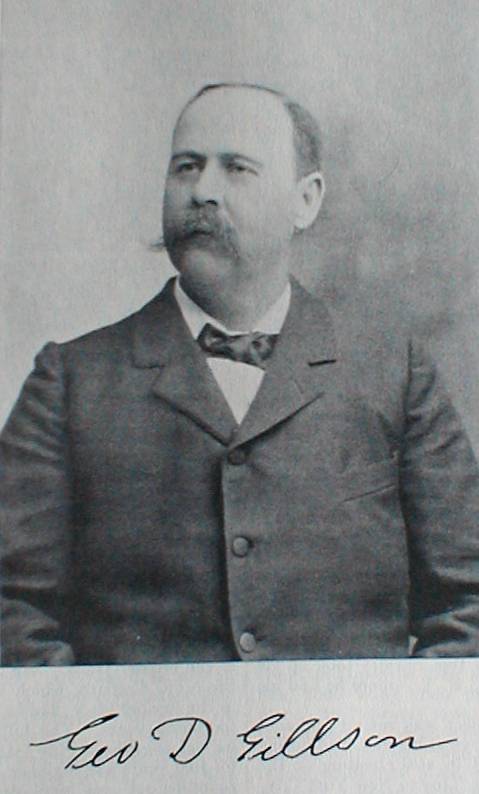
CAPTAIN PETER J. GIRARD
Captain Peter J. Girard, who lost his life with the sinking of the Ironton off Presque Isle, in Lake Huron, September 26, 1894, was born in Amherstburg, Canada, October 7, 1854, and commenced his seafaring life at the age of fifteen years, sailing constantly, with the exception of three years, until his death.
Among other vessels on which he saw service were the Escanaba, H.P. Baldwin, Wagstaff and the Mineral State. For five years previous to his death he was master of a vessel. He was an honored member of the Ship Masters Association, and was highly esteemed by his associates in the lake marine.
On August 21, 1885, the Captain was married to Miss Susan McDonaugh, of Cleveland, a daughter of James and Mary McDonaugh, natives of County Mayo, Ireland.
CAPTAIN COS. A. GIROUX
Captain Cos. A. Giroux was born in Woodstock, Ontario, December 4, 1856, a son of Raphael and Ann (O’Neil) Giroux, and a grandson of Garnesnette and Eliza (Paquette) Giroux. The grandparents were natives of the Province of Loraine, France, and on coming to Canada settled at Riviere du Loup, on the St. Lawrence River, where the Captain’s father was born; his mother was a native of New Brunswick. The parents removed to Woodstock, Ontario, after their marriage, and later to Port Huron, Mich. After attending school a number of years Cos. A. Giroux was apprenticed to a company engaged in the fishing business, and was first employed in knitting and repairing nets, later going out with the boats to the fishing grounds, and after six years he became a thoroughly practical fisherman. In the spring of 1875 he shipped as lineman on the tug Wesley Hawkins, engaged in towing logs on the Au Sable River, holding that berth two seasons. In 1877 he shipped on the tug Ontario as lineman and acting mate, joining the fishing fleet in the fall and remaining in that trade the following season on the tug Lida, until April, 1879, when he went on the steamer City of Alpena, transferring from her to the General Burnside until September. In the spring of 1880 he was employed on the fishing tug Sea Wing, making and mending nets until September, when he shipped on the tug Grayling as fireman. It was his custom up to this time to go into the Michigan lumber woods to drive team during the winter months. In 1881 Captain Giroux went to Sugar Island and engaged in knitting nets, following this handicraft the succeeding year at Alpena. In 1883 he found employment in a restaurant at Alpena, and continued thus for four years. His next berth was at the wheel on the tug Alanson Sumner; in the spring of 1888 he came out on the tug Garden City and remained on her until June, when he went to Ashtabula and shipped with Capt. John Dunn in the steamer Vienna, later transferring to the Corsica, with Capt. William Cummings. That fall and the next year he again engaged in the fishing business, with Captain Motley (now keeper of the Cleveland life-saving station), on the tug Grayling. In 1890 he entered the employ of John Averill knitting nets and sailing on the tug Helene, and two years later he transferred his services to Mr. Edson, with whom he remained several years, sailing the tugs W. L. Davis, Enterprise, Criss Grover and John Gregory, the steam scows Adventure and Duro, and the tug Sea Wing, and knitting nets as occasion required. During the season of 1897 he fished with the tug Sea Fox, out of Ashtabula harbor. The Captain has a shop in Cleveland, where he occupies his time in the winter making nets for sale to the trade.
Captain Giroux was united in marriage to Miss Elizabeth J. O’Neil, of Woodstock, Ontario, the ceremony taking place at Alpena in October, 1883. Two children, Joseph Emmet and George Edward, were born to this union. The wife and mother passed to the land of rest in the year 1888, followed by the two sons, George in 1892 and Joseph in 1895. Captain Giroux resides at No. 247 Viaduct Street, Cleveland, Ohio.
CAPTAIN JOHN R. GLOVER
Captain John R. Glover is a son of Daniel W. and Elizabeth (Jones) Glover. The father was an old-time sailor on the lakes and mate of the steamer Dictator previous to his death, which occurred in 1872. Mrs. Glover lives with her son on Fargo Avenue, Buffalo.
The Captain was born at Buffalo in 1861. At the age of twelve years and immediately succeeding his attendance at Public School No. 2, he began sailing the lakes as second cook on the propeller Toledo of the Union Steamboat Company's line; she was in the passenger service from Buffalo to Toledo, and later in the season running from Green Bay. He was next porter on the propeller Passaic (running between Buffalo and Green Bay) a season, which ended at Buffalo. The succeeding season he was porter of the steamer Canisteo, of the same company and in the same trade. In 1878 he shipped as porter of the steamer St. Louis, remaining with her the full season, and served in the same capacity in the propeller Pacific for the season of 1879. The first two months of the season of 1880 he was wheelsman of the steamer Grand Traverse under charter by the Wabash line and in the trade between Buffalo and Toledo. He then acted as watchman for a trip on the Waverly, and closed the season as wheelsman of the Dean Richmond of the Union Steamboat Company's line. The following season he was wheelsman of the steamer Japan, of the Lake Superior Transit Company, in the passenger service between Buffalo and Duluth. For the first month of the season of 1882 he was fireman of the Buffalo harbor tug Orient, of Maytham's line, from which employment he returned to the steamer Japan and acted as her wheelsman two trips and a half, leaving her at Duluth to become mate of the tug John R. Paige, which was owned by the Sexmith Lumber Company, of Duluth, and was used in rafting logs from Burlington bay and Stewart river to Duluth.
In the season of 1883 Captain Glover began as mate of the tug Alice M. Campbell, owned by the Oneonta Lumber Company, of Duluth. He was then master of the tug John McKay for a couple of months, towing logs in Stewart river and Burlington bay. For a short period he was master of the ferryboat Hattie Lloyd between Superior and Duluth, and closed the season as mate of the tug Henry F. Brower, engaged in the freight and passenger traffic between Duluth and Two Harbors. The following season he was master of the harbor tug Maggie Carroll, of Duluth, about two months, and from her went to the J.H. Upham, Jr., owned by William & Upham Co. He was also mate of the steamer Old Agnes, in the passenger and freight traffic on the north shore of Lake Superior, for part of that season. In 1885 Captain Glover continued in the master's berth of the J.H. Upham, Jr., and was engaged in tug work with her on the Sault Ste. Marie river. Following that work he returned to Buffalo and entered the employ of the Sherman S. Jewett & Co. foundry, where he operated a stationary engine for a period of sixteen months. For the season of 1887, beginning with the month of April, he was master of the tug H.L. Fairfield, of the White Star line, and continued on her during 1888. Until September, in 1889, he was master of the steamer Huntress, between West Ferry street and the McComb House, and finished that season as master of the tug Alpha of the Maytham line, remaining as master of her through the season of 1890 and until August 1891, when he was transferred to the tug O.W. Cheney, of the same line, in which he continued steadily until May 26, 1895. He then became master of the excursion steamer Columbia in the trade between Buffalo and Dunkirk, Erie, Port Dover, Port Colborne and all resorts on Niagara river, occupying that berth until August 10, when he returned to Cheney, of which he has since been master continuously until the close of the season of 1897.
On February 15, 1898, he was appointed master of the government steamer the Gen. John M. Wilson, built by the Craig Shipbuilding Company, at Toledo, Ohio, and later John R. Glover brought her out. The Gen. John M. Wilson is in the engineer service of the U.S. under the Department of War. Captain Glover has been very successful in his marine career.
During his employment in the Maytham Tug line, Captain Glover has on many occasions given abundant evidence of his courage in dangerous times, going to the assistance of vessels in distress when others in the same vocation have preferred to take their chances inside the harbor; and it will not be out of place here to mention a couple of instances by way of illustration. Late in the fall of 1895 the steamer S.C. Hall, with consorts Ida Keith and Nellie Mason, left Buffalo Harbor on a Saturday night bound for Chicago with coal. When off Port Colborne the wheel chains of the Hall parted, and she was at unusually great disadvantage on account of the heavy sea, but she reached the harbor in safety with the assistance of the O.W. Cheney. The Keith, left to her resources, also succeeded in reaching the harbor with the assistance of the tow tugs O.W. Cheney and Acme. The Mason was not so fortunate, as on account of the derangement of her steering gear, she could not be handled properly, and was finally compelled to let go her anchor about two miles off Port Colborne and set up a signal of distress. Captain Glover was sent to her assistance with the tug O.W. Cheney and succeeded with great difficulty in taking off the crew. Neither the Port Colborne nor the Buffalo harbor tugs would attempt the rescue. At another time he went to the rescue of the passengers and crew of the excursion steamer Eldorado, which was stranded on Horse Shoe Reef. The steamer had landed a portion of its passengers at Ferry street, and on its way to Main street run on the reef. Captain Glover with the Cheney not only took off most of the passengers, but with them aboard his tug pulled the steamer off also. Captain Glover was a charter member of the Buffalo Harbor Tug Pilots Association, in the organization of which he was very influential, holding the number "6." He is also a charter member of Local Harbor No. 41, of the American Association of Masters and Pilots, and is starboard quartermaster.
In 1882 Captain Glover was married in Buffalo to Miss Clara May Guillod, daughter of Edward C. Guillod, a citizen of Buffalo. Two children have blessed this union; Earle D., and Pearl M. The family residence is at No. 217 Potomac avenue, Buffalo, New York.
WALTER CHARLES GODDARD
Walter Charles Goddard, at present chief engineer of the Chamber of Commerce building, of Detroit, Mich., was a sailor for many years, following that calling both at sea and on the Great Lakes. He was born February 19, 1840, in Nottingham, England, and remained in his native country until nearly thirty years of age. His first experience on board ship was gained in the British navy, to which he belonged in all for twelve years, and in which he served his time as a mechanical engineer. During the years of his apprenticeship he sailed on the Heron, Inflexible and Thunder, and he was subsequently engaged as second engineer for three years on the boats of the Mediterranean squadron. While in the navy Mr. Goddard made several trips to India, and after leaving the service he spent two years more at sea before coming to the Great Lakes, during which time he was employed by the White Star line as second engineer on the old Republic, the Germanic and the Brittanic, and as first engineer on the Coptic. While on these boats he crossed the ocean between Liverpool and New York sixty-one times. Afterward he sailed on the Nestorian, of the Allan line, between Liverpool, England, and Montreal, Canada. After coming to the lakes Mr. Goddard did not sail very long, making one trip on the Celtic, of the Merchants line, from Montreal to Chicago, and filling a berth on the Cheboygan for one season. He also served for a short time on one or two other boats, and since then has been employed on shore. He has been in the electrical and mechanical engineering business in Detroit for ten years. For six years he was with the Woodward Storage Battery Electrical Company, as general superintendent, and he then fitted out the George C. Baker, a submarine boat, with which he made several experimental trips. Leaving the Baker he engaged with the Citizens Street Railroad Company, of Detroit, continuing with them two years, and since April 1, 1896, he has been chief engineer of the Chamber of Commerce Building. Mr. Goddard was married in October 1886, to Mrs. Hudson, nee Watkins, and to this union has been born one son, Walter Henry, who is now in school. Mr. Goddard is well known in electrical and mechanical engineering circles, in which he has high standing. He is a Royal Arch Mason, belonging to the Peninsula Chapter No. 116, and is also a member of Palestine Lodge No. 357, Detroit, Michigan.
CAPTAIN SAMUEL GOLDEN
Captain Samuel Golden was the master in 1896-97 of the steamyacht Enquirer, the property of W.J. Conners, of the Buffalo Currier and the Enquirer.
The Captain is a native of Ohio, born February 10, 1855, at Bellevue, whence his parents removed to Corunna, Mich., shortly after his birth. When he was about nine years of age they removed to Bay City, where he resided until 1872, and at that place he obtained his common-school education. His first experience on the lakes was as porter on the propeller May Flower, shipping from Bay City in the year last named. He worked in that capacity only a month, and at the expiration of that time shipped a trip from Chicago to Buffalo on the Badger State, at the latter place going as wheelsman on the propeller Burlington for the rest of the season. For the season of 1873 he went as wheelsman on the steambarge Dunkirk, out of Bay City, and for that of 1874 was on the George King as wheelsman. In 1875 Captain Golden was wheelsman of the propeller Merchant until October 25, when she was wrecked on Racine Reef in consequence of thick weather. She was laden with 20,000 bushels of corn, and part of a deckload of pig lead and flaxseed, with her forward hold full of flour, and was bound for Milwaukee to complete her cargo. She was nine days unloading. The machinery was subsequently removed, but the hull went to pieces and became a total loss. For the rest of that season Captain Golden was wheelsman on the Dean Richmond. In the early part of 1876, for about two months, he was mate of the tug Laketon, of Bay City, which was engaged in towing logs, and, for about one month of this season, of the Cora Lock, a side-wheel passenger steamer running between Bay City and Point Lookout, touching at Pine Riffle and Augres river; the balance of season was master of the schooner R. T. Lambert, when only twenty-one years of age. For the season of 1877 he was wheelsman on the Montana and Potomac, of the Western Transportation Company's line; for that of 1878 of the Toledo, and for those of 1879-80-81 second mate of the Canisteo and Blanchard, and of the Dean Richmond until the middle of the season of 1884, spending the remainder of the latter season as master of the steamyacht Fero, the first ferry between Commercial street and Tifft farm. Captain Golden chartering the Fero, and opening the route. She made hourly trips.
During 1885-86 Captain Golden was mate of the Starrucca; in 1887 of the St. Louis and H. E. Packer; and for the seasons of 1888-89-90 was master, respectively of the Montana, Empire State, of the W. T. Co., and Newburgh, of the L. T. Co. In 1891 he was mate of the Florida, of the Lackawanna line; in 1892 of the Avon part of the season, finishing as master of the sidewheel steamer William Henry Harrison, an excursion boat plying between Buffalo and Slosser dock, Niagara Falls, now Echota, on which he also served for the season of 1893. The following season he commanded the steamer Idle Hour, a twin-screw excursion boat between Buffalo and Elmwood Beach, Niagara river, and in 1895 was master of the Island Belle, to the same resort, part of the season, and of the steamer Wyoming, of the Lackawanna line, the remainder of the season. In 1896 Captain Golden became master of the Enquirer, which is the champion steamyacht of the lake for fast running, having won the race with the Say When of Cleveland, owned by W. J. White, on the 13th day of June, of that year. She made the distance from Fairport to Cleveland, twenty-nine and one-half measure miles, in one hour and thirty-four minutes, thus averaging eighteen and eighty-three one hundredths miles an hour, and it was her first fast mile run. Edward Gaskin, the superintendent of the Union Dry Dock Company, was the builder and designer of the Enquirer, and Hershoff of the Say When. The result was a great victory for the Buffalo, because it was not thought that her vessel builders could produce a fast sailing steamyacht, and the idea of building the Enquirer was first suggested to Mr. Conners by Captain Golden. In 1886 the Captain invented a bearing indicator which is now in use on all the boats belonging to the Lehigh Valley Transportation Company, the Western Transit line, the Union Steamship Company, and, in fact, on the majority of the first-class boats.
Captain Golden was married January 12, 1887, to Ida Bordeaux, and they have the following children: Howard B., now (1898) aged nine years; Ida Frances, seven; Edna B., five, and Vera C., one. They reside at No. 223 Bird avenue. The Captain is a member of the Ship Masters Association and of Hiram Lodge, Buffalo Chapter, F. & A. M., of Buffalo, N. Y. In the spring of 1898 he began designing and making a Perfect Propeller Wheel, the first wheel ever advertised as a perfect wheel. There have been perfected and improved wheels, but this is the first one ever advertised. The following letter speaks for itself:
BUFFALO, June 30, 1898,
Mr. Wm. S. Bull, Superintendent Buffalo Police,
Dear Sir-I respectfully submit the following report of the propeller wheel recently placed in the patrol yacht, "Governor Morton" by Samuel Golden.
It is all that was promised for it. It really drives the boat faster and has positively done away with all vibration even when working the engine to its full capacity, and best of all it backs or stops the boat to the entire satisfaction of the three crews of pilots and engineers, and makes the boat handle with the greatest ease and safety, and I must say that I am more than pleased with the operation of the wheel.
Respectfully submitted,
(Signed) CHARLES PRITCHARD,
Captain Patrol Boat "Gov. Morton."
John Golden, father of the Captain, was born near Cork, Ireland, was a shoemaker by trade, and came to America about 1848 or '50 at the age of fifteen. He was justice of the peace at Bay City, Mich., for about twenty-five years and later followed the profession of law. His wife, Elizabeth (Hearle), was born in Ohio, near Bellevue, and died in 1867. Her people were millers by trade. John Golden, a brother of the Captain, has sailed the lakes since 1879, and was master of the steamer Nellie for the season of 1896. Peter J. Golden, another brother, is engaged in the Progressive Cigar Store. Margaret Golden, a sister, is the wife of William R. Davidson, who was formerly a marine engineer, but is now chief engineer of the power house at Bellevue, New York.
CAPTAIN F. A. GOODELL
Captain F.A. Goodell, of Cleveland, is a native of the Buckeye State, having been born at Vermilion, February 18, 1854. Two months later the family removed to what was then the Territory of Washington, there living until he reached the age of twelve years, when they returned to Vermilion.
Captain Goodell attended school at Vermilion for five years, at the end of that time going on the Michael Groh as deckhand, becoming watchman and wheelsman the same year. He then went before the mast on the schooner Winona, with Captain Brown, and, leaving in October, escaped a wreck which befell the boat on its next trip. The following season he spent on its next trip. The following season he spent on the J. S. Fay as watchman, and the years closely succeeding in the S. L. Mather, Mary Jarecki, Samson, Annie Smith, V. Swain, F. A. Morse, S. B. Conklin and Henry Fitzhugh. For one season after this he was engaged in the fish business at Vermilion, but the following year he returned to the water and sailed as mate of the P. S. March. He now became master, and was given command of the Florida, which boat was lost at Marquette Harbor, one man also being lost. He has since sailed the P. S. Marsh, the W. S. Crosthwaite, Oregon, H. D. Alverson, and, in 1896 and 1897 the Columbia, and in 1898, steamer R. E. Schuck.
On November 30, 1880, Captain Goode(sic) was married to Miss Amelia Hinton, of Vermilion, Ohio. They have five children Marion P., William B., Fred C., Edna M. and Hattie B., all of who are in school but the youngest.
William B. Goodell, the father of Captain Goodell, was born in Hamilton, Ontario. He spent the greater part of his life on the water, being in the employ of Bradley and Minch, of Cleveland, in 1854. He had left the lakes, however, at the time of his death, which occurred December 16, 1864. He had been appointed deputy collector at Port Angelus, Wash., and served in that position only one week when he was drowned in a flood.
CAPTAIN A. E. GOODRICH
Captain A.E. Goodrich, founder of the present line of boats known as the Goodrich Transportation Company, was born in Buffalo, N.Y., in about 1825. He was reared and educated in the schools of that city, and removed with his father's family in the later 30's to New Buffalo, Michigan, then one of the principal seaports on Lake Michigan, and which in the contemplation of the then settlers was to be the principal port on that lake.
Captain Goodrich, as a boy, began his long and useful career on the Great Lakes with his uncle, Capt. Harry Whitaker, sailing on Lake Erie. After coming to New Buffalo he began sailing in the capacity of clerk in the Ward line of steamers then running between Chicago and St. Joseph, Mich., in connection with the Michigan Central railroad, which had the mail contract between the East and the West. The Michigan Central railroad at that time was built as far west as Jackson, Mich. The usual line of emigration was from Buffalo and Detroit by boat, taking about sixteen hours; from Detroit to Jackson by railroad, thence by stage to St. Joseph in about nine hours, and St. Joseph to Chicago by the Ward line of steamers which was the only passenger line on Lake Michigan at that time, taking about three hours. This was the usual route until the spring of 1855 when the railroad was continued around the lower end of Lake Michigan to Chicago. Captain Goodrich continued in the employ of the Ward line until the spring of 1855, when, on account of the completion of the railroad around the lower end of the lake, Captain Ward sold his line of boats, consisting of six or seven, to eleven of his employes, Capt. Goodrich being one of the number. He became jointly interested in four or five of these boats with the ten other employes, and also in the same spring individually bought the Huron of the same line. This was the nucleus of the present line of boats known as the Goodrich Transportation Company. Later he sold his interest in the stock boats and retained the Huron. He then bought the propellers Ogontz and Wabash Valley in the next two or three years, and about the year 1859 he built the steamer Union at Manitowoc, Wis. Soon after this he bought the Comet and the Sea Bird of Capt. Ward, and then the steamers Michigan and Planet from the Northwestern railroad. He then built the Sunbeam, Northwest, Arion and Manitowoc at Manitowoc, Wis.; he also added to his line of steamers, the G.J. Truesdell, which he purchased of Martin Ryerson. This was the fleet of boats that Captain Goodrich had gathered together as an individual.
In the winter of 1868 the Goodrich Transportation Company was organized with A.E. Goodrich, president; Joseph Goodrich, first vice-president; W.H. Wright, treasurer; and G. Hurson, secretary. At the organization of the company the boats that were put into the hands of the company were the steamers Northwest, Sea Bird, Arion, Comet, G.J. Truesdell, and the Ottawa and Manitowoc which came out new in the spring of 1868. In the spring of 1869 the Sheboygan was built and the St. Joseph and the Skylark purchased, and added to the line; and in 1870 the Navarino and Corona were built, the latter receiving the machinery of the Comet, and the Orion was lost. In 1871 the Navarino was destroyed by fire, the Muskegon taking her place in the line. In 1872 the Oconto was built, receiving the machinery of the Skylark. The Menominee was also added to the line, and has since been thoroughly rebuilt, provided with new machinery and boilers, and her name changed to Iowa. In 1873 the Depere came out new, and the Manitowoc was dismantled and turned into a barge, her machinery going into the new Chicago, which was added to the line.
In 1881 the steel steamers City of Milwaukee, Michigan and Wisconsin were built by the Detroit Dry Dock Co., to the order of the Goodrich Transportation Company, for the Grand Haven and Milwaukee route, but sold to the Grand Trunk Railroad Company. The Michigan was sunk, the Wisconsin sold to the Crosby Transportation Co., and the City of Milwaukee went to Graham and Morton. In the spring of 1882, the City of Ludington was built and added to the line, and in the winter of 1890 the City of Racine and Indiana came on the line new. The Atlanta and the steel steamer Virginia, both new, were added. In 1898 the Georgia, practically new with entire new machinery and boilers, made her appearance as a candidate for popularity. The Goodrich Transportation Company's fleet of steamers now comprise the Virginia, Indiana, City of Racine, Iowa, Atlanta, Georgia, Sheboygan, Chicago, and the tug Arctic, the tug being stationed at Manitowoc. In the spring of 1899 the whaleback, Christoper Columbus, was chartered by the company, and will be operated as one of the Goodrich vessels.
The founder of the company, Capt. A.E. Goodrich, died in 1886, and was succeeded by his son, A.W. Goodrich, as president, the other officers being E.L. Upton, vice-president; H.W. Thorp, general manager; F.C. Reynolds, secretary; W.J. Louderback, treasurer; and J.W. Gillman, superintendent. This company, under the same name and substantially the same management, has been in existence longer than any other on the lakes.
The Goodrich Transportation Company run their vessels summer and winter, and have met with well-merited success. The season of 1899 opens out for them promisingly, and the addition of the whaleback Christopher Columbus to their service will no doubt prove a strong attraction.
CHARLES C.GOODWIN
Charles C. Goodwin remembers no part of his career upon the Great Lakes with more pleasure or satisfaction than his services in the Life Saving Service. In this department of the United States Government he spent four years, two at Cleveland and two at Erie, and he holds two gold medals which were given him in recognition of his efficient and courageous work.
Mr. Goodwin was born in Portland, Maine, in 1864, a son of Capt. Charles C. and Mary (Brown) Goodwin, the former of whom will be remembered by those familiar with the Life Saving Service as one of the oldest men in that service, he having devoted eighteen years of his life to the Cleveland station. The family has settled in Cleveland, and young Goodwin commenced sailing at the age of fourteen years. His first experience was gained on the schooner Timothy Baker, on which he remained two seasons, and then he became oiler on the steambarge Progress one season, becoming a tug engineer immediately afterward. Since that time he has been engineer of the tugs L. P. Smith, Peter Smith, S. S. Stone, Louisa, Enterprise, and Maikwell at Cleveland, the Pageat, Fairport, and many others.
When the great flood of 1883-84 caused destruction along the Ohio River, Mr. Goodwin was a member of the Cleveland Life Saving Station crew, which responded to the call for help which was sent from Covington, Ky. The crew and their boats were placed upon a fast train and rushed to that point, where they spent twenty-two days in performing deeds of mercy. One of Mr. Goodwin's medals was presented to him at this time by the Masonic Relief Association of Covington. The other medal came from the United States Government, for heroic services performed at the time of a great storm near Cleveland when a number of vessels went ashore. At another time Mr. Goodwin spent two years as chief engineer of the Cleveland Electric Lighting Company. Five years ago he became engineer for the firm of E. R. Edson & Co., in Cleveland.
In 1886 he was married to Miss Nellie Watson, of Cleveland, and they have three children, Charles, William and Dorothy. The family reside at 75 Willett street, Cleveland, Ohio.
CAPTAIN CHARLES C. GOODWIN
Captain Charles C. Goodwin was born at Sanford, Maine, in 1841, and came of old New England stock. He commenced sailing out of his native place at the age of fourteen years, and remained in service on various salt-water craft until he reached the age of twenty-three, when he went to Cleveland. The first boat in which he sailed on the lakes was the schooner Timothy Baker, in which he shipped as man before the mast, and he remained on her four years. He then went as mate on the brig Thomas, where he passed the next eight years of his life, keeping ship in winter. His next service was with Captain Kendrick on a Chicago vessel for two seasons, and following this he was shipmate with Captain Murtah, after which he was appointed master of his old schooner Timothy Baker, which he sailed three years. For a short time after this he did railroad work until, in 1878, he received his appointment as captain of the Cleveland life-saving station.
It is no stretch of the truth to say that Captain Goodwin was one of the most daring and successful officers who has ever filled the position of captian in any United States life-saving station, and during his career he was instrumental in saving the crews of many vessels, and perhaps of one hundred lives under different conditions. The scope of this article is too limited to cite all the rescues he made, but it can be stated that he rescued the crews of all vessels that went ashore within fifteen miles of his station. On October 31, 1883, the crew of the schooner Sophia Minch was rescued from the rigging as she lay stranded off the mouth of the Cuyahoga river, and the same night, on November 1, the crew of the John B. Merrill was taken off at extreme risk of life. On November 11, the crew of the C.P. Johnson was taken off, and on December 17 the crews of the Cossack and H.P. Baldwin were saved, some of them having to be cut away from their frozen position on the masts. Every member of the crew of the schooner Zach Chandler, which went ashore off the east breakwater, Cleveland, about fifteen miles from the station, was saved by the extraordinary exertions of Captain Goodwin and his crew. As soon as he learned of the wreck of the Chandler he rigged up his beach apparatus, and chartered a special locomotive with attending car to take the apparatus and lifeboat to the scene of the wreck. They found her lying some four hundred yards distant from the beach, and stern to, so that it was a hard matter to throw a line aboard with the mortar, but at the first trial the Captain succeeded in putting the line in the cross-trees of the topmast. It was then found that the crew were so benumbed with the extreme cold that they could not manipulate the line, and Captain Goodwin had to send the boat off to assist, and in which they came ashore. It was in such scenes as this that he passed the closing years of his life, and gained from the government such recognition as entitled him to the first-class gold medal for saving life; a medal of the same class was presented to each member of the crew, this being the first and only time on record in the life-saving department where the entire crew of a life-saving station has been thus honored.
In 1884 Captain Goodwin added to his laurels by taking his entire crew and lifeboat to the rescue of the flood-stricken people of Cincinnati, Ohio, and Covington and Newport, Ky., when the Ohio river raged with such fury through the streets of those unfortunate cities. The large lifeboat appeared to the inhabitants as a God-sent miracle for their relief, and they were taken out of submerged buildings by the boatload. For this service Captain Goodwin received a gold medal bearing the inscription: "To Captain C.C. Goodwin, U.S. Life Saving Station, Cleveland, O. From the Masonic Relief Committee, Covington, Ky., February 14, 1884." However, the Government life-saving medal of the first class which he received was his pride, as it represented the approbation of the Government of the United States for the saving of scores of lives under extremely dangerous circumstances. It has engraven upon it the sentence: "In testimony of heroic deeds in saving life from the perils of the sea, Charles C. Goodwin, June 20, 1884." This medal, together with the others for the crew, was presented by Superintendent D.P. Dobbins, his speech of presentation being replied to by A.A. Pomeroy, the editor of the Marine Record, on behalf of the Captain and the crew. Captain Goodwin served his country during the Civil war, and received special mention in general orders for good conduct and bravery in the face of the enemy.
While in vigorous life Captain Goodwin expressed himself to the writer of this brief testimonial as hopeful that when death came to him he would not suffer through any prolonged illness, but would pass away suddenly. This wish, it would seem had been recorded by the Great Giver, and was regarded. He died in an instant, while seated at the evening meal, surrounded by his family, and his last words when he felt the shadow of the death angel's wings were: "What is this that comes over me?" and the dark shadow replied, "Death." Socially he was a Knight Templar Mason, being a member of Holyrood Commandery, and was held in high esteem by all his companions and friends.
Captain Goodwin was united in marriage to Miss Mary Brown, of Portland, Maine, and fourteen children were born to the union, nine of whom are living, viz.: Charles C., who married Nellie Watson; William H., who married Mary Watson; Mattie H., now the wife of Lawrence Diehl; Elizabeth, now the wife of James Martin; David, married to Hattie Ortner; Mamie, now the wife of Michael McCormack; Corinne, now the wife of James Richards; and Eugene and Alice, still at home.
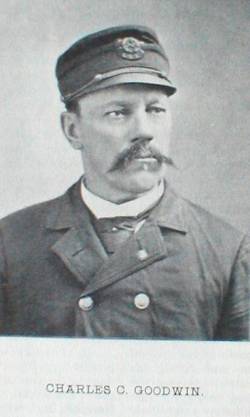
WILLIAM H. GOODWIN
William H. Goodwin was one of the Cleveland life-saving crew during the stormy years of 1883-84, every member of which received United States gold life-saving medals of the first class for gallantry in the rescue of many lives from stranded vessels during the prevalence of violent storms. The station at that time had for its keeper Capt. C.C. Goodwin, father of the subject of this sketch, a man whose judgment and qualifications for that responsible position have never been questioned.
William H. Goodwin was born May 22, 1866, in Portland, Maine, removed with his parents to Cleveland in 1868, and after attending the public schools went to work in the spice mills of Messrs. Stevens & Son, on St. Clair street. In the spring of 1881 he and his father opened a boathouse and did a successful business for two years, after which he was enrolled as a member of the Cleveland life-saving crew, and took an active part in all the notable rescues they performed during the two years he remained; among these it is not out of place to mention the saving of the crews of the schooners Sophia Minch, H.P. Merrell and J.T. Johnson, a total of thirty-six lives, inside of forty-eight hours, and in the teeth of a living northwest gale. The Johnson was scuttled and sunk while the life-savers were on board in order to prevent her from going on the rocks. The same fall they assisted the Burnside, which was ashore and flying distress signals. Early in 1884 Mr. Goodwin was with the crew in the difficult task of getting off the schooner Moonlight, which was ashore off Avon Point, and he also aided in many small boat rescues. He went with his boat to Cincinnati during the flood at that city and Covington, KY., where the crew saved many lives. Mr. Goodwin jumping overboard once and saving a little girl whom the boat could not reach in time. The medal presented to him on this occasion was a ten dollar gold piece, one side of which has the inscription: "Presented to William H. Goodwin, by the Masonic Relief Association, Covington, 1884," on the reverse side is neatly engraved a pair of crossed oars. During this season the crew of the tug S. S. Stone was released by the life-savers from the beach at Nottingham, a feat attended with considerable danger, as the lifeboat capsized; she was righted, however, without loss of life.
In 1885 Mr. Goodwin served as fireman on the tug N. B. Gates until July, when he again became a member of the life-saving crew, this time remaining three years. During that period some notable work was done, especially as regards the tug Dreadnaught and the schooner R.K. Winslow, and individually Mr. Goodwin has to his credit the rescue of a small boy, who had fallen overboard and was helpless in the water. In 1889 he again opened a boathouse on the pier, and after conducting same two years he started a bath and boat house off Lake View Park. At the close of the season he shipped as fireman on the tug T.M. Moore, which boat was destroyed by fire on January 6, 1891, and he then entered the employ of the Vessel Owners Dry Dock Company, running the boiler and pumping engine. At the opening of the boating season he went to Dover, Ohio, where he conducted a boathouse for a time, later engaging as fireman on the tugs Allie May, James Amadeus and Dreadnaught, as fisherman on the E. R. Edson, and on the piledriver Dora as engineer. On February 14, 1893, his father died, and he again took charge of the boathouse on the piers, carrying on the business until August, and finishing the year on Cleveland harbor tugs. In the spring of 1894 he went to Erie and engineered the tug F. M. Matson, and during the winter took charge of the electric light plant of the Willliams Publishing Company, in Cleveland. The next spring he entered the employ of E. R. Edson, as engineer of the fishing tug Louisa, which berth he holds up to the time of this writing.
Mr. Goodwin was united in marriage to Miss Mary Watson, and two children were born to the union: Jessie Irene and Clifford John, both of whom died in infancy. Mr. Goodwin is a member of the Lincoln Council No. 20, Royal Templars. They reside at No. 32 Green street, Cleveland, Ohio.
F. P. GORDON
The name of F. P. Gordon is one of prominence in marine circles, as is also the name of his father, John Gordon. Early in life, as may be seen by this sketch, F. P. Gordon turned his attention to marine and transportation affairs; and his life, thus far, has been spent in that line of work.
Mr. Gordon was born at Detroit, November 5, 1866, and in that city he lived until his sixth year. His father then moved to Duluth, taking the family and remaining eight years. The following thirteen years were spent in Chicago. At that place he entered the employ of the Anchor line, in his twentieth year, and remained two years as clerk. Following this time he spent three years as purchasing agent for the Goodrich Transportation Company. Upon leaving the Goodrich Transportation Company he entered the bank of Meadowcroft Bros., in Chicago, and remained until the death of Robert Meadowcroft. He then came to buffalo, and accepted the position as assistant manager with the Northern Steamship Company. In this place he remained until September, 1895, spending much time in Cleveland during the building of the North Land and the North West, over which he had charge. In August, 1895, he resigned from the Northern Steamship Company, and in the spring of 1896 opened a branch house for Johnson & Higgins. This firm is well known throughout the United States, having offices in the leading cities.
On December 3, 1890, our subject was married to Miss Grace Meadowcroft, daughter of Robert Meadowcroft, of Chicago. Mr. and Mrs. Gordon have one daughter, Miss Catherine. The family reside at No. 1109 Delaware avenue, Buffalo, New York.
EDWARD J. GORIE
Edward J. Gorie was born in Cleveland, Ohio, June 4, 1858, and received his early education in St. Mary's school, which he attended until he was twelve years of age, after that going to work in Pollock's bakery and attending night school in the meantime.
In 1870 Mr. Gorie commenced his marine life, firing on the tugs Shoo Fly, Maggie Sanburn and Old Jack. In 1877 he took out his first papers and engineered the tugs Shoo Fly and Maggie Sanburn, being transferred thence to the night boats, L. P. Smith, James Amadeus, Fannie Tuttle and Peter Smith. The following season he shipped as engineer on the tug Old Jack, following this with a trip to Milwaukee as second engineer on the tug H. M. Martin, remaining but a short time at that port. After a brief stay in Cleveland he went to Chicago and shipped on the tug Union, and was then on the Belle Chase one season, after which he became engineer on the E. P. Ferry, of the V. O. T. Co. For four months following he was engineer of the Viva, from her going to the steam canal boat Welcome, operating on the Illinois canal, with a cargo of flour for Merton Bros. He was also on the steam canal boat Montauk. Then followed service on the tugs F. H. Stanwood and J. H. Hackley. The following season he stopped ashore, afterward working for the Illinois Sand and Gravel Company. He next engineered the tug G. W. Campbell, whose machinery, when burned, went into the tug Admiral. His next berth in Chicago was as engineer on the tug Martin.
In 1890 Mr. Gorie returned to Cleveland and shipped as engineer on the tugs Maggie Sanburn and L. P. Smith, closing the season thus. In 1891 he came out on the tug L. P. Smith, and after laying her up went on the winter boat S. S. Stone. In 1892 he shipped on the tug Tempest, where he remained until June, 1893. In 1894 he engineered the tug W. S. Cushing, and completed the season on the Tempest. In 1895 he was on the tug W. D. Cushing till November, finishing the season on the Harris, then he engineered the tug W. D. Cushing during the entire season of 1896, also laying her up. During the season of 1897 he again entered the employ of the V. O. T. Co. on the tug Harris, and in the spring of 1898 served the same company on the tug H. L. Chamberlin, when, on the 26th of August, 1898, while still on this boat, he caught his hand in the engine, lacerating it so badly that it was necessary to put in thirty-one stitches. This laid him by for the rest of the season.
In 1890 Mr. Gorie was united in marriage to Miss Alice Gorie, and they have three children: Myrtle Gertrude, Carl Edward and Esther E.
CAPTAIN JOSEPH GORMAN
Captain Joseph Gorman, son of James and Ellen (Linden) Gorman, was born at Grand Rapids, Mich., in 1846. After attending the public school until he reached the age of fourteen years, he commenced his lakefaring life on the schooner Magic, trading between Grand Haven and Chicago. On one passage the Magic capsized, and the same fall she went ashore at Grand Haven. In the spring of 1861 he shipped on the schooner Levant. Both of these vessels were owned by ex-Senator Ferry and his son.
On December 19, 1861, young Gorman enlisted in the 14th Mich. Vol. Inf., his regiment being assigned to the First Brigade, Second Division, Fourteenth Army Corps. It participated in the siege of Corinth, with General Pope, and the engagements of LaVergne, Stone River, Tullahoma, Chickamauga; and was with General Sherman on his ever memorable campaign at Atlanta, Savannah and Richmond, taking an honorable part in the contest at Missionary Ridge, Resaca, Lost Mountain, Kennesaw, Peach Tree Creek, and Jonesboro, where the regiment was hotly engaged with Grovan's Brigade, of Hardie's Corps. On the march from Savannah, north through the Carolinas, Captain Gorman's regiment crossed the Savannah River, at Sisters Ferry, and participated in the battle of Bentonville, N. C., - finally reaching Fayetteville, on the Cape Fear River. On March 13, 1865, the regiment was mustered out of service by reason of the close of the war, and marched in grand review at Washington returning home by way of Baltimore, Maryland.
In May, 1865, young Gorman again took up his career on the lakes, shipping before the mast on the schooner Sunshine, with Captain Knight, after which he sailed as mate of the bark Sunny Side, followed by a season on the bark Jane Bell, in the same capacity. In 1867 he sailed as mate of the William B. Hibbard, closing the season on the bark Invincible; 1868, on the E. C. Roberts, closing the season on the D. P. Dobbins, with Captain Kendricks; 1869, on the bark North West, as second mate; 1870, as mate of the E. C. Roberts, with Capt. Harvey Rumage, closing the season on the schooner Grandy, as mate, holding that berth the next season.
In the spring of 1872 Captain Gorman shipped as second mate on the bark Constitution, after which he turned his attention to steamboating, and was appointed mate of the steamer Manitowoc, of the Goodrich line, plying between Chicago, Ahnapee and other west shore ports. In 1873 he went to Cleveland and there entered the tugging business out of that port as master of the A. P. Door, and later of the Old Jack. In 1874 he sailed as mate of the steamer Annie Smith, with Captain March; 1875 mate of the steamer Egyptian, with Capt. J. Smith; 1876, mate of the steamer Raleigh, with Captain Wolvin; 1877-78, master of the General Payne, plying between Grand Haven, Muskegon and Chicago, in the lumber trade. In the spring of 1879 he again shipped as mate on the steamer Raleigh; 1880 he came out as second mate of the steamer Wocoken, but closed the season as mate of the Henry Chisholm, with Capt. George Stone; 1881, was mate of the steamer Cumberland, with Capt. John Coulter, closing the season as master of the schooner Russell; 1882, mate of the Robert A. Packer, of the Lehigh line, and the season following he came out as mate of the steamer H. D. Coffinberry. Before the close of the season, however, he went to Grand Haven, Mich., where he again entered the employ of the Michigan Lumber Company, as master of the tug Campbell.
In the spring of 1884 Captain Gorman again sailed as mate of the H. D. Coffinberry, at that time plying between Chicago, St. Ignace and Marquette; he then went as mate of the Havana, closing the season on the Vienna, of the same line. The next five years were passed as mate, in the order named, of the steamers J. H. Outhwaite, Cumberland, D. W. Rust, R. P. Fitzgerald and C. S. Parnell. In the spring of 1891 he came out as master of the Laura, a passenger boat on Lake Ontario, plying between Charlotte and Ogdensburg, and in 1892 he took the lighthouse boats built by the Globe Iron Works to the coast. The Lilac he took to Portland, Maine, and the Columbia to Tompkinsville Station. On his return to Cleveland he was made master of the steamyacht Comanche, then owned by Mr. Hanna, which he sailed until the close of the season of 1893. He then shipped as mate on the steamer Hesper, and in 1895 was appointed master of the excursion boat Duluth, which he brought down to Cleveland from Chicago. At the close of the excursion season he went as mate on the steamer Missoula, which was wrecked on Lake Superior between Caribou island and Michipicoten on the 7th day of November. It is said that she foundered and the crew took to the yawl boat. The vessel was left about eight p.m., and after pulling at the oars all the next day, they reached Point Broule, and after a wait of two days a steamer came along and took them to the Sault. In 1896 Captain Gorman came out as mate of the steamer George W. Ruby, and the following season he stopped ashore for a well-earned rest, although on the sailing of the cutter Andrew Johnson he took command of her on her duty voyage to Johnson's island to give the naval reserve cadets their first airing. He has twenty-four issues of master's and pilot's licenses.
PETER J. GORMAN
Peter J. Gorman, chief engineer of the Coatsworth elevator, is probably as well known among steamboat men as the old-timers, from his association with them in machine shops, for he spent only a few seasons on the lakes as second engineer.
Mr. Gorman is the youngest of the seven children of Thomas and Bella (Ryan) Gorman, of Watertown, N. Y., where he was born January 6, 1860, and attended school until sixteen years of age. At that time, his father being a railroad engineer, our subject set out to master the same profession by entering the employ of the Steam Engine Works, of Watertown, where he learned the machinist's trade, serving an apprenticeship, and worked as a journeyman for four years. He then went to Chicago, where he worked about four and one half years at his calling, being with the M. C. Bullock Manufacturing Company, the A. Plamondon Manufacturing Company, Fraser & Chalmers and Warner & Swasey, after which he proceeded to Kingston, Ontario, to take a situation as tool maker offered him in the new engine works there known as the Kingston Locomotive Works. In this employ he continued two years, leaving to run an engine on the Canadian Pacific railroad for the next two and one-half years. In 1888 Mr. Gorman went to Austin, Penn., to work on the construction of the Sinnemahoning Valley railroad (now the Buffalo & Susquehanna), at which he was engaged about three years, and then coming to Buffalo went into King's iron works for a few months, from February to August. At this time he began steamboating as second engineer on the Codorus, on which he remained till the close of that season and the next two seasons as well. During the winters of those two years he was employed at the Snow Steam Pump Works of Buffalo, and the Davis machine shops, at Erie, Penn. After the close of navigation, for the season of 1894 he ran a stationary or hoisting engine for the city of Buffalo until August 6, 1895, when he was appointed chief engineer of the Coatsworth elevator, at Buffalo, the position he still holds.
During his long and successful career as a machinist and engineer, Mr. Gorman, like all other engineers, was bothered for the want of a good packing, and, after considerable study, he invented a perforated steam and water packing which is self-acting and expansive, thereby preventing any leaking, an advantage possessed by no other packing now on the market. It is now in use in several places in Buffalo, where Mr. Gorman is giving it a through trial, among them the Evening News Printing Office, Eastern elevator, Coatsworth elevator, Buffalo Dredging Company, and the steam drills used in deepening the Erie canal, where no other packing could stand the strain. He expects to have his packing on the market, and has now his letters patent. He has a contract with the Keystone Rubber Company, of Erie, Penn., to manufacture his goods, and he is putting them on the market himself. He has now also a cylinder oil pump of his own invention, which, for simplicity and durability, is surpassed by nothing now on the market.
Mr. Gorman was married June 10, 1890, to Miss Cora Robertson, of Saratoga Springs, N. Y., and they have three children, namely: Clara, now (1898) aged six; William, aged three; and Earl, aged one and one-half years. The family residence is at No. 12 Elm Street, Buffalo. Mr. Gorman is a member of the Buffalo Association of Stationary Engineers, No. 16, New York, of the National Association, and of Branch No. 20, C. M. B. A.
HARVEY D. GOULDER
Harvey D. Goulder is acknowledged to be foremost among that brilliant array of legal talent now practicing in the United States courts, and especially in the district and circuit courts of the lake region. He is a son of Christopher D. and Barbara Goulder, and was born in Cleveland, March 7, 1853. His father was master of lake craft for many years.
After having completed his education in the public schools of Cleveland, from which he graduated at the age of sixteen, Mr. Goulder commenced the life of a sailor before the mast on his father's vessel. During the season of navigation he passed his life on the lakes, applying himself to completing his education in winter months, so that he might fit himself for his chosen profession, that of law, and all during life he has been a close and varied reader, familiarizing himself with the best thoughts of great minds. He entered the law office of Tyler & Dennison, where he remained during the winter of 1870. In the spring of 1871 he entered the employ of Alcott, Horton & Co., dry goods dealers, in Cleveland, as entry clerk, and continued in that employ for a period of two years, meanwhile carrying forward his legal studies under the tuition of the late John E. Cary, an Admiralty lawyer of much ability. It was during his service on the lakes that Mr. Goulder obtained much of that technical and essential knowledge so valuable in the trial of Admiralty cases. His is a knowledge of experience and association, and many an unwilling witness, surprised by the accuracy of detail and disarmed by a familiar phrase, has forgotten his allegiance to his ship and owner and recounted the facts of a collision as they actually occurred. It is through the possession of this knowledge that he is enabled to prepare his briefs in such a clean, concise and forcible manner. He was so far advanced in his legal studies as to be able to pass the legal examination before he arrived at the age required for admission to the Bar. He took the examination, and was admitted in the spring of 1875. Immediately afterward he formed a partnership with John F. Weh; this, however, lasted but a short time, as Mr. Weh soon afterward was appointed assistant city solicitor. Thereafter Mr. Goulder continued the practice of law with Alexander Hadden and various others, and at times alone, directing his attention practically to the conduct of cases in Admiralty, marine insurance, and, to some extent, corporations. In January, 1893, he associated with him as a partner, S.H. Holding, which relation still continues.
Mr. Goulder, although comparatively a young man, has, perhaps, gained more prominence as a technical maritime counselor than any attorney ever before the Admiralty courts. His legal knowledge and methods are accurate, and he is forceful and eloquent of speech. He is usually found on one side or the other of every case in Admiralty that comes before any of the courts of the lake region, and is never defeated where precedent is nearly equal. He has long since been acknowledged as the peer of any attorney at law, and accepted these encomiums with that modest assurance that they are true, so charming in a really capable man. In the contention over the proposed erection of a railroad bridge across the river at Detroit, Mr. Goulder has been an earnest and outspoken opponent of any plan that shall impede the navigation of that channel. It would not be out of place to say, that, to his untiring devotion to the lake interests in opposition to the plans of the railroad managers, is largely due the fact that the river is free of artificial obstructions. As a citizen he has invariably supported measures that look to the advancement of the interests of the municipality, its upbuilding and improvement. His advice has been sought in the plans for improvement of the harbor of Cleveland, and for widening the Cuyahoga river, and in fact on all measures concerning the shipping interests of the Great Lakes.
Mr. Goulder was employed as counsel by the Cleveland Vessel Owners Association, and has been counsel for the Lake Carriers Association since its organization. He is a prominent member of the Cleveland Chamber of Commerce, and previous to the organization of that body was a member of the Board of Trade and Board of Industry. In all these bodies the impress of his personality has been felt, and his influence wielded for the best interests of all. With the late Hon. George H. Ely, the late Gen. O.M. Poe, and others connected with vessel interests and commercial bodies, Mr. Goulder has at various times appeared before congressional committees in the matter of measures required for the improvement of the waterways of the Great Lakes, deepening of the channels, and improving the commercial advantages of water transportation. He was among those who were most urgent for the establishment of a twenty-foot channel through the lakes and connecting rivers, and into the principal harbors. The wisdom of this movement has, during the past few years, become apparent, as it permitted the construction of ore, coal and grain carriers of great size, by means of which the cost of transportation is largely reduced. His activity in all matters connected with the lake interests has made Mr. Goulder well known to the heads of departments in Washington, the Bureau of Navigation, the Naval Intelligence Bureau, the Bureau of Lighthouses Installation, the chief of the Army Engineers, the Hydrographic Bureau, and indeed of all other departments having intimate or remote connection with the navigation of the inland waters of the country.
Mr. Goulder's intimate connection with marine matters, and his extensive practice, has brought him in association with business men generally in the lake and river cities, from Duluth to Montreal, and he is by all admired for his sterling character and genial fellowship. Commanding and impressive in personality, with a full, rich voice, accurate and distinct in enunciation, plain and forceful in reasoning, he is a power before a court or jury. In argument, he rarely allows his voice to rise above a conversational tone; the plain, accurate words have preference; and his reasoning is cogent and entirely free from stilt. Mr. Goulder's mind is distinctively judicial, and his ability to strip a mass of testimony of its verbiage, to reconcile conflictions, juxtapose contradictory truths, and evolve from the whole a line of action consistent with the conduct of ordinary mortals in ordinary affairs puts an end to many paper-cases of his opponents. The close application which a large and widely scattered practice demands has not crowded out nor dulled an unusually friendly nature, and a more delightful companion it would be difficult to find. The joyousness of youth has continued with him, and abides in perfect harmony with the dignity of manhood, neither dominating nor suppressing, but rounding into one, mollifying the asperities traditionally associated with minds imbued with legal lore. Evenly honest in opinion, the verdict of those who know him well is that "He is distinguished by a cool, clear, thinking head, and a plain, firm judgment."
Mr. Goulder's fine physique, united with his intellectual powers, makes him a good specimen of the better manhood. It is to be believed that Miss Mary F. Rankin found no difficulty in recognizing the qualities mentioned, as their romance resulted in marriage November 11, 1878. Mrs. Goulder is a daughter of Rev. J.E. Rankin, D.D., at one time pastor of the First Congregational Church of Washington D.C.
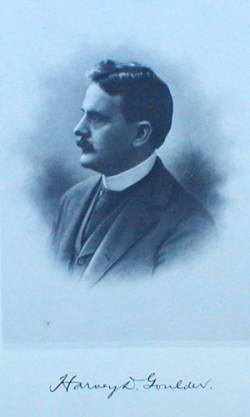
JAMES D. GOW
James D. Gow was born in Lincolnshire, England, in 1868, son of John and Sarah (Robertson) Gow, who were both natives of Perthshire, Scotland, moved to Lincolnshire, and from there emigrated to this country in 1869, settling at Waterloo, New York.
Our subject received his education in the public schools of Lockport and Rochester, and while in Lockport was favorably mentioned for a commission at West Point, but declined the honor, and at the age of seventeen came to Buffalo and started to work at steam fitting for Mr. Summerhays, and afterward found employment with the John T. Noye Manufacturing Company, remaining with them until he was twenty-one. He thus followed the footsteps of his father, who has been a machinist all his life, being at present employed at Lockport, N.Y. During the five years of his service with the John T. Noye Manufacturing Company he became thoroughly proficient in his chosen vocation. He left there in the year 1890 to commence steamboating, the first berth he filled being that of oiler for the season on the Northern Queen. In 1891 he was transferred to the North Wind, on which he shipped for that season in the same capacity. The season of 1892 he was advanced to the position of second engineer of the same boat, the North Wind, and in 1893 he was transferred to his maiden ship, the Northern Queen, of which he was second for the season. The following one, 1894, he was first assistant of the Northwest, at that time the Queen of the Lakes, and in 1895 on her sister ship, the North Land, in the same capacity. The season of 1896 found him with the Union Steamship Company as first assistant of the Owego. Although holding an engineer's license, he became discouraged at the slow advancement, and decided to take a position ashore, and accordingly became engineer of the Ellicott Square Building, which position he held at the time of his death, August 16, 1897. His death was caused by an accident when in the discharge of his duties. His pleasant manner won him many friends, while his courage brought him the respect of his employers and associates alike. He was a member of Local Harbor No. 1, Marine Engineers Beneficial Association.
Mr. Gow was married, in December, 1895, to Miss Ida Schlotzer, of Buffalo, N.Y., where she still resides.
EDMON A. GRAHAM
Edmon A. Graham, St. Joseph, Mich. The name of Graham is inseparably woven with the history of St. Joseph and Benton Harbor, and has been for the past quarter of a century, and especially with the marine interests of the twin cities, whose ports have grown to be of so great importance in the commerce and passenger traffic of the Great Lakes.
For twenty years our subject has been known to the thousands of pleasure seekers from all over the country, who annually visit St. Joseph and the resorts of the beautiful river of that name. His first experience in steamboating began in the middle 'seventies, when he, with Capt. James Brooks, bought the stern-wheel steamboat Union, and ran her in the excursion and freight service up to the St. Joseph river. Toward the latter part of that decade Mr. Graham had built at the lumber yard of Preston & Shaw, of St. Joseph, the first May Graham, a side-wheel steamer for the same service. To suit the time and conditions of a later period the May Graham has been practically three times rebuilt, until she is now a model boat for the excursion service and fruit trade of the St. Joseph river, on which thousands of people each summer visit the points of interest along that historic and picturesque stream. The May Graham had a carrying capacity of 400 passengers, is well equipped and ably officered with the most efficient and accomodating of men, the versatile captain, James S. Fikes, having been the master throughout her history. Some twelve or fifteen years ago Mr. Graham came into possession of the Morrison docks at St. Joe, and later he made additions thereto, and in a manner reconstructed the same, until they are almost complete, substantial and roomy, having a length of 750 feet, with a wall five inches thick all over, on thirty-foot piling set five feet from center to center, and all built of new timber, costing not less than $16,000, and now called the Graham Docks.
Mr. Graham is a native of Indiana, born at La Porte, November 14, 1841, and descended from English stock on his father's side. His parents were John and Lucinda (Nichols) Graham, natives of New York State, and the former in early manhood came and settled on a farm near La Porte, Ind. His death occurred in Boone county, Ill., in 1875. He had made several moves from the time of his settling in Indiana until that of his death, coming in 1864 to Berrien county.
Our subject remained with his father until he became of age, when he went to Elkhart, Indiana, and in 1864 came with him to the county named. Then for a period of twenty years he was interested in and operated a sawmill, which was built four or five miles south of St. Joseph, and in connection therewith was engaged in the lumber business. Mr. Graham as above intimated, has been closely identified with the growth and progress of the twin cities, and he is today interested in a number of the enterprises of St. Joe, and is one of her leading and substantial citizens. He is a broad-minded and public-spirited man, and has made his influence felt as a successful business man, and has accumulated a fair share of this world's goods. In politics he is identified with the Republican party, and socially is a member of the I. O. O. F. He is the agent at St. Joe for the Graham & Morton Transportation Company.
On June 28, 1869, Mr. Graham was married to Miss Edwina A. Bunker, a daughter of Nathaniel Bunker, of Berrien county, and they have one daughter, May Belle.
CAPTAIN JOHN GRAHAM
Captain John Graham, of Detroit, Mich., at present master of the yacht Cynthia, is a typical fresh-water sailor. From the age of ten years he has spent almost his entire life on the Great Lakes, having never taken up any other occupation that would cause him to leave them even for a single season. He was born in Port Huron, Mich., in the year 1852, of Irish parents, both of whom are still living, in Lexington, Mich. He attended school in his native town, and at the age of ten secured a place on one of the smaller lake vessels, and having begun at the bottom he followed his vocation until he reached the top. He had to work his way from the beginning, but by faithful service and natural ability he rose gradually to the position he now holds. After serving before the mast, as second mate, and as first mate, Captain Graham secured his first command some ten or twelve years ago, when he took out the steamyacht Lillie for A.E. Brush, and he was afterward placed in charge of the schooner Brooklyn, still later bringing out the steamyacht Pilgrim, the old Truant. About two years ago Mr. H.B. Mills, the millionaire tobacconist, secured Captain Graham as master of the well-known and costly yacht, the Cynthia, which he brought out and sailed the first time. He is well preserved and enjoys the best of health, his thirty years on the lakes having served to make him strong, robust and well conditioned.
Captain Graham was married in 1885 to Miss Rosa Dowd, of Detroit. They have no children. The Captain usually winters in Detroit.
JOHN H. GRAHAM
John H. Graham, of St. Joseph. For the past twenty years no name has been more prominently connected with the passenger pleasure resort service out of Chicago, and with the great fruit traffic from the Michigan shores, than that of the worthy president of the Graham & Morton Transportation Co. Their line of palatial steamers carry thousands of people daily during the summers between Chicago, St. Joseph and Benton Harbor, and do an extensive freight business between the same points, and between Milwaukee and the Twin Cities.
Mr. Graham is a native of the State of Illinois, having been born in Boone county, December 10, 1849. His parents were John and Lucinda (Nichols) Graham, who are referred to in the sketch of Edmon A. Graham, elsewhere in this work. Our subject passed his early boyhood at Elkhart, Ind., and in 1864 came with his father to St. Joseph, and with him became engaged in the lumber business. Some years later young Graham, in connection with Mr. Andrew Crawford, formed a partnership at Benton Harbor in the hardwood lumber business, and operated a sawmill in connection with it. This firm carried on an extensive business in this line for several years. Early in the seventies Mr. Graham, in connection with J. Stanley Morton and others, engaged in the steamboat business, operating boats between Benton Harbor, St. Joseph and Chicago, under the firm name of Graham, Morton & Co., which in 1880 or 1881, merged into a stock company, which was styled the Graham & Morton Transportation Co., and of which Mr. Graham became president, which position he has since uninterruptedly held.
On February 14, 1881, our subject was united in marriage to Miss Dora E. Chase, a daughter of E. T. Chase, of Benton Harbor, but formerly of Homer, Michigan.
The Graham & Morton Transportation Co., of which Mr. Graham has been so long officially connected, and to the growth of which he has given so many of the most active years of his life, and at times periods of great anxiety, represents the largest single business interest in the docks at Benton Harbor and Chicago, upwards of a half million dollars, and during the season gives employment to more than a hundred men.
Our subject is also identified with other business interests at Benton Harbor and St. Joseph, being the president of the Alden Canning Company, of the former city, and of the St. Joseph Hotel Company, which owns the beautiful and commodious hotel by that name, located on the beach at St. Joseph, and which beautiful structure was burned in the summer of 1898. He is also a director in the Union Banking Company of the latter city. Mr. Graham is strictly a self-made man, beginning early in life to do for himself, and through his own energy and efforts he has made for himself a position of standing in business circles, of which any man might be proud. In politics Mr. Graham is a Republican.
R. S. GRANT
R.S. Grant, at present chief engineer on the palatian steamer North Land, operated between Buffalo and Duluth in connection with the Northern railroad, has had a marine experience more than usually diversified. He is a native of Scotland, born July 1, 1858, in Fochabers, Morayshire, son of Charles and Mary (Calder) Grant.
After the usual term in attendance at the public schools R. S. Grant was apprenticed to the machinist's trade in the engine-building works of Mr. Napier, on the Clyde, remaining in those shops six and a half years, and becoming a skilled mechanic and engineer. At the expiration of that time he decided to become a marine engineer, and secured the position of fourth assistant in the British India mail steamer Bhundhara, remaining on her eight months. Transferring to the Malda, of the same line, he was advanced to the berth of third assistant, and after serving six months in that berth was made second assistant, finally attaining to the position of first assistant on the Malda about six and a half years after he first shipped in her. She was engaged in carrying British troops to Egypt, touching at various seaports. Mr. Grant was next appointed chief engineer of the East Indiaman Coconada, plying between Calcutta and Bombay, on which vessel he remained two years, the following six months having charge of the machinery of the steamship Oriental, which during that time made two voyages to ports in China. He then transferred as chief to the steamship Heron, in the Chinese coasting trade, which was wrecked at the end of a year off Amoy, with the loss of several Chinese sailors. He next took second engineers's berth on the ship Shanghai, owned by Butterfield & Swire, and plied on the Yang-Tse-Kiang, a magnificent stream, navigable for 700 miles; Mr. Grant was in her about eight months and also served in other ships owned by the same company. During the year 1885 he was chief engineer of the man-of-war Coronation, of the Siamese navy. It was in February, 1886, that he joined the Chinese navy as chief engineer in the man-of-war Wan Nien Cheng. A year later she was run into by a P. & O. mail steamer, the Malwa, and sank, 200 disbanded Chinese soldiers losing their lives. Mr. Grant and his crew escaped by reaching the bows of the Malwa before she drew out of the wreck. During the year 1888 he was placed in charge of an engineers' supply shop in Hong, Kew, Shanghai, owned by an American named George Woods, and he subsequently shipped in the United States steamer Marion, the flagship of Admiral Chandler, stationed on the coast of China, under the immediate command of Capt. N. M. Dwyer; the Admiral died and was buried at Hong Kong. During the sixteen months Mr. Grant was in the Marion he was employed as machinist, and as she went out of commission at the end of that time he came to the United States, proceeding direct to Chicago, where he entered the employ of the Illinois Central Railway Company as machinist. At various times he was engaged in the shops of the Union Pacific, North Pacific, Great Northern, and Omaha railroads. On April 15, 1897, he joined the steamer North West as first assistant engineer, retaining that office until October, when he was appointed chief of the North Land, the position which he holds at this writing. He is a member of the Marine Engineers Beneficial Association No. 1, of Buffalo, New York.
On July 11, 1893, Mr. Grant was married to Margaret, daughter of Hon. Robert and Mary (Frazier) Newel, of St. Paul, Minn., who were natives of Scotland; her father represented his district in the State Legislature, his term beginning in 1887. The family homestead is at Williston, N. Dak., and the farm comprises 160 acres of improved land.
WILLIAM WHITNEY GRANT
William Whitney Grant, deputy collector of customs at the port of Conneaut, and a prominent and enterprising citizen of that place, as was his father and grandfather before him, is a courteous gentleman of good business qualifications and a genial companion. His connection with affairs maritime does not consist alone by virtue of his office of collector, as he was a sailor before the mast, a marine engineer and surfman in the United States Life Saving Service. He is the son of James and Sarah (Guthrie) Grant, and was born on his father's farm in Conneaut township, the northeast corner of Ohio, on August 16, 1855, and is a grandson of Whitney and Clara (Calender) Grant, natives of New England. They moved west and located in Port Hope, Ont., where the father, James, was born; the mother being a native of Springfield, Pennsylvania.
After a residence of about two years at Port Hope, the grandfather removed with his family to Conneaut, Ohio, and was numbered among the pioneers of that hamlet. He was appointed keeper of the lighthouse at that port when it stood upon the east pier, retaining that office several years. He sailed as engineer on some of the old-time steamers, notable among them being the first steamer on Lake Erie, the Walk-in-the-Water, of which he was second engineer, his cousin, Brock Grant, being chief. During his residence at Conneaut he acquired, by industry and thrift, a valuable farm and other property. Both he and his wife died at Conneaut Harbor.
The father, Capt. James Grant, was a ship-carpenter and builder, and worked in shipyards at Cleveland and Erie. He was also master and owner of several vessels, among them the schooners Venture, Caroline and others, the Caroline being his own individual property. He sailed on the Traveler, Telegraph, brig Lucy A. Blossom and Banner; also schooners Nightingale, North America and Cascade. He helped to build the Kate Gillett, Richards and Ogaritta. After engaging in the fishing business out of Conneaut for several years, he retired with good village property, to which he devoted much of his time. He passed to the eternal mooring ground on August 23, 1890, the wife and mother following on November 16, 1893.
William W. Grant, the subject of this sketch, improved the opportunities he had for acquiring a liberal public-school education until he reached the age of eighteen years, sailing some in the meantime, however, as cook on the little schooner Caroline, owned by his father, and E. Keyes. In the spring of 1875 he shipped before the mast on the schooner John Fretter, with Capt. Z. L. Wood. During the next three years, in addition to the attention he paid to mercantile interests, he studied mechanical engineering, and applied to Thomas Fitzpatrick for a license as engineer, which was granted, and he was appointed to the fishing tug Eliza Williams. In the spring of 1879 he joined the Thunder Bay Island Life Saving Crew as surfman, and remained there two seasons, during which time he assisted in making some daring rescues, among them the crew of the schooner Empire State, Capt. Archie McHenry. The schooner, in the fall of 1880, ran into a northeaster and stranded on North Point reef and broke in two. The schooners Sunnyside and Charles Hinckley went ashore at the same time. Mr. Grant and two men, who were out with the supply boat after provisions, realizing the peril of the crew of the Empire State, put off to them and succeeded in saving their lives, eight all told, and landed them at Alpena. The next year Mr. Grant was transferred to the life saving station at Fairport, Ohio, and in the spring of 1882 went as engineer in the fishing tug Grace and Ella.
In 1883 Mr. Grant was appointed engineer of the new fishing tug Pearl, built at Erie and operated out of that port. The rest of his active life on the lakes was passed as engineer of the tugs Minna, Wilcox, Lyon and Ruby, and master of the schooner Venture. In 1888 he opened a store in Conneaut Harbor, and engaged in mercantile pursuits, with good business success, adding steadily to his income, until April 4, 1894, when he was appointed deputy collector of customs at the port of Conneaut. Socially, he is a member of the order of the Knights of Pythias.
Mr. Grant was wedded to Miss Lydia E., daughter of Paul and Caroline (Jones) Jones, of Conneaut, formerly of Westfield, the marriage ceremony being performed on October 10, 1886. One daughter, Ruby May, has been born to this union. In addition to the family homestead, which is situated at No. 190 Broad street, Mr. Grant owns other improved real estate.
CAPTAIN GEORGE L. GRASER
Captain George L. Graser has the reputation of being one of the most careful navi-gators on the Great Lakes. He is of German extraction, being a son of Valentine and Anna Grace Graser, both of whom were natives of Germany. Valentine Graser was a cutter by trade. He reared quite a family of children, four of whom are now living besides the subject of this sketch, viz: William, who was a superintendent in the Buffalo post office seven years, but later engaged in the hardware business; Valentine, a cigarmaker; Jacob, a harnessmaker; and Hattie, wife of Mr. McBodie, a resident of Chicago.
Captain Graser was born at Buffalo in 1848, and attended Public School No. 12. He began sailing in the fall of 1862, as waiter in the steamer Plymouth, in which he remained about three seasons, in 1865 entering the service of the propeller Buffalo as watchman, but was compelled to leave her before the close of the season because of illness. During the following season he was watchman and lookout respectively on the Potomac, and the succeeding season he wheeled the Roanoke. The next two seasons he wheeled the old Empire State, and for the three following seasons he was second mate, respectively, of the Empire State, Potomac and Mohawk, and then again mate of the Potomac, His next service was a second mate of the Waverly two seasons, then mate of the Jay Gould part of a season, and second of the Starrucca for the remainder. He then was mate of the Avon half a season, being transferred from that berth to master's berth in the Jay Gould, which he filled for a season and a half. About that time Captain Graser left the lake service for a couple of seasons, during which he was stevedore for the Lake Superior Transportation Company one year, and for the Anchor line for a like period. Returning to his former line of work, he obtained mate's berth in the steamer Arizona for part of a season, from which he was transferred to the same position in the Delaware, remaining on her until the last trip of the season, which he made in the steamer Susquehanna. For the season of 1887 Captain Graser was master of the Arizona until November 17, when she burned inside the breakwater at Marquette, Mich. Her cargo consisted of 800 barrels of oil, 100 tanks of acid, 1,400 boxes of tar paper, matches, some candles, turpentine, canned goods and a deckload of wheelbarrows. She took fire about five miles out, and had just time enough to get into the harbor before the fire gained such headway that the crew were compelled to jump for their lives. The conflagration was so brilliant that the people of Marquette called the steamer the "Wild Arizona." She burned to the water's edge, but was subsequently rebuilt and made over into a steambarge.
During the following five seasons Captain Graser was master of the steamer Gordon Campbell, and in 1893 he became master of the steamer Cayuga, which was sunk in a fog about two miles below Skillagalee light May 10, 1895, coming in collision with the steamer Joseph S. Hurd, a lumber barge. The Cayuga was loaded with flour, and went down in 101 feet of water; her crew was picked up by the steamer Manola and taken to Mackinaw. Captain Graser finished that season as master of the propeller Chili for a couple of trips. During the season of 1896, until August, he was master of the excursion steamer Nellie, out of Buffalo harbor, for the remainder of that season was mate of the Chili, and has been in that position ever since. Captain Graser has been ten seasons with the Union line, ten with the Western Transit line, and nine with the Anchor line and was always a favorite with his employers. He has been a member of the Ship Masters Association about eight years, and of Local Harbor No. 41, of the American Association of Masters and Pilots, since its organization.
In 1882 Captain Graser married Miss Mary Anderson, of Chicago, by whom he has three children: Cyril, George and Gordon. The family residence is at No. 361 Potomoc avenue, Buffalo, New York.
CAPTAIN CARLTON GRAVES
Captain Carlton Graves. One of the oldest vessel masters on the Great Lakes is Capt. Carlton Graves, now in command of the steamer Keystone, who has sailed on the lakes for half a century and has held the rank of master some forty years.
Captain Graves comes from a race of sailors; one of his ancestors was Admiral Graves of the English Navy. His paternal ancestor, Thomas Graves, settled near Boston in 1642, and one of his descendants was a member of the far-famed Boston Tea-party. Captain Graves was born in Pomfret, Chautauqua county, N.Y. in 1829, the son of Eli and Nancy A. (Crane) Graves. The father was born in Berkshire county, Mass., and the mother in Litchfield county, Conn. Eli Graves was a farmer, but his four sons followed the water, and became vessel masters on the Great Lakes. The family moved to Madison, Ohio, in 1836, and ten years later Carlton Graves began sailing as a boy on the little scow Swallow out of Fairport. Later he sailed as seaman before the mast on the schooner North Carolina, the brig Virginia, the schooner Atlas, brig John Irwin, schooner Petrel, and schooner S. L. Noble, in 1855 becoming master of the schooner Caroline E. Bailey, a vessel of 122 tons burden, which he took out new. Captain Graves had become what was known in those days, as a "marline spike sailor," being able to do all the work of fitting out and rigging vessels. Following the Bailey, he sailed the schooner Trenton one season, the scow L.E. Fortier two seasons, the William B. Hibbard one season, and the A. P. Nichols, two seasons. He made in the Nichols what is said to be the quickest trip any sailing vessel ever made between Chicago and Buffalo, taking a cargo of oats for the French troops in Mexico from one point to another in three days and eleven hours. He sailed the Sam Ward two years, making a trip from Chicago to Buffalo with grain, going to Erie and taking a cargo of coal back to Chicago in twelve days. At another time he made a similar trip in thirteen days. In 1856 he went to the schooner Lookout, sailing her two seasons. Then he sailed the Oliver Culver, the bark Thomas B. Rice, and the schooner Lewis Wells, L.J. Farwell and the Valentine in succession, losing the Valentine in a gale off Cleveland, the vessel foundering and the crew remaining in small boats seventeen hours before reaching land. Following this he sailed the barge Ironton, the Daniel E. Bailey and the John S. Richards, owning one-third of the Richards, and being in command of her five years. He owned one-half of the schooner Zach Chandler, and sailed her two years; owned one-half of the steamer Benton, but did not sail her, and owned the schooner Columbian, and sailed her three years. Then he sailed the Charles Wall two years, the propeller Cormorant one year, and the propeller Keystone, of which he owns part, five years. The Keystone was burned near Big Summer island, Lake Michigan, September 19, 1898.
Captain Graves married Mrs. Edna Bragg Smith, daughter of Captain M. W. Bragg, of the Union army, who was confined in Libby Prison during the war. Her father was one of the three brothers, one of whom besides himself, Gen. E. S. Bragg, served in the Union army, and the other, Gen. Braxton Bragg, served in the Confederate army. Capt. M. W. Bragg lives now in Pontiac Mich.; he served in the battle of Buena Vista in the Mexican war, with General Taylor in the Seminole Indian war, and in the war of the Rebellion. Captain Graves's children are Viola E., now Mrs. J. H. Wallace of Faulk town, S. D.; and Vernon A. who for four years has been an engineer on the steamer Keystone. Mr. Graves was married in 1877 to Miss Cora Potter, of Madison, Ohio, who died in 1880 leaving one little girl named Minnie. In 1887 he married Miss Cordelia Gauthier, of Kankakee, Ill. Their children are Carlton, Lewis, Ida, and John Albertis.
Captain Graves is a member of Lake Shore Lodge, F. & A. M., Madison, also of Thatcher Chapter No. 101, Cleveland, Ohio, and Lodge No. 4, Ship Masters Association of Cleveland. He resides at No. 57 Bigalow street, Cleveland, Ohio.
GENERAL JOHN CARD GRAVES
General John Card Graves, prominent as a professional and businessman of Buffalo, N. Y., was born Nov. 18, 1839, and is descended from pure New England ancestry. The first member of this branch of the Graves family to come to New England was John Graves, who emigrated from England and settled in Concord, Mass, in 1635. He had two sons, Benjamin and John.
Benjamin Graves lived in Concord, and took part in the Indian wars from 1655 to 1657, serving in Capt. Wheeler's company. He married the daughter of John Hoar, from whom have descended the prominent Hoar family of Massachusetts, and to which family belongs the present United States Senator Hoar from that State. Mr. Graves lived at Concord until the close of the seventeenth century, when he removed with his family to Saybrook, Conn., where he died. He had three sons, viz: Benjamin, John and Joseph. Benjamin removed to Colchester; Joseph remained at Saybrook, and John went to Killingsworth. They all reared large families. From John descended the large family at Walpole, N. H. Benjamin had a son named Jedediah, who lived for many years at East Haddam, Conn., and from there removed to what is now Sherman, Conn., sometimes between 1753 and 1760. There he died in 1800, aged ninety-two years. From his son, Russell, descended, among others, Hon. John Graves, of Russia, Herkimer county, N. Y., who was the father of John Ezra Graves, the father of John C. Graves, the subject of this sketch. Hon. John Graves was one of those pioneers of Herkimer county, N. Y., was a farmer by occupation, and was a member of the State Assembly several terms and also sheriff of his county.
Hon. Ezra Graves was born December 2, 1803, was reared upon the farm, and educated in the common school. Choosing the profession of the law he was admitted to the Bar and settled in Herkimer, N. Y., to practice his profession. For several years he served as county judge, and was State prison inspector during the years 1873, 1874 and 1875. In 1868 he was a member of the State constitutional convention, and was for many years prominent in politics. In 1825 he married Miss Maria Card, daughter of Jonathan Card, an extensive manufacturer, of Herkimer county, and they had nine children, four sons and five daughters, of whom the folowing are living: John C. Graves, of Buffalo; Mrs. Margaret E. Mayton, of Herkimer, N. Y., and Dr. George Graves, also of Herkimer.
John Card Graves, after attending the common school, was sent to Fairfield Academy, Herkimer county, which he left to enter Hamilton College, graduating from same in 1862, in the classical course. While a student in Hamilton College, he induced enough of his fellow students to enlist to form a company, of which he was chosen captain; but as the quota of the State was full for three-months' service, the services of the company were declined, and as the boys could not afford to leave college for two years the company was disbanded. Soon afterward Captain Graves was chosen major of the Eighty-first N. G. S. N. Y., and held this position until his removal to Buffalo in 1867. He was chosen lieutenant-colonel of the Sixty-fifth Regiment in 1878, and soon afterward colonel, serving in that capacity until he was elected brigadier-general of the Eighth Brigade, which has since been changed to the Fourth Brigade, and is composed of the Sixty-fifth and Seventy-fourth regiments and the separate companies of Rochester, Medina and Jamestown. Soon after graduating from Hamilton College he entered his father's law office as a student, was admitted to the Bar in December, 1862, and entered into partnership with his father, continuing with him until 1867. In that year he removed to Buffalo, and in 1869 was engaged by the Buffalo Fire & Marine Insurance Co. to take charge of its fire department business, managing it successfully until the great fire in Chicago, October 9, 1871, which compelled the company to go out of business, and he was chosen to wind up its affairs. In January, 1875 he was appointed clerk of the superior court, and held the position for twelve years. In 1886 he became interested in the building of the Frontier elevator, mention of which is made elsewhere; in 1893 he aided in building the Eastern elevator, and became president of the company. He has recently been made superintendent of the park system in Buffalo, in which he served as a commissioner for about fourteen years.
General Graves became a Mason in 1861, joining Herkimer Lodge No. 423, was made master of the lodge, and held that position until he removed to Buffalo. He then became a member of Washington Lodge No. 240, of which he is still a member and which he was master two years. He is a member of Keystone Chapter, of Hugh de Payne Commandery, and also belongs to the Palmoni Council, A. S. R., and to the Rochester Consistory, thirty-second degree.
General Graves was married, in 1864, to Miss Augusta C. Moore, daughter of A. C. Moore, of Buffalo, and they have the following named children: Mrs. Carroll Graves Putnam, Charles B. Graves, Mrs. Katharine Graves Brown, Maria Card Graves, John Herkimer Graves, Angeline Augusta Graves and Ruth Graves, all of Buffalo except Mrs. Brown, who resides in Chicago, Ill. The General is a Republican in national issues, but is not a partisan in any sense of the word.
ROBERT GRAY
Robert Gray is a native of Scotland, having been born at Lochee, near Dundee, October 24, 1865, the son of Robert Gray, who was also born in Scotland, and has always lived in that country. His mother, Mrs. Margaret (Wright) Gray, died October 27, 1867. Mr. Gray came to America in 1886 and located first in Philadelphia, where he was employed for about three months on a stationary engine. Coming thence to Cleveland, he worked in the Globe Iron Works as machinist for a short time, proceeding next to Chicago, where he followed the same occupation one year. Returning to Cleveland he was again engaged in the Globe Iron Works, this time for a period of three and a half years, at the close of which he began his marine life. On August 1, 1891, he shipped in the Roman as oiler, and in that position remained throughout the season. He spent the winter in Europe, and upon returning to America in the spring resumed his work on the lakes by going as oiler on the Marina, in which boat he remained two seasons; in 1894 acted as second engineer on the Spokane, in 1895 transferring to the Mariposa, with which he is still connected. Mr. Gray was married January 19, 1894, to Miss Catherine McKichen, a young woman of Scottish birth, and they have one child, Duncan McKichen Gray.
ALFRED A. GREEN
Alfred A. Green, a highly esteemed and enterprising citizen of Muskegon, Mich., is a capable marine engineer, although at this time he is in charge of the machinery of the water works department of that city. He possesses many of the qualifications that assure advancement in the line of his calling, and enable him to obtain some of the more material comforts of life. Mr. Green was born of New England parentage, on September 14, 1849, at Houlton, Maine, being a son Lewis L. and Lydia (Morse) Green, both of whom are natives of the same State. The family removed to Muskegon in June, 1863, the father running a sawmill and also engaging in other business. After his death, which occurred on June 17, 1880, the mother returned to the old home in Maine, where she is still living with one of her daughters. Mr. Green's brothers and sisters are as follows: David, who is in the insurance business at Houghton, Maine; Elvira, Mrs. Frank Carpenter; Hannah Alma S., Mrs. Charles Raymond; Alfretta, Mrs. John Massereau, and Agnes.
It was in Muskegon that Alfred A. Green completed his early education, afterward attending a business school at Mt. Carroll, Ill. The first berth he held on the lakes was that of wheelsman on the passenger steamer Merchant, in 1867, and the next season he went in the new steamer Laketon, which plied as a passenger boat between Muskegon and Grand Haven. In 1869 he went to school in Mt. Carroll, and he subsequently shipped on the steamer Pearl, engaged in towing rafts on the Mississippi river to Memphis, and during the next four years he sailed up the St. Francis river, and returning to New Orleans sailed out of that port on the bayou or river Teche to St. Martinville and other places. In May, 1874, Mr. Green took passage for St. Louis, where he met the steamer Belle of La Crosse, from St. Paul, and shipped in her as oiler. In 1875 he went south again in a small steamer, which was sunk by a snag at Luna Landing, near Greenville, Miss. He then took passage to New Orleans, and having received his first papers shipped as second engineer on a steam canalboat which plied on Lake Pontchartrain; on the passage she broke in two, the crew managing to reach Ship island, however. Being without fresh water on the island, they made a compound of salt water and molasses which served to quench their thirst in a measure until they were taken off by a fishing boat and carried to New Orleans. Mr. Green's next berth was on the steamer Pearl, on which he served as oiler until June, 1876, when he went north and shipped as oiler on the steamer Clyde, engaged in raft towing between Stillwater, Minn., and Clinton, Iowa; he remained on her until October, when he returned to Muskegon.
In the spring of 1877 Mr. Green was appointed engineer of the tug C. P. Kingsbury, and after operating three months at Muskegon he took her to Michigan City, closing the season with her at that port. He engineered her at Muskegon the two following seasons, and in the fall of 1879 he took the tug Elizabeth Arnold, of which he was part owner, to New Orleans, where he sold her to Mexican parties. Returning to Muskegon, he shipped as engineer in the York State, plying as ferry steamer on Muskegon lake, until September, when he joined the tug Alice Campbell. In 1881 he entered the employ of the Muskegon Boom Company, as engineer of the tug Ira O. Smith, towing logs until June, when he transferred to the tug James McGordon, which he ran two seasons. In 1883-84 he served as chief engineer of the steamer Tempest, plying in the passenger and freight trade between Muskegon and Chicago, and in 1885 he was given a similar berth on the steamer Milwaukee, retaininig it until July, 1886, when she was sunk by collision with the steamer Hickox, off Muskegon; one man was lost, the rest of the crew finding safety on the Hickox. He then joined the steamer New York for a short time, but finished the season as second engineer in the Robert Holland. After two seasons as chief on the Swallow, Mr. Green was appointed chief of the J. W. Wescott, plying between Chicago and Traverse City, continuing with her three seasons. In 1892 Mr. Green was appointed engineer of the new water works plant at Muskegon, holding that position until May, 1893, when he went to Chicago and entered the employ of the Williams Transportation Company as chief engineer of the steamer H. W. Williams, plying between South Haven and Chicago; in September, 1895, he transferred to the Hurson Transportation Company as chief engineer of the passenger steamer City of Fremont, plying between Chicago and Milwaukee, and running that winter until January 20. In the spring of 1896 he was appointed chief engineer of the steamer Mabel Bradshaw, closing the season as chief of the Niko. The next season he joined the steamer A. P. Wright as chief, serving as such until September, when he took charge of the Elfinmere, and after laying her up he was appointed to the steamer Nyack, which he ran all winter. It was in the spring of 1898 that he was again appointed chief engineer of the Muskegon water-works plant.
Socially, Mr. Green is a Master Mason. He is also a prominent member of the Marine Engineers Beneficial Association, belonging to Muskegon No. 51, of which he has been treasurer since its organization; has filled the office of president two terms, 1897-98, and he represented his lodge in the National convention at Washington in 1892. Although not an Odd Fellow, he is part owner of the Odd Fellows Block in Muskegon.
Mr. Green wedded Miss Nancy A. Fairbanks of Michigan City, Ind., on November 20, 1874, and this union has been blessed with three charming daughters, Nellie, Carrie and Alma; Carrie is a graduate of the class of 1898 of the Muskegon High School. The family homestead is pleasantly situated at No. 33 South Terrace street, Muskegon, Michigan.
ANDREW J. GREEN
Andrew J. Green, who was mate of the steamer John B. Lyon during the season of 1896, was born near Chautauqua Lake, in New York, in 1860. His parents were Daniel S. and Caroline (Degg) Green, the former being a grape grower who settled with his family near Cleveland shortly after the birth of our subject.
Andrew J. Green commenced sailing in 1874, making one trip on the old schooner Niagara, thence to the old scow Lamar, spending a year on that craft; later on was on the following boats for one season each: The scow I. L. Quinby, the schooner N.C. West, and the schooner Smith Moore. After taking out the Moore on her maiden trip, he transferred to the schooner D. P. Rhodes for one season, then to the schooner Thomas Gawn three seasons, after which he became second mate of the steamer James Pickands, and held that position three seasons. He was one season on the steamer Servia, then commanded the passenger steamer Austria, running between Cleveland and Put-in-Bay, part of one season, the latter part of which he was mate on the steamer Uganda. Since then he has been mate of the steamer George W. Morley one season; of the steamer Columbia two seasons, and of the steamer John B. Lyon one season, that of 1896. Mr. Green is not the only member of his family on the lakes, his brother George having been a mate of sailing vessels.
In 1889 Mr. Green was married to Miss Minnie Tizeau, of Cleveland. They have three children: Grace Gertrude, Raymond and Chester Arthur.
CAPTAIN FREDERICK W. GREEN
Captain Frederick W. Green (deceased) was born in the State of Minnesota, in 1858. His father was Capt. Charles H. Green, who sailed on salt water twenty-eight years and commanded many vessels. His maternal grandfather, Capt. Walter Joss, was also a seafaring man. He sailed ocean ships, and his sons were all sailors, and his daughters married sailors. Our subject's father was born at Frankfort-on-the-Main, Germany, in 1828, and is now living in retirement at Duluth, Minn. His father died in Carthagena, Spain, and is buried there. Both served through the Crimean War in the British navy.
Capt. Fred W. Green commenced sailing on the lakes in 1871. Previous to that time he had made two voyages with his father in the full-rigged ship Clutha, and the brig Lady Cecilia, visiting the greater part of Europe and spending about two years away from home. The first vessel he sailed in was the propeller Arctic, on which he went as porter. The next season he was with the propeller Norman, and he remained with this line for seven years. Then he was with the Joseph L. Hurd and the Manistee for five years, at the end of this period securing master's papers and sailing the tug Amethyst at Duluth the following season. He commanded the tug Rambler at Duluth one season, and then the tug Nellie Cotton for two seasons. He sailed the propeller Hunter three seasons, the tug T. H. Camp one season, the passenger steamers S. B. Barker and Ossifrage, one year each. He was master of the propeller Isle Royale, the barge H. Morrison, and the tug Vernon, in turn, after which he entered the employ of the American Steam Barge Company. He was mate of the steamer Colgate Hoyt and A. D. Thompson, and then master of the whaleback tow barges Nos. 126 and 129. On October 19, 1897, at Ashland, Wis., Captain Green was killed on barge No. 129, and his remains rest in Monroe street cemetery, Cleveland, Ohio.
In 1881 Captain Green married Miss Ellen Haugen, of Duluth. Their children are Clifford Marr, Fred W. Jr., Ellen Watson, Harriet and Stanley. The Captain was a member of the K. O. T. M. and the I. O. O.F. of Duluth. The family reside at 1975 Lorain Street, Cleveland, Ohio.
CAPTAIN JAMES H. GREEN
Captain James H. Green, master of the steamer Scranton, and one of the most widely-known vessel masters of the lakes, was born May 19, 1856, in Buffalo, N. Y., at the public schools of which city he received his education. Our subject entered the lake service as cabin boy at the age of fourteen years, his first voyage being on the propeller Plymouth, of the Western Transportation line. On that boat he remained for three years, and in 1873 shipped as watchman on the propeller Badger State, on which vessel he served as watchman, mate and captain, consecutively, some thirteen yers, sailing her as master from 1881, being at the time the youngest lake captain in the service. The vessel belonged to the Western Transportation line, and plied between Buffalo, Chicago and Duluth. The season of 1886 he shipped as mate on the propeller Russia, of the Lackawanna Transportation line, and the next season (1887) he sailed that vessel as captain. In 1888 he was made master of the steamer Scranton, plying between Buffalo, Chicago, Duluth and Green Bay, and has remained as such ever since. In all his service, of over a quarter of a century, he has never lost a week from sickness or any other cause, and has never met with an accident. During the winter of 1897 and '98 he held the position of Inspector for the Inland Lloyds. Socially, he is a member of the Shipmasters Association No. 1, of Buffalo, being one of the charter members, and is a member of Harbor Tug Pilots Association No. 31. Fraternally, he is a member of Vine Lodge No. 161, F. & A. M., also of the A. O. U. W., Mount Vernon Lodge.
Captain Green was married, in 1888, to Miss Mary E. Greene, of Buffalo, and they have three children - two sons and one daughter - all of whom attended the public schools of Buffalo. The family resides at No. 711 West avenue, in that city. Captain Green has been very successful, and is one of the self made men.
CAPTAIN JOSEPH M. GREEN
Captain Joseph M. Green, son of Joseph C., and Martha (Swallow) Green, the former a native of the State of New Hampshire, and the latter of New York, was born at Buffalo, N.Y., February 26, 1871. After attending the public schools of that place, he started tugging in 1886, decking and firing on the tug H.R. Hibbard, subsequently going on the tug Albany and others. In 1890, four years after beginning, as enumerated above, he was placed in charge of the yacht Eddy, which he ran that season, and next two seasons was in the yacht Baby, in a like capacity. During the season of 1893 he was captain of the tugs Comet and Leo Lennox. In 1894 he was master of the tug John Howell, in 1895 of the tug Trenton, and of the tug Annie M. Pierce for the season of 1897, and the tug T.M. Moore season of 1898.
Captain Green is a member of the Buffalo Harbor Tug Pilots Association, and is financial secretary of the same; also a member of the American Association of Masters and Pilots. He resides at No. 863 Prospect avenue, Buffalo, New York.
JOHN WILLIAM GREENE
John William Greene, of No. 24 Ferrett street, Cleveland, is a practical machinist and marine engineer of wide experience. He was born in Saginaw, Mich., in 1851, his parents removing to Cleveland in 1853, and in 1866 he became an apprentice in the Globe Iron Works. He served out his term of three years and remained one year longer as journeyman machinist, after which he was employed in various Cleveland machine shops, among them the shops of Soovering & Fleming, Thomas Manning & Co., the Arctic Ice Machine Company, Gardner Ranson Air Brake Company, Novelty Iron Works, Teare & Thomas, L.L. Crane, King Bridge Company, Younglove Agricultural Works, Cleveland Rolling Mill Company and the Sheridan Horse Nail Company. In 1878 he returned to the Globe Iron Works, where he has been employed ever since except while sailing. His lakefaring career began in 1881, when he became second engineer of the Henry Chisholm, completing the season in this vessel. The following year he became second engineer of the steamer R.P. Ranney, and he was chief engineer of the steamer Selah Chamberlain the next season, after which he held the same berth in the R.P. Ranney for two seasons. In 1886 he took charge of the tool-room of the Globe Iron Works Company, being a skillful toolmaker, and he retained this position until 1895, when he sailed during the early part of the season, being chief engineer of the Horace B. Tuttle for six weeks. On April 16, 1896, he became chief engineer of the steamer Superior, running between Cleveland and Euclid Beach Park, and he continued in this vessel during the excursion season of that year. Mr. Greene was elected, in 1889, on the Republican ticket, as water works trustee, of West Cleveland, and served three years.
In 1871 Mr. Greene was married to Miss Mary Horan, and they had two children, William and Thomas. Mrs. Greene died in 1881, and in 1886 he was united in marriage to Miss Mary Cavanaugh, of Cleveland, who died in June 1896. This union was blessed with three children - Walter, Hugh and Mary.
ALEXANDER GREENHALGE
Alexander Greenhalge, of Detroit, Mich., was born in Cleveland, Ohio, in 1869. His father was a marine engineer, but is now retired. Mr. Greenhalge has been eight years on the Great Lakes and has been on tugs for the most part, beginning his career in 1891 as fireman on the tug J. A. Warswick, of Cleveland. After two months he went firing on the tug Myrtie, and leaving her soon after finished the season on the tug Thompson. In the spring of 1892 he began firing on the tug Moore, of Toledo, on which he remained four months, transferring to the propeller St. Paul, on which he finished the season. During the season of 1893 he was firing on the tug Dexter, and he also spent four months of 1894 on that boat in the same capacity the remainder of the season being engaged as fireman on the dredge tug M. A. Knapp, of Racine, Wis.; he was retained on her during the whole season of 1895. In 1896 Mr. Greenhalge took out engineer’s papers and ran the tug F. W. Gillett, of Marquette, for four months, the Dexter for two months, and the tug Washburn, of Detroit, one month.
Mr. Greenhalge is unmarried. He has lived in Detroit only a short time.
CAPTAIN BEN GREGORY
Captain Ben Gregory was born at Bristol, England, April 2, 1848. At an early age he came to America with his parents, and settled at Niagara Falls. The strong desire to follow the sailor's life was manifest when he was but a lad, and at the age of fourteen years he began the work to which he has since devoted himself. His first experience was on the brig Christena, in command of Capt. James Kelley. He remained three years, then going on the schooner Margaret A. Muir. He commanded the schooner Canada two years, and the following season brought out the T. J. Merritt, from Port Dalhousie, which he commanded one year.
Captain Gregory then shipped on the Edward Blake as mate with Capt. William McAvoy; and after two seasons served in the same capacity on the F. B. King and R. B. Hayes, with Capt. B. Griffin. His next boat was the Aloha, upon which he acted as mate two years with Capt. Alfred Ade. Upon the F. B. Gardner, in command of Captain King, he sailed three seasons; and later upon the Winona, with Captain Davis, and on the Kate Brainard with Captain Donnelly. At this writing he is on the Winona with Captain Davis.
About 1875 Captain Gregory was married to Miss Margaret McAvoy, sister of Capt. William McAvoy, with whom he sailed in the Edward Blake. To them three children have been born: Anna, who was married to James Dillon, and who is deceased; Minnie, who is unmarried and resides at her father's home, No. 78 West Chippewa street, Buffalo, N. Y.; and Emma, who is married to S. R. Gill, a well-known steward on the lakes, and is deceased.
J. N. GREGORY
J.N. Gregory, the chief engineer of the Buffalo railway power house on Niagara street, was born in Buffalo in 1850. He received his common-school education in his native city, and after leaving the high school completed his education in Ann Arbor University.
Mr. Gregory is a son of John C. and Honor (Best) Gregory, the former of whom was for many years largely engaged in the painting business in Buffalo; he died in 1868. The mother was from Somersetshire, England. Joseph N. Gregory, after leaving the university, learned his trade at the Delaney Iron Works, and after four years in their employ was with the Erie railway for a year. In the spring of 1870 he had his first experience on the lakes as oiler on the steamer Colorado, remaining in this capacity part of the season, but finishing it and the two following ones as second engineer of the same steamer. The season of 1872 he was second on the Scotia and in 1873 on the China. In 1874 he became chief engineer on the Potomac, remaining on her four consecutive seasons, and following with four consecutive seasons as chief of the Arabia. From the spring of 1882 until the end of the season of 1884 he was chief of the Syracuse, and was chief of the Albany for the first half of the season of 1885, when he bought out the Harlem, and was her chief engineer continuously from that time until the end of the season of 1891.
On February 1, 1892, Mr. Gregory was made chief engineer of the Buffalo railway power house and still holds that responsible position. He was a charter member of the Marine Engineers Beneficial Association No. 1, in which he still retains his membership; was its president for four consecutive years, and was a delegate to the national convention for four years. He was also a charter member of the National Stationary Engineers Association No. 50. He has been a member of Erie Lodge No. 161, and Adytum Chapter, F. & A. M., six years, and has been a member of Niagara Lodge No. 25, I. O. O. F., since 1872, being now past grand in that order.
Mr. Gregory was married at Buffalo to Alice A. Warner, and they have two children, Grace M. and J. A. Mrs. Gregory's father was a member of the old firm of Woodward & Warner, shipbuilders at Buffalo, who rebuilt the old steamer Globe.
CAPTAIN THOMAS GREGORY
Captain Thomas Gregory, of Cleveland, Ohio, was born in Liverpool, England, April 16, 1827, and sailed his apprenticeship on salt water, going to sea at the age of fourteen years. He served his time on the bark Anna Dixon, of Liverpool, remaining with her from 1841 to 1849, during which time he worked his way to the position of mate. The following year he brought the propeller Dorus to Quebec, for the Canadian Government to use in the lighthouse service, leaving her at Kingston, Ont. Here he shipped in the schooner Governor, said to be the first lake craft to cross the ocean, in which he made a voyage to Halifax and return. Captain Middleton, of the Governor, persuaded him to go on the lakes, and in 1849 he embarked in the brig Quebec. In 1850 he became mate of the brig Mohawk, leaving her in the middle of that season to go as man before the mast in the schooner Jenny Lind, of Cleveland, Ohio, which was the first American vessel in which he sailed. The Jenny Lind left him at Kingston at one time, sailing away with a fair breeze, the Captain thinking all hands were on board, and he caught her at Cleveland by taking passage on the schooner Saratoga, which was about leaving Kingston at the time.
Desiring to take a trip to his native place, Mr. Gregory made preparation for the journey, and in November, 1850, left Cleveland on what he expected to be his last voyage for a considerable period. The Jenny Lind was loaded with grain for Buffalo, and in the early dawn of November 4, a short time after he had been relieved from the wheel, the vessel was run down by the steamer Buckeye State, and went down; her forward deck was freed from the rest of the boat by the collision, and four of the crew found refuge upon it as it floated away, the captain, mate, steward and young Gregory, all of whom were rescued by the Buckeye State and returned to Cleveland the next day. The worldly possessions of Mr. Gregory, when the Buckeye State left him on the dock at Cleveland, were a pair of trousers and a pair of shoes. He did not return to England. Instead he shipped on the brig Cumberland, with Capt. Charles Wilcox, which on his first trip went ashore on Middle island, and by the next morning the vessel was a solid mass of ice, and seemingly lodged for the winter. Captain Wilcox and all hands except Mr. Gregory and the mate left her to go for help, and while they were gone the wind veered around so that it blew directly off shore. The two men made sail, although with much difficulty, and it was not long before the vessel worked herself off and floated free. when the captain returned with a steamer to be used in pulling the Cumberland off he was astonished to see her riding at anchor in the lee of Kelley's island. By this time young Gregory began to regard himself as a "Jonah," and decided not to sail anymore that season.
During the succeeding winter he worked in the shipyard of Moses & Quayle, of Cleveland, Ohio, and in the spring sailed as mate of the schooner H. N. Gates. The following year, 1854, he sailed the schooner Kosciusko, and in 1855 took command of a new schooner out of Lorain, then known as Black River. During the seasons of 1856 and 1857 he was sailing master of the schooner Yorktown, which was one of the first large vessels to pass through the "Soo" canal. He became master of the steamer Gen. Winfield Scott, in 1858, the year of the Lincoln-Douglas campaign for the United States senate. She was unloading a cargo in Chicago at the time when the two candidates were in that city, and Captain Gregoy was introduced to the man who was to become known as "The Great Emancipator." The Winfield Scott possessed one of the finest sets of flags on the lakes, and Mr. Lincoln, hearing of this fact, requested the loan of them for the occasion of the debate which was to take place between himself and Mr. Douglas; Captain Gregory readily assented, and the flags graced the historic meeting. In 1859 Mr. Gregory was mate of the propeller Scioto, and for one trip was master of the twin-screw steamer Sevastopol. In 1860 and 1861 he was master of the bark Cleveland, with which service he closed his sailing career, and he has since devoted his time to matters on shore. In 1862 he was elected harbormaster of Cleveland, retaining the position until 1866, after which he was captain of the Superior street viaduct for two years. Until within a few years of the present time he was engaged in general contracting, but he retained his interest in the lake marine, owning at different times an interest in the tug Old Jack, the schooner Zach Chandler, and the schooner Kent, the last named vessel being lost in 1895. Captain Gregory took the first tug on Lake Superior, the Dan Rhodes, and also commanded the first vessel that ever made use of the services of a tug in the Cuyahoga river, the schooner Kosciusko; the tug was an old-fashioned end-wheel canalboat, the Niagara. Captain Gregory was married in September, 1852, to Miss Eliza Gilbraith, of Kingston, Ontario. Their children are: Eliza Jane, Grace Virginia, Catherine and Henry T.
JOHN N. GRETZINGER
John N. Gretzinger was born at Fairview, Hancock Co., W. Va., January 12, 1868. He attended the public schools of that village until he was fourteen years old. Upon leaving school he went to work in his father's tannery, where he acquired his first knowledge of steam engineering and soon became engineer of the shop, taking care of the boilers and engine, steam pumps, steam heating system, etc., and making his own repairs. He began to study books and mechanical papers on steam and steam engineering, and by diligent study acquired a good general knowledge of the subject. He became more interested in the profession, and was looked upon as a well-posted young man. He had charge of different stationary engines until he was about twenty-one years old, when he entered a machine shop at Wellsville, Ohio, and where he remained until offered a position in Pittsburg, where he served three years in the engineering department of the American Iron and Steel Works. He then got the idea that he would like to have some experience as a marine engineer, and in March, 1893, he asked for a few days' vacation, which was granted. He kept his own counsel, and he set out for the Great Lakes to see if he could not get a position as oiler on board some ship to work himself up to marine engines. Being a perfect stranger to all marine men he considered his chances for such a position very slim, but fortunately he secured a position as oiler on the steamer City of Cleveland. He at once returned to Pittsburg, resigned his position there and made preparations to go on the lakes, accepting a position as oiler on the City of Cleveland, of the D. & C. line, where he remained two seasons, passing the examination and getting government license for marine engineer in February, 1895. Soon after he was promoted to the position of first assistant engineer of the new steamer City of Mackinac, which position he has held for the past four seasons. His entire life, it might be said, since a boy of thirteen years old, has been devoted to steam engineering in one branch or the other. He takes an interest in all matters pertaining to steam engineering, and is a man much devoted to reading and study.
He is a member of several secret societies, among them the M.E.B.A. and the I.O.O.F.
CAPTAIN WILLIAM H. GRIFFIN
Captain William H. Griffin is a master mariner of large experience, and has been unusually successful with his vessels, having the happy faculty of steering clear of casualties and loss of life.
A son of William and Kate (McDonough) Griffin, our subject, was born on April 14, 1849, in Oswego, N. Y., of which city his parents were also natives. The other members of the family who followed the lakes were: John M., for a long time master of the Guiding Star, Maple Leaf and James Navaugh, died July, 1883; P. J., who sailed the James Platt, George Goble, Cortez, Leadville, brought out the Monteagle new, and is now master of the Charles Stewart Parnell; and a half-brother, M. J. Cummings, a business man of Oswego, who has been owner of vessels since he was twelve years old -among them the Persian, Indiana, Maple Leaf, Seminole, James Navaugh, Augustus Ford, Jane Platt, Twilight, A. C. Contins, Delos DeWolf, Wayne, Cortes and White Star. Those built to his order were the Leadville, Rising Star, Guiding Star, Mystic Star, Blazing Star, Monteagle and Charles Stewart Parnell. Captain Griffin's father was engaged in the grocery business in Oswego for a number of years. During the progress of the Civil war he served with honor in the 181st New York Infantry, serving two years, and participating in the great battles of the Wilderness, Fair Oaks, and Seven Pines, besides many minor affairs. He died in August, 1888, his wife having passed away in June, 1879.
Capt. William H. Griffin commenced his career very early in life, leaving school when he was fourteen years of age, and in 1863 shipped as boy in the brig Seminole, commanded by his half-brother, Capt. A.J. Cummings. The next two years he passed before the mast in the schooners Persian, Maple Leaf, Delos DeWolf, Dreadnaught and Augustus Ford. In the spring of 1866 he joined the schooner James Navaugh, and remained with her three seasons, the last two as mate. She went ashore on Twin River Point in November, 1868, but the crew were rescued by some fishermen. The next spring Captain Griffin was appointed mate of the schooner James Platt, and, in 1870, of the schooner Guiding Star, holding that office two seasons. In 1872 he came out as mate of the schooner George C. Finney, but in September was appointed master of the new schooner Thomas H. Howland, owned by Peter Johnson, of Manitowoc.
In the spring of 1873 Captain Griffin again entered the employ of M. J. Cummings, of Oswego, as master of the schooner Guiding Star and sailed her four seasons with good results, part of the time under charter, from Marquette to Cleveland, with ore at $3.50 per ton, and in 1877 he transferred to the command of the Mystic Star, which he sailed two seasons. In the spring of 1879 he again assumed the office of master of the Guiding Star, in which he owned an interest, and, after four successful seasons, she was driven ashore about twelve miles north of Milwaukee, the crew being taken off by the life-savers of that port. The Captain then purchased an interest in the Jane Maria Scott, changed her name to White Star, and sailed her until September, 1886, closing that season as master of the schooner Blazing Star. It was in the spring of 1887 that Captain Griffin was appointed master of the steamer Monteagle, his present command, which he has sailed eleven consecutive seasons.
Socially, he is a member of the Ship Masters Association, Chicago Lodge, and carried Pennant No. 79. Since 1896 Captain Griffin has belonged to the Catholic Mutual Benefit Association.
On December 10, 1868, Capt. William H. Griffin was wedded to Miss Julia, daughter of Michael and Margaret (Quinn) Shannon, of Oswego. The children born to this union were: Andrew J., an engineer, who met an accidental death on the Rome, Watertown & Oswego railroad, April 18, 1896; Michael J., second mate of the steamer Monteagle in 1897; Frank H., now wheelsman of the Monteagle; John, second mate of the same steamer; George, who died young; Etta Mary, now the wife of Thomas W. Whellahan, and Robert. There is also a granddaughter, Lilly. The family homestead is pleasantly situated at No. 78 West Mohawk street, Oswego, New York.
GEORGE A. GRUBB
It falls to the lot of a few men to carry along the burden and responsibilities of any good movement intended for the general good. One of the institutions in connection with the Great Lakes which has become a potent factor for the benefit of those directly interested therein, is the Marine Engineers Beneficial Association. One of the most prominent workers of this organization in Chicago has been the subject of this sketch. Mr. Grubb was the corresponding secretary from 1893 to 1897 inclusive. The order was founded at that port in 1875, and for some considerable time there were two lodges, known as Lodges No. 4 and No. 68. They subsequently became amalgamated under the name of Chicago No. 4. Besides filling the offices of treasurer, recording secretary and others, Mr. Grubb was the representative of the Chicago lodge to the national convention in Washington for the years 1895, 1896, and 1897.
Mr. Grubb was born in Canada in 1862. He sailed on the Mississippi early in life, and came to Chicago from Burlington, Iowa, and began sailing from this port in 1881. For several years he was on the river tugs, and in 1884 became engineer on the tug Uncle Sam. He was then on a number of tugs of the Dunham Towing & Wrecking co. until 1890, when he was appointed engineer for the Chicago & Northwestern Elevator Co. He remained in that position for five years, and in 1895 entered the employ of the city. He is now assistant engineer of the Chicago avenue water works. For over ten years he has been associated with the traffic of the Great Lakes, and besides the work on the river, he has taken occasional trips on the lakes. He is one of the prominent members of the engineering department of lake navigation.
CAPTAIN STEPHEN B. GRUMMOND
Captain Stephen B. Grummond, in his lifetime one of Detroit's foremost business men and vessel owners, was born September 18, 1834, near what is now Marine City, on the St. Clair river, Mich., a son of Stephen and Mary (Harrow) Grummond. The mother, who died in 1877, was of Scotch descent, and was a daughter of Alexander Harrow, who came to Michigan while it was under English rule, and for many years was connected with the British navy as commander of sloops of war. The father of our subject was born in the western part of New York State, whence, in 1807, he came to Michigan and settled on the right bank of the St. Clair river, where he kept a general store, and accumulated a competency, dying in 1856.
Capt. Stephen B. Grummond passed his early life in St. Clair county, and, early evincing a liking for the life of a sailor, at the age of fifteen years began his business career by securing a position on a lake vessel, his winters being spent in school. When eighteen years old, with the savings of his own industry, and with some aid from his father, he purchased a vessel which he sailed for several years, retiring from the command of her in 1855. He then moved to Detroit, bought another vessel and ever after was more or less engaged in buying, selling and running vessels of various kinds. By enterprise and straightforward business methods he secured a vast deal of business, and among his many ventures may be mentioned a profitable tug and wrecking business, which is now one of the largest on the lakes. He was also owner of Grummond's line of steamers, his business extending from year to year until he became recognized as one of the principal owners of lake vessels. In fact, he succeeded in accumulating a large fortune, which he invested in Detroit real estate and various business enterprises. He died January 3, 1894, after a lingering illness.
On December 18, 1861, Captain Grummond married Miss Louisa B. Prouty, of Detroit, and by her had a family of eleven children, some of whom are deceased. In politics the Captain was a Democrat until the election of Abraham Lincoln, after which he was an earnest supporter of Republican principles. In municipal affairs he held several of the most prominent offices in the government of his adopted city, including that of mayor. Socially, he was a man of broad and generous impulses, and at all times among the foremost in aiding every good and deserving work.
CAPTAIN GABRIEL GUNDERSON
Captain Gabriel Gunderson, one of the oldest and best known vesselmen of the Great Lakes, and for many years a resident of Chicago, typifies in his genial personality the successes that have come to some of those who for many years have ploughed the inland seas. In manner he recalls the master of the prosperous 'fifties - affable, courteous, efficient, cool and ready in emergency - in short the ideal sailor of the halcyon days upon the lakes half a century ago.
The Captain is a native of Norway, whose rugged sons have manned so many of lake craft with natural-born mariners. Born near the village of Farsonin in 1831, he is a son of S.T. and Anna M. Gunderson. His early education was such as the schools of his native land then afforded. It ended when he attained the age of sixteen, and he then began the practical education upon the seas, the beginning of a career that was to last for many long years, and to close with honor and credit to himself. The first nautical experience of Captain Gunderson was obtained in coasting vessels along the shores of his native land. At the age of sixteen he went to sea, but a year later came to America, locating first at Milwaukee, as his future home. In the fall of 1848 he came to Chicago by stage, as there was then no rail communication between the two cities, and Chicago has ever since claimed him as a resident. Immediately upon his arrival in the new land the young sailor sought and secured employment upon the lakes. For a time he was on a small vessel, but he closed the season of 1848 as a sailor aboard the schooner Whig.
In 1849 he went on the schooner Industry for a short time, and then shipped aboard the Honest John, owned by Charles Meyers. The following year, 1850, he sailed the Mary Hilliard, owned by Charles Walker, Capt. Jack Naper being master. The same year he went aboard the brig General Worth out of Cleveland, and later in the same season sailed on the ship Merchant, Capt. Arthur Atkins, master. During the year 1851 he sailed on the brig Venice, the captain and mate of which were subsequently drowned from another vessel, which capsized while entering the harbor of Grand Haven. The next venture of Captain Gunderson was under Captain Hammer on the brig Hoosier owned by John Reed, a lumberman. Captain Hammer was subsequently drowned while on passage to the old country, the vessel going to the bottom. In 1855 Captain Gunderson, then twenty-four years of age, purchased an interest in the schooner Arabella, of which he became master. In 1861 he bought the Pilot, built in Ashtabula, and commanded her for two seasons. In 1863 he sold the Pilot and then purchased the Montauk, which he sailed as master until 1882. On November 24 of that year she was lost off the Manitou during a heavy snowstorm, ran aground with dragged anchor and went to pieces, a total wreck. At the time his son was aboard. Through the admirable seamanship displayed by Captain Gunderson the entire crew was saved, not a man perishing. The loss of his ship proved to be the end of Captain Gunderson's active life upon the lakes. He had previously made investments in Chicago property, and these he now manages. He has been eminently successful in life, and is one of the best known old-time vesselmen of the city. His friends in marine circles are as many as his acquaintances.
Captain Gunderson was married at Chicago in March, 1853, to Miss Mary Johnson. His children are G.M. Gunderson, of Chicago, and Mrs. Lena Decker, also of Chicago. The Captain is a member of Covenant Lodge No. 526, F. & A.M., of Washington Chapter No. 43, and of Chicago Commandery No. 19. He was formerly a member of Union Lodge No. 19, I.O.O.F., joining over thirty years ago. In politics he is a Republican. He is well preserved mentally and physically, and now lives in the easy retirement which is the boon of his business career. His cool judgment in the face of danger, his fertility of resource, his bravery, and skill never deserted him. No life was ever lost aboard a vessel while he was in command, and the same sagacious judgment has been evinced in his business affairs. Combined as these indispensable traits are with the courtesy of a gentleman in the personality of Captain Gundersen(sic), there is found one of the oldest living lake masters, a fitting representative of the school of long ago, yet one who has ever since kept abreast with the advancements of recent years, and who most happily combines with the progress of the present the memories, the deeds and the spirit of his younger days upon the lakes.
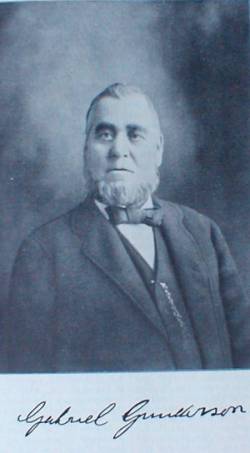
CAPTAIN MARTIN A. GUNDERSON
Captain Martin A. Gunderson is a worthy representative of that highly respected and honored class of Chicago's citizens, whose lives have been mostly spent upon the lakes. He was born in Norway, in 1835, a son of Gunder T. and Mary Ann Gunderson, also natives of the same country. The father was a seafaring man in early life, but after his emigration to America, August 14, 1848, he located in Milwaukee, and only engaged in sailing, until fall, being wheelsman on the steamer Champion. He then removed to Chicago, and turned his attention to lathing. He died in that city, December, 1886, having survived his wife for several years, her death having occurred in the same city in 1870.
In 1849, at the age of fourteen years, Captain Gunderson, the subject of this review, commenced sailing before the mast on the schooner E. Mint, plying between Chicago and Holland, Mich.; he having on the 18th of November of the previous year become a resident of Chicago. He remained on this vessel for one season, and for a part of the next, she being lost in 1850. The Captain's next berth was on the schooner Bolivar, engaged in the lumber trade between Chicago and Grand River, now Grand Haven, the master of this boat being Capt. Ole Oleson, who died of cholera, in 1851, at the mouth of the Kalamazoo harbor, and was buried there. For a part of the following season our subject was on the schooner Ark, engaged in the lumber trade to Michigan points, and owned and sailed by Captain Clawson and Thomas Sims, of Chicago. During the season of 1852 and a part of 1853 he was on the small schooner Petrel, commanded by Capt. Samuel Randolph, carrying Governor Marshall and other government officers to Manistee, Mich., who were engaged in looking after government lands, especially timber lands. He closed the season of 1853 on the schooner Mary E. Hilliard, plying between Chicago and Buffalo in the grain trade, Captain Naper being in command.
In 1854 he was on the bark Orleans, employed in the lumber trade, and the schooner Merchant; and during a part of the season of 1855 was on the schooner General Wert, now the Raber, engaged in the grain trade; then joined the schooner Abigail, in the lumber trade. At that time they had to cart the wheat and load their own vessel, hand to hand. On leaving the General Wert, Captain Gunderson sailed on the bark Morgan, in the grain trade between Chicago and Buffalo, but finished the season on the schooner Paulina, running in the interest of the Muskegon lumber trade. In 1855 was on the schooner Liberty with Capt. John Miller, of Racine, and the following year he and his brother, G. Gunderson bought the schooner Arabella, plying in the lumber trade between Chicago and Muskegon. In 1857 they purchased the schooner Pilot, engaged in the wood trade on the west shore of Lake Michigan, and in 1858 our subject went to Michigan City, where he engaged in fishing for part of that season. During the rest of the season of 1858 and the season of 1859 he sailed the schooner Orion, which was owned by Edward Sackett, and in 1860 sailed the Pilot as captain and mate, and for a part of the season of 1861 was mate of the schooner Attica, belonging to Captain Sims. In 1862 he bought the scow Hercules used in the Lake Michigan and Green Bay trade, and after sailing her one season bought the George Steele, on which he took a load of grain to Kingston, N.Y. In 1864 he engaged in the grain trade between Chicago and Oswego, N.Y., but the following year sold her to Andrew McGraw, and purchased the schooner Telegraph, which he sailed for the rest of that season. On selling her he bought the schooner E. Scoville, of Milwaukee, which he sailed one season, selling her in the fall, after which he purchased the schooner Contest, which he sailed for three successive seasons. She was lost in a snowstorm off Point Pelee island, Lake Erie, in 1873.
In 1874 he bought the schooner Carrier, which he used in the Lake Superior iron trade until selling her in 1894. He also owned the schooners Racine and T.Y. Avery, but sold the former in 1888, and the latter in 1896. He was actively engaged in marine affairs until 1896, giving special attention to lake traffic. He was harbor master under Mayor Washburne's and Mayor Swift's administration, but is now practically living retired after a long and useful career, though he still gives some attention to the real-estate business. In addition to a fine three-story flat building, in which he makes his home, he owns a number of buildings in Chicago, which he rents. Fraternally, he is a member of the Chicago Vessel Owners Association.
In 1855, in Chicago, Captain Gunderson was married to Miss Amelia M. Gunderson, and of the eight children born to them, seven are now living, namely: Matilda Getsena, wife of Soren M. Peterson; George A., a lake captain; Josephine; Henrietta, wife of Viggo Olson; Minnie Jane; Arthur M. and Emma Mae.
CAPTAIN GEORGE GUTCHER
(see notes sent in by researcher below)
Captain George Gutcher, a saltwater sailor who has visited foreign ports in all latitudes, but at this time with the Independent Ferry line plying between Duluth and Superior, was born August 3, 1849, in South Parish, South Ronaldsha, Orkney Islands, Scotland. He is a son of James and Catherine (Taylor) Gutcher, both of whom were also natives of the Orkney Islands. The father occupied a farm of seventy-five acres, was in the employ of the Northern Lighthouse Company for twenty-five years, and became general manager of his district, having charge of the boats of the company plying between the islands. The father died on July 25, 1858, and the mother on March 27, 1867.
Capt. George Gutcher attended the academy at South Parish until fifteen years of age, and leaving home April 9, 1864, shipped in the schooner Reaper for Leith, Scotland. His next berth was on the bark Malcom, of Newcastle, making a voyage to Copenhagen, going thence to Wendon on the Baltic Sea and returning to South Shields, the voyage occupying four months and twenty-two days. He then joined the brig Earl of Aberdeen, as ordinary seaman, on a voyage to Cronstadt, Russia, returning to Hull and Grimsby on the Humber. His next berth was on the brig Narvoa, trading to ports in the Gulf of Finland, until fall, when he went to North Shields, with Captain Ashton, in the Baltic Sea trade. The brig was stranded on this voyage on the Island of Gutland, but was released and proceeded on her voyage to Narva Bay on the Gulf of Finland, returning to London, England, Captain Gutcher receiving an able seaman's discharge from Captain Ashton. He then shipped in the brig Dorothy, of Blyth, bound for Alexandria in the Mediterranean Sea, and other ports in Egypt. He then returned to London, England, and shipped again, making two round trips in the coal trade on steamer Useful, of Sunderland.
Between London and South Shields, February 12, 1867, he joined the steamship Prince Consort, on a voyage to Kirkwall, the capital town of the Orkney Islands, arriving there on the 21st. He then went to the Island of Ronaldsha, and to his home in South Parish. On March 2, 1867, he took passage on the steamer Margaret for the Shetlands Islands, to see the town of Gutcher, at Gutchers bay, returning to his home March 14, 1867. He remained there until March 25, when he joined the steamship Queen on a voyage to Glasgow. On April 6, 1867, he shipped on steamship Hibernia on a voyage to New York, which was accompanied with great danger, the vessel being caught in a hurricane on April 14, and was almost given up for lost; but she weathered the storm and arrived in New York April 22. He reached Buffalo April 25, 1867.
Captain Gutcher then saw his first service on the lakes. He shipped April 29, 1867, on the schooner Rush, of Buffalo, and transferred to the bark Forest King in November, and closed that season on the schooner Amazon. In the spring of 1868 he came out in the schooner Henry Fitzburg, and closed the season as mate on the schooner Snowdrop. In the spring of 1869 he came out in the schooner John Pugsley as mate, in July transferred to the Bay Queen in the same capacity, and in November joined the schooner Henry Fitzburg for last trip, which was one of great peril. She lost her foresail on Lake Ontario, sprung a leak on Lake Erie, went to Buffalo for repairs, and then to Chicago, losing all her sails in a snowstorm on Lake Michigan; lay to anchor near Pine river eight days and eleven hours, and was towed to Chicago, closing that season.
Captain Gutcher finished his education in the winter of 1867 and 1868, also studied the charts of the Great Lakes under a navigator of the lakes and ocean. In the spring of 1870 he joined the schooner David Sharp as mate, but in July transferred to the Bay Queen in the same capacity, taking command of her on the last trip. The next year he was appointed master of the schooner Belle, which was followed by a season as master of the Laura Emma. In 1873 Captain Gutcher purchased the schooner Belle, and sailed her three seasons, doing a general trading business on his own account, doing well. He then sold her to a Mr. Goldring, and joined the schooner David Sharp as mate. In 1876 he bought the Laura Emma and sailed her three seasons, after which he became master of the Union. In the meantime Captain Gutcher had opened a general grocery store and bakery at Victoria, Ontario, which he conducted successfully until March 11, 1879, when he sold out.
In January, 1880, Captain Gutcher moved his family to Amherstburg, and was appointed master of the schooner Union, closing the season, and December 25, 1880, bought a general grocery store and bakery from James Burreman, of Amherstburg. In the spring of 1881, he was appointed mate of the schooner Prince Alexander, was wrecked at Leamington, in Pigeon bay, Lake Erie, April 25, and was left by himself to the mercy of the waves, tied to the tow post for five hours and forty-five minutes, and was then taken off by a fishing boat from the shore, after hundreds of waves had passed over him. On July 16, 1881, he was appointed mate of the bark Monitor, closing the season. Returning to Amherstburg, December 17, he sold his store and bakery to George S. Moonmystare.
In the spring of 1882 (April 13) he was appointed mate of the schooner Amaranth, and on May 15 moved his family to East Saginaw where he entered the employ of the E.R. Phinny Salt Works, closing the season. In 1883 he was appointed foreman of Steavens & LaDues salt block, where he remained four years. On April 25, 1886, he was appointed mate of the Marine City for two seasons. On March 9, 1888, he started in general painting business on his own account in West Bay City, where he remained until, April 12, 1892, he sold out, and on April 19, 1892, was appointed mate of the schooner Crowarth, closing the season. During the 1893-94 he worked at painting in the shipyards of Capt. James Davidson and F.W. Wheeler & Co., until July 6, 1895, when he joined the steamship Rappahannock on her maiden trip with Capt. James Davidson bound for Duluth, Minn. It was then that Captain Gutcher entered the employ of the Independent Ferryboat line, closing that season. On April 26, 1896, he was appointed master of the schooner Wissahickon, and fitted her out all ready for sea, but resigned for reasons best known to himself, and she foundered in Lake Erie, July 9, the captain, cook and one man being lost. In the meantime Captain Gutcher went to Saginaw to see about the loss of his property by fire, with no insurance - a heavy loss for himself and family. On March 29, 1897, Captain Gutcher again engaged with the Independent Ferryboat line, plying between Duluth and West Superior, which was followed by a season, and at this time he is engaged for the season of 1899.
Socially, Captain Gutcher is a Master Mason, a member of Erie Lodge No. 149. March 18, 1874, he was united in marriage to Miss Cythera Adelaide, eldest daughter of Francis Marr, of Port Dover, Ontario. The children born to this union are Daisy C., Bertha L., Isabelle, George Francis, and James William. Mrs. Gutcher died January 21, 1885. The Captain now makes his home in Duluth. In the meantime he is about closing a bargain on some land near Mahtowa, Carlton Co., Minn., where he will retire when old age overtakes him.
Notes from researcher:
(Cherlyn from Australia) Just noticed the very interesting piece about Capt George GUTCHER (Vol II) and believe I have some updated information about him and his family.
I believe he is from the same line as my husband. On the site it states that his mother's maiden name was TAYLOR. In fact, it was also GUTCHER (but her mother's maiden name was TAYLOR, ie George's grandmother).
He was christened on 23 Aug 1846...so perhaps his birth year is slightly out (it states 1849)...to James GUTCHER and Catherine GUTCHER in South Ronaldsay, Orkney. His father James (1811-1859), a farmer, was the eldest son of my husband's grt grt grt grandfather. His wife, Catherine GUTCHER (1804-1867), was the daughter of George GUTCHER and Isabella TAYLOR.
I do believe this is the same family as there are too many coincidences (such as his father's death date being 25 July 1859, and his mother's 26 March 1867 on my records, almost identical to those given on your site for George's parents. Also South Ronaldsay is a very small place!). Catherine's parents were from Grimness and James' from South Parish.
CAPTAIN WILLIAM B. GUYLES
Captain William B. Guyles will long be remembered as a pioneer in the lake trade. A kindly heart and a helping hand were ever noticeable among his many sterling attributes, his generous nature constantly overflowing with the desire to render assistance to those about him, and many were the recipients of his freely given bounty. He was born October 21, 1815, in Ripley, Chautauqua Co., N. Y., son of Simeon and Hester Guyles, who were of Scotch origin, and died at his home at No. 181 Franklin avenue, Cleveland, Ohio, August 13, 1896. The Captain was twice married, his first wife being Miss Ruby Burnes, of Oswego, N. Y. They had no children, but during their long wedded life they adopted, reared and educated four girls, two of whom were nieces. The kindness which was poured out without stint to these adopted daughters is remembered most gratefully by those to whom it meant the greatest of blessings, and the tender interest of Captain Guyles in their welfare smoothed out the rough places in what otherwise might have been a dreary pathway. Mrs. Guyles died in 1885, and on May 23, 1893, the Captain was married at Northport, Mich., to Miss Esther E. Fenn, of Cleveland, who was born in Brecksville, Ohio, and survives him.
Captain Guyles went early on the lakes, having been employed during his boyhood as cook on a man-of-war. When he was thirteen years of age his parents removed to Erie, and there he attended school for three years, commencing his sailing career at the end of that period. When he was nineteen the vessel in which he was sailing went shore at Grand Haven late in the fall, and he was selected by her master to choose two other men who would remain on the beach with him during the winter to guard the boat. He made his selection and the captain with the remainder of the crew tramped away through the woods to civilization leaving the other three behind. The snow was mountain high and the weather intensely cold, but the men constructed a log hut and managed to make themselves fairly comfortable with the ship's stores, a large part of which they carried on shore. Among other merchandise in the cargo was a large quantity of whiskey and this fact coming in some manner to the knowledge of the Indians, who were numerous in the woods, the remainder of the winter was rendered exceedingly interesting. The Indians were determined to have the whiskey, but the white men well understood what the consequence would be and stoutly resisted their demand, managing to fight it out successfully and to save the vessel and cargo. For this heroism and bravery young Guyles was next year made mate and a year later master, thus becoming captain before he attained his majority. He sailed twenty years as commander and during all that time never had an accident that lost a life or any considerable amount of property.
In 1842 Captain Guyles built a house on Abbey street, Cleveland, then Detroit street, where he lived until his removal to the dwelling on Franklin avenue, where his death occurred. He was an active member of St. John's Episcopal Church, and his straightforward, honest life won for him the respect of every one who knew him. He was a member of the financial committee of the Peoples Savings & Loan Association, and for twenty years after he retired from the lakes was in the employ of the Commercial Mutual Merchants Insurance Company, as inspector and surveyor. Captain Guyles was given the credit of being, in 1870, the pioneer advocate of the construction of the Cleveland breakwater. He was interested in the Bethel and gave much assistance to its enterprises.