History of the Great Lakes
Vol. 2 by J.B. Mansfield
Published Chicago: J.H. Beers & Co. 1899
[ A ][ B ][ C ][ D ][ E ][ F ][ G ][ H ][ I ][ J ]
[ K ][ L ][ M ][ N ][ O ][ P ][ Q ]
[ R ][ S ][ T ][ U ][ V ][ W ][ X Y Z ]

PETER LAMARE, JR.
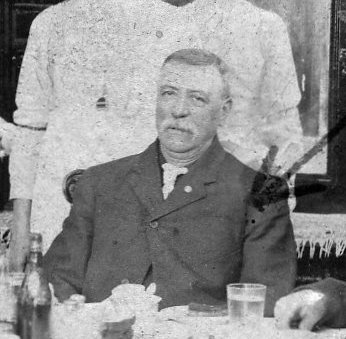
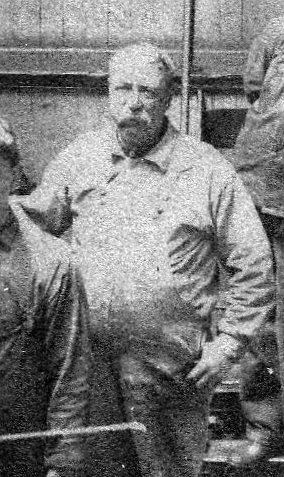
Peter Lamare, Jr., who has been engaged for more than a quarter of a century as engineer on the Great Lakes, was in charge of the motive power of the steamer Charlemagne Tower, Jr., during the season of 1896. He was born in 1852, in Montreal, Canada, and his father, also named Peter, has been a successful marine engineer for many years, at present running a vessel on the Ottawa River, in Canada; his mother was Julia (Sylvester) Lamare. When Peter, Jr., was eight years of age the family removed from Montreal to Ogdensburg, N. Y., where he received his schooling. In 1870 he began sailing, spending three months on the propeller Lawrence, of the Northern Transportation Company, after which he was in the ferryboat Prescott two seasons, and in the propellers Milwaukee and Garden City for shorter periods. Following his service on the Garden City he joined the steamer St. Albans, in which he was wrecked on Lake Michigan in the year 1881. The lake was full of ice, which cut a hole in the bow of the boat, and she foundered twenty miles off Milwaukee. The temperature at that time was twenty-one degrees below zero, and the crew were compelled to row in the small boats to the city, but they succeeded in reaching port in safety. After this Mr. Lamare spent a short time on the propeller Nashua; was in the Selah Chamberlin one year; in the Continental four years as fireman and one year as second engineer; was second on the Haskell three seasons; second of the Colonial five months and chief of her three months, and during 1892 was assistant engineer of the John Harper and Superior, in turn. In 1893 he was chief engineer of the Superior until she was laid up in July, after which he became second on the Missoula. He was chief of the Missoula during 1894 and all of 1895 up to the time she was lost on Lake Superior late in the fall, having thrown off her wheel during a storm. She laid in the trough of the sea for twenty-six hours after losing her wheel, shifted her cargo and rolled over on her beam-ends. The crew left her in the yawl-boats, nearly losing ten men through the tipping over of one of the boats, and they were twenty-two hours in making land and three days on shore without anything to eat. Then Mr. Lamare, the captain, and three men took one of the boats and finally succeeded in reaching Sault Ste. Marie, from which point they sent a steamer after the remainder of the crew. During 1896 Mr. Lamare was chief of the Charlemagne Tower, Jr.
Mr. Lamare was married in 1884 to Miss Mary Ellen Countryman, of Prescott, Canada. Their children are: Warren Tilden, Pearl Adeline and Carrie Irene.
Photos submitted by Rich Pohlman Great Great Great Grandson of Peter Lamare, Jr.
PETER LAMARE, SR.
Peter Lamare, Sr., one of the oldest engineers on the Great Lakes or their connecting waters, has now for many years been engaged on a side-wheel steamer on the Ottawa River. Mr. Lamare has been a marine engineer since 1844 and dates his life as a sailor from 1840, when he was fourteen years of age. He was born in 1826, in Montreal, Canada, the son of Peter Lamare, who was a farmer, and his first experience in his chosen calling was on the St. Lawrence River. He has always been connected with side-wheel steamers.
After he once commenced sailing he continued to follow it steadily and in four years he was a chief engineer. He has been uniformly successful in his work and exceptionately fortunate, having never been wrecked. Among other vessels upon which he has been engineer we have mention of the British Empire, Brittish Queen,(sic) Hercules, Atlas, Prescott, International, Gleaner and Scotland.
Mr. Lamare was married in 1852 to Miss Julia Sylvester, of Montreal, and of the children born to their union, Robert is now deceased; Peter is a successful marine engineer on the lakes; the others are Julia, Stephen, Frederick, John, Louis, Josephine and Rosa.
CAPTAIN JOSEPH LAMPOH
Among the young shipmasters sailing on the Great Lakes few have made a more enviable record than Capt. Joseph Lampoh, of Cleveland, who has been master of steamer and sailing crafts for ten years. He was born in Cleveland, in 1860, his father being Capt. Stephen Lampoh, who sailed vessels belonging to the Bradley fleet for twenty-six years.
Joseph Lampoh began sailing at the age of fourteen years, going with his father on the schooner Fayette Brown. He remained on this vessel two seasons, and then sailed as seaman before the mast on the schooner Alva Bradley, which was also commanded by his father. During the next four years he was engaged on various boats of the Bradley fleet, among them being the schooners Ahira Cobb, S.J. Tilden, Sandusky, J.R. Pelton, Negaunee, and the steamer Superior. During the season 1880 he was mate of the schooner Alva Bradley, with his father, and 1881 was mate of the schooner Escanaba. He was second mate of the steamer Selah Chamberlin, the following season, and a year later mate of the schooner Fayette Brown with Capt. Fred Green. In 1884 he was mate of the schooner John N. Martin, and the next season master of the schooner David Wagstaff. He commanded his first vessel in 1886, in that year becoming master of the schooner H.J. Webb, and the following season was master of the schooner M.E. Tremble. In 1889 he was mate of the steamer Colgate Hoyt, and master of a little steamer called J.C. Liken, and which was lost in that year off Spectacle Reef in Lake Huron. Then Captain Lampoh was given command of the schooner Sophia Minch, which he sailed for four years, in 1894 being made master of the steamer Everett for one year, then the John Glidden, which he sailed until navigation closed in 1896, and the season of 1898 found him in a position on the steamer Onoko of the Minch fleet.
On January 23, 1882, Captain Lampoh was married to Miss Effie Clement, of Brunswick, Ohio, and they have one child, Caddie M.
CAPTAIN STEPHEN LAMPOH
One of the most successful vessel masters who ever sailed on the Great Lakes was Capt. Stephen Lampoh, whose death occurred in 1884. Of his sailing career, twenty-six years were spent on vessels of the Bradley fleet and it is related that he never lost a boat or had a mishap of any consequence. His sailing began almost from boyhood, and he successively filled every position, from cook to master. His first command was the schooner C.J. Roeder, following this as commander of the schooners Escanaba, Negaunee, Ahira Cobb and Alva Bradley, and the steamers Superior, Selah Chamberlin, and Henry Chisholm. He was a sailor to the last, his death occurring on board the Chisholm as she was entering the Cleveland harbor, to put him ashore for medical assistance, he having been taken ill a short time previous.
Captain Lampoh was a native of Brownhelm, Ohio, and was about fifty years of age at the time of his demise. He married Elizabeth Johnson, their children being: Mary, now the wife of Mr. W. Sanderson, of Strongsville; Kittie, now the wife of John Jones, an electrician of Cleveland; and Joseph, now a well-known lake captain.
FRANK D. LANG
Frank D. Lang was one of those reliable and prominent engineers of the earlier days of lake steamboats, now highly spoken of by the younger generation. He was born in County Louth, North of Ireland, December 19, 1832, and is the son of William and Betsey (Kelley) Lang. He removed with his parents to America in 1833, landing at Quebec, Canada, going thence by way of Lake Champlain to Albany, N.Y., and later to Seneca Falls, finally locating in Toledo, Ohio, October, 1842, reaching the latter place as passenger on the old steamer Indiana, which was sailed by Capt. I.T. Pheatt. The Lang family were among the early pioneers of Lucas county, at the time when there was but one house on the east side of the Maumee river, and Toledo proper but sparsely settled. Frank D. Lang was able to tell many pleasant reminiscenses of sport on the Maumee river, when it was visited by myriads of wild ducks and inhabited by shoals of mullet head or cat fish.
In the spring of 1851, after serving an apprenticeship of three years at the machinist's trade in Toledo, and a short time in attendance at the public schools, he shipped as first assistant engineer on the old propeller Pauhassett, but closed the season as chief engineer of the steamer Telegraph, which was destroyed that fall by fire. The following season he was appointed first assistant engineer on the side-wheel passenger steamer Fashion, which plied between Toledo and Sandusky. His next berth was on the steamer Baltic, as first assistant, finishing the season of 1853 on the steamer Mississippi, then running in the passenger and freight trade between Buffalo and Sandusky. During the cholera year of 1854, Mr. Lang for a short time held the unenviable post of engineer on the steam ferry John Pomisey, running between the east and west side of the Maumee at Toledo, on which many victims of that dread disease were transported daily for burial in the grounds of the pest house.
In the spring of 1855, Mr. Lang assumed the management as chief engineer on a line of three harbor tugs, which he engineered with good profit until the fall of 1863, working in the machine shops during the winter months. The next season, he shipped on the steamer Kenosha, owned and sailed by his brother-in-law, Capt. Robert Montgomery.
The Kenosha was destroyed by fire at Point Edwards that fall, and Mr. Lang then went to Cincinnati, where he joined the United States Transport Steamer Rob Roy as chief engineer. This was a stern-wheeler, and was used principally on the Ohio, Cumberland, and Tennessee rivers during the last year of the Civil war. The berth of engineer on those river steamers at that time was a dangerous one, and many narrow escapes are recorded. At the close of the war in 1865, Mr. Lang returned to Toledo and shipped as chief engineer on the steamer Sun, running between Sarnia and Chicago, Ill., which position he retained five years. During the seasons of 1870 and '71 he engineered the propeller Cuyahoga, between Chicago and Duluth. He then put the machinery in the steam-barge Tempest, and brought her out, running her until he accepted a position on the steamer Mary Jerecki, and in 1873 he closed his active life on the lakes as chief engineer of the propeller Nahant, at that time one of the largest steambarges on the lakes. In the fall of that year, Mr. Lang accepted a position as chief engineer in the sawmill of W.H.H. Smith & Co., which place he held twenty-three years. During this busy life Engineer Lang acquired some good fruit property, at Lang's Bend, near Toledo, upon which he lived, his son occupying during the summer one of the farms near him.
He was a Master Mason of Toledo Lodge No. 144.
On April 2, 1854, Mr. Lang was united by marriage to Miss Mary A. Williams, of Bedford, Monroe Co., Mich. Four children were born to them, one son, Augustus H., surviving. He is now treasurer of the Shaw Kendall Engineering Company, and was wedded to Miss Sarah A. Bodley, of Angola, Steuben Co., Ind., December 9, 1882. The children born to this union are: Florence, Frank Greenwood, Robert, Delmer, Alfred and Warren, and they have a pleasant home both in the city and the country. After a brief illness, Engineer Frank D. Lang joined the silent majority December 21, 1897.
STEPHEN F. LANGELL
Stephen F. Langell, after an honorable and useful career in connection with marine interests, is now being retired at his home in Cleveland. He was born in Nova Scotia in 1829, and removed to the United States in 1835. His father was taken sick on the Erie canal, and, though they were bound for Ohio, were obliged to stop at Buffalo, where he died four days later. They remained in Buffalo four years, and then went to Cambridge, Ohio.
In 1847 Mr. Langell removed to Cleveland, where he became an apprentice in the shipyards of Washington and Buell Jones. The next year he went to Sheboygan, Mich., and built a small vessel which was used in carrying stone for the construction of a lighthouse near that point. On returning to Cleveland, he helped finish the steamer Buckeye State, then being built by the Jones Brothers. During the next eight years he was employed by Roderick Calkins, Quayle & Martin and Lafrinier & Stevenson. In 1857, he built in Fairport, for Solomon Snell, the top-sail schooner called Calvin Snell. In 1860 he went to work for Peck & Masters, and for fifteen years was employed in the responsible position of foreman and draftsman. The following are some of the vessels he aided in constructing: Pewabic, Winslow, Meteor, Atlantic, City of Chicago, City of Buffalo, City of Milwaukee, Golden Fleece, Sunshine, St. Louis, Arctic, Passaic, Nebraska, David Stewart, Manistee, Fremont and the revenue cutters Sherman and Fessenden.
In 1872 he went into business for himself, in partnership with the late William H. Radcliff, building the schooner Genoa, the steamers Havanna and John N. Glidden, and the tug Triad.
In 1853 was celebrated his marriage to Miss Catherine Perrin, of Cleveland. They have had nine children, only one of whom, Frederick W., has followed the marine business. He was head draughtsman in the engineering department of the Globe Iron Works Company from 1886 to 1897.
CAPTAIN FRANK F. LANGLEY
Captain Frank F. Langley is the youngest son of Captain Samuel G. Langley, and was born July 4, 1860, in St. Joseph, Mich., receiving his education in the public schools of his native city and at the State Normal school at Ypsilanti, Mich., from which he was grad-uated in 1878.
His fondness for water was inherited, and as a child his parents were unable to keep him beyond the reach of its fascinating influence. At the age of nine years he ran away from home and began his career as a sailor, and when twelve years old he went for part of a season with his brother, Capt. John H. Langley, on board the Comet, trading between Buffalo and Duluth. The next year he was sent to Ypsilanti to school, but preferring sailing, he went to Detroit and shipped on the steamer Phil. Sheridan, plying between Buffalo, Cleveland and Bay City, and was on her part of two seasons. After graduating from the State Normal school he resumed sailing. In July, 1883, he bought the schooner Anna Robinson, which he sailed as master until November 17, of that year, when she was wrecked at Muskegon, Mich., becoming a total loss. He then went with Captain J. M. McGregor of Detroit, as wheelsman on the steambarge Otego, and remained with him six years, the last four years as second mate. Since that time he has not followed sailing but has operated some on the board of trade in Chicago and superintends the home farm, taking care of his mother in her old age, and worthily sustaining the dignity of an old and honored name.
He is a member of the Knights of Maccabes, and is a stanch Republican in his political preferences.
CAPTAIN HORACE K. LANGLEY
Captain Horace K. Langley (deceased), the son of Capt. Samuel G. and Sarah A. (Hilton) Langley, was born at Lee, New Hampshire, about the year 1830. His father later lived in Newburyport, Mass., and was a shipbuilder. [For the ancestry of our subject, the reader is referred to the sketch of Capt. Samuel G. Langley, which appears elsewhere in this book.] Like his distinguished brother, Capt Langley was early accustomed to the water, and when but a lad began the life of a sailor, going as cabin boy with an older brother, John F. Langley, who was sailing on a line of vessels between Boston and New York City. In 1845, the brother was lost, and young Langley returned to his home, and was for a time employed with his father at Newburyport. Along in the 'fifties Horace K. came out to Buffalo, N. Y., and began sailing from that point; subsequently he went to Chicago, and entered the service of the Western Transportation Company, and was with it for many years, during which time he sailed the propellers Omar Pasha, Mohawk, Bucephalus and the Concord - all first-class vessels, some of them in the Detroit and Chicago trade and some running Chicago and Buffalo. He also sailed for Duncan Stewart, of Detroit, the Anna Young, between Buffalo and Saginaw and intermediate ports. After leaving that company's service he came to St. Joseph and went to farming, having years before located his family at that point. Later he sailed the Skylark for a season or two between St. Joseph and Chicago, and then returned to the farm, on which his death occurred December 4, 1875.
Captain Langley possessed many of the sterling qualities of his brother Samuel G., and ranked with the first-class masters then on the lakes. He was a Mason, and in politics a Republican.
In 1849, he was married to Mrs. John F. Langley, whose maiden name was Davis, a daughter of Samuel and Sarah (Chapman) Davis, the daughter being a native of Connecticut, but who grew up in New York City.
Capt. John F. Langley, a brother of Horace K., was a native of Lee, New Hampshire, born in 1820, and at the age of fourteen left home and went to Boston. He seemed determined upon going on the water, and so was apprenticed to a Mr. Davis, of Connecticut, who owned or was on a line of vessels between Boston and New York, and in that company young Langley served out his time. At nineteen he was made master of one of the vessels, and remained in that company's employ until he was lost on the schooner Reecide off Hell Gate, in February, 1845. Captain Langley married the niece of the Mr. Davis referred to, and to this union were born two children; George and Kate. After the death of John F., and in 1849, the widow married the brother, Capt. Horace K. Langley. She now resides at Rockford, Illinois.
CAPTAIN JOHN HORACE LANGLEY
Captain John Horace Langley, of St. Joseph, Mich., a worthy son of Capt. Samuel G. Langley, whose noble and brave life of public service as a sailor of the Great Lakes is portrayed elsewhere in this work, and to which the reader is referred for the family genealogy, was born at the Langley homestead at St. Joseph, Mich. March 16, 1844, amid a great storm, which may account for his placid and peaceful makeup, for even a short acquaintance shows him to be of mild disposition, modest, retiring and unostentatious. Like his ancestors, from whom he inherited a love for the water, he early began a seafaring life, and after receiving the rudiments of an education in the common schools of his native place and in Detroit, at the age of fourteen he sailed on the bark Sunshine, before the mast, the boat plying between Buffalo and Chicago. A year later he went as watchman on the propeller Illinois between Detroit and Buffalo. He then served successively on the May Flower and the Tonawanda as watchman and wheelsman, and was promoted to second mate of the last named, being then only about sixteen years of age. The following season he was made mate of the Tonawanda. For two years he sailed on the Dean Richmond, then the largest propeller on the lakes, carrying 1,400 tons. The Dean Richmond ran on the New York Central line, and connected with that line railroad trains from Buffalo to Chicago.
At about the age of twenty years our subject was made captain of the side-wheel steamer Philo Parsons, which ran from Grand Haven along the eastern shore of the lake to St. Joseph and across to Chicago. From the Parsons he sailed the St. Joseph, which was built in Buffalo by Captain Gibson, our subject holding an interest in her, and which was a passenger and freight boat, plying between St. Joseph and Chicago. He sailed her for several years, and then sailed the V. N. Raalte, Benton, Lake Breeze and the Messenger, respectively. The last named was the first boat owned by Graham & Morton. Later he sailed the Roanoke, Colorado, Comet, and about 1884 he quit sailing and became the agent at St. Joseph for the Dix, owned by Captain Cochran, who sailed her between St. Joseph and Chicago. The Dix was taken off the route and Captain Langley was instrumental in getting the Detroit on the same route, and for which he was the agent at St. Joseph. In about 1892, the Captain, in connection with John G. Williams, of Terre Haute, Ind., and F. W. Wheeler, of Bay City, Mich., formed the Lake Michigan Transportation Company, and put on four boats, namely the Soo City, Ossifrage, the Laura and Minnie M., two of which ran daily between Milwaukee and St. Joseph, and two twice daily between St. Joseph and Chicago. This was styled the Vandalia line, and of which our subject was manager. These boats were run a couple of years, and then Captain Langley withdrew and retired from the lake service. He is now residing on one of the many beautiful fruit farms about St. Joseph, where he grows all kinds of berries and small fruits, and, if one can judge from appearances, has one of the model fruit farms of Berrien county, and himself an expert grower. His forty-acre farm and homestead are on the Langley tract, and adjoin that of his mother.
Captain Langley through his long years on the lakes met with now serious accidents. Like his illustrious father, however, he has been instrumental in saving life. He possesses a handsome gold medal given him by the United States Government for bravery and heroism in rescuing four men from the several vessels lost off the shore between Grand Haven and St. Joseph; the men had been clinging to the topmast for twenty-four hours when rescued.
On New Year's Eve, 1865, Captain Langley was united in marriage to Marian A. Oviatt, daughter of O. W. Oviatt, now a successful business man of Chicago, and to their union have been born the following children: John H., Jr., on the City of St. Joseph, between St. Joseph and Chicago; Marian A., deceased; Marian Berenice, now teaching; Delia A., deceased; Margaret Ruth; and a son that died in infancy. The mother of these children is a woman of education and culture, born November 13, 1843, at Edenburg, Ohio. Her education was completed at the Convent of the Ladies of the Congregation, at Kingston, Canada, where the accomplishments of music and French were received. Mrs. Langley's mother, Delia Wadsworth, was a native of Ohio, a daughter of Jeremiah Wadsworth, of Hartford, Conn., who was one of the pioneers of the locality of Cuyahoga Falls, Ohio, where he settled on land obtained from the government. The great-grandfather on Mrs. Langley's father's side was a colonel under LaFayette in the Revolutionary war, and she is thus a Daughter of the Revolution.
CAPTAIN SAMUEL GILLMAN LANGLEY
Captain Samuel Gillman Langley (deceased), late of St. Joseph, Mich. Within fifteen walk from the business center of St. Joseph, there stands the commodious and inviting old homestead of the Langleys, a name that is a household word in the cities and villages along the shores of the Great Lakes; a family noted for its many and efficient sea and lake commanders. Here on this site, on the bluff of the St. Joseph river, commanding a grand view of that beautiful stream. And the lowlands, and of the city of Benton Harbor in the distance, and on historical ground, Captain Langley chose a home, and here now resides his widow.
He was born at Lee, New Hampshire, August 11, 1813, the son of Captain Samuel G. and Sarah A. (Hilton) Langley. Our subject early imbibed the taste for a seafaring life, and when a lad of thirteen or fourteen years began sailing the seas, first as boy royal, and then rose step by step upward, until he reached the topmost round of the ladder, and there stood the peer of any of the great commanders of the seas and lakes.
The Hiltons and Langleys settled in New Hampshire in Colonial days, and some four generations were born and raised on lands still in possession of their descendants, and on which the old graveyards are still kept in orderly condition, and in which are tombstones bearing inscriptions back to 1623.
The Langleys were of Scotch, and the Hiltons of the Irish extraction. Mrs. Samuel G. Langley was the eldest daughter of Gov. John Hilton, one of the early governors of Massachusetts. Captain Langley sailed the seas until grown, was on several whaling voyages, and touched many foreign shores. At one time he met with a terrible accident, and was taken to Buenos Ayres, South America, where an operation was performed, and where he was left for a year, the vessel returning for him, and he sailed her as captain to Boston. In about 1839 or 1840, he came west and located at St. Joseph, purchasing upward of 300 acres of land on the St. Joseph river above referred to, which he improved and beautified, and where his children grew up, and to which he retired on leaving the lakes. Near the old homestead is the site of the old trading-post of William Burnett and his son James, which was established there about 1775, and was continued until 1825. Among the early vessels he sailed on the lakes were the Indiana, the Frances Mills, which he owned, the Napoleon, of which he was a part owner, and at the time was associated in the elevator business with John. F. Porter, R.C. Payne, Colonel Fitzgerald, and Hiram F. Wheeler (the great elevator man of Chicago), and Judge Fish. The boats mentioned were run principally in the grain trade between St. Joseph, Buffalo and Chicago. Later he sailed and commanded the Earl Cathcart, the first propeller on the lakes, and which was engaged in the Chicago and Buffalo trade. Subsequent boats he sailed were the Fintry, which was blown up on Lake Erie, the Falcon, the Mississippi, the May Flower, and the Tonawanda, from which he retired in 1863 for a time to his farm at St. Joseph. He again resumed sailing in 1870, then commanding the propeller Favorite, of which he was part owner, and on which his death occurred suddenly of heart disease while she was at the dock in Chicago, June 4, of that year.
The Detroit Tribune refers to the Captain and to some of his noble acts:
Captain Langley has always seemed to us the very beau ideal of a thorough sailor and commander - one born to the profession. Ever since we knew him in command of the propeller Fintry, we have thus esteemed him. There he had but a limited scope in which his true qualities could be developed. Yet even there they were tested under circumstances of severe trial. Well do we remember him when he fell in with the burning E.K. Collins, * * * We can easily recall the superior judgment, coolness and presence of mind which he then displayed. And most of those who escaped from the fiery seas of flame that enveloped the boat and the treacherous waves that waited to devour them, around, owed their preservation to the quick and ready hand that Captain Langley extended to their relief. His exertions knew no bounds. No sacrifice was too great to make - no gift was too much freely to bestow upon the unfortunate sufferers by calamity. With a practical wisdom worth everything at that juncture, the drowned were resuscitated and the wounded carefully tended. With the mind of a man to direct and the heart of a woman to prompt, his efforts could not be otherwise than successful.
The recent disaster that befell the Northern Indian brought these same qualities into full exercise, and he proved just the man for the terrible emergency. His prudence, good management and superior skill were extolled in every quarter. Survivors saved through his timely exertions expressed their gratitude in many letters in the public print, while many more testimonials that could scarcely contain words enough to express the sentiments of their writers’ overflowing heart, found their way to him in a more private manner, and doubtless were preserved by him as next precious to the thoughts of having done his whole duty, with which he is cheered and blessed. Most worthy indeed is he to occupy his high position of responsibility and trust. Years and years hence may we be permitted to grasp the hand of as true a man and sailor as lives, and find both in the person of Samuel G. Langley.
In referring to the E. H. Collins and Forest City the Grand Rapids Enquirer thus speaks:
It was Captain Langley who, with the propeller Fintry, went to the rescue of the passengers and crew of the steamer E. K. Collins, which was burned just below Malden last fall. Upward of sixty lives were saved by his noble efforts. For his kind and noble conduct on that occasion, he was presented by some of the survivors with a rich service of silver.
Last September he picked up the boats containing the saved passenger and crew of the propeller Forest City, which was sunk by being run into by a vessel near Grand Traverse. These were only a few of the many testimonials tendered to him for many and brave efforts in rescuing lives during his long and noble service on the lakes.
On February 2, 1843, occurred the marriage of Captain Langley to Miss Sarah Ann Fitzgerald, of Detroit, and a daughter of Edmund A. Fitzgerald, of Sea View, Ireland, who came to New York City and married Miss Sarah A. Hilliard, of Albany, Sarah Ann Fitzgerald was born in Albany, N. Y., April 2, 1823. The children of this union are John H., Samuel E., Franklin F. and Emma A., the wife of J. J. McLeod, of Detroit. All the sons, as the mother expresses it, “took to the water like ducks,” and early went on the lakes, and each became a master of a vessel.
ALF H. LANTHIER
Alf H. Lanthier, a young man of genial, happy temperament, and by occupation a first-class pilot was born at Prescott, Ontario, in January, 1870, the second son of Damascus and Maria (Winters) Lanthier. His older brother, Edward P., has been a steamboat man and master on the lakes for twenty yeaars and recently captain of the propeller Petoskey; James is with our subject in Ashtabula. After graduating from the public schools in Prescott and Ottawa, at the age of sixteen years, Mr. Lanthier repaired to Montreal and entered the McGill Medical College, as a student of the science of medicine, remaining there one year. The bard of Avon once wrote, "There's a divinity that shapes our ends, roughhew them how we will." So it happened in this case. After Mr. Lanthier had advanced thus far on the road to the profession others wished him to follow he declined to study it further, and the storm center of his own desires took him to the lakes. He therefore returned to Prescott and in the spring of 1887 shipped before the mast on the L. D. Bullock, with Captain Eccles, remaining one season. The next year he sailed with Captain Bullock in the schooner Mineral State, and spent the following season in the schooner Benson. Becoming weary of the duties of an ordinary seaman, he secured the berth of mate on the Canadian schooner New Dominion, and after laying her up in the fall purchased the entire outfit and properties, including the required number of boats usually used by a prosperous fisherman, opening up business at Monroe, Mich., on his own account. He gained a good trade, shipping everything fresh East, West and South, and it may be noted here that he continued this business each winter until 1893. Having decided to get a license to run a steamboat he turned his attention to steam, in the spring of 1891, shipping as wheelsman on the steamer John C. Gault; in 1892 on the steamer German, in the same capacity; and in 1893 on the steamer Cherokee, closing on the steel steamer Saxon. The next season he shipped as wheelsman with Capt. Willliam Cunnings on the steamer Corsica, and in 1895 on the Saxon, closing the season on the Cambria. In the spring of 1896 he secured pilot's papers, and having accomplished his object again engaged in the fishing business, this time at Ashtabula harbor as manager of the Ashtabula Passenger & Fishing Co., which was incorporated in February, 1896. The opening of the season of 1898 found the company in the possession of a greatly enlarged plant and their facilities for taking fish enhanced by the addition of a new steam tug and the necessary outfit.
Mr. Lanthier makes his home in Ashtabula. His grandparents still live in the province of Gascony, France. His maternal grandparents, Stephen and Lucy Winters, were natives of Ipswich, England. His father and mother were married in France and came to Canada in 1856, locating first in Montreal and afterward removing to Prescott, where they acquired some property. The father died while Albert was quite young.
CAPTAIN CRAWFORD LARGE
Captain Crawford Large, a well-known master mariner who sailed out of Ashtabula many years ago, now retired from active life on the lakes, is agent for the Mutual Life Insurance Company of New York, also of the United States Casualty Company. In addition to this business he performs the duties of constable, to which office he was elected in 1897. He was born March 23, 1833, a son of William B. and Lydia (Benham) Large, both natives of Connecticut. The mother was a sister of the late Capt. Samuel Benham, of Cleveland. During the early years of his life, while working with his father on the farm near Ashtabula, Ohio, young Crawford attended the district schools in the winter months.
In the summer of 1847 Crawford Large shipped as boy on the schooner John F. Porter, which he left on arrival at Buffalo, and shipped on the schooner Vermont, but after a short time transferred to the schooner Industry, of Cleveland, and when she laid up that fall in St. Clair river, Captain Bedford, who had formed quite an attachment for our subject, took him home with him for the holidays, after which the lad went home and remained until spring of 1849, when he joined the noted brig Banner, as boy, with Captain Scoville, closing the season on the brig Clarion and also joining her the next season. In 1851 he went as seaman on the little topsail schooner T.G. Colt, with Captain Downs, until August, when he was appointed mate, and in September, the captain wanting to quit the schooner, put our subject in charge of her, securing as mate for him J. Davidson. He objected to this arrange-ment on account of his youth, but Captain Downs prevailed as he was owner of the schooner, and young Large finally gave a good account of the little vessel. The next season he shipped in the Chief Justice Marshall, continuing in her until 1853, when he was made mate with Captain Moray on the schooner Atlas, which was sold to Detroit parties that fall, our subject keeping his berth on her the next season until September, when he was appointed master. That fall he took into Erie, on the Atlas, the first two cargoes of ore that had ever been transported on the lakes east of Detroit. This is accounted for by the fact that it had been for a number of years the custom of passenger steamers coming down to carry ore with which to trim. This they threw out on the docks at Detroit until quite a large quantity had accumulated, sufficient to make two cargoes for the Atlas. In the spring of 1855 he shipped before the mast in the Chief Justice Marshall for a trip to Saginaw, where he joined the schooner Benjamin F. Wade, as mate, Capt. John Paine, and remained on her until the fall of the next season, when he was promoted captain of the scow L.B. Fortier, owned by Capt. J. Butler, of Buffalo.
In the spring of 1857 Captain Large was appointed mate of the brig Caroline A. Bemis, followed by a season as mate with Capt. Harvey Hall on the brig Lucy Blossom. He then stopped ashore until 1860, when he and his brother, William, bought the scow Union from their uncle, Samuel Benham. The Union had gone ashore the previous fall above Sturgeon Point and lay there all winter. The new owners raised and rebuilt her, and Captain Large sailed her until the fall of 1861, when he purchased a third-interest in the schooner-rigged scow Nebraska, and took command of her, sailing her until the close of 1863. He then sold his interest, and bought into the bark Sam Ward with Messrs. Haskill, and sailed her seven years. In the spring of 1871 he was appointed master of the bark Sunshine, holding that berth two seasons. He then became the marine manager of the line, and took command of the propeller Buffalo and sailed her two years. In the winter of 1874 he sold his interest in the Sam Ward, and although he was appointed to a steamboat in the Union line, he declined with thanks in order to take charge of Strong & Manning's coal dock No. 1, and that fall opened a restaurant in Ashtabula, Ohio.
In 1876 Captain Large purchased a building at the harbor, and went into the restaurant business. The freshet in Astabula river in the fall of 1877 carried away his building, and he then turned his attention to politics in a mild way. In 1878 he was elected constable and policeman, and was appointed harbor master also, holding that composite office until 1881, when he was appointed postmaster at the harbor by President Hayes. He located the office in his own store, and connected a news depot and notion business with his post duties until President Cleveland was elected, when he was relieved of the duties of postmaster, the other branches of his business being continued, together with the agency of the Adams Express Company, however, until President Harrison was elected, when he was again appointed post-master. At the end of this term Mr. Cleveland again appeared on the scene and, in spite of his former friendship for our subject in Buffalo, Captain Large was again removed. As has been said he then engaged in the insurance business, adding to it the duties of constable. Socially he is a Master Mason and has been a Royal Templar for twenty-one years.
On February 24, 1853, Captain Large was united in marriage with Miss Susan B., daughter of James and Catherine McKenzie, of Saybrook, Ohio. The children born to this union are Capt. Kenneth M., who lives at Naples, Lee Co., Fla., owns and sails a small schooner in Florida waters, runs a boat house, is postmaster and carries the mail; Kate M. is the wife of C.L. Merrill, superintendent of the eastern division of the Pullman Palace Car Company, stationed in Pittsburg; John B. and William are both railroad engineers; Hattie J. is the next of the family; and Minnie is the wife of Ed S. Henry, superintendent of the Minnesota ore docks at Ashtabula harbor. Mrs. Large died in March, 1872, and the Captain was again married, his second wife being Mrs. Kate (McKinzie) Webster. The family residence is at No. 26 Vine street, Ashtabula, Ohio.
CAPTAIN W. H. LARRABEE
WOOD, Emma C. (wife of Captain W.H. Larrabee)
HILLIKER, Nancy C. (mother-in-law of Captain W.H. Larrabee)
WRIGHT, Susan (mother of Captain W.H. Larrabee)
Captain W.H. Larrabee is a ship master who commenced sailing when very young, but eleven years having passed over his head. He was born in Colchester, Canada West (now Ontario), January 17, 1848. He is the son of Peter and Susan (Wright) Larrabee, and was brought to the United States when four months old. They located near Trenton, Wayne Co., Mich., where the lad grew up and attended the district schools until he was eleven years old, and still continued his studies during the winter months for some years after he commenced sailing. The Captain's paternal grandparents were originally residents of New York State, and his father was born on Walpole Island, and his mother in New York.
In the spring of 1859 he went out as cook on the scow Find Out, a craft with one spar, used in carrying wood on the Detroit river, and a boat not considered a monster even in those days of limited tonnage. The next season he shipped before the mast on the scow Joe Gates, followed by two seasons on the scow Annie, engaged in the lumber trade between Ecorse and Toledo. During his life before the mast Captain Larrabee shipped on many vessels, as do most of the up-to-date sailors. He sailed on the scows William Bartley, and Storm, with Capt. Nelson Little, the schooners Columbia, Forwarder, H. B. Steel, joining the Forwarder a second time as mate, then went on the Topsey, with Capt. Dan Sinclair, also was on the Lincoln Dall, and the Selkirk, with Captain Banford, going as second mate the second season, after which he connected himself with the schooner Evaline Bates, and was with her the year the ore docks at marquette were destroyed by fire, and when she carried the first cargo of ore consigned to Charlotte, New York. He was second mate of the brig Waverly two seasons, which was dismasted the last fall he was on her, after which she was cut down and converted into a tow barge.
In the spring of 1870 Captain Larrabee was appointed mate of the schooner Alva Bradley. The next spring he shipped as wheelsman on the new steamer J. S. Fay, closing the season on her as second mate, and in 1872 was appointed mate of the Lady Franklin. The next year he was made master of the towbarge Clifton, and sailed her for two seasons. She sprung a leak and foundered in September, about fifteen miles below Point Pelee, while in tow of the steamer Henry Howard. The Captain then desiring to command a vessel of his own, purchased the scow Senator, and sailed her five years, doing fairly well with her. In the meantime he formed a partnership with a friend, investing much of the money he had earned with his scow in manufacturing a new carriage gear. At the end of four years the Captain dissolved this partnership, asserting that it was out of his line of business, and returned to the lakes as mate of the steamer Ira Chaffee. He then shipped as wheelsman on the Bulgaria, closing the season as second mate; later on was second mate of the steamer Henry Chisholm; mate with captain Gaines on the steamer A. Folsom; mate of the steamer Osceola, in the package trade between Duluth and Port Huron; master of the schooner Swallow, which was lost on Sleeping Bear Point while in tow of the tug John Martin. In the spring of 1890 he was appointed master of the steamer Empire, and the spring following was in charge of the steamer Linden as master, and laid her up at the close of navigation.
The Captain is a lover of a good horse, and usually has one, which he enjoys caring for and driving during the winter months. Socially he is a Master Mason, a member of the Order of the Maccabees and of the Ship Masters Association, holding Pennant No. 911.
On April 25, 1872, Captain Larrabee, was united in marriage to Miss Emma C., daughter of Martin A. and Nancy C. (Hilliker) Wood. Two children were born to this union, Melvin A., and Maud E., who passed to the better land in 1887. Some years ago the Captain purchased a plot of land, comprising five acres, on Twenty-fourth street, Port Huron, Mich., upon which he erected a homestead, where the family now resides.
MANDIUS LARSEN
Mandius Larsen passed the early years of his seafaring life on the North Sea, whereby he contracted a desire for a life on the water. He was born at Stavanger, Norway, October 2, 1859, and is a son of Lars Mikkelson and Elizabeth (Olson) Larsen, both parents being natives of Norway. His father was a successful fisherman out of the port of Stavanger, and owned his own boats, in which Mandius passed much of his youth, attending school in the winters. As is customary in Norway, when he was seventeen years of age he enlisted in the army and passed two years at the army schools, tutors being employed by the government to teach the young men inclined to acquire an education. At the end of his school term he was appointed corporal in the first company of the third battalion of Stavanger, and served that rank for three years, at the end of which period he took advantage of his privilege and resigned.
In 1881 Mr. Larsen again took up his life on the ocean, shipping before the mast in the schooner Langen. After passing a year on her he joined the schooner Fingal, plying on the Baltic Sea, trading between different Russian ports. In 1884 he came to the United States, and passing through New York and Chicago he reached Seneca, Ill., where he spent three years among farmers, during which time he acquired the English language, learning also to read and write. In the spring of 1887 he came to the lakes and shipped on the steamer Maggie Marshall as fireman, and after four months transferred to the Marshall F. Butters. In 1888 he became fireman on the steamer Omaha, retaining that berth three seasons. Being of an observing and ambitious nature he soon learned the duties necessary to become an engineer; he applied for a license, which was granted, and he was appointed second on the Omaha, remaining in her four seasons. In the spring of 1895 he became second engineer of the Monteagle, which was followed by another season on the Omaha. In 1897 he was appointed chief engineer of the steamer Monteagle, commanded by Capt. William H. Griffin, still retaining that office.
On November 4, 1890, Mandius Larsen was wedded to Miss Mary Olson, of Frondhjem, Norway. The children born to this union are: Neil, Oscar, Mendell and Louis. The family residence is at No. 312 Madison street, Milwaukee, Wis. Socially, Mr. Larsen is a member of the Marine Engineers Beneficial Association No. 9, of Milwaukee, and of the Scandinavian Beneficial Order.
NICHOLAS LARSON
Nicholas Larson was born July 25, 1844, on the island of Fohr, then under the dominion of Denmark, but now ruled by Germany. He attended the public schools until he was sixteen years of age, when he came to America, locating at Milwaukee, Wisconsin.
After having learned the machinist's trade Mr. Larson entered the employ of the Goodrich Transportation Company, and in 1871 was appointed first assistant engineer of the side-wheel passenger steamer Orion, on which he remained one season; this boat was wrecked a short time after on the beach at Grand Haven. In 1872 Mr. Larson shipped on the Manitowoc, in 1873 on the Alpena, remaining two seasons, and in 1875 was appointed chief engineer of the steamer Muskegon, the machinery for which was taken from the hull of the Orion, and Mr. Larson remained in her engine room three seasons. In the spring of 1878 he took the screw steamer Oconto, a passenger boat plying between Chicago and Green Bay, holding this berth until the fall of 1879. His next boat was the side-wheel steamer Corona, which he ran three seasons. In 1881 Mr. Larson purchased the Isabella, a small side-wheel steamer, from parties in Oshkosh, and ran her from Peoria to Havana, Ill., in the passenger trade on the Illinois River, selling her after a poor year. In 1882 he went down the river to New Orleans, and worked in machine shops during the winter; also worked in the Crombell line of ships, fitting up engines for the shop, and in the spring came to New York City on the New Orleans, one of the line. In 1883 he left New York City for Buffalo. About this time Mr. Kelderhouse built the Queen of the West, at Bay City, and he went there, put in the machinery, and ran that boat for six years.
In 1887 the Rochester & Pittsburg Railroad Co. gave up the business on the canal and sold their boats. Mr. Larson bought one of them, the steamer Durant, and ran her for three years, towing canal boats for Mr. Bissell. He then bought the consorts Carthage and Jonathan Scovill, and on one of his trips to New York City sold the latter. The other two boats he ran for four years, when he sold both at a good price. In 1889 he was again employed as chief engineer of the steamer Corona, now owned by the Woodlawn Beach Company at Buffalo, which he ran on the excursion business. In 1894 he entered the employ of the Crystal Beach Steamboat Company, as chief engineer of the Pearl, holding this berth until the fall of 1898, and finishing the season on the Gazelle. In 1885 Mr. Larson was wedded to Miss Catherine Veidinger, of Buffalo, and one son, William N., has come to this union. The family residence is at No. 85 Waverly Street, Buffalo, N. Y. Fraternally Mr. Larson is a member of the Ancient Order of United Workmen, also of the Marine Engineers Beneficial Association.
M. S. LAUCKS
M.S. Laucks was born in Rondout, N.Y., February 22, 1866, son of Samuel and Samantha (Pettengill) Laucks. He comes of a patriotic family, for his father's brothers, David and Chester, and his mother's brothers, Manford and Alanson, were veterans of the Civil war, and took honorable part in all the engagements in which their regiments participated.
Mr. Laucks attended the public schools of his native town until he reached the age of eighteen years, when he went to Watertown, N.Y., and entered the employ of the Watertown Engine Works to learn the machinist's trade. After remaining there three and a half years, during which time he became a competent and skillful mechanic, he purchased a threshing or traction engine, and ran it through the farming regions contiguous for two seasons. In the spring of 1891 he entered the employ of the Byron Cupola Works, in Detroit, as foreman, holding this position for about a year, after which he went to Chicago and worked in the shop of Baker, Smith & Co., as a steamfitter. In the spring of 1893 he took out his first papers as marine engineer, and was appointed to the tug Clara Belle, operating out of the port of Chicago. The next season he went to Grand Haven, and took the tug Elk, a large boat having compound engines. Before the close of the season the Elk was sold, and he took her to Buffalo and delivered her to the purchasers, remaining with her until the close of the season of 1895. Mr. Laucks then opened a marine engineers' supply and steamfitting shop in Buffalo, which he carried on a number of months, selling out at an advance of $2,000, and returning to Watertown, N. Y., for the winter. In the spring of 1897 he went to Detroit and engaged with Mr. Hackett to run a tug, giving entire satisfaction. During his service on the lakes, Mr. Laucks has proved himself to be a sober, industrious and thoroughly qualified engineer. He is a member of the Marine Engineers Beneficial Association, and of the Knights of the Maccabees.
In 1895 Mr. Laucks wedded Miss Lizzie Warner, daughter of the Rev. Dr. Warner, a Baptist minister, and one son, Edward Stanley, has been born to this union. The family residence is at No. 41 Lyman street, Detroit, Michigan.
JOHN LAUDVICK
John Laudvick, who has had some experience as a salt-water sailor, is a native of Norway, having been born in Bergen in 1868. He is a son of Johannes and Mary (Johnson) Laudvick. He attended the public schools in Bergen only two years, but later took advantage of an opportunity to acquire a good education.
In 1884 he joined, as ordinary seaman, the ship Nora, out of Bergen bound for Hull, England, and was wrecked on the return voyage in the North Sea. After suffering extreme cold weather for two days and a half in the small boats, the crew was picked up by an English steamer and returned to Hull. On arrival at that port the Norwegian consul found a place for him on the English ship Penora, bound for Calcutta, and he remained on her in the East India trade eighteen months. In 1886 he quit the Penora in New York and shipped in the schooner Fred Gowan, at that time engaged in the coasting trade between Boston, New York and Baltimore, remaining one year. He then stopped ashore, and took railroad passage for Hawley, Clay Co., Minn., and went to work on his aunt's farm.
In the spring of 1888 he went to Duluth and found occupation in the roundhouse of the Great Northern Railroad Company, oiling and caring for locomotives, after which he went into the Mesaba range and ran a planing-mill engine. The next spring he shipped as seaman on the lumberbarge Brightie. In 1890 he enlisted in the Fifteenth Infantry, U. S. A., stationed at Fort Sheridan, Ill. He was appointed second coxswain of the life-saving crew at that point, Lieut. W. W. Blow being the captain of the crew, and took an honorable part in all the rescues made by the crew while he was with them, and was assistant engineer of the water works connected with the fort. During the time he was in Fort Sheridan he studied engineering and electricity under the tutelage of Lieutenant Blow, and after fifteen months he purchased his discharge and went into Chicago, and there entered the employ of the Chicago Telephone Company as electrical wireman, holding that position about eighteen months.
In the spring of 1893 he went to Allis Junction, Wis., and ran a sawmill engine four months, after which he went to Duluth, and shipped in the barge Alta as donkey engineer. The next year he shipped on the schooner Edward Kelley as seaman and donkey engineer, holding that position until 1895, when he was made second mate of the schooner. In the spring of 1896 he joined the steamer A. L. Hopkins as fireman, but before many months passed he was called to take the position of mate on the schooner Edward Kelley, and in 1897 he was made engineer of the barge Aurania, 3,113 tons, owned by Capt. John Corrigan, of Cleveland, and one of the largest cargo carriers on the lakes. Mr. Laudvick resides at No. 43 Hillside avenue, Cleveland, Ohio.
EDWIN J. LAW
Edwin J. Law, of Cleveland, one of the younger engineers on the lakes, was born in that city in 1871, a son of Capt. Samuel Law, who was a well-known lake navigator in the earlier days. Mr. Law's experience on the water began when he was thirteen years of age, when he served as fireman on the tug Florence and later on the tug Mary Virginia. Then he was employed successively upon the tugs George Presley, Schnoor, Havana, Patrick Henry, James Amadeus, S.S. Stone, L.P. Smith, Alva B., Dreadnaught, Bolton, and Doan. Since that time he has also been engaged on the sailing yachts Stella R., Penny Press and Silver Spray, both as sailor and captain. He has been engineer of the tugs J.R. Worswick, Maggie Sanborn, Mary and Norman, Englesbe, Harrow and Rainbow. He laid up the Mary and Norman in November, 1896, and then became foreman of Walter V. Metcalf's diving rig at Ashtabula, having charge of everything above the surface while the diver is under water. Mr. Law has also made numerous descents beneath the surface himself and has followed the occupation of diver at odd times for several years, having been employed in this work at Menominee, Wis., Fairport, Ashtabula, Sandusky and Milwaukee.
JAMES LAW
James Law was born in Cleveland, in 1864, his father being Capt. Samuel Law, a well-known lake navigator. He first sailed at the age of thirteen years as fireman on the tug Shoo Fly, afterward serving on the tugs Sanborn, Fannie Tuttle, James Amadeus, John Gregory and S. S. Stone, and then going to Chicago, where he remained four years, employed on the tugs Butler, Mary McLean, Mike Shields, Laurina, Gardner and Charlemagne Tower. Returning to Cleveland he was engaged as engineer on the tugs Charles Henry, Curtiss, Amadeus, L. P. Smith and Dennis Crowley; as second engineer of the steamer Lora; and as chief of the rivertug John Martin, the John E. Hale, and the Erie tugs Jose and Norma. He spent two seasons on the two Erie tugs, and in 1896 held chief engineer's berth on the tug Red Cloud, of Ashtabula, and the Norma.
Mr. Law was married December 30, 1896, to Miss Keziah McMullen, of Cleveland.
CAPTAIN SAMUEL LAW
An old-time mariner of the Great Lakes, who began his life's career at the early age of seven, is Capt. Samuel Law, of Cleveland. His educational advantages were very limited, his time being divided between work and school till he was ten years of age, when he quit school, studying at odd times evenings by firelight. His father, James Law, was an expert cotton spinner in England. About the year 1820 he desired to remove to the United States, but learned that the English Government did not allow skilled mechanics to go to the young republic, and it was only by securing a laboring man, whom he knew, to take out papers in his own name that he was enabled to get past the wary customs officers, thus coming to America as "James Leonard, laborer." When he reached this country he commenced building woolen machinery, and also superintended the erection of many woolen spinning mills before he retired from active life to become a farmer. At first he lived at Niagara Falls, on the Canadian side, but afterward removed to Goat Island, residing there some time, when he returned to the Canadian side, and, though he was much of his time employed in the United States, made Canada his home. His wife and his daughter, Sarah, and his sons, John and Samuel, followed him to America, two years after he crossed the Atlantic, going up the St. Lawrence river from Montreal in Canadian bateaux; from Prescott to Queenston they took passage on the old steamer Frontenac.
Samuel Law, living so close to the water all his life, early became a sailor. His first practical experience came when he was eleven years of age. A thirty-ton schooner became becalmed off Highland creek, near Toronto, and he being sent on board to deliver the cargo of tan bark, and bring back woolen machinery for which it was traded, the captain, having a fatigued crew, asked him to remain on board and watch the vessel while the sailors slept. Captain and crew had not been in their bunks fifteen minutes before a breeze sprang up. The boy knew the vessel's destination to be Niagara, and he also knew the course to be steered to reach that point. All the sails having been left standing, he stepped to the wheel when the breeze came, laid the little craft upon her course, and navigated her alone from nine o'clock in the morning to five o'clock in the after-noon. When the captain finally came on deck, he was astonished to perceive the boy at the wheel, and the guns of Fort Niagara in sight over the port bow, the vessel having sailed forty miles since his nap began.
After this the young man remained at home several years, working with his father, then he spent a season in the schooner Schultz, Captain Quick, after which two years were spent in learning the carpenter's trade, then he bought the schooner Native, afterward known as the Highland Chief, which he sailed five years. This vessel went ashore in a storm January 9, 1849, near Oswego, being stripped of her canvas. Five days later Captain Law got her off, and, borrowing some sails, he managed to take her into Oswego, where she was repaired. After this he went to Chicago on the schooner Fashion, which went aground at Erie and at Chicago during the trip, but the Captain succeeded in working her off each time. Then he joined the schooner Velocity, and after two or three months went to Lake Superior on the steamer London. There he shipped on the steamer Monticello, which had been hauled over the passage before the canal was built, as wheelsman, and after making one trip remained ashore following the trade of carpenter. He was mate of the steamer Manhattan in 1853, and since then he has not sailed, except for pleasure. Since leaving the water he has largely devoted his time to shipbuilding, having been employed in the shipyards of Quayle and Martin, Roderick Calkins, Allen E. Turner, Capt. Sir Francis Drake, Ira La Frienier, E.M. Peck and others. In 1874, he commenced the building of a small boat near the west pier at Cleveland and has followed that occupation up to the present time.
During 1863 and 1864 Captain Law was engaged in the construction of vessels for the United States navy, at Bridgeport, Ala., and while there he saw the beginning of Sherman's famous march to the sea. When the bonding law first went into effect, Captain Law took the first cargo of bonded merchandise from a foreign port into Oswego, N.Y. This was in 1848 while he was sailing the Highland Chief, and the cargo consisted of flour from Darlington, Ont. Captain Law relates that the customs officials then at the port of Oswego had not yet become familiar with the new regulations, and were at a loss how to make out the proper papers. He had made a study of the matter, however, and was able to make the necessary entries himself.
Captain Law was married in Ontonagon, Mich., in November, 1855, to Miss Eliza Hutchinson. Their children are Lucy Laura, now the wife of Charles Metcalf; Mary Ann, widow of Wilton Woodward, once a well-known marine engineer; Fannie Ethel, who is married to Walter N. Metcalf, the deep-water diver; Sarah Emma; James S., a marine engineer; Carrie, now Mrs. Edwin E. Closse; Edwin J., a marine engineer; and Maud, who is a telegraph operator.
Captain Law claims to be the first discoverer of stilling the seas by pouring oil upon the troubled waters. As far back as 1849 he discovered, by experiment, that raw linseed oil was the best to calm the turbulent waters.
GEORGE C. LAWRENCE, JR. HANSON, Eliza Jane (wife of George C. Lawrence, Jr.)
BILLINGTON, Sarah Jane (mother of George C. Lawrence, Jr.)
George C. Lawrence, Jr., is the only son in the family of five children of George C. and Sarah Jane (Billington) Lawrence. The parents were natives of Dedham, Maine, and our subject was born at Holden, in the same State, March 21, 1857. He attended the public school at that place until seventeen years of age, when he began work in Dunham's machine shop, at Bangor, of which his father was foreman at that time, and here he remained about three years.
After this he ran stationary engines at several different sawmills until 1880, when he began steamboating as oiler on the North West, of the Detroit and Cleveland Line, remaining on her one season. The following year he went, as second engineer, on to the Idlewild, of the same line, which berth he filled for three seasons, when he was promoted to the position of chief on her, and remained thus for three more seasons. He was then transferred to the Greyhound, and was her chief four seasons, until he was again transferred, this time to the Iron Chief, in which he remained three seasons, thus rounding up a service of fourteen successive seasons with one line. In 1894 he engaged with the Davidson line, in that season bringing out new the Madagascar, and, the following season, the Rappahannock, remaining on each a season. In 1896 he brought out new the Appomattox, whose engines he ran during that and the succeeding season of 1897. He has sixteen issues of license.
In 1888, Mr. Lawrence was married to Miss Eliza Jane Hanson, of sarnia, Ontario, and they reside at No. 247 Fifteenth street, Detroit, Mich. Socially he is a member of Marine Engineers Beneficial Association NO. 3, of Detroit, and of Detroit Lodge No. 2, F. & A. M.
JOSEPH LAWSON
Joseph Lawson is a son of Richard and Louisa (Wise) Lawson, and was born in 1852 at Buffalo, where he received a common-school education at Public School No. 3, on Perry street. Richard Lawson was a machinist by trade. His wife was a very industrious woman, and for twenty-one years did the laundry work for the passenger steamers of the Western Transit line.
Joseph Lawson was early prompted by generous motives to turn his hand to helping his mother, and at the age of twelve years began the work of his life. He started by peddling the Penny Post, following that enterprise with a more prosperous one, that of boss of a gang of bootblacks at the Central wharf, foot of Main street. He continued in this occupation about six years, succeeding it by about seven years as master of a Buffalo creek ferryboat named the Fenian Girl. His first experience on tugs was as fireman of the Jim Jackson, of Buffalo harbor. During his time he has been in many tugs and in all capacities; he was fireman eight years, engineer ten years and master eight years - twenty-six seasons in all. His last employment was as master of the tug Conneaut for the seasons of 1895-96, in the tug Sill at Racine, four months at Chicago in the tug Ingraham, and about the same length of time at Cleveland in the tug George Sickerson, In 1881 he became engineer of the Erie county jail, and continued in that position two years and three months, during which time his brother, W. W. Lawson, was sheriff of Erie county. Mr. Lawson is a charter member of Local Harbor No. 41 of the American Association of Masters and Pilots. He has also been a member of the Buffalo Harbor Tug Pilots Association five years, and of the Catholic Mutual Benevolent Association sixteen years.
Mr. Lawson was first married in 1881, to Miss Kittie Bennet, by whom he had one child; both are now deceased. He was married the second time in 1894, this union being with Miss Katherine Fay, and they have one child, Theodore J., now (1898) aged twenty-one months. The family reside at No. 422 Fargo avenue, Buffalo, New York.
CAPTAIN JAMES LAWLESS
Captain James Lawless, who has been before the marine public for fifty years, during the last forty of which he has been prominent as shipbuilder, owner and master, is still in prime vigor, owing in great measure, doubtless, to his freedom from all ills that flesh is heir to, and to the temperate life which he has chosen to adopt.
Captain Lawless was born in Old Niagara, November 2, 1839, and is the son of John and Mary (Graley) Lawless, natives of Ireland. They came to America in 1842, locating in Old Niagara, Canada, where the father, who was a stationary engineer, followed his business. He lost his life while endeavoring to save life and property at the time the steamer Zimmerman was destroyed by fire at the dock in 1861. The deck gave way under him and he fell into the fierce flames, and was burned to death. The steamer plied between Toronto and Old Niagara in the passenger and freight business. Mr. Lawless was mourned by his fellow-townsmen because of his sterling integrity and humanity to man. The wife and mother was laid to rest in 1870 at Alton, Illinois.
Young James acquired his education in Old Niagara, for which his father paid the usual fee of twenty-five cents per month, but according to the legend the tax on the resources of the paternal strong box did not continue many months, as James, not liking enforced confinement any more than he did his teacher, ran away from home when he was but ten years of age and went to St. Catharines, where he engaged in delivering for a butcher for the handsome stipend of $2.00 per month. One fine day he concluded to throw up his job as not worthy of a lad of his genius, and applied for and obtained employment in the shipyard of Lewis Shickluna, where he thoroughly learned all branches of the shipbuilding trade. The Captain remained in the shipyard until 1855, when he went to Vermilion, Ohio, the home of a great number of old-time owners and skippers, and shipped on the schooner Exchange, owned by Capt. A. Bradley, and commanded by Capt. Joseph Grover. The next spring he shipped as seaman on the schooner F.T. Barney. In 1857 he again joined the schooner Exchange as mate, closing the season and all of that of 1858 on the steamer Queen City, commanded by Capt. George Stone, and he insists that it is owing to his association with Captain Stone and to his advice and good judgment that his success in life is greatly due. In 1859 Captain Lawless shipped on the schooner Berlin (the first three-and after on the lakes) with Capt. William Wadsworth, closing on the Miami Belle with Captain Parks. The next season he joined the schooner Philip Minch as seaman, but was soon promoted to the office of second mate. In the spring of 1861 he shipped on the schooner Queen City, closing the season on the R.J. Bemis. The next spring he was appointed mate on the schooner Exchange, Capt. C. Rewell, master, and held that berth two seasons. During the season of 1864 he was mate, Capt. James Stone, on the schooner S.J. Kimball, and on the Escanaba with Capt. George Stone, and the next year was again under Capt. C. Rewell as mate on the schooner Negaunee, followed by a season as mate of the Exchange with Capt. M. Thompson.
He was made master of the schooner S.H. Kimball in 1868, and sailed her two seasons and in the spring of 1870 was appointed to the command of the schooner George Worthington, and for thirty-one years his success as a shipmaster was uninterrupted, having also acquired a money interest in many vessels during these years. 1871-72 he sailed the schooner Escanaba; the Negaunee five seasons; the S.J. Tilden in 1878; and the next two seasons the Thomas Quayle. He then turned his attention to steam vessels, and in the spring of 1881 was appointed master of the Henry Chisholm, sailing her two seasons, followed by three in a like position on the steamer Selah Chamberlain, and one on the E.B. Hale. In the spring of 1887 he took command of the steamer City of Cleveland, and sailed her three seasons. In the spring of 1890 the Captain entered the employ of Hurley Brothers, of Detroit, as master of the steamer Majestic, and sailed her successfully five seasons, after which he took command of the steamer Superior, which office he held two seasons. His next boat was the E.B. Hale, which foundered with him in Saginaw bay, without involving loss of life, however, and was the only boat lost during the Captain's sailing life. In the spring of 1898 he assumed command of the schooner John Martin. Being an industrious man he has spent many of his winter months in the shipyard, laying down and superintending the construction of vessels.
He owns an interest in the steamers City of Cleveland, Gladstone, Pasadena and Thomas Quayle. During his long experience as master he has been instrumental in rescuing many seamen in distress.
Socially, he is a member of the Ship Masters Association, and carries Pennant No. 43.
On February 22, 1863, Capt. James Lawless was united in marriage to Miss Eliza, daughter of R.S. and Laura (Brooks) Harris. Five children have been born to this union, four of them still living: Fred S., who became a sailor and was master of the Oregon, but is now engaged in the plumbing business in Cleveland under the firm name of Patterson, Lawless & Co.; Cora, the wife of E.L. Coen, a banker in Vermilion; Miles, cashier of the Erie County Bank in Vermilion; Bertie, who died at the age of four years; and Olive, a graduate of the Vermilion high school. The Captain's only grandchild is Edward Coen. The family homestead is pleasantly situated in Vermilion, Ohio.
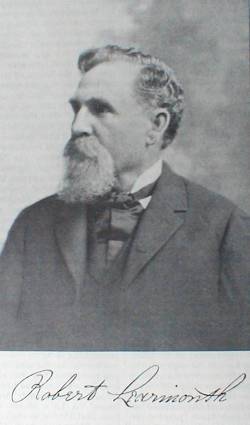
ROBERT LEARMONTH
Robert Learmonth, for many years well and widely known in connection with the handling of machinery on the Great Lakes, and at present chief engineer of the Anchor line, is a Scotchman by birth. He was born at Kingston, East Lothian, Scotland, January 30, 1831, a son of Robert and Christian(sic) (Fair) Learmonth. The father, a farmer by occupation lived at Quebec, Canada, whither he had come in 1842, and where he died in the year 1886, at the age of eighty-six years, having been born in 1800. His children were Alexander (deceased) Gavin, Janet and Robert.
Robert Learmonth came to Quebec with his father in 1842, and remained on the latter's farm in that vicinity for about five years. Subsequently he removed to Quebec and worked five years in Bissets Foundry, learning his trade of machinist and engineer. He removed to Buffalo in 1852, where he worked about a year in Sheppard's Works, now known as the King Iron Works. His first employment on the lakes was in 1853, when he put an engine in the steamer Iowa, of the Evans (now the Anchor) line, for the Buffalo Steam Engine Works. This steamer was changed from a side-wheeler to a propeller, and was commanded by Captain Pratt, with Almer Johnson as her chief engineer. Mr. Learmonth ran her only one trip. In 1854 he became second engineer of the steamer Toledo, then owned by Messrs. Lee & Able and Captain Montgomery, the last named being also her master. He was on this steamer the full season, and the season following was employed by the Buffalo Steam Engine Works to go to Milwaukee to fit out the steamer Allegheny, built by James Jones, of that city. On this steamer he was chief engineer for two consecutive seasons.
The following three seasons Mr. Learmonth remained ashore, and during those years had charge of the machinery of Stewart & Shoemaker's distillery, located at Black Rock. The seasons of 1860-61-62 he was chief engineer of the steamer Queen of the Lakes, of the Evans line, and the two following seasons was chief engineer of the steamer Pacific, of the New York Central line, running between Buffalo and Cleveland. For the next fifteen years he was master mechanic for Pratt & Co.'s rolling mill and blast furnace. This company has been out of existence since 1880, and was succeeded by The Griffin Car Wheel Company. Beginning with the year 1880 Mr. Learmonth was for three years U.S. local inspector of boilers for the Ninth district, under the administration of President Hayes, and located at Buffalo, N.Y. On July 1, 1884, he resigned that office to become chief engineer of the Anchor line which position he now holds.
During Mr. Learmonth's time as chief engineer three steamers belonging to the Anchor line have been lost. The Philadelphia came in collision with the Albany off Point aux Barques in a heavy fog in November, 1893, and was a total loss. The crews of both steamers attempted to get ashore in the two small boats of the Philadelphia, one of which being overloaded was lost; the other, containing twenty-two men, reached the shore in safety. The Winslow was burned at the dock at Duluth in 1891, and was a total loss also; she was being unloaded at the time and had very little cargo aboard. The steamer Annie Young was burned on Lake Huron, about ten miles from Port Huron, in 1890, and was a total loss. There have been added to the fleet during this time four new steamers, Susquehanna, in 1886, Codorus, Schuylkill and Mahoning, in 1892. Mr. Learmonth is also the patentee of the Buffalo Feed Water Heater and Purifier, an apparatus which has added greatly to the efficiency of the marine boiler, and is now being extensively used, with good success, on many of the largest lake steamers.
Mr. Learmonth was wedded to Miss Anna Frame, a native of Leith, Scotland, who died in 1892. Four children were born to this union, three of whom are now deceased; the other, now Mrs. John Ferguson, resides at No. 200 La Fayette avenue, Buffalo, N.Y., and with her our subject makes his home.
JOHN JAMES LEAVY
John James Leavy was born at Buffalo July 12, 1868, a son of Patrick and Mary Leavy, the former of whom was a cartman by occupation, and died in Buffalo several years ago. Our subject has only one brother, William Leavy, who was fireman on the steamer Arabia during the season of 1896.
Mr. Leavy attended Public School No. 3 in Buffalo, but because of the death of his parents in his early life he was compelled to forego the advantages of a good education, and commenced the work of his life at a very tender age. He began first by feeding the press of the Evening Telegram, at which occupation he remained two years. After a couple of months at the same work on the News, he acted as bell-boy at the "United States Hotel," Buffalo. His first employment in connection with Buffalo harbor was on the canal steamer Clock, he acting as assistant engineer for a trip which lasted a month. He then shipped as porter on the steamer Robert Mills for a month, and at the expiration of that time went as deckhand on the ferry steamer Niagara, subsequently acting as fireman and succeeding that employment as fireman of the Mascot, an excursion steamer belonging to the International Ferry Company, on which he remained four years all told. His next berth was that of fireman of the tug Alpha for a month, shipping after that as engineer of the fish tug Helen Lewis for three months, which constituted his first experience as marine engineer.
Mr. Leavy's next service was as engineer of the Dispatch, a supply boat for Messrs. Howard Baker & Co., ship chandlers on the Terrace, Buffalo, and he followed that with a term as engineer of the tug James C. Fullerton. In each of the two last mentioned berths he remained six months. He was then engineer of the small canalboat Star for a month, after which he entered the employ of the Maytham Tug line as engineer of the tug John C. Ingraham, and continued with the line about nine months altogether. The next berth he filled was that of engineer of the Ismalia, a supply boat for the Buffalo Ship Chandlery, and for the season of 1896 he was engineer of the tug A.I. Holloway, owned by Fox & Holloway, in the sand trade from Port Abner, Canada, to Buffalo. For season of 1897-98 he was engineer for second time of the Ismalia.
Mr. Leavy was married September 28, 1895, to Miss Barbara Hullmer, and they have two children: William and Nettie. The family reside at No. 208 Trenton avenue, Buffalo, N.Y. Mr. Leavy is a member of the Buffalo Harbor Tug Pilots Association.
SIDNEY LE BEAU
Sidney Le Beau is one of the seven children of John and Saphrona (Lauderville) Le Beau, the former of whom was a carpenter by trade, and was born in Odgensburg, N.Y., March 31, 1869. Mr. Le Beau began his seafaring life in 1885, shipping before the mast on the Buckley, an Ogdensburg boat, for that season, and in 1886 went as porter on the Japan. The following season he was in the same capacity on the India, on which he also commenced the season of 1888, making two trips as her lookout. He then went into the city of Fremont, wheeling her during the season of 1889, and shipped in the same capacity the next season on the Josephine, remaining for half of the season; the balance he spent on the Sheldon. The three succeeding seasons he was with Captain Brown, of Cleveland, on the Choctaw, wheeling her two seasons, and acting as second mate the third season. In 1894 he went on the Kearsage, helping to fit her out new, and remained as her second mate all season; the following one, 1895, he was about divided equally between the Hopkins and the Pearl, his service as mate on the latter ending when she was laid up, and he finished the season on the Lehigh, as second mate. For the seasons of 1896-97 Mr. Le Beau was second mate of the Juniata, and during the season of 1898 he was employed as mate of the steamer Geo. Presley, with C.D. Woodward. He has two brothers who are now sailing, George being wheelsman on the Schuylkill, and Theophile wheelsman on the Delaware. Mr. Le Beau is a painstaking, conscientious and faithful worker, paying attention to every little detail, and these qualities will ultimately, in the no-distant future, secure him command of one of the fast liners. Mr. Le Beau was married to Miss Eva Marcou, of Odgensburg, February 17, 1896, and one daughter has blessed their union. The family residence is at No. 50 Canal street, Odgensburg, New York.
CAPTAIN SETH LEE
Captain Seth Lee, now a prominent citizen and business man of Muskegon, Mich., has been one of the popular and successful master mariners. He began his career on the lakes over fifty-two years ago. He was successful because he acquired vessel property of his own, and never lost any belonging to other people; he was popular because he was a manly man, a good officer and a wholesome, hearty companion. Still possessing robust and vigorous health, he loves to go down to the steamboat landing and recount old times and adventures with the officers yet in active command of ships, this being especially true of his meetings with his shipmate, Capt. David M. Cochrane. Captain Lee is the son of George and Sarah (Rose) Lee, of Kalamazoo, Mich., and Auburn, N. Y., respectively. The father was a stone mason and contractor, and among other works built the courthouse and jail at Elyria, Ohio. He died in 1844, his wife surviving until 1891. Of their sons, George and Seth became sailors, the former, among other vessels, commanding the Sea Gull and Dawn.
Seth Lee began his career on the lakes in the spring of 1846 as cook in the schooner Citizen, commanded by Capt. Dennis McBride, who treated the boy right, according to the legend. At the close of the season the schooner was laid up at Erie, and the captain gave Seth $110 for his season's work and $10 to pay his way home to Elyria. Instead of using the money for that purpose he walked the distance, and gave his mother the entire sum. The next season he shipped in the schooner Colt with the same captain, and in the spring of 1848 in the schooner Industry with Captain Snell, closing that season in the schooner Monsoon with his brother-in-law, Capt. John Peterson, with whom he continued as sailor before the mast the next three seasons, going with him in the schooner Forest in the spring of 1852. During the next three years he sailed as mate in the schooners Wild Rover, Tartar, Eclipse, Scott and William Buckley, in the brig Julia Dean, a handsome and speedy ship, and as wheelsman in the steamer Rochester, with Capt. James Lundy.
In the spring of 1855 Captain Lee was appointed master of the schooner Ellen Kent, finishing the season in the Velocity. He followed this season with a season in the schooner Tartar, engaged in carrying stone for the construction of the old Sault canal, and in 1857 he joined the schooner Cuba as master, sailing her two seasons. His next command was the schooner Circassian, which he retained until the spring of 1861, when he brought out the schooner Kelpie, transferring to the Capt. Horn, however, before the close and sailing her until 1865. That year he brought out the schooner Presto, but after purchasing an interest in the George C. Drew he changed to her command. During the winter of 1865-66 he built the schooner Mystic, brought her out new and sailed her with good financial success for six consecutive seasons, selling her in the month of May and purchasing the schooner Kate Lyons, which he sold that fall. In the spring of 1873 he purchased the schooner Rouse Simmons, continuing to sail her until August, 1874, when he retired and accepted the position of superin-tendent of the Muskegon Boom Company, and office which he held five years. During this time, in 1877, the tug Ira O. Smith was built to Captain Lee's order. In 1879 the Captain returned to his lakefaring life as owner and master of the schooner S. Anderson, and was out in her during the fierce Alpena storm of October 16, 1880, which caused great loss of life and property. In the spring of 1881 he bought the schooner Andrew Jackson, selling her that winter. The next year the Captain founded a ferry line on Musekgon Lake with the steamers Centennial, Mary E. Menton and Ira L. Hackley, operating this line ten or twelve years; but as a motor line of cars was put on between the points reached by his steamers he gradually disposed of his boats, in 1895 trading the Centennial for a valuable tract of land near Muskegon. In conjunction with the ferry enterprise in 1882 he made contracts with the city of Muskegon for the paving of several streets. In 1888 he opened the People's Steam Laundry, which is under the immediate direction of his wife, and she has conducted it with good success for ten years, being endowed with the enterprise and thorough business methods so essential in that trade. On October 1, 1897, Captain Lee was appointed collector of customs for Muskegon.
For his first wife Captain Lee married Miss Fina Mills, daughter of Durlin Mills, of Milan, Ohio, and they had one daughter, Cora, who is now the widow of Tate Starke, who at the time of his death was superintendent of the Thayer Lumber Company. On August 19, 1874, the Captain wedded Mrs. Kittie M. (Haight) Burrows, daughter of Charles Haight, of Buffalo, N. Y., shipbuilder and contractor of the tugs Kittie M. Haight (named in honor of his daughter) and Annie Laurie. The children born to this union are Kittie M., a graduate from the Muskegon high schools, who is now assistant librarian in the Hackley public library at Muskegon, and Charles Henry Hackley, a lad of good mechanical ingenuity, who declares he will be lake captain like his father. The family homestead is at No. 172 Webster avenue, Muskegon. Socially the Captain is a veteran Master Mason of Erie Lodge No. 239, of Milan, Ohio, in which he was raised when twenty-one years old; taking his dimit, however, to Muskegon Lodge No. 140.
WILLIAM P. LEE
William P. Lee, who was born at Detroit, Mich., March 26, 1861, is the only son of Andrew and Mary (Kellett) Lee, who were natives of New York State. He received his education in the public schools of his native city, and when sixteen years of age secured employment as shipping clerk in the Pullman car shops at Detroit, which position he held for six months. He then commenced firing on the Michigan Central railroad for three years, after which he learned the molding trade, working at same for five years. At the end of this time he started steamboating, firing on tugs belonging to the Mills line, of Detroit, for two seasons, the steamer Queen of the West one season, the Starke one season, and the tug Crusader one season. He then obtained second engineer's papers, and filled that berth on the John E. Hall one season, and the Toledo No. 3 three seasons, in 1896-97 going as second to John R. Judge, on the Eber Ward, with whom he had begun steamboating in 1884 on the Mills line of Tugs.
Fraternally, Mr. Lee is a member of Amity Lodge No. 335, I.O.O.F., of Detroit, and of Detroit Lodge No. 6, A.O.U.W.
He was married, in 1893, to Miss Mary Woolen, of Lafayette, Ind., and they have two children: Bertha Elizabeth and Andrew. The family residence is at No. 1443 West Fourth street, Detroit, Michigan.
ROBERT LEITCH
Robert Leitch, a marine engineer of considerable experience, was born August 3, 1837, in county Antrim, Ireland. He is the eldest of eight children born to David and Elizabeth Leitch, the others being: Thomas, at present a marine engineer on the steamer Maine, resides in Buffalo; Eliza is married to William Herdman, who is in the employ of the Grand Trunk railway at Air Line Junction, Ont.; David is a farmer, and resides at Air Line, Ont.; Frank is a stationary engineer employed by Car Bros., of Buffalo; Annie is married to Ruben Appleyard, and resides at Stone Ridge, Ont,; Ester was married to her cousin, William Leitch, and died in 1889; and John (unmarried) resides with his father near Welland, Ontario.
When seven years of age Robert Leitch came to America with his parents, who first settled in Dunnville, Ont. From that place they moved to Welland, Ont., and from there, at the age of nineteen years, he shipped on the tug L.N.G., engaged in towing on the Welland canal and Chippewa creek. He then went in the steamer Ocean, running to Montreal; then (in 1874) went on the tug Agnes McMann, towing rafts from Collin's Bay to Lachine, near Montreal, after which he was on the tug Sam Perry and H. Kneeland, owned by Harvey Kneeland, of Port Dalhousie.
After one season (1880) as engineer of the tug Jessie, running on the Detroit river, he entered the Grummond's line, and remained about three seasons. He then returned to Welland and spent one year (1886) on a farm; but being more inclined to follow a sailor's life than that of a farmer, he soon went to Buffalo and shipped on the tug Holloway for the seasons of 1887-88-89, afterward, for 1890, on the tug Samson, engaged in towing lumber rafts from the upper ports to Tonowanda. There he accepted the position as chief engineer on the Oscoda, and remained two seasons. In 1893 he went to the Viking, owned by Gilchrist & Co., of Alpena, as chief engineer, and has since remained in that position.
On January 5, 1887, Mr. Leitch was married to Miss Sarah J. McDowel, daughter of John and Rebecca (Wilson) McDowel, natives of country Tyrone, Ireland. Mr. And Mrs. Leitch had four children: Anna Isabel, born September 26, 1877; Elizabeth Mabel, born July 27, 1879; Andrew Thomas, born February 6, 1881; and Harry Mortimer, born September 1, 1886. Mr. Leitch is a member of the Marine Engineers Beneficial Association No. 1, of Buffalo, N.Y.; also of the F. & A.M.; DeMolay Lodge No. 498, of Buffalo, N.Y. He is a member of Park Presbyterian Church, of Buffalo.
THOMAS LEITCH
Thomas Leitch is a son of David and Elizabeth Leitch, and was born March 27, 1849, in County Antrim, Ireland. With his parents he came to America, at an early age, and lived for some time in Dunnville, Ont., where his father still resides.
His brother Robert, now chief engineer of the steamer Viking, went to Welland and shipped on the tugs in the canal, in 1866, thus beginning the occupation to which he has since devoted his life. Following his example, Thomas first found employment on a tug, where he remained until he was given the position of assistant engineer on the Robinson. Upon this boat he was shipwrecked on Lake Superior, and barely escaped with his life, reaching a small island, in the yawl boat, whence he was rescued by Indians. He then spent one season on a dredge in the St. Clair Flats, after which he spent several years as assistant engineer in the propeller Celtic, owned by McKay & Bros., of Hamilton. He then acted as chief engineer in the propellers Ontario and Canada. Upon leaving the latter boat he came to Buffalo, and has since sailed upon American boats in the position of chief. After some time in the Monteagle, he spent two seasons on the propeller W. H. Barnum, and was in the Samuel Marshall. In 1896 he was in the Norseman, and in 1897 was in the Progress until October, when he went on the steamer Maine, engaged in the lumber trade from Bay City to lower ports.
On November 24, 1875, Mr. Leitch was married to Miss Isabella Herdman, daughter of James and Sarah (McCoppen) Herdman, of Welland, Ontario. They have had six children: Frank, who died in infancy; Sarah Isabella, at present employed as a stenographer in Buffalo; Hattie M.; Maggie Anna; Thomas James, who died August 2, 1889; and Florence Irene.
CAPTAIN T. LEMEY
Captain T. Lemey is well-known in Detroit and vicinity as a vesselmaster who has a thorough knowledge of marine work, at which he has been occupied all his active life since his sixteenth year. He is the youngest son of sixteen children born to Alexander and Mary (Campau) Lemey, the former of whom was a native of France, but spent nearly all his life in America. He settled in Detroit at an early day and there built a sawmill on the site now occupied by the "Biddle House." Mr. Lemey died in 1847 at Amherstburg, Ont., and his wife survived him many years, dying in the same place in August, 1885. Captain Lemey was born September 1, 1845, at Amherstburg, and there spent the first seventeen years of his life. While in his sixteenth year he sailed out of that place on the Dispatch with Capt. S. Grummond, remaining two months in the capacity of deckhand. He then went with Capt. John Edwards in the tug George B. McClellan, spent the following season with Captain Dustin on the side-wheel steamer Dart, and the next season acted as wheelsman of the L. L. Lyon, with Captain Raymeau. After leaving this boat he remained on shore one season, but he returned to the water the following year as man before the mast on the Hemisphere, afterwards sailing the same capacity on the Margaret R. Goff and James F. Joy. After acting as mate on the schooner Dakota, he was given command of the schooner Liberty, and sailed her two seasons, transferring from her to the Maid of the Mist, which he commanded for a year and a half. He then bought an interest in the Mary Amelia, and sailed her during 1874-75, after which he brought out the schooner Adventure. When his connection with this vessel was ended he entered the employ of A. A. Parker & Bro., and sailed the Eagle Wing two seasons; the Columbian and Reuben Dowd one year each; the James C. King five years; and the Anna Smith, which was lost in a storm November 28, 1889, on Lake Huron. For the next two years he took the Minneapolis, and he has since been in command of the John Oades, having now been on her for several seasons.
On May 19, 1868, Captain Lemey was married to Miss Henrietta Miller, who died March 1, 1887. They had two children; Rosetta, who died in September, 1895, and Della, who is married to William H. Lehman, of Syracuse, New York.
WILLIAM S. LENNOX
William S. Lennox, engineer of the tug H. J. Warren, of Buffalo Dredging Company, is a son of Charles E. and Hannah Lennox, the former of whom has navigated the lakes for fifty years, and is still a vessel master, residing at Charlevoix, Mich. The mother is now deceased. There were but two children in the family, William S., and Frances, who is the wife of Herman Powell, a Baptist minister, residing at Ionia, Michigan.
The subject of this sketch is a thoroughly practical tug engineer. He was born at Mt. Clemens, Mich., December 23, 1863, and at the age of four years moved with his parents to East Saginaw, where he received his common-school education. At the age of fourteen he became apprenticed in the shops of Mitts & Merrell at East Saginaw, serving five years, and later he worked a year each in the shops of Wicks Bros., at Saginaw and Smalley Bros., at Bay City. He began practical work in his chosen occupation as engineer of the fire ferry tug Handy Boy, owned by William Armstrong, of East Saginaw, whose fleet of five tugs also included the Lee, C. M. Farrar, James Hay, and Davis Sutton. The duties of these five tugs were to patrol the lumber yards, a distance of eight miles, making one trip each two hours a day until ten P. M. After a year in that employ Mr. Lennox became second engineer of the tug Matt Stickney, owned by Carkin, Stickney & Cram, a dredging firm, remaining with them also a year. His next service was as engineer of the canal tug Dickey, at Buffalo harbor. From here he became engineer of the tug M. Moore, of Maytham's line, then of the ferry tug Cornell at Grand Island, Niagara River, the passenger steamer Mascott, the ferry boat Niagara, and then of the harbor tug Gee. In the spring of 1896 he became engineer of the harbor tug O. W. Cheney, and continued in that berth during the season of 1897. During season of 1898 he was on the H. J. Warren.
Mr. Lennox was married at Grand Island, Niagara River, November 29, 1888, to Miss Ada L. McCarrick, by whom he has two children; Gordon C. and Francis H. The family residence is at No. 940 West Avenue, Buffalo, New York.
CAPTAIN SAMUEL E. LEONARD
Captain Samuel E. Leonard is a marine engineer who has distinguished himself for his bravery in rescuing persons in danger, and who is now engineer of the Main street bridge in Cleveland. His birthplace was Lancaster, Fairfield Co., Ohio, having been born there in 1865. His parents were Samuel and Mary (Bowers) Leonard, the former born in 1827, in Columbiana county, Ohio, and the latter in 1838, in Pickaway county, Ohio. Mrs. Bowers, the mother of Mrs. Leonard(sic), was born in Virginia in 1815, and is still living. Samuel Leonard was at one time a farmer in Indiana, and up to the year 1872 he was superintendent of the Ohio canal. His death occurred in 1890.
The subject of this sketch began his seafaring career as fireman on the tug Castle, in 1882. Up to that time he had been employed on the Ohio canal. He was attentive to his duties and watchful of his employers' interests, and he had advanced to such a degree in 1887 that he was able to take out an engineer's license. Four years later he was in possession of a license for pilot or captain. Other vessels he has been connected with are the steamer Cyclone, of Chicago, of which he was fireman; the tug Maytham, of Cleveland, of which he was engineer two years; the H. L. Chamberlain, Florence, Curtiss, Dreadnaught, W.W. Richardson, all of Cleveland, one year each; the tug A. Miller, of Chicago, of which he was engineer one year.
Captain Leonard has been somewhat interested in owning floating property during recent years. In 1891 he purchased a half-interest in the tug Florence, but this vessel was lost in collision September 28, the same year, and the case is still pending in the United States courts. Three years later he purchased a half-interest in the tug W.W. Richardson, selling the same in 1895 to take his present position as bridge engineer. During the year 1889, while Captain Leonard was engineer of the tug Maytham, towing rafts of logs from Rondeau, Canada, to Cleveland, he was instrumental in saving the lives of five men and a woman from the schooner Lewis Ross. The schooner went ashore near Rondeau, and was seen to be rapidly breaking up. Captain Leonard took the yawl boat of the tug, manned it with a volunteer crew and made three trips to the wreck. The yawl boat capsized twice before it reached the wreck the first time, and the four men in it were thrown into the water each time. All were good swimmers except Captain Leonard, who, as he relates the story now, could not swim a stroke but managed to get into the yawl again. All on board the wrecked schooner were saved, but the vessel went to pieces an hour afterward. Captain Leonard and the men who went with him in the yawl were promised medals of honor from the Canadian government, but have never received them.
In 1894, the Captain was married to Miss Kittie Kavanaugh, of Cleveland. They have two sons: H. B. Leonard, who was born in 1895, and S. C. Leonard, born in 1897.
EDGAR C. LEWIN
Edgar C. Lewin, of Detroit, Mich., was born in Fall River, Mass., in the year 1844, and moved to Detroit when quite young. He went on the lakes after leaving school, beginning as fireman on the tug George B. McClellan, then owned by Hunter, Wilcox & Trowbridge, on which he was engaged one season, and the following year he fired on the steamer Sheridan. He then enlisted in the regular army and went West for seven years, at the end of that time returning to the lakes. He served a season on the P. H. Birckhead as second engineer, and another season in the same capacity on the steam barge Tempest, after which he fitted out the steam barge Bessie, in which he remained for one season as chief engineer, the following year shipping on the steam barge Ruby, where he remained four years, the first two as second engineer, and the last two as chief. After leaving the Ruby he became chief engineer of the steam barge Marsh, which was chartered in the lighthouse service, and he was on this boat when the Cleveland lighthouse was removed from the piers to the crib on the breakwater. Later Mr. Lewin was chief of the steambarges Shephard and Mary Pringle, one season each, and he then went to Chicago, where he served as chief during one year on the tugs Hood and Protection. He started the following season on the Protection and then returned to Detroit to take the position of chief engineer of the tug Carrington. Mr. Lewin left the lakes in 1890, and for two years was engaged in hoisting stone for the Hammond & Hudson buildings in Detroit, in 1892 becoming chief engineer for the Gaylord Iron Company, where he is still retained. Mr. Lewis is married and has two sons: John and William.
CAPTAIN CHARLES H. LEWIS
Captain Charles H. Lewis was born in Watertown, N. Y., April 17, 1855. He is the son of Charles A. and Mary E. (George) Lewis, the father born in Watertown, N. Y. September 18, 1825, and the mother in Lowell, Mass., April 24, 1834. The father removed to Peoria, Ill., in about 1853, where he was made agent of the Illinois Central railroad and returned to Watertown in 1855, dying there when Capt. Charles H. was an infant of four months.
The subject of this sketch was educated in the public schools of his native town, and began his lakefaring life April 21, 1872. He shipped out of Cape Vincent, N. Y., June 21, 1872, as deckhand, on the steamer Lawrence for one round trip, but not being prepossessed with that line of work he did not sail again until 1880. During this interval he worked with his stepfather on the farm, and established himself in the milk business at Watertown. N. Y. In the spring of 1880 he concluded to try the issue on the lakes again, and shipped on the steamer Portage as lookout, closing the season as wheelsman; in 1881 he went as wheelsman on the steamer Avon; 1882, on the steamer J. Gould as wheelsman, finishing the season on the H. J. Jewett; 1883, shipping on the steamer Buffalo as wheelsman; 1884, on the steamer Newburgh as wheelsman; 1885, as second mate, closing the season as mate of the Newburgh, and the following season as second mate on the steamer A. L. Hopkins, finishing the season as mate; and in 1886 as mate of the Hopkins, continuing in that position until the fall of 1890. In the spring of 1891 he was appointed mate of the steamer John C. Gault, holding that berth until 1893, when he was advanced to the position of master, and sailed her for the seasons of 1894, '95, '96, '97 and '98. He is a member of the Ship Masters Association, and carries Pennant No. 999.
In March, 1890, Capt. Charles H. Lewis was united in marriage with Miss Anna Black, of Buffalo, N. Y. The family residence is at No. 7 Red Jacket boulevard, Buffalo, New York.
J. E. LEWIS
J.E. Lewis, whose papers as marine engineer date back to 1867, is one of the best known and most universally esteemed men on the lakes. He carried on an engineers, supply store in Detroit for many years and had the reputation of being honorable and upright in all his dealings.
Mr. Lewis is a son of Daniel and Mary (Barker) Lewis, and was born June 6, 1848, in Utica, N.Y. His parents were born in the northern part of Wales and came to the United States in the year 1835, locating in Utica, in which city the father opened a wagon shop. In the course of time he gained a large patronage and became fairly prosperous, continuing the business until the fall of 1855, when he sold out and removed to Detroit. In 1861 he constructed the little steamer Star on Hog Island (now Belle Isle), and took her to the Saginaw river, where he used her as a ferry between the two cities of that name. He was prompted to become a shipbuilder one day while in the wood on the Island, chancing upon a tree that was bent after the fashion of the bow of a boat, and cutting the tree he at once went to work on the little steamer. He reached Saginaw with her on the Fourth of July, his son James being with him, and commenced business, the receipts the first day amounting to over one hundred dollars, and he continued ferrying on the Saginaw river until 1867. In 1863 Mr. Lewis built the side-wheel steamer Excelsior at Saginaw, and in 1864 the steamer S.R. Kirby, the work being done under the supervision of Mr. Kirby, father of Frank Kirby, of the Detroit Dry Dock Company. He also owned the tug May Belle, but did not keep her long.
J.E. Lewis received his primary education in the public schools of Utica, and graduated from the high school in Detroit. He served his apprenticeship to the machinist's trade with the Wickes Brothers, of East Saginaw. Mr. Lewis' first marine experience was gained in 1861-62, as wheelsman in his father's boat Star, and he went as engineer on the Excelsior the next two years. He passed the succeeding seasons in the tug May Belle and steamer S.R. Kirby (taking out engineer's license in 1867) up to the year 1869, when he left Saginaw and went to Detroit, shipping in the steamer Gem, then plying in the ferry between Windsor and Detroit. He remained in that employ eight years, being transferred as chief engineer into the steamers Argyle and Hope. In the spring of 1877 he entered the employ of the old Northern Transportation Company as chief engineer of the City of Toledo, following with a season in the steamer Clara. In 1879 he stopped ashore in Detroit and took charge of the machinery in Clee's mill, retaining that position three years. In 1882 Mr. Lewis was appointed assistant United States boiler inspector for the Detroit district, William J. Wray being the chief, but he resigned this office to accept a position with the Brush Electric Light Company, for whom he ran the first tower that ever gave forth electric light in Detroit. In the spring of 1884 he opened an engineer's supply store, dealing also in lubricating oils, at No. 36 Jefferson avenue, and carried on profitable business until the Standard Oil Company interfered with him in the fall of 1887, when after a struggle he discontinued the trade. Mr. Lewis then went to West Bay City and put the machinery into the steamers F.W. Wheeler and W.H. Gratwick, built at Mr. Wheeler's yard. In the spring of 1888 he returned to Detroit and shipped as chief engineer with Capt. J.M. Mitchell in the steamer Saginaw. The next year he opened a produce and commission store in Detroit, which he conducted successfully until his retirement from business in June, 1895. On the 19th of that month he again entered the Government employ as engineer of the steamer Florence B., the first mail boat on the Detroit river engaged in delivering mail to passing vessels, remaining in this service until May 14, 1898, when he was appointed chief engineer of the passenger steamer City of Holland, plying between Holland and Chicago under command of Capt. J.M. Mitchell.
On January 3, 1873, in Chicago, Mr. Lewis wedded Miss Margaret Flood, of Detroit, the marriage ceremony being performed by the Rev. Dr. Daniels. The children born of this union are: James E., Jr. (who has pilot's papers and has held that office on the passenger steamers Flora, State of Michigan and Atlantic, of the Grummond line), Fred W., William B., Frank and Mary A. Mr. Lewis recently established his sons in the produce and commission business in Detroit, in which they have met with encouraging success. The family home is at No. 16 South street, Detroit, Michigan.
H. D. LIGHTHALL
H.D. Lighthall, who has been engineer of the Times building, Chicago, since 1895, was born in Huntingdon, Canada, in 1857, a son of H.S. and Ellen (Crinklaw) Lighthall, the former a native of Troy, N.Y., and the latter of Essex county, the same State. The father now resides in Chicago. Our subject was reared and educated in New York, and when a boy went on the lakes, being identified with the lake marine for many years.
In 1870 Mr. Lighthall began sailing from Ogdensburg, N.Y., as mess boy on the steamer Ada in the United States lake survey, and remained two years in that service. He was then employed as second cook on the steamer Glasgow, but finished the season as first or chief cook. The year 1874 was spent in the East, and the next season (1875) was on board the ferryboat plying between Odgensburg and Prescott - the steamer Transit, of the Grand Trunk and Vermont Central railroads - remaining on her until August of that year. The following three years he was with the Whitney line, of Detroit, on the Albany, and then came to Chicago, where he fitted out the Garden City, plying between Chicago and Ludington, Mich., in the passenger and freight trade. He served as lookout on her for a time, and afterward engaged in firing on the steamer Nashua. He fitted out the Champlain at Cleveland, Ohio, and was on her until July, when he transferred to the Albany, but left her at Odgensburg, N.Y., after one trip, and shipped on the India, making one trip, to Saginaw, Mich., and the same year (1879) he was on the Adirondack for a time.
After a short time spent on the Welland canal, he returned to Ogdensburg as lookout on the steamer Maine, and was later on the City of Toledo. In 1880 he came to Chicago and shipped as wheelsman on the steamer Anna Laura, engaged in the lumber trade, but remained on her only twenty-five days, when he transferred to the schooner William Jones. He then made a trip to Hancock on the steamer Peerless, of the Leopold & Austrian line, after which she was laid up in Chicago. The next season Mr. Lighthall helped to fit out the Game Cock, engaged in the lumber and grain trade, and on her filled the berth of cook. He was next on the Anna Dall, engaged in the lumber and stone trade, and from her went to the City Chicago, laying her up at the close of the season. He was then steward on the Lincoln Dahl a part of a season, also on the Charles Reitz, followed by a season on the schooner Ada Thedora, running to Sandusky and Traverse City in the lumber trade. His next berth was on the Allegheny, of the Anchor line, for a part of a season, and on leaving her at Chicago shipped on the George Dunbar, where he finished the season and remained until October of the following season. After a time spent on the tug Prindiville he transferred to the tug Tom Brown, remaining on her two seasons, and he then accepted the position of assistant engineer for Donahue & Henneberry in Chicago. The following season he was in St. Paul, Minn., until July, when, coming back to Chicago, he shipped in the steamer Worthington and closed the season on her. The next season he was engaged in the lumber business on Cedar River, and then returned to the lakes, shipping on the Hattie Perew for a part of a season, and from her transferred to the Worthington, on which he finished the season and remained the following season. Retiring from the water in 1891, he entered the employ of Mr. Leiter as engineer, and in 1892 was chief engineer of the Lee's estate at Nos. 108 and 110 Randolph Street. On resigning that he accepted his present position as engineer of the Times building. He received his first issue of license as engineer in 1891, and is now a member of the Progressive Stationary Engineers Association No. 3 and of the Knights of the Maccabees.
In 1881 Mr. Lighthall was married in Chicago to Miss Hattie Behnke, and they now have two children: Henry Schuyler and Agnes Ruth.
JOSEPH LIMBERGER
Joseph Limberger is not in active service on the lakes at the present time, yet he may well be classed among marine men, for he is widely known among the lake engineers and was identified as one of them for many years. He was born March 22, 1847, at Detroit, Mich., and in that place has lived the greater part of his life. His first sailing was done in 1866, when he went on the Henry Howard as deckhand, and after this he was on the City of Port Huron, in 1876 shipping on the River Queen as fireman. He then served in the same capacity on the William A. Moore and the St. Joseph, after which he spent three years on the Winslow as second engineer. He served one year upon the North West as greaser, and the same length of time as second engineer on the Atlantis; after acting in the latter capacity on the St. Paul, H.S. Pickands and George L. Caldwell he entered the employ of the Detroit, Belle Isle & Windsor Ferry Co. and sailed as chief engneer on the Excelsior, Garland and Fortune. For part of a season he was on the J. Emory Owen, but on account of illness was unable to finish the year and returned to Detroit, since when, with the exeption of one season on the yacht Magna as chief engineer, he has not sailed. In 1893 he accepted the position of chief engineer for the school board of Detroit, in order to be near home, was located in the Lincoln school and has remained there ever since.
On January 7, 1885, Mr. Limberger was married to Miss Ellen Brown, of Windsor, Ontario; their only child, Tillion P., is attending school at the present time. Mr. Limberger is a member of the Marine Engineers Beneficial Association and Stationary Engineers Association of Detroit.
CAPTAIN PATRICK LINN
Captain Patrick Linn was born in Buffalo January 4, 1849, a son of Capt. Charles and Margaret Linn, the former of whom will be remembered by some of the older lake sailors, he having been one of the old lake captains, dying in the year 1881; he was one of the best known captains on the lakes in his day.
Our subject passed his schools days studying the common branches in the schools of his native city. While sculling a ferry boat back and forth on Buffalo creek, he laid the foundation for the career which he has followed up to the present time. The first vessel he shipped on was the bark Great West No. 1, in 1859. After the bark was laid up in the fall he dropped back to his first occupation on the ferry boat. The following seasons he shipped on the schooner B.F. Wade, and followed this by some experience in the Arcturus, Invincible, Lookout, schooner Cascade, Hans Crocker and May Collins; he was mate of the schooner Minnehaha one season, at the wheel on the propeller F.W. Backus, and was also second mate of the propeller Iowa. He then turned his attention to the tugging business, being appointed master of the tug Last Witness, owned by John Brown, of Canada, who had a contract to dredge out Saginaw river and shoal spots in Saginaw bay. Returning to Buffalo he entered the employ of Mr. Dunbar on harbor tugs out of that port, sailing during his engagement the tugs A. L. Griffin, Alida, Dart, Day Spring, Daniel Boone and Tiger. After severing his connection with this line he shipped as wheelsman on the propeller Winslow, holding that berth one season, and next entered the employ of the Tonawanda Tug line, remaining with the same boat five years. During this time he sailed the tugs Ada, J.W. Cramer and F.L. Danforth, taking the latter boat up to Duluth, she being the first steam-propelled vessel entering from St. Louis bay past the present piers into the port of Duluth, the channel not being yet cut into Lake Superior.
The Captain then returned to Buffalo and entered the employ of the Hand & Johnson Tug line, with which company he still remains, now holding the position of senior master of the line, having been in this line since 1879, the year it was established. He has had the honor of bringing out all of their new tugs since J.B. Griffin (of which he was master) was launched. The list includes the J.B. Griffin, John Johnson, Buffalo, James Byers, R.H. Hibbard, Cascade No. 1, and Cascade No. 2, of which he is now master. During his life on the water Captain Linn has saved at least twenty persons from drowning. His first rescue was during his early boyhood, when he was ferry boy, two women being saved through his efforts. Another time, in the night, a man walked off the dock into the creek, and the Captain saved him, and after working with him a long time succeeded in reviving him. The man walked away without even saying "thank you," and Captain Linn has never seen him since. He has also saved a great deal of property that has been wrecked, being more than ordinarily successful in that line. He is a member of the American Association of Masters & Pilots of Buffalo.
In 1873 Captain Linn was married to Miss Ellen Farrell, and they have had five sons and three daughters: Mary Ellen, Mathew T., Alonzo, Johnnie, Etta, Jennie, William and James. Of the sons, Mathew T. and Alonzo, follow the lakes, the former as engineer and the latter as mate.
MICHAEL LIVINGSTON
Michael Livingston, the hale and hearty mate of the Toronto Ferry Company's steamer Mayflower, comes from a family of sailors, his father, a native of Scotland, having been an officer on an English man-of-war, and in fact served in the Royal navy for some twenty-one years, when he retired honorably on a pension. Our subject's mother was an English woman.
Mr. Livingston has now been sailing for over forty-five years, and although compara-tively an old man, he has a most marvelous memory, and recalls his early experiences on the Great Lakes with the utmost ease. At the age of sixteen he shipped on the fore-and-aft schooner Trafalgar, which had a capacity of 20,000 bushels. He then went on the schooner Peerless, of Bronte, remaining on her nine years, when he joined the crew of the schooner Lewis Shickluna. From the Shickluna he went on board the Sir Edmund Head, of St. Catharines, remaining on this boat for two years. After this Mr. Livingston was for nine years on the tug N. P. Sprague, engaged in towing rafts from Malden to Buffalo and Tonawanda, and then for a season he was mate of the three-mast schooner Gibraltar, of St. Catharines. He was afterward respectively on the fore-and-aft schooner J. McLeod, of St. Catharines; mate on the Queen of the Lakes, the Hotchkiss (which has a capacity of 1,500,000 feet of lumber); the Otonabee, mate of the famous old tug Robb, which took an active part in repelling the Fenian invaders in 1866, and still exists as a dismantled hulk alongside the dock at Victoria Park, Toronto. Mr. Livingston was afterward on the steambarge Wales, engaged in the lumber trade, and has for the past eleven years been in the service of the Toronto Ferry Company, being at present mate of the steamer Mayflower.
He has been twice wedded, his last marriage taking place September 22, 1897, and he resides at No. 269 Jarvis street, Toronto, Ontario.
SAMUEL A. LLOYD
Three names closely connected with the history of the Great Lakes are William A., Mark A. and Samuel A. Lloyd, three brothers, all of whom have taken an active part in marine work for many years. Of these, the last, Samuel A. Lloyd, was employed many years as a marine engineer, but for time has been employed in Cleveland, as foreman in the establishment known as the Cleveland Block Company. He was born February 26, 1852, in Westminster, Canada, and is the son of William and Margaret (Currie) Lloyd, natives of England and Scotland, respectively. William Lloyd died at Chatham, Ontario, December 8, 1885, having spent his life as a millwright and the owner of a small machine shop at Morpoth, Ontario. Mr. Lloyd survived his wife, however, who died November 10, 1860.
At his native place Samuel Lloyd had lived only two years when the family removed to Morpoth, Ontario, where he resided until he reached his fourteenth year. At this time he entered a shop at Chatham, and served three years to the trade of machinist and practical engineer, after which he began the marine life by sailing on the City of Chatham, which came out in August of that year. Upon the Passport, Kingston and Manitoba he acted as oiler, and then as second engineer on the Quebec and Bob Hackett. At this time he came to Cleveland and spent five months on the Superior, and several seasons afterward on the following named boats: Selah Chamberlain, J.S. Fay and A. Everett as second engineer. The following season the position of chief engineer on the John N. Glidden was given him, and the season after the same position on the Egyptian. Remaining one and a half seasons on the last named boat, he came on the Continental and finished the year after August, and came on the Marquette the following spring, where he remained one season. After a season spent on the Continental as chief he came off the lakes, and since 1892 has not been in active marine work.
On June 4, 1879, he was married to Miss Jennie Smith, of Ridgetown, Ontario. They have two children, who are both in school at the present time: Nelle Margaretta, who was born August 12, 1881, graduated with honors and is now attending college; and Myrtle Edith, born October 8, 1886. In social life Mr. Lloyd is well known, being a member of the I.O.O.F., Mayflower Lodge, No. 679; and the M.E.B.A., No. 2, of Cleveland
WILLIAM A. LLOYD
William A. Lloyd, well known throughout the lake region as a skillful machinist and marine engineer, is superintendent of the machinery department of the Ashtabula Harbor Ship Chandlery Company. He removed to Ashtabula in the spring of 1897 from Cleveland.
Mr. Lloyd was born on April 2, 1853, in Morpeth, Kent county, Ontario, and is the son of William and Margaret (Currie) Lloyd. His father was born in Brecknockshire, South Wales, and came to America about the year 1840, locating on Lake Ontario. He followed the trade of millwright, erecting mills on the Isle of Tonty and at St. Thomas. It was Mr. Lloyd, Sr., who transported by team the first load of rails used in the construction of the Great Western railroad, from Port Stanley to London, Ontario. At the close of this contract he opened a machine shop and foundry at Morpeth, later removing to Chatham, where he entered the employ of Hislop & Ronald as millwright and foreman of the pattern shop. He died in 1887. The mother or our subject was born near Picton, Ontario, of an estimable family, and preceded her husband to the realm of death, passing away in 1860.
William A. Lloyd attended the Canadian schools at Morpeth and at Chatham, and acquired the education peculiar to the youth of the period, after which he worked as carriage painter one year at Chatham. In 1866 he entered the employ of Hislop & Roland to learn the machinist's trade, remaining with that firm three years, his duties at times taking him on shipboard, the steamer Tecumseh being the first boat on which he sailed. For two years after he finished his time as apprentice he worked at the trade in St. Catharines, Dundas and other Canadian towns. In the spring of 1870 he obtained the position of chief engineer on the steamer Manitoba, where he remained until fall, and the next season he was appointed chief engineer of the side-wheel passenger steamer Alice P. Stewart, fitted with a beam-condensing engine. He closed the season as chief engineer of the side-wheel passenger steamer Alexander, she having a high-pressure engine. In the winter of 1872 Mr. Lloyd stopped ashore and worked at his trade at Detroit, Windsor, Port Huron and Sarnia until 1877, when he took the berth of engineer on his father's tug, Hero, plying on the Sydenham river. That winter the Hero was sold, rebuilt and her name changed to Henry Smith. Through some default in the payment of the purchase money she reverted to the original owner, and finally passed into the hands of our subject. In 1878 he leased her to other parties, and the next year assumed command and sailed her as master until August, when he sold her to a Mr. Miller, of Detroit, and that fall went to Cleveland and worked in the Cayahoga Furnace. During the two years that he remained there he took out American engineer's license, which was granted by Thomas Fitzpatrick, local inspector. In the spring of 1882 he shipped as second engineer on the steamer Robert Wallace, serving two years with Edward Prince and F. Kirby, respectively. In the spring of 1884 Mr. Lloyd brought out new the iron steamer William Chisholm, the second iron steamer built in Cleveland. That fall he laid her up in Chicago, and upon return to Cleveland entered the employ of the Globe Iron Works as foreman of the erecting shop, where he remained until the winter of 1889. During this period he built the engine of the steamer Cambria, the first triple expansion on the lakes, and all other engines under construction by that firm up to the time mentioned above.
In 1890 he started business on his own account, designating his works the Continental Machine Company, and continued to do general marine repair work, also manufacturing deck hoists, shears, marine engines, etc., until the fall of 1893. On account of the financial stringency that year, he discontinued business and entered the employ of the Union Casualty Insurance Company, as inspector of boilers and machinery, afterward entering the employ of the Cleveland Ship Building Company. In the spring of 1895 he was appointed chief engineer of the steamer Specular, on which boat he remained until September, when he again returned to the Cleveland Shipbuilding Company, and was employed in putting in engines and machinery in the steamers Maricopa and George N. Orr, then under construction at Chicago. He then returned to Cleveland and engaged in setting up machinery and blowing engines for the company until March, 1897, when he removed to Ashtabula to take charge of the machinery department of the Harbor Ship Chandelry Company.
He is a member of the Marine Engineers Beneficial Association, of the order of Maccabees and a Master Mason of Bigelow Lodge of Cleveland.
In 1891, Mr. Lloyd was united by marriage to Miss Marietta, daughter of Robert and Martha Thompson, of Cleveland. Three children have been born to this union: Pearl A., Mark A. and Harold F. The family residence is at No. 27 Hubbard street, Ashtabula, Ohio.
CAPTAIN C. W. LOCKWOOD
Captain C. W. Lockwood, a noted ocean and lake navigator, and a master of wide experience, is a descendant of a family of shipbuilders doing business at Ashtabula, Ohio. He was born in that city on March 13, 1836, and is the son of Edmund and Elizabeth (Wilkins) Lockwood, who had four children – Charles W., Edward W., Eugene, and Ellen, now Mrs. Felix Perew, of Ashtabula. The father was born in Onondaga county, N. Y., son of James Lockwood, who removed with his family to Ashtabula in 1808, transporting the household effects by ox-team. The great-grandfather emigrated to the United States from England with two brothers, Erastus and Garrett, in the year 1668. After the arrival of the family at their new home in Ohio, Edmund Lockwood and his brother, who had learned the shipbuilding trade, opened a shipyard and took contracts for the construction of vessels, the first one launched by them being the schooner Whittlesey, in 1834. Then followed the Windom and Convoy, which they built near Conneaut; the steamer Julia Palmer, at Monroe, Mich.; the brig Joshua R. Giddings, at Ashtabula; the R. R. Johnson and Snell, at Fairport; the Ontonagon and Falena Mills, at Madison, Ohio; the schooner Dahlia, full-rigged brig Oleander, brigs Constellation and Chicago, at Ashtabula. The father then purchased the tug Lady Franklin, which he rebuilt and sailed, and later built the tug George B. McClellan, for Captain Lunday, of Cleveland, which was his last boat; he made the model, however, for the Edwin Harmon in 1866.
Charles W. Lockwood attended the schools of his native place and studied for one term at the Kingsville Academy, after which he worked one year in the shipyard with his father. In the spring of 1853 it was his pleasure to adopt the career of a sailor, and he shipped on the brig Powhattan, remaining the entire season. The next spring he went before the mast on the schooner Puritan, was made second mate in July, changed to the schooner J. G. King as mate, and then to the brig Monteith, which was soon after wrecked near Fairport. He closed the season on the schooner Petrel, which he left in Grand Traverse Bay, December 9, and walked about one hundred miles through the forest to Croton, Mich., thence to Kalamazoo, where he secured transportation for Buffalo. In the spring of 1855 he shipped on the brig Empire State, as seaman, and was promoted to second mate, holding that berth until September and finishing the season on the brig Boston.
In 1856 Captain Lockwood went to San Francisco, Cal., and thence to Forbestown, where he worked in the gold mines some months. Not striking it very rich, he returned to San Francisco and shipped on the bark Ivanona, in the coasting trade, after the first trip receiving promotion to the office of mate and holding that berth eighteen months, until he joined the schooner Isabelle Ebbitts, also as mate. He was then appointed master of the Far West, sailing her until 1859, when he was given the J. K. F. Mansfield to sail, continuing on her nine months, and subsequently for six months on the James E. Murdock; he also sailed the schooner Sovereign, all for the same owner, and the brig Coricoa. He then took the schooner Augusta as master on speculation to Frazier river, during the trouble in that region, and brought down a load of passengers. In 1861 he came out as master of the brig Wolcott, sailing her the entire year.
In 1862 the Captain left the coasting trade and joined, as second mate, the full-rigged ship Hemisphere, San Francisco to Hong Kong, China, during this voyage of eight months finishing his studies in navigation. He then shipped on the schooner Mary, on a voyage to the Armour river with a cargo of provisions for a government station. In 1863 he was appointed master of the schooner Brilliant, and afterward of the James E. Murdock. In April, while riding out a gale at anchor, the Murdock parted her mooring chains and went ashore near Noyo river, above Mendocino. When the sea went down he tightened her up and recaulked her, got her on ways, launched her and took her to San Francisco. On June 12, after accounting to the owner, he took passage on the steamer Moses Taylor and returned to New York, thence to the lakes, and shipped on the bark Golden Fleece. In the spring of 1864 he engaged as mate of the schooner Gen. Franz Sigel, but before the season was far advanced he went to New York and shipped as mate of the brig Neponsite, bound for Mediterranean ports, the voyage lasting about eleven months. On his return to the lakes the next year he sailed as mate on the schooner Dauntless, closing the season as master of the bark Fame. In the winter of 1866 Captain Lockwood took out steamboat papers and came out in the steamer Mendota and the G.L. Newman. On leaving this berth he went to Boston and made voyages in the coasting trade between that port, Philadelphia and New Orleans in the bark Mechanic. He passed the next year in the marine insurance business in New York, and in 1868 engaged in the roofing business until September, when he sold out and shipped on the Ward J. Parks, of Boston, bound for Mediterranean ports. During this voyage the ship had all kinds of weather, and smallpox having broken out, the crew was short handed; during the prevalence of a hurricane the Captain stood a trick of fourteen hours at the wheel, and he was on duty for six weeks without turning in. The vessel had a cargo of raisins valued at $250,000. On returning to the lakes the next spring he joined the schooner Vanderbilt in 1870, at the end of the season proceeding to New York and joining the schooner Annie Bliss, in the West India trade, with which he remained two years. In 1873 he was mate of the Mocking Bird on the lakes; 1874, mate of the schooner J.D. Sawyer, 1875, mate of the schooner A.W. Smith, in the coasting trade on the Atlantic; 1876, master of the schooner R. E. White, in the wood trade between ports in Virginia; 1877, mate of the steamer City of Dallas, of the Mallory line, out of New York. In the spring of 1878 he was appointed master of the schooner John Schuette, of Green Bay, Wis., and took her down to the Atlantic on a voyage to Gloucester, England, with deals, returning to Wilmington, N.C. His next voyage was to Hamburg (with naval stores) and return to New York (with phosphate), and was followed by a voyage to London and return to Wilmington, N.C., then to Riga, Russia, on the Baltic Sea, thence to Portsmouth, England, engaging in the coasting trade to Sunderland, where he loaded coal at $2.50 per ton, gold, for the West Indies. He then took sugar for Montreal, loading salt for Chicago, and arriving there in September, 1880, by way of the St. Lawrence river. This was the last of the Captain's voyaging on the ocean.
In 1881 he became mate and then master of the schooner Maria Martin; he sailed the Colonel Cook the next three seasons; in 1884 the J.S. Richards; the H.P. Baldwin four seasons; in 1887 the M.E. Tremble; in 1888 the George W. Adams; in 1889 the J.G. Masten, Thomas Quayle and Frank Perew; the B.L. Pennington four seasons; in 1895 was mate of the steamer Bulgaria; in 1896 mate of the steamer Nahant, and in 1897 master of the schooner Columbia for part of the season. He has thirteen issues of lake licenses and a number of salt-water papers, which give him an enviable record as a seaman and navigator who is never at a loss to define his position on the water, a fact which will be acknowledged when it is asserted that he has never been ashore but the one time noted above during the forty-four years he sailed on lake and ocean. He carries Pennant No. 85, of the Ship Masters Association. Socially he is a member of the Order of the Knights of Honor.
On January 11, 1883, Captain Lockwood wedded Miss Jennie Henderson, daughter of John Henderson, Esq., of Elgin, Morayshire, Scotland. The Captain first met his wife in Buffalo, but the marriage ceremony was performed in Cleveland. Three children have been born to them, Nettie Estelle, Leslie Brown and Ann Besant, who died young and was laid to rest in Riverside cemetery, Cleveland. In 1890 the family removed to Ashtabula, where they now reside, at No. 38 Main street. Mrs. Lockwood keeps her home surrounded with choice flowers, and Miss Nettie fills it with music.
D. LONG
D. Long, second mate of the Milwaukee, was born in 1858, in Hamilton, Ontario. He grew up in the city of Milwaukee, and at the age of eighteen years shipped as watchman on the steamer Saginaw, plying between Milwaukee and Grand Haven, and remained with her in that capacity two years. He then served as lookout on the same steamer, a season, and for another season as wheelsman. During four winters when the boat was laid up, he was her watchman. About the year 1880, he shipped as second mate on the Flora, which ran between Milwaukee, Wis., and Ludington, Mich. From the Flora he went in the same capacity on the steamer John A. Dix for one season, travelling(sic) the same route, and the next season was first mate of the same steamer. The following season he shipped as second mate on the steamer Minneapolis, which ran between Chicago and Buffalo. About eight years ago Mr. Long entered the service of the Graham & Morton Transportation Co., with the exception of one season, when he was second mate of the steamer Wisconsin, has since been with that company and in the capacity of second mate. Mr. Long has served his employers faithfully, and is a capable officer. Socially he is a member of the Maccabees Lodge No. 203, of Milwaukee, in which city he makes his home.
The parents of Mr. Long were Daniel and Agnes (Brady) Long, natives of Ireland. His father was a farmer by occupation and left Canada, removing to Milwaukee when our subject was about ten years of age. His death occurred in that city in 1888, and the mother passed away in 1896, and she now rests beside her husband in the cemetery at Milwaukee.
CHARLES LORIMER
Charles Lorimer, the subject of this sketch, was born at Banffshire, Scotland, in 1854. He is the son of John and Isabella (Taylor) Lorimer. His father was a veterinary surgeon of high repute among horsemen. Charles acquired his education in the public schools of his native shire. In 1876 he entered the employ of the Tochineal Brick Company, and ran a stationary engine in their works, remaining with that company six years. In the spring of 1882 he came to the United States, locating in Detroit, Michigan, where he worked for Messrs. Ferguson & Co. until the spring of 1886, when he shipped as oiler on the passenger steamer City of Mackinaw, holding that berth six years. In the spring of 1893 he took out an engineer's license and shipped on the Republic Iron Company's steam monitor Chocktaw, remaining one season, when, in 1894, he was appointed assistant engineer on the steamer James Fisk. In 1895 he sailed as assistant engineer on the passenger steamer State of Ohio, out of the Cleveland and Buffalo Transit Company. In the spring of 1896 Mr. Lorimer transferred to the new steamer City of Buffalo, of the same line, as first assistant engineer, which berth he held two seasons, and in 1898 was chief engineer of the steamer State of Ohio. He has four issues of marine engineer's license.
Mr. Lorimer is a man of genial disposition, a careful and competent engineer, and has gained for himself a host of friends during his residence in the United States.
ANSON LOVELESS
Anson Loveless was born April 19, 1856, at Muskegon, Mich., son of Charles and Elizabeth (Piggott) Loveless, are natives of Pennsylvania and Canada, respectively. They are still living and reside at Fremont, Michigan.
Anson Loveless attended school at his native place until he was eighteen years of age, when he went to Ann Arbor and served two years at the machinist's trade. In this occupation he spent seven years altogether, and then began his marine life, shipping on the steamer Massachusetts as oiler. He served three seasons in that capacity upon the Minnesota, Manhattan and Manchester, in December, 1890, receiving his papers. The following year he spent in Milwaukee as engineer of the Milwaukee Light & Power Co., and upon his return to the lakes he became second engineer on the William H. Wolf for part of a season, finishing same on the Lackawanna, afterward spending a year and a half on the Escanaba and the same length of time on the E. P. Wilbur. In 1896 he came on the Parks Foster to fill the position which he now holds. Mr. Loveless has traveled extensively throughout the United States, has visited the Pacific coast twice, and made a trip to China on the City of Pekin as ship machinist.
Mr. Loveless was married, June 8, 1876, to Miss Jennie Hough, of Kingston, Ontario, who died in December, 1878, leaving one child, Minnie, who still lives at her father's home. On January 1, 1896, he was married to Miss Jeanette Stewart, of Racine, Wis., and they have one child. Socially Mr. Loveless is a Royal Arch Mason, a member of the Eastern Star, I. O. O. F., M. E. B. A. and Hoo-Hoos.
CAPTAIN JOHN LOWE
Captain John Lowe was born December 9, 1839, in Aberdeen, Scotland, and he came to the United States with his parents at the age of seven years, settling in Cleveland. He went on the lakes in 1852, as boy on the steamer John Hollister, on which he spent one year, and commenced learning the trade of ship carpenter. He was employed in various shipyards in Cleveland for a number of years, sailing at odd times. Among the vessels with which he was connected were the schooners William B. Castle, Corinthian, E.M. Peck, Kosciusko, Great West, the barks Massillon, Colorado, and the Ethan Allan, and the schooners Plover, Challenge and R.G. Winslow. He followed his shipbuilding pursuits until he was competent to draught and mould a schooner, and he has assisted in the construction of vessels in Cleveland, on the lake shore east of Cleveland, and in Lorain, being associated with Roderick Calkins, Ira La Frienier, Quayle & Martin, Luther Moses, Peck & Masters, Capt. William Treat, George Washington Jones and Stephenson & Presley.
For three years, commencing in August, 1862, he served in the Civil War, being two years in the army and one year in the navy. He was a member of the Nineteenth Ohio Battery under Capt. J.C. Shields, which, after being transferred to the Covington barracks joined Burnside on the march into Tennessee, having participated in the pursuit of John Morgan just previous to that time. He was with Sherman at Chattanooga, and in all the engagements until after the battle of Kennesaw Mountain. Then he was transferred to the United States Navy at Cairo, Ill., on receiving-ship Siren, and became carpenter's mate of the dispatch-steamer General Lyon. In 1865, at the close of the war, he returned to the lakes, resuming his work in the shipyards during the winter, and sailing during the summer season being connected with the schooner Idaho, Colonel Cook, and the schooner Fayette Brown, as mate, after which he was given command of a steamer on the Lake Superior mail route in 1871-72. In the seasons of 1873-74 and 1875 he sailed the schooner George W. Holt, after which he sailed the schooner Frank R. Perew, three years; the steamer D.M. Wilson, two years; the steamer Tacoma, one year; the steamer Wallula, four years; the steamer Spokane, one year; and the steamer Kaliyuga, nine years. He is connected with the Bessemer Steamship Company.
In 1871 he was married to Miss Kate Porter, who departed this life, leaving a son, John C. Lowe, who is now (1898) engaged in the study of medicine. In the year 1877, Captain Lowe married Miss Clara Jones, of Cleveland, Ohio. Their children are: Esther, Agnes and George.
JOHN W. LOWE
John W. Lowe was born in Exton, England, November 18, 1854. He is a son of John and Mary Ann (Chester) Lowe, natives of England who always lived in that country, Mrs. Lowe still surviving her husband, who died in 1857. She has been visited twice by her son John W., who has traveled to some extent throughout Great Britain.
At the age of three years Mr. Lowe moved with his parents to Rugby, where he lived until he reached his twelfth year. At this time he went to sea as boy on the schooner Mistletoe, and remained on her part of a season, then going as engineer's messroom boy on the steamer Siloth, with which he remained eight months. The following year he shipped on the Helvetia as butcher's mate, and then acted in the same capacity on the Celtic, running between New York and Liverpool. At this time he came to Detroit and entered the employ of Hull Brothers, by whom he was engaged one year, after which he shipped on the Superior as fireman, continuing thus for three seasons. Following this he served as fireman upon the Fred Kelley and the E.B. Hale, and as oiler on the Wallula, later holding the berth of second engineer on the Columbia, tug Goodnow, Smith Moore, A.E. Everett, George Spencer, and J.H. Devereux. In 1889 he went on the Elfinmere as chief, and after two seasons transferred to the Republic to occupy the same position, in which he is still retained.
Mr. Lowe was married, September 18, 1882, to Miss Fannie McRae, of Pomeroy, Ohio. They have one child, Bessie, who is attending school at the present time.
CAPTAIN JOSEPH LOWES
Captain Joseph Lowes is a man of great force of character, genial and kindhearted in disposition, and wholly competent as a steamboat man. He was born November 7, 1859, at Blenheim, Ont., son of Mathew W. and Catherine (Coulin) Lowes, with whom he removed to the United States in 1878, and located in St. Clair, Mich. He received a public-school education in his native town. After engaging for several years in various occupations ashore, Captain Lowes, in the spring of 1886, shipped on the passenger steamer City of Alpena as deck watch. After two weeks service in that berth he was advanced to the grade of lookout and soon to the position of wheelsman, owing this rapid promotion to the sterling qualities which the officers of his boat discovered in him. In the spring of 1887 he was appointed wheelsman of Mr. Mark’s new yacht Mary, holding that berth two years. The following season he shipped as wheelsman on the steamer Oscar T. Flint, of which he was appointed second mate the next season and in the spring of 1892 he was promoted to mate’s berth. In the spring of 1893, Captain Lowes was given command of Hon. Mark Hopkins’ steamyacht Bonita. His next berth was that of mate on the steamer St. Louis, which was engaged in the pulp wood trade between Bay Mills and Niagara. In the spring of 1895 he was made mate of the steamer Charles A. Street, and on leaving her resumed command of the steamyacht Bonita, sailing her for Mr. Hopkins until August, when she was sold to Gen. Joseph T. Torrence, of Chicago. Captain Lowes, who was retained by the new owner, took the yacht to Racine and gave her a thorough overhauling and repairs, to the extent of $5,000. Unfortunately General Torrence did not long have the pleasure of enjoying his purchase, his death occurring almost four months later. Captain Lowes speaks in high praise of the General's good qualities. He remained in charge of the yacht until the close of the season, when he returned home to St. Clair, Mich. In the spring of 1897 he was appointed master of the steamer Tempest, engaged in the lumber trade between Lake Superior and Lake Erie ports. She has a tow of two consorts and is owned by T.M. Hubbard, of Algonac.
In December, 1889, Captain Lowes was united in marriage with Miss Alice Langell, daughter of Thomas Langell, a boat builder of Marine City, Mich. They reside at St. Clair, Michigan.
JONATHAN LOWRY
Jonathan Lowry is the son of Henry and Elizabeth (Wyate) Lowry, natives of England, who came to America about twenty-two years ago, and reside in Windsor, Ontario, at the present time.
Mr. Lowry was born December 29, 1856, at Modbury, England, and there lived ten years, when he commenced sailing, and since that time he has spent the greater part of his life on the water. He went first as boy on the coaster Trangers, from Salcombe, England, remaining on her about eighteen months, after which he acted as seaman several months on the Pembrokeshire of the West Indies line. He then entered the English navy and shipped on the Impregnable, from which he was transferred to the Swiftsure, stationed on the Mediterranean Sea. At the close of his naval service he came to New York and shipped with Captain Cummings as second mate on the Young America, running between New York, Liverpool and San Francisco, and after leaving this boat in London shipped as seaman on the New Zealand trader Jessie Redmond, from which he went on the Corsica, running from London to the East Indies. During these years of adventure Mr. Lowry visited China, India, Africa, Australia and New Zealand, and many of the principal ports of other foreign countries, having seen a large number of the points of interest on the globe. In 1883 he came to Canada and settled in Windsor, Ontario, soon afterward accepting a position on the carferry Landsdowne, where he has since remained.
Mr. Lowry was married October 15, 1885 to Miss Emma Evans, of Goderich, Ontario, and they have had five children: Philip, Henry and Harry, who are attending school; Mary Louisa and George Evans, who are deceased; and Blanche Irene. Fraternally, Mr. Lowry is a member of the A. O. U. W. and the I. O. O. F., of Windsor.
JASPER D. LUEHRS
Jasper D. Luehrs, engineer of the tug Thomas Monson, was born in 1867, at Cleveland, Ohio, and attended the public schools of his native place until he reached the age of fifteen years. He then went as fireman on the tug Patrick Henry, in the employ of the Smith line, later serving on the Gates, Amadeus and S. S. Stone. He then shipped as fireman on the steamer Wallula for a season, spending the following season in the Everett. In 1886 he received his license as engineer and in the spring of 1887 was appointed as such on the tug Enterprise, on which he remained two seasons, transferring from her to the tug Thomas Monson. After three seasons in this boat he was made second on the steamer Everett, but he closed the season on the Thomas Monson, on which he has since remained as chief engineer. Mr. Luehrs is a member of Amazon Lodge No. 567, I. O. O. F.
Mr. Luehrs married Miss Nellie M. Wing, and two children were born to them, Hazel M. and Arthur L. Mrs. Luehrs died February 26, 1893.
THEODORE LUSTIG
Theodore Lustig, chief engineer of the C. H. McCormick estate, has had charge, since 1890, of the Reaper block, the Owings and the Shepherd buildings, Chicago, and has the entire confidence and respect of his employers. He is one of the honored citizens that Germany furnished to the New World, his birth occurring in that country in 1855. His parents, Charles and Mary (Slottan) Lustig, were also natives of the Fatherland, where they spent their entire lives, dying there when our subject was only ten years of age.
Mr. Lustig received a good practical education in the schools of his native land, At the age of fifteen years he crossed the Atlantic and took up his residence in Davenport, Iowa, and from that place engaged in sailing on the lower Mississippi in 1871. The following year he came to Chicago, and for eighteen years was actively identified with marine affairs, being especially interested in tugging as engineer and owner, though he also served as engineer on barges for a time. He owned an interest in the tugs he ran, and still owns the tug Torrence, used in towing. He is one of the best known marine engineers, and tug owners of Chicago, and in business circles stands deservedly high.
Socially, he is a member of the old M. E. B. A. No. 4, and the Independent Order of Foresters.
Mr. Lustig was married in Chicago, in 1880, to Miss Emma Buchholtz, also a native of Germany, and to them have been born eight children: Minnie, Alvena, Augusta, Clara, Charley, Paula, Lulu and Emma.
T. C. LUTZ
T.C. Lutz, secretary and treasurer of the Hausler & Lutz Towing & Dock Co., No. 9392 Ewing avenue, South Chicago, is one of the well-known and self-made marine men of Lake Michigan. His father was a fisherman, and with that example before him it was natural for our subject to drift into the lake service. He began in the "free hold' of a vessel, and whatever success he has attained by his energy and ability is due wholly to himself.
The Hausler & Lutz Towing & Dock Co. owns the only line of tugboats in South Chicago, and the four craft which the firm owns and operates are the tugs T.C. Lutz, M.G. Hausler, Chas. Halladay and C.W. Elphicke. Of these the Lutz is the largest and most powerful tug on fresh water. The company not only engages in the towing business, but also conducts large and successful operations in dredging, docking, pile driving, building foundations, bridges, etc.
Mr. Lutz was born in Sheyboygan county, Wis., in 1858, and is a son of John and Margaret (Schumach) Lutz, natives of Germany, who emigrated to America early in life, the father coming at the age of thirteen years. He was reared in Wisconsin, married there and became a fisherman. His wife, the mother of our subject, died at Sheyboygan, and since then the father removed to Escanaba, where he now lives. Our subject was educated at Sheyboygan, but early in life he assisted his father with the fishing boats. At the age of seventeen he started out in life for himself, and took to the lakes. He began at the bottom, and has worked up to the command of vessels and their ownership also.
In 1875 Mr. Lutz, then only a boy of seventeen, started in the tug business at Michigan City, and with him was associated A.D. Campbell. One of our subject's tugs, the Anna C. Waters, burned and sank between Chicago and Michigan City in 1885, proving a total loss, but losing no lives in the disaster. Mr. Lutz also owned and operated an extensive fishing plant at Michigan City, which was destroyed by fire in 1889. He was also financially interested in a fish-freezing plant at St. Joseph, Mich., the second plant of the kind in this country. In 1896 Mr. Lutz moved to Chicago. For some years previous he had formed business relations there, and had taken the contract to build all dockage and similar work at the World's Fair. At Jackson Park he had at the time a force of 500 men engaged under him. This contract work extended through the years 1891-92-93. When he left Michigan City one of the tugs owned by Lutz and Campbell was sold to B.B. Inman. The Pearl B. Campbell was lost off Marquette in the fall of 1895.
In 1885 Mr. Lutz was married to Miss Gertrude W. Wells, in St. Joseph, Mich., and to this union one child, Julia, has been born. Socially, Mr. Lutz is a member of the Windsor Park Lodge No. 836, F.& A.M., and is also a member of the Chapter and Commandery, and of Medinah Temple. He has prospered in business, and is a thorough lake man. He has shown ability in the management of men, and in the extensive work in which his firm is constantly engaged a large number of hands are daily employed. His acquaintanceship with vessel men is very large, and all know him as an efficient and prominent representative of the Great Lakes.
CAPTAIN CHARLES A. LYMAN
Captain Charles A. Lyman, of the tub Nyack, is one of the best known lake men of Milwaukee. He has numerous appointments to test his bravery in saving of human life on the lakes, and has always proved equal to the occasion. The Captain began shifting for himself when a lad of ten years, while his father was helping to fight the battle of his country on Southern fields, and he thus early cultivated that spirit of self-reliance and readiness, which is essential to the success of a master.
Captain Lyman was born in Carthage, Jefferson Co., N.Y., in 1853, the son of Lucius Lyman, also a native of New York and by trade a millwright. The father removed in 1860 to Spring Lake, Ottawa county, Mich., and the following year entered for three years in a Michigan regiment. Returning home at the expiration of his services, he then continued his trade as millwright. Charles A. was one of nine children. He received a good common-school education at Spring Lake, and while learning quickly and easily, he had an active temperament, and as a boy was soon able to take care of himself. For eleven years he was on harbor tugs in Grand Haven, doing harbor and wrecking work. For two years he was master of the tug Johnson at Grand Haven. He then went into the tug Batchelder, and had her for five years. He was also captain of the tug Arctic and of the Myrich, and was one winter in the Thompson, of Port Huron, breaking out the ice at Grand Huron. When the Michigan was lost, it was Captain Lyman who saved the crew. It was one of his most hazardous experiences, because of the shifting of the ice and the blocking of his tug he was out for nineteen days. The captain now wears a souvenir watch presented him by the Michigan crew. He saved the crew of Gen. H.E. Paine, which went down in the Grand Haven harbor. He also rescued all hands from the schooner Anna Tomine, and took the schooner Jessie Martin off the beach, saving all but one of the crew. He has resuscitated several drowning persons, and altogether has one of the best records in life saving on the lakes. At 2:30 A.M. October 27, 1898, he picked up the schooner Aberdeen in distress, having on board eight men. Her cargo consisted of 76,000 bushels of barley, and the valuation of vessel and cargo was $80,000; he towed her to Grand Haven harbor safely but with great difficulty.
After leaving the tug service Captain Lyman went on the Carrie Ryerson, a passenger boat plying on Muskegon Lake. Leaving the Carrie Ryerson, four years later he went as mate on the City of Racine, on the Goodrich line, Captain John Gee. Remaining three and a half years, he was in 1893 appointed master of the tug Crosby, towing barges. The next year the same company bought the Nyack and made him captain of her, a position which he has since held. The steamer Nyack in 1894 ran between Muskegon and Milwaukee, and in 1895 between Chicago and Milwaukee, since then between Grand Haven and Milwaukee.
Captain Lyman has been very successful in his work on the lakes. He is one of the most prominent members of the Milwaukee branch of the Ship Masters Association; is also identified with Lodge No. 29, F. & A.M., of Grand Haven. He was married in 1874 to Miss Mary Kelley, of Spring Lake, Mich., and has two sons, Howard and Herbert (twins). They are song writers of great promise, and popular as vocal musicians; for two years they have been on the road illustrating their songs with the vistascope, the entertainment constituting one of the principal attractions of a prominent theatrical company.
CAPTAIN E. J. LYNN
Captain E.J. Lynn was born in Port Huron, Mich., July 13, 1857, a son of Capt. Dennis and Ellen Lynn. After graduating from the public schools of his native city he went to Detroit and became a student in Bryant & Stratton's College, taking a two years' course, and on his return to Port Huron he entered the office of the Italian Marble Company, which had its headquarters in Boston. In the spring of 1871 he shipped on the tug J. H. Martin, owned by Captain Spaulding, for three months, finishing that season on the tug L. L. Lyon. In 1872 he shipped with Capt. Cy Sinclair, on the tug John Prindiville, at Port Huron. The following season he went as wheelsman on the tug Gladiator; in 1874 as mate on the tug Kate Williams; in 1875 he fitted out the tug Crusader, and passed the season on her as wheelsman. In 1876 he went with Capt. Robert Ballentine in the tug Gladiator, remaining until July, when he left his boat for the purpose of going to California. Arriving in San Francisco he shipped with Capt. J. H. Monte on the tug Walter Witch, operating out of that port, and later transferred to the steamer Constantina, belonging to the Pacific Mail Steamship Company, as donkey-man. In 1877 he shipped as quartermaster on the steamer Empire, plying between San Francisco and San Diego, closing the year on the steamer Salinas, which plied between Monterey and Moss Landing.
In 1878 Captain Lynn purchased a farm of 250 acres near Salinas City, and stocked it with sheep and cattle; but having inherited a desire for life on the water, he sold the property after two years and returned to San Francisco, again entering the employ of the Pacific Mail Steamship Company, under the management of Messrs. Goodale & Parsons. Mr. Parsons was elected governor of California some years later. In 1881 our subject met Captain Moon, who induced him to go to Seattle, Wash., for the purpose of engaging in the tug business; but not being well impressed with the opportunities offered, Capt. Lynn returned to San Francisco. In the spring of 1882 he removed to Chicago, where he accepted the position of night superintendent with the Vessel Owners Towing Company, holding same two years. In 1883 he sailed the tug Meteor, for Fitzsimons & Connolly, a dredging firm doing contract work in Chicago harbor, and following this spent a season on the tug Redmond Prindiville, with Capt. Joe Everett. In the spring of 1885 Captain Lynn went to Port Huron and shipped with Capt. Cy Sinclair on the tug H. N. Martin, which they took to Chicago and put into the towing business. In 1886 he shipped as lineman and mate on the tug Tom Brown, finishing the season on the tug Commodore. In the spring of 1887 he entered the employ of the Chicago Vessel Owners Towing Company, as master of the tug Thomas Hood, transferring to the tug Union the following season. In 1889 he was appointed superintendent of the company, and in 1892 was transferred by the firm to South Chicago to superintend operations at that point, where he remained another year. In 1894 he was appointed bridge dispatcher under Capt. Redmond Prindiville, but at the change of the city administration, some months later, he went to Duluth to take the position of assistant manager for the W. W. Singer Tug line, which he retained with satisfaction to all concerned until the close of the season. In 1895 Captain Lynn went to Toledo, Ohio, to look after the interests of the Fistler, Faythorne & Ames Carferry line, plying between Peshtigo and South Chicago. In the spring of 1896 he went to Cleveland and entered the employ of the Cleveland Towing Company, as master of the tug S. S. Stone, transferring from her to the Marguerite, which he commanded for the remainder of that season, being retained for the same berth in 1897. Captain Lynn is known as one of the strongest swimmers on the lakes, and has been instrumental in saving the lives of three women and ten men.
In 1894, the Captain wedded Mrs. Mary Collins, daughter of Mrs. Bridget Collins, who lives at No. 139 Indiana street, Chicago. Their children, Georgie and James, both died young. The family residence is at No. 96 Bond street, Cleveland, Ohio.
GEORGE F. LYNN
George F. Lynn is a son of Dennis and Ellen Mulvill Lynn, residents of Port Huron, Mich. The father was a pioneer in marine circles, being a prominent and successful tug agent and marine reporter, and followed this vocation up to the time of his death, which occurred May 30, 1898. There were seven boys in this family, all of whom are or have been identified with navigation on the Great Lakes: James J., being general agent of the General Electric Company and in charge of their lake work; Edward, a tug captain in Cleveland; M.J., who is retired from marine life, and is in the hardware business at Bay City; W.J., captain of the new Niagara, owned by Muson and Hall, of Buffalo; Dennis, Jr., marine reporter at Port Huron; and Daniel E., in the employ of Dunham Towing and Wrecking Company, of Chicago, as assistant superintendent of tug line. He received the gold medal from the government in recognition of his services in saving a number of lives on the St. Clair river, and a particularly gallant attempt to rescue the crew of the schooner William Shupe, which went ashore above Fort Gratiot light during a severe storm in May, 1894.
George F. Lynn, the subject proper of this sketch, was born at Port Huron, Mich., May 29, 1868, and there attended school until sixteen years of age. He was first occupied in machine shops during the winter, and at firing and decking on tugs of Lynn's Tug line in the summer season, spending two years in this way. In 1887 he went as oiler on the Aurora, which was the largest steamer then on the lakes, and the following season was on the Wyoming in the same capacity. In 1889 he was second engineer on the Robert Mills, and for the four consecutive seasons of 1892-91-92-93 was chief of the John G. Moran. The two succeeding seasons found him serving in the same capacity on the Choctaw Chief, going on to the F. & P.M. No. 5 as her chief in December, 1896, and continued on her up to 1897. The F. & P.M. No. 5 is in service continuously the year round, never laying up winters.
In 1898 our subject became engineer and superintendent of the Lake Michigan Car Ferry Company's boats, plying on Lake Michigan between Peshtigo, Wis., and South Chicago, remaining in this position till the close of navigation, when he became manager of the marine department of the O.S. Richardson Fueling Company, of Chicago. Mr. Lynn is recognized as a prominent and competent engineer in the lake service, and that estimate of his qualities is borne out by his record on the lakes, and also by his service as chief engineer at the Detroit power house of the Citizens Electric railway during the first years of the electric service. He has eight issues of chief's licenses. He is unmarried, and lives at No. 1498 West Adams street, Chicago.
CAPTAIN W. J. LYNN
Captain W.J. Lynn, master of the steambarge Canisteo for the early part of the season of 1897, was born in 1862 at Port Huron, Mich., at which place he also attended school. He is a son of Dennis and Helen (Melville) Lynn, the former a native of Brockville, Canada, and the latter of Ireland.
Dennis Lynn removed to Port Huron in 1851, going at once into the vessel agency business. After several years thus occupied he became marine reporter of that city, but he retired some time ago from active life, turning his business affairs into the hands of his son Daniel. The following is a brief record of the children of his family: James is employed placing plants for the General Electric Company, of Port Huron. Edward was for fifteen years in the employ of the Vessel Owners Towing Line of Chicago, but is now assistant manager for Messrs. L. P. & J. A. Smith at Cleveland, Ohio. Michael was a sailor for several years, then became a commercial traveler for Messrs. Sherman Jewett & Co., Cleveland, Ohio; he is now residing at Bay City. Daniel is marine reporter at Port Huron; he has the reputation of being a courageous life-saver, and has numerous medals, cups and other tokens received for such service; in the summer of 1892 he saved the lives of seventeen people at Port Huron, and he carries an elegant gold medal for saving the crew of the schooner Shupe, about three miles above the lighthouse at that point, in the fall of 1895; besides all this he is a great swimmer, tub racer and oarsman, having received the honor at Watkins Glen, N. Y., when but fourteen years old, of being the youngest oarsman in the National Regatta. Dennis J. was originally a dry-goods clerk, was afterward for five years master with the Vessel Owners Towing line at Chicago, and in 1897 served as master of the tug Record, owned by Berry Brothers, at Chicago, but in commission at Duluth. George was for three seasons chief engineer of the steamer Choctaw, owned by the Lake Superior Mining Company, but during the fall of 1896 served as chief engineer of the Flint & Pere Marquette freight boat No. 5, between Milwaukee and Ludington. Frank is employed as clerk in the Chicago & Grand Trunk railroad office at Port Huron. Nellie is the wife of William P. Boynton, chief engineer of the steambarge Canisteo, of the Tonawanda Barge line.
At the age of ten, W. J. Lynn began his sailing career as second cook on the steam barge V. H. Ketcham. He remained a season in that capacity, and the succeeding one was promoted to the berth of watchman on the same steamer. In 1874 he was wheelsman of the lake tug Gladiator; 1875 of the Crusader, and in 1876 of the Kate Williams. Beginning with 1877 he was wheelsman of the tug Andrew J. Smith, owned in Buffalo, for two seasons, with Peter Kenney as master, and was then for a half season mate of the same tug. He was next mate of the tug William A. Moore a half season, and for the season of 1880 was mate of the Canadian tug Kittie Haight. For 1881 he was second mate of the steamer Oceanica, under Capt. William Dickson, and mate the succeeding season; for the seasons of 1883-84-85 he was master of the tug Mollie Spencer, in which he owned a half-interest with his brother James J. She was burned, a total loss, off Chicago, between Evanston and the Marine Hospital, in August 1885. There was but one life lost, that of the cook, who became frightened, jumped off the fantail and was drowned. The Spencer was at the time filling a contract to tow the schooners John Kelderhouse and Oak Leaf from Snow Island to Chicago, carrying cedar. The remainder of that season the Captain was mate of the steamer H. E. Packer, with Captain Prindeville; 1886 mate of the steamer F. R. Buell, whence, after three months, he was transferred to master's berth in the steambarge Canisteo, in which he remained until the close of the season of 1896. He continued to sail her until June, 1897, when he took command of a new steel screw steamer, 300 feet over all, for the Niagara Paper Company, engaged in the pulp trade between Bay Mills and Niagara Falls.
Captain Lynn is a level-headed and careful navigator, and his record is devoid of serious accidents. On the 4th of December, 1896, he avoided one on Lake Michigan. He lost his rudder between Poverty and Squaw island, but saved his vessel by backing steadily into the wind for eleven hours, at the end of which time he was picked up by the steamer Elmer and towed into Manistique, Mich. On August 22, of the same season, he was the direct means of saving the lives of two persons, Frank Darby and Emily Thompson, who had been in a small clinker-built rowboat one whole night, at the mercy of the wind and sea. Both are residents of Toronto, and at that time were employed in the same dry-goods store in that city. They had gone out for a row the evening previous, and when some distance from the harbor at Toronto lost one oar, and in the gentleman's effort to recover it he lost the other one. The wind rising about that time they were blown out into the lake, and as the spray came into the boat Mr. Darby bailed it out with his hat. On his way up the lake from Oswego Captain Lynn discovered them about eight o'clock in the morning of the 22nd, and with great difficulty got them aboard his boat one at a time, as there was a tremendous sea running. They were both nearly exhausted, and were given a change of clothing, stimulants and refreshments. On the arrival at Port Dalhousie they were landed, and proceeded immediately to Toronto, where it was believed they were lost.
Captain Lynn was married, in January, 1892, at Mt. Clemens, Mich., to Miss Adele Dulac, daughter of Capt. William Dulac, a lifelong sailor, who is now manager of the Tonawanda Barge line at Mt. Clemens, and also controlling owner of the steambarges Norwalk, Charles A. Street and S. B. Pomeroy, and the towbarges Godfrey and Lothair. Captain and Mrs. Lynn have two children, John and George. Their home is at Mt. Clemens, Michigan.
CAPTAIN R. J. LYONS
Captain R.J. Lyons, of Lorain, Ohio, master of the Queen City, stands very prominent among the captains of the present day and is well known to the lakefaring class in general. He has brought out several boats whose size would have seemed almost an impossibility to the past generation, and in the discharge of his marine duties has won for himself the greatest laurels and the utmost confidence of his employers. He is still a young man, having been born August 4, 1861, in Lorain, Ohio, and he has a bright outlook for his future in the vast field of maritime industry. Captain Lyons' life has been closely connected with the lakes since 1877, when he went on the schooner King Fisher as boy and seaman, later serving in that capacity on the Exile and D. K. Clint, and thence going to the H. B. Tuttle as second officer. His next berth was that of second mate on the D. W. Rust and after a season he was given the position of mate which he retained two seasons. During part of the next season he was on the J. H. Devereux, as second mate and mate, and he then changed to the J. H. Outhwaite, where he remained three years as mate. In the fall of that last season he was given command of the Chenango and the next year sailed the Australasia, follow-ing which he was engaged two years in command of the Bulgaria and the same length of time on the Caledonia. At the close of his service on the latter boat he proceeded to go to Chicago to look after the building of the Zenith City, which he brought out new, and he remained upon this vessel until transferred to the Queen City, which he brought out new in 1896.
Captain Lyons was married, December 13, 1883, to Miss Jeanette Vorwerk, of Lorain, and they have three children: Mary E., born in 1884; Carrie J., born in 1887; and Ralph Scott, born in 1892. Socially the Captain belongs to the Knights of the Maccabees and the Ship Masters Association.
Winfield Scott Lyons, father of Captain Lyons, was a native of Lorain. Ohio, where he was engaged in shipbuilding, and he was an owner many years of his life. He died February 28, 1867. His son, Winfield Scott Lyons, Jr., was on the lakes for several years as master, but in 1873 he abandoned the water and has since been engaged in business in Kansas City, Mo. Another son, Frank D., who died in 1882, was a sailor for many years on the lakes.
CAPTAIN S. A. LYONS
Captain S.A. Lyons was born in the township of West Flamboro, County of Wentworth, Ontario, June 21, 1855, and removed to the United States with his parents when eleven years of age. The family settled in Clay township, St. Clair Co., Mich., where our subject completed his education, commenced in Ontario.
During his summer vacations Mr. Lyons followed the bent of his inclination, and at the age of thirteen commenced the life of a sailor, by shipping as wheelsman on the tug Ontario, a Philadelphia boat, on which he remained four years. He then shipped as wheelsman on the river tug Stranger, finishing the season on the tug Kate Moffat, and the next season shipped in the same capacity on the tug Gladiator. His next berth was at the wheel on the passenger steamer Winona, plying between Cleveland, Mackinaw and Alpena, which position he held three years. During the latter part of 1876 and the season of 1877 he stopped ashore. In 1879 he shipped as wheelsman on the passenger steamer Dove, continuing thus until September, from which time to the end of the season he went in the Chicago and Buffalo trade. The following year he started as second mate on the barge Northerner, acting as such for one trip, and finishing the season as first mate, in which berth he was retained until 1882. He then shipped as mate of the barge Nelson Bloom, holding same over the following season.
In the winter of 1883 he took out his first papers as master, and in the spring of 1884 was appointed second mate of the steamer James Davidson, on which boat he remained one season, the following two seasons sailing the barge Nelson Bloom as master. He had the good fortune during this time to rescue the wife and child of the master of the schooner Seaman, who had been lost overboard off Grosse Point. Entering the employ of Messrs. Hawgood & Avery, in 1887, he sailed the Frank D. Ewing two years, and was then transferred to the Hawgood, which he sailed until September, 1891, closing the season in the John J. Barlum, in which he had purchased an interest. In the winter of that year he purchased an interest in the steamer Mark Hopkins, which he sailed four years. During the season of 1896 he was appointed master of the steamer Pioneer, laying her up at the close of navigation.
In January, 1886, Captain Lyons wedded Miss Georgie G. Stewart, of Algonac, Mich., and one daughter has been born to them, Florence S.
CAPTAIN JOHN LYSAGHT
Captain John Lysaght, keeper of the life-saving station at Grand Haven, Mich., during the last ten years has been uniform in his efforts to rescue life and to relieve vessels in distress. Always cool and collected in emergencies, his work has been well directed, and the results attained redound to the credit of himself and his brave surfmen. He is the son of Captain Richard and Catherine (Yore) Lysaght, and was born at St. Joseph, Mich., on January 7, 1854. His parents were natives of Ireland, the father of County Clare and the mother of County Meath. The title of Captain here applied to the father is a military one, and was earned during the Civil war. He had been a soldier in the British Army for four years, stationed in the West Indies and Canada. When he dissolved his connections with that army in 1828, he came to the United States, locating in St. Joseph, where he opened a grocery store, which he conducted up to July 28, 1862, when he decided to take part in the struggle then going on between the North and the South. He sold out his business, and enlisted in Company I, 19th Mich. Vol. Inf., and owing to his qualities as drill master, he received a commission from the Governor of Michigan as captain of his company. His regiment was assigned to the Army of Kentucky, afterwards being transferred to the Army of Cumberland. He was with his regiment in the battle of Thompsons Station where it captured the colors of the 4th Mississippi Regiment, and at Stone river and McMinnville. After remaining in the front about a year he resigned on account of illness, and returned home, where he died in August, 1872.
Capt. John Lysaght, the subject of this sketch, acquired his education in the public schools of St. Joseph, and in 1872 shipped before the mast in the schooner Guide with Captain Whitney, transferring to the schooner Lizzie Doak, and closed the season on the Bessie Boalt, then engaged in the iron ore trade. During the next four years he sailed on the schooners Lizzie Doak, Nelson, Sunrise, Golden West, Eliza Gerlach, A.C. King and others. In 1877 he went to the Black Hills and gained some experience in a mining camp, but he is very reticent regarding the amount of his wealth obtained. On returning to the East he with some companions stopped at Fort Randall where they constructed a raft out of four slabs and an old door, with which they navigated the Missouri river. In the sprng of 1882 he became mate and supercargo of the scow Libbie Carter. During the previous years the Captain had become an expert boat-man and in 1883 he joined the Muskegon life-saving station as surfman, transferring the next year to the station at Big Point Sauble, and it was in March 1885, that he was promoted to be keeper of that station. During his incumbency the most notable work was a pull of twelve miles to the rescue of the crew of the tug Williams, which was destroyed by fire. In 1866 Captain Lysaght was appointed keeper of the station at Racine, Wis., where he remained until July, 1888, and where his crew made a good record, saving lives and property, including the schooner Howland, which they took to Chicago waterlogged, and the schooner Miami, with five lives. It was July, 1888, that he was transferred to the station at Grand Haven, where he is keeper at this writing, and where he and his crew have made a most enviable record among life savers on the lakes. The surfmen composing the crew at Grand Haven are William Walker, Jacob Van Welden, Peter Denean, John Dwiggans, Charles Robinson, and John Welsh, ranking in order named. The most notable relief afforded by Captain Lysaght and crew in 1889 was the rescue of seven small boats and thirteen men, schooner Fond du Lac and two men, schooner Eveline Bates and two men, schooner Una and three, schooner Rambler and four; in 1890, Laura Miller and three, Spanish Lou and two, J.W. Johnson and two; in 1891 a yawl boat and one; schooner Ellen Stevenson and three. On this occasion the Stevenson came down from a topping wave and split the surf boat; a part of the line ran out, but the crew succeeded in saving the lives of three people. In 1892 a capsized canoe and one man, schooner Mary Cornell and two, fish boat Magdalen and three, schooner Joseph C. Snit and seven, Hattie Leroy and three, Jessie Martin and two, Una and two, Archie McDougall and two; in 1893, tug John A. Miller and six men, schooner Wandered and three, steamer Nellie D.; 1894, schooner Pearl and two, Agnes L. Potter and one, Maria and two, Alert and two, and Antelope; 1895, schooner Henry C. Richards and eight men, Maria and one; 1896, schooner Nellie Johnson and four, a naptha launch and seven, capsized skiff and two, steamer Joe and four, schooner Indian Bill and one, Lena Behn; 1897, schooner Mary Dykes and two men, scow and five, skiff and one, launch Restless and two, Indian Bill and one; 1898, schooner Condor and two men, James H. Hall and four, and a naptha launch and three. It is useless to go into detail regarding other work of this crew of life savers. Captain Lysaght found the bones of schooner Orphan Boy six weeks after she disappeared, on January 1, 1895, four miles north of Big Point Sauble. She carried a crew of eight, who were supposed to have been robbed after being drowned.
Capt. John Lysaght was wedded to Miss Mary, daughter of Rev. Ezekia (sic) and Elizabeth (Hammond) Harney, of Ludington, Mich., the ceremony being performed on April 6, 1885. The children born to this union are: Agnes L., Alice Elizabeth, John W., Kathleen Mary and Jane Margaret. The home of these little ones has been beautified in many ways, and they keep it surrounded by a charming lawn studded with bright scarlet blossoms. Socially the Captain is a member of the Sons of Veterans.