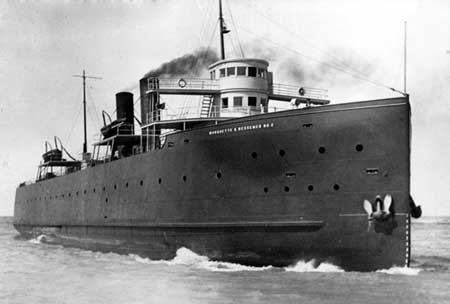
History of the Great Lakes
Vol. 2 by J.B. Mansfield
Published Chicago: J.H. Beers & Co. 1899
[ A ][ B ][ C ][ D ][ E ][ F ][ G ][ H ][ I ][ J ]
[ K ][ L ][ M ][ N ][ O ][ P ][ Q ]
[ R ][ S ][ T ][ U ][ V ][ W ][ X Y Z ]

CAPTAIN J. MCARTHUR
Captain J. McArthur was the commander during the season 1893, at the time of the Columbian Exposition in Chicago, of the large steam passenger monitor Christopher Columbus, and gave every evidence of a clear, strong mind, quick in its application and a nerve force that stood a very severe strain, as his great boat with the load of humanity plied the waters of Lake Michigan. When it is known that during the continuance of the World's Fair no less than 1,800,000 passengers were carried on his boat with the loss of but one single life, a member of the crew, one can realize the immense responsibility he bore, and the care with which he transported these sightseers. In recognition of his admirable management the commissioners of the Exposition presented him with a fine gold watch, on the back of the case is engraved a miniature of the Christopher Columbus, and on the inner side an appropriate inscription. When the Columbus was launched and thoroughly fitted out Captain McDougall said to him, "There is your steamboat; take her down to Chicago and make a success of her." This injunction was literally fulfilled.
Captain McArthur was born in Edwardburg, Ontario, on July 12, 1847, son of Alexander and Barbara (Graham) McArthur. The father was born in Ireland and came to America with his parents, locating in Canada, where he met his wife. During the Canadian rebellion of 1837 he espoused the cause of the patriots, and as a volunteer partici-pated in several of the engagements with the Government troops. Some time after the close of the war he was commissioned pilot on the St. Lawrence river and sailed in the schooners Traveler, Gildersleeve, John Munn, and other vessels, retiring in 1855. Two years later he removed his family to Goderich, Ont., and purchasing a farm began to till the soil. It was in the spring of 1859 that Mr. McArthur began his lakefaring life as boy on the little standing-keel schooner Annexation, of 120 tons burden; she traded between Goderich and Montreal. The same year he served a short term in the schooner Wilson and bark Gem of Kingston. During the period between 1860 and 1864 he sailed before the mast in the barks Unadilla and Alexander, the Groton, Minnehaha, Minnie Williams, Trivola (which spring a leak off Oswego and after sailing to Kingston, sank), and bark Massillon, and as mate of the schooner Hercules. He was one of the crew of the bark Mary Jane when she went ashore on Long Point, Lake Erie, and capsized on the beach during a November gale; the entire crew remained at Port Rowan that winter. In the spring of 1864, having decided to turn his attention to steamboating, he went to Buffalo and shipped as wheelsman in the passenger steamer Empire State; in 1865 he served as wheelsman in the steamer Mohawk; 1866, as second mate in the steamer Badger State; 1867, as second mate in the twin-screw steamer S. D. Colwell; 1868, in the city of Fremont as seond mate; 1869, in the steamer Meteor, as second mate; 1870-71, in the Northern Light with Capt. M. H. March, closing the latter season, however, in the steamer Artic. In the spring of 1873 he was appointed mate and pilot of the Canadian steamer City of Chatham, plying between Chicago and Montreal in the passenger and freight trade, followed with a season in the same capacity in the propeller Eastern about the same route. During the season 1874 he was mate of the passenger propeller Benton, plying between Cleveland, Saginaw and Detroit.
In the spring of 1875 Captain McArthur was appointed master of the Benton. The next two seasons he sailed the Canadian steamer Mary R. Robinson, in the lumber trade between Chicago, Georgian Bay ports and Quebec, and during the seasons of 1878-79 he sailed the Canadian steamer Van Allen, between Chicago, White Lake and Quebec, carrying black walnut lumber and deals. The next spring he went as mate of the steamer Jim Fiske, but closed the season as mate of the City of Duluth. In the spring of 1881 he brought out new the steamer Samuel F. Hodge, as master. The next season he commanded the steamer James Davidson, at that time one of the largest vessels on the lakes. He passed the season of 1883 as master of the steamer Siberia, and sailed the W. R. Whiting the next three seasons for Leopold & Austrian. In 1887 he was appointed master of the steamer Hiawatha, which he sailed three seasons, after which he became master of the steamer Aurora for a season. In 1891 Captain McArthur entered the employ of the American Steel Barge Company as master of the steam monitor Colgate Hoyt. The next season he brought out new the great steam passenger monitor Christopher Columbus and made a pronounced success of her as a passenger steamer during the Columbian Exposition. His next command was the monitor James B. Colgate. In the spring of 1895 he brought out new the steam monitor John B. Trevor as master, and the next season the new steam monitor Frank Rockefeller. In 1897 Captain McArthur entered the employ of the Northern Steamship Company as shore captain, was stationed at Duluth. The Captain has been eminently successful with every vessel of which he has had command, and thrifty with his earnings, having acquired considerable real estate and improved property in Port Huron. He is also a heavy stockholder in the Kentyre Mining & Smelting Co., at Roseland, British, Columbia.
Socially, the Captain is a Master Mason, belonging to Pine Grove Lodge, and Huron Chapter, R. A. M. He is also a member of the fraternity of Elks, and he has been a member of the Ship Masters Association from the inception of that order in Port Huron. He carried Pennant No. 78. Captain McArthur was united in marriage, in November 1870, to Miss Agnes Lean, daughter of James and Eliza Lean, of Teeswater, Ontario. Their children are Madeline; John, who was mate of the steamer Matoa in 1897; William, a graduate of Sarnia Commercial College; and James and Eunice, both attending the public schools of Port Huron. The family homestead is at No. 1018 Washington street, Port Huron, Michigan.
M. MCAULIFFE
M. McAuliffe was born at St. Johns, Mich., thirty-three years ago. He was one of twelve children born to Charles and Mary (Collins) McAuliffe, natives of County Limerick, Ireland, who emigrated to the United States in the early 'fifties.
The subject of this sketch was engaged on his parents' farm until about eighteen years of age, and in 1888 started steamboating as oiler on the City of Alpena. After a year and a half in that employment he went onto the William H. Wolf, on which he remained a season as oiler, and the following season was in the E. P. Weed in a like capacity. The next season he went as second engineer of the Fedora, which berth he held for six consecutive seasons.
Mr. McAuliffe is a member of Local Harbor No. 57, M. E. B. A., also of the Knights of Pythias, Lodge No. 1, of Owosso, Mich., and of Shiwasso Lodge, Division No. 1, A. O. H. He is a single man, and resides with his parents at Owosso, Michigan.
BURNARD McCABE
Burnard McCabe began life in the city of Detroit in 1878. His father was P.B. McCabe, an engineer, and his mother was formerly Mary J. Curtis. He early showed that he possessed much artistic talent, and since a lad has spent a large portion of his time sketching and painting. He seems to prefer the crayon and pastel work, and the walls of his father's house show several of his pastel works in marine views which are very creditable. He has never seemed to think of making art his profession, but sketches and paints for recreation because he loves it. He also has a penchant for the water, and spent the season of 1895-96 as oiler on the Volunteer, under his father as chief. In the fall he expressed a desire to see the world, and went East to go on the ocean for a short time.
CAPTAIN FRANK McCABE
Captain Frank McCabe, master of the steamer Chicago, of the Western Transit Company, Buffalo, N.Y., is a native of that city, having been born there October 24, 1845. Patrick McCabe, father of our subject, was born in the North of Ireland, and about the year 1834 left Dublin for the United States, coming direct to Buffalo. For a time he was fireman on the lakes, and then entered the employ of Bidwell & Banty, shipbuilders, with whom he remained some thirty years. By his wife Catherine McCabe, also a native of the North of Ireland, and whom he had married in that country, he had children as follows: Michael (who was mate of the schooner Metropolis, and was drowned off her in 1864), Joseph (who was an elevator man), Frank J., Elizabeth (deceased), and Mary (wife of Owen Gologly).
Our subject received his education in School No. 4, Buffalo, N.Y., and from the time he was twelve years old until he was twenty he attended night school only, during the winter seasons. In 1858 he commenced sailing the lakes, at first in the capacity of cabin boy on the steamer Iowa, Capt. Robert Jones, from which humble position he worked his way up, entirely by his own exertions and merit until by the year 1869 we find him master of the schooner Wat Sherman. In 1872 he left sailing vessels for steamships, in that year becoming captain of the tug Evans, of Chicago, and in 1873 he was mate of the Camden. In 1874 he served on the harbor police force of Buffalo; in 1875 he was mate of the steamer Java, one of the Commercial line of vessels, in the latter year entering the service of the Western Transit Company, being mate for two years, and master of the Chicago (his present position) for some eight years, or up to this writing. In point of service he is one of the oldest captains at present in the employ of that company, and in his lake career he has been both successful and fortunate, never having experienced collision, shipwreck or cast-away. On December 21, 1868, Captain McCabe was married to Miss Mary Murphy, daughter of the late Joseph and Elizabeth Murphy, and three children have been born to them: Mary, Elizabeth and Frank. The family residence is No. 393 Elk street, Buffalo.
Captain McCabe has always taken an active interest in marine matters, and in 1890 he united with the Ship Masters Association, of which he was president in 1896; in which year, and also in 1897, he was a delegate to the Shipmasters convention. Socially he is affiliated with the Catholic Mutual Benefit Association, Branch No. 8.
FRANK I. MCCABE
Frank I. McCabe is a son of John McCabe, a native of Ireland, who spent the greater part of his life in America, dying in 1893. He was a blacksmith by occupation.
Frank I. McCabe was born January 29, 1861, in Ontonagon county, Mich., and when six years of age removed with his family to Marquette, same State, where he has since resided. At the close of his school life he entered the Iron Bay Manufacturing Company's shops, and served a three-years' apprenticeship, afterward continuing in their employ for eight years. He then went to Seattle, Wash., engaging for two years with the Washington Iron Company, after which he shipped, as oiler, on the Michigan, running from Portland to San Francisco. For the following five years he acted as engineer on the James G. Bayden, at the close of his service on this boat returning east, and he was given the position of foreman of the coal docks at Marquette, which he held one year. He then resumed marine life, shipping on the Wawatam in the capacity of second engineer. Mr. McCabe's future seems one of promise in his chosen line of work, for he has thus far succeeded in gaining the respect and confidence of all his employers. He is a single man.
CAPTAIN FRANK L. McCABE
Captain Frank L. McCabe, who for several years has been in the employ of the Western Transit line, is the son of Patrick and Katherine McCabe, natives of Ireland. Patrick McCabe was for many years in the employ of Bidnell & Banty, shipbuilders of Buffalo in the early days. It was during his employment with them that they built the great side-wheel steamers City of Buffalo and Western Metropolis - noted at that time - which plied for many years in the passenger service between Buffalo and Cleveland. He also sailed the lakes for several years. In this family were five children, the three now living being the subject of this sketch. Joseph, in the elevator business at Buffalo, and Mary, a resident of Buffalo, who is the widow of Owen Gologley, a former lake pilot.
Frank J. McCabe was born at Buffalo in 1845. After attending the public schools for a short time, and at the age of ten years, he began the work of his life as a ferry boy on Buffalo creek, at which occupation he remained three seasons. In the spring of 1858 he made his first trip on the lakes in the capacity of cabin boy on the propeller Iowa, under Capt. Robert Jones, in a few months, however, returning to his original employment as ferry boy, and thus closed that season. The following season he acted as cabin boy on the propeller Galena with Captain Steel part of the time, and closed it in the same employ as that of 1858. For the succeeding two seasons he was cabin boy on various steamers, and in 1861-62-63 he shipped as boy before the mast on the schooner Metropolis with Capt. James Murray. The next two seasons he went before the mast on the schooner William O. Brown with Capt. Harry Bonner, and from that time until 1869 he was first mate of several first-class vessels. For the seasons of 1869-70-71 he served in the capacity of master of the schooner Watts Sherman, and for that of 1872 he was master of the harbor tug C. W. Evans, at Chicago, owned by a son of Edward Madden, an ex-alderman. After a couple of seasons spent on different vessels he returned to Buffalo, and during 1875 was one of nine members of the harbor police. This was previous to the building of the Michigan street bridge, and when the patrolling was done in small boats propelled with oars. After an interim of several years in steam and steel vessels, he, in 1888, entered the employ of the Western Transit Company as mate of the propeller Albany, which was sunk in 1893 in collision with the Philadelphia. Remaining in that vessel but one season, he was mate of the Hudson for the season of 1889, and in the spring of 1890 was given master's berth in the propeller Chicago, which position he has held continuously since (1897), thus establishing himself as a careful navigator. Captain McCabe has been a member of the Ship Masters Association since the fall of 1890. He held the office of second vice-president during 1894, was first vice-president during 1895, and one of the delegates to Washington, and during 1896 was its president.
In 1878 Captain McCabe was married at Buffalo to Miss Mary Murphy, at that time a teacher in Public School No. 34. They have three children: Matie, a teacher in Public School No. 33, Elizabeth and John F. The family residence is at No. 393 Elk street, Buffalo, New York.
OWEN McCABE
Owen McCabe was born on Sixteenth street, in Detroit, in 1876, and has concluded to follow the footsteps of his father, P.B. McCabe and became a marine engineer. He was educated in the schools of Detroit, and at the age of sixteen shipped on the Volunteer, as oiler under his father as engineer. Wishing to have his early experience varied, so as to pick up as many ideas as possible, he accepted a position in the engine room of the Andaste in 1894, and again in 1895; he then shipped on the Zenith City, but after two months was taken ill and remained off the lakes the balance of that season.
P.B. McCABE
P.B. McCabe has the reputation among the captains of being one of the best natured engineers on the lakes. He knows his business thoroughly, and there is no clashing with the other end of the boat. It is said that he and the late Captain Hackett worked together longer than any other two men on the lakes. They went on the same boat in 1868, and were together every season after that until Captain Hackett died in 1894.
Mr. McCabe was born in Yonkers, N.Y., a son of Michael and Mary (McCoy) McCabe. He thoroughly learned the machinist's trade in Yonkers, so that when he came west in 1864 he at once secured a position as engineer for the tug firm of Hubbard & Bronson, of Chicago, and spent the next five years on their tugs Brothers, Success and Constitution. Then he spent one season on the tug Prindiville, owned by Ballentine, Moore & Co. The next season the large tug Torrent came out new, and Mr. McCabe took charge of her engines and remained on her six years doing towing for Alger, Smith & Co. Then he was transferred to the tug Vulcan, owned by the same company, and ran her engines for seven years, or until the Manistique was launched, when he superintended the placing of her engines and ran her for two years. In 1884, the company brought out the Schoolcraft and Mr. McCabe was called upon to see that her engine and machinery were properly place, after which he had charge of her engine room for four years. Then in 1888 the company brought out the Volunteer, and Mr. McCabe was selected to superintend the placing of her engine and machinery. He has run her ever since, and will probably continue to do so until the company brings out another new boat, all of which speaks highly for his ability and attention to his business. Mr. McCabe has saved some money and has it well invested in property in Detroit, to which place he moved in the latter sixties.
On January 10, 1870, he was married to Mary J. Curtis. He has four sons, Francis, Owen, Burnard and Thomas, and two daughters, Mary and Ursula. He is a member of the M.E.B.A., C.M.B.A. and C.K. & L. of A.
HUGH MCCANN
Hugh McCann, one of four brothers and six sisters, children of Daniel and Annie (O'Rourke) McCann, was born at Dundrum, County Down, Ireland, January 1, 1865.
Mr. McCann began his sailing career when about fourteen years of age, going first as ordinary and afterward as able seaman on a vessel trading to the East Indies. Next going on the Carniolo as able seaman, he made two trips from Belfast to Brooklyn, Java and the Phillipine Islands and back to Liverpool, the voyages covering a period of three years and four months. Following this he went on the Lord Donnshire in the same capacity for a trip to Adelaide, Australia, taking fifteen months. The next two years he was on the steamboat Bell, on the Black Sea, and for the succeeding ten months went on the coast on the Express, following with about eleven months on the Bell Brake to Montevideo. He now commenced sailing on the Great Lakes, remaining five months on the Albacor, on Lake Ontario. Afterward he went before the mast on the F. L. Danforth, A. P. Beals, O. H. Hollaren, Savin and A. P. Nichols in the order named, his service in these boats covering a period of about two years, and in 1891 he went as lookout on the Philadelphia for that season. During 1892 and the first half of 1893 he was wheeling on the Wissahickon, finishing the latter season on the Conemaugh. The season of 1894 found him wheeling on the Grand Traverse, and the next on the Russia, finishing the last half as her second mate, which position he also held for the season of 1896. Mr. McCann was on the Conemaugh when she ran into and sunk the Brittania on Lake Huron, near Detroit, picking up all of her crew but one, who was drowned. He is a member of Local Harbor No. 41, Buffalo Harbor Lake Pilots Association, and resides at No. 10 Kentucky street, Buffalo, New York.
B. T. MCCANNA
The name of the subject of this brief review is well known to all marine engineers in connection with the McCanna Cylinder Lubricator, which has come into such common use since its introduction in 1890. This useful device was invented by our subject, B. T. McCanna, and his brother, J. F. McCanna, who were employed in engine works together at the time, and it is manufactured by Hills-McCanna Company of Chicago.
B. T. McCanna was born November 18, 1867, at Waukegan, Ill., a son of John M. McCanna, a native of England, who at the age of four years came to America, and from 1852 until recently made his home in Illinois; he now resides in Spokane, Wash. While living in Waukegan he owned a flaxmill, and in it our subject secured his first lessons of the machinist's trade. At the age of nineteen years B. T. McCanna began the marine life to which he has since devoted the greater part of his time. His first season he spent on the Thomas Simpson as fireman, and he then went on the George Dunbar and served one year on her in the same position. In the following years he served on the Ira H. Owen, Marina and Maritana as second engineer on each, and then went on the Maruba in 1893 as chief, which position he held five years, or up to the close of the season of 1898. He is now (1899) filling a similar position on the Maricopa.
Mr. McCanna is married and resides at No. 25 Gross Terrace, Chicago. Socially, he is a member of the M. E. B. A. No. 4, of Chicago.
JOHN J. McCARTHY
John J. McCarthy is a son of John and Mary (Tormey) McCarthy, of Gordon, Ont., where the former for the past thirty years has been superintendent of the Stone Works. His brother, Capt. Daniel McCarthy, is master of the steamer State of Michigan, plying between Detroit and Cleveland.
John J. McCarthy was born in Lime Kiln Crossing, Ont., on January 22, 1870, and attended school at that place. When nineteen years old he commenced his steamboating career on river tugs at Detroit, which were owned by an uncle of his, his first berth being as watchman for about six months, after which he wheeled the tug Swain two seasons and the Gladiator one. He then went into the steamer Majestic, wheeling her two seasons, and served a like time in the Schuylkill in the same capacity until, in 1895, he was promoted to second mate's berth on the Susquehanna, which he filled creditably enough during the two seasons of 1895-96 to merit his appointment as first mate of the Codorus under Captain Ryder, for the season of 1897. The Codorus is one of the two remarkably fine boats of the Anchor line, and Mr. McCarthy's five years continuous service and rapid advancement to a first-class boat speak well for his future in marine circles. He is a single man, and makes his home at Detroit, Michigan.
WILLIAM J. McCLURE
William J. McClure, chief engineer on the City of Chicago, belonging to the Graham & Morton Transportation Company, is a native of Detroit, Mich., born December 29, 1838. While yet in his "teens" young McClure began learning the rudiments on his life's occupation, that of an engineer. His first experiences in this line were on the engine in a rolling-mill and blast furnace located at Wyandotte, just below Detroit.
In the fall of 1859 he went to Marquette and entered the machine shops of Thomas Healy, where he remained one year, and on the following spring (1861) began life on the water, going on the side-wheel steamer Cleveland as second engineer, which ran between Cleveland and Lake Superior. He was on the Cleveland one season, and the next season was passed on the Michigan, a side-wheel boat plying between Buffalo and Green Bay. In 1863 he was made chief engineer of the Sarah Van Epps, a side-wheel boat that ran between Green Bay and Escanaba. He remained with her that season and a part of the next, and finished out the season of 1864 on the steamer George L. Dunlap, which was also a side-wheel boat, and was on the same route, from Green Bay to Escanaba. In 1865 he was on the tug Zouave, towing on the Detroit River from Lake Huron to Lake Erie, for a part of the season, when he took charge of the side-wheel steamer R.R. Elliott, and that winter took her engines out and put them into the City of Sandusky, a side-wheel steamer built at Sandusky, and ran between Cleveland and Saginaw, and for a time between Sandusky and Detroit. Our subject remained with her until October, 1868, that fall going on the Keweenaw, which ran between Buffalo and Lake Superior, and was with her until the fall of 1872. The Keweenaw carried and landed at Duluth, as it were, the forerunners or advance guard of those who laid the foundations, and set the wheels in motion for that metropolis of today. During the years 1873-74, Engineer McClure was for a period on the tug Wm. B. Castle, a tug towing between the lakes Huron and Erie. In 1875 he was employed at Milwaukee putting the engine into the Flora and running her during the season. The following year he went on the side-wheel steamer Milton D. Ward, and was with her until 1883, her trade for a part of the time being from Detroit to Port Austin, and then from Detroit to Port Huron. Next he put the engine of the Dunlap into the Darius Cole, a new steel boat, which he ran until the fall of 1887, she, too, being a side-wheel boat, and was in the trade between Detroit and Port Huron. During the seasons of 1888-89 he was in charge of the steamer barge Iron Duke, and the steamerbarge F. W. Wheeler, respectively, running on the former one season and part of the next, and then on the latter the balance of the time.
In January, 1890, he went to Bay City and took charge of the City of Chicago, then building, inspecting and looking after her machinery. She was built for the Graham & Morton Transportation Company, of Benton Harbor, St. Joseph and Chicago, our subject serving as chief engineer on this boat, and for two years past has been the chief engineer of the Graham & Morton Company's line of steamers.
He is a thorough and most competent engineer, and has rounded up thirty-five years of experience on the water, and the third of a century as chief engineer. He is a member of No. 3 Post of the Engineers Association of Detroit.
On January 3, 1863, Mr. McClure was united in marriage to Miss Elizabeth Healy, of Detroit, and to this union were born a family of five boys and two girls: Kate, Colin, Edward, Mary, William, Frank and Walter (the last named dying in March, 1895).
MICHAEL MCCORMICK
Michael McCormick, was born at Cleveland, Ohio, December 13, 1859, and received his education at St. Malachi's parochial school in that city. On commencing his marine life he went as fireman on the tugs Shoo Fly, Fannie Tuthill, and Maggie Sanborn, owned by L. P. & J. A. Smith, and then shipped in the same capacity on the tug Abe Nelson, owned by Robert Fields, all of the service occupying three years. He took out his license as engineer in May 1877, and was appointed engineer of the tug Maggie Sanborn, transferring from her to the Fannie Tuthill, Peter Smith and L. P. Smith, in the order named; he served one season in each, finishing the year on the last named tug, and the following year brought out new the tug S. S. Stone, with which he also remained one season. He then went to Chicago and entered the employ of the Vessel Owners Towing Company, being assigned to the tug Blackball No. 2, in which he remained two seasons, and later to the tug Protection, which he engineered one season. He next entered the employ of the Dunham Wrecking & Towing Co., and shipped on the tug Chicago for one season, following this service by a season on the Mosher. In 1894 he returned to Cleveland and entered the employ of the Vessel Owners Towing Company as engineer of the tug Criss Grover, on which he remained to the close of that season and throughout the next. In 1896 he brought out the same boat, finishing the season on the tug William Kennedy. Mr. McCormick is held in high esteem by the companies who have employed him, and having acquired a well-deserved reputation for diligence and close application to duty, his services as engineer are always in demand.
CAPTAIN GEORGE A. McCOY
Captain George A. McCoy, the popular master of the side-wheel passenger steamer Superior, plying between Cleveland and Euclid Beach Park, was born in St. Clair, Mich., on December 20, 1854. He is the son of George and Elizabeth (Kitchen) McCoy. At the age of twelve he adopted the live of a sailor, sailing on small scows and schooners trading between Bay City and Port Huron as a pastime during vacations, going to the public schools at St. Clair during the winter months.
In the spring of 1870 he shipped in earnest on the ferry Hattie T. Brown, plying between Bay City and Banks (now West Bay City). The next two seasons he secured a berth on the larger ferry boat J. G. Hubbard, which plyed between Essexville and Bay City. In 1893 he was wheelsman on the steamer Nelson Mills, followed by a season on the A.A. Turner in the same capacity. The seasons of 1875-76 he passed as a wheelsman on the steamers R. Prindiville and S. D. Caldwell, respectively. In 1877 he entered the employ of the Bay City and Alpena Company, and remained on that route five years, as wheelsman on the passenger and freight steamers George L. Dunlap, Metropolis, Dove and Arundell alternatively, finally being promoted to the office of mate and sailing on all in that capacity. In the spring of 1882 Captain McCoy took out master's papers, and sailed the rafting tugs Willie Brown and Marion Teller for T. H. McGraw & Co., for three years, after which he took command of the side-wheel steamer Emerald, which was also engaged in raft towing. In 1886 he was appointed master of the W. A. Avery. The next spring he came out as mate of the new steamer Elfin-Mere, and in 1888 he was appointed master of the passenger steamer Lucille, plying between Saginaw, Bay City and other shore ports.
In the spring of 1890 he removed to Port Huron, Mich., and entered the employ of N. Mills as master of the schooner Leader, remaining on her two seasons when he advanced to the command of the steamer Point Abino, sailing her two seasons, after which he again assumed command of the Leader. He came out in the spring of 1895 as mate with Capt. D. A. Hutchinson on the steamer Iosco, remaining until July, when he was appointed master of the passenger excursion steamer Superior, holding this command until the close of the pleasure season 1897, when he was made the master of the steamer J. S. Fay, on which he closed the year.
He is a member of the Ship Masters Association No. 2 of Port Huron, and carries Pennant No. 880; also of the beneficial order of the Royal Arcanum. He is one of those masters designated as "lucky," never having met with an accident to his boat, or lost a man.
On February 12, 1877, Captain McCoy was united by marriage to Miss Sarah Fitzgerald, of St. Clair. Their children are: Bessie, Nellie, Edward, Harry and Allie. He removed with his family to Cleveland in 1896, and they reside at No. 253 Washington street.
WALTER McCREA
Walter McCrea is known as one of the most competent and reliable engineers sailing out of Bay City, Mich., and has performed the duties of his present responsible position with the Saginaw Bay Towing Company for seven years. He is a son of Alexander and Caroline (Easton) McCrea, and was born in Norristown, N.Y., December 8, 1845. Some time later his father returned with his family to Easton's Corners, Ont., a village named in honor of his mother's family, and where she died November 14, 1861. Four years later the father left his farm, and removed his family to Bay City, Mich. Previous to this the father had passed some years on the lakes, and after locating in Bay City he purchased the barge Bay City, and sailed her successfully seven years. He also owned an interest in the tug Sea Gull. His death occurred in April, 1877, in Bay City. The other members of his family are Alexander, who is in the painting business; William H., a bookkeeper and advance agent for a notable physician; Harley and Samuel, both of whom died while young; and Mary, now the wife of John H. Fulford, and residing at Brockville, Ontario.
Mr. McCrea, after acquiring a liberal education in the public schools at Easton's Corners, and working with his father on the farm during the winter months, went to work in a flourmill at Merrickville, Ont., owned by his uncle, H.S. Easton, serving an apprenticeship of three years, after which he was promoted to be chief miller, holding that position five years; and as his uncle was the owner of vessels, our subject, in the meantime, sailed some while in his employ, he first going as second engineer on the steamer Mary Ann, part of two seasons, and in 1872 he was appointed chief engineer on the tug H.P. Clinton, closing the season as chief on his father's tug Sea Gull. The year following he joined the steamer Dunkirk as chief, but before the close of the season he accepted an offer to run the engine in a sawmill at Milwaukee, which position he held until the spring of 1876, when he entered the employ of Eddy & Avery as chief engineer on the lake tug McDonald, engaged in towing, and engineered her eleven seasons. In the spring of 1887 he was appointed chief engineer on the steamer Mary Martini. The next year he took the tug Maud S., and ran her three seasons, then going as chief engineer on the steamer George W. Morley. Mr. McCrea then entered the employ of Captain Boutell as chief engineer on the tug Niagara, engaged in towing logs from Georgian Bay to Saginaw river, which position he filled for some years, and has well earned the confidence and esteem of the owners for the satisfactiory manner in which he has performed his duties.
In July, 1873, Mr. McCrea was wedded to Miss Elida, daughter of Thomas and Jane (Sherman) Daniels, of Kendallville, Ind., and who is a cousin to General Senator Sherman. Two children have been born to this union: Samuel and Frances, both attending school at Chesaning, Mich., where the family homestead is located. Fraternally, Mr. McCrea is a member of the Marine Engineers Beneficial Association, No. 27, of Bay City, and has been treasurer of his lodge seven consecutive years.
WILLIAM T. McCULLAGH
William T. McCullagh was born in 1860 in Lapeer, Mich., where he received his common-school education.
Mr. McCullagh's first experience in sailing was on the well-known tug Sweepstakes in the year 1879, and the next year he shipped on the steamer Mary Pringle, after which he was on the Winslow and the Arctic. During the years 1884-85-86 he was railroading, and for the season of 1887 was wheelsman of the steamer Oceanica. In 1888 he began the season as wheelsman of the steamer Kasota, but finished it in the same capacity on the passenger steamer Japan. The next season he was wheelsman on the Lackawanna. In the spring of 1890 he took out his papers and shipped on the steamer Brazil, remaining that season, and in 1891 entered the employ of the Northern Steamship Company as second mate of the steamer North Wind, holding that position until the close of the season of 1896, when he laid up with his boat in the harbor at Buffalo. At the opening of navigation in 1897 he again assumed the berth of mate of the North Wind. Mr. McCullagh, who, it will be seen, is a pilot of the first class, is an ardent member of the American Association of Masters and Pilots.
CAPTAIN W. MCCULLOUCH
Captain W. McCullouch, of Detroit, Mich., was born October 10, 1861, at St. Catharines, Ontario, and lived at that place until he was one year old, when his parents removed to Port Huron, Mich., and where he grew to manhood. He is the son of Robert and Christina (Ferguson) McCullouch, natives of Glasgow and Edinburgh, Scotland, respectively, the former of whom was a ship carpenter all his life; he died July 15, 1885, the mother on February 20, 1892.
Captain McCullouch serves a double mission in marine work, for besides being owner and vessel master, he is a diver and spends the greater part of his time in business necessitating that work. At the early age of eleven years he began sailor's life by shipping on the schooner Christina, built by his father and running out of Port Huron, upon which he acted as cook. He then went on the Sweden, before the mast and for several seasons served in that capacity on the schooners running between Buffalo and Chicago, and afterward entering the employ of the Cosat Wrecking Company, of New York. He spent two seasons on the steamer Rescue and then bought the Rosella, which he sailed for four seasons. When he sold this boat he built the scow L. B. Forester, on which he has now been for nine seasons, engaged in the wrecking business. Captain McCullouch was married on June 6, 1892, to Miss Minnie Flanagan, of Port Huron.
A. G. MCDONALD
A.G. McDonald, the president and general manager of the Killarney Fish Co., of Detroit, was born in Mobile, Ala., July 8, 1864. Soon after the close of the Civil war, when he was but two years old, his parents came North, and located at Algoma Mills, Ont., on the Georgian Bay. In 1877 Mr. McDonald came to Detroit, and after taking a business-college course he obtained a position with the Buffalo Fish Company, which at that time maintained a branch here. His early life on Georgia Bay had given him a liking for the fish business, as well as a good general knowlege of it, and during his experience with the Buffalo Company he became familiar with its details. He employed himself to such good purpose and gave such attention to the affairs of the company that in course of time he was enabled to produce a half-interest in the business. In 1895 the branch of the Buffalo Company was closed out to Mr. McDonald and he formed a stock company with a capital stock of $25,000, which took over the business. This firm has since greatly enlarged and extended its connections, and today Mr. McDonald occupies a prominent place among those interested in the fishing industry of the Great Lakes. Mr. McDonald was married in 1888, and has one child.
CAPTAIN ANGUS J. McDONALD
Captain Angus J. McDonald, master of the steamer Hudson for the seasons of 1896-97-98, is of Scotch extraction, and a native of St. Catharines, Ont. His father, Donald McDonald, was a master of lake vessels. He died about 1884 at St. Catharines, where the principal part of his life was spent. Hannah (Doyle), his mother, who was American-born, resides in Buffalo at the present time. They had five children, of whom William was mate of the Grand Traverse during the season of 1896, Isaac of the Commordore, and Frederick of the Milwaukee. The daughter, Mary, resides in Buffalo.
The subject of this sketch was born August 18, 1857, and after passing through the public schools of St. Catharines, he by means of a scholarship entered the grammar school, where he spent about one year. In 1870, when he was but thirteen years of age, he commenced life as a horse-boy on the schooner Fanny Campbell, which plied between Kingston and Toledo in the timber trade. After a couple of seasons on the Campbell he shipped from St. Catharines as porter on the steamer Prussia for the seasons of 1873 and '74. He was lookout on the Colorado for season of 1875, shipping from Buffalo, for the following seasons until October, 1877, at which time he rose to the position of second mate. In 1878 he was second mate of the Commodore, in 1879 of the China, of the Anchor line, and of the Commodore, and wheels-man of the Egyptian. In 1880 he was mate of the Oneida for four months, and in August was second mate a couple of trips on the Boston, continuing on the Arabia for the rest of that season as mate. Captain McDonald has been in this company's employ twenty-one years, and is one of the most successful of the younger men.
From the spring of 1881 until June, 1885, Captain McDonald was mate of the Boston, and for the rest of the last named season was master of the Vanderbilt, this being his first boat as master. In 1886 he was mate of the Chicago until September, when he was promoted to the master's berth, filling same until September 1 of the season of 1887. On that day he was given the command of the ill-fated Albany, on which he remained until the 7th of November, 1893, when she was lost in the collision with the Philadelphia at two o'clock in the morning off Point aux Barques, Lake Huron. The Albany was struck on her port side about midships, but did not sink immediately, because her cargo of grain prevented the water from rushing into the hole in her side. The Philadelphia was badly stove in at her bow, but remaining afloat because of her water-tight compartments took the Albany in tow and attempted to reach shallow water, although the distance to shore was about nine miles. The Albany sank on the way about an hour after the collision, in about 210 feet of water, and the Philadelphia went down shortly thereafter in 120 feet. The crews of both vessels took to the two small boats of the Philadelphia, only one of which reached shore in safety, it being supposed from the condition of some of the bodies afterward recovered that it had been struck by the wheel of the Philadelphia just after the men got into it. The Albany's crew lost eight men: Thomas Pierce, second mate; S.B. Muirhead, chief engineer; James Malloy, oiler; Samuel McMurty, second cook; a watchman, porter and two deck hands, names unknown. The Philadelphia lost seventeen men in all, among them being the mate, whose name was Hunt, and chief engineer Leggett. The master, Albert Huff, was among those saved. The Albany had a cargo of grain and package freight, and was east bound; the Philadelphia had 900 tons of coal aboard, besides some miscellaneous merchandise. Both vessels were a total loss, and no attempts were made to recover either of them. Captain McDonald was master of the steamer Hudson for the full season of 1894-95 and 1896.
Captain McDonald was married at Buffalo in 1879 to Miss Annie Higgins, by which union they have four children: George D. (at this writing fourteen years of age), Edith (twelve), Charles (nine) and Annie (six). The family reside at No. 264 Grant street, Buffalo, New York.
CAPTAIN DONALD S. McDONALD
Captain Donald S. McDonald, master of the steamer Sevona for the season of 1897, is a native of Canada, born at Dunnville, Ont., August 28, 1861.
The Captain is a son of James and Margaret (Burgess) McDonald, both of whom reside at North East, Penn. The former, now a retired merchant, was born in Scotland, and the latter at Niagara Falls. There were seven children in the family, of whom James is a grocer at North East; John is assistant cashier of the First National Bank of Erie, Penn.; Arthur is bookkeeper in the same bank; Frederick is in New York, as correspondent of the bank; Annie lives with her parents; and Hall is a clerk in the grocery store of his brother James.
Capt. John Burgess, father of Mrs. McDonald, was a Scotchman, and at one time owned and sailed ships out of London, England, in the Mediterranean trade, and was also for several years on the Canadian lighthouse board, located at Dunnville, Ont. Capt. Alexander Sutherland, also a Scotchman, first cousin of Mrs. McDonald, first sailed the old iron steamer Magnet, which was brought to Canada in pieces, stowed away in a shiphold and put together at Kingston. She was in the passenger and mail service between Toronto and Montreal.
At the age of two years Captain McDonald removed to North East with his parents, where he lived until sixteen, in the meantime attending school. In 1877 he left home to indulge his desire to become a seafaring man, taking passage from New York to Glasgow, Scotland. After a stay on shore of about six weeks he shipped for the West Indies on the ship Hilding, of Christiania, Norway, and was wrecked on the coast of Ireland when but ten days out, all but three of the crew of nine being drowned. He remained aloft on a mast all night, but was released the next day, and taken to the castle of Sir Harvey Bruce, which was but a short distance from the scene of the wreck, and entertained for ten days. At the end of that period he proceeded to Londonderry, in the North of Ireland, and shipped on the merchantman Huntington, of Leith, Scotland, remaining eight months in the coast trade along the west shore of Ireland. His next service was as ordinary seaman on the steamship Shumlee, built on the Clyde for the China tea trade from Glasgow through the Suez canal to Hong Kong, stopping at Singapore. At Hong Kong the crew were all paid off because of the sale of the ship, and Captain McDonald remained ashore there three months. He finally shipped on the bark Ida Melmore, to Yokohama and San Francisco, at which latter place he remained ashore a month, and then took a voyage in the full-rigged British ship Fiona to Hull, England. They carried a cargo of wheat, and the voyage occupied 155 days. Upon his arrival at Hull, Captain McDonald immediately took passage by rail to Edinburgh and back to Glasgow, from there going to Downhill castle, the home of Sir Harvey and Lady Bruce, near the scene of his first shipwreck, where he made a visit of two weeks. Returning to Glasgow he shipped for Melborne, Australia, upon the full-rigged ship Ben Crughen, and, upon reaching that destination, left to spend sixty days in the gold diggings south of Botany Bay. From Sydney, New South Wales, he went on board the ship Hereward (named for the last of the Saxon kings), which carried a cargo of coal to San Francisco, and from that port returned to London, England, the trip taking 140 days.
From London Captain McDonald shipped on the bark Shiner, of Glasgow, which went on a voyage to Negapatam, Malay Peninsula, thence to Calcutta, and from there to Liverpool, from which place he went by rail to Glasgow. After another short visit with his benefactors at Downhill castle, he shipped from Glasgow to Montreal on the St. Patrick, of the Allan line, which ship he abandoned upon arrival at her destination, going immediately to Kingston, Canada, where he began his lake career. It was in 1882 that he shipped before the mast on the schooner Speedwell, and after four months he left her to go one trip on the schooner Mystic Star to Chicago. From her he went to the schooner Wells Burt, bound for Buffalo, and then obtained a watchman's berth on the steamer Havana, of the Cleveland Transportation Company. That winter he was shipkeeper on the Havana, and others of the same fleet. The next season he was wheelsman on the Havana part of the time, and of the steamer E. B. Hale, of the Bradley fleet, the remainder, and during that winter obtained from old Capt. Ben Stanard, local inspector of Cleveland, a license as first-class pilot. For the season of 1884 he was second mate of the steamer Vienna, of the Cleveland Transportation Company, and in 1885 filled the same berth in the Sparta, until August, when he became second mate of the steamer Ohio, owned by Ryan & Johnson, of Sandusky, Ohio, John Estes being captain and managing owner of her. For the next three seasons he was mate of the Ohio, and in 1889 mate of the Spokane, owned by Thomas Wilson. In 1890 he was mate of the Wiley M. Egan, of the Fitzgerald fleet; in 1891, of the Kalagua, owned by the Cleveland Cliffs Iron Company, and commanded by Capt. John Lowe; and in 1892 of the Aurora, owned by John Corrigan. In 1893 he was ashore, engaged in the real-estate and fire-insurance business, at North East, and during 1894-95 was master of the steamer Nyanza, of the McBrier fleet, of Erie, Penn. In 1896 the McBrier fleet added the steamer Emily P. Weed to its list of boats, and Captain McDonald was given command of her, sailing her also for the seasons of 1897-98. She has been rechristened, however, and is now known as the Sevona. Captain McDonald is a member of the Ship Masters Association.
In December, 1888, he was married at North East, Penn., to Miss Jessie M. Town, by whom he has two children, Bruce and Jay. The former was named after Sir Harvey Bruce, the friend of his early sailing days. The family residence is at North East, Pennsylvania.
F. MCDONALD
F. McDonald, son of Donald and Hannah (Doyle) McDonald, was born at Buffalo, March 31, 1871. The family consisted of four brothers and one sister, and all of the sons have risen to responsible and lucrative positions at steamboating, A.J. being a lake captain, and William M. and I.K. mates.
The subject of this sketch, although a young man, has rapidly climbed toward the top rungs on the ladder of his chosen profession, and it certainly is not out of place to predict for him a brilliant future, as one of the lakes' foremost navigators. He began his sailing career as watchman of the schooner Badger State, remaining on her in that capacity all of one season and part of the next, which he finished on the Idaho. The succeeding three seasons he was on the Syracuse and for the season of 1890-91 was wheelsman on the Hudson, and the following season mate of her. For the past four seasons, 1893-94-95-96, he has been mate of the Milwaukee, and also filled that position during the season of 1897 under Captain Folan.
Socially Mr. McDonald is a member of the Buffalo Harbor and Lake Pilots Association, Local Harbor No. 41, of Buffalo, and also of Red Jacket Lodge, of the Royal Arcanum. He resides at No. 326 North Division street, Buffalo, New York.
MURDOCK N. McDONALD
Murdock N. McDonald, a young engineer of good repute, and one who has advanced rapidly in the line of his chosen work, and holds the berth of first assistant engineer on one of the most notable passenger steamers on the lakes, the North Land, is the descendant of a good old Scotch ancestry on both sides, his parents being Norman and Annie (McCrea) McDonald, of Stornoway, Scotland, where the subject of this sketch was born December, 1867. His parents are still living at the old homestead in that city. His opportunities for acquiring an education were limited to the public schools of his native place, and he was early apprenticed to the firm of McClelland & Co., in Stornoway, to learn the machinist's trade, turning to good account the seven years put in their employ, and becoming a thoroughly qualified constructor.
At this time a longing for a change of scenery and country coming over him, he took passage on a steamer bound for the shores of the New World, where he was to take his future welfare in his own hands. On landing in the United States he went directly to Duluth, Minn., and, in 1887, obtained the berth of engineer on the tug Maud S., which he retained four seasons, in the spring of 1891 joining the passenger steamer Hiram R. Dixon, of the A. Booth Packing Company. The next spring he shipped as second engineer on the steamer Nyanza, holding that berth two seasons. At the close of navigation, in the fall of 1893, he entered the employ of Burnett Iron Works Company, at Duluth, continuing in this position until the spring of 1895, when he joined the tug Charles M. Ritter, as engineer. He then purchased the tug Jessie Slyfield, and operated her in St. Louis bay and river, doing general towing until fall, when he sold her. On February 3, 1897, Mr. McDonald entered the employ of the Northern Steamship Company, as second assistant engineer of the passenger steamer, North West, plying between Buffalo and Duluth, remaining on her in this position till July, when he was promoted to first assistant on the same vessel; and in February, 1898, he was transferred to the sister ship, North Land, as first assistant, and on August 16, of the same year, was advanced to the position of chief engineer, holding it through the season. He has his eight issues of license as marine engineer.
Fraternally, he is a member of the Independent Order of Foresters, and of the Marine Engineers Beneficial Association No. 78, of Duluth. Two brothers, William, who is a farmer in Manitoba, and Alexander, for three years a member of the engineer's crew of the North Land, came to this country a year following Murdock's landing in America.
On May 25, 1894, Mr. McDonald was united in marriage to Miss Della, daughter of John and Annie (McKay) McDonald, of Green Bay, Wis., but originally from Scotland, and though of the same name were in no wise related. Two children, Lillian and Murdock, have been born to this union, the son dying when but six months old.
WILLIAM M. MCDONALD
William M. McDonald, one of the sons of Donald and Hannah (Doyle) McDonald, has, like his brothers, A.J., I.K. and F.C., adopted a sea-faring life. He was born at Buffalo, N.Y., October 8, 1863, and began his sailing career at the early age of thirteen by shipping as boy on the schooner Edward Blake, on which he remained for a term of four years. During the next four years he served before the mast on several vessels, among them being the Leadville, Cortez, J.J. Wurtz, and Jesse Drummond.
Mr. McDonald began steamboating in 1884, as wheelsman on the Boston, and was on the Vanderbilt, in a like capacity, for the season of 1885, going back to the Boston for that of 1886. In 1887 he was second mate of the Hudson, when she was brought out new, being on her about two months when he transferred to the Harlem for her maiden trip, and remained on her the balance of that season. The season of 1888 he divided as second on the Vanderbilt and Tioga, and the two succeeding ones was second of the Russia, after which he spent one season each as second on the Scranton, Russia, Wyoming, and Florida. For 1895 he was mate of the Lackawanna, and during 1896 of the F. & P.M., No. 5, for about two months, leaving her to go on the Grand Traverse, on which he was only eight days, when the Livingston ran into and sunk her off Colchester, Lake Erie. He finished the season as second of the Scranton, and for the season of 1897 was mate of the Wyoming. Mr. McDonald is a member of local Harbor No. 41, Buffalo Harbor, and Lake Pilots Association. He is a single man, and resides with his mother at No. 326 N. Division street, Buffalo, New York.
THOMAS J. MCDONNELL
Thomas J. McDonnell, who is a close student of engineering works and accomplished in his profession of marine engineering, is descended from a long line of patriotic warriors, and although himself too young to take an active part in the Civil war, the family was well represented in that struggle. He was born in Rochester, N. Y., August 31, 1853, a son of James and Hannah (Covelle) McDonnell, both of whom were natives of New York and of Scotch parentage. His grandfathers, James T. McDonnell and William C. Covelle, both came to the United States from Scotland prior to the war of 1812 and espoused the cause of their adopted country, the former joining a clipper ship belonging to the American navy, which was very successful in its operations against the enemy; the latter joining General Proctor's army of invasion and being killed at the battle of Maidstone Cross, twenty miles back of Windsor, Ontario. During the Civil war, the father of our subject enlisted at Ann Arbor in the Seventh Michigan Cavalry, and with his regiment did gallant duty in various cavalry engagements, all of which are recounted in detail in the work entitled "Michigan in the War." Mr. McDonnell was a veterinary surgeon and when General Grant took command of the Army of the Potomac, he was appointed to his staff with a commission as lieutenant. At the close of the war he resigned and soon afterward was appointed veterinary surgeon for the State of Nebraska, holding that honorable office fourteen years, after which he retired to more fully enjoy the comforts of home life. His son, William C., enlisted in the 22d N. Y. V. I., at the breaking out of the war, and at the end of his three months' time re-enlisted in August, and served with his regiment until the close of the war. He then became a railroad construction boss and while at work on a section of the Tennessee railroad in Mississippi, he was murdered by a negro, who at once paid the penalty of his crime. James H., the second son, also enlisted in the 22d N. Y. V. I., and was captured during a hot engagement, sent to Libby prison in Richmond, where he remained confined many months, suffering all the horrors for which the southern prisons were notorious; since returning home at the close of the war, he has been a captain of the Detroit detective police force. Harriet is the wife of Samuel Robinson, a speculator in oil at Oil City, Pennsylvania. Sarah E. is the wife of John Enbody, a pork speculator, living in Fremont City, Neb. George C., like his brother Thomas J., is a marine engineer and was chief of the steamer Arundel, N. K. Fairbanks and George Stone, among other boats. On June 1, 1898, he was appointed chief engineer of the United States man-of-war Massachusetts, a first-class battle ship of the flying squadron under command of Commodore Watson.
Thomas J. McDonnell, received a liberal education in the Rochester public schools, and became a competent machinist, passing four years under instruction with the firm of Jackson & Wyley, of Detroit, Mich., and in 1876 shipped in the river tug Gladiator as second engineer. Two years later, having thus fulfilled the requirements of law he was appointed chief engineer of the steamer Albert Miller and ran her five seasons. He was then placed in charge of the fine pleasure yacht Uarda, owned by Cameron D. Waterman, of Detroit, retaining that berth three seasons. He passed the seasons of 1884-85 as chief engineer of the steamer Chenango, and the next season stopped ashore at Wyandotte, Mich., having been appointed chief engineer of the soda ash works in that place. In 1887 he was engaged by William H. Langley, a wealthy New Yorker, to take charge of the machinery of the yacht Tilley, cruising on the Atlantic coast. At the close of the pleasure season he returned to Detroit and became chief engineer of the power house of the Detroit & Wyandotte motor line, where he remained two years. In 1890 he entered the employ of the Davis Bolt & Oar Works at Wyandotte, as chief erecting boss. In 1893 went to New York City and took charge of the steamyacht Sultana for Mr. Langley, who retained his services two seasons, and after a year spent at home in Alma, Mich., he again took charge of the yacht Sultana. In the spring of 1897 Mr. McDonnell entered the employ of Capt. James Davidson as chief engineer of the steamer Shenandoah, transferring to the steamer Appomattox in the spring of 1898.
On August 31, 1875, Mr. McDonnell was united in marriage with Miss Mary M. Davis, of Rochester, N. Y., and the family residence is in Alma, Michigan.
CAPTAIN ALEXANDER McDOUGALL
Captain Alexander McDougall, inventor of the whaleback or monitor type of lake vessel, and founder of the American Steel Barge Company, at Duluth, is a man of great force of character and of rare ability as an executive. The head of the lakes, or in other terms Duluth and Superior, has been productive of many prosperous and substantial enterprises. Concerns which a few years ago were in their infancy or had passed a short time of weak existence, are to-day among the foremost in enterprise and prosperity, and their importance is recognized throughout the entire chain of lakes. The most prominent among these is the American Steel Barge Co., under the management of Captain McDougall. To have reached this prominence in the ship building industry with a wholly new type of vessel such as the monitor assuredly is in so short a time, required ability, perseverance, a consummate knowledge of business affairs, untiring energy, and, above all, unerring judgment. That these qualities were innate in the Captain is abundantly proven by his standing in the business world to-day. But for the tenacity of purpose and the unyielding determination which has been characteristic of all notable inventors, scores of prosperous manufacturing towns requiring the employment of vast numbers of skilled workmen, would not now be in existence. The cities of Duluth and Superior make a parallel. If Captain McDougall had not preserved his faith in the utility of his cigar-shaped vessels over a quarter of a century ago, and had not held to his convictions through all adverse criticism, the whaleback would not now have been an important factor in lake transportation, and it is possible that the denizens of those two cities would not have witnessed the launch of any class of vessel. Although the captain had conceived the design of his type of vessel as early as 1872, he had not been able to impart his confidence or accumulate sufficient funds to demonstrate the feasibility of his views until 1887, when his first barge 101 was launched, and her success as a seaworthy freight carrier soon determined the practicability of his theory. With a life-sized model in demonstration he was no longer considered a visionary, and in January, 1889, Eastern capitalists became interested in his invention, and the American Steel Barge Company was organized, a plant erected in Duluth and the construction of the whalebacks begun. Besides the other whalebacks constructed by this company, it owns thirty-five of all classes built on its own account, and one can more readily compute the value of this magnificent property when it is considered that they will carry 100,000 tons of cargo each trip, and making fifteen trips would move 1,500,000 tons during the season.
Captain McDougall first came on the lakes in 1861, and was made second mate of the passenger steamer Ironsides in 1863, plying to Lake Superior, and remained on her until July, 1865, when he transferred to the steamer Iron City as mate, holding that office until the spring of 1866, being then appointed mate to side-wheel steamer Illinois. His next office was mate on the steamer Meteor. In 1870 he was appointed master of the steamer Thomas A. Scott, holding that office until September, when he was transferred to the iron steamer Japan, which he brought out new, sailing her until the fall of 1875. The next spring he assumed command of the passenger steamer City of Duluth, operated by the Lake Superior and Lake Michigan Transportation Company, and sailed her successfully three years. In the spring of 1878 he was appointed master of the steamer Hiawatha, which office he held until 1881, when he retired from active ship life aboard and went into business in Duluth, and it was at this period that he perfected his plans for the production of the whaleback type of vessel, now so familiar on the lakes. He spent much time in travel on business lines in Europe, to secure his patents, the results of which may be read in another volume of this work. The only vessel which bears his name is the last addition to the fleet of the American Steel Barge Company, launched at their shipyard in West Superior in July, 1898, a whaleback in every way worthy of the honor of bearing the name of the inventor and promoter. This steamer was christened by his little daughter, Emmeline.
The family homestead is pleasantly situated in Duluth.
CAPTAIN JACOB MCDOWELL
Captain Jacob McDowell has had numerous and varied experiences on land and water. He has served many years as master on the lakes, and in the Civil war he also won for himself the rank of Captain, thus giving the title a double significance. He is the son of Alexander and Maria (Smith) McDowell, the former of whom, a native of Ireland, spent the greater part of his life in America, dying in 1849; he was custom-house officer for many years at Kingston, Ontario. The mother, who was a native of New York State, died in 1871.
Captain McDowell was born April 12, 1834, at Cape Vincent, N.Y. Soon after his birth, however, the family removed to Kingston, Ontario, where they lived for fourteen years, on their return to New York settling at Oswego. Jacob received his education at the schools of Kingston, and then began the marine life to which he has since devoted so much of his time, shipping first on the Hudson as boy for a season, and going on the Annie Winslow for the same length of time. He then served in various capacities on different schooners until 1862, when he enlisted in the Union army, serving in Company K, One Hundred and Sixtieth N.Y.V.I., until August 5, 1863, when he received an honorable discharge at Palmyra, N.Y. During this time his life was marked with much distinction, for he was appointed first lieutenant in June, 1863 — this promotion being closely followed by his captain’s commission. He was in all the battles fought under Major-General Banks, and had the good fortune to escape from all unwounded, but was confined in Libby prison from the time of the battle of Cedar Creek until February 22, 1865.
Upon his return home Captain McDowell resumed his old occupation and shipped on the schooner Richards as mate, spending the following seasons on the Czar and James C. King as second mate. During the winter of 1869 he went to New Orleans and sailed a small schooner, and then returning to the lakes he took command of the Thomas Mott and John Webber for one season. Following this he visited South America, where he was employed on a yacht owned by the president of Peru, and visited all of the principal ports of the continent. Shipping next out of Liverpool, England, he made several trips to America as second mate of the Isaac Webb, and then served in the same capacity on a bark plying to the West Indies. Again he returned to the lakes and spent two years on the Angus Smith as mate, the three succeeding years filling the same berth on the Winslow, and the next season on the E.C. Hutchison. The following year he sailed the Moonlight, and during 1888 and 1889 acted as mate on the Queen of the West, transferring the next year to the Griffin to occupy the same berth, which he still holds.
Captain McDowell married Miss Annie Mullett, a native of Switzerland, and they have two children: Nora, who is married and resides in Cleveland, and Ada, who is still in school. The Captain is a member of the Equitable Aid Society of Pennsylvania and of the “Forlorn Hope”. John McDowell, his brother, has been master on the lakes for many years, and also served in the Civil war. Another brother, Charles McDowell, has been connected with the First National Bank of Oswego, N.Y., for many years.
CAPTAIN JOHN MCDOWELL
Captain John McDowell, was born in 1848, at Brooklyn, N. Y., and received a public-school education in his native city. He was apprenticed to the Black Rock Iron Company to learn the machinist's trade, to which end he applied himself four years, and he then commenced his lakefaring life in the capacity of fireman on the tug Medina. Removing to Buffalo he entered the employ of the Hand & Johnson Tug line, with which he remained eleven years, being first appointed master of the tug Ella B., and at different times sailing all the tugs of that line, transferring to the Mary E. Pierce, Lorenzo Dimick, John B. Griffin, Compound and James Beyer, in the order named. In the fall of 1889 he came ashore and embarked in business on his own account, devoting all of his time and attention to same until the spring of 1896, when he entered the employ of the Vessel Owners Towing Company at Cleveland, Ohio, as master of the tug Cris Grover, which he laid up at the close of navigation that year. While on ferry duty at Buffalo in 1886 Captain McDowell ran into and capsized a scow. In the confusion attending the mishap, two boys who were spilled into the creek escaped observation, but the Captain, seeing their danger, swam to them and conveyed them to the shore. During his long period of service with the Hand & Johnson Tug line he proved himself a thoroughly competent tug man.
CAPTAIN ARCHIBALD McEACHERN
Captain Archibald McEachern, at present mate of the steamer Niko. This well known vessel master was born at Islay, in the Scottish Highlands, in 1843, and in boyhood attended the public-schools of his native town. In 1855 he came with his parents to Buffalo, and began his life as a sailor as cabin boy on a small schooner. From early boyhood until 1868 he served in various capacities on lake craft and then became second mate on the steamboat James Davidson, from that time until 1884 serving as first and second mate of various vessels on the Great Lakes.
In the year last named our subject became captain of the Idaho, of the Western line, plying between Buffalo and Duluth. He was then for two years master of the Vanderbilt, of the same line, and for one season following sailed the City of Glasgow, of Bay City, as master. In 1892 he became master of the American Steel Barge Company's whaleback, for the past two seasons sailed as mate of the steamer Niko, of Chicago, running between Buffalo, Chicago and Milwaukee.
In 1873 the Captain was married to Miss Agnes McKay, and they reside at 186 Vermont street, Buffalo, New York.
CAPTAIN ALEX. MCFARLAND
Captain Alex. McFarland is a shipmaster well known along the chain of the Great Lakes. He manifested a strong desire for a marine life at an early age and has thus far spent the greater part of his life in sailing. He was born November 29, 1842, at Sault Ste. Marie, Mich., the son of Peter and Elizabeth (Greenow) McFarland, who were natives of Michigan and Montreal respectively. They had a family of five children, of whom Anna, now the widow of Ebenezer Warner, is a resident of Sault Ste. Marie; Charlotte, unmarried, also resided at that place; Jane is deceased; John is in the employ of the Government surveying party at present operating at Vermilion, Ohio. Peter McFarland died in 1894; he was a lifelong sailor, and was for many years connected with a surveying party engaged in making lake charts.
At his native place Captain McFarland lived for only a short time, and for six years his home was in Montreal, where he attended school. He then returned to Michigan and from there went to Philadelphia, from which port he began sailing as boy on the schooner Wing. Along the coast of the United States he cruised for four years, and he then came to the lakes, where he was first employed on the schooners St. Andrews, De Soto, E.C. Roberts, Warner and Delight. The following two years were spent on the Manhattan as wheelsman, after which he transferred to the Northern Light as second mate, and then to the Likely Bell as second mate and mate. Captain McFarland's reputation as a pilot on Lake Superior is well known. For several years closed following his service on these boats, he was employed in this capacity on a Buffalo fleet, and he then returned to salt water, sailing from Pugent Sound to Lower California for two years, after which he came to Ashland, where he was employed in the ore trimming business three years. In 1890 he entered the employ of Pickands, Mather & Co., of Cleveland, and sailed on the Matoa and Masaba as mate, afterward taking command of the Mariska, which position he held four years; in 1896 he came to the Matoa.
Captain McFarland was married, July 5, 1894, to Miss Elizabeth Gore, of Cleveland. They have one child, Gertrude.
CAPTAIN DANIEL MCFARLANE
Captain Daniel McFarlane, of Delray, Mich., who has been in command of the M. I. Wilcox since 1891, was born November 19, 1853, at Mount Forest, Ont., and at that place spent the first fifteen years of his life. He is the son of Hugh and Flora (McIntyre) McFarlane, natives of Scotland, who are residing at the present time in Windsor, Ont. The father has been a ship-carpenter and sailor the greater part of his life.
When sixteen years of age Daniel McFarlane decided to follow the life of a sailor, and shipped on the Sophia J. Luff, running from Detroit to Ogdensburg, spending part of a season upon this boat as boy, and finishing the year on the barge Venus. The following season he spent three months in the spring on the Nebraska, transferring from her to the schooner Camden, where he served before the mast. He was then mate of the New Dominion, of Toronto, three years, and later served in the capacity of seaman on the Helena, Niagara, Lucerne, barge Guiding Star and schooner Guiding Star, after which he was given the position of second mate on the Daniel G. Fort. From this boat he came on the Unadilla, on which he served before the mast four years and acted as mate one year, and he was then on the Richard Morwood one season, and mate of the Philo Scoville for one and a half years. After holding the berth of second mate on the Edward Kelly and mate on the Canton, he was given his present position, that of master on the M. I. Wilcox, being in the employ of the Michigan Wreck & Salvage Co.
On June 4, 1890, Captain McFarlane was married to Miss Margaret Buchanan, a sister of Hugh Buchanan, chief engineer of the Ira Owen. They have two children: Walter D. and Janette.
HENRY F. McGINNIS
Henry F. McGinnis, son of John and Catherine McGinnis, was born in 1842 in Dublin, Ireland, and removed to the United States with his parents in 1852, locating in Cleveland, Ohio. Before leaving his native city he attended school for a short time, completing his education in Cleveland. He was one of the prominent engineers sailing out of the port of Cleveland, and attained to the position of chief engineer of the Black line, under the management of Capt. George P. McKay, and of the Mutual Transport-ation line, under the same management.
In 1858 Mr. McGinnis began to learn the machinist's trade, in the shop of Thomas Manning, remaining there three years, after which he entered the employ of the Cuyahoga Furnace Company, working at this trade one year. He commenced his career on the lakes in 1863 as second engineer with William Kennedy, on the steamer Michigan, remaining on her two seasons, and in 1865 he was appointed chief of the steamer S.B. Caldwell, which position he held until the fall of 1868. In the spring of 1869 he took the Ontonagon, and engineered her two seasons, followed by four seasons on the steamer Plymouth. During the spring of 1875 he joined the Vanderbilt, and engineered her two seasons. In 1877 he opened a crockery store on Lorain street, and continued that business until the spring of 1882, when he again took up marine engineering as chief of the Black line, filling this office on the steamer Sparta, on which boat he remained four seasons. In 1887 the (sic) brought out new the steamer Cambria, and was chosen chief of the Mutual Transportation line of boats; in 1888 went as engineer on the steamer Ohio.
During the seasons 1889 and 1890 he took the George G. Hadley, after which he retired from the lakes, and opened a plumbing and gas-fitting establishment at No. 728 Lorain street, in company with his son Henry F.
In 1869 Mr. McGinnis was united in marriage with Miss Louise Gumlich, of Cleveland, Ohio, and at the time of his death which occurred April 24, 1894, he left four children: Henry F., who is carrying on the business which his father established; Frank; Lizzie E.; and Anna S. Mr. McGinnis was a member of the Marine Engineers Beneficial Association, a competent engineer, and gave good satisfaction wherever employed. He had twenty-one issues of license.
CAPTAIN L. HUGH McGOWEN
Captain L. Hugh McGowen was born in Port Huron, August 1, 1860, and is a son of Capt. Edward McGowen, who, before his retirement, was one of the best and oldest known masters of the lakes. He was born in County Donegal, Ireland, April 10, 1827, and was brought to America, while still an infant, by his parents, who located at Erie, Penn. His career as a sailor began while he was a boy of thirteen years, and when he reached the age of twenty-one was captain of the schooner Buckeye. He also sailed the brigs Hubbard, Harvest Queen, Vincennes: the barks Mary Stockton, D. S. Austin; propeller City of Madison; steamer Henry Howard; and was pilot of the revenue cutter John Sherman during the season of 1871, when the dense volumes of smoke from the forest fires hung over the lakes and endangered vessel property and lives of the sailors. During this period Capt. Edward McGowen was instrumental in saving many lives. He ranks as captain in the navy, his commission having been issued by the United States Government in 1872. He was pilot of the revenue cutter Fessenden two seasons. The last vessel of which he was master was the schooner Frank C. Leighton. His homestead is in Port Huron, to which he retired from active life on shipboard in 1883, after an eventful career of over half a century. He was wedded to Miss Mary Trombley, of Port Huron, in 1849, to which union eight daughters and six sons were born. Two of the latter, having adopted the life followed by their father, having reached the grade of master on lake vessels.
Capt. L. Hugh McGowen started his career in marine life in 1873 as petty officers' boy on the revenue cutter Fessenden, upon which his father was pilot, and there contracted a desire for the life of a sailor. The next season he shipped as boy on the schooner Home, and after sailing before the mast a number of years in various schooners, was advanced to the office of mate on the David Stewart. The next season he was appointed second mate of the schooner G. F. Boyce, then mate of the H. A. Kent, followed by a season as wheelsman on the steamer Roanoke. That winter he went to Philadelphia, and shipped on the schooner Emma J. Meyers, making a voyage to Havana, Cuba, in the coasting trade. His next schooner on the Atlantic was the Herald, which traded to the West Indies. After an absence of eighteen months he returned to the lakes, and shipped out of Buffalo as wheelsman on the propeller Toledo, with Capt. Harvey Kendall, joining the schooner Mary D. Ayer as second mate the next spring.
In the spring of 1889 Captain McGowen was appointed mate of the schooner R. J. Carney, and in 1890 mate of the steamer Nellie Torrent, holding that berth three seasons, and in 1893 was appointed mate of the steamer Louis Pahlow, remaining in that position five consecutive seasons, and in 1898 was promoted to the position of master of the same steamer.
He is a member of the American Association of Masters and Pilots of Steam Vessels, a Knight of the Maccabees and a Knight of Pythias. He makes his home with his father in Port Huron, Michigan.
CAPTAIN WILLIAM MARKUS McGRAIN
Captain William Markus McGrain has been a reliable mate and pilot of a good class of steamers for the last ten years, and is always attentive to the duties of his office. He is the son of William and Martha (McKee) McGrain, and was born September 27, 1861, at Vermilion, Ohio, the birthplace of so many of the most notable captains and owners of lake vessels in times past. His father was born in Dublin, Ireland, emigrating to the United States about the year 1848, and first locating in Cleveland. Ohio, where he opened a shipsmith shop. He did an extensive business in ironing vessels, among them those of the Bradley fleet. Martha (McKee) McGrain, the mother, was a native of the State of Pennsylvania, removing with her parents to Cleveland, where she met and married Mr. McGrain. During the next few years Mr. McGrain carried on blacksmithing business in Clyde, Norwalk, Lagrange and Sandusky, finally settling down at Vermilion, where he again opened a shipsmith shop, carrying on business there for over twenty years and acquiring some vessel interests, notably in the scows I.U. Masters and Q.B. Conklin. It was there that his son William was reared and attended school, working with his father in the shop in the meantime, until he was fifteen years of age. The other members of the family who followed the lakes are John G., an engineer in one of the Minnesota steamers; George F., now mate in the steamer Henry Chisholm; and Joseph P., mate of the Griffin.
In the spring of 1876 Captain McGrain commenced his lakefaring life in the schooner Anna P. Grover as boy, with Capt. Russell Pelton, remaining in her two seasons and part of the third, when he shipped in the steamer D.P. Rhodes as seaman. In 1879 he transferred to the steamer Charles Wall, closing the season in the steamer East Saginaw as wheelsman, holding that berth until the close of the season of 1880, and passed the next season in the Sophia Minch. In 1882 he was on the Onoko, and on the A. Everett and Cumberland the next two seasons respectively, and in 1885 he shipped as wheelsman in the steamer City of Rome, joining the steamer Wocoken the next spring as second mate. In the spring of 1888 Captain McGrain was appointed mate of the steamer J. H. Devereux, closing, however, as mate in the E.B. Hale. The next spring he was appointed mate of the new steamer Pontiac; 1890, mate of the Corsica; 1891, mate of the steamer Joliette; 1892, mate of the John Harper; 1893-94, mate of the W. L. Wetmore; 1895, mate of the steamer George Presley; 1896, mate, of the steamer St. Paul; 1897, mate, of the Victory, and in 1898, of the steamer Bulgaria, which he laid up at the close of navigation.
In January, 1890, Captain McGrain was wedded to Miss Margaret, daughter of R. M. J. and Ellen (Burns) McKisson, of Northfield, Summit Co., Ohio, and a cousin of Mayor R. McKisson, of Cleveland. Ellen Martha, the only child born to this union, died at the age of 5 years. The family residence is at No. 221 Burton street, Cleveland, Ohio. Socially the Captain is a member of the Independent Order of Odd Fellows.
JAMES McGRATH
James McGrath was born in Kingston, Ont., in 1840, and received part of his education in that town. In 1848 the family moved to Cleveland, where James attended the public schools and finished his education. About the age of fourteen he was apprenticed to the machinist's trade in the shops of the Columbus, Cincinnati, Cleveland & Erie Railroad Company, and after serving his term of apprenticeship he worked as journeyman in that and other shops.
In 1863 he started on the lakes as assistant engineer on the steamer Northern Light, owned by Hanna, Garretson & Co., and served in various steamers as second and as chief engineer up to 1869. In 1869 Mr. McGrath gave up sailing and was employed by the Lake Shore & Michigan Southern Railroad Company as machinist and engineer up to 1883. During his service with this company, in 1874-75, he was elected to the city council, where he served two years under the administration of Mayors Otis and Payne. In 1883 he was appointed superintendent of the city bridges, having charge of all their mechanism, and in 1886 was appointed United States local inspector of boilers for the district of Cleve-land, a position in the steamboat inspection service which he has filled ever since.
In 1862 Mr. McGrath married Miss Catherine Lennox, of Cleveland, by whom he has eight children - six daughters and two sons - the elder of whom, Jennie and Frankie, are now married, and the younger children are finishing their education. Mr. McGrath resides with his family at No. 118 Sibley street, Cleveland, Ohio.
CAPTAIN ANGUS MCGREGOR
Captain Angus McGregor is the son John and Ann (Irkard) McGregor, natives of New Brunswick and Nova Scotia, who died in 1887 and 1859, respectively.
John McGregor, the father, was a fisherman and a shipbuilder, and upon his boats the subject of this sketch learned the rudiments of the sailor's life.
Our subject was born December 31, 1835, in East Port, Maine, and lived in that place until he was about ten years of age, when he went to Sidney, N. S., where he received an education from private instructors, not having the advantage of public schools as in his native place.
When his father built the brig Lady Young, he sailed her ten years along the coast between Newfoundland and West Indies, and lost her on Sable island. He went to Toronto at this time and spent three years on the Merchant Miller. Since that time he has acted as mate of the Typho, Ithaska, Cornan, Ellsworth, Cream City, and schooner Twin Sisters.
Captain McGregor was married to Miss Maria Davis, and in 1865, with her, he visited Russia, England, India, Australia and New Zealand, going on the ship Norman, which was in command of Capt. Kenneth Irkard, uncle of Mr. McGregor.
CAPTAIN WILLIAM F. MCGREGOR
Captain William F. McGregor, of Milwaukee, has inherited, at least to a partial degree, the taste and skill he has shown as a mariner of the Great Lakes. His father, Capt. Alexander McGregor, of Goderich, Ontario, is a well-known vesselman who has sailed successfully through life the unsalted seas, and his grandfather, Alexander McGregor, was an early Indian trader along the St. Lawrence and Georgian Bay. The family is descended from the the famous Rob Roy of Scotland.
William F. McGregor was born in Goderich, Ont., April 18, 1848. In his native city he received a good common-school education which he has since supplemented by a wide and extensive reading. Captain McGregor is especially interested in whatever pertains to marine affairs, and is well informed upon all phases of lake sailing. It was at the age of sixteen years that he left school and went before the mast with his father. He followed sailing vessels until 1867, when he went on the side-wheel steamer Keweenaw, plying between Cleveland and Superior, and the year following, at the age of twenty years, became second mate on that steamer. In 1867 he became a citizen of the United States at Detroit. In July, 1868, he was appointed second mate of the side-wheel steamer Clinton.
In the fall of 1868, at the close of the season, Captain McGregor diversified his experience by engaging in railroading on the Union Pacific, then attracting considerable attention in the opening up of a through route to the Pacific. But he was drawn back to the lakes the following summer, when he shipped as second mate of the steamer Alpena; from her he went to the propeller Boscobel, where he remained until she was burned on St. Clair river. Captain McGregor tried tugging for a short time on the Champion on the Detroit and St. Clair rivers. He then went to Montreal and conveyed to Mill Point the wrecked schooner Babeneau and Goudery, the property of his father. He superintended her rebuilding, and when the vessel was sold he went on the steamer Tonawanda, at Buffalo, as watchman. He was with the Tonawanda until she foundered off Point Abino, Lake Erie, when he finished the season as mate of the schooner Tecumseh.
In the following spring Captain McGregor went as second mate of the steamer Chicora, running between Collingwood and Duluth, finishing the season as mate. Then for two seasons he was mate of the steamer Benton, on the Cleveland and Saginaw route. For two months of the next year, 1874, he was mate of the steamer J. Cook, running between Detroit and Sandusky; then he was appointed master of the propeller Michigan. Captain McGregor was only twenty-six years of age when he thus took command of the vessel. He was reappointed in 1875, but the season being dull she did not fit out, and on July 3, 1875, Captain McGregor was appointed mate of the steamer St. Paul, finishing the season in her. He sailed during the season of 1876 as master of the steamer Benton. In the spring of 1877 he came to Lake Michigan as mate of the steamer Sheboygan, and served in that capacity for two and a half years. He was then appointed master of the steamer Truesdell, and in the spring of 1880 became master of the steamer Menominee, of the Goodrich line. Remaining two years, he next took command of the steamer Wisconsin, running between Grand Haven and Milwaukee. In May, 1888, he changed from the Wisconsin to the steamer M.H. Boyce as master and part owner, and has been in command of the steamer ever since. The vessel interests of Captain McGregor are not confined to the Boyce, as he is part owner of the Mary McGregor also. He is a safe and companionable navigator of the Great Lakes, and his career has been in every respect most successful. He is a prominent member of the Shipmasters Association of Milwaukee, and is also a member of the Royal Arcanum and of the United Workmen.
In January, 1872, he was married to Miss Mary Nolan, of Goderich, and has five children: Flora, Ethel, Genevieve, Frederick and Clifton.
CHRISTOPHER J. McGURN
Christopher J. McGurn, although a young man, has by his efficiency in both theory and practice, already attained to a responsible and lucrative position. But eight years have passed since he first adopted marine engineering as a profession, and he has advanced so rapidly that he is now chief engineer of the Reed Wrecking Company, and practically has under his charge the machinery of the three tugs of the line, together with the entire wrecking outfit. His knowledge of machinery appears to be intuitive, and he has doubtless inherited a share of his father's mechanical genius.
Mr. McGurn is a son of John and Elizabeth (Maloy) McGurn, and was born in Bay City on Christmas day, 1866. He has a brother Thomas, who is a marine engineer, now serving as second in the Protector. His mother's brother, Thomas Maloy, was also a marine engineer, and the fraternity lost a trusworthy brother when death claimed him on January 26, 1897, in Bay City, Michigan. Christopher McGurn acquired his education in the public schools at Cheboygan, to which place he moved with his parents, after which he went to Duncan City to work in the shop with his father. In the spring of 1890 he first devoted himself to marine engineering, preliminary to which he shipped as fireman with his uncle, Engineer Thomas Maloy, in the steamer W.H. Sawyer. The next season he joined the steamer Iosco as oiler with Chief Thomas Welsh. In the spring of 1892 he shipped as oiler in the steamer Neosho, remaining in her until May, 1893, being advanced to the position of first assistant engineer the second season and was then transferred to the Neshoto holding that berth until the fall of 1894. The next spring he was appointed second engineer of the passenger steamer Lawrence, of the Graham & Morton Transportation Company. In the spring of 1896 Mr. McGurn entered the employ of the Reed Wrecking Company as second engineer in the lake tug George W. Parker, and in July was appointed chief and laid her up that fall. The next season he was transferred to the fine steamer tug Protector, as chief engineer, with supervision over the other tugs of the company and the entire machinery of the wrecking outfit, which responsible position he holds at this writing. During the winter months he is employed in overhauling and repairing the engines and machinery of the company, and by industry and ability commands the entire confidence of his employers.
Fraternally, Mr. McGurn is a member of the Marine Engineers Beneficial Association, and has been, during the last three years, recording secretary of Cheboygan Lodge No. 55. He makes his home with his parents in Cheboygan, Michigan.
M. G. MCINTOSH
M.G. McIntosh was born in Goderich, Ont., August 5, 1864, a son of Charles McIntosh, who was born near Balmoral Castle, Scotland, and is at present master of the City of Chicago, of the Graham & Morton Transportation Co. He is one of the oldest captains on the Great Lakes, having missed scarcely a season of sailing since his boyhood.
M.G. McIntosh received his education in the common schools of Goderich, and in 1879 came to Detroit, where he has since resided. In the spring of that year he went on the lakes aboard the Birtchby, as watchman, on this boat suffering shipwreck at Grindstone City, Lake Huron, September 3, 1879. For a season he remained at home, but in 1881 he shipped on the City of Milwaukee, when she came out new, subsequently serving as wheelsman on the City of Alpena, as second mate on the Oconto and Saranac and finally as mate on the Moran. In 1892 he became master of the Samuel F. Hodge and in 1894 sailed the James Fisk, Jr. In 1896 he took the Eber Ward, which he commanded throughout the season. Captain McIntosh is a member of the Ship Masters Association of Detroit.
See also other captains bios for Charles McIntosh.
DANIEL C. McINTYRE
Daniel C. McIntyre, the well-known freight and district passenger agent for the Detroit and Cleveland Steam Navigation Company, at Cleveland, Ohio, was born in Glasgow, Scotland, in 1852, but when a child of five years was brought by his parents to America, locating first in London, Ont., and later in one of the suburbs of that city, where he received a fair education in the district schools. At the age of twenty-two he entered the employ of the Detroit and Cleveland Steam Navigation Company as watchman on one of their steamers, and was thus employed until appointed to a position in the general office of the line at Detroit. In 1884 he was appointed local freight agent at Detroit, and became general freight agent in 1887. Five years later Mr. McIntyre was also made district passenger agent, and shortly afterward was transferred to Cleveland, succeeding T.F. Neuman as general freight and district passenger agent. He has since had charge of the eastern terminal of the Detroit and Cleveland Steam Navigation Company, and is most capably and satisfactorily filling that responsible position.
In 1873, Mr. McIntyre was united in marriage to Miss Flora Ferguson, and they became the parents of six children, the eldest born in 1874, and the youngest in 1887. They are: Tena, Alexander, Duncan, George, Mary, and Flora Bell, all still living with the exception of Alexander, whose untimely death occurred in the summer of 1896, and was a severe blow to his family and many friends.
PETER MCINTYRE
Peter McIntyre has literally grown up in the steamboat business, and his energy is plainly visible when he is sitting in his office on Milloy wharf, at the foot of Yonge street, Toronto, almost buried among way bills and freight receipts. He was born January 4, 1844, in Kingston, Ont., within three hundred yards of the shores of Lake Ontario, whose elements had such an influence on his life, and he acquired his education chiefly in the schools of Kingston, proving a very apt scholar. His sister was a teacher, and she thoroughly supplemented the good work done in the public schools for her young brother, which may account to a large extent for the unquestionable culture which Mr. McIntyre possesses.
While yet a mere child Peter McIntyre acquired a strong liking for the water. His father was a lake captain, and at Peter's earliest recollections he was master of the schooner Alert, considered at that time one of the largest craft on the lakes. She had a carrying capacity of 6,000 bushels of grain. He was only eight years of age when his father took him for a trip between Kinston and Toronto in that vessel, and this, his initial experience afloat, created within him that desire for the waves which tinges all his after life.
Being considered a bright lad, he had no difficulty in finding employment when he began life for himself, and when he was barely thirteen years of age he was taken into the office of Messrs. Berry & Walker, of Kingston, where he was intrusted with duties which might have staggered many an older boy of less pluck. His firm were mill and vessel owners, one of the most extensive flourmills in Canada belonging to them, and beside their numerous line of barges they owned two large schooners and the propeller Oliver Comwell, one of the first crew boats on the lakes. Shortly after Mr. McIntyre's entrance into the firm's office, one of the partners, Mr. Walker, withdrew from the concern and returned to England, Mr. Berry carrying on the business. Mr. McIntyre remained with him ten years, during which time he gradually advanced until he became general manager of the entire establishment. Mr. Berry went into the shipbuilding business about that time, and constructed a fleet of ten ocean-going barges, the work being carried out at Portsmouth, about three miles east of Kingston. That speculation proved the ruin of one of the finest gentlemen Canada has ever known. Mr. McIntyre, however, was faithful to the last, nor did he leave until he had carefully wound up the estate for his employer.
Mr. McIntyre was subsequently engaged for one year in the Commercial Bank at Kingston, and then, in 1867, he shipped as purser on the steamer Her Majesty, which had been placed on the run from Toronto and Hamilton and to Picton and Halifax, Nova Scotia. Her Majesty was owned by those two well-known gentlemen, Messrs. George Shaffey and T. C. Chisholm. Mr. McIntyre was her purser for three years, and remembers vividly the first trips made to Pictou, N. S., where they were derisively called "d----d Canadians," and the black flag was hoisted on Dominion Day in that city, Nova Scotia then refusing to come into the Confederation. Her Majesty carried large quantities of flour from Lake Ontario to Nova Scotia. The St. Lawrence canals being only nine feet deep, she loaded 4,000 barrels at Toronto, passed down the canals and loaded at Montreal an additional 7,000 barrels. Her good work came to grief in November, 1869, when she stranded on a reef, off Cape Despair, just below Gaspé, and became a total wreck. It was only ten minutes from the time she struck until she went to pieces, but all on board were safely landed by the boats. Coming back to Lake Ontario, Mr. McIntyre concluded that there were better things on the higher lakes. Accordingly he went to Chicago and shipped on the steamer Norman of that port, owned by Messrs. Leopold & Austrian, and here his duties as purser were not light. He ran from Chicago to Duluth, calling at Sault Ste. Marie, Marquette, and a number of south shore ports. The "Zenith City" was then little more than a "howling wilderness;" the Norman carried up the materials to build the first elevator there, and was battling in the ice for three days at the beginning of May before she could get in. When Mr. McIntyre left the Norman he went as purser in the Chicora, owned by Donald Milloy, of Toronto, and running between Toronto, Collingwood and Fort William, and later to Duluth, the "Zenith City."
In 1873 Mr. McIntyre accepted the position of chief freight agent for the Lake Superior Navigation Company, whose boats were running in connection with the Northern railway of Canada. Coming back to Toronto in 1874 he entered the office on the Milloy wharf, staying there until the following year, when he went into partnership with Colonel Shaw and Mr. George in the fishing business on Lake Superior, their quarters being at Michipicoton island, Parisian islands. Batchewana and Mamianse Point. He continued in that line during the years 1875-76-77, in 1878 returning to Toronto, where he again took charge of the office of Mr. Donald Milloy's Yonge street wharf. In 1883 Mr. McIntyre took over the management of the Turner Ferry line and ran that company three years, their boats plying between Hanlan's Point, Mead's, Ward's and Toronto. At that time he began to develop the present ferry system, and finally organized that powerful corporation now known as the Toronto Ferry company. In 1886 he organized the Lorne Park Summer Resort Company, retaining his connection with same until 1888. During 1889 and 1890 he organized and managed successfully the Humberstone Summer Resort at Port Colborne. Since then he has been chiefly in the general summer resort excursion agency business, taking charge of the Milloy wharf offices as well. No man has worked harder to create an interest in Canadian summer resorts than he, and there is no other man who can give as much information to tourists and people seeking summer residences.
Mr. McIntyre was married, in 1883, to Miss Laura Adeline Shepard, third daughter of the late W. A. Shepard, manager of the Mail job-printing establishment, of Toronto. Four children have blessed this union: Arthur Jamieson, Helena May, Laura Frances and Norman Melville, the oldest two attending the public schools of Toronto. In Dominion politics Mr. McIntyre was always Conservative, until Sir Wilfrid Laurier advanced upon the scene at the demise of Sir John A. Macdonald. With the conviction strong upon him that Laurier was the proper statesman to thoroughly repair and direct the affairs of Canada, he worked for him in the Liberal ranks which put the clever French-Canadian into power. Nor has Mr. McIntyre for a moment rued his vote and influence. In municipal elections in Toronto he always took a prominent part, invariably supporting the men whom he considered best qualified to fill the positions sought, irrespective of their party leanings. While Sir John A. Macdonald was alive Mr. McIntyre supported him in Dominion politics, and he gave his vote for Sir Oliver Mowat in Ontario. In religion he is a prominent Presbyterian; he and his wife being active members of the new St. Andrew's Church, on King street west, Toronto. He was brought up in St. Andrew's Church, Kingston, under the pastorate of the Rev. John Maule Machar. Before the division in old St. Andrew's Church Mr. McIntyre was librarian of the Sunday-school, and after the new Church was organized he was Sunday-school teacher and usher for ten years. He also worked actively in the Young Peoples Society in connection with that Church.
During 1876-77 Mr. McIntyre worked arduously in the cause of temperance, and it was through discussion in St. Andrew's Church in which he took part that the Coffee House Association, of Toronto, was inaugurated. Rev. D. J. Macdonell was at that time pastor of St. Andrew's. Mr. McIntyre was one of the leaders in the Prohibition Club at the time of the Howland campaign in Toronto in 1881.
Besides attending to his other interests Mr. McIntyre served a term in the militia of Canada, and took up arms in 1862. He was in the Fourteenth Battalion, of Kingston, and worked his way from private to the rank of ensign. In 1866 he graduated from the Royal Military College at Kingston with a first-class volunteer certificate and a second-class military school certificate on serving half time. During the Fenian raid into Canada he turned out to defend his country, and went with the Fourteenth Battalion to Cornwall, where they were two weeks under canvas. Lieutenant-Governor Kirkpatrick, of Ontario, was at that time the adjutant commanding their battalion. In 1867 Mr. McIntyre joined No. 5 Company, of the Queen's Own Rifles, of Toronto, remaining with that regiment two years, when he was compelled to relinquish his military connection, the steamboat business requiring all of his time and attention. In his younger days he took an active part in athletics and yacht racing. While in Kingston he put money in an eighteen-foot skiff, with which he won a race for a good prize against a number of able competitors.
CAPTAIN WILLIAM McKAY
A half century on the Great Lakes, with a score of thrilling experiences by both fire and water, with the saving of many lives to his credit - such is the record of Capt. William McKay, who retired two years ago from active service.
Captain McKay, as his name clearly indicates, is a Scotchman, having been born in the village of Golspie. When quite young his parents came across the ocean and settled in Ekford township, county of Elgin, Canada West (now Ontario), where he passed his boyhood employed at farm work. His first work for himself was in Heddin's steam sawmill at Morpeth, where he shortly arrived at the dignity of head sawyer. One Sunday, while standing on the beach of Lake Erie at Riddle's Landing, he fell in with the captain of the schooner Caledonia, of Kingston, bound for Quebec with a load of staves. He was fortunate enough to hit the captain's fancy, and striking a satisfactory bargain embarked on the schooner and began his first voyage. Next year he sailed on the schooner Madison, of Cleveland, and before the season closed was acting mate. In the following year the owner of the Madison offered him a captain's berth; but having made up his mind that steamboating was more to his taste that(sic) sailing, he shipped on the steamer Nile, running between Buffalo and Chicago.
His next employment was in the capacity of wheelsman on the Atlantic under Captain Clement, and the following season was second mate of the Canada, Captain Willoughby. Later the Canada was sent to Lake Michigan, her crew transferred to the Sam Ward, with McKay as first mate, thus beginning the Detroit and Cleveland passenger line, which carried one passenger down and two coming back on the first trip. From the Ward he went as second mate on the Caspian, plying between Cleveland and Buffalo. When the Caspian was wrecked, he was made mate of the side-wheel steamer Cleveland, as will be again mentioned farther on. Next he became mate of the Western World, then master of the Arctic on Lake Michigan, and from there went to the steamer City of Buffalo.
Captain McKay entered the employ of the Detroit and Cleveland Steam Navigation Company in 1857, leaving the city of Buffalo to become mate of the steamer Ocean, Captain Evans. >From 1862 to 1864 he was master of the May Queen, and upon the death of Captain Evans was placed in command of the old City of Cleveland, where he remained until 1867, at that time going to the N.R. Rice. He sailed the Rice for ten years, or until she was burned at the Star Line dock in June, 1877, and in the following year was placed in command of a fine new steamer, the City of Detroit. On this boat he remained until 1883 when he retired from the service of the Cleveland line.
In 1884 the Star line, in which Captain McKay owned stock, found itself with one more boat than could be used profitably on the river route, and after considerable discussion it was decided to put the Evening Star on the Toledo river route. Captain McKay was asked to command the boat, and accepted, although his route had been abandoned by several boats that failed to make it pay. The Evening Star was started out of Toledo in the morning, returning in the evening, and as at the close of the first season it was seen that the traffic could be made profitable, the Star line has kept a steamer on that route ever since. After the Evening Star was abandoned, Captain McKay sailed the Idlewild over the same route, and when the Greyhound was purchased he was placed in command of her. He sailed the Greyhound until his retirement, two years ago.
The record of the lives saved by Captain McKay during his half century of service is a large one, and began very early in his career. In 1854, while mate of the Western World, running between Detroit and Buffalo, the steamer ran down a smuggling craft near the Canadian shore opposite Buffalo. The captain of the "Smuggler" was drowned, but Captain McKay saved the crew, consisting of one man and one boy. In 1856 the steamer Arctic caught fire on Lake Michigan, there being one hundred and fifty passengers on board who became panic-stricken. Captain McKay, who was in command at the time, jumped into the hold with the fire hose in his hand, and had the blaze extinguished before any serious damage had resulted, excepting to himself; his return being cut off, his whiskers were burned, and he sustained injuries from which he has never completely recovered.
On the night of October 7, 1864, Captain McKay was in Cleveland, on the steamer City of Cleveland, and learning that the captain and crew of the United States steamtug Winslow were in a perilous position, he determined to rescue them. Taking one of the steamer's boats and a crew of picked men, he rowed out into the storm, and through a tremendous sea, until he reached the piles to which the men were clinging. Eleven persons were saved, including Captain Ottinger of the Winslow. About a month later the brig Sultan was lost in Lake Erie, and Captain McKay rescued the only person who escaped. For those heroic actions the citizens of Cleveland presented him with a handsome gold chronometer, suitably inscribed, which the Captain still wears.
In the wreck of the Morning Star in 1868 all that were saved owed their lives to the prompt action of Captain McKay, who took the survivors aboard the R.N. Rice. On August 6, 1874, the R.N. Rice took an excursion party from Sandwich to Put-in-Bay, and after reaching the latter place Captain McKay saw a little child fall into the lake from the steamer's side. He immediately sprung into the water, and succeeded in bringing the little one, a girl, to the surface, and she was taken aboard the boat not much the worse for the accident. The child was found to be the daughter of F.W. Whitelaw, of Windsow, and a few days afterward a large party of Windsor citizens boarded the Rice and presented Captain McKay with a gold-headed cane.
The schooner Cecelia Jeffery went down to her anchors off Cleveland about eleven o'clock on the night of November 17, 1874, and the crew took to the rigging, whence they were rescued by Captain McKay and his men after the custom-house officers had made an unsuccessful attempt to reach them. It was in the wreck of the Caspian off Cleveland that he saved the Misses Snow, of Pittsburg, and Miss McGregor, of Toronto, from drowning; and while sailing this same boat he rescued a lady and child who had fallen into Buffalo creek. He also saved a man and a boy in Detroit a few years ago, and, all told, he has saved some seventy-three lives.
During the wreck of the Caspian he made the acquaintance of Captain Stanard, who wished our subject to go as mate with him on the Cleveland (then the Western World), and on that vessel Captain Stanard died in Captain McKay's arms. When the Western World commenced running there were no express messengers on the lake vessels, and the mates received twenty dollars per month extra for looking after the express business. While on the steamers Ocean and May Queen, Captain McKay passed safely through the crooked channel of the Maumee river, where it was deemed impossible for a large vessel to pass. David Carter was clerk on the Ocean at the time. It is, therefore, no wonder that one who has known the Captain for many years should say to him: "He is a man of wonderful nerve, few words and great deliberation."
Few men of his profession have earned so enviable a record, and his declining years are made pleasant with the recollection of duty faithfully performed, and with the respect and esteem of the thousands of people who have journeyed on the vessels under his command.
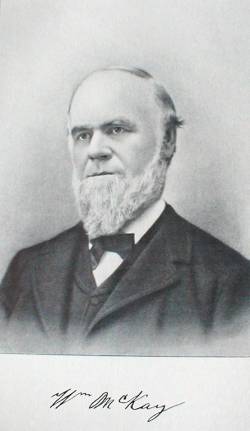
CAPTAIN A. MCKENZIE
Captain A. McKenzie was born at London, Ontario, July 16, 1844, and lived at that place until he was twelve years of age, when he came with his parents to Sanilac county, Mich. His paternal grandfather, Andrew McKenzie, was a surgeon in the British army and later a merchant of Manchester, England, and the same relative on his mother's side, Edward Carney, was a surveyor employed by the British Government to survey the Canadian country between Niagara and the lower end of Lake Huron, for which service he was granted seven hundred acres of land. John and Mary (Carney) McKenzie, the Captain's parents, were natives of Scotland and New York State, respectively. The father spent the greater part of his life in farming; he died in May, 1889, survived by his wife, who passed away in April, 1892.
Having no desire to follow the occupation to which his father had devoted his life, Andrew McKenzie decided to be a sailor, and beginning that career at age of fourteen years he shipped on the Avenger, as boy. The following season he acted as able seaman on the Harwich, afterward serving one season in the same capacity on the Falcon. The next year he was master of the New York, and after one year as mate on the Coleman was put in command, continuing thus for two years. In 1866 he bought the Malisa, and sailed her two years, soon after coming to Detroit, where he entered the employ of the Western Transportation & Coal Co., with whom he remained seven years. He then shipped on the schooner Clement, and after one season in command of that boat left the water for some time, returning in 1892, when he took command of the lighter Gray Oak, at Duluth, for the Western Transportation Company. In 1893 he came to the Bay City, of which he has since been in command, looking after the repairs in the winter season.
On December 25, 1864, Captain McKenzie was married to Miss Mary L. Ashley, of Lexington, Mich. Their children are: Florence, who is married to H. W. Belville, a marine man, and lives in Detroit; Nellie, who is married to Capt. H. W. Baker, and also resides in Detroit; Alice, wife of Edward LaPine, of Detroit; and Grace, who is married to Andrew Zimmerman, and resides in Marshall, Michigan.
CAPTAIN H. McKENZIE
Captain H. McKenzie has spent his life on the water since his thirteenth year and is thoroughly competent in all the different departments of marine work. He was born April 19, 1853, at Port Huron, Mich., and lived at that place until he reached his sixth year, when he removed to Detroit. After a short residence in that city he went to Amherstburg, Ontario, where he remained several years. His first experience as a sailor was obtained on the scow Mary, on the Detroit river, in which he shipped as boy, and he afterward acted in the same capacity on the barges Colorado and Mohican, later becoming mate on the Colorado. From this boat he went to the steamer Colin Campbell as second mate, after which he acted as mate of the B.W. Jenness nine years and was in command of her four years. He commanded the J.C. Potts one season and the W.R. Stafford two seasons, and he later entered the employ of the lumber firm of Charles Hebard & Son, operating on Lake Superior, and he has since been in command of the tug Daniel L. Hebard, having held this post nine years.
On December 7, 1877, Captain McKenzie was married to Miss Elmira Sunderland, of Amherst-burg, Ontario, a daughter of Capt. John Sunderland, and sister to Robert H., W.W. and John Sunderland, Jr., all of whom are marine men well-known in this vicinity. Captain and Mrs. McKenzie have had three children: Elmira, Hamilton and Irene. Socially he is a member of the Ship Masters Association, K.O.T.M., K. of P., and I.O.O.F., in Detroit, in which city he resides.
CAPTAIN JAMES MCKERRALL
Captain James McKerrall, of Cleveland, was born in Bangor, Ireland, in 1839. His father, also named James, was an ocean sailor, and died of yellow fever in the West Indies. The Captain commenced sailing at the age of twenty-one as steward of the bark Standard, an ocean vessel, later shipping on the Golden Era and the Lighting in turn, going to Melbourne, Australia, where he ran away to the gold diggings for three months. He next shipped on the Pioneer, a very speedy vessel, which held the record at that time of having made the quickest trip from Melbourne to the Line. Then he joined the ship America, making a trip to Appalachicola for cotton, and his next voyage was to Bombay as second mate in the Rosalia. On returning to England he engaged to go again on the ship America, which was waiting for orders, and he remained at his home in Bangor prepared to go when she was ready. When he received notice that the vessel was to sail Mr. McKerrall started for the point of departure, but he missed the boat that was to carry him there and the America sailed without him; soon afterward he learned that she was lost with all hands on the trip. Having missed this vessel he shipped on another belonging to the same line and made a voyage round the Horn and up to Puget Sound, to Australia and back to England, where he joined the ship Sir Jmsetgee Custegee, making the trip to Bombay. Following this he sailed in an opium clipper, returning to Bombay, and next sailed to Quebec in the ship Elmira, on the return voyage being driven by a furious gale into a harbor near Holyhead, and there going aground in sight of eleven other wrecked vessels. A tug was finally secured to tow the vessel to port, but before reaching it she seemed to drag heavily on the bottom, and it was found that a portion of the mizzen mast had gone through the hull of the ship when the masts went overboard. At the conclusion of this trip Mr. McKerrall returned to Bangor, where he married Miss Jane Phillips Hassan. They have had three children: William Hassan, who is a successful dentist, having an office on Euclid avenue, Cleveland; John, a machinist, and James, Jr., who died at the age of eighteen years.
Mr. McKerrall now made his last ocean voyage, going to Cadiz, Spain, on the steamer St. Patrick, with a load of convicts for Little Fish Bay, on the coast of Africa. The convicts planned to mutiny and seize the vessel, but their designs were discovered and the protetion of a British warship sought, the ringleaders being taken off their vessel. Our subject was at St. Paul de Loando on this voyage when the explorer Livingston left Africa for his home, a bent and grizzled old man. On the completion of this trip Mr. McKerrall brought his family to the United States, coming in the schooner William Topscott, and at once commenced life on the lakes. Joining the schooner Clayton Belle he sailed in her two seasons, becoming first mate. After serving a short time in a small schooner from Buffalo he became mate on the schooner George Sherman, the W. W. Arnold and the Empire State, in turn, later serving in the same capacity on the Southwest (three years), Edward Kelly (five years), E. Fitzgerald, Sophia Minch, Sunrise, bark Sunnyside and schooner Gilmore. At this time he made a trip to the old country to see his mother and father. Returning he remained on shore for three years, employed in Chicago, St. Louis, and Austin, Texas, and finally shipped as mate of the schooner Constitution, transferring from her to the schooner Mineral State as master, and subsequently serving as mate of the steamer James F. Shrigley, second mate of the Tuttle, and mate of the steamer H. B. Tuttle. This closed his sailing career, and he accepted the position with the Hill Clutch Works, of Cleveland, which he still retains, having charge of the store room of the works.
CAPTAIN PETER A. McKINNON
Captain Peter A. McKinnon was born in Glasgow, Scotland, in 1847, and removed with his parents to the United States in 1857, locating in Buffalo.
Our subject acquired his education in the public schools. In the winter of 1861 he was shipkeeper on the steamer Susquehanna, which was laid up in Cleveland, and was in that city when Abraham Lincoln, then newly elected President, passed through on his way to Washington to be inaugurated. Captain McKinnon remained on the Susquehanna the following season, and in the spring of 1863 shipped on the steamer Pittsburgh as wheelsman. This was followed by three years as lookout on the Canisteo, and in 1866 he was appointed second mate of the steamer Rocket, on which boat he remained three seasons, the last one as mate. He was then appointed master of the F. C. Carney, the following season holding the same position on the barge G. H. Orton, and then becoming mate and sailing master of the propeller Plymouth. His next berth was on the propeller Toledo, of the New York Central line, as lookout with Capt. Thomas Watts. He then went as wheelsman on the new steamer Equinox, the following season going in the same capacity on the Evergreen City with Captain Parsons, and in the spring of 1884 he shipped as lookout on the steamer Winona, with Captain Conkey. In 1885 he was appointed mate of the propeller Toledo, remaining on her three years, the last two as master; in 1888-89 he sailed as mate of the steamer Samuel F. Hodge; in the spring of 1892 he was appointed master of the Northerner, which went ashore near L'Anse, Lake Superior, in a driving snowstorm; she was laden with oil and was destroyed by fire. In the spring of 1893 Captain McKinnon entered the employ of the Lackawanna Steamship Company, being appointed mate of the Scranton, and remaining on her two seasons; in 1895 he became mate of the steamer Lackawanna, which he laid up in Buffalo creek at the close of navigation; in 1896-97 was on the Lackawanna, and in 1898 was on the Brazil.
Captain McKinnon was united in marriage to Miss Lucy A. Brant, of Buffalo, in 1888. The family residence is at No. 715 Plymouth avenue, Buffalo. Socially he is a Master Mason, a member of Erie Lodge, in Buffalo.
WILLIAM McKITTRICK
William McKittrick is one of the few engineers who did active duty on the lakes before licenses were required by the government, and although several years have passed, while working ashore, that he did not take out license, he has thirty-one issues.
Our subject is the son of Thomas and Clarissa (Sweet) McKittrick. The father was also a lake engineer, but the mariners who were contemporary with him have all passed away. He was born in Glasgow, Scotland, and came to America about the year 1813, locating in Kingston, Ont., with his parents. In the course of time he became second engineer on the older steamer Telegraph, plying between Oswego and Kingston. He also served as second engineer on the old steamer St. Lawrence seven years. She was operated by the American Express Company between Ogdensburg and Lewiston, N.Y. He then shipped in the old Vandalia, the first propeller ever built, as second, John Fayette being chief engineer. He was chief for four seasons on a steamer built by Sylvester Doolittle, of Oswego, and the next season he brought out new the steamer Oswego, as chief, running her four seasons between Oswego and Chicago. In those days the marine engineer did not receive the consideration that is shown him to-day. His wages are $30 per month, and he fired his own watch with wood; the second getting $20 and firing his own watch. These were the good times so often discussed by shipmates of the present day. But to return to Mr. McKittrick, Sr. After leaving the steamer Oswego, he took charge of the machinery of the first elevator in Oswego operated by steam, afterward having charge of the stationary engine in a planing-mill for twenty years. The last vessel of which he was chief was the propeller Kentucky, on which he remained one season, then went to the planing mill. He died about a year later at the age of eighty-six, after having lived a long life of usefulness, and integrity. The mother was a native of Massachusetts, and died about the year 1841.
Engineer William McKittrick was born January 12, 1833, in Oswego, N.Y., where he was educated. His first experience as an engineer was under his father, as second in the Oswego elevator, in 1853, after which he served as second with him on the propeller Kentucky without license. The next spring he was appointed engineer of the tug Blower, at Oswego harbor, and the three following seasons ran the tug Mulford, A.A.Smith, Dobbie and Manwaring.
In 1857 Mr. McKittrick went to Chicago and ran an engine in an elevator, but later took the tug Sturgis and ran her for Capt. Redmund Prindiville, and after passing some months as superintendent of a retail coal yard, he shipped as engineer on the tug Walter McQueen. In 1861 he went to St. Louis and took charge of the machinery in the six tugs which had been built by Mr. Adams for General Fremont, and took them to Cairo, where he turned them over to Commodore Foote for use by the navy department; after which the Commodore gave him a position on the tug used as a dispatch-boat by him and on which he saw active service during the war. He then returned to Chicago and joined the propeller Prairie State as second engineer. In 1863 he sailed as second and then as chief engineer of the old propeller Ontario. The following year he entered the employ of the Northern Insurance Company as chief engineer of the tug Hector, which had been chartered by the government to tow the steamer New World, when dismantled to be used as a floating hospital, to Fortress Monroe. He returned with the Hector after completing the contract.
During the next four years Mr. McKittrick was chief engineer of the Northwestern elevator at Oswego, N.Y. In 1869 he went to Bay City and ran the tug Tornado for Dobbie & Manwaring. This was followed by two seasons as chief engineer of the lake tug Winslow, then owned by Ballentine & Co. He was chief engineer of the steamer R. Prindiville, of the Anchor line, in 1872, and the next spring bought a half-interest in the tug Seeley, and ran her. He was then chief engineer of the steamer Phil Sheridan two seasons; chief of the Annie L. Craig; chief of the St. Joseph; part of the season on the tug Stranger, and chief of the tug Sweepstakes; then assumed the position of assistant superintendent of a blast furnace at Hamtramck, after which he worked in the car shops of the Michigan Central Company. In the spring of 1882 he again took up the duties of an engineer, and was made chief of the steamer Business, and, in 1883, of the steamer Osceola, which he ran three seasons, followed by two on the H.D. Coffinberry. In 1888 he fitted out the steamer Monteagle, but closed the season on the lake tug Music. He then ran the steamer S.C. Baldwin two seasons, and the Nipigon one. In the spring of 1892 he was appointed chief engineer of the passenger steamer William Harrison, which he ran two seasons in the excursion business between Buffalo and Niagara Falls. In 1894 he received a government appointment as chief engineer of the mail equipment at Washington, D.C., which he retained three years. In the spring of 1896 he was appointed chief of the ferry steamer Fortune, on which he closed the season; and took out the steamer Germania, during the spring of 1897, and in 1898 joined the steamer R.J. Hackett as chief engineer.
Socially, he is a member of the Marine Engineers Beneficial Association, and of the Ancient Order of the United Workmen.
On December 24, 1853, Mr. McKittrick was wedded to Miss Elizabeth A., daughter of Henry and Margaret (Henry) Watson, of Oswego. The children born to this union were William, who sailed as chief engineer many years, and died in South Chicago, October 12, 1897, at the age of 43 years; Edith, now the wife of S.A. Whipple, of Detroit, a former lake captain. The family homestead is at No. 226 Twenty-fourth street, Detroit, Michigan.
A. H. McLACHLAN
A.H. McLachlan, who was at one time the efficient pilot of the City of Buffalo, is a young man whose future is full of promise, judging from the advancements he has made from time to time on different boats upon which he has served. At the age of seventeen he went sailing, and since that time has devoted all his attention to thorough knowledge of marine affairs.
He was born November 17, 1861, at Detroit, Michigan. He lived there about two years, and then removed with his parents to Alvinston, Ontario, where he lived about fourteen years, there obtaining an education from the public schools. He first shipped on the North West, and spent the first year as deckhand, after which he acted as watchman one season. As wheelsman and lookout he spent two seasons on the old City of Detroit, two years as second mate, and in June, 1887, was given the position as mate, which he held until the close of navigation in 1888. During 1889 and 1890 he acted as mate on the new City of Detroit, and in 1891 went on the barge C. Towar as second mate. In 1892 he acted as second mate of the Flora, in 1893 of the State of New York, and in 1894 and 1895 as second mate of the State of Ohio. When the City of Buffalo came out new in 1896 he was given the position of pilot, and served in that capacity for the following two seasons, and in 1898, when the City of Erie came out new, he was transferred to her as pilot.
Mr. McLachlan is a son of H. T. and Jane (Ferguson) McLachlan, natives of Canada, the former of whom has been a sailor on the lakes about forty years. Daniel and John, brothers of the subject of this sketch, are both sailors, the former frequently going to England.
On December 26, 1888, Mr. McLachlan was married to Miss Alberta M. Blain, of Detroit. He is a member of the Masonic order, and is second officer of the A. A. of Masters and Pilots, Cleveland Harbor No. 42.
CAPTAIN DUGALD McLACHLAN
In Detroit and vicinity Capt. Dugald McLachlan is well known among marine men, having spent many years of his life in that occupation, but has not sailed since 1895, having last been in the command of the City of Cleveland of the D & C line. He was born January 1, 1845, at Dunoon, near Glasgow, Scotland, and in that country spent the first ten years of his life, after which he came to America and settled in Canada. He is the son of Donald and Anna (Cameron) McLachlan, natives of Scotland, who died in 1855 and 1894, respectively.
In early life Captain McLachlan had a desire to be a sailor, and in gratifying this desire shipped on the propeller Montgomery as a deckhand, when he was nineteen years of age. He then shipped on the Morning Star of the D & C line, there acting as deckhand a short time, after which he spent two years on sailing craft, among which were the schooner C. J. Roeder and the barge City of Milwaukee. he sailed on the Surveyor and the Search, both government boats and steamers; then was on the Coquette, which went ashore at Rock Island, Green Bay, in a snowstorm, and was left there a wreck. he then spent one year on the tugs Sampson and Metamora, as wheelsmen, second mate and mate; the tug Sampson was burned at Amherstburg, and all on board being asleep when she took fire they had to jump for their lives; later he went on the propeller Chicago as wheelsman.
After a season spent on the Fountain City as wheelsman, he returned in 1868 to the Morning Star, which was lost the same year on Lake Erie, in a collision with the bark Courtland. In the place of this boat the North West, now called the Greyhound, was chartered, and upon that he finished the season and spent the following year. After spending four years on the R. J. Hackett as second mate, he entered the police force, and there spent about thirteen months. He then returned to the North West as mate and pilot, and finally became master, remaining four years; after which he brought out the City of Cleveland in 1866 and sailed until 1895.
Captain McLachlan stood high in the estimation of his employers, who knew him to be a man thoroughly acquainted with his business, and one who exercised the greatest thought and care in all matters under his direction.
January 4, 1873, he was married to Miss Elizabeth McKellar, a native of Canada, who died April 12, 1891. They had four children: Harry S., born July 21, 1875, who died February 14, 1883; Donald L., born September 26, 1878, and is sailing at this writing; Katie, born September 22, 1880, who died February 5, 1883; and William, born April 17, 1888, who is attending school at the present time.
On December 20, 1893, Captain McLachlan was married to Jeanette Campbell, and resides with his family at No. 185 17th street.
Donald L. has been sailing for two years, in 1897 went on the City of Cleveland, and for the last two seasons has been on Lake Superior.
CAPTAIN DUNCAN MCLACHLAN
Captain Duncan McLachlan, an older brother of Malcolm McLachlan, was born in Argyleshire, Scotland, and came with his family to America in 1869, locating in Watford, Ontario, where the parents still reside. In this country he was first employed on sailing vessels, his first experience with steamboats being acquired on the Concord, running between Saginaw and Cleveland. The following year he was second mate on the Superior, and then for several years served on different barges until he became connected with the City of Detroit, now the City of Straits, where for two years he was lookout. Subsequently he commanded the Evening Star, the Idlewild and the Greyhound, returning from the last-named to the City of the Straits, of which he has now been master for fifteen seasons. He is one of the most popular captains with the Detroit & Cleveland line, and makes his home in Detroit. He holds membership in the Masonic fraternity.
MALCOLM MCLACHLAN
Malcolm McLachlan, pilot on the City of Detroit, belonging to the Detroit & Cleveland line, is a native of Argyleshire, Scotland, and a son of Archibald McLachlan, a fisherman and sailor of that place, who in 1869 brought his family to the New World and has since made his home in Canada. In tracing the ancestry of our subject we find a sturdy race of seafaring men and fisherman living on the coast of Scotland, and coming down to the present time there are two other members of the family beside himself on the water, his brothers commanding boats of the Detroit & Cleveland line. On his father's fishing boats in Scotland Malcolm McLachlan obtained his rudimentary knowledge of sailing, and soon after coming to America he found employment on the Great Lakes, first as wheelsman on the J. L. Hurd and later on the R. N. Rice, remaining on the latter boat for some time; he was serving as second mate on that vessel when she was burned at Detroit. The following season he accepted a similar position on the City of Detroit, which is now the City of Straits, and during the ten years of his connection with that vessel he rose from second mate to pilot. On the completion of the new City of Detroit, he was made pilot on her and has since acceptably filled that responsible position. Socially, he is a member of the Masonic order.
On January 6, 1885, Mr. McLachlan wedded Miss Margaret Leitch, a young lady of Scotch parentage and Canadian birth, and to them have been born six children -Duncan, Malcolm, Archie, James, Nicol and Mary Bell, all living, with the exception of Archie. The family reside in Detroit, where Mr. McLachlan's marine duties keep him the greater part of the time.
CAPTAIN JOHN MCLACHLIN
Captain John McLachlin, who has been engaged as master in the tugging business out of Bay City, Mich., for many years, was born in Dunwich Township, Elgin County, Ontario, on September 1, 1842. He is the son of Archie and Catherine (McLellan) McLachlin, the former a native of Argyle, Scotland, the latter born in Canada, of Scotch parents also from Argyle. At an early age Archie McLachlin commenced the life of a seaman out of Glasgow, serving an apprenticeship of five years and visiting many European ports, including in his voyages one to the East Indies. When but nineteen years of age he came to the United States, and stopped at Erie, Penn., for a short time. He had no comprehensive idea of the magnitude of the lake commerce in those days, but seeing the steamer Queen City, owned by Mr. Reed, lying at the dock, he shipped on her and found himself well satisfied to remain in the lake region. About this time Chicago was in her infancy and cargoes destined for that port were unloaded into scows to be discharged on the docks. Mr. McLachlin was mate in the steamer Keystone State and among other notable steamers the Western World and Louisiana, remaining in the Reed employ about twenty years. His family consisted of eight sons: Duncan, John, Archie, Angus, Abner, Colon, Isaac and Lachlin. The eldest, Duncan, who was a vessel captain, sailed the schooners A. Shade and Indian Maid, and was mate of the Three Bells, of Toronto, and the Hubbard, of Sandusky.
In the spring of 1861 John McLachlin left home and went to Cleveland, where he shipped with Captain Rummage as boy in the Winslow, remaining with her two seasons, the second as seaman. In the spring of 1863 he went with Capt. John Varner as second mate in the schooner Ellington. His service during the next eight seasons was as follows: On the bark Jennie P. Mack, of Port Burwell, with Capt. Alex McBride: as wheelsman in the Morning Star, with Captain Visier; with Captain Campbell, in the George Laidlow, a saltwater barkentine, owned by Mr. Taylor; on the schooner Hubbard, of Sandusky, two seasons; on the schooner Lookout, of Milwaukee, with Capt. J. Thompson, two seasons; in the schooner Fitzgerald, with Captain Fitzgerald. In 1870 he accepted a lucrative position in a lumber camp at Unionville, Mich., where he remained ten years. In the spring of 1880 Captain McLachlin went to Bay City, Mich., and entered the employ of Captain Boutell as master of the tug Sea Gull, and during the fifteen years of his service with Captain Boutell has transferred from one tug to another as occasion required, sailing the tug Cora B., again as master on the Sea Gull three seasons, as master on the Annie Moiles, mate on the lake tugs Music, Emerald, Traveler and Niagara, and as master of the tug Annie Moiles in 1897. The three intervening seasons he was in the employ of the Michigan Log Towing Company, as master of the tug Avery two seasons and of the tug Howard one season.
On November 9, 1870, Captain McLachlin wedded Miss Annie McIntyre, of Ekfried township, Middlesex County, Ontario, and they have had four children; Archie, who is a captain of the tug Charley O. Smith; Ward, who is a mate on the same boat; Henrietta, and Alice. Socially the Captain is a Master Mason and a member of the Knights of the Maccabees.
JOSEPH H. MCLARY
Joseph H. McLary, one of Chicago's well-known marine engineers, and now chief engineer for Wilson Brothers, Chicago, was born in Prescott, Canada, in 1858, a son of Henry and Emaline (Payne) McLary, the former born in Ireland of Scotch ancestry, and the latter born in Canada. For some years the father was a resident of Ogdensburg, N. Y., and in April, 1862, enlisted in the Fifteenth New York Regiment and was killed at the second battle of Bull Run. The mother is still living and now makes her home in Prescott, Canada.
The education of our subject was acquired in the schools of Ogdensburg, N. Y., in which place he spend the greater part of his boyhood and youth, and he learned engineering there and at Buffalo and New York city. He commenced sailing early in life and followed it successfully until 1892, when he accepted his present position with Wilson Brothers, of Chicago. In 1876 he sailed out of Ogdensburg as assistant engineer on the vessel George T. Seymour, engaged in the towing business, and after one season spent on her he entered the T. Teft machine shops, of Buffalo, N. Y., where he spent the winter. He commenced the next season as second engineer on the William Gardner, of Ogdensburg, but closed in the same capacity, on the Inter Ocean, which he laid up at the close of navigation. He then worked at taking out engines for the Argonaut, and was chief engineer of her the next season. Going to New York city the following year, he sailed along the coast for two years and eight months, in the interest of the South American trade, and also in the West India trade, and later worked in a machine shop in New York city, doing marine repairs. Coming to Chicago in 1885, he brought out the Rhoda Emily, which was engaged in general lake trade, and as chief engineer he remained on her one season. He then entered the employ of the Escanaba and Lake Michigan Transportation Company, remaining with them for nine years, when he left to go again to New York City, and after a time spent in that city, he returned to Chicago and re-engaged with this same company, with which he was connected until entering upon his present duties on November 25, 1892. He has permanently resided in Chicago since 1887, and his home is now at No. 513 Twenty-eighth street.
Socially, he is identified with the old Marine Engineers Association, the Royal Arcanum, and the Foresters.
In Chicago, Mr. McLary was married, in 1888, to Miss Lizzie Flynn, and to them have been born four children, namely: Joseph H., Jr., Edward Augustus, Mary and Lillie.
GEORGE MCLAUGHLIN
George McLaughlin, although young in years, has by natural ability and close study of technical marine engineering works, fitted himself for the responsible position he now holds, as chief engineer of the largest passenger steamer on the lakes, the monitor Christopher Columbus. This monitor was built by the American Steel Barge Company, has become a great favorite with the traveling public since her debut at Chicago during the World's Fair year, when she carried 1,800,000 people with the loss of but one life, a member of the crew, and as she is now as well officered, all who ride on her experience the utmost comfort and confidence that they are well guarded against any form of accident.
Engineer George McLaughlin was born in Collingwood, Ont., on March 4, 1874, and is the son of Charles and Jennie (Cameron) McLaughlin. The father was born in New Brunswick, of Scotch descent, and the mother in Scotland, coming to Canada with her parents. After some years, attendance in the public schools of Collingwood, George, in 1884, removed to the United States, locating in West Superior, where he soon afterwards went to work in a sawmill. This occupation being somewhat out of the line of life he had marked out for himself to follow, he transferred the scenes of his labors to the machine shop of the American Steel Barge Company, remaining with that concern until 1892, learning the machinist's trade so thoroughly that he felt confident of his ability to take charge of marine engines. He assisted in putting in the machinery of the Christopher Columbus and in the spring of 1893 shipped as oiler on her, holding that berth three seasons, the fall of the second, however, going as oiler on the monitor A. D. Thompson, and in the spring of 1894 coming out as oiler on the monitor Colgate Hoyt, these several berths being rendered possible by the fact that the passenger seasons of the Christopher Columbus are of short duration. That same fall, after laying up the passenger steamer, he closed the season in the steamer W. H. Gilbert, of the Empire Transportation Company, and in the winter went down the Mississippi as third assistant engineer of the United States hydraulic dredge Beta, engaged in government work in the river, with headquarters at Memphis, Tennessee.
In the spring of 1896 Mr. McLaughlin was appointed first assistant engineer of the Christopher Columbus, closing the season in the Centurion as oiler, in order that he might gain experience with other machinery. That winter he worked in the machine shop of the American Steel Barge Company, at West Superior, taking out marine engineer's license in the meantime. In the spring of 1897 he fitted out the Christopher Columbus, and was appointed chief engineer and ran her all season on the route between Chicago and Milwaukee. That winter he sailed the supply boat Islay, on the St. Louis Bay for the Steel Barge Company. In 1898 he was chief engineer of the Christopher Columbus on the same route, she running in the line of the Chicago and Milwaukee Transportation Company.
In November, 1894, Mr. McLaughlin was wedded to Miss Tena M., daughter of William Foreman, of West Superior, formerly of Collingwood, Ont. One daughter has been born to this union. Fraternally, our subject is a member of the Marine Engineers Beneficial Association No. 78, of Duluth, Minnesota.
CAPTAIN MURDICK McLEAN
Captain Murdick McLean, a well known master sailing out of Duluth, Minn., and a born sailor, is a son of Captain John and Mary (Rowan) McLean, natives of Inverness, Scotland, who came to America in the early forties, first locating near St. Thomas, Ontario, Canada, and later removing to Kincardine, Ontario, where the birth of our subject occurred December 4, 1855.
The father was in the schooner Robert Willis when she disappeared from off the face of the waters, supposed to have been captured and sunk by the Mormons in 1856. Her crew all told consisted of eight men, all the specimens of manhood, six feet and over in height. The Willis left Chicago for Buffalo with a load of flour and provisions late in the fall, expecting to get through the rivers before they froze up. The last seen of the vessel was at the lower end of Lake Michigan when laboring in a snow squall, being seen by J. P. Merrill, of Milwaukee, who was at the Skillagalee lighthouse on Thanksgiving day. Straight out from the island he saw the Willis through a rift in the snow. It would appear that the same rift enabled the crew of the brig to sight the island, as they put about, but the next minute she was shut in again by the storm. That was the last seen or heard of her. Some probability was given to the story that she was lured to Beaver island, and the crew murdered by Mormons under King Stang, by finding, some years afterward, of a grave containing eight corpses, and many believed that this was a solution of the puzzling disappearance. Captain McLean’s kinsmen on the maternal side were also lake masters, one of his uncles, Duncan Rowan, having sailed the Emily, held to be the first schooner plying regularly on the east shore of Lake Huron. The mother was also quite handy, and qualified to take her place at the wheel even in heavy weather.
Capt. Murdick McLean, whose school days were passed at Kincardine, shipped as porter in the steamer William Seymour with his uncle, Capt. Duncan Rowan, in 1869, and after two seasons was advanced to the position of wheelsman in the steamer Adelaide Horton until September, when he took the wheel in the tug Welcome. In the spring of 1872 he shipped before the mast in the schooner Fannie Campbell, a Canadian vessel, which went ashore near Kincardine, and was released and drawn into that harbor by teams, hitched tandem fashion. Then followed the bark Butcher Bay; the steamer Benton, of which he was wheelsman; the steamer, Burcher; closing the season in the Asia at the wheel,; the side-wheel steamer Manitoba, plying between Sarnia and Duluth; and the steamer Ontario, in which he shipped as wheelsman and was promoted to second mate. In the spring of 1878 he shipped with Capt. Alexander McDougall, as wheelsman to the steamer City of Duluth, closing the season in the Canadian boat Northern Queen, and after season in another Canadian boat as second mate, he joined the Anchor line steamer Conestoga, as lookout, transferring to the new steamer Boston, of the Western line, and remained with her until July, 1881 when he took out license and was appointed second mate of the steamer Samuel F. Hodge.
The following spring he came out as wheelsman in the steamer Peerless, closing the season as second mate. During the season of 1883 he was mate of the tug T. H. Kent, followed by a season as mate of the steamyacht A. Booth; 1885, master of the Kemp, closing in the steamer Australasia, the largest boat on the lakes; 1886, master of the passenger steamer Isle Royal, plying between Duluth and Port Arthur; 1887-88, on the St. Paul & Duluth railroad dock, and patrolman during the winter in Duluth; 1891, master of the ferry steamer Mayflower, between Duluth and Superior, 1892, mate on the steamer N. K. Fairbanks; 1893, mate on the steam monitor James B. Colgate; 1894-95, mate of the river tug Howard; 1896, wheelsman on the Samuel Mather, mate of the Nahant; 1897, second mate on the steamer Victory and second mate on the Horace A. Tuttle; 1898, master of the passenger steamer Bon Voyage. Socially he is a master Mason and a member of the Independent Order of Foresters.
On December 23, 1884, Captain McLean married Miss Louisa Strieff, of Superior, and the children born to them are: John Duncan (who died at the age of five years), James Rowan and Stanley. The family residence is at No. 122 East Second street, Duluth, Minnesota.
RONALD MCLEAN
Ronald McLean, mate of the City of Detroit, was born in Inverness, Scotland, January 1, 1854, the son of a farmer. In 1879 he came to America, but for a number of years afterward he sailed on salt water, during that time visiting ports of Russia and East Indies. He received master’s papers for the ocean and was in command of sailing vessels for seven years. In 1887 he went upon the lakes as wheelsman on the Fountain City, of the Lake Superior Transit line, and has been connected with the lake marine service ever since, in 1892 shipping as wheelsman on the City of Detroit of which he has been mate since 1893. He makes his home in Detroit. Mr. McLean’s career has been an interesting and changeable one; while serving before the mast he was shipwrecked off the coast of Ireland. He has long been a member of the Masonic Fraternity.
CAPTAIN DANIEL McLEOD
Captain Daniel McLeod was born on Prince Edward Island in 1835. After receiving a public-school education such as the youth of that day were blessed with, and boating about until 1852, he shipped on the American schooner Reward, of Newburyport, Mass., plying in the fishing trade between the Gulf of St. Lawrence and Boston and other ports.
In 1855 the Captain was appointed master of the schooner Garland, of which he was part owner, and remained on her seven years, coasting in the winter and fishing in the summer. In November, 1861, he shipped as mate on the schooner Gold hunter, one hundred twenty tons burden, Capt. Neil McKay, out of Prince Edward Island, bound for New York. During the passage she was blown out of her course, and on the 1st of January, 1862, was entirely dismasted. The schooner from that date drifted along like a derelict until May, when the crew (five all told) were picked up by a brig bound for the Barbados, from which place they were shipped to Halifax, arriving in June, 1862. During the time the Gold Hunter drifted as a derelict the crew, after the provisions were exhausted, lived on the oats with which the schooner was loaded from February 10 to April 1, when they boarded the West Indiaman, the master of which refused to take them off, but furnished them with a barrel of flour, a barrel of hard bread, and some pork.
In 1863 Captain McLeod shipped on a coasting vessel out of Boston; in 1865 shipped as second mate, and afterward became mate on the schooner Rachel Seaman, hailing from West Dennis. In 1865-66 he went as mate on the barque Charles and Edward; in 1867 he removed to Buffalo, shipped one trip on the schooner Pamlico, and then went on the schooner St. Lawrence for one season, continuing on her as mate the two following seasons. In 1869 he was made mate of the schooner William Grandy, which position he held the following season also. He was then appointed master of the schooner St. Lawrence. In the meantime he removed to Chicago, and after the Chicago fire he stopped ashore and engaged in business as a ship carpenter and rigger until 1887, in which year he was appointed inspector for the manager of Inland Lloyds, and in January, 1890, was appointed manager. In this capacity he was stationed three years at Buffalo and one year at Detroit, and has at this writing (1898) been stationed three years in Cleveland. Socially he is a Knight Templar, a member of St. Bernard Commandery, Chicago; belongs also to the Mystic Shrine in Buffalo, and to the Consistory in Detroit.
Captain McLeod was married in 1863, to Miss Mary Palmer, of Halifax, Nova Scotia, and has one daughter, Olive Genevieve.
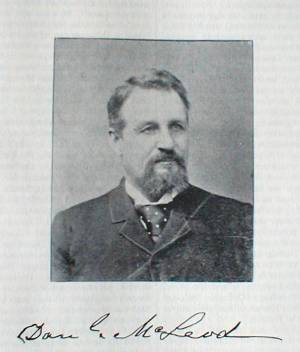
CAPTAIN GEORGE A. McLEOD
Captain George A. McLeod, at the age of fifteen, left home and went to Port Huron, where he has resided ever since. He is one of the most skillful steamboat masters sailing out of that port, and in his long experience as a captain on the Great American Lakes has filled many positions of responsibility and trust. During the last five years he has been the fleet captain for the Jencks Shipbuilding Company, and brings out all their new steam-boats. He is a man of well-defined characteristics, and although he expresses himself forcibly and earnestly, he makes no enemies among those whose friendship is worth the having - a Christian gentleman, a man of conscience and integrity.
Captain McLeod was born in Titusville, Penn., September 5, 1854, and is the son of William and Elizabeth (Ramey) McLeod. His father, who is a railroad contractor, was born in Scotland, and came to the United States when he was about twenty-eight years of age, locating near where Titusville now stands, where he met Miss Ramey, and soon after he had made her his wife, and where their son George, the subject of this sketch, acquired his education. After reaching Port Huron George McLeod in 1869 shipped as a boy on the schooner Adair, remaining all season. The next season's experience was on the brig Preble, being advanced to the grade of seaman the second year he was on the Preble. During the year 1871 he shipped as seaman out of Chicago on several vessels until the fall, when he was made second mate of the schooner Maize. The next season he came out as second mate on the schooner Collingwood, but changed from one vessel to another during the last part of the year. In 1873 he shipped as wheelsman on the river tug U.S. Grant. The three following seasons he shipped as mate on the schooner Halstead, the last half of the season of 1876 as master. The next vessel of which he had command was the schooner Homer, sailing her two seasons.
He then entered the employ of John Demas, of Detroit, as master of the schooner Belle Hanscom, sailing her the next five seasons, and at the same time being manager of the fleet of four vessels and tug Anderson, belonging to the same owner, and operating them as though they were his own vessels; making charters, attending repairs, employing the men and performing all business transactions necessary for their successful management until the close of the season of 1888, when he went to work for Mr. Bradley, of Cleveland, as master of the schooner Fayette Brown. The next season he transferred to the schooner D.P. Rhodes, and sailed her three seasons, or until July, 1892, when he was promoted to the command of the steamer Sarah E. Sheldon. His next steamboat was the Superior, sailing her until the close of the season 1893. It was in the spring of 1893 that Captain McLeod entered the employ of the Jencks Shipbuilding Company, as master of the steamer H.E. Runnells, sailing her two seasons. In the spring of 1895 he brought out new the steamer Linden, built by the company to the order of A.M. Carpenter. He sailed her two seasons, and then took command of the steamer Black Rock, built by the same company, and sailed her two seasons, up to the close of the season 1898. During the winter months Captain McLeod superintended all repair work necessary on these vessels. Captain McLeod was united in marriage to Miss Kate, daughter of Charles Stuart, of Port Huron, December 11, 1880. The children born to them were Elenior (sic), Florence and Georgia. In December, 1890, the wife passed to the better land. Captain McLeod, in January, 1893, led to the alter Miss Theresa, daughter of John Messmore, of Port Dalhousie, Ont., and one daughter, Theresa, has been born to them. The Captain is a member of the Grace Episcopal Church at Port Huron, of the Knights of the Maccabees, and of the Shipmasters Association, carrying Pennant No. 997.
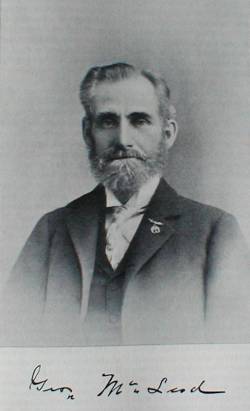
CAPTAIN GEORGE McLEOD
Captain George McLeod easily ranks as the first wrecking master of the lakes. He was born May 1, 1836, at New London, Prince Edward Island, a son of John and Katherine (McKay) McLeod. John McLeod, his father, was born about 1794, and followed farming as an occupation, dying at the age of seventy-six; he was a son of Kenneth McLeod, who with two friends came from Scotland in 1805 and settled on Prince Edward Island on land granted them on the north side of the island by the British government for over a score of years of service in the army. Kenneth McLeod passed the rest of his days on this land, and died at the ripe old age of ninety-five years. Katherine (McKay) McLeod was born in 1801, and died in April, 1879.
George McLeod remained at home until he was fourteen years of age, in the mean time receiving a common-school education. He then chose a seafaring life and shipped on the schooner Ornament, which hailed from New London. Next year he shipped on the schooner Mariner, for England, returning to Halifax on the ship Humber, and in the fall of the same year he went to Boston and shipped in the new ship Jacob Badger. The vessel went to New Orleans for cotton, which she landed at Liverpool, and took railroad iron for Calcutta, which voyage he made in 1855, returning in 1856. In 1856 he shipped from London to New York on the passenger boat West Point.
In July 1856, Captain McLeod came to the lakes. He sailed in the schooner Huntress, and afterward in the William Treat, during that season, and the next season he was mate of the schooner R. G. Winslow. For the next three seasons he was mate of the Oriole, and during the season of 1861 and 1862 he was master of the schooner Plover, acting in the same capacity on the bark De Soto for two seasons following. In 1865 he was master of the Flying Mist, and for the next five seasons of the St. Lawrence. In 1871 he became master of the bark Northwest, which he left some time in the insurance office of W. M. Egan at Chicago, remaining through 1875; he returned to sailing the next season as master of the schooner Red, White & Blue, and as she laid up in mid-season he finished in the Alice B. Norris. He was master of the Lucerne in 1877, and of the schooner Porter during the next two seasons.
This closed Captain McLeod's career afloat. The twenty-five years of almost unbroken marine service had fitted him for a more marked success in special occupation in the same line ashore. In the fall of 1879 he engaged as wrecking master for Smith & Davis, now Smith, Davis & Co., of Buffalo, which position he still holds. The work was specially suited to him. There is no record of it, but he has traversed the chain of lakes from the day of his appointment for the purpose of releasing from the shore vessels that had been stranded. At a moment's notice he must go on a journey of perhaps one thousand miles over land to meet a wrecking tug sent out in answer to a telegram from a nearer port to save time and expense. If this unfortunate vessel is far from railroad communication, the trip is concluded by wagon or on board a tug obtained at the nearest port. Bad weather or other circumstances are deemed of the slightest account, the order always being to get the vessel afloat as soon as possible. Captain McLeod has saved more than one hundred vessels this way. A complete record of his operations would go far toward giving a partial list of losses on the lakes since 1877. A brief mention of some of them will have to suffice. In 1888 he raised the barge William Crosthwaite, coal laden, from the bottom of the Sault river at the Sailors' encampment, and the next season the steamer Francis Hinton, from Pilot island at the entrance of Green Bay. The same season the steamer Plymouth went high and dry on Washington Island, in Green Bay, but with three tugs, Captain McLeod succeed in floating her, the neatest pulling match, he says, that he ever saw, for he could walk all about the vessel before he bagan to work on her. In 1890 the steamer Viking went ashore at Eagle River, Lake Superior, having been caught in a thick fog, and she was also released by Captain McLeod. That year he also saved, among others, the steamer Nevada, from Pilot Island, the S. C. Reynolds from the north shore of Lake Erie after she had been beached on account of getting afire, the Canadian schooner Gulnair from the shore near Alpena, and the steamer Rube Richards from Starve Island reef in Lake Erie. Among the successful wrecking feats of 1891 were the release of the steamship Hiawatha from near Detour, Lake Huron, leaving her consort, the Minnehaha, to be wintered there ashore and be floated next spring, the Canadian schooner Sligo, from the north shore of Lake Huron, the steamer Susan E. Peck (now the Lewiston) from the Sault River, and the John B. Lyon from Point Pelee, Lake Erie. The Peck had sunk in a collision with the barge G. W. Adams, in tow of the Aurora, and blocked the passage of Lake Superior for several days.
Among the notable expeditions of 1892 was the one in which Captain McLeod saved the Canadian schooner S. J. Luff from the rocks of the Georgian Bay and took her to Collingwood; he also released the steamer Russia from Rondeau Point, Lake Erie, the steamer John B. Lyon from near Sand Beach, and later on the H. D. Coffinberry near the same point; the Coffinberry had rolled so terribly in the gale that her boilers had shifted.
There is a long list for the stormy season of 1893. The Captain saved the steamer Pridgeon from the south shore of Lake Erie, near Geneva, Ohio, the Norwalk, with a cargo of $100,000 worth of copper, from the Canadian shore of Lake Erie, near Buffalo, the N. K. Fairbank from Point Iroquois, Lake Superior, the S. E. Peck from the Bar Point, Lake Erie, the Colonial and Hecla from Lake Ontario shores, the Burlington from Sand Beach and the C. B. Lockwood from Lime Kiln Crossing in the Detroit River. The Lockwood had been sunk in collision with the E. A. Nicholson and was one of the worst wrecks that had ever been floated. Among the stranded vessels floated in 1894 by Captain McLeod were the steamer R. Mills from the Straits of Mackinac, where she had been sunk by the Jewett, the S. C. Baldwin from the St. Clair River, and the Monteagle from near Chicago. Two bad collisions made work for 1895. The Canadian steamer Jack, in the midst of a remarkable career of accidents, sank the steamer Norman in Lake Huron, never to be raised, and went down herself in waters shallow enough for Captain McLeod to raise her. The steamer R. L. Fryer was sunk in the Sault River in a collision with the steamer Corsica, her whole forward part being laid open; it was a feat of submarine engineering to raise her, but Captain McLeod accomplished the job in comparatively short time. The steamer P. P. Pratt from Lake Huron, near the Sault River, the schooner S. J. Tilden from lower Lake Huron, and the Michigan from near Chicago, where the other consort of the J. E. Owen, the E. A. Nicholson, was lost, were also raised the same season. In 1896 the William Chisholm was raised in the St. Clair Lake after being sunk in collision with the Oceanica, also the steamer Samoa from the St. Lawrence River, and the Monteagle from near Kingston. In the fall of 1898 he took the schooner Aberdeen off the beach at Grand Haven, and took her to Milwaukee. In about 1879 or '80, Captain McLeod was put on the committee for compiling the Inland Lloyds Registers, and has been upon that committee ever since.
Captain McLeod is an honorary member of the Shipmasters Association; member of Erie Lodge, Buffalo Chapter, Keystone Council, Lake Erie Commandery, and a 32nd degree Mason, of what is called Buffalo Consistory; he has always taken quite an interest in Masonry, and is one of the leaders. In politics he is a stanch Republican.
CAPTAIN JOHN C. McLEOD
Captain John C. McLeod has been captain of the steamer Osceola for the past four years, and thogh his years do not give him a place among the older mariners of the lakes, he ranks justly as a trustworthy and reliable man among the first. He is a native of Nova Scotia, born February 3, 1856, a son of Donald McLeod, who was born in Lochinvar, Scotland, and came to America, locating in Nova Scotia, where he followed his calling, that of a fisherman, for a number of years. Later he became a farmer.
John C. McLeod passed his youthful days in the place of his birth, and was about twelve years of age when the family removed to Upper Canada, where the father engaged in agricultural pursuits. There he received his schooling, which was rather limited, but fortunately his ambition to learn did not end with his attendance at school, and he has read and studied all his life, acquiring a good store of practical and useful information on subjects of general interest to intelligent people. When fourteen he commenced what has proved to be his life vocation, shipping from Sarnia, Canada, on the New Dominion, on which he remained for about a year. The following year he sailed on American vessels, and in about 1880 he had risen to the position of second mate on the Ontario, a Canadian boat out of Sarnia. He held that berth one year, being subsequently employed in the same capacity on the Manitoba, of the same line, which plied along the north shore of Lake Superior conveying supplies to Hudson boats for the Indians. After serving on this boat for parts of three seasons he became captain of the tugboat Houghton, which was owned at Sault Ste. Marie, and the following season was on the ferry Essex, running between Port Huron and Sarnia. During the three succeeding years he was connected with the consruction of the St. Clair tunnel, working as foreman; and he started the first gang of men at work who drove a pick there. However, he returned to the lakes, in the position of wheelsman on the steamer Roanoke for about three years, his next vessel being the Colorado, on which he filled the same position for part of a season. The following season he went as second mate on the Osceola, plying between Port Huron and Duluth; then was promoted to mate, and from that time up to 1898 served as master.
The Captain has proved faithful and competent in his responsible position, and has been very fortunate and successful in handling and running his boats; he was never known to draw back in stormy weather. For the past four winters he has been running across Lake Michigan with exceedingly good luck, one winter making sixty trips. Captain McLeod takes to his vocation naturally, for he comes of a family of mariners. His maternal grandfather, James Rown, was mate of the first steamer that ever ran into Glasgow, Scotland, and Capt. Duncan Rown sailed one of the first vessels on the lower lakes. Our subject has two brothers on the lakes: Capt. Robert McLeod of the Shenango No. 1; and Duncan McLeod, first mate of the Osceola.
Captain McLeod was united in marriage to Miss Mary Jane Scanlon, and they have a family of five children: Margaret, Charles, John, Catherine and Angus.
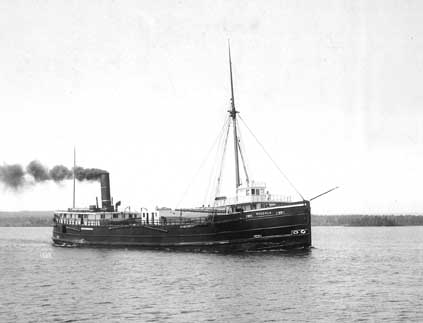
Ship Osceolo
CAPTAIN ROBERT ROWAN McLEOD
Captain Robert Rowan McLeod is one of the few lake masters who have made a success of winter navigation, in which he has been engaged in the interests of railroad companies for the last ten years. He is a son of Donald and Isabelle (Rowan) McLeod, and was born October 3, 1862, at Kincardine, Ontario. His parents are natives of Scotland, the father being born in Sutherlandshire, and the mother at Edinburgh. They were not married when their respective parents removed to America, locating at Woodstock, Ontario, where they met, afterward going to Kincardine, where the marriage ceremony was performed. The young people then made that city their home, and as their five sons grew up they adopted the life of a sailor; John C. became master of the steamer Osceola; Duncan A. also sailed the Osceola; John S. is wheelsman on the steamer R.W. Linn, and H.D. is second mate on the steamer Gordon Campbell.
Capt. Robert R. McLeod, the subject of this article, was a pupil of the public schools of Kincardine until he began his life on the lakes, which was in 1874, his first berth being as cook on the schooner Maple Leaf. The next season he filled like offices on the steamer Mary Ross Robinson, plying between Georgian Bay ports and Chicago. In the spring of 1876 he shipped as deckhand on the steamer Ontario, but after two weeks he became watchman, and a month later was advanced to the berth of wheelsman, performing the duties of such for seven seasons, after which he transferred to the English-built steamer Campana. In the spring of 1884 Captain McLeod was appointed second mate of the Pacific railroad passenger steamer Algomah, the first of the three Scotch-built steamers put on the route. The next season he joined the steamer Rhoda Emily as second mate, transferring to the passenger steamer A. Booth as mate, and held that office until she was wrecked at Grand Portage island, Lake Superior. He closed the year as mate of the steamer T.H. Kemp. In 1886 he shipped as second mate of the steamer Roanoke, and was soon promoted to the office of mate, which he held until the spring of 1888, when he joined the steamer Wisconsin as mate, remaining with her two seasons.
In the spring of 1890 Captain McLeod was appointed mate of the steamer Osceola, going onto the Colorado the next season, and after laying her up at the close of navigation, he went as mate on the railroad steamer Ann Arbor No. 2, plying between the winter months between Frankfort and Kewaunee. The next spring he came out as master of the Osceola, but at the close of the season he was appointed master of the Ann Arbor No. 1 for the winter navigation. In 1894 he sailed the steamers Colorado and Osceola between Grand Haven and Milwaukee. In the spring of 1895 he again brought out the steamer Colorado and sailed her until September 22, and on October 1, of the same year, he was appointed master of the large carferry steamer Shenango No. 1., and has sailed her, summer and winter, every since. During the twelve years that the Captain has being an officer of a steamboat his record has been unusually clear of casualty.
Socially, he is a Master Mason of Grand Haven Lodge No. 137, and a member of the Maccabees.
In December, 1888, Captain McLeod was wedded to Miss Murdena, daughter of Donald and Christina Martin, of Kincardine, Ont., the marriage ceremony being performed in Duluth. The children born to this union are Bella Rowan and Lulu Wilkie. Although the Captain has a home in Conneaut, the family homestead is in Kincardine, Ontario.
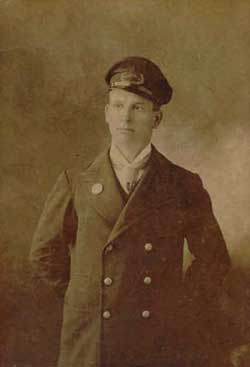
Robert Rowan McLeod Abt 1895
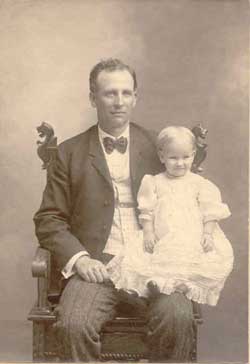
Robert Rowan McLeod with Charlotte Roberta (photos submitted by contributor/see credits page)
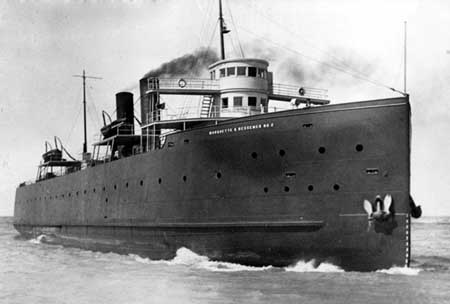
Marquette & Bessemer 2
Sank in Lake Erie in 1909 taking all hands.
A. McMINN
A. McMinn, who is a prominent tug man, both as pilot and engineer, was born in 1861 in Thomaston, Maine, and came to Buffalo with his parents about 1867, here attending the public schools. After leaving school he entered the employ of Knight & Sisson to learn the machinist's trade. Mr. McMinn first became connected with the tugging business in the spring of 1872, beginning as fireman on the tug Double Exhaust, and the following season served in the same capacity on the tug Sarah E. Briant. His next tug was the Post Boy, on which he was employed two seasons. In the spring of 1876 he entered the employ of Hingston & Woods as fireman on the J. F. Bean, being advanced the following season to the berth of engineer, which he held two years. In 1879 he shipped on the tug Maud S., and took her to Pequaming, Lake Superior, where he ran her that season. On returning to Buffalo in the spring of 1880 he was appointed engineer of the tug John F. Griffin, was given a similar position the following season on the A. P. Dorr, and in 1882 on the tug Alpha, continuing on her four years, after which he went to Chicago and took charge of the machinery of the tug Morford. On his return to Buffalo the next season he entered the employ of the Maytham Tug line as engineer of the Annie P. Dorr; in 1888 he was transferred to the E. C. Maytham, and in the spring of 1889 he was appointed master of the tug Adams. In 1890 Mr. McMinn went to Duluth as chief engineer of the Inman Tug line, running the iron tug Record, so named for the Marine Record, published in Cleveland, where the tug was built. He remained with Captain Inman two years and while there was recognized as a veritable "doctor" of tug machinery, saving many a repair bill to the firm by his knowledge of mechanics. In 1892 he took the tug O'Brian at Oscoda, Mich., and in the spring of 1893 was appointed her engineer, going out of Conneaut, Ohio; in the spring of 1894 he was appointed engineer of the river tug Howard, at Ashland, and the following season became engineer of the Pleasure boat Idle Hour, for W. Zeigler, at Buffalo. In 1896 he was appointed master of Maytham's tug Alpha, which he sailed until the close of navigation, and during the winter he had charge of the tug Woods, running as tender or dispatch boat on the Niagara river, in connection with the water-works crib and other Buffalo enterprises. Mr. McMinn is a member of the American Association of Masters & Pilots and of the Buffalo Harbor Tug Pilots Association. He has nineteen issues of marine engineer's license and nine issues of pilot's licenses.
Mr. McMinn was married, in 1882, to Miss Loretta Hackett, of Buffalo, and their children are George, Loretta, Albert and Grace. The family residence is at No. 102 Hawley street, Buffalo.
CAPTAIN GEORGE McMINN, JR.
This official, well-known in the merchant marine of the Great Lakes, was born in Thomaston, Maine, September 12, 1854, and in boyhood attended the public schools of his native town.
In 1871 the Captain began life as a mariner on the lakes as sailor on the bark Favorite, and served in various capacities on several other vessels until 1889, when he shipped as mate of the steamer Starrucca, continuing to hold that position with efficiency for two years. In 1891-92 he was master of the steamer R. A. Packer, and in 1893 sailed the H. E. Packer as master part of the season, the balance of the year commanded the Clyde, of the Lehigh Valley line, sailing between Buffalo and Chicago, and intermediate points. In 1896 he shipped as first mate of the steamer Globe, of the Great Lakes Steamship Company, which position he is still filling with great credit to himself, sailing between Buffalo and Cleveland.
Captain McMinn is unmarried, and resides at No. 239 Dewitt street. He is a valued member of the Ship Masters Association, Buffalo Branch No. 1.
GEORGE McMONAGLE
George McMonagle, the subject of this sketch, is one of the most efficient and prominent marine engineers out of the port of Cleveland, and traces his genealogy through a family of sailor men. He is the fourth son of Captain John and Sarah McMonagle, his brothers being Daniel, James, John and Joseph. There was one sister, who died in early girlhood.
Our subject was born in Toledo, Ohio, on the 21st day of July, 1862, where he attended the public schools until he reached the age of seventeen years, after which he went to Cleveland and obtained employment as apprentice with the Globe Iron Works Company, remaining until the spring of 1879, at which time he commenced his career on the lakes. On July 5, 1880, he took out his first papers as engineer, and was appointed second engineer of the tug James Reed, out of Alpena, Mich., holding that berth one season, joining the river tug O. Wilcox the following spring. In the spring of 1882 he was appointed second engineer of the steamer Manistique, closing the season of the Schoolcraft in the same capacity. In 1883 he was appointed second engineer of the steamer C. H. Green, which berth he filled two seasons, and growing steadily in favor, by reason of skill and ability, he was made chief engineer of the same steamer the third year he remained on her.
In the spring of 1886 Mr. McMonagle was appointed chief engineer of the steamer Canisteo, running her one season, transferring in 1887 to the steamer Cayuga, which he engineered as chief until August, 1889, when he joined the City of London, remaining on her eighteen months. In the spring of 1892 he was appointed chief engineer of the steel steamer J. H. Wade, Captain Swartwood, which berth he held for six years. He is what is known in mechanical parlance as a successful engineer, and has always had good results from his machinery. He is a member of the Marine Engineers Beneficial Association, and of the Order of the Maccabees.
On January 12, 1891, Mr. McMonagle was united in marriage to Miss Mary Garvey, of Cleveland. Three boys, George Harold, William Joseph and John Ralph, have been born to this union. The family residence, which was purchased some time ago, is at No. 89 Dare street, Cleveland, Ohio.
CAPTAIN ALEXANDER McMURRAY
Captain Alexander McMurray, who has been connected with the traffic of Niagara River since some time in the "forties, was born in Bertie township, Welland county, in the Province of Ontario, Canada, April 21, 1829, and received but an ordinary education. His father, John McMurray, came from near Belfast, in the North of Ireland, to America about the year 1820. He was a baker by trade, but followed farming after settling in the Province of Ontario. His wife's name was Margaret Mills.
Alexander McMurray began life as a deckhand on the Erie canal. He took only one trip, to Albany and return, which he considered enough, as it lasted thirty-two days. This was in 1846. During the year of 1848 he was engaged most of the time at farm and carpenter work. In 1849 he engaged in business at Grand Island with David Hibbard, continuing thus for about six years, and then carried it on alone for the four years following. During the balance of the time until 1868 he conducted a summer resort and managed the pleasure yacht Jerome C. Keyes, which he built. This yacht he sold in 1868, and he then removed to Black Rock, where he was employed variously in farming, boating and carpenter work for about eight years. From 1873 until 1878 he worked at the carpenter's trade at Buffalo, and from that time until 1889 he lived at Grand Island. While there he farmed a tract of land of about fifty acres which he owned, did some carpenter work, and engaged also in the boat trade on the river. Part of this time he was master of the steamyachts Emma V. and Minnie, owned by David Sutton. From 1889 until October, 1895, Captain McMurray was master of the S.D. Cornell, of the Buffalo and Grand Island ferry, at the end of that time retiring to his quiet home at Bridgeburg (formerly Victoria), Province of Ontario, Canada, where he is enjoying rest from his many years of steady labor.
Captain McMurray was married, November 5, 1850, to Eliza Jane Wightman, and they have the following named children: William E., now (1898) thirty five years of age; Robert J., aged forty-four, captain of the tug Internation; John A., aged thirty-eight, engineer of the ferryboat Niagara; Mary Jane, aged forty-one; Cora, aged twenty-nine; and Stella, aged twenty-two. William was captain of the Idle Hour during the season of 1896.
JOHN McMURRAY
John McMurray was born in Grand Isle, Erie Co., N. Y., in 1858. After attending the common schools the allotted number of years he commenced marine engineering on the tug Eagle, of the Buffalo harbor, remaining on her until the fall of 1879. In the spring of 1880 he took the tug International, and held this berth on her for ten years. The International is a powerful tug, owned by the railroad company, and is stationed above the international bridge spanning the Niagara river, at Black Rock, to assist vessels up and down the river at that point. In 1891 Mr. McMurray remained ashore and ran a stationary engine for the Kahle Manufacturing Company in Buffalo, remaining with that firm two months. In the spring of 1895 he entered the employ of the International Ferry Company as engineer of the steamer Niagara. He has nineteen issues of marine engineer's license, and one of pilot's license.
In 1887 Mr. McMurray wedded Miss Anna Morrow, of Buffalo, and they have one daughter, Grace M. The family residence is at No. 1146 Niagara street, Buffalo.
CAPTAIN ROBERT J. McMURRAY
Captain Robert J. McMurray, of the Grand Trunk tug International, is widely known in Buffalo, having for the most part been reared on the Niagara River. His father, Capt. Alexander McMurray, has been connected with the traffic of the river during the greater part of his life as a boat owner, and the son Robert was brought up on his father's boats.
Robert J. McMurray was born at Black Creek, Canada, in June, 1852, and received his common-school education in Buffalo and Grand Island. His first experience in handling a steamboat was in 1867, when he was but fifteen years of age. During the season of that year he was master of the steamyacht Jerome C. Keyes, which made daily trips from Buffalo to Grand Island, and continued aboard her in that capacity for the season of 1868. In 1869 he was master of the Undine, owned by C. T. S. Thomas, for the season, and in 1870 he was master of the Maggie Wilson. In 1871 he was ashore managing the farm interests of his father at Grand Island. In 1872 he was managing excursion and pleasure boats during the summer, and in the fall engaged in the fruit trade between La Salle and Buffalo, which he continued until the spring of 1879. At that time he entered the employ of the New York Central Railroad Company as clerk in their freight offices at Buffalo, and remained with them about two years.
On May 1, 1880, he was appointed mate of the old tug International, and continued in that berth until shortly after the new International came out in 1884, when he was promoted to master's berth. He still retains that position with great credit to himself. It requires a man of prompt and decisive action for master of the International, when the duties and purposes of the tug are fully understood. She is owned by the Inter-national Bridge Company, which is controlled by the Grand Trunk Railway Company. In accordance with the provisions of the charter of the Bridge Company, she is in duty bound to render all assistance necessary in getting crafts of all kinds through the drawbridge, without charge, and she not only performs this service, but goes to the assistance of any damaged or sinking craft in her vicinity, and also to the aid of drowning persons. Captain McMurray has rendered gratuitous service both to vessels and individuals without number, and many persons owe their lives to him. The work is very difficult, as the current of the river is quite rapid, and quick action is absolutely necessary. An instance of this is furnished in the particulars of the loss of the steamyacht Dixie on the memorable Saturday of July 17, 1892. She was an excursion boat, plying between Buffalo and Navy Island, and usually on pleasant days carried from fifty to one hundred people at least. On this occasion, however, and it was a singular coincidence, she had only fourteen passengers all told, as she left the dock at Buffalo. This state of things proved exceedingly fortunate, for had there been the usual number most of them would certainly have been lost. On the Saturday above mentioned, about three o'clock in the afternoon, the Dixie left the dock at Buffalo just about the time the steamer Pilgrim was coming up to it. The Pilgrim blew two whistles, a signal for the Dixie to take the starboard side. The master of the Dixie answered with two whistles, but for some unaccountable reason did not obey, and when near the Pilgrim changed his course and started to take the port side. This action, together with the rapid current, brought the boats together shortly, although the engines of both boats were reversed and every effort made to avoid a collision. The Pilgrim, being much larger than the Dixie, was consequently not easily stopped, and she struck the Dixie aft of midships on the port side, making a large hole through which the water rushed rapidly. In the excitement the passengers all hastened to reach for life preservers, and the engineer of the Dixie was signalled to go ahead strong, pointing the boat for the Canadian shore, where the captain hoped to reach shallow water. Captain McMurray, of the International, was standing on the dock at the time of the departure of the Dixie. Immediately following the giving of the signals he noticed the complicated state of affairs, and, scenting danger, ran to his pilot-house to be in readiness for whatever emergency might arise. After the collision had taken place, as above narrated, he put out from the dock and started in pursuit of the sinking boat, and when he reached her the passengers and crew were on the rails and decks, the water up to their necks. The passengers and crew were picked up by Captain McMurray and saved. The boat was slowly going down and sank immediately afterward about five hundred yards from shore. The Pilgrim was uninjured, and after the excitement was all over proceeded on her course down the river. The engines and boilers of the Dixie are still lying in the river, but it is supposed that the hull has passed down and over the Falls, as it has never been seen since the accident.
The new International, which figured in the scene above mentioned, was built by the Globe Ship Building Company, of Cleveland, Ohio, and came out in June, 1884. She is the counterpart of the tug Record, built by the same company, and takes the place of the old International, which was sold. She cost $15,000, measures seventy-six feet over all, seventeen-foot beam, nine foot depth of hold, and has a speed of twelve miles an hour. She has a high-pressure cylinder, 20x20, and is allowed 150 pounds steam pressure. Her hull, deck and house are all of iron, and she has water-tight compart-ments forward. She is manned by a master, mate, engineer, fireman and watchman. Captain McMurray has had twenty-one issues of master's papers, and has held engineer's papers as well. He has been a member of the Masters and Pilots Association for four years, of the Royal Arcanum seven years, and is also a member of the Forresters.
In April, 1892, the Captain was married at Buffalo to Miss Flora Parmelee, daughter of Albert Parmelee, who is one of the oldest residents of Buffalo, having settled there in 1839-40. He operated the first street-car line in that city, and subsequently engaged in the sawmill and lumber business. Mrs. Parmelee is a sister of E. K. and B. F. Bruce, formerly large vessel owners at Buffalo, the former of whom died in 1895, the latter on June 13, 1898; E. K. Bruce was at one time a large grain dealer on the Chicago Board of Trade.
WILLIAM J. McMURTY
William J. McMurty, son of Charles and Jane (McIlwaine) McMurty, is a native of Ireland, born at Belfast, January 30, 1861.
At the age of sixteen Mr. McMurty shipped as boy on the bark Eleanor, Belfast to Quebec, on which he remained about six months, until she was waterlogged and sunk, he and the balance of the crew taking to the small boats. After three days drifting they were picked up by an Italian bark and carried into Falmouth, where our subject immediately shipped as ordinary seaman on the brig Isabelle, continuing seven months on her, after which he went as able seaman aboard the Ariadne for the next six months. The barkentine Clara, to South America, had him aboard for five months, the Orontes, to St. Johns, N.B., the next six weeks, and thence, without going ashore, he stepped into the new brigantine Ohio, bound for Ireland. After four months' service there he shipped on her to the Mediterranean, and then coasted around St. Johns for about a year, thence shipping on the British Queen to Valencia, Spain, where he went in the Erato to Hull, England. From the latter port he again began coasting on the Ensign, Flexmoss and others, around England and France, for about nine months, and then went into the Caledonia, on a voyage of three months to the Mediterranean and Black Sea, then on the Kohinoor to Calcutta, and then on the Mooltan to London, from where he went home on a visit.
Finally, in 1886, he went to Chicago, where he began his lake career, as watchman on the Arabia to Buffalo, and then as lookout on the Syracuse, finishing that season wheeling the Vanderbilt. In 1887, he was wheelsman on the Chicago, and during the early part of 1888 as lookout on the Wyoming, finishing that and the season of 1889 on the Boston as wheelsman. For the season of 1890 he was lookout on the Chicago, and then went home to Ireland again, returning in 1891 and going as lookout on the Boston till August, spending the balance of that season on the Harlem. In 1892 he was lookout on the Badger State until August, and finished the season as second mate of the Milwaukee. For the two succeeding seasons he served as second mate of the Chicago, in 1895 shipping on the Anchor line as wheelsman on the Mahoning, and in 1896 he was second mate of the Chemung, until the Ramapo was brought out. He was also second mate on her, and engaged as second mate on the John V. Moran for 1897. For the season of 1898 he was second mate of the W. H. Stevens.
On January 12, 1891, Mr. McMurty was married, at Belfast, Ireland, to Margaret Jane Ferguson, of that city, by whom he has had three children, two of whom are living; William J., Jr., and Margaret. The family reside at No. 244 Fulton street, Buffalo, New York.
CAPTAIN THOMAS McNAUGH
Captain Thomas McNaugh was born in Cleveland, in 1860. He attended the common schools of his native city until 1876, when he shipped as fireman on the tug Monitor, and remained on that boat for two years. From that time on he found employment on various other tugs in different capacities until 1883, when he received his first papers, and was appointed master of the tug Maggie Sanborn. He was then appointed to take charge of the night boat, which necessitated his changing from one tug to another each night while so employed, after which he sailed one season on the L. F. & J. A. Smith's tug line. His service in the Vessel Owners Towing line occupied a space of nine years, of which time he sailed one season on the Dreadnaught; one season on the Thomas Maytham; three seasons on the Chamberlain; one on the Alva B. and Dreadnaught; a half season on the Grover and three on the William Kennedy, respectively, laying up the latter boat at the close of navigation of the season 1896.
In 1882 Captain McNaugh was united in marriage to Miss Mary F. Arnold, of Cleveland, and four children have been born to them: James, Kitty, Thomas and Frances McNaugh.
CHARLES A. MCPHAIL
Charles A. McPhail is a promising young engineer sailing out of Lorain, Ohio, and was born in Lorain in 1866, son of Capt. Alexander and Annie (Loveland) McPhail. His father was for a long time master and mate of many good lake vessels, among which may be mentioned the David Wallace. He is of Scotch descent, and came to the United States at the age of twenty years, locating at Black River, now Lorain, Ohio.
After attending school Charles A. McPhail entered the employ of the Cleveland, Lorain & Wheeling Railway Co., to learn the machinist's trade, remaining in their shops two years. In 1880 he engaged to run hoisting engines on the docks at Lorain, continuing thus for seven years, after which he went to Fairport, where he was similarly employed for four seasons. In the spring of 1891 he entered upon his lakefaring life as fireman on the steamer Vulcan, holding that berth until June, when he shipped as oiler on the steamer Aurora. Late he remained ashore at Fairport to run a hoisting engine. In the spring of 1892 he shipped as lookout on the steamer Vulcan, closing the season as wheelsman, and the next year going as oiler on the same boat. In the spring of 1894 he took out engineer's papers, and was appointed first assistant on the Vulcan, which position he has continued to hold to this date.
Mr. McPhail is a member of the Marine Engineers Beneficial Association, of Cleveland. Although he is not a married man, he has purchased five acres of land near Lorain, which is proof that he is clear-sighted, as Lorain is destined to become a great lake port in the near future.
CAPTAIN ALEX McRAE
At the present time Capt. Alex McRae is acting in the capacity of harbor-master, and has proven himself to be a capable man in that position. He was born January 12, 1844, in Rosshire, Scotland, and in that county spent the first three years of his life. His parents, Farquhar and Isabella (McRae) McRae, came to Canada at this time, and with their family settled in Dunwich, Ontario.
Alex McRae left Dunwich when he was seventeen years of age, and began the marine work. He first acted as boy on the Pt. Stanley, after a short time shipped on the Gem of the Lakes, in the same position. After leaving this boat he came to Detroit and shipped on a tug, where he remained until the close of navigation, when he went to Dearborn, Mich., and spent the winter in school. The following spring he resumed work on the lakes, and continued until 1875, having been on the B. Parsons, White Cloud, Chas. Hinkley, Thos. Kingsford, Light-Guard, Jane Rawlston, Maj. Anderson, Naiad and Wm Sturgis. On May 31, 1875, he entered the police force in Detroit, and has there remained to the present time, having been commis sioned as harbor-master, April 6, 1894.
On October 14, 1875, Captain McRae was married to Miss Mary McNabb, also a native of Scotland, but who has spent the greater part of her life in America. Their only child, Jeanette May, is attending school in Detroit at the present time.