History of the Great Lakes
Vol. 2 by J.B. Mansfield
Published Chicago: J.H. Beers & Co. 1899
[ A ][ B ][ C ][ D ][ E ][ F ][ G ][ H ][ I ][ J ]
[ K ][ L ][ M ][ N ][ O ][ P ][ Q ]
[ R ][ S ][ T ][ U ][ V ][ W ][ X Y Z ]

CAPTAIN JOHN W. RABSHAW
Captain John W. Rabshaw was born in Buckingham, Ontario, May 18, 1858, a son of Gideon and Catherine Rabshaw. He moved to Cleveland with his parents when seven years of age, and received his education at St. Patrick's school in that city.
Captain Rabshaw commenced sailing June 3, 1871, on the schooner General Winfield Scott, and the year following he went with Capt. John McKay on the propeller Concord, where he remained two seasons. In the spring of 1873 he shipped on the steambarge Superior, and in 1874 on the passenger steamer Munster, which was lost sometime later on Lake Superior with all hands on board. He remained on the Munster three seasons as second mate, closing the last season, however, as mate of the schooner Colin Campbell. In the spring of 1877 he shipped on the bark J.S. Austin; and in 1878 on the schooner Empire State, which was lost on Long Point, Thunder Bay island, that fall. She struck at 7:30 p.m. and broke in two at twelve o'clock. The crew took to the rigging where they remained in the most perilous position until nine o'clock next day. They were taken off by two fishermen in a clinker boat. The boatmen could not make the island with safety, hence too the rescued men to Alpena, Mich. Capt. Archie McHenry was master of the Empire State at this time. The names of these two brave fishermen have passed out of mind. In the spring of 1880 Captain Rabshaw shipped on the schooner Francis Palms as mate; in 1881, as mate of the schooner David Dows; in 1882, as mate of the schooner Camden; in 1883, as mate of the schooner H.G. Cleveland; in 1884 and 1885, as mate of the schooner Charles Wall; in 1886, as mate of the schooner Leonard Hanna, which berth he held two seasons, with the exception of the last trip he made in the fall of 1887, when she was lost on the North Fork with a cargo of ore from Escanaba. Captain Rabshaw designates the Leonard Hanna as having been the smartest schooner on fresh water.
In the spring of 1888 Captain Rabshaw was appointed mate of the steamer Robert R. Rhodes, and the following season mate of the steamer Corona. In the spring of 1890 he was appointed master of the schooner Verona, which was sunk by the steamer Cambria, near Ashtabula harbor in August; he finished that season as master of the Ironton. In 1891 he shipped as mate of the steamer Emily P. Weed, closing the season as master of the propeller John C. Pringle. The steamer Saranac was his next boat, on which he held the berth of mate one season. In 1893 he was appointed rigger at the World's Columbian Exposition at Chicago, and with a force of three hundred men handled all the heavy machinery in the mechanical engineering department. Testimonials he has preserved from the superintendent recite that his work gave general satisfaction, and was done in a workmanlike manner. In the spring of 1894 Captain Rabshaw was appointed master of the passenger steamer John Gordon, plying in the excursion business out of Chicago. The next season he stopped ashore and engaged in business on his own account. In 1896 he was appointed mate of the steam monitor John Ericsson. In the spring of 1897 he was appointed master of the schooner H.P. Baldwin. He superintended the repair work on the Baldwin, and has improved her condition very much.
Captain Rabshaw is a man of great strength, and stands over six feet in height. During the winter months he has a class in training for athletic sports, especially in that of wrestling, in which field he has gained many notable victories. He was a teacher of athletics in the Union Business College in Cleveland in 1879, and graduated some cunning wrestlers. The Captain is not a married man, but lives with his parents at No. 108 Whitman street, Cleveland, Ohio.
CAPTAIN JOHN RADIGAN
Captain John Radigan, master of the tow barge J. R. Edwards, is one of a family of ten children, four of whom are sailors. He is the son of James and Mary (McCormick) Radigan, the former a farmer at Marysville, on the St. Clair river, where John was raised and went to school, and where his mother still resides.
Our subject was born in 1844 at London, Canada, where he lived with his parents until about five years of age. At the age of fifteen he began life on the lakes as deckhand on the old propeller Globe, remaining on her two seasons, and then for the same period was before the mast on the schooner John Rice. Later he was in the same capacity on the schooners City of Tawas and Otter. His first experience on a steam-boat was as lookout on the steambarge Celina, for one season. For different seasons since in his career he has filled mate's berth in the following named vessels; scows - Medora and D. G. Williams; schooners - Margaret R. Groff, Home of Port Huron, Jupiter, Mattie C. Bell, Rose Sunsmith and Racine. Those of which he has been master are the Mary Stockton, Yankee, Constitution, A. T. Bloss, Michigan, Bahama and Jr. R. Edwards, of which latter he has been in command since the beginning of the season of 1893. She is owned by the Pewanee Boat Company, of Port Huron, and is one of the consorts of the barge Pewanee, the others being the Orton and William A. Young, also owned by the same company.
Captain Radigan has encountered the usual experience of a life on the lakes, but he has had very little trouble in the way of mishaps. Only once has he gone ashore, that being when he was master of the Bahama; she went ashore in a gale at Kincardine, Ont., but was raised the spring following. While in the Constitution an accident occurred at Dollar bay, while they were unloading coal, a coal handler being struck by a swinging bucket and knocked from a platform to the vessel's deck, being killed instantly. This was the only death that took place while Captain Radigan was master of a vessel.
Captain Radigan was married in 1879 to Miss Belinda Strong, by whom he has had three children: John Roy, William and Belinda. They reside at No. 381 Niagara street, Tonawanda, New York.
WILLIAM RAMEY
William Ramey, who is at present employed as assistant engineer of the Niagara Bakery, at Buffalo, was born in that city June 18, 1857, and obtained his education at her public schools. His first employment in connection with the lake service was in the capacity of fireman and oiler upon the steamer China for two seasons; also served on various other steamers, such as the Japan, and was for a time in some sailing vessels, for three seasons, beginning with that of 1871.
During the season of 1874 Mr. Ramey was part of the time an apprentice upon the schooner Emma L. Coin, owned in Toledo, and the remainder before the mast on the schooner Rutherford B. Hayes. In 1875 he went in the same capacity on the schooner Our Son, and subsequently spent about four seasons steadily as engineer of Buffalo harbor tugs, being in the Kelderhouse and Alpena. From that time he was employed as stationary engineer and as machinist until about 1895, when he accepted a position in the D. E. Morgan building as chief engineer, which position he held until July, 1897, when he went as assistant in Dolds Packing House until March, 1898, at which time he was appointed to the position of second engineer of the Niagara Bakery Company.
Mr. Ramey was married, in 1885, at Dunville, Ont., Canada, to Elizabeth Gilson, and they reside with their four children at No. 895 Genesee street, Buffalo, New York.
D. B. RAMSEY
D.B. Ramsey, chief engineer for A. M. Rothschild & Co., Chicago, was born in Cleveland, Ohio, in 1851, a son of William and Minerva E. (Bassett) Ramsey, the former a native of Vermont, the latter of New Hampshire. At an early day his parents became residents of Cleveland, where the father was a member of the firm Walton, Hitchcock & Ramsey, stove founders. He died in that city in 1858, and his wife departed life in 1892.
The subject of this sketch was reared and educated in Cleveland, and at the age of fifteen years commenced learning the machinist's trade, serving a four years' apprenticeship under Dennis Holt, whose shop was on Center street, that city, and who is still a resident of Cleveland, now aged and blind. On leaving him, in 1870, Mr. Ramsey sailed from Cleveland as second engineer on the steamer Northern Light, engaged in the Lake Superior trade. He was next employed as passenger engineer on the first railroad built from St. Paul to Duluth, Minn., but in 1871 returned to steamboating, sailing as second engineer on the W. L. Whetmore, from Cleveland to the Lake Superior trade. In 1873 he was engineer on the S. E. Sheldon, engaged in the northern trade, and owned by C. L. Russell, of Cleveland, in whose employ he remained for five years. He was engineer on the passenger steamer Garden City, of the Northern Transportation Company, plying between Cleveland and Chicago and Ogdensburg. After two years spent upon that vessel he entered the service of the Western Transportation Company, of Buffalo, with which he remained for some time. He next sailed out of Buffalo as chief engineer on the M. M. Gregg, in the freight trade to all lake ports, remaining on her two seasons.
In 1886 Mr. Ramsey quit the lakes and came to Chicago, and took charge of the Western Electric Manufacturing Company, remaining with this company for three years. Being an ardent Republican, he then became interested in political affairs of the city, and was very prominent as a leader during Mayor Roche's administration. Later he went to Louisville, Ky., where he had charge of the Du Pont powder mill for one year, when he returned to Chicago and was appointed chief engineer for the Union League Club, where he remained for two years. The following four years he was employed as chief engineer of all the buildings belonging to L. Z. Leiter, and then accepted his position with A. M. Rothschild & Co., whose interests he has served most creditably.
Mr. Ransey is an inventor, in 1878 having built a small double marine engine of about six-horse power, which was on exhibition for one year in the old Exposition building of Chicago, and can be seen at the Engineers Supply Company, Chicago. The patterns, models and everything for this work were drawn by himself, and his engine possesses many points of great merit. In early life he joined the M. E. B. A., in Cleveland, and in 1871 was admitted to No. 4, of Chicago. He is also a member of the National Association of Stationary Engineers, of which he has been vice-president and treasurer for one term.
Mr. Ransey was married, in Cleveland, in 1873, to Miss E. A. Norris, of that city, and they have become the parents of three children: Clifford C., C. Russell and Mamie E. He is well known among marine men, and has seen many changes on the lakes since his inception into the craft.
GEORGE RANDERSON & SON
George Randerson & Son, No. 238, Detroit street, Cleveland, Ohio. This business was established in 1851 by Joseph Randerson, brother of the present owner and at his death in 1870 passed into the hands of George Randerson, who was born in Yorkshire, England, in 1831.
George Randerson received a common school education and worked at farming until he came to the United States in 1849, settling in Cleveland in 1851. He then engaged in the meat-market business until his brother Joseph died, when he continued the business as above stated. The firm does a large marine trade in meats and ice, which they deliver aboard vessels by means of a steam launch. During the war days of 1861-62 the old firm supplied Camp Cleveland with meats. In 1893 they erected a fine new block on Detroit street, which is a great contrast to the old building in which they did busines for thirty-five years, and their marine trade has assisted very materially in this improvement.
In 1853 George Randerson was united in marriage to Miss Eliza Jackson, and two children were born to them: George Jr., and Emma, now Mrs. C.A. Provost.
George Randerson, Jr., was born in 1860, in Cleveland, Ohio, and attended the public schools of that city until his twentieth year, when he went to work in the meat market with his father. In 1879 he was admitted as partner in the firm, which then became George Randerson & Son. In 1889 he was married to Miss Mary Bailey, and they have one daughter, Edith M.
GEORGE RANSIER
George Ransier is a son of Andre Ransier, a carriage maker of Collingwood, Ontario, and he was born in 1862, and spent his boyhood fishing on Georgian Bay. His first sailing was in 1882 when he became watchman on the steamer Oneida. Then he was lookout successively on the steamers Japan, Alaska and Starrucca, and wheelsman on the steamers Blanchard, Delaware, Japan and Boston, spending one season in each vessel. He was second mate of the Empire State one season, of the James Fisk two seasons, and the passenger steamer State of Ohio one season. He was first mate of the passenger steamer State of New York during the season of 1894, and pilot of the same vessel the following season. During the season of 1896 Mr. Ransier was pilot of the State of Ohio.
In 1891 Mr. Ransier was married to Miss Maggie McLane, of Collingwood, and they have one son, Andrew.
ELIAKIM F. RANSOM
Eliakim F. Ransom was born in Claridon, Geauga county, Ohio, October 14, 1829, son of John and Annie (Ames) Ransom. The father was a farmer part of his life, and at one time owned a foundry and furnace near Plainville, Ohio. He died at Claridon in 1830. John Ransom, the grandfather of our subject, was of English birth, and was master of salt-water craft, owning vessels which plied between New York and China in the tea trade. He lost his life at sea many years ago on a trip in one of his own vessels. The father of our sujbect died when the latter was less than a year old.
Eliakim F. Ransom received a common-school education, in Livingston county, N.Y., beginning to study when he was about seven years old, and for three years succeeding his school life was located on a farm. When he was seventeen years of age, he came to Buffalo, and for eleven years following he was employed at the old Shepard Iron Works, learning his trade and building steam engines. In 1859 he began his sea-faring life as fireman with his brother, Giles T. Ransom, who was chief engineer of the Monticello. This brother died of yellow fever while in the employ of the government on a gunboat on the Mississippi river during the Civil war. It was through him that Eliakim Ransom first served as second and chief engineer with the following lines from 1857 till about 1892, when he was compelled to retire from the lakes on account of ill health; the Union Steamboat Company, Anchor line, Western Transportation Company, Davidson's line (of Bay City), Michael McComb's line of Buffalo, the old Commercial line, the New York Central line, and also with a lumber firm of Toledo, Ohio. Upon retiring from the lakes he was for a time engineer of a stone crusher for the Barber Asphalt Paving Company, but was compelled to give that up also for the reason above mentioned. During his experience on the lakes he met with but one accident of moment. When he was engineer of the Siberia she lost her rudder on Lake Superior, and drifted about eighty miles to White Fish Point, where she was picked up by a wrecking tug.
In 1852 Mr. Ransom was married in Buffalo, to Miss Mary Jane Sharkey, of Chicago, who died in 1863. They had eight children, three of whom are living, namely: Giles, in business in Toronto; Eliakim, deceased; and Frank, steward of the Seneca. In 1878 Mr. Ransom married Eliza Ann Drake, of Rochester, N.Y., and they reside at 160 Massachusetts street, Buffalo, New York.
JOHN S. RANNEY
John S. Ranney is at present acting as engineer of the new Detroit High School, but was formerly closely identified with the lake commerce, as an engineer. He was born at Ogdensburg, N. Y., May 1, 1850, and at the schools of that place received his education.
When nineteen years of age he shipped on the Sheckilma, a tug and freight boat, and acted as assistant engineer two years, having previously served two years to the machinist's trade. He then went on the Sarah Daly, of Ogdensburg, and there acted as chief two seasons, after which he entered the N. T. line, and acted as assistant engineer on the Maine. Upon leaving this boat he came to Buffalo, and put the machinery in the Joseph Mack and ran her one season. After one year on the Lowell as assistant engineer, he acted as chief on the Maine, and the Sparta, the old Granite, and the Empire State, then coming on the Belle Cross and the propeller Glasgow. He then spent five years as chief engineer of the S. C. Baldwin, after which he was on the Governor Smith, the Walter L. Frost, Oregon, Alcona and Aurora, then remaining on shore, acting as assistant engineer of the Edison Light Company. When he returned to the lakes he acted as chief of the Canisteo and Weston, and then in 1895 accepted the position in the High School which he still holds.
On May 17, 1893, he was married to Miss Ida Heinicke, and at the present time resides at No. 352 Chene street.
Mr. Ranney is the son of John S. and Eliza (Loucks) Ranney, and is the only son in a family of seven children. John S. Ranney, the father, was born in Scotland, and spent the geater part of his life in America as a pilot on the St. Lawrence river, dying in 1870. He was survived by his wife, who passed away in 1872.
PETER RASMUSSEN
Peter Rasmussen was born in Stouse, Denmark, April 21, 1853, and there attended the public schools. He worked on a farm until 1874, when he came to the United States, locating in Reese, Mich., where he remained three years. In the spring of 1877, Mr. Rasmussen entered the employ of John C. Liken & Co. as fireman on the passenger steamer John C. Liken, which plyed between Bay City and Sebewaing, Mich. Two years later he transferred to the Mary Martini, owned by the same firm, and was also on her for two years. In the spring of 1882 he received his license as engineer, and was appointed to his old steamer, the John C. Liken, as chief, holding this berth one season, and in 1883 stopping ashore to run a stationary engine for the same firm; he continued thus for four years, being in all ten years in that employ.
In the spring of 1887 Mr. Rasmussen went to Bay City, where he entered the employ of Harry Shaw as engineer of the tug Mildred, closing the season on the Kittie Smoke. He put in two other years on the Saginaw River as engineer of the tugs Willie Brown, Harley, and V. H. Mundy. In 1890 he went to Cleveland and ran the tug John B. Griffin for the Independent Tug line. In the spring of 1891, he was appointed engineer of the fishing steamer Fred King, operating out of Erie, Penn. In 1892 he engineered the fishing steamer Loretta Inglesby, and after she was laid up he made several winter trips as assistant engineer of the Northern King. In the spring of 1893 he returned to Cleveland and entered the employ of the Vessel Owners Towing Company as engineer of the Allie May and Dreadnaught, closing the season on the Tom Maytham. His next berth was on the Marguerite, out of Fairport, from which he transferred the following spring to the tug L. W. Knapp, remaining on her two seasons. In the spring of 1897 he entered the employ of the Cleveland Tug Company as engineer of the Ben Campbell. He has eleven issues of license.
In 1879 Mr. Rasmussen was united in marriage with Miss Marietta Parker, of Grant township, Huron county, Mich. Their children are Georgie Muriel, and Oscar Ralph. The family residence is at No. 1 Whitman Street, Cleveland, Ohio. Fraternally Mr. Rasmussen belongs to the Marine Engineers Beneficial Association, the Knights of the Maccabees, and the Arbeiter Verein.
CAPTAIN E. RATHBUN
Captain E. Rathbun was born January 5, 1844, at Port Ontario, Oswego Co., N. Y., and is perhaps the oldest active shipmaster sailing out of Algonac, Mich. Captain Rathbun is the son of Orrin and Philinda (Marsden) Rathbun, and is of English descent. The family espoused the cause of the Colonies during the dark days of the Revolution. His grandfather was born in New York and his grandmother in Vermont, and his great-grandparents were numbered among the pilgrims of early days. Mr. and Mrs. Orrin Rathbun came from New York State to St. Clair County, Mich., and settled on Ruby's island in the year 1849, thence removing to Algonac, where the father died January 27, 1881; the mother passed away October 27, 1892. Their children were Capt. Andrew J., who was mate of the tug B. B. Jones with Captain Burnham when she exploded her boilers on the St. Clair river and killed eight out of twelve people aboard, Captain Rathbun being one of the unfortunates; Egbert M. Van B., the next son, was also a lake captain, sailing the Burlington and many other vessels, and died in Algonac; our subject was the third son; James K. P., a marine engineer, died August 8, 1873, his last boat being the Satellite; the fifth son, Charles Marsden, is also a lake pilot and mate, and sailed with his brother Eugene for many years.
Captain Rathbun acquired his education in the public schools of Algonac, and in 1860 began his career as a sailor in the side-wheel steamer Canada, towing on the St. Clair river. The next two seasons he shipped as wheelsman on the tugs Hamilton Horton and John Martin, respectively, following with a season as mate under his brother Andrew. In the spring of 1864 he joined the tug E. M. Peck as wheelsman with Capt. R. H. Hackett, the next season receiving promotion to second mate's berth. In 1866 the Captain sailed as mate of the tug W. B. Castle with Captain Ames; 1867-68 as mate of the Matamora; the next three years as master of the tug Zouave; 1872-73 as master of the steamer Burlington; and in the spring of 1874 was appointed master of the steamer Superior, sailing her five seasons. The steamer Annie Smith was his next command, and he transferred from her into the steamer J. S. Fay as mate with Capt. Merrin Thompson. In 1881 he brought out the streamer Jessie H. Farwell new, and sailed her two seasons, the following season commanding the steamer Salina. In the spring of 1884 he shipped as mate of the steamer Sarah E. Sheldon with Capt. Greenlee; 1885 as mate and sailing master of the steamer Australasia, and the next season sailed as mate of the steamers Australasia and J. H. Outhwaite until the Aurora was completed and placed in commission, when he went as mate in her with Capt. William Mack. In the spring of 1888 Captain Rathbun was appointed master of the steamer John F. Eddy, which he sailed two seasons, the following season acting as master in the steamer John Plankinton. During the summer of 1891 he stopped ashore and built two houses for himself in Algonac, one of which he has made the family homestead, but during the fall he sailed as mate in the steamer Henry Johnson. In the spring he joined the steamer Samuel Johnson as mate, and in 1893 went as sailing master of the steamer Wocoken, later becoming master of the steamer Garden City, and for two seasons of the Santa Maria. In the spring of 1897 he was appointed to the command of the steamer W. R. Stafford, which he laid up at the close of navigation in Cleveland, thus rounding out thirty-eight years on the lakes, twenty-nine of which he has been mate or master.
In 1862 Captain Rathbun wedded Miss Harriet A. Smith, of Algonac, who died in 1882; one son, Harvey Design, was born to this union. On January 1, 1883, the Captain married Miss Harriet Anna, daughter of David and Harriet (Billow) Cadotte, of Algonac.
CAPTAIN J. E. RATHBUN
Captain J. E. Rathbun was born in Algonac, Mich., on August 14, 1858, a son of Andrew J. and Mary G. (Smith) Rathbun, the former of whom was a native of Oswego, N. Y., and was a lake captain of some note; he met his death while mate of the lake tug B. B. Jones, with Captain Burnham, when she exploded her boiler near Port Huron in 1871. The mother is still living in Algonac. Captain Rathbun's sister, Helen Adelaide, who became the wife of John D. Burke, a hotel-keeper at Mt. Clemens, Mich., is the only other member of the family now living.
The school days of John E. Rathbun were necessarily limited, as he commenced sailing when fourteen years of age, in the spring after his father's death, as second cook in the steamer Neptune. In 1873 he shipped in the barge Iceman, before the mast, with Capt. Charles Marsden. The succeeding years of his lakefaring life have been passed as follows: 1874, before the mast in the S. Burchard, with Captain Pickle; 1875, in the schooner Eagle, logging on the St. Clair river; 1876, in the steamer Superior, with Capt. E. Rathbun, as second cook; 1877, as cook in the barge H. C. Potter; 1878, as mate in the barge Star of Hope, closing the season as wheelsman in the Robert Holland; 1879, advanced to the berth of second mate of the Robert Holland; 1880, in the scow Leader, engaged in gathering stone for use on the breakwater and harbor of refuge at Sand Beach; 1881, wheelsman in the Jesse H. Farwell with his uncle, Capt. E. Rathbun, remaining two season; 1883, again engaged in the stone trade at Sand Beach, in the scow Leader; 1884, mate with Capt. E. Rathbun in the steamer Salina; 1885, mate in the lake tug Music; 1886, wheelsman in the steamer Horace B. Tuttle, closing the season in the Rhoda Stewart; 1887, stopped ashore at Algonac, working at carpentering; 1888, second mate of the steamer Monohansett; 1889, mate of the steamer Margaret Olwill; 1890, second mate of the steamer Jesse H. Farwell, closing the season in the George T. Hope; 1891, mate of the steamer John N. Glidden. In the spring of 1892 Captain Rathbun was appointed mate of the steamer O. O. Carpenter, holding that berth until the close of the season of 1894, and the next season receiving promotion to the position of master, and he sailed her four successive seasons, giving Mr. Runnels, the owner, good satisfaction during the years he was in his employ. To place among the notable rescues with which this volume abounds is one by Captain Rathbun, made in 1893, when he saved the engineer of the raft tug overboard in Duluth harbor; and another in 1896, at which time he saved from drowning four men, who had been clinging for four hours to a capsized yacht off Monroe, Mich., in Lake Erie.
On May 21, 1886, Captain Rathbun was married to Miss Matilda J., daughter of George W. and Sarah (Language) Day. The children born to this union are Marietta Geraldine, Mattie Ilene, Andrew Jackson and Horace Runnels.
GEORGE H. RAUSCH
George H. Rausch is a son of George and Dorothy (Weller) Rausch, the former of whom, a tailor by occupation, died at Buffalo in 1886. The children of the family now living are George H., the subject of this sketch; John, who is a picture frame gilder; Henry, a letter carrier; Julius, by trade a marine engineer but now manager of a Casualty Insurance Company, at St. Louis, Mo., and Augusta, Julia and Sophia, married and residing in Buffalo.
George H. Rausch was born in 1848 at Buffalo, where he attended the German school and also Public School No. 12, after which he worked at printing a short time and then learned his trade in Sutton Brothers machine shop. He was subsequently engaged at different times in the King Iron Works, for E B. Holmes & Co., and Hardwick & Wares. On April 16, 1893, Mr. Rausch went on the lakes as oiler on the steamer Roswell P. Flower, owned by Vance & Co. of Milwaukee, remaining that season. In the fall of the year he received his license papers, and the following spring shipped as second engineer of the steamer Wissahickon, of the Anchor line, on which he also continued the full season. His next employment was at the W. Ziser Steam Forge, where he remained until July, 1896, after which he was employed with the Buffalo Steam Engine Works. He is a member of the Marine Engineers Beneficial Association Local Harbor No. 1, of Buffalo.
On February 16, 1871, Mr. Rausch was married at Buffalo to Miss Mary Gross, by whom he has had seven children. Those now living are Dora, Mary, Richard and Henry. The family residence is at No. 207 Grape street, Buffalo.
JOHN L. RAWSON
John L. Rawson, the well-known and popular chief engineer of the Title & Trust building, Chicago, and who was for many years identified with the lake marine, is a native of Vermont, born in 1842, and is a son of Hiram and Harriet Rawson, who followed farming as an occupation, and who spent their entire lives in the Green Mountain State. In early life he learned the printer's trade, which he followed until 1863, when he shipped in the navy, at New York, for service in the Civil War, and was assigned to the steamer Calypso. When the war was over he was honorably discharged at Philadelphia, in 1865, and in the fall of that year went to New Orleans, where during the season of 1866, he was in the employ of the Morgan line.
For twenty-three years Mr. Rawson engaged in sailing, beginning his career on the lakes of Detroit, Mich., on a tug belonging to the Strong Tug line, as assistant engineer. After four years spent with that company he entered the service of the Union Steamboat line, with which he was connected from 1871 to 1888, the first three years as assistant engineer, and the rest of the time as chief engineer on different boats. He fitted out boats, and was on the Newberg from 1871 to 1879; the Portage from 1880 to 1884; the New York from 1885 to 1886; and the Jewett until the close of the season in 1887. He then came to Chicago, and accepted the position of assistant engineer of the Rookery building, after which he was employed as chief engineer at the Western Bank Note building. On leaving there he became chief engineer of the Ellsworth building, and from there came to the Chicago Title & Trust building, and is still holding that position.
Socially, Mr. Rawson became a charter member of the M. E. B. A. of Buffalo, of which he was financial secretary in 1883 and 1884, but now holds membership in the same Order, No. 4, at Chicago; and is also a member of the National Association of Stationary Engineers, No. 1, of Illinois. He resides at 6339 Eggleston avenue, Chicago.
G. H. RAYMOND
G.H. Raymond was born August 23, 1853, at Adams Basin, N.Y. He is descended from pure American stock, his ancestors having been in this country since 1632. Over one hundred and fifty persons bearing the family name fought for American Independence. His grandmother, on his mother's side, Betsey Atchinson, was the first female child born west of the city of Rochester.
Mr. Raymond received his education from the State Normal School at Brockport and the University at Rochester, N.Y. He entered into the grain trade at Brockport, and continued until 1893, when he came to Buffalo. In that city he formed a partnership with A.M. Kalbfleisch, a resident of Brooklyn, N.Y., who built the Great Chemical Works at Buffalo. They constructed a floating elevator upon a canalboat, and started the business which has developed into one of considerable importance, now being located at the foot of West Genesee street. In 1895 Mr. Raymond was instrumental in having a bill introduced at Washington to widen the locks of the Erie canal, to enable canalboats of a capacity of 20,000 bushels of wheat to be used. In 1896 he originated the Consolidated Lake & Canal Co., with a view of placing a large fleet of boats on the canals of New York State, to be operated regularly and on railroad principles. In this project he met with great opposition, and was unable to get a charter under the laws of the State.
Mr. Raymond is of the progressive type, as his life thus far shows; and the business in which he is interested will doubtless extend its boundaries in the future as it has in the past, under his management, making it one of the well-known establishments at the port of Buffalo. He was married, in 1880, to Miss Ida E., daughter of Samuel Johnson, the celebrated inventor of harvesting machinery.
THE RAYMOND FAMILY
In 1622 Sir Fernando Gorges and Capt. John Mason, of London, were given a grant of land in what is now Maine. In 1629 the grant was divided. Mason formed the "Company of Laconia," In 1630-31 this company sent out to Little Harbor (now Portsmouth, N.H.), Ambrose Gibbons, William Raymond, with other stewards and forty servants. December 15, 1632, Mason and others of the company wrote to Gibbons thanking him for assisting John Raymond. June 24, 1633, Gibbons wrote to the company at London: "I have delivered unto John Raymond seventy-six pounds of beaver, six musquashes and one martin. I did advise Mr. Raymond to return with all speed unto you," etc. The last letter found is from the Gibbons to the company at London, dated July 13, 1633. "Have taken into my hands all the trade goods that remains of John Raymond and George Vaughn," etc. Mason died in 1635. His widow gave up the colony, and records were lost, but many remained and retained some of the company property. This is all the information discovered until we find Richard, John and (Captain) William Raymond at Salem and Beverly, Mass. As early as 1636 Richard received a grant of land for fishing purposes at Winter island, Salem. It is said he made voyages to Barbadoes, etc. While there is no evidence that Richard was at Mason's colony he was doubtless one of those sent over from 1623 to 1630-31 to establish the fishing business at the colony.
A very exhaustive search has been made, but without success, to find the original record of that William Raymond mentioned of Salem in 1648, in Felt's "Annals of Salem." If such a record exists, which is probable, it must have referred to William the steward and not to Captain William, who was at that time only about eleven years of age. That John and Captain William were brothers is proved by a deed in Salem Registry, book 17, page 24, in which John Raymond, of Middleboro, who was a son of John the emigrant, conveys an estate unto his brother Jonathan describing a boundary thereof "until it comes to the land which I sold to my uncle, William Raymond, and his son George Raymond." Of the relationship which existed between Richard and the others there is nothing decisive, but they all came from the county of Essex, England. All those bearing the name lived side by side for several years at Salem and Beverly, and none other has been found for at least an hundred years from that time who could not trace his ancestry to those named. In compiling this genealogy the records have been kept in two distinct branches, that of Richard under his single head, and that of John and William under a double head, so to speak, as the latter were brothers.
The removal of Richard to Connecticut in 1662 facilitated the separation of the branches, and though the name is very common in Connecticut, there are not ten families who are not his descendants. The conclusion arrived at is that Richard was of the next preceding generation to John and William, and that to equalize and perfect the two branches it needs to find the father of John and Captain William. It is therefore doubtless true that William, the steward of Mason's colony, was the father of John and Captain William, and that Richard and the steward, William, were brothers. It is also very probably that William, the steward, was not only the father of John and Captain William, but also of Lieutenant Edward, who held his commission in Captain Hawthorn's company, under Major Sedgwick, at the capture of St. John and Port Royal, Nova Scotia, in 1654, and that Captain William, after naming his eldest son after himself, possibly named his second son after his brother Edward.
Ancient History of Raymonds. From Le Nobiliare de la France par Saint Allias, Tome 10, p.1, we find the following: "The house of Raymond establishes since the third century in Lauragais, where is has continuously held the lands of Saint-Amans and of Las-Bordes until the year 1775. Distinguished by its military services, by its alliances, by its possessions, and yet again by its antiquity. A crowd of authentic facts, published and certified, engraved upon historic monuments, testify that it sprung from the same source as Raimond d'Agenois, and originally from Toulouse, where the name has been held in honor from time immemorial."
It is impossible to copy the history of the Raymonds of France from 778 to 1225, though this book gives it all; but it may be said that they were the most powerful family in Christendom and were in continual wars with the Pope for some twenty years, from 1200 to 1225. They married into the most powerful families and into many royal families. During some of the serious wars they were engaged in the members not such wild fighters went into Italy, Germany and England, and the name is found in all these countries. The first evidence of their presence in England is in 1066 when they settled at a place called Raymond in the Hundred of Wye, In Kent. While there are several prominent families of the name in Essex who claim their ancestors from Raymond in Kent, yet none appear to trace back farther than about the middle of the sixteenth century. As noted, our ancestors came from Essex county, England. This book contains records of over 1,000 families of Raymond, but will only give so much as to show the genealogy of our immediate family and not all of that of course. The numbers following the names are those used in the book, so I copy it.
JOHN RAYMOND (1.), brother of William (2) as noted.
WILLIAM RAYMOND (2) was a brother of John (1.), Beverly, Mass. The court records of Salem, December 2, 1697, says: "The testimony of William Raymond, aged sixty years or thereabouts. Testifieth: I said Raymond came to New England about the year 1652." He was a prominent citizen of the town. Was in the Narragansett fight, 1675. Was appointed by the general court in 1683 lieutenant commander of Beverly and Wenham troop. He commanded a company in the Canada expedition 1690, and was a deputy for Beverly 1685 and 1686. He married Hannah, daughter of Edward Bishop; she was born April 12, 1646, and had William Raymond (7) about 1666. A son, Edward, was baptized July 12, 1668, and he married Mary ________, who was dismissed from the First Church, Salem, to the New Church, April 2, 1716. There is no evidence he had issue. George Raymond (8) was baptized October 30, 1670. Hannah was born May 18, 1673, and married (1) Nathaniel Hayward, and (2) _____Hutchinson. Abigail was born July 23, 1676 and married John Giles, March 29, 1694. Hannah Raymond died, and William married (2) Ruth, daughter of Isaac Hall, of Beverly, who survived him and had Mary, born May 2, 1682, who married Josiah Batchelder, and Ruth, born 1690 and married Jonathan Batchelder, Ebenezer (9) was born (date not given). Captain William Raymond died January 29, 1709, aged seventy-two years.
William Raymond (7) was son of William (2); married Mary, daughter of John Kettle, of Gloucester, Mass. He was a witness in a witchcraft case in Salem, and seems not to have been one of the deluded parties. He had, at Beverly, Mary, born May 16, 1688, and died January 20, 1689; William (20) born February 11, 1690; Daniel (21), born November 21, 1691; Paul (22), born January 22, 1695; William Raymond was killed in January, 1701, by the fall of a tree. Paul Raymond (22), son of William (7), of Salem, Mass, married Tabitha, daughter of Freeborn Balch, February 28, 1717, and had baptized in First Church, Salem, Elizabeth, April 9, 1721; Mary, March 10, 1723; William (50), born July 30, 1725; Edward (51), born December 17, 1728; Paul (52), born May 17, 1730; Nathan (53) born February 29, 1740; Tabitha, born September 19, 1733. Lieut. Paul Raymond died 1752, aged 65.
Edward (51) son of Paul (22), Salem and Bedford, removed to Chelmsford, Mass., married, October 3, 1751, Abigail Patch, who was born 1730 and had six children, first four born at Chelmsford, and are recorded there. Abigail, born May 8, 1752, married Jonathan Barrett March 28, 1771; Ruth, born April 12, 1754, probably married Josiah Goddard, of Athol, June 15, 1775. Anna, born June 17, 1756, probably married Joshua Bullard of Athol, June 15, 1775. William (112), born April 30, 1758; Edward (113) born June 4, 1763; Stephen (114) born June 13, 1769. Abigail Raymond died 1814. Edward Raymond died at Royalston, December 6, 1798.
Paul (52), son of Paul (22), of Salem and Bedford, removed to Holden, Mass. He was major in command of a company, and marched through Concord to Cambridge at the Lexington Alarm Roll of April 19, 1775. Was commissioned a major February 2, 1776, of Col. Denny's First Worcester County Regiment, June 1776. Commissioned lieutenant-colonel of New Worcester County Regiment, Colonel Hollmans, for service in Canada and New York. On rolls 1777. Balance of Paul's family record is omitted. William (50), son of Paul (22), married Mercy Davis. He marched in Major Paul's company through Concord to Cambridge at time of Lexington Alarm Roll April 19, 1775. Balance [of] William's record omitted. Record given of Paul (52) and William (50) for the Revolutionary record as being brothers of ancestor Edward (51), as his name does not appear so as to be accurately traced, though there were two Edwards in the Revolutionary army in 1777 and 1778, and one was a prisoner at Halifax in 1778.
William (112), son of Edward (51), married July 9, 1778. Lydia Ward of Athol, Mass., who was born July 13, 1760, and had, at Royalston, Alpheus (237), born November 24, 1780; William, born June 6, 1783; Lydia, born January 29, 1786; Daniel, born September 19, 1789; Stephen, born March 29, 1791; Mary, born June 20, 1793, married Jonathan Wheeler December 22, 1822, and died April 30, 1830; Lydia Raymond, died, and William (112) married (2) Sophia Ward, who was born August 10, 1758, and had Franklin (238) born March 22, 1796; Stillman, died young; Sullivan (239), born October 4, 1799; Artemas (240), born February 27, 1801; Joseph Stillman, born April 9, 1804, died May 3, 1804; Joseph Stillman, born September 9, 1805, died September 23, 1823; Lieut. William Raymond died at Royalston September 28, 1824; Sophia Raymond, died September 24, 1849; William Raymond (112), of Athol, was in the Revolutionary army in 1777, as per Massachusetts recods. The war records of Massachusetts and Connecticut show over 150 Raymonds in the roll.
Alpheus (237) son of William (112), published July 1, 1809, to Cynthia Daniels, and had at Athol, Worcester Co., Mass., Mary Ann, born July 23, 1811, married Luman Cross April 28, 1833, died September 3, 1876, also at Athol. Alexander Daniels ( ), born May 1, 1813, also had at McDonough, Chenango Co., N. Y., the following: Lydia Ward, born December 21, 1814, married Calvin Smith Wadsworth, at Rochester, N.Y., August 19, 1838, who died August 9, 1884; Lucia Almeda, born March 16, 1816, died November 1816. Alonzo Bachelor ( ), born July 18, 1819. Kendall Alpheus ( ), born October 3, 1821. Florine Elmina, born July 5, 1826, married Charles Diehl July 11, 1850. Alexander Daniels ( ), a son of Alpheus (237) married Melona Bates Burch (who was born October 24, 1814), October 1, 1834, and had Henry Bates ( ), born July 30, 1837. Frederick, born June 15, 1842, was in the war of the Rebellion, Company F, 13th N. Y. V., and was killed in the battle of Gaines Mills, June 27,1862. Alexander Kendall ( ), born September 24, 1849. Flora, born October 23, 1852; Melona born______, died April 16, 1891.
Alonzo Bachelor ( ), son of Alpheus (237), married at Parma, N. Y., August 28, 1843. Elizabeth Almira Wyman, born in Parma, N. Y., August 24, 1821. Her mother, Betsey Atchinson, was born at the Atchinson Settlement, in Parma, N. Y., January 22, 1799, and was the first female white child born west of the city of Rochester, in the State of New York. A. B. and E. A. had at Unionville, now Hilton, N. Y., the following: Alvan W., born March 16, 1845, died March 11, 1846; Alonzo Clayton ( ), born May 16, 1847 at Spencerport, N. Y.; Lufanny Gertrude, born November 7, 1849, died March 29, 1851, at Adams Basin, N. Y.; Elizabeth Gertrude, born October 22, 1851, died March 1, 1855. George Herbert ( ), born August 23, 1853. Charles B., born February 23, 1855, died May 20, 1855. Alonzo Bachelor died at Brockport, N. Y., December 26, 1897.
Kendall Alpheus ( ), son of Sipheus (237) married, at North Parma, now Hilton, Monroe Co., N. Y., Clarina Jane Tucker (who was born at Cicero, N. Y., May 3, 1824), and had, at North Parma, Juliette Kendall, born November 19, 1845; married November 19, 1867, at Iowa City, Iowa, Kersey O. Holmes. Henry Bates ( ), son of Alexander Daniels ( ), married Eliza Maria Clark, _____, 1855, and had Medora Sophronia, born September 2, 1857, married at Rochester, N. Y., December 27, 1876, to Nicholas Rappleyea.
Frank Henry ( ), born August 10, 1860. Eliza Maria died October, 1867, and Henry Bates married Harriet Amelia Schafield, in 187_, and had one child, Henry B. died November 15, 1891, at Rochester.
Alexander Kendall ( ), son of Alexander Daniels ( ), married January 18, 1868, Laura P. Wakefield, who lived only a few weeks. Then married (2) Eliza Burke in 187_. Alexander K. died August 9, 1881.
Alonzo Clayton ( ), son of Alonzo Bachelor ( ), married Ida M. Graves, daughter of E. H. Graves, Esq., of Brockport, N. Y., 1874, and had, at Brockport, Helen Graves, born February 17, 1875; at Detroit, Ida Elizabeth, born May 11, 1876, died June 29, 1889; Alonzo Herbert, born February 28, 1878; George Clayton, born January 3, 1880; Frederic Belden, born December 14, 1881, died August 9, 1882; Edwin Pickett, born August 20, 1883; John H. Kingsbury, born December 17, 1888.
George Herbert ( ), son of Alonzo Bachelor ( ), married at Brockport, July 8, 1880, Ida Estelle Johnston, daughter of Samuel Johnston, Esq., the celebrated inventor of harvesting machinery; had, at Brockport, Samuel Johnston, born March 16, 1883; Ruth, born July 17, 1885; Paul Clayton, born June 10, 1888.
Frank Henry ( ), son of Henry Bates ( ), married Hattie C. Thomas at Rochester, N. Y., June 12, 1883, and had at Rochester Clarke L., born March 12, 1884; Hazel, born May 4, 1887, died April 8, 1890; Willis Earl, born February 2, 1890.
CAPTAIN ALEXANDER REDDICK
Captain Alexander Reddick, one of the prominent early lake captains, and one well known on Lake Michigan, having commenced sailing from Chicago in 1848, is a native of England, having been born in the Parish of Holcomb, Somersetshire, in 1818.
Jude and Julia (Manning) Reddick, parents of the Captain, were born, the father in Somersetshire, England, the mother in Ireland. Jude when a young man enlisted in the British navy under Admiral Nelson, and served seven years. He married in Ireland, after-ward engaged in coal mining in England, and was accidentally killed. The mother also died in England.
Our subject received his education at the schools of his native parish, and when yet a lad went sailing from the port of Bristol, England, as ordinary seaman on the ship Hugh Johnson, bound for St. John, N.B. This vessel sailed from Bristol to all points, including the ports of Liverpool, London, Portsmouth, etc. At the end of one season he entered the British navy, his first vessel being the man-of-war brig Pantaloon, from which he was afterward transferred to the sloop-of-war Hazard, remaining on her eighteen months. He then left the navy and traveled through the country. While residing in Ireland he was married, in 1846, in County Cork, to Miss Josie Green, a native of that locality, and in 1848 they came to the United States, making their permanent home in Chicago. Ten children were born to them, five of whom are yet living: Alexander, William, Mrs. Rooks, Jude and Julia, a teacher in the Douglas Park school.
In the spring of 1848, just after his arrival in Chicago, Captain Reddick commenced sailing on the schooner Samuel Hale (afterward converted into a brig), in the grain trade between Kenosha and Buffalo; but after one trip he left her and went on the schooner Vermont, and next season sailed on the schooner A.G. Wilcox, Captain John Reid. After one season on her he went on the old brig Enterprise three seasons, in the lumber trade between Chicago and Grand Haven; then went before the mast on the old scow Ark for two seasons. About this time the Newbold, on which our subject's brother John was a sailor, was lost with all hands off Racine, Wis., and the old Ark was caught in the same gale and driven ashore some miles farther north. The Captain then went to Racine in order to procure some block and tackle, etc., but learning there of the loss of the Newbold with all on board, including his brother, he did not return to the Ark.
After that event he sailed various vessels (the first one being the Ashtabula), up to the time he bought the James Catchpole in Oswego, N.Y.; he sailed her two seasons, and then sold her to Capt. Thomas Simms, at the same time buying the Lamplighter at Detroit. This vessel he brought to Chicago, sailed her a short time, and then sold to Captain Simms, taking in part trade a one-third interest in the Puritan, built by Miller Bros., and sailed the latter one year or season. He then traded his one-third interest in the Puritan for the schooner H.N. Gates, which he sailed a good many years in the lumber trade. At one time he rescued the J.B. Wright, forty miles off Waukegan, and towed her into Chicago. Captain Reddick owned the Gates for many years. After leaving that vessel he went to Cleveland and bought the Rutherford B. Hayes, sailed her one season, then sold to Woodruff & Payne, although he still continued sailing the lakes. Later on he went to Downer's Grove, Ill., and resided there some years, after which he sailed the Radical for J.V. Taylor, and in 1873 retired from the lakes. He first became captain somewhere about 1859 or 1860.
CAPTAIN MOSES REDMOND
Captain Moses Redmond has had a long marine experience, and is thoroughly acquainted with the work pertaining to that industry on the Great Lakes. His father, Capt. Nicholas Redmond, was a sailor and a ship builder, and under him the subject of this sketch obtained his father's knowledge of a sailor's life.
He was born August 9, 1856, at Detroit, where he has always lived. At the age of thirteen he shipped on the Eagle Wing as cook, and remained as such until June, 1869, when he returned home and went with his father on the yacht Fleet Wing, running to New Baltimore for cargoes of potatoes. During the next season he was on the same boat with his father, and in 1872 he shipped as cabin boy on the Sarah Van Epps, owned by Capt. S.B. Grummond, and which was in the employ of the government, surveying for the Sand Beach Harbor of Refuge. When this boat was laid up he went on the tug Resolute, then engaged in towing barges between Detroit and Dresden, and there kept ship during the winter. In 1873 he remained on the same boat until September, when he went on the tug Douglass, where he remained until July 4, 1874. As cook and sailor he spent the remaining part of the season on the racing yacht Cora, owned by Commodore K.C. Barker. In 1875 he acted as mate on the Mechanic. Until the fall of 1876 he was mate on the Morning Lark, and then went on the scow Harmon, where he remained until she was frozen in the Thames river. In 1877 he went to Chicago from Detroit, having shipped on the Catamaran, J.C. Buchtel, where he remained until September 1, then returned to Detroit to go on the Maid of the Mist. He left this boat in October, however, and finished the season on the Maggie. In 1878 the yacht Cora was sold to a Chicago firm, and he was given the position of cook and mate on her, which he held throughout the year. In 1879 he was in command of the yacht Mamie, remaining in charge of her until October 23, when he went as mate on the old steamyacht Truant, and from September 8, 1886, until September 1, 1892, he was in command of her. He then went to Bristol, R.I., and shipped on the new yacht Truant, which was brought to Port Colborne, Ont., and there turned over to him September 26, 1892, and ever since that time he has been in command of her.
On October 18, 1886, Captain Redmond was married to Miss Josephine Wilkins, of Detroit. They have had three children, Wilkins, who is in school at the present time; Moses, who was killed in June, 1895, and Frank, a younger child, who is still at home. The Captain has several times done good service in rescuing lives, and for an act of prompt action, done June 19, 1893, he received a gold medal. He is a member of the Knights of the Maccabees of Detroit.
CAPTAIN NICHOLAS REDMOND
Captain Nicholas Redmond was born in Ireland, in 1811, and in that country spent his younger life. His first occupation was that of fisherman, in which business he was engaged for many years, also sailing out of Liverpool on different ships several times. He came to America in 1847, and settled first in St. Catharines, Ont., where he was engaged in hauling stones for the Kingston penitentiary. He then came to Detroit, moving himself and family on a scow. Here he found employment in the shipyards, where he worked for some time. When business in the yards was dull he worked at ship carpentry, and built several boats, among which are the scow May Breeze, sold to Parsons Bros. of Cleveland, and the scows Hero, Joseph R. Bennett, Fleet Wing, N. Mercier and Maud Beniteau.
Captain Redmond was married to Miss Margaret Shields, and was the father of nine children, having had four by a previous marriage. One son, serving under General Burnsides, was killed at Petersburg during the war of the Rebellion.
W. E. REDWAY
W.E. Redway, member of the Naval Institute of Naval Architects of England, is one of the best known marine constructors on the Great Lakes, and he is about the only member of the Institute of Naval Architects in Canada. To be a member of this Institute means a good deal, for unless a man is unusually clever he is not permitted membership in that organization. Mr. Redway was born in South Devon, England, his father being a shipbuilder of Exmouth and Dartmouth, so that our subject was literally born into the business and reared in it.
Having received a thorough education, Mr. Redway served a long apprenticeship, and passed through every department of the noted Chatham dock yard, besides being on the northeast coast of England and on the Clyde. His last position in Great Britain was as general manager of the Castle Steel & Iron Works, of Milford Haven. Thus he became thoroughly acquainted with everything connected with vessels sailing in deep water, and was made a member of the Institute of Naval Architects in 1884. In 1885 Mr. Redway made up his mind to emigrate, and brought his family to Canada, settling in Toronto. Not much time was lost before Mr. Redway became fully employed in his line of business. Besides being connected with several big engineering schemes in Toronto, he has up to June, 1897, planned and constructed many vessels, among which were the Imperial, Mayflower, Primrose, Garden City, Mascotte, Cleopatra, Mistassini, Medora and others. Hearing of his good work the managers of the Union Shipyards at Buffalo sent for Mr. Redway, and he went there, becoming second in charge of the building of the steamer Ramapo, which occupied six months of the year in 1895. Among the other achievements in later years, he has contributed a number of valuable and cleverly written articles to the marine publications, notably the Marine Record, of Cleveland, Ohio.
Of course Mr. Redway has not fought through this active and successful career alone, for Mrs. Redway has taken a lively interest in every undertaking. Her maiden name was Miss Ellen Rose Hodge, and on her mother's side she is connected with the aristocratic and wealthy Wheaton family, of Silverston, in England. Mr. and Mrs. Redway have four sons and one daughter. Three of the sons, Horace, Sydney and Edwin, are with the Polson Shipbuilding Company, of which Mr. Redway is construction director. Edwin is a draughtsman, Sydney, an accountant, and Horace, a foreman shipbuilder. The other son Edgar, is in the provision trade, and Miss Redway is an accomplished musician. Mr. Redway's active life near the water has had a beneficial effect upon his constitution, for he is yet as strong, and perhaps more able, than most men who are twenty years younger. His faculties are as sturdy as ever they were, and are likely so to remain for many years, and their owner is capable of building any craft from a battleship to a schooner.
CAPTAIN A. H. REED
The family to which this gentleman belongs is one of importance in the history of the five Great Lakes, two previous generations having spent their lives in marine service, and played a conspicuous part in the events of that period.
George Reed, grandfather of our subject, was a native of New York State. The most active part of his career was about 1830, when he was a vessel owner, builder and master of considerable reputation, having made the quickest trip from Cattaraugus, N.Y., to Green Bay that had ever been made up to that date. Upon this trip his cargo consisted of potatoes, which were exchanged for furs on the homeward trip, the whole voyage lasting about three months. Another notable incident of his life was a trip he made to Michigan City for grain, and the people of that place presented him with a purse containing $100 for so doing, from the fact that they soon afterward received an appropriation from the government for the building of a harbor. His son, William A. Reed, father of our subject, was a prominent marine man for years, having spent forty years of his life in active service. He was born in Chicago, but spent the greater part of his life in Sheridan, New York.
His son, Capt. A.H. Reed, was born November 11, 1862, at Sheridan, and at that place has lived since with the exception of ten years' residence at Buffalo. The calling to which his father and grandfather had devoted their lives was his earliest desire, and at the age of eleven years he went on the lakes, having been on them every season since that time. He first went before the mast as boy on the Helvetia, and on her remained three years, then coming to the F.A. Georger for a season in the same capacity. On this boat he was promoted to second mate, acting as such three seasons. After spending one year on the Hazard he began steamboating, going on the B.W. Blanchard and the Dean Richmond as second mate. Upon the New York he also spent a season as second mate, and then transferred to the steamer Alpena as mate, subsequently serving in the same berth on the Australasia. He next went on the David Dows as master, and in the fall of the same year took command of the steamer Raleigh, where he remained two years. Until September of the following year he was in command of the Australasia, and at that time went in the North Star. He then brought out the Nimick, new, and sailed her six years, coming in 1896 to the Maruba, which he sailed until October 1, at that time taking command of the Maricopa. Captain Reed stands in the front rank among marine masters, and his care and precision have won for him the greatest confidence of his employers, so that at the present time he is in command of one of the finest boats on the lakes.
The Captain was married, January 21, 1884, to Miss Nellie Clark, of Buffalo, whose father, George H. Clark, a native of New York State and now residing in Buffalo, has been a sailor for fifty-two years of his life. Her brother, William E. Clark, is captain of the Saginaw Valley at the present time, and her brother, John Clark, is also a sailor in active service. Captain and Mrs. Reed have two children: Alice A. and Clark H., both of whom are in school. The Captain's brother, William Reed, has sailed for ten years, and is now first mate in active service, having served in that capacity on the Maruba, and for the three preceding seasons on the Nimick.
LAWRENCE J. REGAN
Lawrence J. Regan has chosen the occupation of marine engineering and he has a bright outlook for the future in that line of work, having thus far commanded the highest respect and confidence of his employers and superiors. He was born May 23, 1869, at Chaffey's Locks, Ontario, and is a son of John and Mary (Hamilton) Regan, natives of Ireland, who had a family of ten children, nine now living: Bridget died April 16, 1894; Rosa is married to Lawrence Joyce, and resides in Canada; Michael and John are farmers in Canada; Marry married Thomas Joyce, a farmer of Canada; Margaret is the widow of Michael Doyle, who was a sailor for years on the St. Lawrence river; Katherine and Anna reside in Rochester; and Theresa still lives with her father in Canada. John Regan survives his wife, who died March 8, 1888, and is living retired on a farm at Chaffey's Locks.
At his native place Lawrence Regan attended school and lived for twenty years, going thence to New York State, where he was engaged for three years on a farm at Cape Vincent; at the end of that time he went to Ashtabula, Ohio, and shipped on the steamer Sparta as fireman, remaining on that boat until September, when he changed to the Cambria as oiler for the remainder of the year. The following spring he proceeded to Cleveland and shipped on the New Orleans as fireman, acting one year in this capacity, and in the winter going to Marine City. The next season he engaged as fireman on the Corsica, and in September went to the P. J. Ralph, from this boat transferring to the Iroquois, in the same capacity. In the spring of 1896 he was given the berth of second engineer on the Romania. Mr. Regan is unmarried.
FREDERICK REHBAUM
Frederick Rehbaum, another one of the prominent and well-known engineers of the lakes, was born in Saxony, Germany, December 27, 1840, a son of Frederick and Christina (Habenstreit) Rehbaum. The family emigrated to this country in the year 1851, coming direct to and settling in Buffalo, N. Y., where the subject of our sketch entered and completed his education in the public schools of the city.
When about twelve years of age he started to work, learning the machinist's trade with the firm of Sutton Bros., and for the next twenty years his services were solicited by the various machine shops of the city, among which were the Shepard Iron Works (now King's), David Bell's, Knight & Sissons, Rugers, Farrar & Trefts, the King Iron Works, and the Buffalo Steam Forge Company, being also employed in the same line in Chicago and Louisville. While in the employ of these concerns he put in the machinery of several boats, and was very often urged by owners and masters of steamboats to take to the lakes. He finally entered the service of the Union Steamboat Company, with which he remained for twenty consecutive seasons; starting as second engineer of the Potomac, he remained for half a season, and then went back to the King Iron Works, to return again to the water the next season as second on the Dean Richmond. Next season he shipped on the old Tioga as her chief, and the seven succeeding seasons was chief of the St. Louis. The next two seasons he acted as chief of the Avon, and then brought out new the Jewett, on which he remained six seasons, subsequently going on the Portage, of which he was chief until September of that season, when he brought out new the Owego, running her on her trial trip. The next season he was back on the Jewett, and at the end of it left the employ of the Union. He then put in the machinery and brought out the America, running her most of the season, which he finished with a couple of trips on the E. P. Wilbur. Next season he ran the Owego, and the following one fitted out the Schlesinger, and then brought out new the Maruba, of which he was chief for half of that season, the remaining half being put in on the Armour. He next put in the machinery of, and ran for one season, the excursion steamer Idle Hour, and then went with the Anchor line as chief of the Wissihickon, which berth he has held for the last five seasons.
In April, 1858, Mr. Rehbaum was married to Agnes Roth, of Switzerland, and they have had ten children, six now living, viz.: Emily, Robert, Fred, Jr., John, Hannah and Elizabeth, of whom Emily, Robert, John and Hannah are married. Robert is a second engineer on the lakes; Fred, Jr., has also six issues of license, being second on the Gordon Campbell; and John is greaser on one of the Rockefeller boats.
Mr. Rehbaum is a member of Local Harbor No. 1, Marine Engineers Beneficial Association, and of Queen City Lodge, A. O. U. W. He resides at No. 152 Madison street, Buffalo, New York.
JOHN REIF
John Reif, a well-known and prominent marine man, was born in Winnetka, Cook county, Ill., in 1855, a son of John F. and Catharine (Reese) Reif, natives of Germany, and who became residents of Winnetka in 1853, and in April, 1863, removed to Chicago, where they still reside. Reared in his native county, our subject began his education in the public schools of Winnetka, which he attended for a year and a half, and upon his removal to Chicago entered that city's schools where he completed his literary course.
As early 1872 Mr. Reif began sailing out of Chicago and in 1874 was made fireman on the tug Mansler, after which he was connected with various tugs for some time, and since 1876 has been filling the position of engineer. In that city Mr. Reif learned engineering. In 1877 he sailed out of Chicago on the Charles Reitz, engaged in the lumber trade as assistant engineer, remaining on her until the fall of that year. The next season he was engineer of the Mary Grow, also engaged in the lumber trade from Chicago to Ludington, Mich., and was afterward engineer of various boats until 1890, when he accepted the position of chief engineer for the W. P. Dunn Publishing Company, No. 167 Adams street. In 1878 he took out his first license as engineer.
He is one of the most prominent and active members of the Marine Engineers Beneficial Association, of Chicago, which numbers about 130 members in good standing, and was the honored president of that body for two years, being first elected in 1895.
LOUIS REIF
Thirty years have been spent by Louis Reif, of Cleveland, on steam vessels on the Great Lakes, and all but two years as engineer. He was born in 1847 in Bavaria, Germany, his parents moving to the United States two years later, and located in New Orleans, moving from there to the primitive State of Missouri, where he lived for three years as one of its pioneers, and at the age of nineteen moved to the lake region, and spent two years as tug fireman, after which he secured engineer's papers and sailed as an engineer. Among the boats with which he has been connected are the tugs Volunteer, Alida, Levi Johnson, Abe E. Nelson, Shoo Fly, L. P. Smith, Sickerson, Maggie Sanborn, H. N. Martin, Ida Simms, Helene, R. K. Hawley, Florence N., C. R. Edson and F. E. Smith; also the river tugs Constitution, Annie Dobbins, E. N. Peck and George M. Brady; the passenger steamer Charles Hickox, the wrecking steamer Magnet, the barge Morning Star, and the yacht Herald. He is now chief engineer, as well as a member, of the firm of Crangle & Co., having charge of the machinery of all the boats belonging to the firm.
Mr. Reif married Miss Mary Normand, of Cleveland, Ohio; their living children are Eliza May, Julius Augustus, Estelle, George Albertice, James Henry, Joseph, Mary Adeline, Mary Ellen, Maud Margarite; Edith and Alice Maybell are deceased.
THOMAS REILLY
Thomas Reilly was born December 7, 1865, in Buffalo, N. Y., and received his education in the common schools of his native city. He commenced sailing at the age of seventeen years, in the spring of 1882 shipping as fireman on the tug R. F. Goodman, with Captain James Doyle, for one season. In 1883-84 he went as fireman on the tug Edward Fisk, with Capt. R. L. Byers, and during this season he and the other members of the crew performed a meritorious act, running out in the face of a terrible gale and rescuing the crew of seven men of the barge Little Jake, off the Buffalo breakwater. In 1885-6 he shipped on the tug John B. Griffin, as fireman, and in 1887 on the tug Alpha, in the same capacity. In the spring of 1889 he was appointed chief engineer of the tug Annie L. Sloan; in 1890 chief of the Thomas Edwards; in 1891 chief of the tug Genevieve, finishing the season on the tug Cheney; in 1892 chief of the Kelderhouse, finishing on the W. F. Halstead, on which he remained till the close of navigation in November, 1896.
Mr. Riley was united in marriage, July 19, 1891, to Miss Mary Safe, of Buffalo, N. Y., and they have three daughters, Mary, Elizabeth and Margaret. The family residence is at No. 150 Sandusky street, Buffalo.
F. J. REYNOLDS
F.J. Reynolds, whose record as a lake shipbuilder, wrecker and diver is well known, is an old and highly esteemed citizen of West Bay City, Mich. He has led a widely diversified life, interspersed with many thrilling and interesting episodes but being of a diffident nature, he scarcely ever makes mention of them. Mr. Reynolds was born in St. Albans, Franklin county, Vt., on September 5, 1832, and is the son of John and Catherine A. (Oates) Reynolds, both of whom were born in Ireland, the former of English and the latter of Scotch ancestry. The father came to the United States when he was sixteen years of age, and after a residence of three years, during which time he prospered in a reasonable degree, returned to the old country, where he married. He brought his bride to America, locating in St. Albans, Vt., in 1831, and nine years later he removed with his family to Detroit, Mich. Being a man of strong political proclivities, and quite popular, he was chosen to a municipal office in his adopted city, and served with honor.
F.J. Reynolds received his education in Detroit, his school days, however, coming to an abrupt end in consequence of some difference of opinion with his teacher, and he ran away from home, making his way to Buffalo. About the year 1846 he became an apprentice in the shipyard of Bidwell & Banta, and remained with that firm seven years, during which time he assisted in the construction of many ships, notable the Western World and Western Metropolis. Being a workman of fine mechanical ingenuity and great force of character, he soon acquired all the technical knowledge of the shipbuilding industry and at the end of six years was made foreman of the yard. In 1854 Mr. Reynolds went to Detroit and entered the employ of John Skenskey, who carried on a shipyard at the foot of Rivard street, where he again assumed the duties of foreman. He held the position seven years, and it was during this period that he first engaged as a professional diver, sending to Boston for his armor. The first work he undertook in the nature of wrecking was on the schooner Clara, which had been sunk by collision in the Detroit river, and he succeeded in raising her; she was repaired in the shipyard. He was finally entrusted with the conduct of the entire business, being occupied frequently on wrecking jobs in different localities, which, in connection with his duties in the yard, kept him very busy. His next shipyard work was as foreman for Sandy Steward, in Port Huron, where he built the tug Kate Moffat.
In June, 1863, Mr. Reynolds enlisted in the Twelfth Michigan Battery, which upon the reorganization of the First Michigan Light Artillery, was consolidated with same as Company M, and assigned to the Western army, serving under General Burnside at the siege of Knoxville. He took an honorable part with his battery in the battles of Stone River, Lookout Mountain, Missionary Ridge and many engagements of less consequence, at the battle of Missionary Ridge receiving a dangerous and severe wound in the thigh. He was sent to a hospital at Chattanooga and thence to Indianapolis, where he remained five months, being honorably discharged from the service on account of disability. He returned home to his family in Detroit, and after three years spent on a farm for the benefit of his health again took up his regular line of work. In 1876, Mr. Reynolds entered the employ of the United States Government as inspector and diver at Sand Beach during the construction of the harbor of refuge at that place, remaining thirteen years and discharging his duties to the satisfaction of the engineer in charge. The contract under which he was working during this period specified that in the spring and fall months, when his services were not needed, he would be independent of government and might engage in wrecking business on his own account, and, among other notable jobs which he performed at such times he assisted in floating the schooners Starlight and Young America. Since the completion of the Sand Beach harbor of refuge contract, he has devoted the greater part of his time to shipbuilding and individual wrecking jobs, with headquarters in Bay City.
On September 5, 1854, Mr. Reynolds wedded Miss Eliza N. Sears, daughter of James H. Sears, of Detroit, and children were born to them as follows: John James, who died young; Annie E., now the wife of W. Wright, of Sand Beach; Thomas W., a lake engineer; Hugh E., who died October 3, 1894 (he was foreman in F.W. Wheeler’s shipyard for a time, and also a lake captain); George S., a ship-carpenter and master of one of Capt. B. Boutell’s tugs; Charles L., a machinist, now surfman No. 1, of the life-saving crew of Middle island; Carrie M.; and Lewis, who studied for the profession of civil engineering and is now employed in F.W. Wheeler’s shipyard as riveter. The family homestead is at 907 Walnut street, West Bay City, Michigan.
CAPTAIN J. E. REYNOLDS
Captain J.E. Reynolds, who was born in St. Clair Township, near Port Huron, St. Clair Co., Mich., on March 27, 1862, attained to his first steamboat command in the spring of 1897, and sailed her with such satisfaction to the owners that he was retained in the same office for the season of 1898. He is the son of Bernard and Ann (Hayes) Reynolds, the father a native of County Longford, Ireland, the mother born near Picton, Canada. They were married in Port Huron in 1860. Their other children are Bernard, Jr., Christopher J. (who sailed for a time but is now located on timberland in West Virginia), Margaret A., and Mary A. (who died April 3, 1893). The Captain makes his home with his parents at No. 603 Ontario street, Port Huron, Mich., his father now living retired after having been engaged in the lumber business for many years.
After acquiring a common-school education J. E. Reynolds worked in the lumber camps of B. C. Gill and N. & B. Mills. He then took a business-college course. His lakefaring life began in the spring of 1886, when he shipped as watchman on the steamer Ogemaw, going as wheelsman the second season. During the season of 1888 he was lookout on the Lake Superior transit steamer Vanderbilt, the next season sailing as wheelsman on the steamer Simon Langell, with Capt. Alex. Sinclair. In September he took out pilot’s papers and shipped as wheelsman on the steamer Montana. In the spring of 1890 he entered the employ of the Vermont Central Steamship Company as mate of the steamer Alex McVittie, with Capt. William Rollo, remaining on her two seasons, and transferring to the steamer F. H. Prince, as mate with Capt. David Kiah. The next year he joined the steamer Selwyn Eddy, as mate with Capt. H. Zealand, remaining until July, when he suffered a serious accident and was incapacitated for duty for about three months, being confined to hospital part of the time. About the middle of October he went to Chicago and joined the steam-monitor Christopher Columbus, as mate under command of Captain McArthur, bearing his share of the responsibility of transporting the enormous number of passengers carried by that noted monitor during the World’s Columbian Exposition.
In the spring of 1894, Captain Reynolds came out as mate and pilot of the steamer Marquette, but closed the season as mate of the steamer T. D. Stimson. The next year he came out as mate of the steamer Mariner, and during the season made several changes, going as mate of the steamers Cherokee, Cadillac and Rappahannock. While he was in the last named vessel her tow, the barge Aberdeen, parted her line and went ashore at Point Iroquois, White Fish bay; Captain Reynolds, with a boat’s crew, took off the Aberdeen’s crew and landed them. He closed this season as mate of the steamer Cleveland, Capt. Daniel Sinclair. In the spring of 1896 he shipped as second mate on the steamer Sitka, left her to go as mate in the steamer Zenith City, and closed the season as mate in the George H. Corliss with Captain Gunderson. In the spring of 1897 Captain Reynolds was appointed master of the steamer H. E. Runnells, which he laid up at Port Huron on December 16. While on the last trip his steamer grounded slightly during a driving snowstorm, and as a matter of precaution he took the crew ashore for the night, all returning to the stranded vessel the next morning, when they succeeded in releasing her.
Captain Reynolds is a member of the Ship Masters Association. He was the first officer to fill the position of chaplain of the Lake Pilots Association, and the first captain of Port Huron Harbor N. 46, of the American Association of Masters and Pilots of Steam Vessels.
RALPH H. REYNOLDS
Ralph H. Reynolds, second engineer of the J. C. Gilchrist, is the son of Charles W. Reynolds, who was born in Buffalo, and spent twelve years of his life as a marine engineer on the Great Lakes, serving also on the gunboat Louisville as first assistant during the Civil war. He died in 1874.
Ralph H. Reynolds was born August 21, 1872, at St. Joe, Mich. When he was three months old his parents moved to South Haven, same State, where he lived till he was seven years of age, at that time removing to Chicago. The early years of his life were spent in school, and at the close of his school days he entered the shop where he served his time until 1888. In that year he began the active life of a sailor, first shipping on the Alfred P. Wright, on which he acted as second cook the first few trips, and then became watchman, remaining one year as such. For the three years following he was greaser on the same boat. During the World's Fair he took charge of an electric launch for four months, and then spent the remainder of the season as lookout on the Arthur Orr. He then served three months as fireman upon the C. H. Bradley, and for a short time was second engineer, then going on the Marina as greaser for the remainder of the season. At the close he entered the shipbuilding shops at Chicago, where he had previously spent several winters, and remained until the spring of 1895, when he went on the Fred Kelley as second, remaining six months and finishing the season on the Zenith City as greaser. He then entered the shops again, continuing there until in August, 1896, he came on the J. C. Gilchrist to the position which he now holds.
Mr. Reynolds is a single man. His future seems one of promise in marine life, for he has thus far filled all positions in a manner which has gained for him the utmost confidence of his employers.
THOMAS REYNOLDS
Thomas Reynolds, assistant engineer of the Sixty-eighth streets waterworks, Hyde Park, Chicago, was born in Little Falls, N.Y., in 1853, a son of Michael and Catharine Reynolds, who spent their entire lives in the Empire State, and when but twelve years of age our subject came to Chicago, and learned the machinist's trade in the shops of the Chicago & Northwestern railroad.
The lakes had an attraction for him, and in 1873 he made his initial trip sailing from Chicago on the barge Frankfort, being six weeks on her, after which he became second engineer on the old propeller Union, which was lost off White Fish bay, Lake Superior, then finished the season on the steambarge Nahant, engaged in the iron ore trade, and laying up in Milwaukee. The next season Mr. Reynolds accepted the position of engineer on the steambarge George Dunbar, which was engaged in the lumber trade, and after serving as assistant on her during the season of 1874, he was next selected to act as her chief, and remained as such for the following three years. In 1878 he stopped ashore, working in the machine shops, but in 1879 again accepted the position of chief engineer of the Dunbar, and remained in this position through the following season. In the fall of 1880 he brought out the new tug Alpha for the Chicago Dock & Dredge Co., and remained on her until 1882, when he brought out new the tug Calumet for the Chicago Canal & Dock Co., but after spending one season on her he returned to the Alpha, where he put in his time during 1883 and 1884. The following year, however, he again accepted the position of chief engineer on the Calumet for the Chicago Canal & Dock Co., remaining on her until November, 1886, when he entered the employ of the city as assistant engineer at the Sixty-eighth street water works, Hyde Park, Chicago, the duties of which responsible position he has discharged for many years to the entire satisfaction of all concerned.
Socially, Mr. Reynolds belongs to the National Stationary Engineers Association, No. 29; of the Independent Order of Foresters, and was at one time a member of the old original No. 4, M.E.P.A. Since 1865 he has been an honored resident of Chicago, where, in 1876, he was married to Miss Margaret Flood, a native of Waukegan, Ill. They have a family of six children: Kittie, Lillie, Ada, Willie, Margaret and Charley.
CHARLES RICE
Charles Rice, marine engineer, of Cleveland, Ohio, was born July 10, 1858, in Newry, Ireland. The same year he was brought to the United States by his parents, who made their home in Sandusky, Ohio, and he attended the common schools there until he reached the age of fifteen years. His first experience in the marine line was acquired by a season's service as fireman on harbor tugs out of Sandusky. He then went to Cleveland and ran an engine on a pile-driver for the Smith Tug line for six months, dividing his time between Cleveland and Meadville, and after the completion of this contract he shipped on the tug Shoe Fly out of Cleveland harbor. Engineers in those days were not compelled to carry license when the property on which they engaged was not licensed, and he did not take out papers until October 22, 1873. In 1874 he shipped on the R.K. Hawley, and on leaving her he went to Chicago and fired on the tugs G.W. Wood and Harrison, closing the season as engineer on the A. Van Dalson, which he laid up. Going to Kenosha, Wis., he entered the tug Martin Green, under contract by the city, towing dredges and remained all season. In the spring of 1876 he returned to Cleveland and went as assistant engineer of the tug Levi Johnson to deliver her at Milwaukee to the Maxon Tug Line, by which she had been purchased. He left the tug at Port Austin, Lake Huron, and with a letter which carried him by lake and rail free of expense he went on to Michigan City, where he shipped as engineer of the tug American Eagle. When he laid this tug up he took a place on the steam fishing boat Jim Sheriffs, continuing on her through the winter and until May. In 1877 he returned to Cleveland and ran the tug Maggie Sanborn a short time, afterward going to Chicago and shipping as second on the tug O.B. Green, which he took to Cheboygan, Mich., after dredges, leaving her at that place. His next position was on the steamyacht Minnie F. Sutton, plying on the inland mail route between Petoskey and Mackinaw Island, Mich., and after finishing the excursion season on her, he went to Grand Haven, and was employed in steam fitting a short time; he closed the season on the revenue cutter Andrew Johnson, laying her up in the fall of 1878. That winter he went to Sandusky and in the spring to Cleveland, where he was appointed engineer on the tug Maggie Sanborn, remaining until July. He then took the tug Mollie Spencer at Ashtabula, laying her up at Charlotte, N.Y., the latter part of October, and returning to Cleveland made one trip as second on the steamer Birchey to Bay City.
In 1879 he shipped as engineer on the tug Thomas Dowling, on which he was engaged two seasons. In 1881 he fitted out the tug Dreadnaught, and engineered her until July, when he went to Chicago and took a berth on the J.C. Ingraham, closing the season on the tug J.C. Hackley. The next season he served in the tug Patrick Henry until July, transferring from her to the tug Brady, and closed the season on the steamer Jarvis Lord. The following year he filled engineer's berth on the Horace B. Tuttle, and then took a like position on the steamer Kasota, which he brought out new, and he remained with her four seasons. In 1889 he went as engineer of the steamer Missoula for one year, and was on the Kaliyuga the following season until July, when he took the yacht Peerless down to the coast, laying her up at Philadelphia. In 1891 he went back to the lakes, shipping at Buffalo, on the steamer Pontiac, on which he served as second engineer until the close of navigation. The following season he shipped on the Cayuga but did not sail, and went to work for the Smith Tug line by the year. In 1893 he engineered the steamer Iron King until she was laid up in ordinary, finishing the season on the steamer A.L. Hopkins. In 1894 he went on the Margaret Olwill, plying durng the winter between Cleveland and the Islands, and continued on her until August, finishing the season on the Corona. In 1895 he went to Chicago and brought the excursion boats Duluth and Superior to Cleveland, remaining with them during the excursion season, and finishing the year on the steamer S.F. Hodge, which he laid up in Milwaukee. He opened the season of 1896 as engineer of the steamer H.D. Coffinberry, and finished on the G.W. Morley, laying her up at Chicago.
In 1880 Mr. Rice was united in marriage with Miss Mary Monkman, of Cleveland. He is a member of the Marine Engineers Beneficial Association.
DANIEL F. RICE
Daniel F. Rice, now engineer of the fire-boat Geyser, of Chicago, has been a trusted employee of that city for the past fourteen years, and has the respect and confidence of all who knew him. He was born there in 1855, at No. 29 Wolcott (now State) street, and is a son of Patrick and Mary (Sloan) Rice, natives of Ireland. During his boyhood the father crossed the Atlantic, first locating in New York City; but at an early day, prior to his marriage, he came to Chicago, and for several years sailed out of that port. During the Civil war he enlisted, in 1861, in the Mulligan Brigade, and was wounded in the service of his adopted country. He died from the effects of his injuries in 1867; the mother survives, and still makes her home in Chicago.
Daniel F. Rice was reared and educated in his native city, and in early life learned the machinist's trade. He commenced sailing from Chicago, in 1872, on the tug J.L. Higgie, of the Vessel Owners Towing Company, and remained on her for two seasons. For the two following seasons he was engineer of the Bench No. 2; and for a part of the season was on the tug Protection, closing it on the tug Flossie Tilkey, and remaining on her the next season. He was on the tug Ed. L. Anthony and the J.H. Hackley the next season, the latter still being in commission. After serving as engineer on the W.H. Warfe, he held a similar position on the propeller Cuba, of the Commercial line of steamers, sailing out of Buffalo in the grain trade. Later he was engineer of the Colorado for the same company and in the same trade. He again engaged in tugging as engineer on the Robert Torrent one year; then on the tug Alpha; and later on the firetug William Hallee, Mr. Rice was next with the fire engine company stationed at No. 40 Franklin street, was subsequently transferred to the firetug Chicago, and in 1892 to the fireboat Geyser, where he still remains. Since 1873 he has been an honored and prominent member of M.E.B.A., No. 4, and had held office in the order.
In 1884 Mr. Rice was married in Chicago to Miss Minnie Schnaitman, who was born on Chicago avenue, that city, and well known on the North Side, and they now have an interesting family of five children, Walter, Joe, Florence, Daniel and Beatrice.
CAPTAIN WM. E. RICE
Captain Wm. E. Rice, custodian of the Harbor of Refuge at Sand Beach, Mich., is the son of Versal and Samary Rice, and was born at St. Johns, New Brunswick, April 28, 1842, of American parents, who were temporarily residing there. In the fall of the same year, he removed with his parents to the United States, locating at Buffalo, N.Y., where they remained two years then removing to Dunkirk, N.Y., remaining there only one year. Late in the fall of 1845 they removed to Detroit, Mich., and soon after his father became master of the steamer Red Jacket, plying between Detroit and Port Huron. His father then became infatuated with the lumbering business and removed his family to St. Clair, Mich. Soon after, resigning his position as master of the Red Jacket, he engaged as superintendent of the lumbering firm of Parker & Rice (the latter a brother), and shortly after with Wesley Truesdall, with whom he remained until his death at St. Clair, in 1849, leaving the mother with five sons, the oldest being fifteen years of age, and William E. but seven years. The family being left in somewhat poor circumstances (owing to the long sickness of the father), it became necessary to use the greatest economy, and at that it was a hard struggle for the brave mother. At the age of nine years, William E., on his own hook, looked up a job and went to work in the sawmill of William Oakes at St. Clair, being at work for a contractor and earning $15.00 when he was taken sick and had to give up the situation. He has always regretted that he was not taken sick sooner, as he never succeeded in collecting the $15.00, and now counts it a dead loss. His school privileges were very limited, but his practical education is now quite extensive and was acquired by the constant and varied experience in connection with the world, and it may be said in this connection he has not been worsted. He is a man of strong convictions and self-reliant power, in fact one who may be termed a self-made man; without any particular assistance from friends, and without the influence of money to aid him, he started in life and has been successful. Usually he is quiet and unassuming, but in conversation on topics of interest to him he is a strong and forcible speaker, and the trend of his thoughts gives evidence of a well stored mind. Above all he is patriotic, espousing the cause of his adopted country in its struggle for life as readily as if it had been his own quarrel. Early in the Civil war (1862) he enlisted in Company E, 22nd Mich. Vol. Inf. at St. Clair, Mich., and remained in the field until the close of the conflict, being honorably discharged July 14, 1865. He was with his regiment in the battle at Wauhatchie, near Lookout Mountain, and saw the famous battle above the clouds on Lookout Mountain, although his regiment took no active part in this battle. The regiment having been attached to the Cumberland army, was detailed, built and laid the pontoon bridge for Sherman's army to cross the river above Chattanooga, preceding the battle of Missionary Ridge, and was thereafter with General Thomas' army until the close of the war, including the engagements of Sherman's campaign to Atlanta. They returned with Thomas' army to Nashville, but were detailed to remain at Chattanooga, where they still were ordered to be mustered out of the service. Mr. Rice was promoted to the rank of first sergeant of the company just before the Atlanta campaign, which rank he held when mustered out of the service. On returning home at the close of the war Captain Rice located at Alpena, Mich., and engaged in the arduous task of lumbering, and from the station of a laborer, he reached the top of the ladder, being appointed foreman of the largest mill in Alpena, that of F. N. Barlow & Co., remaining in that position until 1872, when he was engaged as superintendent of the long timber business of Ives, Green & Co., of Detroit, Mich., where he remained two years. He then resigned to accept the position of general superintendent of the extensive lumbering and mercantile firm of Geo. L. Colwell & Co. at Au Sable and Harrisville, Mich., in which position he remained nine years.
Captain Rice had invested his savings in vessel property, having first purchased a quarter-interest in the steambarge Mackinaw, and resigned his position with Geo. L. Colwell & Co. for the purpose of devoting his time to the vessel business. Soon after, with Mr. Van Buskirk, he purchased the whole of the Mackinaw, and later on the steamer T. W. Snook, two years later sold the Snook, and the Mackinaw was destroyed by fire in 1889. Captain Rice, on his connection with the vessel business, at once took command as master of the Mackinaw, and general manager of the vessel in which he was interested. After the loss of the Mackinaw, Captain Rice purchased the steamer Rhoda Stewart and became sole owner, and today owns in addition the barge Magnet, besides an interest in several other barges. Captain Rice sailed the lakes as master for seventeen years, and finally retired to accept the government position of custodian of the harbor of refuge at Sand Beach, Mich., where he is now located.
Captain Rice has been president of Port Huron Lodge No. 2 of the Ship Masters president of the Grand Lodge of that association two terms; at the last annual session of the same, held in Milwaukee in February 1898, he was elected to the highest office in the association, that of grand president. He is an ardent and active worker, and at all times deeply interested in the welfare of the association. He is also a Knight Templar Mason and a member of the Mystic Shrine.
While on detail in 1864, as recruiting officer from the army, Captain Rice was married to Miss Mary Brabant, with whom he had been acquainted from early childhood. She died in 1870, leaving two children; Minnie, now Mrs. Louis F. Yearn, and Charles H., who is now an engineer on the lakes. In 1873 the Captain was again married, his second union being Miss Mary Ripkey of Port Huron., Mich., in which city the Captain lived the ten years preceding his removal to Sand Beach, in July, 1898.
CAPTAIN HENRY RICHARDSON
Captain Henry Richardson is a native of England, born on June 22, 1842, at Nottingham, where he attended school. He is the son of Thomas and Charlotte Richardson, farming people, the latter of whom died when the subject of this sketch was seven years of age. There were other children in the family, the two now living being, Thomas, a resident of New Zealand, and Sarah, now Mrs. Tollas, residing at Bilbrough, England.
Captain Richardson has had a varied experience during his sailing career. When he first came to America in 1857 he shipped out of Baltimore in ocean vessels, continuing thus until the Civil war broke out in 1861. For about ten months during that year he was before the mast in the frigate Roanoke, the flag ship of the squadron under Commodore Goldsborough, and with her during the engagement between the Monitor and the Merrimack. Subsequently he was in government supply vessels for a short period, and from then and including the year 1866 he spent the summers on the lakes and the winters on the ocean. At various times during the winter seasons he has shipped in ocean vessels, having taken several trips to Galveston, Texas and the West Indies, and was on one trip to Hamburg, Germany, on the bark Pearson. His first experience on the Great Lakes was in 1864, during which season he was in the brig Commerce, but he started permanently in the lake service in 1866, before the mast in the bark Sunrise, out of Chicago. The second and third trips he was second mate of her, and then went into mate's berth for the remainder of the season. In 1867 he was mate of the Sunrise until July, when he was given master's berth in the schooner Ellsworth, because of the death of the master, who had been shot by a member of his crew. The first trip of the season of 1868 he was mate of the schooner Gertrude, Captain Councer, which was sunk in the Straits of Mackinac by ice, and was a total loss. He finished the season as mate of the Collingwood with Capt. John Keith, now a vessel broker in the City of Chicago.
In 1869 Captain Richardson was master respectively of the schooners Maggie Dall and Lincoln Dall, in which latter vessel he remained until the season of 1871, at which time he left her at Milwaukee to go as mate of the steamer barge East Saginaw for three trips. He was then promoted to master's berth in the Saginaw, holding the same for several years, during which she was sold and rebuilt, and finally sunk, a total loss, off Sand Beach, Lake Huron. From her he became master of the Stephen C. Hall, which he sailed until 1889. In the spring of that year he made two trips as master of the lake tug Summer, when she was sold to Henry Howard of Port Huron. In September of the same year, he brought out the new steel steamer Viking and sailed her until the close of the season of 1894. During the seasons of 1895-96 Captain Richardson was located at Buffalo, looking after the vessel interests of Frank W. Gilchrist, of Alpena, Mich. Besides being master he owns interests in the steamers Stephen C. Hall, Viking, and the tow barges Light Guard, Ida Keith, and Vinland, the latter the consort of the Viking. He was also a member of the Ship Masters Association, and carries Pennant No. 133. Fraternally he is a Mason and a member of the A. O. U. W.
Captain Richardson was first married in Chicago, to Miss Isabella Dall, by whom he had one child, Harriet, now the wife of W. O. Wallace of Chicago. His second marriage took place in Buffalo in 1890, when he was united to Miss Harriett Schoonover, and has one daughter, Ruth Evelyn, born May 30, 1897. They reside at No. 133 Lexington avenue, Buffalo, N. Y. The Captain has been quite a reader and is well informed. He has met with success in his undertakings, and belongs in the ranks of those men who have relied on their own resources, and owe their present position to no outside influence.
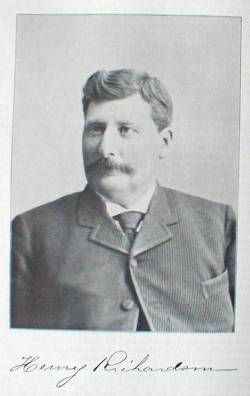
CAPTAIN JAMES RICHARDSON
Captain James Richardson is one of the most experienced mariners on the Great Lakes, having held many important positions aboard different vessels, not the least onerous of which is his present office, that of chief mate on the big steamer Chippewa, of the Niagara Navigation Company's line, on the run between Niagara river ports and Toronto. Always faithful to his duties, respectful to his superior officers and firmly courteous to the men beneath him, Captain Richardson is well liked by all.
Born at Dublin in March, 1829, the Captain is a true Irishman, but he lacks not in affection for Canada, the land of his early adoption, for he was only seven years of age when his parents brought him hither, landing at what is now Church street wharf, Toronto, then Little York, in July 1836, just the year before the William Lyon McKenzie rebellion in Upper Canada. Being of the Roman Catholic faith his parents had him educated under the care of the Church, in the schools of that time, and the young man proved a clever pupil. Living at a lake port and constantly seeing vessels arrive and depart, he acquired a liking for the water, and at the age of thirteen began sailing, going in the spring of the year 1842 as mess boy in the sailing vessel James Coleman, of St. Catharines, under the late Captain Emslie, the vessel's chief mate being Sam Sherwood. She traded on Lake Ontario. The following season he acted as seaman in the same vessel, and leaving her the next year he went as sailor in the brig Ocean Eagle of Buffalo, trading between Buffalo and Chicago. In April, 1857, he shipped as first mate in the schooner Alameda, of Toronto, trading on Lake Ontario, and remained in her two years, transferring in April, 1860, to schooner John A. MacDonald, as chief mate, which berth he occupied one season. In September, 1863, he took the position of second mate in the schooner Rainbow, of Detroit, and stayed with her until December, 1864, trading between Chicago and Buffalo. During 1865 he traveled through the United States, and the next spring shipped as chief mate in the brig Flora de Mara, of Montreal, trading between Milwaukee and Kingston, sailing in her two years. She was one of the largest ships on the lakes at that time. Coming back to Toronto, he purchased the schooner J. G. Baird and sailed her on Lake Ontario, as master, for three months, when, receiving a favorable offer, he sold her, and, in July, 1874, shipped as first mate in the steamer Clyde, of Montreal, on which he continued for five months in the passenger and freight business on Lake Ontario. In the year 1879 he shipped in the steamer Southern Belle, of Halifax, as chief officer, remaining in her for five years; the Southern Belle was a blockade runner during the Civil War, and was brought to Lake Ontario at the close of the war by Messrs. Keith & Fitzsimmons, of Toronto, who had her remodeled. She ran for several years in the passenger business on Lake Ontario, chiefly on the Hamilton-Toronto run, and was finally broken up on the marine railway at Picton, Ont., in the year 1889, and sold for old metal. On leaving the Southern Belle, Captain Richardson in the spring of 1888 became chief mate of the new steamer Cibola, which was built that year by the Niagara Navigation Company, of Toronto, to run between Toronto and Lewiston, N. Y., and burned to the water's edge in Niagara River in 1894, the second engineer losing his life. Captain Richardson was not mate in her at the time, however, he having been advanced in the spring of 1894 to the office of chief mate on the steamer Chippewa, belonging to the same company, and under command of Commodore McGriffin, which responsible position he has held ever since.
Captain Richardson has been married twice. In October, 1857, he wedded Miss Gray, of Toronto, who died in the year 1871; no children were born to that union. In 1877 the Captain was again married, and one son, James, was born to this union, who is now on the steamer Chippewa, along with his father, as a deckhand. Captain Richardson is independent in politics, always voting for what he considers the best measures and the best men. He has always remained true to the religion of his forefathers, being a member of the Roman Catholic Church.
With so long and active a career on the water, it is only natural that Captain Richardson should have had some exciting adventures. In the late autumn of 1861, when he was in the schooner Omar Pasha, that vessel was driven ashore on the rocks at the foot of Lake Ontario, a terrific gale and snowstorm prevailing at the time. Capt. Frank Jackman was in command, and he bravely had all the men out of the boat before he left her. She was laden with 16,500 bushels of wheat, and both cargo and vessel belonged to Messrs. Gooderham, of Toronto, from which port she was bound for Cape Vincent. All hands managed to scramble off on the rocks, and from there got safely to land, excepting the man cook, who slipped away in the darkness and was drowned. Cargo and vessel were a total loss, only the mast being saved. The ship broke in two and all the grain was flooded out of her. Remaining in the snow and cold until daybreak, the captain and crew then struck out afoot, and found a habitation where they were hospitably cared for. In the summer of 1845 Captain Richardson had a close call in the brig Ocean Eagle. While crossing Lake Erie with two locomotives aboard, she was stuck by a squall and capsized, the great weight on her deck having made her top-heavy. Both locomotives rolled off into the lake and were never recovered. All hands clung to the capsized vessel until they were picked up by the steamer Keystone State and put ashore at Dunkirk. Captain Todd, of Buffalo, who had command of the brig, secured a wrecking tug and brought in his vessel, which was ready to sail again in a few days.
CAPTAIN CHANCEY RICHARDSON
Captain Chancey Richardson, for a long time a resident and one of the most prominent citizens of Ashtabula, Ohio, is at this writing deputy collector of customs at that port, and to him is due the credit of much of the statistical matter in this volume having reference to the commerce of the harbor. He is a son of Capt. Henry and Mary (Cunningham) Richardson, and was born December 23, 1833, at Madison, Ohio. His father was appointed lightkeeper of the Madison docks, Ohio, in 1844, and remained in charge of the lighthouse until it was discontinued by order of the lighthouse board. In 1849 he removed with his family to Ashtabula, purchased real estate, and as a pioneer of that flourishing hamlet became one of its most active and esteemed citizens. He died in 1858 after having lived a useful life.
Chancey, the subject of this sketch, received what was considered a liberal education for those days, in the district schools of Madison and Ashtabula. Early in his life he entered the employ of the Ohio Stage Coach Company, at that time running a line of coaches and hacks between Warren and Ravenna, carrying passengers and mail. This company ran their business on schedule time. The line also performed like services between Buffalo and Cleveland, and in fact between other profitable points in Ohio, before the railroads were built. Young Richardson's first duties consisted in carrying mail on horseback between Warren and Ravenna. It is evident that he gave satisfaction to the management as he was in due time promoted to be driver of a coach and four, a position of far more importance than that of conductor of the fast train of to-day, in the young mind. He drove his four-horse team at a spanking gait into Ravenna at the first train on the Cleveland and Pittsburgh railroad. He remained in the stage-coach employ until the railroad encroached so seriously upon the traffic that it was compelled to carry the business farther west and south. At the specified time all the stock, horses, stage coaches and wagons started for Columbus, where the entire plant was turned over to the new company, young Richardson resigning his own team after his arrival. On his return home he was strongly seized with a desire to become a sailor, with the laudable end in view of attaining to the office of captain of vessels in the dim future. He therefore went down to the lake, and shipped as cabin boy on the steamer Cleveland. The next season, being a well-grown lad, he secured the berth of second porter on the noted steamer DeWitt Clinton. The next three years he passed as cook and before the mast in various vessels, among them the Artic, in 1853, which came out new that year. In the spring of 1854 he shipped as wheelsman in the new steamer Iron City, and was promoted to the office of second mate. He was also second mate of the schooner New Lisbon with Capt. H. G. Morey. In 1855 he joined the schooner Rainbow, Capt. H. Hall, as second mate, followed by two seasons on the schooner Carrington and Seabird as mate, respectively, Captain Hall being in command of the Seabird.
With the lapse of time Captain Richardson became a skillful seaman, and during the period between 1857 and 1860 he was second mate and mate of many good vessels, viz.: Brig Blossom; schooners Altair, Oak Hill, B. F. Wade, Anna C. Raynor, Rocket, White Squall and Sioux with Captain Ford; wheelsman on the propeller Portsmouth, and second mate on the new steamer B. F. Wade, with Captain Goldsmith. In the spring of 1860 he was appointed mate of the schooner Bay State, and the next two seasons he sailed with Captain Hall as mate of the schooner Corinthian, closing the last season on the bark Naomi. In May, 1863, he was promoted to be master of the schooner Jessie, followed by two years as master of the schooner New Lisbon. In the spring of 1866 he shipped as second mate on the steamer Fountain City, transferring to the new schooner Amaretta Mosher, the next year. In the spring of 1868 he joined the schooner York State, transferring to the new schooner Edwin Harmon, on which he closed the season. He and his brother Wesley C., now a prominent vessel owner in Cleveland, then purchased a half-interest in the schooner Transport, which he sailed as master, and his brother as mate. At the close of the season the brothers sold their interests in the schooner Transport, and the Captain decided to retire from active life on shipboard.
Captain Richardson then associated himself as secretary and manager, with George C. Cooper, in his meat market business in Ashtabula, which he conducted successfully for six years. This market was the pioneer in suppying meats to the lake trade at Ashtabula, the first good customer being Capt. C. Allen, of the steamer R. J. Hackett. Captain Richardson then embarked in the grocery business on his own account, and after nine years of successful trade sold out, and soon after went to Lorain to take charge and settle up the business of Mr. Tunty's ship-supply store. In 1885 he shipped for a short time as wheelsman on the steamer J.H. Devereux, of which his brother Wesley is manager. He then passed some years in the grocery store of H. C. Tombes, and as clerk in the American National Express office, also in the store of Gee & Rogers and other business houses, until 1890, when he retired from active business life for a well-earned rest, profiting by the time thus at his disposal, however, by building for himself two commodious residences. In 1894 he accepted the position of deputy collector of customs, tendered by President Cleveland, and is the incumbent at this writing.
Socially, he has been a member of the Odd Fellows fraternity for twenty-two years. He is a man of good influence in Ashtabula, and has hosts of friends, especially among young men, whom it gives him pleasure to assist in getting berths on shipboard and at other employment when occasion arises. Although sixty-four years of age, he has the bearing and appearance of a much younger man, and as a descendant of old Massachusetts stock he gives evidence of great vitality. In official duties he is accurate and careful of details, his reports being rendered with unusual clearness and precision.
On January 7, 1856, Capt. Chancey Richardson was united by marriage to Miss Eliza A., daughter of Adnah Scoville (one of the pioneers of Ashtabula, and an extensive land owner; he was mayor of Ashtabula one term - 1848-49). Two sons, Clarence E. and Charles H., were born to this union. The former is secretary of the Bradley Manufacturing Company, is mayor of the city, being nominated by acclamation, and the latter is bookkeeper in the wholesale house of Richards Brothers. The family homestead is at No. 5 Scoville court, Ashtabula, Ohio, where the family is surrounded by every evidence of comfort and refinement.
DEAN RICHMOND
Dean Richmond, formerly a resident of Buffalo, who attained more than a national reputation, was largely interested in elevator property as well as in vessel property on the lakes. He was born in Barnard, Vt., March 31, 1804, and was a son of Hathaway and Rachel (Dean) Richmond. He was a direct descendant of John Richmond, who emigrated from Taunton, England, and who in 1637 was one fo the founders of Plymouth colony at Taunton, Mass. His ancestors were farmers living in and around this colony, but his father removed to Vermont, where Dean was born. In 1812 the family removed to Salina, N. Y., and there Hathaway Dean met with business reverses, which caused him to go South, and he died in Mobile, Alabama.
When Dean Richmond was fifteen years old he engaged in the manufacture and sale of salt, and was very successful, and before attaining his majority he was chosen a director of the Syracuse Bank. From the manufacture of salt he became a forwarding and commission merchant, and was largely interested in various enterprises. In 1842 he established himself in business in Buffalo as a dealer in and shipper of Western produce, residing at first in Attica and later in Batavia. His reputation for upright dealing was not surpassed by that of any resident in the lake region. becoming interested in railroads, he was a leader in the movement which at length resulted in the consolidation of seven corporations into the New York Central Railroad Company, and was mainly instrumental in securing the passage of the Act under which this consolidation was effected.
Upon the organization of the company in 1853, Mr. Richmond was made a vice-president, and in 1864 he was elected to the presidency, which position he held until his death. Though he failed to secure the advantages of early education, yet by wide and careful reading and by contact with and observations upon men and things, he became one of the most intelligent and influential men of his time in the State. He was a man of sound judgment, of broad comprehensive views, and of great force of character, being looked up to even from his boyhood as a leader among his associates, and so continued throughout his life. While a young man he espoused the cause of the Democratic party, and enjoyed the confidence of the men composing the Albany regency. A leader of his party in the State of New York, he was made chairman of the State committee, but never held or sought office of any kind.
On February 19, 1833, he married Miss Elizabeth Mead, in Troy, N. Y. Nine children were born to them, of whom four still survive, namely: H. A. Richmond, Buffalo N. Y.; Mrs. A. R. Kenny, Batavia, N. Y.; W. E. Richmond, Buffalo, N. Y.; E. G. Richmond, Chattanooga, Tenn. Mr. Richmond left at his death (which occurred August 27, 1866), at the home of Samuel J. Tilden, a fortune of several millions to his wife, who built in Batavia the Richmond Memorial Library, in memory of her youngest son, who died in 1885. Mrs. Richmond passed away April 6, 1895.
JOHN D. RILEY
John D. Riley, a young marine engineer who has gained his experience in some of the best steamers on the lakes has been in the employ of Capt. John Mitchell for many years. He is a genial and companionable officer, and is noted for the cleanliness of his engine room and the good condition of the machinery under his charge, always being ready to start when the bells ring. He is the son of Henry Riley, of Goderich, Ont., who removed to the United States when he was twenty years of age and located at Forestville, Mich. It was there that John D. Riley was born and educated, attending the public schools until his seventeenth year. In the spring of 1887 Mr. Riley shipped as fireman in the steamer City of Mt. Clemens, and he passed the next season on the tugs George Hand, Mollie Spencer and Mystic, in the same capacity. In 1889 he joined the steamer Thomas S. Christie, also as fireman, following with a season in the steamer John Mitchell. In the spring of 1891 he became oiler on the steamer R. L. Freyer, holding that berth two seasons, and in 1893, having applied for and received engineer's license, he was appointed second engineer on the steamer J. J. Hill. The next spring he transferred to the steamer Robert L. Freyer, in 1895 to the W. F. Sauber, and in 1896 to the large steel steamer John J. McWilliams, as second engineer. In the spring of 1897 Mr. Riley was appointed chief engineer of the steamer John Mitchell, which position he has held two seasons.
Mr. Riley was united in marriage on December 30, 1896, to Helen M., daughter of Daniel Smody, of Forestville, and one son, Charles W., has been born to this union. They live in Forestville, Mich. Socially Mr. Riley is a Master Mason of Cato Lodge No. 215, a member of the Foresters, the Maccabees and the Marine Engineers Beneficial Association.
PETER RILEY
Peter Riley was during his active life one of the well-known marine engineers on the Great Lakes. He spent many years in the merchant marine, and enlisted in the United States navy during the Civil war, joining the United States steamer Great Western at Chicago, and receiving his discharge from the United States steamer Grosbeak when the war was over. During the latter part of his life he was a locomotive engineer on the Cleveland, Cincinnati, Chicago & St. Louis railroad.
WILLIAM F. RILEY
William F. Riley was born in Cleveland in 1866, son of Peter Riley, who was a successful marine engineer. He spent several years in a machine shop, and in 1882 commenced sailing, acting as cabin boy on the steamer City of Rome for one month. Returning to shore, he was employed in the machine shop of Smith & Olwell for a year and a half, and spent the season of 1885 as fireman of the tug Amoretta Miller, and in 1886 worked in the shipyard of the Cleveland Shipbuilding Company. The next season he was oiler on the yacht Peerless, and the year following was with the steamer Corona. Then he spent another year in the shipyards, in 1890 going as second engineer of the Joliet. The years 1891 and 1892 he spent on shore of the employ of the Cleveland Shipbuilding Company, of Cleveland, and for a part of this time was engaged in putting in the engines of the steamer Cadillac, at Chicago. He was in Chicago again in 1893 installing the engines of the steamer Manitou, and during 1894 was for a time in the employ of the Cleveland waterworks department, later running as second engineer of the Pontiac. He was with the steamer Gladstone for part of the season of 1895, and during 1896 was in charge of the pipe-fitting department of the Cleveland Shipbuilding Company.
On February 18, 1890, Mr. Riley married Miss Nellie Grau, of Cleveland, and they have three children: Mary, Peter and William.
CAPTAIN SAMUEL RIOUX
Captain Samuel Rioux, of Detroit, Mich., for four years commander of the United States lighthouse tender Marigold, was born in Quebec in the year 1845. He attended school and worked on a farm until he was seventeen years old, and began to sail on the pilot boats of the gulf of St. Lawrence, after acting in the capacity of cook, etc., on small coasters for some years.
After several years' experience on the pilot boats, Captain Rioux came to the Great Lakes, where he has remained ever since, and all told he was on the lakes about thirty-three years, during nearly all that time in the government service. He remained three or four seasons on schooners when he first came to the lakes, and after leaving the schooners he served on another boat one season as able seaman. The other thirty years of his life on fresh water have been spent entirely on government boats. During his first year under the government, Captain Rioux was on a lighthouse tender at Spectacle Reef lighthouse, which was being erected at that time. Later he served on the tender Belle Stevens for two years, and was then transferred to the Warrington, on which he was second mate for six consecutive seasons, subsequently continuing on her fourteen more seasons as first mate. At the end of that time he was transferred to the Marigold, on which he served as first mate for a season, then becoming captain. He formally took command of the tender Marigold on July 8, 1893, and held that command until April, 1897. At present (1898) he has left the lakes, and is giving his attention exclusively to his real-estate interests in Detroit, but may later on return to marine work.
Captain Rioux has never been married, and has lived on his boat winter and summer. The Marigold, together with several other of the lighthouse tenders, generally lay up at the government dock below the Marine Hospital in Detroit.
CAPTAIN ED. RISTO
Captain Ed. Risto has from early life displayed a gift for the easy acquirement of knowledge necessary to the successful lake pilot and master, and as a tug captain he has come to the front rapidly, and is now a young officer of great promise. He was born in St. Joseph, Mich., on August 14, 1867, a son of Peter and Mary (Brown) Risto, natives of Germany, who came to the United States in 1850, first locating in Chicago and going thence to St. Joseph, Mich., where they settled permanently.
In that city Ed. Risto acquired his public-school education. In the spring of 1882 he first evinced an earnest desire for a life on the lakes, and he shipped as linesman in the tug A.C. Waters, of Michigan City, Ind., with Capt. Alex Campbell. After two years he was made fireman in the same boat, which berth he held two seasons, and in 1886 he shipped before the mast in the schooner Cora, with Capt. Henry Risto, under whom he learned much practical seamanship. In the spring of 1888 he joined the schooner Kelderhouse as seaman, and was in her when she performed the notable feat of jumping the Chicago breakwater, without touching. While in the fishingtug Hannah Sullivan; in 1889, he witnessed the wrecking of the schooners Minnecaunee and Marinette, and helped to rescue one of the crew, who eventually died from exposure, however, he notes with interest that a dog which came ashore divided his attention between the man who was dead and the boat that floated, not being able to define to which he owed allegiance, Captain Risto also witnessed the wreck of the steamer Manistique, which drowned all hands with the exception of one man, and he had a leg broken. In the spring of 1890 the Captain was appointed second mate of the steamer Puritan, commanded by Capt. Stein, remaining in her until August 9, when he came before the government engineer in charge of improvements on the east shore of Lake Michigan. He was well recommended, his application bearing the indorsement of J.H. Graham (president of Graham & Morton Transportation line), J.A. Manning, Inspector Lloyd Clark (of the United States navy), and Capt. Charles Clark (commander of the United States man-of-war Oregon, when she made her gallant passage from San Francisco to Cuban waters to take part in the destruction of Cervera’s Spanish fleet). In the spring of 1890 Captain Risto was appointed master of the steamer Lizzie Walsh, and in 1898 master of the steamer Music, plying between Holland and Saugatuck.
Captain Risto was married, on September 6, 1896, to Miss Laura Welch, of Holland, Mich., and one son, Leslie Leo, has been born to this union. They reside in Twenty-sixth street, Holland, Mich. Socially, the Captain is a Master Mason, holding membership in Pomona Lodge No. 281, of St. Joseph.
CAPTAIN CHARLES ROACH
Captain Charles Roach, one of the early lake captains, and now one of the prosperous and successful citizens of Chicago, has spent forty of his sixty years upon the Great Lakes. During that time he has experienced many perils, and has undertaken many hazards in the rescue of human life, and in the preservation of lake property. It is an evidence of his skillful seamanship that he has never lost a man on any vessel which he has commanded, and of his daring and bravery he now possesses fitting testimonials.
Captain Roach was born at Medoxville, Canada, January 23, 1838, the son of Garrett and Elizabeth (Donohue) Roach, natives of Ireland, who became early settlers in Canada, where the father for many years was an industrious and successful farmer. Our subject received his education in the common schools, but at the age of fifteen years became identified with the interests of the Great Lakes. He then entered a shipyard at Oswego, N. Y., and served a three-years' apprenticeship. Subsequently he was for two years employed in the same yards.
At the age of twenty he forsook the shipyards for the more active life of the water. In the same year, 1858, he came to Chicago as a ship carpenter aboard the H. C. Winslow, which is yet on the lakes. In August of that year he began tugging in this city on board the wrecking tug McQueen. In 1859 he became master of the tug Mulford, comman-ding her one season. In 1860 he commanded the tug Rumsey, which later, during the Civil war, was confiscated by the United States Government. In 1861 Captain Roach superintended at Miller's yards, Chicago, the construction of the tug Monitor, and when she was launched became her captain. He sailed her for the season, then bought a two-thirds interest in the tug Union, which had blown up, and which he rebuilt, and sailed for many years. About fifteen years ago Captain Roach sold the Union, and since then has been in the employ of the Dunham Towing and Wrecking Company, commanding various boats of that line. He has had an active life upon the lakes, and participated in many rescues of crews.
On December 12, 1867, during a furious, blinding snowstorm from the northeast, the bark David Morris went ashore at Glencoe, north of Evanston. Captain Roach, with his tug Union, took a lifeboat and volunteer crew (Calvin Carr, now insurance and vessel agent in Chicago, being captain of same) out to the wreck, and Captain Carr succeeded in taking off the entire crew, including the female cook - nine persons in all - and landing them safely at Glencoe. For meritorious services rendered on this occasion our subject received a gold watch worth $575 which he still has in his possession. It bears the following inscription:
TO:
CAPTAIN CHARLES ROACH
BY THE
UNDERWRITERS AND CITIZENS
OF CHICAGO
FOR GALLANT CONDUCT IN RESCUING
THE CREW OF THE
BARK DAVID MORRIS
AT EVANSTON
DECEMBER 12, 1867.
The other members of the crew (eight in number) each received a silver watch worth $100, all being presented by the citizens and underwriters of the city of Chicago.
In Traverse bay, many years ago, occurred one of the most protracted efforts to save life and property, in the wrecking of the schooner Kate Richmond, by Captain Roach and crew of the tug Union. He had pumped out the schooner to relieve her, but when about complete a northeasterly squall coming on, she left her bed. The anchors were swung and she went on the beach again, the hawser breaking. Her spars were chopped down within four hours, but the tug, because of the high seas, could not keep alongside. The next morning after two attempts the lifeboat was sent to her, which failed, however. The captain went fifteen miles for another lifeboat, which took off four of the crew under the captain's direction; four others escaped on a raft made of booms and spars. The steamer Ironsides, bound for Milwaukee, came along and was paid forty dollars an hour to help; she held on till they reached the west shore.
In 1894 the Rainbow went down off Chicago. Captain Roach went in the tug Mollie Spencer, and took off four men, one of whom was in the water at the time. A sea struck the tug, broke in the windows and filled her with water. She had to get away for her own preservation, leaving two men on the wreck, the captain and mate, who finally drifted ashore, at Thirty-first street, more dead than alive.
Another rescue occurred some years when the Monticello missed the piers and went on the bars during a heavy northeaster. Captain Roach organized a crew and went to the rescue, bringing off all the men.
In 1869 Captain Roach was married at Chicago, to Miss Eliza Dee, and to them have been born five children: William, Joseph, Mrs. George Dempsey, Mrs. William Scully, and Genevieve. Mrs. Roach died in May, 1897. Chicago has been the home of Captain Roach since 1858. During the big fire in 1871, he was burned out on Ohio street between State and Dearborn streets. He is a member of the Ship Master Association, and for years has been connected with the order of Foresters. In person he is a tall and straight as an arrow, and active far beyond his years. In manner he has the bluff, crisp address of the typical mariner, but is courteous and considerate. Few if any of the men now sailing the lakes have passed through so many perils as he; few if any have a record so clear and untarnished. He has never been injured in the forty years of his lake service, and never has lost a man. He has amassed a comfortable property, and is in every sense a worthy and conspicuous representative of the great inland marine.
CAPTAIN WILLIAM ROACH
Captain William Roach, of Detroit, Mich., was born November 14, 1860, in County Wexford, Ireland, and was brought by his parents in 1861 to Hamilton, Ontario. He had his first sailing experience when yet a lad, in 1869, as porter on the propeller Bristol. The next year he remained at home, going to school, but in 1871 he sailed as day watchman on the R. N. Rice, running from Detroit to Cleveland, continuing on this boat for four years, and when he left her he had been second mate for a year. In 1876, he was wheelsman on the propeller Bertschy, of which he served as second mate the season following. In the spring of 1878 he shipped as first mate on the steamer Cuyahoga and remained in that position until the close of the season of 1879. During the season of 1880 he served in various capacities, being captain of the tug Alpena, doing river towing, and first mate of the Saginaw Valley, Iron Age, and Sanilac. In 1881 he was captain of the Saginaw Valley, and during the years of 1882-83 he was captain of the Sanilac, running from Saginaw to Cleveland. During the seasons of 1884-85 he sailed the Saginaw Valley on the same route, and in 1886 he was captain of the Don M. Dickerson. In 1887-88 he sailed the steamer Arundell, and in 1889 he was captain of the propeller Laura, owning $5,000.00 worth of stock in her. As the stockholders were unable to agree as to the best route for her the next season he went in 1890 to the steamer W. R. Stafford as master and sailed her successfully to the close of 1896, when he signed a contract to sail the S. S. Wilhelm during 1897.
The Captain was married, in Detroit, in January, 1879, to Miss Mamie Myers, and they have two children, Eliza B., and Anna M. He is a member of the Ship Masters Association.
CAPTAIN JOHN J. ROBERTS
Captain John J. Roberts, a man of strong personality, good judgment and logical convictions, performs the duties of harbor master at the port of Chicago with rare tact and wisdom, and consequently is highly esteemed both by owners and captains of craft entering that harbor. He has corrected many evils existing on the river previous to his appointment, especially as regards the bridge ordinances.
He was born in County Limerick, Ireland, September 19, 1844, and is a son of Thomas and Mary (Mead) Roberts, who brought their family to America about 1849, and located at St. Catharines, Ont., where our subject attended school until he reached the age of twelve years. He then went to Oswego, N. Y., and shipped as cabin boy on the brig E. W. Cross, with Captain Moore, and remained with her continuously until 1861. That year he went to Montreal and shipped as seaman in the brig Danube, bound for Dundee, making a good passage, and going thence to Liverpool, where he joined the barque Oriole for Callao, thence to New York. He then returned to the lakes, and shipped out of Buffalo. On August 28, 1862, the Captain enlisted in the 164th N.Y.V.I., serving four months in that regiment with the Army of the James. He was then transferred to Battery D. Fourth United States Artillery, and served with honor in the great battles of the Wilderness, Fair Oaks, Cold Harbor, Gettysburg, the sieges of Suffolk and Petersburg, entering Richmond, Va., with his battery, on April 3, 1865. It was at this time that Archduke Maximilian entered Mexico to subvert the government in defiance of the Monroe Doctrine, and the Fourth United States Artillery was dispatched with other forces to the Rio Grande for the purpose of driving the invaders out of the Republic. This movement had the desired effect, and as all the warring elements had become quelled Mr. Roberts received his honorable discharge at Fort Pickens, Texas, December 28, 1865.
Captain Roberts then returned to his home in St. Catharines, Ont., and passed some time on Canadian vessels. In 1867 he went to Oswego and shipped in the schooner Russia with Captain Clement, closing the season as mate of the schooner Coquette. The next spring he was appointed mate of the schooner Granada, followed by a season as mate in the Madeira with Capt. William Mack. In 1870 he was appointed master of the Canadian bark Gibraltar, sailing her until August, when he resigned to bring out new the schooner Grantham. During the winter of 1870-71 he superintended the construction of the schooner Shandon, and brought her out new. He sailed her ten consecutive seasons, and lost her off Cabot's head, Georgian Bay, in a blinding snowstorm. In the spring of 1881 Captain Roberts was appointed master of the schooner Jessie Scarth, and after sailing her two seasons she foundered off Portage, Lake Michigan, in an October gale, the crew being saved. The next season he sailed the schooner Flying Cloud for Scott & Channon. In 1883 he entered the employ of the Watson & Little Fuel Company as agent and manager of their coal docks, remaining with that corporation four years. Resigning that position in 1887, he accepted the surperintendency of the O.S. Richardson Fueling Company. It was on April 27, 1897, that he was appointed harbormaster at Chicago by Mayor Harrison, and confirmed by the council of Chicago.
In January, 1877, Captain Roberts was married to Miss Sarah V., Daughter of Owen and Elizabeth Sleavine, of St. Catharines, Ont., and the children born to this union are: Agnes Maude and Frederick George, who are both graduates of the Chicago High School, having also taken a two-years' course in the Chicago Business College. The family residence is at No. 365 East Ohio Street, Chicago, Illinois.
DANIEL H. ROBERTSON
Daniel H. Robertson, for some few years chief engineer of the Jay Gould, of the Lake Michigan Transportation Company, belonging to Leopold & Austrian, was born in Cleveland, Ohio, in 1867, a son of Daniel and Caroline (Dwyer) Robertson. The father was a native of Scotland, and on crossing the Atlantic first located in Canada, but in 1846 removed to Cleveland, Ohio, where he made his home for some years. When a lad of twelve years he began sailing from Glasgow, Scotland, and continued to sail on salt water until his removal to Cleveland, when he became interested in lake marine, and was master of the Snow Drop and other vessels. He was for many years one of the most prominent and well-known shipmasters on the Great Lakes. He died in Chicago in 1885, and his wife departed this life in Cleveland, in 1881. In their family were three sons, of whom William is now captain of a tug at Cleveland; Charles A. engaged in sailing until 1885, and was second mate of the Hiawatha, but is now interested in the patent-right business, he having patented a back-pressure trap.
Daniel Robertson continued to make his home in Cleveland until he was seventeen years old, when he came to Chicago. Four years previous to this he began sailing -in fact was reared on board a vessel. He was first employed on a sailing vessel out of the port of Cleveland, and later engaged in firing on tugs at that place, obtaining his first license as engineer in Chicago in 1886. For some time he shipped out of New Orleans as first assistant engineer on boats engaged in the fruit trade on the South American coast; was then engineer on the tug B. D. Wood; and was also engineer on boats in trade with Jamaica. He sailed from New Orleans on different packets some eight months, and during the season of 1895 served as engineer on the yacht Pindar, and the same year accepted the position of engineer for a contracting firm on a government dredge at Cairo - the largest section dredge in the world; later on he left this firm to become chief engineer on the Jay Gould. In 1888 he joined the Marine Engineers Beneficial Association, of which he has since been an active member, and is now serving as recording secretary, and in 1898 was a delegate to the National Convention of that organization. He also belongs to the Knights and Ladies of Honor, in Chicago.
In 1897, in that city, Mr. Robertson was married to Miss Lena Daab, a native of Chicago, and they now make their home at No. 36 North Canal street.
GEORGE W. ROBERTSON
George W. Robertson, chief engineer of the J.E. Mills, was born September 25, 1856, in Algonac, Mich. His father, Henry Robertson, who was a native of Vermont, was engaged during the greater part of his active life as a custom-house officer at Algonac, where he died in 1852. He was succeeded by his son, John M., who has also been a representative from the Huron district to the State Legislature.
At the age of ten years George W. Robertson accompanied the family on their removal to St. Clair, Mich., where he has since made his home. When eighteen years of age he began work as fireman on a ferry trading between St. Clair, Courtwright and Moretown, and after serving for three years transferred to the ferry Courtwright, owned by D.A. Daly, as engineer. He served as assistant engineer upon the steambarge Emma E. Thompson, of Saginaw City, and was later on the Alpena for two years, spending the same length of time on the Michigan as assistant, after which he shipped on the Sprite as chief. He was subsequently engaged on the Shoo Fly, L.Q. Rawson, S.S. Curry, Clara, Island Belle and Huron City, from the last-named vessel coming to the J.E. Mills, where he has since served in the capacity of chief engineer to the entire satisfaction of his employers.
In July, 1876, Mr. Robertson married Miss Emma O'Dougherty, of St. Clair, Mich., and they have one daughter, Mary, who is still under the parental roof.
CAPTAIN H. W. ROBERTSON
Captain H.W. Robertson is a marine master of long experience and one thoroughly acclimated with all the departments of his work, having devoted his entire life to this occupation. He was born February 19, 1841, at Marine City (then called Newport), Mich., and there lived until his sixteenth year, when he went sailing. His first experience was on the A. Rust, where he acted as seaman two years, later as mate, for the same length of time and finally as master. When he left this boat he went on the propeller Genesee Chief as mate and remained one season, subsequently serving in the same capacity in the Bay City and East Saginaw, and then shipping on the C.G. King, of which he was master two seasons. After commanding the D.K. Clint one season, he remained on shore for a year, engaged in business, and on returning to the water he went on the Rumage, and the following year on the Andrew J. Smith. During the seasons closely following he commanded the Alpena, Emma Thompson, B.W. Jenness, Porter Chamberlin, Havana, C.H. Green and Oscar T. Flint, coming in 1896 to the E.M. Peck, where he has since acted as mate.
On December 17, 1867, the Captain was married to Miss Mary Higley, of St. Clair, and they have one son, L.C., who sailed for several years, but is now engaged as bookkeeper for Buhl & Sons, of Detroit; Frank, an older son died in infancy. Captain Robertson is a member of the Knights of the Maccabees, Royal Guards and the Masonic Order, Evergreen Lodge No. 9. His parents, James and Theodate (Millard) Robertson, were natives of Michigan and New York State, respectively; both are deceased.
CAPTAIN W. J. ROBERTSON
Captain W.J. Robertson, son of Daniel and Caroline (Dwyer) Robertson, was born in Cleveland, Ohio, September 22, 1857. His father, who was a native of Scotland, was a salt-water sailor and afterward for many years master of lake vessels, among which are mentioned the Riverside, William Brandy, Kate Winslow, Middlesex, brig C. G. Breed, and schooner Helena, which he brought out new. Daniel Robertson came to the United States in 1848 and located at Cleveland, where he met and was united in marriage to Miss Caroline Dwyer, formerly of Oswego, New York.
Capt. W.J. Robertson attended the Cleveland public schools, receiving a liberal education. He then joined his father in Smith's rigging loft, and, after remaining there two years, entered upon his career as a sailor, serving as boy in the schooner Middlesex, bark Merrimac and schooner Kate Winslow, until 1877, when he was appointed second mate of the schooner William Grandy, holding that berth two years. In the spring of 1879 he shipped as second mate of the schooner Kate Winslow. The next spring he went as fireman on the tug Levi Johnson, owned by Pennington & Warner, remaining on her two seasons, after which he served in a like capacity on the tugs Old Jack and H. N. Martin, out of Cleveland, Eber Ward, out of Detroit, and Levi Johnson, S. S. Coe and F. C. Maxon, on contract work at Milwaukee. In the spring of 1885 Captain Robertson entered the employ of Capt. Patrick Smith, his first appointment being that of master of the tug James Amadeus, followed by service in a like capacity on the tugs Fanny Tuthill and L. P. Smith. He then took out engineer's papers and was appointed engineer of the tug Maggie Sanborn, on which he continued one season, acting at times in the capacity of both engineer and master. For some time following he sailed the tug Dexter out of Ashtabula, and on his return to Cleveland took command of the tug Tom Dowling, transferring to the L. P. Smith before the close of the season. The following season he brought out the tug W. H. Doan for Capt. Robert Greenhalgh, afterward taking charge of the C. E. Bolton and the Mary Virginia. He then entered the employ of L. P. & J. A. Smith as master of the N. B. Gates, and while in the employ of that firm sailed successively the tugs Patrick Henry and S. S. Stone.
Captain Robertson then went to Fairport, Ohio, and took charge of the R. K. Paige, holding the berth of master three years, during which time he made his home in that port. The next season he went to Ashtabula and was appointed master of the big tug Wisconsin, which he sailed until he was again called to Fairport, to take charge of the Annie. In the spring of 1893 he went to Sandusky with the tug Myrtle, remaining there on contract work three months, after which he entered the employ of the Cleveland Vessel Owners Towing Company, as master of the tug Alva B., one of the smartest tugs operating out of that port; later he was on the Dreadnaught and Tom Maytham. In the spring of 1894 he went to work for the Cleveland Towing Company as master of the S. S. Stone, going to Ashtabula the season following to sail the tug Sunol, on which he was engaged the entire season. In the spring of 1896 he returned to Cleveland and sailed the tug Kennedy for the Cleveland Towing Company. After Captain Dell Moffett resigned the position of master of the tug Chauncey Morgan, early in the spring, Captain Robertson was appointed to her and continues to sail her at this writing. Captain Robertson has been instrumental in saving many lives. In the fall of 1884, he put a new crew aboard the Zach Chandler, which lay at anchor outside the breakwater, leaking badly and under great stress of weather. The act was attended with much danger. He also saved the crew of a vessel while master of the tug Stone. He has eighteen issues of first-class master's papers, and a number of engineers licenses. He is a member of the American Association of Masters & Pilots.
Capt. Robertson was united in marriage to Miss Emily Stevenson, of Cleveland, November 3, 1880. The children born to this union are Mira Elizabeth, Franklin W. and Gracie. The family residence is at No. 60 Harbor Street.
ALEXANDER R. ROBINSON
Alexander R. Robinson, of Conneaut, Ohio, is the son of Alexander and Mary E. (Bensom) Robinson, both natives of New York State. He was born November 5, 1856, at Clayton, Jefferson Co., N. Y., and at that place spent all of his younger life, attending the public schools of Clayton until he was fifteen years of age. He then had a great desire for a marine life, which he gratified by going on the Gen. Burnside as seaman. Here he remained one season, and then went on the schooner Grace Whitney, continuing thus for one and a half seasons, after which he served as her second mate the same length of time. He then served as mate on the schooners Montana, Bigler, Monterey and Henry Folger, transferring the following season to the Prince Alfred as master, and remaining three seasons. After a season spent on the James Couch, he remained on shore for a year, and then took the same boat for four years. Shipping next on the schooner North West, he remained three years on her, after which he took the barges Nos. 27 and 31 for two years. The two seasons following he spent on the A. D. Thompson and the season of 1895 on the V. H. Ketchum, coming in 1896 to the Kaliyuga. The only misfortune which has befallen Captain Robinson was on the Prince Alfred, which was wrecked on Lake Huron, near Collingwood. The boat was soon repaired, however, and put in running order.
Our subject was married January 18, 1876, to Miss Isabella McCrea, of Clayton, N. Y., a sister of John McCrea, who has been a sailor for several years. Their children are Alratha I., Henry R. and Thomas S., all of whom are in school at the present time. Mrs. Robinson is a member of the Ladies of the Maccabees, and Captain Robinson of the Masonic Order, I. O. O. F., and Knights of the Maccabees. His brothers, Thomas J. and Willard J. Robinson, are both sailors, the former having been a master for several years.
FREDERICK W. ROBINSON
Frederick W. Robinson was born in Picton, Ontario, December 3, 1872. His mother was formerly Miss Isabella Buchanan, and his father was William F. Robinson, who was drowned while on the tug Washburn, in 1892, when it was sunk in the Detroit river by the steamer City of Mackinaw. Mr. Robinson was engineer of the St. Paul, and was going ashore on the tug at the time. Frederick's uncle, T. W. Robinson, was also drowned. He was engineer of the Unique in 1895, and the bursting of her boiler threw him into the water with such force that he could do nothing to save himself, and thereby lost his life. Two girls were also born to this family, Edith and Lottie, the former of whom died in 1892.
Frederick W. Robinson removed to Detroit with his parents in 1878, and in 1890 he went on the lakes as fireman on the steamer T. S. Christie. In 1891 he became oiler on the steamer German, and in 1892 he oiled on the Majestic. During the season of 1893 he was oiler on the Fayette Brown, and in 1894 he was second engineer on the same vessel, remaining until 1896, during which time he did not sail, being laid by with rheumatism throughout the entire season, but in 1897 again took up his duties as second engineer on the steamer Fayette Brown, on which he was serving previous to his illness. During the season of 1898 he was chief engineer of the steamer T. S. Christie.
On November 12, 1896, Mr. Robinson was married to Miss Jennie Smith, daughter of William Smith, a farmer.
ROBERT A. ROBINSON
Robert A. Robinson, engineer of the fire-boat J.M. Hutchinson, was born at Buffalo, August 19, 1859, and was educated at the Brothers school in Buffalo. His parents are William J. and Katherine (Pendergrass) Robinson, the former of whom was a native of Genesee, N.Y., and the latter of Tipperary, Ireland.
Mr. Robinson began life on Buffalo creek as engineer of the yacht Kate Sutton, an excursion boat, in 1877, and from that year until 1891 he was wheelsman, engineer and master of the following tugs in Buffalo harbor: Stella, Dave Sutton, Newsboy, Arrow, Allington, Huntress, George M. Donaldson, John Howell, Ella B., Leo Lennox, Armstrong, Oneida, Annie M. Sloan and Lone Star. During this time, in the first part of the year 1881, he also ran a stationary engine for Saxton & Amethon at Buffalo, and in 1888 he was master of the tug Charles Henry, owned by Patrick Smith, of Cleveland, part of that season. Mr. Robinson was for two seasons, in about 1881 and '82, in steam canal-boats on the Erie canal. On February 25, 1891, he was appointed engineer of the fire-boat City of Buffalo, now the George R. Potter, where he worked three years, and on July 22, 1894, he was transferred to the J.M. Hutchinson, where he is now employed.
Mr. Robinson has been a member of the I.O.O.F. for five years, and has also been a member of the Firemens Beneficial Association since September 24, 1891. He is a single man.
CAPTAIN WALTER ROBINSON
Captain Walter Robinson, who has been with the Union Steamboat Company's line for thirty years, came of good old "down-east" Yankee stock. His father, George Robinson, was born in Vermont in 1817, and located in Sheridan, N.Y. when he was sixteen years of age. He was a millwright by trade, but also engaged in farming part of the time after he came west; he died in 1880. His wife was Miss Clarissa Meyers, of Washington county, N.Y., who died in 1848, when the subject of this sketch was only three years old. Almond Robinson, a brother of George, was a sailor by occupation, and Nelson, his son, who died in 1894, was at one time master of the steamer M.M. Drake, and of the Inter Ocean; he was considered a skillful pilot. William, another son, is a millwright at Silver Creek, New York.
Captain Robinson was born at Sheridan, Chautauqua Co., N.Y., in 1844, and attended school at his native place, spending part of his early life on a farm. Being brought up on the lake shore, he acquired a liking for sea-faring life, thinking it preferable to the drudgery of a monotonous existence on farm. In 1864, at about the age of twenty, he went before the mast with Captain Blake on the schooner Restless, and after about three years' service, in sail vessels, he became wheelsman with Capt. M.M. Drake on the steamer New York. In September, 1866, he was made second mate of the same steamer, remaining in that capacity until the close of that season. The following year he was second mate on the propeller Owego, which went ashore on November 25, at Van Buren Point, Lake Erie, and became a total loss, five of the crew being drowned. In 1869 Captain Robinson was second mate with Capt. William Thorne on the Olean for a season, and in the same berth with the captain on the Tioga for the season of 1870. The next season and also that of 1872 he was mate with Captain Shannon on the Evergreen City and Eclipse, respectively. For the seasons of 1873-74 he was master of the steamer Olean, and during that of 1875 he was master of the Tioga, which was burned in 1880 on Lake Erie. In 1876-77 he was master of the James Fisk, Jr.; 1878, of the Dean Richmond; 1879-80-81, of the Waverly; 1882-83, of the Starrucca; 1884, of the Portage, 1885, of the New York; 1886-87-88, of the H.J. Jewett; 1889, of the new Tioga, and in 1880-91, of the new Owego. From the spring of 1892 until September of the season of 1896, he was master of the steel steamer Chemung, being then transferred to the new steel steamer Ramapo; the following season he was transferred to the new steel steamer Starrucca, which he has since commanded. Captain Robinson has had a very clean record, having lost no boat in all his thirty years with the service of the Union Steamboat Company. He is to-day the oldest master with the line, has always commanded their best boats, and has been with the company continuously since he entered this employ in 1867.
In 1869, while he was before the mast on the schooner Rebecca with Capt. Elijah Gibson, he had his first experience going ashore. The schooner was bound for Sandusky harbor, but she was caught in a gale to the northward of Kelley's Island, Lake Erie; the anchors were dropped when off the east end of the island, but the cables parted and the schooner went ashore. While on the H.J. Jewett Captain Robinson experienced some difficulty in handling her without her rudder, which she lost in one of her trips on Lake Michigan; but he managed to weather a gale in a heavy sea by working her stern first to the windward, and was picked up later and towed into port. In 1893, while master of the Chemung, he reversed operations in the management of the rudderless steamer. He was on the way to Chicago, on Lake Erie between Grand river and Mohawk island, abreast of Port Maitland, when he put about in a heavy sea a third time to render assistance to a disabled craft, losing his rudder in the attempt. However, he forced his boat bow first into the eye of the wind and a sea, and succeeded in getting under Erie peninsula, where he was subsequently relieved by a couple of tugs from Buffalo, which took lines from the stern of the Chemung and steered her into that harbor.
On April 6, 1887, Captain Robinson was married to Miss Hattie Chesebrough, a daughter of Gordon D. Chesebrough, who was on sailing vessels on the lakes twenty years ago. They have two children, and the family reside at No. 326 Fifteenth street, Buffalo, New York.
WILLIAM J. ROBINSON
William J. Robinson, an engineer of some eighteen years' experience, and chief engineer of the C. R. Corwith estate building at Nos. 116-124 Market street, Chicago, was born in Montcalm county, Mich., in 1850 a son of Stephen and Mary (Stoneburner) Robinson, the former of whom was born in Scotland, the latter in Michigan, of Scotch ancestry. Prior to coming to America the father was a sailor on salt water, and while residing here he sailed on the lakes. His death occurred at Grand Rapids, Mich., in 1867. The mother has since become the wife of John Thompson, of German descent, who was also a saltwater sailor in early life, and afterward sailed on the lakes, following that pursuit for twenty-four years, became a practical seaman, and who is now residing on a fruit farm near White Lake, Mich. Our subject's paternal great-grandfather, Ritz Robinson, was an Indian trader, and was the first white settler on the eastern shore of Lake Michigan, having trading posts at Grand Haven and Grand Rapids, Mich., where he traded in furs for many years. He married an Indian maiden, the daughter of the chief of the Ottawas, and died in Michigan.
In that State William J. Robinson spent his boyhood and youth, his education being mostly acquired at Grand Haven, where he also learned engineering. In 1875 he commenced sailing on fishing tugs out of that port, and engaged in all kinds of fishing for a time, being shipwrecked while on a fishing boat out of Grand Haven, after which he served an apprenticeship to the machinist's trade in the shops of Wilson & Henry, at Montague, Mich. He then became a licensed engineer, and was engineer of the T. W. Snook, engaged in the lumber business between Chicago and all Michigan ports, remaining on her three seasons. The following season he was engineer on the Charles A. Street, running from Chicago to Ashland and Buffalo; and assisted in the building of the barge H. C. Ackley, engaged in the ore trade between Escanaba and Grand Haven, which was lost off Grand Haven in 1878, only seven of the crew of fifteen men being saved. For three years he was engineer on tugs running along the eastern shore of Lake Michigan between Grand Haven, White Lake and other ports, followed by three years on the summer and winter boats of the Goodrich Transportation Company, including the City of Racine, and the City of Ludington. Going to Sheboygan, Wis., he fitted out the J. W. Johnston for the Shores Lumber Company, of Ashland, Wis., formerly the Powers, and remained on her one season. In 1893, or the World's Fair year, he was employed as engineer on one of the boats belonging to the World's Fair fleet, running from Van Buren street to the fair grounds, and the same year sailed the Fanny M. Rose, a pleasure yacht, on Spring lake, making trips from the summer resorts, Fruitport and the Springs to Grand Haven. He engaged in stationary work in Michigan, but the following year came to Chicago, and in February, 1896, accepted his present position.
At one time Mr. Robinson was a member of the Volunteer Life Savings Station at Grand Haven, and was fortunate in saving the life of E. B. Ward, a wealthy lumberman of Detroit, his life boat being an Indian Mackinac. Socially, he is a member of the Stationary Engineers Association, No. 3, of Chicago; Ottawa Lodge No. 26, and the Knights of the Maccabees, both of Grand Haven; and the Ancient Order of United Workmen at Grand Rapids.
In 1881, at Grand Rapids, Mr. Robinson was united in marriage with Miss Olivia Chaffee, a native of Kent county, Mich., and they are the parents of one daughter, May Edna.
CAPTAIN GEORGE ROBSON
Captain George Robson has been associated with the tug interests of Buffalo harbor for about thirty years, sixteen of which he spent in the service of the White Star line, and during his time has been on almost all the principal harbor tugs. He is accounted a capable and reliable tug man, is of a modest, retiring nature, careful in his money matters, devoted to his family, and does not indulge in intoxicating liquor of any description.
The Captain is a son of William A. and Betheny (Steel) Robson, the former of whom was a hotel-keeper; both parents died when George was twelve years of age, thus compelling him to begin the struggle of life at a great disadvantage. He was born at Buffalo June 27, 1855, and because of the loss of his parents as above related was not favored with much education. In fact he left school to begin the work of earning his living, shipping as deckhand on the tug Port Smith, with Albert Green as master. He was subsequently engineer, respectively, of the tugs Syracuse, Champion and Double Exhaust, one season each. His next service was as second engineer of the Canadian steamer Prairie State, on which he remained for one season, after which he became engineer of the tug News Boy for a couple of seasons. For the next twelve successive seasons he was master of the Post Boy, and for four seasons thereafter of the Lennox, which was none other than the News Boy. The next berth occupied by Captain Robson was that of engineer of the tug Hi Smith for the season of 1877; she was wrecked about November 1, of that year, near Port Maitland, becoming a total loss, but the crew were picked up by the schooner Grace Amelia, which had been in tow of the Hi Smith, and safely landed in Buffalo. In 1878 Captain Robson was engineer of the tug Minnie Maytham, continuing on her until she was sold, and the following season he went one trip to Pequaming, Lake Superior, as second engineer of the steamer Huron City. He was also a year in the Buffalo Last Factory, owned by Dr. Abbey and was engineer of the tug William Morris when she sank at the dock in the canal slip at the foot of Lloyd street. For one season he was at Dunkirk on the tug Dave & Mose, towing for Jennings & Co., contractors, and at Erie harbor on the tug Maggie Ashton for the same firm. He was also at Sandusky a couple of months engaged in tug work, and also served for a couple trips as engineer on the Erie canal between Buffalo and New York. For the season of 1896 Captain Robson was master of the tug Annie M. Pierce. For season of 1897 he was engaged in the saloon business until July 15, when he sold out, and during the balance of the year was with the Buffalo Belting Works as engineer; for season of 1898 he was captain of the tug Trenton.
Captain Robson was married, November 7, 1877, to Hannah Heary, by whom he has had ten children. Those now living are Mary, Katherine, Florence and Irene. Socially, our subject is a member of the Knights of the Maccabees, and of the Harbor Tug Pilots Association of Buffalo, New York.
JEREMIAH O. ROGERS
A more genial spirit is not known among the marine men of Buffalo harbor than this gentleman, better known as "Jerry" Rogers, the skillful chief engineer of the Union Steamboat line, the "Soo" line and the Union Transit line. He is the only remaining member of the family of Captain Charles and Mary (Mason) Rogers, the former of whom, born in Bristol, England, was a well-known sailor in his day, and was master of lake vessels for many years previous to his demise in 1854. Captain Rogers had at one time command of the old propeller Charter Oak, and was also part owner of her with A. R. Cobb, one of the most prominent business men of Buffalo, in the early days. The Charter Oak was originally a brig. Her engines were small and of the old high pressure pattern, the cylinder having an 18-inch bore and 24-inch stroke. She plied between Buffalo, Fort Stanley and Chicago. The mother of our subject was a daughter of Squire Mason, who was a justice of the peace at Black Rock in 1808, and went on a trip of inspection with Gov. Dewitt Clinton on the Erie canal in 1825.
The subject of this sketch was born in Buffalo, September 24, 1841, and upon leaving school became apprentice in the shops of the Sheppard Iron Works. Before finishing his time he enlisted in the 11th New York Cavalry for service in the Civil war, served to the close of the struggle, and then returned and completed his term at his trade. His first experience in the lake service was as second engineer of the steamer Mendota, of Dole's line, during the season of 1866. The succeeding season he entered the service of the old Northern Transportation Company, of Cleveland, and while with them was chief engineer of the propeller Michigan one season, and of the Maine two seasons. In 1870 his services were engaged by the Union Steamboat Company, his first berth with them being that of chief engineer of the old propeller Araxes. Succeeding that he served several seasons each as chief engineer of the steamers Atlantic, Arctic and Nyack, all in the passenger service, and was in the latter steamer six seasons. On his last trip in the Arctic down through the Sault Ste. Marie river, in the fall of 1876, she was frozen in at the Sailors Encampment on the 28th of November, together with thirteen other propellers and twenty-six vessels. The passengers, officers and crew of the Arctic were compelled to walk on the ice to Detour, and there hired a sailboat to take them to Mackinac Island. From there they managed to get to Cheboygan, Mich., at that place boarding the steamer St. Joseph, on which they eventually reached Detroit, and from there went by rail to their respective homes. The weather was bitterly cold during all the trip, it being fourteen degrees below zero while they were in the sailboat, going across to Mackinac. Before leaving on the St. Joseph they were compelled to cut her out of the ice, as she had frozen in the night previous to their departure. Mr. Rogers was appointed chief engineer of the Union Steamboat line in March, 1883, and resigned in November, 1897, then of the Soo Line, and in October, 1894, of the Union Transit Line, which later two positions he still retains to the complete satisfaction of all concerned.
CAPTAIN FRANK D. ROOT
Captain Frank D. Root, one of the most prominent and highly respected lake captains sailing out of Chicago, is a Western man by birth, being born in Green bay, Wis., October 7, 1849, a son of William and Emily (Wheelock) Root. The former a native of Delhi, Delaware Co., N.Y., and the latter of Vermont. William Root, the father, was a lieutenant in the army, stationed at Sault Ste. Marie, and Mackinaw, Mich., and Fort Howard, Wis., where the mother died. Two years after his mother's death the Captain returned to his father's native place, Delhi, and lived with his grandmother Root till 1864, when he shipped as boy on a vessel sailing out of New York, and was on the salt water till 1867, when he came to Buffalo, and not being able to secure a berth on a sailing vessel at that time took the position of deckhand on the old steamer Acma. Thence came to Milwaukee, and shipped as boy on the bark Jessie Hoyt, engaged in the lumber trade, and in 1868 came to Chicago, since which time he has made this city his permanent home. Later on he became identified, as sailor before the mast, with different vessels in the grain trade, plying between Chicago and Buffalo, rising from this position till he became second mate, then mate of steam and sail vessels. In 1872 was on the White Squall when she was lost and was the only one of the crew saved. In 1878 he became master of the bark Unadilla, sailing her till 1881, when he entered the employ of the Wabash line, going as the master of the steamer Marley, from Toledo to Buffalo, and in 1882, while still in the service of this company, sailed in charge of their new steamer Russell Sage. From 1884 to 1888 he officiated as master on the steamer Fred Mercur, belonging to the Lehigh Valley line of Buffalo, N.Y., after which he was in command of the City of Rome for two years, when he was engaged as master with the Minnesota Steamship Company, in 1890 took out the steamer Manola, the first of the Minnesota fleet to be built; 1891 was in charge of the steamer Marina, of the same line and the first steel steamer built at South Chicago yards; was on the Maritana, Minnesota line, also built at South Chicago, from 1892 till 1895, when this same company placed him in command of the Mariposa, he remaining with her till 1898.
The Captain is known as a brave and fearless man, and has been highly commended by the Buffalo press for his courage in times of danger, and it was through his efforts that the crew of the Idaho was saved.
Socially, he is an honored member of the Ship Masters Association No. 3, Chicago, having transferred from the lodge at Buffalo; and is also a prominent member of Harbor Lodge No. 731, F. & A. M.
In 1888, in Chicago, Captain Root was married to Miss Alice Hotchkiss, a native of Bay City, Mich., and they have one child, Manola. The family residence is at No. 9314 Central avenue, South Chicago, Illinois.
CAPTAIN HENRY ROSE
Captain Henry Rose, of Detroit, who has lived retired for the past seven years, is a mariner of wide experience, and has seen every phase of a sailor's life. He was born in Memel, a Prussian seaport, in 1825, and ran away to sea at ten years of age, since which time he has never seen his native town. For thirteen years he sailed to all ports of the world, several years as a member of the British navy, during his service in which he was in the Asiatic squadron which participated in the Chinese and New Zealand wars. Captain Rose came to the Great Lakes from New Orleans in 1848, and sailed on them from that year until his retirement. His first command was the schooner Quickstep, which he sailed for several seasons, and later he was master of the H. H. Brown, the C. J. Breed and many other vessels, always commanding sailing craft; he maintains that before steam was in general use they had better times and better pay. For twelve years he was in the employ of Godfrey, of Detroit, a well-known vessel owner, and he also sailed Jesse Farwell, of Detroit, several seasons. The Captain has had several narrow escapes from drowning. In 1879 the schooner C. J. Breed, of which he was captain and half owner, was capsized in Lake Erie, off Ashtabula. Five men were lost, and Captain Rose and two others were in the water eighteen hours before being picked up. It was three days later before he could get word to his family in Detroit, who had been mourning him as dead.
Captain Rose has one son and three daughters, all of whom are married. His wife died about six years ago, and he now resides with one of his daughters, hale and hearty, though he is now past three score and ten.
EDWIN E. ROSS
Edwin E. Ross is a young man, but he has all the requirements of a thoroughly capable marine engineer, and though he has been in the service but a few years he has during that time developed qualities that eminently fit him for his chosen occupation. He is a son of James and Susan A. (Rushton) Ross, who reside at No. 150 Congress street, Buffalo. The former is a machinist in the employ of Josiah Ross, who has conducted a machine shop in Buffalo for twenty-seven years, and was originally with Frank & Co., on the Terrace.
Mr. Ross was born in 1869 in Haldimand county, Ont., and attended school both at his birthplace and at Welland. In 1885 he removed to Buffalo and entered the employ of Josiah Ross, his uncle, with whom he worked for about five years, learning his trade. He first began to sail the lakes in 1890 as oiler on the Russia, of the Lackawanna line, on which he remained three seasons, in 1893 obtaining the berth of second engineer of the steamer Grand Traverse. After a couple of seasons in that service he went as second engineer of the steambarge Kitty Forbes, owned by McLachlan, of Port Huron, for part of the season of 1895, and during the remainder of 1895 and all of 1896 he was second engineer of the steamer Wyoming. In social affiliation Mr. Ross is a member of the Marine Engineers Beneficial Association No. 1, of Buffalo, of the F. & A.M., and of the I.O.O.F. His is a single man and resides with his parents.
JAMES ROSSAN
James Rossan, a young marine engineer, thirty years of age, who possesses many good qualities of head and heart, has protected himself in his calling by an assiduous study of works on engineering, and close attention to his machinery, and winning by this the reward true merit brings in a rapid rise in his calling, until he has attained a position equaled by a few men of his age and short experience. He is the son of Bartel and Annie Margaret (Langker) Rossan, and was born near Hamburg, Germany, on April 28, 1868. His father, who is a farmer, removed with his family to the United States about the year 1872, locating at Pierceville, Ill., where he purchased a farm, and where James attended school and worked on the farm until he was sixteen years of age. During the winter of 1891-92 he further improved himself by studying mathematics and mechanical drawing at the Chicago Athenaeum, completing two terms of thirteen weeks each at this famous school. His first duties away from home life were on the Burlington & Quincy railroad as fireman working in the shops at Aurora, Ill., as opportunity afforded.
It was in the spring of 1889 that Mr. Rossan began his career as a sailor by shipping as foreman on the steamer M.T. Green. In 1890 he entered the employ of R.P. Fitzgerald, for whom he has since worked with the exception of a few months. His first berth in his new work was sailing on the steamer John Plankinton, which he held two seasons. In the spring of 1892 he applied for and was granted an engineer's license, and was appointed first assistant on the steamer George Burnham, of Milwaukee, which city he had made his home during 1890. He retained this position, until August, with John E. Eaton as chief, when he was appointed to the steamer John Plankinton in a like capacity, holding that berth until the fall of 1897. The next spring he was promoted to chief engineer on the steamer Phil D. Armour, retaining that office until the close of navigation.
The only casualty worth mentioning since he has been sailing was the loss of the rudder of the Plankinton in 1895, when she drifted helplessly for two days, until she was discovered and taken in tow by the revenue cutter Andrew Johnson.
Fraternally he is a member of the Marine Engineers Beneficial Association No. 9, of Milwaukee.
On January 20, 1897, James Rossan was wedded to Miss Daisy Maud, daughter of John E. and Annie (Proctor) Eaton, of Milwaukee. One daughter, Marion Eaton Rossan, has been born to this union. Mrs. Rossan's father is an old and highly esteemed marine engineer, and has been in the employ of William Fitzgerald a long time. Although Mr. Rossan now resides on Churchill Street, Chicago, he owns a pleasant home in Maywood, one of the suburbs of that city.
G. P. ROTH
G.P. Roth is a genial, broad-minded man, and as an engineer enjoys the fullest confidence of the people by whom he has been engaged since he attained to the rank of chief engineer. He was born at Frankfort-on-the-Main, Germany, October 3, 1843, and is a son of Michael and Mary (Liebach) Roth, with whom he came to the United States in 1849, locating first in New York City. After eighteen months the family removed to Milwaukee, Wis., where the parents made their home up to the time of their deaths, the father passing away in 1871 and the mother two years later.
Mr. Roth, or "Phil," as he is familiarly known, acquired his education in the public schools of Milwaukee. At the age of sixteen years he determined to become a sailor, and his first berth was that of cabin boy in the side-wheel steamer Traveler, plying in the passenger trade between Chicago and Milwaukee under command of Capt. Barney Sweeney. In the spring of 1858 he shipped as porter in the passenger steamer Gazelle, the next season going as watchman in the steamer Sunbeam and learning to wheel at the same time, as, through his invariable good nature, he would relieve the regular wheelsman at times. He was thus able in the spring of 1860 to ship as wheelsman in the passenger steamer Comet, holding that berth throughout the season, and in the spring of 1861 he was appointed second mate of the same boat. During the next three years Mr. Roth worked in the engineer's department of the Goodrich Transportation Company at Manitowoc, Wis., with the purpose of becoming a marine engineer, and in 1865 he shipped as oiler in the passenger steamer R. N. Rice. He followed with a season in the steamer Orion as second engineer, with a license which he had taken out the previous winter, and in 1867 he was appointed second engineer of the steamer Sheboygan, after three years in that berth receiving promotion to the office of chief of the same boat, which he ran successfully for six consecutive seasons. In 1877 Mr. Roth purchased the side-wheel steamer Isabella at Oshkosh, Wis., and started for the Yazoo river, where he and his companions in the enterprise expected to make a fortune. They went by way of the Wisconsin and Mississippi rivers as far as St. Louis, where they were quarantined, and they eventually gave up the Yazoo river expedition, returning north up the Illinois river to Peoria, where they established themselves in the passenger and freight business, plying between that city and Beardstown.
The Isabella being finally sold, Mr. Roth returned to the lakes and was given the appointment as chief engineer on the steamer Chicago, of the Goodrich Transportation Company, in whose employ he had passed many seasons. In 1881 he brought out the new passenger steamer City of Milwaukee, and when she was sold to the Milwaukee & Grand Haven Co., he went with her as chief, running her five years. During this period he was chief of the winter boat of the line, and in the winter of 1883-84 was in the steamer Michigan when she was frozen in the ice in mid-lake, where she was confined forty days, the crew subsisting during the latter part of their imprisonment on very short rations. At the breaking up of the ice in the spring the Michigan sank, the crew succeeded in getting on the ice, however. They walked ashore, a distance of twenty-five miles, having no food for many hours, and arrived at Saugautuck, Mich. In the spring of 1886 Mr. Roth returned to the employ of the Goodrich Transportation Company as chief engineer of the Chicago, which he ran until the close of the season of 1890. The next spring he went to Cleveland and brought out new the steamer Atlanta, remaining in her until the twin-screw steamer Virginia was completed, when he brought her out as chief, and he has retained that office to the present time. Socially Mr. Roth is a member of the Marine Engineers Beneficial Association, No. 77, at Manitowoc, and represented that body as delegate to Washington in 1896; he was presiding officer in 1897, and is now past president. He also belongs to the Independent Order of Odd Fellows and the Ancient Order of United Workman.
In June, 1863, Mr. Roth was united in marriage with Miss Annie Burkhardt, daughter of Philip Burkhardt, of Manitowoc, Wis., and their new and modern home is located at No. 414 Eighth street, that city.
JAMES ROURKE
James Rourke, who has sailed on many different vessels during his life on the lakes, was born in Ireland, in 1842. His parents removed to Cleveland in 1844, bringing him with them. His father was a distiller, and came to the United States to take charge of a large distillery situated in that part of Cleveland known as Whiskey Island.
James Rourke commenced sailing in 1860 on the scow Black Swan. Later he went on the schooner Gibbs, making a voyage to Marquette, where the first iron ore mines were opened at that point, and on his return trip brought a full cargo of 350 tons to Cleveland. [In those pioneer times the ore was placed on the vessel by means of wheelbarrows, and it required a week to load the Gibbs.] In 1863 he joined the steamer Osage, of the United States navy, remaining on her a year, and being present at the battles of Vicksburg, Fort Hudson and other engagements; and was also in the Red River campaign. In the following year he served on board the Ranier, then joined the Plymouth Rock, and later served on the Idaho, and the schooner Africa. In 1871 he retired to the shore, engaging in the business of buying and selling marine supplies, etc., which occupation he still follows. During recent years Mr. Rourke has been interested in a number of sailing vessels, owning at different times a half-interest in the Marie Martin, J. S. Richards, Golden Fleece, F. A. Georgia, Irene and the scow Kitty.
On November 25, 1881, he was married to Miss Mary McNelley, and they have one child, May Florence.
CAPTAIN WILLIAM H. ROWAN
Captain William H. Rowan is a native of the State of Michigan, born at Monroe, in October, 1835, and obtained a common-school education at that place. His father, after whom he was named, died in 1836 of cholera, while engaged in building the harbor at Monroe, and the mother following him to the grave a year later; our subject never enjoyed her loving care, being brought up by relatives. There were five children in the family. Captain Rowan began sailing at the age of twelve years. His first venture was as cook on the schooner Emaline, of Ottawa, Sandusky Bay, commanded by Capt. Dan Stewart, and later he was mate of the schooner Post Boy, out of Buffalo, owned by Samuel D. Flagg and commanded by Captain Curtis. Mr. Flagg had a grocery business at that time on Main Street, Buffalo. The Post Boy was afterward sold to George Berryman. In 1852 Captain Rowan became master of the Post Boy for a few trips, and was subsequently in the same capacity on the steambarge Dunkirk and on the Prairie State and the propeller Sun. For seven years, beginning with the year 1861, he was on the propeller Mary Stewart, of Western Transportation line, after which he was on the steamer Illinois, schooners Monteagle, Cambridge and Resolute, tow barges H. & G., and Nellie McGilvery and steamer St. Louis. He was mate of the propeller Araxes three different seasons, and mate of the propeller Hunter, under Capt. George Dickson. His last employment on the lakes was as master of the government yacht Leewandin for the season of 1892, at the close of which he retired from active work because of physical disability. Captain Rowan is a member of Local Harbor No. 41, of the American Association of Masters and Pilots of Steam Vessels, and of C. M. B. A.
Our subject was married in 1857 at St. Bridget's Church, Buffalo, to Miss Mary Keys, and they have one daughter, Mary, who is a teacher in Public School No. 38, Buffalo, New York.
JACOB RYAN
Jacob Ryan was born in 1869 in the town of Welland, Ontario, and there attended school. After commencing the active work of life he was employed as a butcher, at railroading, and various other occupations on land until he began the calling which he now follows. The first boat he was on was the John Hanlon, a ferry-boat which is still in active service between Toronto and the Island, and from her he went on the steambarge W. B. Hall, which ran between Port Arthur and Kingston. His next berth was on the steamer Garden City, which is owned in St. Catharines, and ran at first on the route between Toronto and Port Dalhousie. From her he transferred to the Empress of India, owned by Mr. A. E. Hepburn, of Picton, which runs on the same route during the week, with one weekly trip to Charlotte, N. Y., on Saturday nights. In 1895 Mr. Ryan served until August on the propeller Africa, which was engaged in the lumber business between Georgian Bay and Buffalo. The very month he left her at Buffalo, in fact the very next trip, the Africa went down with all hands on board, no less than twelve lives being sacrificed in the merciless waters of Lake Huron. Only three of the bodies were ever found, those of the two wheelsman and the second engineer. Mr. Ryan naturally considers this a very lucky escape. Then it was that he went on the fine sidewheel steamer Spartan, of the Richelieu & Ontario Navigation Co.'s line, which plied between Montreal and Toronto and intermediate ports on Lake Ontario and the St. Lawrence river. From the Spartan he shifted to the Rosemount, an ironclad screw boat, which was brought across the Atlantic from Newcastle-upon-Tyne, and is one of the largest Canadian freighters plying on the great Lakes; her route was between Fort William and Kingston. At the beginning of the season of 1896 he became second engineer of the screw steamer Queen City, which is engaged in the lake excursion business out of Toronto. Mr. Ryan is unmarried. He resides at No. 66 Albert street, Toronto.
THOMAS M. RYAN
Thomas M. Ryan, one of the most experienced vessel men connected with the Great Lakes, was born November 14, 1841. His father, John Ryan, was born in Ireland, about 1810, and came to America about 1830, locating in Canada, where he was married about 1837; his children were as follows: Margaret; Thomas M.; Charles J.; John; and M.J., of whom only Thomas M. and M.J. are still living. John Ryan died in August, 1886, and his widow in 1892.
Thomas Ryan was reared and educated in Buffalo, N.Y., and began his career on the lakes in 1855. At first he served as second cook on the steamer Dover, remaining on her one season. In 1856 he was cook on the tug R.L. Howard, and in 1857 he went into the shipyard of Daniel Conners, to learn the carpenter and ship building trade. There he served a three-years apprenticeship, and in 1860 went to New Orleans, where he worked at his trade until the breaking out of the Civil war, when he returned to Buffalo. In 1862 he bought the canalboat C.J. Ryan, and after running her one year sold her, and bought the Henry B. Miller, which he also sold, and went into the Army of West as a member of the engineer corps, serving in Missouri, Kentucky and Tennessee. In 1865 he again returned to Buffalo, and bought the tug Swan, which he kept one year, and since then he has been a large owner of boats on the Erie Canal, buying and selling to suit his interests up to the number of nearly or quite two hundred boats. In 1893 he bought all the steam canal boats then running on Erie Canal belonging to the Anchor line. Of these there were eight, some of which he owns at the present time. In 1886-87 he was the manager of the Erie Boatman & Transportation Co.
Since 1870 Captain Ryan has been an extensive owner of vessel property on the lakes, in which year he bought the schooner Walt Sherman, which he sold a year later. This schooner is still afloat. He then built the tug Van Buren, and bought an interest in the tug Bruce, the latter of which he was the managing owner. In 1879 he bought the schooner China which went ashore in Georgian Bay in 1881, and became a total loss. In 1880 he bought the tug, Fred Copp, which he owned until 1885, in 1881 he bought the tug C. C. Ryan which is now at Grand Traverse, Mich.; in 1882 he built the tug Alonzo Dimick and also bought the America which was lost in 1888; in 1885 he bought the J. C. Christian, which he sold in 1887. In 1885 he bought the steambarge America, which he sold in 1887, the Princess Alexandria, which he lost the following year off Port Burwell, and the tug Seneca which he sold in 1888; in 1887 he bought the steamer Nipigon, 646 gross tons burden, which was built at St. Clair, Mich., in 1883 and which he sold in 1889; in 1888 he bought the steamer Stephen C. Clark and sold her in 1889 to the Tonawanda Lumber company; in 1890 he bought the steamer Ontario, which was wrecked on Lake Superior in 1891 with the loss of one man; in 1891, he bought the steamer C. C. Ryan, which was lost in 1892, also on Lake Superior; and the same year he bought the schooner Journeyman which he still owns; in 1893 he bought the schooner A. J. Rogers, which is of 322 tons register, and which he still owns, and the same year he bought the steamyacht High Bridge, which he also still owns. The High Bridge was built in Philadelphia, in 1874 and is forty-seven feet long.
In 1896 he purchased the steamer Emerald, and on March 8, 1897, bought the steamer Saginaw Valley which he still owns. At the present time Capt. Ryan owns the A. J. Rogers, the Journeyman and the High Bridge. The Journeyman is of 235.04 gross tons burden and is 129.9 feet long. At the present time he owns about fifteen canal boats and one half-interest in the Erie Canal Elevator and the Ryan Floater, his partner in the ownership and management of this property being Mr. Stephen C. Clark. They are among the largest forwarders on the lakes. The captain was first a member of the firm of Alexander Kendrick and Co., forwarders, then of the firm Van Buren & Noble, then Van Buren & Ryan, and lastly Thomas M. Ryan & Co., consisting of Thomas M Ryan and Stephen C. Clark which firm has been in existence for five years.
In 1865 Captain Ryan was married to Miss Mary J. Frawley, by whom he has had eight children, four of whom are still living as follows: John, a clergyman of the Catholic Church; Mary, a teacher; Charles C., with his father; and Stephen, in Manhattan College. Those deceased are Thomas, Frank, George and Thomas. Captain Ryan is one of those men whose untiring energy and perseverance have won for him an honorable and enviable position. He is a man possessing a great fund of common sense. In politics he has been an active Democrat, and for twenty-five years lived in the same district in Buffalo with ex-President Cleveland, and assisted in pushing him to the front, but has not been an office-seeker in his own behalf. He lives with his family at No. 345 Porter Ave, Buffalo, New York.
CAPTAIN DALLAS RYDER
Captain Dallas Ryder, the present master of the Codorus, is one of the eight children, five sons and three daughters, of David and Hannah (Jackson) Ryder.
He was born in the town of Lyme, Jefferson county, N. Y., where he assisted his father at farming, and attended the district schools, until sixteen years of age. At that time, in answer to the government's call for help, he entered the Thirty-fifth New York Volunteers, went to the front, and, after two years of service, re-enlisted in the Frontier (Twenty-sixth New York) Cavalry, from which he was discharged with the rank of second lieutenant. He immediately began sailing, and has ever since continued to follow the lakes, becoming a very successful and competent navigator, as his record and the high-class steamer which has been committed to his care will show. His first service was before the mast on the Henry Hoag, on which he remained about six months, after which he was on the Gilmore, Penfield, Selkirk, and one or two others in the same capacity. In 1871 he went as second mate on the steamer Lawrence, and in 1872-73 was the mate of the Brooklyn, then master of the Buckeye one season, and the Lowell two seasons. He entered the service of the Anchor line in 1881 as mate of the Juniata, on which he continued for two seasons, and was next on the Annie Young one season. Following this he was master of the Gordon Campbell one season and Juniata seven seasons, and for the past three seasons, including that of 1897, of the Codorus, one of the two finest boats of the line. Captain Ryder has twenty-four issues of master's papers, and during his entire career has been fortunate, as well as careful, having never experienced any serious disaster. The closest approach to one was while he was on the Brooklyn, her boilers exploding when she was ten miles below Detroit, and killing eleven men, our subject escaping with a broken arm.
In February, 1865, Captain Ryder was married to Miss Annette Wilson, also from Lyme, and they have two children, a son and a daughter; the eldest, Archie, being a law student at the Buffalo University.
The Captain is a member of the Ship Masters Association of Buffalo, No. 2; of Chaumont Lodge No. 172, F. & A.M., and of Lodge No. 498, I.O.F.(sic) and the G.A.R. The family residence is at Three Mile Bay, Jefferson county, New York.