History of the Great Lakes
Vol. 2 by J.B. Mansfield
Published Chicago: J.H. Beers & Co. 1899
[ A ][ B ][ C ][ D ][ E ][ F ][ G ][ H ][ I ][ J ]
[ K ][ L ][ M ][ N ][ O ][ P ][ Q ]
[ R ][ S ][ T ][ U ][ V ][ W ][ X Y Z ]

CAPTAIN H. L. SANDERS
Captain H.L. Sanders, part owner and master of the steambarge Mark B. Covell, of Manistee, Mich., is a native of that State, having been born October 20, 1859, in Marine City, a son of Capt. Jerre Sanders, whose place of nativity was Cattaraugus county, New York.
Capt. Jerre Sanders was a sailor by occupation, and followed the lakes for many years - from the age of fourteen until his death in 1866, which was caused by accidental drowning while acting as pilot on the St. Clair Flats, at the time they were building the canal there. He was one of the best known men on the Great Lakes in his day, and at one time he was captain of the propeller Ottawa, and of the brig Roscius.
Our subject attended the public schools of his native city until he was fourteen years of age, after which he attended school only one winter; but he has been a great reader, as well as a keen observer of passing events. When fourteen years old he commenced sailing the lakes, his first occupation being watchman on the steambarge Salina, of the Anchor line, on which vessel he remained two seasons, one as watchman and one as wheelsman, at the remarkable early age of fifteen. In the following season he shipped on the steamer V. H. Ketcham as lookout man for a short time, and from her went on a schooner as a boy before the mast. Next season he went as wheelsman of the Detroit and St. Clair river tug Kate Moffat, while the greater part of the following three seasons he passed on sailing vessels before the mast and as mate. His next vessel was the steambarge R. C. Brittain, running between White Lake (on the east shore of Lake Michigan, twelve miles north of Muskegon) and Chicago, on which he served first as wheelsman, then as second mate, first mate and finally as master. In the spring of 1888 he brought out the steambarge Mark B. Covell, and has been master of her ever since. In 1894 he acquired a quarter-interest in the Covell, and is now both part owner and master.
In 1881 Captain Sanders was married at Whitehall, Mich., to Miss Laura E. Rodgers, of that place, and two sons, Jerry and Mark, have been born to them. Socially the Captain has been a member of the Ship Masters Association and is affiliated with the F. & A. M., Lodge No. 310, Whitehall, Michigan.
CAPTAIN C. M. SAPH
Captain C.M. Saph, one of the prominent steam boatmasters sailing out of West Bay City, Mich., is a pleasant sociable companion and possesses many enduring friends. He is a son of Valentine A. and Mary (Drewyor) Saph, and was born in Newport, now Marine City, Mich., July 25, 1853. His father is an attorney-at-law in Marine City, associated with one of his sons under the firm name of V. A. Saph & Son. His mother died in September, 1870. Her father, Capt. John Drewyor, will be remembered by some of the mariners of past decades as a popular and well qualified Lake Superior pilot, sailing in the vessels of the Ward Lake Superior line.
Captain Saph acquired a public-school education in Marine City, attending until he reached the age of fourteen years, when he shipped as deckhand in the steamer William Cowie, with Capt. S. Andrews, and was with her when she put the first day mark locating Stanard rock. In the spring of 1869 he shipped in the schooner Idaho, and he passed the next eight years in different capacities on various vessels and steamers, among which may be mentioned the schooner Lizzie Belle, the Michael Groh, Forester, Florence Lester, John Ritchie and C. H. Wilkes. In the spring of 1878 he was appointed mate of the schooner Keepsake, remaining on her until August of the following years, when he took command of the schooner A. H. Brown. At the opening of navigation in 1880 he came out in the Birckhead, made one trip in the Unadilla, and was then appointed mate in the new schooner Grace Holland. In 1881 Captain Saph took out pilot’s papers and was appointed mate in the steamer D. F. Rose, retaining that office four successive seasons, after which he was given command of the steamer Oswegatchie, which he sailed two seasons. In 1887 he was appointed master of his old steamer, the D. F. Rose, of which he had charge for four seasons, giving good business satisfaction, and his next steamer was the S. C. Clark, which he commanded two seasons. In the spring of 1893 he was again appointed master of the steamer D. F. Rose, which position he has held up to the time of this writing. He has been exceedingly fortunate with the vessels under his command and has won and retained the confidence and esteem of the owners.
Captain Saph was married to Miss Lorena Ellery, daughter of Philip and Delphina (Blair) Ellery, of Port Huron, in November 1888, and the children born to this union are Lee W. and Cassie M. The family homestead is at No. 401 West Midland street, West Bay City, Mich. Socially, the Captain is a member of the Ship Masters Association, carrying Pennant No. 223, and he is a charter member of the Bay City Lodge; he is also a member of the Ancient Order of Foresters.
CAPTAIN JAMES M. SAUNDERS
Captain James M. Saunders is the son of Capt. John and Eliza B. (McQuoid) Saunders, and was born March 2, 1861, in Kingston, Ontario. He attended the public schools and worked on his father's farm until he reached the age of eighteen years.
One bright spring day of 1879 our subject went down to Kingston and shipped on the barge William McGregor as seaman. He enjoyed this berth to such an extent that he remained on the barge six years, the last year being advanced to the position of second mate. In August of the season of 1885 he shipped on the new barge Susan E. Peck as second mate, and the following season of 1886 was appointed mate of her. In 1887 he went as mate of the barge Harvey Brown, following this service during the season of 1888 as second mate on the steamer Forest City. In the spring of 1889 he entered the employ of the Northern Steamship Company as wheelsman on the steamer North Wind, under Captain Waite. The following season he transferred to the North Star as second mate, and in 1891 was advanced to the position of mate of the same boat, which berth he held up to the close of navigation in 1896, laying up with his steamer in Buffalo Creek. For the season of 1897 he held the same position on the North Star, under Capt. William Thorn, of Detroit. In spring of 1898 he was appointed captain of the Northern King, of the same line.
In 1886 Captain Saunders was united in marriage, at Cape Vincent, to Miss Maud E. Howard, of Kingston, Ontario, and their children are Elma and Howard. The family residence is at No. 34 Laird avenue, Buffalo, N.Y. The Captain is one of the younger and most successful men of the line.
CAPTAIN H. L. SAVAGE
Captain H.L. Savage, of Cleveland, master of the schooner Manda, was born in Belfast, Ireland, May 12, 1858, the son of William Savage, a cattle dealer, who lost his life on the English Channel by the wrecking of a vessel on which he had a large consignment of stock. The Captain came to the United States in May, 1873, and soon afterward shipped as second cook on the steamer Egyptian. The following eight years he served before the mast on various vessels, and the first ship of which he was master was the J.I. Case, which he commanded one season. The next season he was mate on the steamer Aurora, later became master of the schooner Helvetia, and in 1896 was given command of the steel schooner Manda, which in the spring of that year broke all records in carrying the largest cargo of corn into Buffalo; she lost this record later in the season, however, when the larger vessels came out in the same business. In all his sailing experience, which has extended over a period of twenty-five years, Captain Savage has never seen a time when he believed he had cause to be frightened. The only serious accident with which he has met occurred during his service as second mate on the steamer Mary Jarecki, which went ashore on Sable Reef, Lake Superior, July 4, 1883, in a dense fog. The fog lifted after the vessel had been on the beach about ten minutes, and the men camped there several days before the wreck was abandoned. With this exception his sailing career has been of the most peaceful type.
Captain Savage was married, in February, 1888, to Miss Mary McCarty, who had been a school teacher in Cleveland for several years, and they have one child, Daniel, who was born in 1890.
CAPTAIN HENRY SAVAGE
Captain Henry Savage, a retired lake mariner, well known among the older generation of masters, and quite popular with those of the present day, was born August 1, 1834, in Sutton, Lincolnshire, England, a son of John and Catherine (Harley) Savage. The father came to the United States in 1853, the other members of the family joining him a year later in New York City. On New Year's Day, 1855, they removed to Avon, Lorain Co., Ohio, locating on a farm, where the parents died, the mother passing away in April, 1897, at the advanced age of ninety-three years.
It was in Avon, Ohio, that Henry Savage received his education, working on a farm in the summer months. He began his career as a sailor in the spring of 1856 as cook in the scow Prince of Peace, out of Black River, Capt. Charles Moore being in command. It is said that he did not make a magnificent success as a cook, and we find him three months later before the mast on the schooner R. J. Gibbs, in which he made his first visit to Chicago with Capt. Con Young. The next spring he helped fit out the bark W. S. Pierson, commanded by Capt. Frank Church, but closed the season in the new schooner William H. Craig, launched at Huron, Ohio, that year. In 1858 he shipped before the mast in the schooner Grace Murray, but soon transferred to the schooner William H. Craig, of which he had been appointed mate. That fall, during a lively gale when there was a most appalling loss of life and vessel property, the Craig rode out the storm at anchor off Presque Isle. During the next three years the Captain stopped ashore, working on a farm summers, and each winter he went to New York and studied medicine in the Hygeio Therapeutic College.
In the spring of 1862 Captain Savage returned to the lakes as master of the scow John P. Hale, and while in her went to Ashtabula and raised the sunken schooner Black Rover, which was considered a famous wrecking job for those days. He then sailed in different vessels in various capacities until the spring of 1866, when he shipped with Capt. George Mallory as mate in the schooner A. Buckingham. The next spring he was appointed mate of the schooner Nonpareil, commanded by Capt. John Pomeroy, holding that office two seasons. In 1869 he sailed on the schooner W. S. Lyon with Capt. I. Woodruff. This was followed by two seasons as second mate in the schooner Mocking Bird, in which he made his first trip to Duluth. In 1872 he was appointed mate of the schooner F. L. Danforth, and in 1873 he got his first vessel, the schooner Redwing, to sail. He held that office three years, and then purchased an interest in the schooner G. S. Hazard, which he sailed two seasons. In the spring of 1878 he was again appointed master of the schooner Redwing, holding that command until October, 1882, when he retired and went to Duluth, where he purchased a temperance billiard hall, which he conducted several years. He then went into business on Lake Avenue, Duluth, but his store and fixtures were destroyed by fire in 1896, after which he opened a place on Superior Street, which he now carries on.
Captain Savage married Miss Frances Mallory, and to them were born one daughter, Ella M., now the wife of Rev. E. D. Minch, of New Vienna, Ohio. The Captain makes his home at 602 West Superior Street, Duluth, Minnesota.
JOHN R. SCHIEBEL
John R. Schiebel, assistant engineer at the Buffalo railway power house, is a son of John and Anna (Harnish) Schiebel. The father was born in Bavaria and emigrated to America with his parents at the early age of three years. He has been connected with the King Iron Works for the last thirty-two years. The mother was American born.
The subject of this sketch, John R. Schiebel, was born at Buffalo, September 3, 1866, and received his education in the public schools and at Bryant & Stratton's College, in that city. In the spring of 1885, after five years in the employ of the King Iron Works, during which time he was learning his trade, he shipped as oiler on the steamer Juniata, under chief engineer J. J. Kiellee, and remained four consecutive seasons on that boat, the three last, however, as second engineer. For the season of 1889 he was second of the Northern Light, of the Northern Steamship line, and in 1890 was second of the Northern Queen until July 1st when he was made chief of the former steamer, and held that position until the end of 1892. During the month of June, 1890, the Northern Queen collided with the schooner Fayette Brown, of Bradley's fleet, of Cleveland. The accident occurred in the north passage in Lake Erie in a fog off Point Pelee at about two o'clock in the morning; the Brown went to the bottom immediately and four of the crew were picked up by the Queen, the balance by the steamer Robert Mills. Mr. Schiebel was appointed assistant engineer of the Buffalo railway power house on March 28, 1893, and still holds that position. He has been a member of the Marine Engineers Beneficial Association since 1887, of the National Stationary Engineers Association, Keystone No. 50, since November 1, 1896, and of the Independent Order of Odd Fellows, Omega Lodge No. 259, for four years.
Mr. Schiebel was married to Emma Ritter on February 17, 1892, and they have two children, Walter and Edwin, aged respectively three and two years. Mrs. Schiebel is the daughter of Felix Ritter, who was with the Tift Iron Works for forty-three years, and from 1850 was foreman of the pattern shop; he is now engaged at times doing pattern work for iron building fronts.
CAPTAIN PHILLIP SCHIED
Captain Phillip Schied, a former resident of Cleveland, now doing business at Ashtabula harbor as marine manager of the Ashtabula Towing Company, is, as Sir Walter Scott would say, "a tall man of genial disposition." Having adopted good business methods he is well liked by the officers of the tugs under his direction and also by the captains of the many vessels putting in at the port at Ashtabula. A son of Phillip and Christina (Miller) Schied, he was born in Cleveland on April 15, 1857, and after attending the public schools in his native city, entered the employ of John Thomson to learn the steamfitting trade.
In the spring of 1872 Captain Schied shipped as fireman on the steamer Levi Johnson, then managed by Pennington & Warner, remaining two seasons. He was employed the season of 1874 as fireman on the W. B. Scott and the next two years in the same capacity on the tug Peter Smith. In the spring of 1877 he began work for the Standard Oil Company as fireman on the tug Standard, and taking out his engineer's license that winter, he was in 1878 appointed chief engineer of the tug R. K. Hawley. His next berth was on the tug Mary Virginia, formerly the George W. Lorimer, as engineer. In the spring of 1880 he brought out the tug Effie L., as chief, engineering her eighteen months, and when she was sold he was appointed engineer of the tug Forest City, in which he remained another period of eighteen months. In 1883 he was appointed engineer of the tug Charles Castle, then owned by W. A. Collier and others, remaining on her four seasons. During the winter of 1886 he took out pilot's papers, and the following spring brought out the tug William Dean, as master, sailing her part of the season and then transferring to his old boat, the Charles Castle, continuing in her until the close of navigation in 1888. In the spring of 1889 Captain Schied was appointed master of the H. L. Chamberlin, of the Vessel Owners Towing line, and sailed her until June 15, 1893, when he went to Buffalo and brought out new the fire tug William Kennedy, which he sailed three years. In 1896 he was appointed marine superintendent of the Ashtabula Towing Company, stationed at Ashtabula harbor, where he has under his direction the tugs Sunol, William D., Kunkle Brothers, John Gordon, Red Cloud and Kittie Downs, holding himself in readiness to assume command of any of these as occasion may require. He has nineteen issues of marine engineer's license and fifteen issues of pilot's papers. Socially the Captain is a Master Mason, a member of Pearl Council No. 513, Royal Arcanum; and of Pearl Tent, No. 23, K. O. T. M.
In November, 1877, Captain Schied married Miss Celia, daughter of John and Catherine Merrick, of Toledo, Ohio, and to this union have been born two sons, Merrick M. and Austin P. The family residence is at No. & Spruce street, Ashtabula, Ohio.
HERMAN E. SCHMIDT
Herman E. Schmidt, a young marine engineer of much skill and promise, and who spends a great part of his leisure time in the study of standard works on engineering, was born in Detroit, Mich., June 30, 1873. He is a son of Gustavus A. and Mary H. (Blank) Schmidt. His father was born in Germany, and came to the United States when but thirteen years of age, previous to which time he had been employed in a tanyard, and on arriving in this country became an apprentice to that trade and learned the business. He is now a traveling salesman for the firms of Trauget, Schmidt & Co. and Austin, Ladue & Co., both prominent Detroit firms. He met his wife in Detroit, where their marriage ceremony was performed.
Herman Schmidt acquired his education in the schools of Detroit, afterward going to the schools in Port Huron, Mich. In the spring of 1890 he shipped as a deckhand on the tug Summer, out of Port Huron, but closed the season as fireman. That winter, after an attack of typhoid fever, he went to Los Angeles, Cal., remaining there until the next spring, when he returned to Port Huron and became fireman on the steamer W.H. Sawyer, holding that berth two and a half years, when he transferred to the Gogebic for a like berth. In the spring of 1894 he became fireman on the steamer Merida, taking out an engineer's license the next year, when he was appointed first assistant on the steamer Business, holding that berth two seasons. In the spring of 1897 Mr. Schmidt was appointed second engineer of the steamer Germania, then transferred to the Alaska, of the Anchor line, as oiler, after which he again joined the steamer Business as second, and closed the season on the Minnie Kelton. In the spring of 1898 he was appointed first assistant on the steamer Chili, of the Lackawanna Transportation Company, a position he held for some time. He has four issues of license. His brother, Gustavus, was second mate on the steamer Pridgeon, and has sailed on the Tioga and other good boats, and is now employed by the Union Steamship Company, of the Erie Railroad line, at Milwaukee, Wis. Another brother, Albert J., is oiler on the steamer Victory.
Mr. Schmidt is a member of the Marine Engineers Beneficial Association No. 43, of Port Huron, and of the Knights of the Maccabees, He makes his home at Adair, Michigan.
WILLIAM SCHOEMAN
The motive power of the crack steamyacht Say When is under the supervision of this gentleman, who has held the position of chief engineer for seven years. He was born in Cleveland in 1868, his father being Matthias Schoeman, who was interested in the cooperage business.
Our subject commenced sailing in 1886, having been employed at the Globe Iron Works for seven years previous to that time and becoming a skilled machinist. He was also employed at the works of the Cleveland Ship Building Company for a time. The first vessel with which he was connected was the propeller Northern Light, in which he served as second assistant engineer. After one season in this vessel he sailed with the steamer George J. Handley one year, and was then second engineer of the steamer Vulcan one season. The next year he became chief engineer of the Say When, which position he has retained up to the present time.
JAMES SCHOLES
James Scholes, the efficient superintendent for Samuel F. Hodge & Co., Detroit, Mich., was born October 21, 1836, in Lancashire, England, and at the age of eleven began work in the cotton factories there. Four years later he entered the foundry and machine shops of Walker & Hackins in the town of Berry, near Manchester. In 1857 Mr. Scholes came to America, intending to go to Chicago, and had, indeed, purchased his ticket for that point, but on looking out of the car window at Detroit he saw an old-country acquaintance and left the train. Soon he found employment in the Great Western roundhouse in Windsor, and later crossing the Detroit river secured work at the Detroit Locomotive Works, corner of Third and Congress streets, where the Buhl stamping works are now located. He also worked for James Flower & Co. for a time, but during the early part of the Civil war was back again in Windsor at his old place in the roundhouse. In 1863, returning to Detroit, he began work at the bench in the machine shop of Cowie, Hodge & Co., the immediate predecessors of Samuel F. Hodge, and with the exception of four years spent at the Frontier Iron Works. Mr. Scholes has been employed in the Hodge shops ever since, at present holding the responsible position of general superintendent of that establishment. He is a careful, painstaking man, thoroughly conversant with the duties of his position and fully commands the respect and confidence of his employers. A large proportion of the great engines turned out by the company have been constructed under his immediate direction, and no small share of the success attending the business of this large manufacturing institution has been due to his advice and care.
L. SCHREIBER
L. Schrieber, a finished machinist and boiler maker, whose marine life began in 1891, attained to the position of chief engineer in a comparatively short time, receiving his first license in 1897. He was born in Piqua, Ohio, on October 27, 1864, and is a son of Henry and Veronica (Miller) Schreiber, both of whom were born in Bavaria, Germany, and came to the United States in 1857, locating in Piqua, where the father went into business as a weaver. Lewis Schreiber also leared that trade, serving an apprenticeship in the felt mills of F. Gray & Co., with whom he remained eight years. In 1885 Mr. Schreiber went to Chicago and found employment in Mr. Mason's boiler shop, on North Clinton street, after about a year going to New York for a short time, and on his return to Chicago working in C. Pfeifer's boiler shop. Proceeding to Sacramento, Cal., he entered the employ of the Central Pacific Railway Company there. The next scene of his labor was Winslow, Ariz., where he worked in the Atlantic & Pacific railroad shops. He also passed some time in the Central Pacific shops at Eustice, Texas, building locomotive fire-box boilers. On again returning to Chicago he re-entered the employ of Mr. Mason. In the spring of 1891 Mr. Schreiber shipped as fireman on the steamer F. S. Butler, closing the season on the tug Robbie Dunham, and following with a season as fireman on the steamer Bob Teed. In the spring of 1893 he shipped as fireman on the tug L. P. Johnson, and in 1894 was prmoted to the berth of oiler on the steamer Northern Wave. After firing the next two seasons on the tug A. G. Van Schaick, Mr. Schreiber applied for and was granted marine engineer's license and entered the employ of Commodore J. S. Dunham as second engineer of the lake tug Perfection; in 1898 he was promoted to the office of chief engineer on that boat, which he now holds.
Mr. Schreiber makes his home with his parents at Piqua, Ohio. He devotes much of his time and attention during the winter months to the study of works on engineering.
WILLIAM SCHUMAKER
William Schumaker, of Detroit, Mich., the chief engineer of the steamer Charles Hebard, was born near Berlin, Prussia, in the year 1856, came to the United States when twelve years of age, and lived in Marquette, Mich., until 1878. His first experience on the lakes was on the tug Dudley, of Marquette, with which he remained a season and a half, and he subsequently worked about three seasons on various Lake Superior boats. He then left the lakes for four years, being employed during that time by the Joliet Steel Company, outside Chicago. Returning to his former occupation, Mr. Schumaker has sailed every season during the last fourteen years, and has been engaged continuously with the Charles Hebard & Sons Lumber Co. He was on the tug J.C. Morse, in Lake Superior, for one season, was on the steambarge Alpena for three seasons as second engineer, and then became chief engineer of her for a season, after which he brought out the steamer Charles Hebard, of which he has been chief engineer for the last nine years. The only accident Mr. Schumaker has experienced occurred in 1895, when the Hebard and the Marie Posie, a Minnesota steam freighter, collided in a fog, His boat was damaged to the extent of about $5,000 by the collision.
Mr. Schumaker was married, in January, 1888, to Miss Kate McCormick, of Detroit, and has three children, William Charles, Celia Jennette and Mary Louise. He has lived in Detroit, his present home, for thirteen years.
CAPTAIN SYD. SCOTT
Captain Syd. Scott has been in active service on the lakes for over thirty years in different branches of maritime industry. He was born June 21, 1844, in Detroit, the son of George Scott, a farmer, who came from England in 1837 and after living in Canada for a time located in that city. He died in 1878, at Mt. Clemens, Mich. Captain Scott is one of six brothers, of whom William, a salt water sailor, was lost at sea; Frank, a lake sailor for twenty years, lives at Muskegon, Mich.; Thomas G., who was a lake sailor, died in 1892 at Detroit; George Scott, the author of Soctt's New Coast Pilot, died in Detroit in 1893; A.B., who lives at Houghton, Mich., was also a sailor for a short time.
Syd. Scott was twelve years of age when the family removed to Mt. Clemens. He received a common-school education, and in 1860 commenced the fishing business on the west shore of Lakes Erie and Huron, continuing in this employment until 1872, at which time he began the more active life of a sailor. His first service was as wheelsman on the steamer Warrington, a boat owned by the government, which was working about Spectacle Reef on Lake Huron when the large lighthouse was being built. She was commanded by his brother, George, who was in the employ of the government for thirty-five years as master of the lighthouse supply vessel. From this boat he transferred to the John Miner, which he purchased soon after and sailed during the seasons of 1873-74. In 1875 he was in command of the Louisa; 1876, of the T. W. Snook; 1878, of the steamer Henry Howard; 1880-81-82-83, of the Toledo; 1884-85-86, of the St. Paul; 1887-88-89, of the George L. Caldwell; 1890, of the steamer Samuel Marshall; 1891, of the Norwalk; and in 1892 he went on the J. C. Ford, upon which he has remained ever since. In all his years of sailing Captain Scott has been only four years upon boats in which he has no interest, and he is half owner of the J. C. Ford, of which he is master at present. His career has been a most fortunate one, and he is well-known and deservedly respected among lakefaring men.
C. L. SCOVILLE
C.L. Scoville, a well qualified and prominent marine engineer of the early days of steam navigation, who, in 1853, held the berth of chief engineer of the propeller Genesee, has virtually retired from active steamboat life and is now located at Ashtabula, Ohio, where he has charge of the machinery of the swing bridge at Ashtabula harbor. He was born in Ashtabula in 1834, son of Adnah and Perseus Smith (Homan) Scoville. Adnah Scoville was one of the pioneers of Ashtabula county, owned large tracts of land in and around Ashtabula, and was at one time (1848 and 1850) mayor of the hamlet and a director of the public schools and the county infirmary. He married the widow of Joseph Homan. Charles L. Scoville had a half-brother, Capt. Joseph Homan, who was a lake master, and three half-sisters, all of whom were married to lake captains - Caroline to Capt. William Hancock; Mary to Capt. Robert Brown (and their daughter to Capt. J. S. Dunham, vessel owner of Chicago and now president of the lake Carriers Association), and Sarah to Capt. Harvey Hall, of Duluth. Mr. Scoville's own sister, Eliza J., is the wife of Capt. Chauncey Richardson, deputy collector of customs at Ashtabula, his brother William is in the butcher business, and John is proprietor of the Park Hotel in Ashtabula.
C.L. Scoville attended the public schools of his native town and worked with his father in the blacksmith shop until he reached the age of eighteen. In 1852 he went to Cleveland and after working in a horseshoeing shop until fall he shipped on the Hendrick Hudson as oiler. The next season he shipped as engineer on the propeller Genesee, plying between Port Burwell and Rochester, which carried about 250,000 feet of lumber. She was finally considered too big for that trade and put in the passenger business between Buffalo and Port Stanley. Mr. Scoville remained on the Genesee until she was destroyed by fire in the fall of 1855. The next season he came out as chief engineer of the propeller L. L. Brayton, remaining until August, when he joined the propeller Chicago as second. That winter he went to Buffalo, where he worked in Barton’s machine shop, and while there he helped to build the engine for the big wrecking tug Leviathan, owned by the Lake Navigation Company. It was thought that the Leviathan required a more experienced engineer than they had on the lakes in those days and one was imported from New York. Mr. Scoville going as second. In the spring of 1858 he came out as second engineer of the propeller Chicago, but after making one round trip from Buffalo to Chicago on her he went to Cleveland and fitted out the Forest Queen, which he engineered as chief until November 24, 1860, when she went ashore at Bailey’s harbor, Lake Michigan. She was scuttled and sunk until the spring of 1861, when she was raised and he assumed his old berth, his second being George Tower, an Ashtabula lad, who enlisted in the United States navy in the spring of 1862 and served throughout the entire war and subsequently on various gunboats, his last steamer being the Indiana, in which he ended his thirty-four years of service for his country. He was chief engineer of the gunboat Kearsarge at the time she sank the Confederate privateer Alabama. In 1896 Mr. Tower was placed on the retired list as chief engineer of the United States navy, and at this writing lives at Washington full of honors.
But to resume the legitimate thread of this article: Mr. Scoville, in the spring of 1863, came out as chief engineer of the propeller Araxes, plying in the New York Central line; in 1864 as chief of the Chicago; and in 1865-66 as chief of the Rocket. In 1867 he purchased an interest in the iron tug Dexter with Capt. George Field, engineering her until the fall of 1868, when he joined the steamer City of Port Huron. He next shipped in the steamer Governor Cushman, leaving her after two trips on account of a defective boiler; the next spring she exploded and killed thirteen men. In the spring of 1869 Mr. Scoville shipped with Captain Estes on the steamer Yosemite and remained in that berth five years. In 1874 he was made chief engineer of the Rocket, then owned by Mark Hanna, which he left after one trip to Duluth to ship on the steamer W. L. Wetmore, with Captain DeWolf, now local steamboat inspector at Cleveland. That fall he laid up three steamers Wetmore, Rocket and Comet. In the spring of 1875 Mr. Hanna prevailed upon Mr. Scoville to again take charge of the machinery of the Rocket.
In 1876 the town of Ashtabula purchased a fire steamer and Mr. Scoville was placed in charge of her as engineer, adding the duties of policeman to those of fireman. He held this composite berth five years, and in 1881-82 resumed his lakefaring life, joining the steamer R. J. Hackett as chief engineer. The next year he sailed with Capt. Thomas Wilford as chief of the J. H. Osborne, and was with that steamer when she was run down and sunk on Lake Superior by the Canadian Pacific steamer Alberta; the crew were taken off by the steamer Heckla. On reaching home that fall Mr. Scoville opened a shop for general blacksmithing and horseshoeing, conducting same until the spring of 1886, when he helped build and put in the engines of the steamer J. H. Outhwaite, in which he went as chief for two seasons. In 1888 he brought out new the steamer Bulgaria, engineering her until the swing bridge was completed at Ashtabula harbor, when he quit his steamer and took charge of that structure, which he continues to operate to this day. He is a member of the Marine Engineers Beneficial Association. He has forty issues of marine engineer’s license, having been engineer two years before licenses were required.
Mr. Scoville was united in marriage, in July, 1862, to Miss Lavinia Sykes, daughter of F. W. and Jeanette (Fowler) Sykes, and four children, Frederick Adnah, Roy Albert, Edith and Robert were born to this union, the two last named dying when quite young. The family reside at No. 4 Scoville court, Ashtabula.
FRANK SEILER
Frank Seiler first saw the light July 26, 1868, at New Baltimore, Mich., and he is the son of John and Agnes (Johr) Seiler. He has three brothers, George (also a sailor), Rudolph and William, and one sister, Nellie.
In 1884 Mr. Seiler came to Detroit and entered the shops of the Enterprise Machine Company, where he thoroughly learned his trade. In 1892 he went on the lakes as oiler on the steamer George W. Roby, the following year transferring to the Frank L. Vance, on which he served in the same position. In 1894 he was promoted to second engineer of the Vance; in 1895 he accepted the berth of second engineer on the C. F. Bielman. For the season of 1896 he served on the S. R. Kirby as second, and he began the season of 1897 in that capacity on the steamer Crescent City, running from Buffalo to Duluth. Mr. Seiler is an enthusiastic member of the Marine Engineers Beneficial Association, and of East End Tent, K. O. T. M., Detroit.
CAPTAIN WILLETT A. SESSION
Captain Willett A. Session, a young lake master who passed his boyhood amid the fascinating pleasures of yachting, and who was unusually successful in handling some of the crack flyers, notably the Niobe and Irene, determined to adopt the career of a sailor and make it one of the practical issues of his life. He was born in Neenah, Wis., March 3, 1867, a son of L. D. and Margaret (Hodgins) Session. The father is a native of Jamestown, N. Y., born in 1825, while the mother's birth occurred in Philadelphia, Penn., in 1833. They removed to Wisconsin about 1849, first locating at Neenah, and were numbered among the earliest pioneers of that place. The father started a machine shop, and carried on a lucrative business for some years. Later he removed to Oshkosh, Wis., where he entered the employ of the Singer Sewing Machine Company as general manager in that city, and conducted the business for twenty-two years.
Captain Session acquired a liberal education in the public schools of Oshkosh, and as his early experience with yachts fitted him for an officer's berth on shipboard, he joined the steamer North Star, with Captain Booth. In 1884 he purchased the steamer Corona and sailed her. The next spring he went to Ashland, Wis., and sailed the tug Hope for the Superior Lumber Company. In 1886 he was appointed master of the steamer Theresa, operated by G. W. Gates, at Oshkosh, in the interest of the Diamond Match Company. The next spring he returned to Ashland and sailed the tug E. P. Fish until she was sold, when he went to Duluth and took command of the Walter S. Lloyd. In the spring of 1888 he was appointed master of the tug Minnie Karl, owned by the Prentice Brown Stone Company. He passed the season of 1891 as wheelsman and mate in the lake tug Howard, followed by a season in the pleasure yacht Mystic, used in the passenger and excursion business out of Oshkosh. In the spring of 1893 Captain Session was appointed master of the tug Ward, owned by the Ashland Brown Stone Company, trans-ferring the next spring to the tug Hope, which he sailed for the Keystone Lumber Company. In the spring of 1895 he took the tug Edmund P. Fish to Duluth for Capt. W. H. Singer, doing general towing out of that port. The next spring he brought out the new tug Chief, as master, but closed the season in the tug Joe Dudley. During the season of 1897 he sailed the ferry boat Estelle between Duluth and West Superior, and in the spring of 1898 entered the employ of the Duluth Dock & Dredge Col, as master of the tug Effie L., which office he now holds.
Socially, Captain Session is a member of the American Association of Masters and Pilots of Steam Vessels, Harbor No. 44, of Duluth. His home is in Oshkosh, Wisconsin.
CAPTAIN JOSEPH SHACKETT
Captain Joseph Shackett, one of the most successful steamboat masters on the lakes, was born at St. Marys, Canada, April 30, 1838. He removed with his parents to the United States in 1842, locating at Buffalo, N.Y. His parents being very poor, he had no opportunities to acquire an education in early life, and was thrown upon his own resources when he was only ten years of age. He took passage in the spring of 1848 on the steamer New Orleans, and on reaching the St. Clair river he secured a berth as boy on a small bateaux sailing that stream.
In 1850 he shipped as cook on the schooner John Woods, and entered the service of Governor Jerome that winter, and the following spring as porter with Captain Frazier on the propeller Globe. His next berth was on the side-wheel steamer Minnesota, plying between Buffalo and Chicago. In 1853 he shipped on the brig Banner, finishing the season on the Minnesota, which ran on a rock at Amherstburg that fall and sunk, but was afterward recovered. In the spring of 1854 he served as deck hand on the passenger steamer Lady Elgin, which struck a rock at Manitowoc and sunk. She was raised, however, taken to Buffalo and put in dry dock. His next berth was that of cook on the schooner Stranger. In 1856 he shipped as wheelsman on the old ferryboat United, also on the tugs Lyon, Uncle Ben, Rescue and Forester in the same capacity until in the fall of 1857. In the spring of 1858 Captain Shackett was appointed mate of the tug John Martin, and the following spring mate on the tug Reindeer, closing the season on the R.R. Elliott. In 1866 he was appointed master of the steamer F. Park. He then entered the employ of Messrs. R.J. Hackett & Co., of Detroit, and sailed the steamer Constitution two seasons.
In the spring of 1870 Captain Shackett was appointed master of the steamer D.F. Rose, which he brought out new for Francis & Co., of Marine City, remaining in their employ nineteen years, having transferred to the steamer George King in 1874, and bringing her out new. During the time he was with this firm he gave the utmost satisfaction for the able and successful manner in which he handled his boats. In the spring of 1889 he was appointed master of the steamer Samuel Marshall. The three following seasons he sailed the steamer Samoa. His next steamboat was the Wotan, which he brought out new in 1893 and sailed six seasons.
It will be seen that Captain Shackett commenced his lake career in a humble position, but by close application and diligence he has been master of good business steamers on the lakes, and has the esteem and confidence of his employers, and of the marine fraternity in general. He is a member of the Ship Masters Association, and carries Pennant No. 98.
In 1860 Captain Shackett was united by marriage to Miss Mary Louisa Boutelyea, of Detroit. Twelve children have been born to the family, six of whom survive: Mary G., Charles J., William F., J. Matthew, John A., and May. The family homestead is in Marine City, Mich., where the Captain has acquired some realty.
CAPTAIN HARRY L. SHAW
Captain Harry L. Shaw has been identified with many and varied enterprises. He is a man of good ability, and readily adapts himself to the different callings in which he has been engaged with more or less financial success, his pluck and indomitable will giving him the mastery over all difficulties to be met with in the battle of life. He was born in Fremont, Ohio, March 9, 1859, a son of Henry L. and Sarah (Dixon) Shaw, both of whom were natives of Ohio, the father born in Toledo, the mother in Perrysburg. Harry attended the public schools in Fremont and Toledo, Ohio, and also in Saginaw, Mich., his parents removed to the latter city in 1864. After leaving school he became a messenger boy in the Western Union Telegraph office, and in the course of time learned to be an operator, and it was he who assisted in establishing the first telephone line between Saginaw and Bay City, their encouragement being but three subscribers.
In 1880 he entered the employ of L.P. Mason, a lumber shipper, as tally boy, and was with him about nine seasons, becoming a full-fledged lumber inspector and expert in that business, and it is said that he could carry three and even four columns of figures of different grades of lumber in his head, and call the totals of each. During this period he worked winters for the Bell Telephone Company, and became assistant and manager of the Saginaw office, under James Green; was also correspondent and agent of the Marine Record, published in Cleveland by A.A. Pomeroy. His first venture in the maritime way was the purchase of the tug Edgar Haight and barge J.I.C., which he handled successfully. The next vessel property that came into his possession was the tug Mildred, in 1887, followed by the tugs Jordon Beebe, Jr., John B. Griffin, Sallie, Kitty M. Smoke, James L. Allison, James L. McCormick; the passenger steamer Charles P. Fish, barge Norway, a dredge and six lighters. He passed successfully the examinations for both a master's and engineer's license in 1886, and assumed charge of either end of his steam tugs as occasion required. Some of his tugs were fitted up as fire boats and became, under his management, very necessary auxiliaries to the city of Saginaw, on account of the numerous lumber yards which lined the valley on each side of the river, the office for the fire tugs being established at the Mackinaw street bridge. The tugs for towing purposes were stationed near his office, at the foot of Genesee avenue. From this point Captain Shaw conducted a large and lucrative business, doing general towing between Saginaw and the Bay cities. He also secured a government contract for excavating the Crow Island cut, and performed private dredging, looking at the reclaiming of marsh islands in the Saginaw valley. He had the contract for the stone work in the construction of the Belinda and Twenty-third street bridges in Bay City, and the Mackinaw street bridge in Saginaw; also for the stone work on the Interurban mother line between Saginaw and Bay City, all of which will remain as a monument to his industry and enterprise.
About this time Captain Shaw was overtaken by reverses, and he disposed of the vessel property and shipped as chief engineer on the passenger steamer Periwinkle, followed by a season as chief on the steamer E.F. Gould. He then sailed as master of the Straightaway, afterward named Wapiti. He also sailed the yacht Fannie H. His last work on Saginaw river was on the superstructure of Court street bridge on the west side. The Captain is now nicely berthed as chief engineer of the United States engineer's private yacht, under Colonel Lydecker, at Detroit, Michigan.
In 1886 Captain Shaw was married to Miss Laura W. McCormick, daughter of James L. McCormick, a well-known and wealthy lumber merchant in Saginaw. The family residence is situated at No. 1423 Genesee avenue, Saginaw, Mich. Mrs. Shaw has always taken an earnest and helpful interest in all of the Captain's various enterprises, and is blessed with a charming disposition and happy temperament.
SAMUEL SHAW
Samuel Shaw, an ex-lake captain, was for more than thirty years actively engaged on the lakes, but has recently retired from sailing, though he still retains interests in vessel property. He is well remembered as one of the old and efficient masters, and is now engaged in the flour and grain business at No. 288 Forty-third street, Chicago.
Captain Shaw was born in Ireland in 1836, the son of William and Catharine (Piper) Shaw, who were born, lived and died in Ireland, the mother dying in 1888. During his early life in the old country Samuel was engaged in farming and fishing, and at the age of twenty-three came to New York, and two years later, in 1861, he reached Oswego, and there began on the lakes a service which lasted for more than thirty years. He came to Chicago in 1863, and went before the mast on the schooner Muskegon, carrying wood; remained on her three months, and then joined the schooner Dawn, and later on the scow Beloit. The next season he shipped on the scow C. C. Butts, carrying wood and lumber, and the season of 1865 was on the William F. Allen, engaged in the grain trade.
In 1866 Captain Shaw and Nicholas Martin bought an interest in the schooner Enterprise, and sailed her until 1871, both acting as masters during the years 1869-70. They then purchased the schooner Glad Tidings, and sailed her until 1879, after which he became master of the Red, White and Blue, serving for seven or eight years. Following this he took charge of the Alice B. Norris for one year, and was then master of the Ada Medora for a season. Quitting the lakes for a time, Captain Shaw returned and sailed the Frank Miner. He retired permanently from the lakes in 1892, since which time he has been engaged in the grain, hay and feed business, although he still holds his interests in various vessels. He is part owner of the schooner Ada Medora, now in commission.
Captain Shaw was married in Milwaukee to Miss Sarah Colter, and to this union have been born four children: Margaret, Catharine, John (a sailor) and Sarah.
CAPTAIN CHARLES P. SHERBNO
Captain Charles P. Sherbno was born in Ogdensburg, N. Y., in 1855, and is a son of Edward and Clara (Smith) Sherbno. He was a regular attendant at school until his thirteenth year, and after he commenced sailing continued his studies during the winter months until he acquired a good common-school education. Edward Sherbno, father of the Captain, was drowned off the steamer Reindeer, just below Ogdensburg in the St. Lawrence River, about 1858.
Captain Sherbno commenced his career on the lakes in the spring of 1868 as boy on the schooner Glad Tidings, with Capt. John Blackburn, of Oswego, who was drowned on Lake Ontario. In the spring of 1869 he shipped as seaman on the schooner Mystic, with Capt. Seth Lee, of Milan, Ohio; in 1870 on the schooner Dashing Wave; in 1871 on the W. W. Grant and Melrose; in 1872 on the schooner Riverside, and while still in this position he was called home to attend the funeral of his mother, she having died on the 7th of May of that year. After the last sad rites had been paid her, he returned to his lakefaring life, taking a berth as seaman on the schooner M. L. Collins. In 1873 he entered the employ of Shepard & Hall, of Ogdensburg, as surveyor of lumber, remaining with them the entire year, and the next year was engaged in a freight house with Robert Tulley.
In the spring of 1875 Captain Sherbno was made mate of the schooner H. F. Church, with Capt. H. Morey; in 1876 shipped before the mast on the schooner Telegraph, Captain Allen, and later on the Wabash; in 1877 as second mate of the propeller Lowell, of the Old Northern Transportation line, and later in the season became master of the schooner A.J. Root, remaining on her until she was sold that fall. In 1878 he shipped on the Grace Whitney as seaman, and remained on her until August, when he went to Toledo and accepted a position on the schooner C.B. Benson, with Capt. John Duff. (The Benson, with all hands, was lost off Port Colborne in 1896). He closed the season of 1878 on the schooner Brightie, and during the winter went into the woods, where he corded wood. In the fore part of 1879 he joined the schooner Emeau, finishing the season on the Maze, and the following spring, 1880, he was made mate of the C.A. King, after which he put in a season on the schooners Maze and E.R. Williams, the former owned by Carrington & Casey, and the latter by M.I. Wilcox. In the spring of 1882 he went as second mate of the schooner P.B. Locke, then transferred to the Annie P. Grover, and finished the season on the Daniel G. Fort. In 1883 he shipped topsail schooner Jury, the Lewis Rose, Mary Copely, Monterey and Grantham. In the spring of 1884 he was appointed second mate on the schooner Comanche, and closed the season on the Robert L. Seaton, and the following season found him sailing on several vessels as seaman, among them the Maze, Lyman Casey and W.H. Rounds.
In the spring of 1886 Captain Sherbno took out papers as master, and sailed the tug Belle for George H. Breyman. He took her to Racine, Wis., where Mr. Breyman had a contract to put in a new waterworks plant, and remained until August, when he took charge of the steam barge James. G. Blaine. The bones of the Blaine are now lying on Goose Point, in the Maumee river, at Toledo. During the season of 1887 he sailed the tugs Thompson Brothers, the American Eagle, at work on the channel at the entrance of the Maumee river, for Captain French, and the Edwin Eddy, for Carkins, Stickney & Cram, laying this tug up December 3. In the spring of 1888 he entered the employ of Commodore L.S. Sullivan, as master of the tug Mary A. Green, later transferring to the new government steamer Swansea, in the same capacity. The next three years were passed as master of various tugs on the Maumee, and in the spring of 1892 Captain Sherbno sailed S.C. Schenck's tug Uncle Sam, when the following season he shipped as mate on the steam yacht Sigma, conveying the owner, S.C. Reynolds, and his family to the World's Fair at Chicago. He then went to work on the tug Shelby for George Breyman, who had the contract for dredging the new cut on Lake St. Clair. In the spring of 1895 he entered the employ of L.S. Sullivan as master of tugs and dock watchman. The next spring he sailed the tug Fanny L. Baker for Capt. John Dunseith, remaining on her until August, after which he sailed the tug McCormick for Capt. John P. Nagle till the close of the season, and in the spring of 1897 he again took her out, but transferred to the large tug Saugatuck, same owner. Captain Sherbno has held every position on both steam and sail vessels, from boy to master, and is the possessor of eleven master's licenses, and it is due to him to day that he has been very successful with all boats, and has not cost the owners $20 by way of carelessness or neglect of duty. He is a member of the American Association of Masters and Pilots. On January 6, 1872, Captain Sherbno wedded Miss Maggie Cavanaugh, of Prescott, Ont. Two sons, William J. and Charles T., were born to this union. On February 19, 1896, a deep sorrow fell upon the family in the loss of the wife and mother. The family residence is at No. 617 Magnolia street, Toledo, Ohio.
CAPTAIN JAMES SHEILS
Captain James Sheils, mate of the S. C. Reynolds, has for more than forty years been actively engaged in the navigation of the lakes, and he has taken a conspicuous part in the building up of the merchant marine of these great inland seas.
Born May 15, 1838, in Dungiven, County Derry, Ireland, he in 1846 was brought by his parents to Ontario, Canada, where he received a somewhat limited education in the public schools. At the age of eighteen he went to Ogdensburg, N. Y., and began life as a sailor on vessels plying between that place and Lewiston and Toronto, being employed in that service until 1860, when he removed to Buffalo and from that point to Chicago and Duluth. He has been sailing ever since. In 1863 he shipped as wheelsman on the propellor Winslow, and in that capacity, and as mate and sailing master, he has been employed up to the present time. In 1876 he was sent to Marquette, Mich., to fit out the propeller City of Port Huron, and sailed on her as mate until the 16th of September of that year, when the vessel was sunk in a storm off Lexington, in Lake Huron. For the balance of the year he was second mate of the propeller Oneida, and in 1877-78 he was master of the barge Dictator, sailing from Buffalo to Chicago and Duluth. In the spring of 1879 he shipped as first mate of the propeller Potomac, of the Western line, and the following year shipped as second mate of the propeller Philadelphia, of the Anchor line, completing the year in the same capacity on the propeller Roanoke and the steamer Cuba, of the Commercial line. In 1881 he retired from active service, and did not return till 1883, when he shipped as first mate and sailing master of the Potomac, running between Buffalo and Chicago and Duluth.
In 1885 Captain Sheils entered the service of the Union Steamboat Company, the same year becoming second mate of the propeller Winslow, of the Anchor line, and November 2, of that year, he shipped as mate on the propeller Cuba. The next season and until October he sailed on that vessel, and then became mate of the Russell Sage, finishing the year as second mate of the propeller Chicago. In 1887 he shipped as mate of the Russell Sage, of the Wabash line. In the spring of 1888 he fitted out the propeller Gordon Campbell, of the Anchor line, on which he sailed as mate for two seasons, and in 1890 he fitted out the steamer Northerner, of the Maytham line, on which he remained as mate till June 12, when he shipped on the steambarge A. L. Hopkins, of the Wabash line, as mate. In 1891 he served as mate and sailing master of the steamer St. Louis, and the following year he again became mate of the Hopkins. In 1893 he sailed in the same capacity on the steamer Russell Sage, of the Wabash line, and on the 3rd of August of that year he was transferred to the S. C. Reynolds, of the same line, on which he is still employed as mate.
Captain Sheils was married to Miss Fannie McCormick, of Ontario, Canada, daughter of Francis McCormick. Socially, he is a member of the American Association of Masters and Pilots of Steam Vessels of the United States. He resides at No. 345 Herkimer street, Buffalo, New York.
CAPTAIN A. M. SHEPHARD
Captain A.M. Shephard may be designated as a master mariner who has made a success of the calling he has followed for over thirty-eight years, both as regards skill in handling his steamers and in a financial way. He is the son of Robert and Nancy (Neild) Shephard and was born March 14, 1846, in Manchester, England, of which city his parents were also natives. They came to the United States in 1847, locating first in Rochester, N. Y., and removed thence to Dover, Ontario. Later they returned to England, but after five years came again to America, this time locating at Bruce, Ontario, whence they removed to Goderich, same Province, and finally to Buffalo, N. Y. The mother died in that city in 1875.
It was in the public schools of Goderich and Buffalo that Captain Shephard acquired his education, and in the spring of 1860, when fourteen years old, he first shipped in the schooner Wilson, out of Goderich. The next year he went to work in a loft, where he gained much practical knowledge of rigging and sailmaking, and at the opening of navigation he shipped as boy in the schooner Maitland with Captain Donay, remaining on her until July, 1862, when he joined the bark Constitution, commanded by Captain Kenneston. She went ashore in November, on Lake Erie, between Conneaut and Ashtabula, the crew being taken off by the tug Leviathan and landed at Buffalo. In 1863 Captain Shephard shipped before the mast on the schooner Tecumseh, of Goderich, leaving her in August to accept the berth of second mate on the bark Nucleus, from which he trans-ferred to the E. W. Cross and Racer. In the spring of 1864 he again joined the Tecumseh and this time remained on her three seasons, the two following seasons serving as mate of the schooner N. C. Ford. Having then determined to learn to handle steam propelled vessels he shipped as watchman on the Keweenaw, being promoted to the office of second mate and mate the next year, and retaining mate’s berth until the close of the season of 1872. In the spring of 1873, he was appointed master of the Keweenaw, which he sailed five consecutive seasons. In 1878 he took command of the steamer Northerner. The next spring he came out as mate of the Jay Gould, but closed the season in the Empire State. In the spring of 1880 he was again appointed master of the Northerner and sailed her until she was destroyed by fire in November, 1886, making eighteen years that he was in Captain Ward’s employ. In 1887 he assumed command of the steamer Osceola, and sailed her until July, when he entered the employ of the Wilson Transit Company, bringing out the new steamer Missoula, and continuing on her as master until in the spring of 1889, when he brought out new the steamer Olympia, in which he owns an interest, and which he has sailed in the package freight business nine consecutive seasons with good business success. It will be observed that the Captain does not believe in changing employers to gain experience, and that he has succeeded in keeping his vessels off the beach. He has twenty-six issues of first-class papers.
Socially, the Captain is a Royal Arch Mason and a member of the Ship Masters Assoc-iation, carrying Pennant No. 556.
On January 13, 1875, Captain Shephard was united by marriage to Miss Emily Middleton, youngest daughter of Charles Middleton, of Bayfield, Ontario. The children born to this union are: Marion, Fred C., Emily and Helen. Their homestead is in Goderich, Ontario.
THOMAS W. SHERIFFS
Thomas W. Sheriffs, the secretary, treasurer and general manager of the Sheriffs Manufacturing Company, of Milwaukee, Wis., is the eldest son of James Sheriffs, the founder of this establishment, which is known as the oldest foundry and machine shop in Milwaukee, and which has been conducted practically under the same management ever since it was established in the year 1854, being one of the oldest on the Great Lakes.
James Sheriffs was one of the pioneer manufacturers of Milwaukee, where he spent the most active years of his life, having arrived in the then comparatively unimportant city when a young man, to become, in a few years, prominent in the iron manufacturing industry. He was a native of Scotland, born September 22, 1822, in Banff, the chief town in Banffshire, where he was reared and educated. Naturally ambitious and independent of spirit, he early had a desire to take up mechanical pursuits, and as a consequence his schooling was somewhat limited, for he was only a boy when he commenced his apprenticeship to the iron maker's trade in the Banff foundry, where he served four years, learning molding in all its branches. His apprenticeship completed, he followed the custom of the times and traveled through England, Ireland, Scotland, France and Belgium, working in some of the leading shops of those countries as a journeyman molder. After working for a time in Belgium he returned to London, whence, in 1847, he set out for America, inspired by the glowing accounts of the opportunities for success which awaited young men of enterprise and energy in the United States. He landed in New York City in April, and for some time, traveled quite extensively, visiting Detroit, Chicago, and St. Louis before coming to Milwaukee, where he found employment in the old Menominee shops of Lee & Walton, located on Reed street, where for many years afterward the old Union Depot stood. While with this firm he held the position of foreman, and it was under his supervision that the castings for the first locomotive constructed in the West were made. This was what was known as an inside connected engine, and was built for and used by the Milwaukee and Mississippi Railroad Company.
In June 1854, not long after settling in Milwaukee, Mr. Sheriffs opened the machine shop and foundry known as the Vulcan Iron Works, which still stands at the corner of South Water and Barclay streets, and is now the property of the Sheriffs Manufacturing Company, the entire plant having been sold to that corporation after his decease, which occurred July 18, 1887. He operated the business as sole proprietor, at first doing jobbing and general foundry work, making kettles for boiling feed, building castings, etc., but after a few years he turned his attention to the manufacture of saw-mill machinery, and finally to the marine trade, of which they now make a specialty. Marine machinery of all kinds was turned out, and in 1876 he constructed the Sheriffs propeller wheel for steam vessels of every class, which has now become widely known, being used very extensively on the lakes, in New Orleans and on the Pacific coast; they make shipments to almost every part of the world. Vessels equipped with this wheel are conceded to be superior to all others for speed and other desirable attainments, and their popularity has been acquired by the universal success which has attended their use.
When Mr. Sheriffs commenced life on his own account he felt that his character and abilities, if he had any, would now make themselves manifest, and if he was to make his way in the world it would have to be by his own exertions. Perseverance and strong will power were among his marked characteristics, for although he had a successful business career of thirty-three years, all was not smooth sailing, and three times he suffered the complete loss of his shop and tools; with never-failing energy he set to work each time, however, and re-established himself, losing no time in getting his works in operation after each disaster. Mr. Sheriffs possessed great firmness and decision of character. He was careful and deliberate in all his judgments, but at the same time had advanced and progressive ideas, and was thoroughly wide-awake in all his affairs, sincere in every act, and one who gained and retained the confidence of all with whom he came into contact. Generous and public-spririted, he contributed liberally of his time, influence and means to whatever was conducive to the welfare of his adopted city and the good of his fellow men. He was an able and forcible public speaker, and was for many years prominently identified with the Republican party; but he was not a politician, and though tendered office several times invariable declined. He served on several occasions as chairman of the Republican central committee. Socially he was well known in the Odd Fellows fraternity, being a member of the Cream City Lodge No. 139, and he was also an honorary member and one of the founders of the Hanover Street Congregational Church, established in the 'fifties, and his wife is also one of the charter members of that society.
On December 6, 1849, Mr. Sheriffs was married, at Jericho, Waukesha Co., Wis., to Miss Christina Duncan, and their union was blessed with six children - four sons and two daughters, viz.: Thomas W., whose name introduces this sketch; John Henry, who is in the employ of the Hoffman Billings Manufacturing Co.; Jeanette Elizabeth (now Mrs. Fred E. Carlton); Mary Agnes (now Mrs. John T. Llewellyn); James Alexander; and George Duncan, who is secretary of the Western Malleable Iron Foundry Company, of Milwaukee, Wis. The sons are all married.
Thomas W. Sheriffs was born March 26, 1852, in the Fifth ward, Milwaukee, and until April 1866, attended the public schools of his ward. During the term of 1866-67 he was a pupil in Markham's Academy, Milwaukee, and in 1868 he attended the high school for three months, which completed his school education. He has been connected with the business since April 1866, when he went to work for his father as office boy, and continued to do odd jobs in and around the place during his vacations until he left school, making collections, acting as bookkeeper, etc. In 1868 he commenced an apprenticeship to the machinist's trade, and continued to follow it until his father's death; in 1879 he became foreman of the shop, in which he acquired a one-third interest when the property was divided. He managed the works until they were incorporated into the company known as the Sheriffs Manufacturing Company, located on the original site of the foundry, when he was made secretary and treasurer, as well as general manager of the concern. This establishment has enjoyed more than an average degree of success under his management, and the capacity of the plant has been greatly increased, employment being given to about thirty-five men, and the yearly output amounts to about $135,000 worth of manufactured product. Their particular specialty is the Sheriffs propeller wheel, but they continue to manufacture marine machinery exclusively, and have furnished a large number of steamers, barges and tugs with their engines, steam steerers and other devices. The property has a frontage of 235 feet on Barclay street, and 120 feet on South Water street.
In August 1874, Mr. Sheriffs was united in marriage to Miss Kate Storm Nelson, who is the daughter of Joseph Nelson, one of the early settlers of Racine county, and who now lives at No. 807 Scott street, Milwaukee. They have three daughters: Flora May, Grace and Cornelia Mandaville. Mr. Sheriffs is not a church member, but he considers the Hanover Street Congregational Church as his abiding place, his father and mother, as above stated, having been among its founders. Politically, Mr. Sheriffs follows the foorsteps of his father, and is a loyal member of the Republican party, with which he has been closely identified for the past twelve years, having attended most of their conventions in the capacity of delegate, and as such a member of the county committee. Socially he is a member of the Calumet Club since 1889, and since 1897 has held membership with the Iroquois Club.
CHARLES S. SHRIVER
Charles S. Shriver is a son of Capt. Seymour and Emma (Brown) Shriver, both natives of Buffalo, N.Y., the former having been born on Spring street. Captain Shriver is one of the oldest tug men in Buffalo harbor.
Our subject was born in Buffalo, January 19, 1863, and is one of a family of thirteen children, eight of whom are now living. He obtained his education in the public schools of that city, leaving school when about sixteen years of age, began life in Buffalo harbor as fireman of the tug Ascension, and by degrees worked himself to his present position by his own efforts. Subsequently he acted as fireman on the tugs Harley, Oneida, J.C. Adams, Annie P. Dorr, Alpha, Goodman and James Ash, and as engineer of the tugs H.B. Abbott, Annie P. Dorr, Alpha, P.M. Moore, James C. Adams and Thomas Wilson, which he took to Ogdensburg. He was also in the H.A. Dickey, which he took to Taunton, Mass. While on the tug Annie P. Dorr Mr. Shriver was shipwrecked off Dunkirk, and the entire crew, consisting of Capt. William Hazen, Charles Dovey, fireman, two deckhands and our subject, were picked up by the tug James P. Adams, Capts. Herbert Vrooman and Ed. Maytham, who ran great risks in the rescue, inasmuch as there was a heavy sea. The Adams tore her rail and fender-rail off of her starboard side, and succeeded in taking the crew off one at a time, Captain Hazen being the last man to be rescued.
In 1892 Mr. Shriver was engineer of the tug J.B. Gardiner, at Chicago, and of the tug Percy Campbell, at Duluth. It was during his service on the former tug that the Halsted street bridge, in Chicago, was knocked down by the Tioga, which vessel at the time was in tow of the Gardiner. During the season of 1895 he was in charge of the tugs Erastus Day and Conneaut, as engineer, at Conneaut harbor, Lake Erie. He was also at one time second engineer of the steamer Otego and chief of the Mentor, being on the latter about four months. For the seasons of 1896, '97 and '98 he was engineer of the tug Conneaut, at Buffalo harbor. Mr. Shriver has been a member of the Buffalo Harbor Tug Pilots Association five years.
On March 4, 1894, Mr. Shriver was married to Miss Ella A. Cooper, by whom he has one son, Charles Williams. The family reside at No. 130 Jefferson street, Buffalo, New York.
CAPTAIN SEYMOUR SHRIVER
Captain Seymour Shriver is one of the oldest tug men in Buffalo harbor. He was born in St. Remi, Quebec, Canada, December 14, 1833, and at the age of two years went with his parents to Ransomville, N. Y., where he resided for about nine years. On the first day of January, 1844, he located in Buffalo. The first practical work Captain Shriver engaged in was running an engine in Rumsey's tannery for three months. >From that time until 1858 he was employed in various capacities on the Erie canal, and during the last named season he commenced tug work in Buffalo harbor as engineer of the tug Itaska, on which he remained three successive seasons. On election day, in November, 1861, he was quite seriously injured while on duty. In 1862 be became master of the tug Daniel Boone, and was subsequently master of the tug May Queen and several others until 1866, during which season he took the tug Ontario, owned by Captain Kingman, and towed the Fenians across the Niagara river, from Black Rock to Lanigane dock, near Fort Erie, and then took her to Galveston, Texas, at which place he commanded her until November. Captain Shriver has been steadily on tugs from the time he began in 1859 until the close of the season of 1896, during which he was master of the Oneida. At one time he took the tug H. G. Knowlton to Albany for Mr. Ed. Maytham, and during his career has handled tugs for the Cotter's line, White Star line, Shriver & Killelia's line (his brother being a partner of this firm) and Owen's line. No person connected with the interests of Buffalo harbor is better posted about tug matters than Captain Shriver.
On September 8, 1861, our subject was married to Miss Emma Brown, who was born in St. Emma, near Three Rivers. They have had thirteen children, the following named being the only ones now living: Emma, wife of Henry M. Hummel, of Gowanda, N. Y., now of Buffalo; Charles, engineer of the tug Conneaut for the season of 1896; Selina; Elizabeth, wife of Arthur Dolbear (born in England), now a resident of Buffalo; Julia; Josephine: Fanny, and Arthur, who is employed at the Catholic Publishing Company.
CAPTAIN DAVID SIDNEY
Captain David Sidney, of Detroit, Mich., was born in County Down, Ireland, in 1841, and obtained his schooling in his native place. In 1856 he joined the British navy and sailed to India, but not liking the service he left it in Calcutta one year after his enlistment. He was in China for a short time and then crossed the Pacific to the United States, going directly to New Orleans and serving in revenue cutters and pilot boats until Louisiana seceded from the Union. Proceeding to Chicago from New Orleans Captain Sidney has been on the lakes ever since with the exception of the year 1864, when he served in the United States navy, and during his first year he sailed before the mast on the schooner A.G. Morey. Up to 1873 he was second mate of several vessels, principally the Emeu and the brig Mariner. In 1873 he came to Detroit, where he has since resided. During his first season there he was master of the schooner H. A. Richmond, owned by Scott & Brown, and he has since commanded the Emma L. Coyne, Gardner, William Holmes, Cuba, Young America, Iron City, George M. Case, Reuben Down, the yacht Pastime, the steamyacht Countess and the steamyacht Azalea, of which he is still master. Captain Sidney was married in 1881 to Miss Mary Roach, of Oswego, N. Y. who died in April 1896. They had no children.
JOHN L. SIMMONS
John L. Simmons has inherited a penchant for the lakes from his father, George L. Simmons, who is a well-known engineer. His mother was formerly Miss Sarah D. Wyatt, and he was born December 14, 1871, at Bedford Mills, Ontario. In 1879 the family removed to Detroit, from Kingston, Ontario, where they had resided a couple of years. Mr. Simmons has four brothers: Thomas, James, Charles and Ezra, and one sister, Edith. In 1884, when still a lad, as a start for a lake career, he put in the season as second porter on the Atlantic, of Grummond's line, running from Cleveland to Detroit and Mackinaw. In 1885 he began the season as porter on the Idlewild, but he soon left her to become a waiter on the Dove, running between Mackinaw and Manistique. During 1886 Mr. Simmons was wheelsman on the tug Swain and lookout on the Flora, and he began the season of 1887 as watchman on the Mary Pringle, but after she was wrecked off Cleveland he returned to the Swain as watchman and closed the season on her. In 1888 he went to the tug Champion as oiler, and during the season of 1889 he oiled on the steamer Florida, holding the same berth on the A. D. Thompson for part of the season of 1890, which he finished on the Cayuga. The season of 1891 he served on the Chemung, and in the spring of 1892 he went to Boston from Buffalo to come around the ocean route, around Nova Scotia and down the St. Lawrence to Buffalo, as oiler on the steamer William Harrison, making a run of about two thousand miles on salt water with a jet condenser. He had an interesting trip, during which they suffered a partial wreck below Quebec, at Riviere De Loup. The boat was floated after a hard and long struggle, and Mr. Simmons finished the season on her. That fall he procured his papers, and in 1893 he was second engineer on the State of Michigan and the Corona. In 1894 he helped to fit out the William H. Barnum, at Chicago, and started as her second engineer, but as she was wrecked in the Straits by ice he went as second engineer of the M. M. Drake. He began the season of 1895 as second of the tug Sampson and finished it on the M. M. Drake, in 1896 serving as second engineer of the Colorado, and in 1897 his position was chief engineer of the steamer Unique.
When Mr. Simmons was about seventeen years old he was chief engineer of a Canadian fishtug in Georgian Bay, but on his second day in that position he burned the soft plug out, and they were all night making the five miles to Duck island by the use of oars and sail; he became discouraged with his luck and contemplated taking up another line of business, but he failed to give up engineering, as his record shows, For eight years Mr. Simmons spent his winters with his father, who was chief engineer of the Grummond line, in doing repair work. During the last couple of winters, however, he has acted as solicitor for the Fraternal Life Co-operative Association of Michigan. Socially he is a member of the M. E. B. A., No. 3, and he is also an enthusiastic Mason, belonging to Detroit Lodge No. 2, F. & A. M., Monroe Chapter No. 1, R. A. M., and Monroe Council No. 1, R. & S. M.
Mr. Simmons was married on June 5, 1896, to Miss Arlie Burt, daughter of E. J. Burt, a contractor of Port Huron, Michigan.
THOMAS G. SIMMONS
Thomas G. Simmons, mate of the City of Erie, of the Cleveland & Buffalo Transit Co., was born in Kingston, Ont., March 17, 1868, and when ten years of age was brought by his parents to Detroit.
His career on the Great Lakes began in 1883, when he went as porter on the steamer Riverside, later becoming watchman and wheelsman on the same boat, where he remained for three years. From 1886 to 1888 he was wheeling and watching on the steamers: E.K. Roberts, Atlantic, Flora, A.A. Turner, C.H. Green, and Aurora; from the spring of 1889 to the summer of 1891 he was mate of the tug Swain, second mate of the C.H. Green, Iron Chief, Alcona and Florida. He then remained ashore for three years, engaging in the grocery business in Detroit, but the waters proved too alluring, and in 1894 he became mate of the tug Champion, and for part of the season of 1895 he held a similar berth on the steamer City of Green Bay, the remainder of the season being master of the tug Arthur Jones. He began the season of 1896 as second mate of the State of New York, and then became mate of the new steamer City of Buffalo, which berth he also held throughout the season of 1897, and the next year became mate of the City of Erie.
On December 24, 1889, Mr. Simmons was united in marriage with Miss Lizzie Butwell, of Detroit, and to this union have come three children: Lyster, Hazel and Ethel.
Mr. Simmons came by his love of the lakes naturally, his father, George L. Simmons, now engineer on the Favorite, has been on the lakes for many years, and his brother, John L. Simmons, who died January 30, 1898, was chief engineer on the R.J. Hacket.
CAPTAIN CYRUS SINCLAIR
Captain Cyrus Sinclair has perhaps had as wide and varied an experience as any master on the Great Lakes, and is as well known as any navigator, although comparatively a young man, as regards the essential qualities - vigor and vitality of body and mind. He is at this time the representative of the well-known marine and fire insurance firm of C.A. McDonald & Co., doing business in the Rialto building, Chicago. He bears many of the finer traits of character so necessary in a business of that nature, honesty, integrity, and justice, which have caused many of the vessel owners on the American lakes to give in their adhesion to the firm which he represents.
The Captain was born in Simcoe, a town near Port Dover, Ontario, in 1846, and is the son of Capt. John and Agnes (Sinclair) Sinclair. Although his mother did not change her name, she belonged to another family of the same name, and being satisfied with her maiden name she was pleased to bear it through life. The father was born in the Shetland Islands in 1811, and came to the United States in 1842, first locating in Lockport, afterwards removing to Buffalo, out of which port he sailed a number of years, going thence to Simcoe and finally to Strathroy, Ontario, in 1847. He continued to sail as master until 1864, his last command being the schooner George B. Steel. He was then appointed keeper of the lighthouse at Fort Gratiot, Port Huron district, holding that position until 1878, when he resigned to give personal supervision to his real-estate interests in and about Port Huron. The family consisted of eight sons and one daughter, all living to take part in the celebrating of the golden wedding of their parents. All the sons are master mariners and all living but Peter, who was drowned off the schooner Zach Chandler, a day or two after the event above mentioned. The mother of the family passed to her last rest in December, 1880, and the father in October, 1887.
As may have been observed, Capt. Cyrus Sinclair was but three years of age when his parents became residents of Port Huron, at which place he acquired a good public-school education, and began sailing before the mast in various vessels when quite young. At the age of twenty-one Captain Sinclair applied for and was granted master's license and was appointed to the command of the tug John Prindiville. He is best known among the older vessel men as a well qualified master of river tugs, towing barges between Lakes Huron and Erie, and it is but right to say that some of the most prosperous owners on the lakes graduated from that branch of marine business. In the spring of 1871 he was appointed master of the steamer Iron City, plying in the oil trade between Cleveland and Buffalo in the interests of Frank D. Rockefeller. His first practical experience as a wrecking master was gained in 1874, when he entered the employ of George E. Brockway and placed in charge of his wrecking appliances, and stationed at Cheboygan, Mich., afterwards known as the Detroit Tug Association. He succeeded in floating many notable wrecks, recovering everything he undertook. In the spring of 1879 he entered the employ of Capt. James Davidson, and sailed the steamer of that name two seasons.
It was in the spring of 1881 that Captain Sinclair removed to Chicago, taking charge of the tug Martin and sailing her two seasons, after which he was appointed master of the tug Commodore. In the spring of 1886 he was chosen superintendent of the Chicago Tug line, founded by Capt. George B. Gilman, consisting of five tugs, and later on so well did he represent the line and push business that a pool was organized consisting of twenty tugs, and the captain was appointed superintendent of the entire fleet. In June, 1886, Captain Sinclair was appointed United States inspector of steam vessels for the Chicago district, and performed the duties of the office until 1894, when he resigned to accept the position he now holds as the wrecking master of the A.C. McDonald & Co., in the fire and marine insurance business in Chicago. Captain Sinclair owns a one-fourth interest in the steamer Phenix(sic), the other shares being owned by W. Rardon and James Davidson.
In 1872 Captain Sinclair was united by marriage to Miss Mary M. Brockway, of Port Huron, Mich. To this union three sons were born, two of whom are now living, Cyrus F. and Lewis B.
JOHN SKELLY
John Skelly, chief engineer of the steamer Yuma, was born in Ogdensburg, N. Y., July 21, 1856, a son of John Skelly, a railroad man. After leaving school he spent some time on shore in the locomotive department of the C. V. railroad, later becoming oiler of the steamer Philadelphia, remaining one season, and then joined the side-wheeler Admiral, and in turn became second engineer of the steambarges Cleveland, Glasgow, and S. C. Baldwin. After that he sailed as chief engineer, holding that position successively on the tug Maud S., the steambarge Schoolcraft, the Nashua, C. Towar, Jr., Sitka, Gladstone, Bulgaria and the Yuma, serving on the latter vessel since 1893.
Mr. Skelly was married July 30, 1888, to Miss Lillie Gibson, of Cleveland. Their children are Iva M., Harry M., John H. and James E.
CAPTAIN JAMES A. SKIFFINGTON
Captain James A. Skiffington, of Detroit Michigan, was born in Cornwall Ontario, January 1, 1842. His parents were natives of Ireland, Patrick Skiffington, his father, coming from Tyrone, and his mother, Marie Skiffington, nee Smith from Dublin.
Previous to his life on the lakes Captain Skiffington busied himself for a time at farm work, and was engaged in a couple of stores. He began his lake career as fore-castle boy, and in a few years rose to the command of the fore-and-alt schooner, having filled before this event the positions of cook, deckhand, wheelsman and mate, and was also before the mast.
For the past twenty-two years, since 1876, Captain Skiffington has been in command of the steamyacht, now known as the Pilgrim, but was formerly the Truant, and ten years later, 1886, became commander of the Idler. He was in the boatbuilding and boat-livery business for a period of ten years, and was owner of the Wm. Lachapelle, a smaller steamer, most of the time. During these ten years Captain Skiffington saved at least fifty people from drowning in Lake St. Clair and the Detroit river. On some of these occasions he rescued people at the risk of his own life, but never thought of personal danger when in the noble duty of saving a life.
The Captain has had some narrow escapes during his career. In the season of 1860 he shipped as fireman on the propeller Gore, formerly the Protection and while on her a very severe storm rose on Lake Ontario, almost wrecking the Gore, and those on board narrowly escaped drowning. The top masts came down through two decks, the steering gave way, and the lifeboats were stove in by the water barrel breaking loose. Captain Nelligan, who was in command of the vessel at this time was lost overboard, but the others escaped safely.
In 1864 Captain Skiffington was married in Kingstown, Ont., to Annie G. Dowler. They had nine children (seven of who are living): Henrietta (deceased), Evaline, Alfred J., Hubert H., Winnifred, Vincent T. (deceased), Truman John, Harrie R. and Willow.
CAPTAIN WILLIAM G. SLACKFORD
Captain William G. Slackford, son of Capt. William J. and Gertrude (Moore) Slackford, was born in 1861 at Plaster Bed, near Sandusky, Ohio. His father was born in London, England, and sailed out of the river Thames, as did also his grandfather. He came to the United States, in 1849, and, locating in Sandusky, he soon became part owner and master of lake vessels, the first being the passenger steamer General Grant, followed by the Clinton R. B. Hayes, all of which he sailed. Previous to this in the 'fifties, he commanded various schooners for Messrs. Smith & Lockwood. Gertrude (Moore) Slackford was born near New York city, and came West with her parents early in life.
William G.. Slackford acquired a liberal education in the public schools of Sandusky, and attended the private-school of Mrs. Motley three winters. Much of his public-school life was limited to the winter months also, as he commenced sailing at the age of seventeen years, that is in 1878, when he shipped on the passenger steamer R. B. Hayes, of which his father was part owner, plying between Sandusky and the peninsula. The next season he was appointed clerk of the same steamer, holding that berth until 1887. The Hayes was then sold to the Cedar Point Steamship Company, and Captain Slackford was appointed master, and sailed her successfully four seasons. In the spring of 1890 he accepted the position as clerk on the A. Wehrle, Jr. At the close of the year she was also sold to Cedar Point Steamship Company, and Captain Slackford was appointed master. He held this berth until the close of the pleasure season of 1897, when he was appointed master of the Sandusky Tug line tug Dan Connolly, with which he closed the season.
Captain Slackford is highly esteemed as a passenger steamboat man, and bears the reputation of being a careful and successful master. Socially he is a member of the Ship Masters Association, and carries Pennant No. 850; and of the American Association of Ship Masters and Pilots.
In November, 1887, Captain Slackford was wedded to Miss Hattie Andrews, of Danbury, Ohio. The children born to this union are: William Andrews, Gertrude Sophia, Fritz and Edward Thomas. The family homestead is at No. 313 Campbell Street, Sandusky, Ohio.
EDWARD SLATER
Edward Slater is a son of Edward Slater, who for many years kept a hotel on Ohio street, Buffalo. The father was born in Dublin, came to America in the early days and died in 1892. Bridget (Brennan), the mother of our subject, was born in Sligo, Ireland, and is a close relation to Patrick Brennan, who was chief engineer of the Buffalo Water Works in 1896, and for many years previous.
The subject of this sketch was born at Buffalo, August 18, 1861, and received his education in the public schools of that city and in St. Joseph's College. His first experience on the water was as second cook on the little barge City of Port Huron, which ran from Buffalo to Marquette and Houghton. She was lost in 1877, foundering off Burchville, about eighteen miles out from St. Clair river. The crew got ashore at Lakeport, a town on the American shore about ten miles from Port Huron. Mr. Slater's next occupation in his chosen line was as fireman on the tug Orient, on which he remained for two seasons; this tug foundered off Point Pelee in 1890, and all on board were lost. For three seasons beginning with 1880 Mr. Slater was employed on Chicago harbor tugs and in the coasting trade on Lake Michigan, and in 1883 he was engineer of the tug Orient. On the 21st of June, 1884, he entered the employ of the Buffalo Fire Department, and acted as assistant engineer of engine No. 12 until 1888, when he was appointed engineer of the City of Buffalo fireboat (now the George R. Potter), and was in this position one year, when he was transferred to engine No. 17, which position he has held for nine years.
On February 19, 1889, Mr. Slater was married to Miss Nellie Purcell, at Buffalo. They have four children, named, respectively, Clair E., Thomas H., Florence M. and Arthur V. The family residence is at No. 539 Front avenue, Buffalo, New York.
WILLIAM J. SLATER
William J. Slater, the present chief engineer of the famous Gold Dollar Saloon on Main Street, Buffalo, was born at Buffalo, January 14, 1857, of Irish parentage, and passed five years of his early life in St. Joseph's College, that city, obtaining his education. He also attended the public schools for three years. His parents, Edward and Bridget (Brennan) Slater, were residents of Buffalo for forty-five years.
The subject of this sketch began active life as ferry boy on Buffalo creek in 1866, and in 1870 hired out as a wardroom boy in the United States marine service, aboard the United States revenue cutter Hamilton. After a year in this service he worked for three months at his trade in the Buffalo Boiler Works, and the following three years and a half as machinist in David Beli's shop. In 1875 he became fireman on the harbor tug Orient, and two years later went as second engineer on the steamer Missouri. Here he remained three months, and then became engineer on the Orient for two months, following this as second engineer on the Badger State, and in 1879 became chief of the Michael McGraw for the season. In 1880 he was in the tug William H. Upham, at Duluth, one season, and in 1881 was chief of the steamer J. C. Pringle. In 1882 he spent six weeks on the P. H. Ralph, the balance of the season working on the Newburgh; in 1883 he went to New Orleans and took charge of the tug Mamie Wood two months, and in February of that year went as oiler of the steamer Eldorado, on which he continued for eighteen months; she plied betweeen Algiers and New York City. In 1885 Mr. Slater went as second of the City of Galveston, which ran from Savannah to New York City, and on her remained two years, after which he went as second on the Arkansas from Galveston to New York City, where he worked six months. In 1888 he changed to the Ohio river, and was on the steamer Iron Age as second engineer for three months, starting from Pittsburgh. In 1889 he went to Chicago and acted as engineer on the Michael Shields, of the Vessel Owners Tug line, for one season, in 1890 working for Patrick Smith, of Cleveland, as engineer of the tug James Amadeus, one season. The next season he was second engineer of the steamer Newburgh; in 1892 was second of the P. J. Ralph six months, and the balance of the season on the E. B. Hale; the season of 1893 he was on the Arctic; for three months of the season of 1894 he was on the barge Ohio, and the balance of the year chief of the tug Sprague; during the season of 1895 he acted as chief on the Cormorant, as second on the Charles A. Eddy, for two months, and for three months as chief of the Iron Duke. In April 1896, he became chief engineer of the plant of the Camden Iron Works, at Buffalo, and on November 20, of that year, went to his present employment, that of chief engineer of the Gold Dollar Saloon, which operates an electric plant not only for its saloon but for adjoining stores.
Socially, Mr. Slater has been a member of the Independent Order of Red Men for five years, of the Catholic Mutual Benefit Association ten years, and is also a member of the National Association of Stationary Engineers, No. 151.
On October 30, 1878, Mr. Slater wedded Mary Kane. Their children are Edward, Esther, Mary and Edith. Mrs. Slater's brother, William E. Cane, was second engineer of the propeller Emily P. Weed, of the Lackawanna line, during the season of 1896.
CAPTAIN THOMAS SLATTERY
Captain Thomas Slattery, master of the steamer Commodore, of the Western Transit line, for the seasons of 1897 and '98, has not been in the lake service many years, but during his time has proved himself to be a capable seaman. He was born August 8, 1864, at Prescott, Ontario, and is a son of Thomas and Honora (Kelley) Slattery, the former a native of Tipperary, Ireland, and by occupation a laborer. The other children in the family are named as follows: Bridget, James, Mary and Katherine, all residents of Prescott but the last named who is now deceased.
Captain Slattery has a good clean record, as the following facts will show. At the age of twenty-one he shipped out of Ogdensburg in the fall of the year, as deckhand on the steamer Pacific of the Central Vermont line. After three months he changed to watchman of the Otego for a month, and then went as deckhand of the steamer B.W. Blanchard of the same line. On July 6, 1887, he transferred to the Simon Langell as watchman, then to the Russia as wheelsman, and closed the season as wheelsman of the Gordon Campbell. The next season he wheeled the Cuba the first thirteen trips, changing to the Arabia, of the Western Transit line, which he wheeled the remainder of the season. The first fourteen trips of the steamer New York for the season of 1889 he was her wheelsman, and closed the season in the same berth in the Chicago, which he also filled during that of 1890. For the season of 1891 he was wheelsman of the Boston, and during the season of 1892 he was wheelsman of the Commodore until September 15, when he was promoted to second mate filling same continuously until the end of her first trip in the season of 1894, at which time he was again promoted, this time to mate. The latter berth he filled continuously until July 15, 1896, when he was given command of the Commodore, remaining her master until the close of that season, and at the beginning of 1897 he received his appointment to continue as such.
Captain Slattery was married at Buffalo, in 1894, to Miss Bridget Norton, by whom he has two chided, Mary and James. The family reside at No. 183 Orlando street, Buffalo, New York.
L. SLENO
L. Sleno, a marine engineer of the first class, was born in Oakville, Ontario, June 20, 1850, son of Joseph and Eleanor Sleno. He removed with his parents to the United States in 1857, the family locating in Saginaw, Mich., where the father, who was a machinist, opened a shop which he conducted up to the time of his death, in 1879. The mother died in 1894. Mr. Sleno’s oldest brother, Talbert, is a practicing physician of Jackson, Mich. His other brothers are Charles and Samuel, the latter of whom is a millwright.
After a few years’ attendance at the public schools Leonard Sleno, then a well-grown lad of thirteen years, enlisted, in January, 1863, in the Twenty-seventh Mich. V. I., his regiment being at that time incorporated with the Ninth Army Corps. He joined his command in the field, participated in the battle of Halls Gap and many skirmishes, and was with General Burnside at the siege of Knoxville, Tenn. After the siege was raised he crossed the Cumberland mountains with his regiment, which was afterward made a component part of the Army of the Potomac and took an honorable part in the battles of the Wilderness, Spottsylvania, Cold Harbor, North Ann River, and the operations before Petersburg. During the hottest part of the engagement at Petersburg Mr. Sleno received a serious and painful wound through the right shoulder which incapacitated him for further service, and from the effects of which he has never recovered. He was taken to the Howard hospital, in Washington, where he was confined four months, at the end of that time receiving his honorable discharge from the army on account of his wound, and returning home he again took up his studies at the public school.
In 1866 Mr. Sleno entered the employ of Mr. McKenzie, of Saginaw City, to learn the machinist’s trade, afterward going to work in a blacksmith shop with his father. In the spring of 1868 he was appointed engineer of the tug Barleycorn, subsequently serving in the same capacity in various tugs on the Saginaw river — notably the Prairie Flower, Emma, Elizabeth White, Star No. 1, Challenge, Witch of the West, Fannie Tuthill and Kate Fletcher — until 1878, when he entered the employ of Capt. B. Boutell as engineer of the tug Dixon. He followed with a season in the tug Sol S. Rumage, and in the spring of 1880 was appointed chief engineer of the lake tug Ella Smith, running her four seasons and transferring to the Peter Smith also as chief engineer, holding that berth another four seasons. In the spring of 1888 Mr. Sleno took charge of the steamer tug Traveler, formerly the Chief Justice Fields, and ran her three seasons. He then stopped ashore about a year to do repair work to the machinery of the line, after which he was appointed chief engineer of the large tug Winslow, retaining that position two seasons. In the spring of 1894 he was again placed in the Traveler, and after two years on her as chief, was transferred to the Winslow for two seasons. During the winter months of each year he is employed on repair work to the various tugs of the line and during the winter of 1897-98 he was engaged in overhauling the machinery of the notable tug Sweepstakes, which he takes charge of as chief engineer. By industry and thrift and the help of his wife Mr. Sleno has acquired quite a block of improved real estate in West Bay City, and a fine farm in Bangor township, about one-half mile west of town.
Mr. Sleno was married on December 23, 1871, to Miss Mary J., daughter of Robert and Hannah Hough. Their only daughter, Blanche, has attended the public schools of West Bay City, and graduated with the class of 1898. The family homestead is on the farm adjacent to West Bay City. Fraternally Mr. Sleno is a Master Mason, belonging to Winona Lodge, West Bay City; a charter member of the Marine Engineers Beneficial Association No. 27; a member of the Knights of the Maccabees, and one of the youngest members of the Grand Army of the Republic.
SAMUEL M. SLOAN
Samuel M. Sloan, partner of B. L. Cowles, of the firm of Sloan & Cowles, the most extensive excursion boat owners of Buffalo, N. Y., was born in that city December 30, 1858. He was educated there in the public schools, leaving school when eighteen years of age, since when he has been engaged in the grocery business, from 1878 to the present time on his own account, at No. 104 Main street. He has been unusually successful in his ventures, possessing a pleasant and genial disposition, which has naturally been the means of gaining him many friends.
Alexander Sloan, father of Samuel M. Sloan, has been a resident of Buffalo since 1835, the prosperous period of the city's history. Alexander Sloan was born near Belfast, Ireland, November 4, 1820, the son of John and Sarah (Barron) Sloan, who were married in 1812. In 1801 John Sloan built a house in Ireland still standing, in good repair, on the cornerstone of which is engraved: "Built in 1801." The children of John and Sarah Sloan were as follows: First, a daughter; twin boys, William and James; then Alexander, Matthew, Thomas and Hugh. The father had been married before and has three sons by his first wife, the youngest of whom, Samuel, came to the United States in 1833, bringing Alexander with him. They landed in New Orleans, but on account of the prevalence of cholera and yellow fever, remained there only three days, sailing up the Mississippi and Ohio rivers to Louisville, Ky., where they remained about a year. Samuel died there in August, 1834, and young Alexander, being thus left alone in this country at the age of only fourteen years, determined to come to Buffalo. He proceeded up the Ohio to Portsmouth, from which place he rode on horseback in six days to Cleveland, Ohio, and from Cleveland to Buffalo, also on horseback.
At the time of Mr. Sloan's arrival in Buffalo that city contained about 15,000 inhabitants. To hold an election required three days. The following boats were in the harbor: William Penn, Pennsylvania, Daniel Webster, Henry Clay, Robert Fulton, Sheldon Thompson, Charles Townsend, and New York, the captain of the last named being Robert Bristol. The schooner Julia Palmer, of 300 tons, was on the stocks building; her cabin was elegantly finished in mahogany and bird's eye maple. This schooner rode out the fearful storm of November, 1842, with 300 passengers aboard, her anchors holding her fast off the foot of Main street, where she pitched and rolled in a manner frightful to behold all the day of the 19th, and was brought into the harbor on the 20th, much to the relief of all on board and their friends on shore. Mr. Sloan well remembers the Superior, the second steamer on the lakes. Of the British fleet of the war of 1812 he remembers the Queen Charlotte and the Detroit. There was also a fine ship named the Milwaukee, which was wrecked off the mouth of the Kalamazoo river. Captain Webster of this boat had his feet so badly frozen that it was necessary to amputate them. Mr. Sloan also recollects that a number of new boats were built at Black Rock in 1838, among them the Constitution, Constellation and New England. There was also the Thomas Jefferson, which made a famous chase after the New York, overtaking her, as he says, at the mouth of the Detroit river, notwithstanding she had a day and a night the start. There was a daily line between Buffalo and Erie, some of the boats belonging to which were the Red Jacket, the Indian Queen, and the Charter Oak, the last named commanded by Capt. Simeon Fox, a man weighing 280 pounds. The Charter Oak foundered off Erie or Conneaut, with the loss of all hands aboard, while commanded by Capt. Charles Rogers. The Atlantic was lost off Long Point in 180 feet of water, nothing being saved but the safe. A fine new brig named the Mechanic was lost off Point Abino in 1845. Mr. Sloan also remembers the fine brigs Indiana, Ilinois, Robert Hunter and Martha Freme, the Freme commanded by Capt. John McKinty, who now lives in Cleveland, Ohio; also the Owanunyah, built at White Haven on Grand island, and commanded by Capt. Augustus Todd.
In 1840 Mr. Sloan, in company with his twin brothers - who came to Buffalo in 1837 - began business in the grocery line where Spaulding's Exchange now stands, corner of Terrace and Main streets, remaining there until 1845. They built a block for themselves on the southwest corner of Washington and Exchange streets, and kept a grocery store there a number of years, Mr. Sloan finally turning the business over to his brothers and erecting the building at No. 104 Main street in which Samuel M. Sloan now has his establishment.
In 1867 Mr. Sloan erected a residence at No. 67 Oak street, in which he lived until 1896, when he removed to his present home, No. 410 Norwood avenue. On October 12, 1846, he was married to Miss Nancy Young, daughter of William Young, of Waterford, Penn., a farmer by occupation. Mr. and Mrs. Alexander Sloan have had the following children: John Y., born December 5, 1847; William J., born February 7, 1849: Alexander H., keeper of the penitentiary in Buffalo, born October 28, 1850; Sarah J., born February 14, 1853, married to L. H. Plogsted; Mary C., born February 11, 1855, married to O. G. Bradeen; Julia B., born December 24, 1856, wife of George J. Volger, of Buffalo, N. Y.; Samuel M., born December 30, 1858; and Annie L., born April 22, 1861, unmarried.
Politically Mr. Sloan was a Democrat until after the breaking out of the Civil war, in 1861, in which year he and his five brothers joined the Union League, and he has been a Republican ever since. He served in the war of the Rebellion as a member of the Seventy-fourth Regiment, his company, R, being known as the Buffalo Light Dragoons. He was called out twice during the war, once when General Lee invaded Pennsylvania, and once afterward for a longer period, performing valuable services in the cause of the Union.
The first ferry boat Mr. Sloan can remember which crossed the Niagara river between Buffalo and the Canadian shore was propelled by horse-power, two horses working on a tread-wheel, one on each side and headed in opposite directions. The driver stood in the center of the wheel, and constantly kept his whip going, first on one horse and then on the other. The tread-wheel had gearing underneath which turned the paddle-wheels and propelled the boat across the river in about ten minutes. The first boat he recalls was the Waterloo, after which came the Cygnet and the Alliance, and finally the Union, all owned by James Haggert, who had the ferry privilege for many years.
CAPTAIN E. SMADES
Captain E. Smades, master of the Penobscot and a resident of Hamburg, N.Y. was born November 5, 1848, in Ogdensburg, that State. His father, John Smades, was a native of that same place, born November 3, 1825, and there spent the greater part of his life, dying, however, in Prescott, Ontario, in 1885. He was a carpenter, vessel master and owner, owning and sailing the George Henry and the Harriet Ann, of Milford. In early life he married Miss Annie McLeod, of Buffalo, who still survives him, and he left a family of five sons and three daughters.
The boyhood and youth of Captain Smades were spent under the parental roof and he learned the carpenter’s trade with his father. When in his eighteenth year he made his first trip upon the lakes in the propeller Lowell and he has since devoted nearly all of his time to marine pursuits. He was on the Empire State for two seasons as second mate, and in 1883 became master of the George Henry having served the intervening seasons on different boats in various capacities. Subsequently he was master of the Frank Perew, Emily P. Weed, Charles A. Eddy and R.J. Atchison, and in 1895 was made captain of the Penobscot, which was new at that time, and on which he is still serving to the entire satisfaction of the owners. His career on the Great Lakes has been a very fortunate one.
Captain Smade was married, in September, 1870, to Miss Nellie M. Hill, of Canada, who died in Ogdensburg, N. Y., in 1888. She was a sister of W. J. Hill, United States Senator from California. The captain was again married, in 1890, his second union being with Miss Mary Thompson. He is the father of the following children: Washington L., who has been second mate on the Emily P. Weed, and is now wheelsman on the North West; Harry Albert, who is wheelsman on the Appotamatox; and Edwin Bruce, Ethel Blanch, Irene Lillian Marguerite, Florence R. and Harold, all living at home. In social affiliation Captain Smades is an Odd Fellow, belonging to a lodge in Buffalo, where he made his home for twelve years. He changed his residence to Hamburg, N.Y. in the spring of 1896.
CAPTAIN A. C. SMITH
Captain A.C. Smith, of Detroit, Mich., was born May 16, 1844, in the township of Raleigh, Ont., near the shore of Lake Erie, where his parents were at that time residing. They were Americans by birth, and the Captain can trace his ancestry back to the Pennsylvania and Connecticut Colonists. His father was a farmer, and Alfred is the only member of the family who has followed the occupation of a sailor. He first went on the lakes in 1862, and sailed as a boy during that season on the schooner Northern Belle, afterward sailing for six years before the mast on the Imperial, Young America, and several other schooners. Captain Smith later became wheelsman on the steamer Henry Howard, and first rose to command on the steamer Mystic, on which he shipped as mate. Leaving the Mystic he sailed the tug Brady for three seasons for J. M. Jones, of Detroit, commanded the steambarge Mary Gerecki two seasons, and sailed different schooners for Captain Bradley during the three years following. Captain Smith then sailed the schooner Dot for two seasons, after which he commanded the Propeller Favorite for one season, the steambarge P. H. Birckhead, three seasons, and the steambarge George L. Colwell four seasons. He superintended the building of the George Farwell, which he brought out in the season of 1895, and in 1896 he brought out the schooner P. P. Dobbins, with which he is still connected.
Captain Smith is married and has four children, who are attending the Detroit schools. He is a member of the Ship Masters Association, Branch No. 7, of Detroit, Michigan.
ABRAM SMITH
Abram Smith, a noted shipbuilder, may be very appropriately designated as the patriarch of Algonac, Mich. He was born in Plainfield township, St. Clair Co., Mich., on September 8, 1819, and notwithstanding his eighty years he is a man of great vigor and vitality, exemplifying in an eminent degree the truth of the adage that "blood will tell". He is the son of John K. and Catherine (McDonald) Smith, and a descendant of old New England stock. His father was born in Vermont of English parents and his mother in Scotland, coming to America with the Selkirk colony, which formed the settlement of Belldoon about the year 1808. The father, after residing at Ogdensburg, N. Y., for some time, enlisted at the beginning of the war of 1812, and was commissioned quartermaster, discharging the onerous duties of that office until the American arms were victorious; he participated in the battle of Lundy's Lane and other notable engagments. In 1815 he located in St. Clair county, and he died in April, 1854, in Algonac, at the age of sixty-nine years, his wife living to the advanced age of eighty-six.
Abram Smith passed the first twenty-four years of his life on a farm, working in his father's sawmill at times. In 1844 he purchased a stock of goods and opened a store in Algonac, which he conducted twenty-five years, the business constantly increasing. In 1855 he established a shipyard, which he carried on in addition to the store. The first vessel constructed at his yard was the steamer Princess, and was followed by the steamers J. B. Smith and Emerald, schooners Alice Barr and R. C. Crawford, barge Rhoda Stewart, John Ritchie, J. A. Smith and steamer Anna Smith; others built under supervision there were the tug Ella M. Smith, and the schooners Oliver Mitchell, Bell Mitchell and Bell Cash. He also hauled out and rebuilt the barge Middlesex and schooner Telegraph, and rebuilt the propeller Allegheny and the Lady Franklin. He next constructed the propeller Albert Miller and four small tugs on builders account, and hauled out and rebuilt the schooners Thomas L. Parker and H. C. Potter.
In 1889 Mr. Smith admitted his son Angus into partnership in the shipbuilding business, which has since been conducted under the firm name of Abram Smith & Son. The vessels built and launched by this firm comprise the schooners Delta, J. B. Comstock, Abram Smith, Interlaken, W. K. Moore, A. W. Comstock and Vinland. The shipyard has a frontage on the St. Clair river of about eight hundred feet, extending back to Water street, with two slips for launching and repair work. Messrs. Abram Smith & Son have the reputation of building upon honor, and their vessels are noted for strength, durability and good sea-going qualities. The firm owns interests in several vessels. Abram Smith is one of the substantial, public-spirited men of Algonac, being held in high esteem by his fellow citizens for his integrity and system of upright living, and his word is held to be as good as his bond. The younger member of the shipbuilding firm is at this writing serving as president of the village council, and he is a young man of high business qualifications.
On November 25, 1844, Mr. Smith wedded Miss Fidelia Burt, daughter of James and Betsy Burt, and children were born to them as follows: James B., who married Miss Elizabeth Harris; Cornelia D., now the wife of George E.C. Seaman; John A., who married Miss Alvina Snoor; Ella M., widow of Dr. W.K. Moore; and Angus M. who married Miss Lizzie Craddock. Mr. Smith has eleven grandchildren and two great-grandchildren.
CHARLES E. SMITH
Charles E. Smith was born in Buffalo, N.Y., August 25, 1863, and attended the public schools of his native city until fifteen years of age. He commenced his career on the lakes as a ferry boy, sculling his boat across Buffalo Creek, and in 1882 he shipped on the steamer Edward Fisk, finishing the season on the tug Annie P. Dorr as fireman. The following season he went on the tug Bryant, transferring to the Lorenzo Dimmick, Alpha and J.E. Williams in the order named.
In 1884 Mr. Smith took charge of the machinery in the Evans elevator, and in 1885-86 he was engineer of the Watson elevator. In the spring of 1887 he shipped as chief engineer of the tug Alpha, remaining on her three seasons. In 1890-91 he engineered the tug Medina, and in 1892 he took out pilot's papers and sailed the tug Ingraham. In 1894-95 he was engineer of the tug Cheney, and in 1896 of the tug Tam O'Shanter; for the season of 1897 he remained on shore, and for the season of 1898 he was engineer of the O.W. Cheney, of Maytham's line. He has fourteen issues of engineer's license, and five of pilot. On one occasion, while with Capt. John R. Glover, he ran out on a tug with Joseph Morris and Osman Rollo, as fireman, at great risk of life, and took a crew off a barge in distress, which was at anchor three miles off Gravelly Bay, Port Colborne; the act was greatly to the credit of all on board, as no other tug cared to venture the rescue, so violent was the sea running. Mr. Smith is a member of the I.O.O.F., the Knights of Pythias, Selkirk Lodge No. 295, of Buffalo, and of the Harbor Tug Pilots Association of Buffalo.
On April 6, 1887, Mr. Smith was united in marriage with Miss Agnes Thompson, of Stamford, Ontario. Their children are Charles E., David T., and Pearl A. The family residence is at No. 215 Mackinaw Street, Buffalo, New York.
EDGAR J. SMITH
Edgar J. Smith, the only living child of Joshua and Sarah (Crooker) Smith, the former a native of Goshen. N. Y . and the latter of Buffalo, N. Y., was born in Goshen, Orange Co., N.Y., January 9, 1869. Sarah (Crooker) Smith was a daughter of George and Chloe Ann Crooker; her father was born in Windom, Greene Co., N. Y., and was the builder and proprietor of the old "Brown Hotel" and also of the "Red Jacket," corner of Elk and Seneca streets, Buffalo, New York. When Edgar J. Smith was four years of age his parents removed to Buffalo, and there he attended the public schools until about fourteen years old, when he started to work for the Times, as fireman, where he remained through the winter of 1893, leaving then to begin tugging in 1883, firing and decking on the George D. Gilson. During the next two seasons he was second engineer of the steam canalboat Neptune, and also decking and firing on the tug Donaldson. In the winter of 1885 he went to New York and secured a berth on the tug L.P. Dayton, of the N.Y.C. Transportation Company, which he held until the close of the season of 1887, when he was given a position on Dr R.V. Pierce's yacht Nydia, where he remained about three and a half months, making a cruise of the lakes, and finished the season on the tug Leon. The season of 1888 and 1889, he was firing on the tug S.W. Gee and steambarges Inter Ocean and Belle Cross. In 1890, he received his first papers as an engineer, and went to Cleveland, where he spent the first part of the season with the V.O.T. and the balance on the fishing tug Ada, and was subsequently on the tug Sea Bird, of Ashtabula, until going south, where he was engineer of the tug Arctic for the C.& O. R.R. and the passenger boat Harbinger, plying between Norfolk, Va., and Hartford, N.C., until 1893, when he came back north and went into the fishing tugs Jose and McCarthy, out of Erie, and that winter went south again, as second engineer of the H.J. Wemple, of Norfolk, from South Carolina ports to New York, returning to Buffalo and spending about a year ashore as engineer of the Alabama flats, and the next season had charge of the electric light plant at Sour Spring Grove. In the summer he took the tug Benham, to the "Soo," and then went into the wrecking tug Stanwood and was in her when she, after six days' work, got the Col. Ellsworth off the beach, near Deer Park, Lake Superior. He afterward went to Chicago, where he fitted out the tug D.T. Helen and took her to Duluth and laid her up there, afterward returning to Cleveland. For the season of 1896 he was on the tug Ganzee, of Erie, and during the winter was employed running a hoisting machine on the Erie canal, and for the season of 1897 was back on the Ganzee again. Mr. Smith's grandfather, George Crooker, for a number of years ran the "Red Jacket," "Browns" and old "Kinney" hotels, in Buffalo and also with his brother, Erastus, built the old side-wheel steamer Garden City, which was lost. Mr. Smith is a member of the Buffalo Harbor Tug Pilots Association. He resides with his mother at No. 196 Vermont street, Buffalo, New York.
F. B. SMITH
F.B. Smith, the popular engineer of the Joliet, was born in Geneva, N. Y., October 19, 1850, and is a representative of a family of English origin. His ancestors came to Canada early in the nineteenth century. His father, James B. Smith, was a native of New York State and there spent the greater part of his life. He served through the Civil war in the One Hundred and Twenty-sixth N. Y. V. I., and was killed soon afterward near Castleton, N. Y. Francis B. Smith received his early instruction in the public schools of his native city, completing his education in the academy of Ogdensburg, N. Y., of which his step-father, John H. Sigourney, was at that time principal. During his youth he was employed in different stores in Geneva, but in 1868 he went as porter on the Buckeye, of the Northern Transportation line, where he remained for one year. The following year he was wheelsman on the Empire and he served in the same capacity on the Evergreen City, of the Union Steamboat Line of Buffalo. Going to Philadelphia, he and his brother, James L. Smith, started the point Breeze Oil works, of which he was distillman and general manager. Some time later he returned to the lakes and for one season was mate on the City of Sandusky, but at the end of his service we again find him in Philadelphia, serving an apprenticeship to the plumbing and steamfitting trade. Mr. Smith was next engaged as engineer on the Volunteer, Mary Groh and Forest City, and then became connected with the Lake Shore & Michigan Southern railroad, being promoted to a position in the auditor's office at Cleveland, where he remained for eight years. On account of ill health he was forced to resign and returning to the lakes he became chief engineer of the Joseph S. Fay. For several years he was connected with the Mallory line of salt-water vessels, sailing between New York and Florida ports, and later went as chief engineer on the Wadena from Cleveland, on her trip to Alexandria, Egypt. Leaving the boat there, he traveled extensively through Europe and then returned to Cleveland, where he has since made his home, now residing at No. 1 Mona street. He was for a time chief engineer on the Choctaw and has since served in the same capacity on the Joliet.
On May 20, 1872, Mr. Smith wedded Miss Mary McIntyre, of St. Thomas, Canada, and they have become the parents of four children – Minnie F., Francis L., Alfred B. and Jennie Bell. The sons are both learning the machinist's trade, the older with the Cleveland Ship Building Company, and the younger with the Standard Tool Company. In his social relations Mr. Smith is a Knight Templar Mason.
FRANK A. SMITH
Frank A. Smith is the son of James A. Smith, who is probably the oldest marine engineer on the Great Lakes. He was born in Warren county, Penn., October 29, 1853 and attended school at Erie and also at Niagara Falls, when he was eighteen, grad-uating from the high school in Bay City, Mich., whither the family had removed. Mr. Smith early felt an inclination to follow in his father's footsteps, but he resisted the desire until he had possessed himself a good high-school education and had spent three years in a machine shop to qualify him to take up the engineering profession aright. His first license was issued in the fall he became of age, and shortly afterward took the position of second engineer of a large steamer which was propelled by a high pressure engine, spending three years in this vessel. He then served in a number of other craft, entering the employ of the Northwestern Transportation Company in 1874 and remaining five years in the steamer Forest City. In 1879 he left the lakes and for three years was in charge of the engine of a sawmill owned by J.E. Potts & Co., on the Fox river, in De Pere, Wis., but on account of illness in his family he was forced to leave this position and for two years was engineer on a lumber barge. In 1883 he became chief engineer of the steamer H.S. Pickands, owned by J.E. Potts & Co., remaining with that vessel three years, after which he spent one year as chief in a small steamer, going to the J.P. Thompson, as chief, in 1887, and remaining on her two years. During the next two years he was chief of the David W. Rust, following which he entered the service of the Minnesota Steamship line as chief of the Manola. The year after this he was chief of the Mariposa, changing from her to the Mariska, on which he served two years, and he then returned to the Mariposa, finishing the season of 1896 on her.
In 1875 Mr. Smith married Miss Mary J. Gilbert, of West Bay City, and their children are James A., Frank A., and Hiram R. The eldest son, James A., who was born in West Bay City in 1877, has been oiler on his father's vessel for two years. He passed through the public schools of West Bay City, graduated from the International Business College, of Bay City, and has now taken up the study of medicine in Western Reserve Medical College, Cleveland; he will leave the lakes to become a physician.
CAPTAIN GEORGE W. SMITH
Captain George W. Smith did not begin his lakefaring career very early in life, but by devotion to the duties incumbent upon him soon attained to the rank of master. He is a son of John and Elizabeth (Forbes) Smith, and was born March 12, 1865, in Madiwasco, Ont. After the mother's death, in 1866, the father moved his family of four children to Adams Center (ten miles from Watertown) N.Y., where George W. grew up and attended school until he was fourteen years of age. He then went to Carthage, N.Y., entering the employ of L.H. Mills to learn the miller's trade, serving an apprenticeship of three years. At the end of that period he went to Odessa, Ont., near Kingston, and ran a gristmill. His next move was to Bishop Street, Jefferson Co., N.Y., where he spent about four years on a farm. In 1888 he engaged in drilling artesian wells, and after a few months experience took charge of the machinery and ran it successfully.
In 1889 our subject shipped as wheelsman with Capt. E.A. White, on the steamer Missoula. The next season he transferred to the steamer Spokane, where he remained until August, when he was made mate of the Monitor barge 103, with Captain Baxter. During a severe fall gale on Lake Superior the barge broke away from her steamer, and was adrift eight hours, being reported as foundered and all hands lost. Such was not the case, however. She let go her anchor with ninety fathoms of chain, and fetched up in fifteen fathoms of water above Vermilion Point. The life-saving crew at Crisp's station were active and courageous in rendering assistance, and Captain Smith speaks of them as being the finest men he ever saw in that service. In the spring of 1891 Captain Smith was appointed mate of the Monitor 117, with Captain Holdridge, transferring to the Monitor III the next season as mate, holding that position until June, 1893, when he was promoted to master, sailing her until the close of the season of 1895. The following spring he shipped as wheelsman of the steamer V.H. Ketcham, remaining until June, when he was made mate of the schooner Wadena. In the spring of 1897 Captain Smith was again appointed master of the Monitor barge III, and the next season was transferred to the Monitor 202 as master, holding this office till his death, he dying of appendicitis November 5, 1898, at Ashland, Ohio.
On March 28, 1888, Captain Smith was wedded to Miss Lillian, daughter of Albert and Jane (Stores) Damon, of Henderson, N.Y. the children born to this union are Gordon Albert and Glen J. The family homestead is in Henderson, New York.
JOHN SMITH
John Smith, a popular and skillful marine engineer sailing out of the port of Cleveland, was born in 1829, at Glasgow, Scotland, a son of Thomas and Jane Smith. He is, perhaps, one of the oldest engineers in service on the lakes. The vigorous and enduring constitution so often assigned to the Scot is his, and his stock of vitality and energy doubtless emanates from a system or principle in his youth and followed closely during the many years of his life. He has secured for himself many warm friends, and has made but few enemies.
He attended the public schools of his native city four years, after which he went into one of the many shops in Glasgow to learn the machinist's trade, applying his attention more especially to engineering, and in the meantime attending a night school. After having served the usual apprenticeship he secured a lucrative position as engineer in one of the large manufacturing establishments of Glasgow, still continuing his attendance at the night school, until finally he was requested by the tutor to take charge of the senior class, which request he reluctantly complied with, thus continuing his night studies and duties as teacher for eight months. He then opened a class on his own account, and his school was well attended until 1862, when he closed it. He continued his occupation as engineer in Glasgow up to April 9, 1863, when he removed with his family to Canada, locating in Montreal. He there entered the employ of Mr. Gardner, a machinist of much note at that time. After remaining in the shop a short time, he shipped as chief engineer of the tug steamer Minerva. In the spring of 1864 he took charge of the machinery of the side-wheel mail steamer Express (this steamer
was destroyed by fire in Alexandria Bay in 1865). In the spring of 1865 Mr. Smith took the steamer Arctic, owned by O'Shea & McNorton, two years. In 1867 he was transferred by the same firm to Ottawa to fit out and run a blast furnace, where he remained eighteen months, when the company went out of business. Still remaining in the employ of O'Shea & McNorton, he was transferred to the side-wheel passenger ferry Fairy. In 1868 he was sent by the firm to Brazil, Ind., at the request of Mr. Henry Chisholm for a competent engineer to take charge of all the machinery of two blast furnaces, a rolling mill, five coal banks, and all necessary pumps. Here he remained four years, when he went to Niles to take charge of the Andrews mill as master mechanic. On July 17, 1874, he went to Cleveland and shipped as engineer of the steamer City of Sandusky, plying between Cleveland and Port Stanley and making three round trips per week, till the fall of 1875. In the spring of the following year he took the steamer Roanoke, plying between Buffalo and Chicago, remaining one year; in 1877, the yacht Rosalind; in 1878, the side-wheel steamer Saginaw on the old route between Cleveland and Port Stanley. In 1879 he entered the employ of the National Flouring Mills in Cleveland as engineer, where he remained six years. In the spring of 1886 he returned to marine engineering, and was appointed chief of the steamer George T. Hope, which berth he held for five seasons, leaving it to take the machinery of the steel steamer Northern Queen, which he brought out new, then transferring to the Caledonia, after which he brought out the Italia, new, for the same line. In 1891 he shipped as chief on the C. W. Elphicke. In 1896 he took out the George N. Orr, which he laid up at Chicago at the close of the season. His first Canadian license was taken out in 1863, and his first United States license in 1874.
John Smith is a Mason of the Chapter and Council, also a prominent Odd Fellow, and is an ardent worker in the Marine Engineers Beneficial Association, in which he has filled the chair for three years consecutively.
On June 21, 1851, Mr. Smith was married to Miss Catherine McClure, of Glasgow, Scotland, and after her death, he, on March 7, 1873, was married to Miss Agnes Mair, also of Glasgow. They have a large family of grown sons and daughters. The family residence is at No. 100 Tracey street, Cleveland, a new brick building which Mr. Smith erected between the time of laying up his boat and sailing the following spring. It is well filled with all the comforts and luxuries of home-life.
JOHN H. SMITH
John H. Smith, through whose death the shipbuilding industry of the Great Lakes suffered the loss of one of its most competent and skillful constructors, was born in Pembroke dock, South Wales, in 1846. He received a liberal education in his native county, and then served an apprenticeship to an iron shipbuilding firm in Hull, Yorkshire, afterward working in London in the same line. While engaged in the government shipyards in London he worked on the war ships Northumberland, Minotaur, Agincourt, Black Prince and others. For some time he was in private dockyards, and being an observant young man he greatly improved upon the experience gained on naval vessels.
Mr. Smith came to the United States in 1869, and in 1871 assisted materially in the construction of the steamer Japan, at Buffalo. Shortly after this he entered the employ of the Anchor line, and performed a notable job of repairs, prompted by intuitive resource, on one of the steamers of that line at Erie, Penn., which attracted a great deal of attention. He listed the boat on shore, and made all necessary repairs to her bottom, thus saving the expense of a long delay in dry-dock. His reputation as an iron worker caused the Grand Trunk railway magnates to engage him to superintend the construction of the iron carferry steamer International at Buffalo, and later a second ferry boat, the Huron at Point Edward, and on the completion of the ferry steamers he was appointed to superintend the construction of bridges for the same railroad. In the meantime Mr. Smith had built a blast furnace on Lake Champlain, New York, which was soon in full and perfect operation. On the completion of the above detailed work he was tendered the position of general superintendent of the Globe Shipbuilding Company's yard, which he accepted, and which position he held up to his death, which occurred October 21, 1893, after an illness of about four months.
Mr. Smith was a man eminently qualified to accomplish great aims, and at the same time win not only the regard and esteem of the men working under his direction, but the confidence of those for whom he himself worked. While he did not appear as an important factor outside of the shipyard of the Globe Iron Works company, he had been so essential in the building up of that great industrial concern that his death seemed a loss irreparable.
The first large iron steamer, the Onoko, built by the Globe Shipbuilding Company, and the largest among the first metal steamers built on the lakes, was constructed under the immediate supervision of Mr. Smith. After that he superintended the building and launching of a fleet of over fifty steel steamers, making it a point of conscience to attend closely to the detail work. These boats ranged in price from $150,000 to $250,000. There was one year during which he launched a steel steamer each month. He was closely identified with the corporation with which he worked, having acquired some of the stock, and had grown up with it, taking cognizance of every advanced stride made in the steel ship building. The steamers of the Northern Steamship Company, which are perhaps the best type of ship construction to be found in any country, received the impress of his know-ledge and skill, more especially those designed for passenger traffic. In the shipyard he displayed all the qualities necessary to a good general, and when invitations were sent out for friends of the ship-building industry to attend a launch at a certain hour, Mr. Smith was ready for the event to the minute, or, as Longfellow aptly describes it:
        Then the master

        With a gesture of command,

        Waved his hand

        And at the work,

        Loud and sudden there was heard,

        All around them and below,

        The sound of hammers, blow on blow,

        Knocking away the shores and spurs,

        And see!  she stirs!

        She starts, she moves---she seems to feel

        The thrill of life along her keel,

        And spurning with her foot the ground

        With one exulting, joyous bound

        She leaps into the ocean's arms.
Mr. Smith never seemed to have too many men engaged on any one piece of work, but always a large enough force - possessing that rare faculty of organizing his men to advantage while retaining their support and good will. In the work of repairing steel ships he had no superior in any yard, and in this respect he had so gained the confidence of owners and underwriters that they entrusted matters of the greatest importance to his integrity. Energy and self reliance gained for him the prestige of maintaining any position he assumed in relation to his line of work, even against the opposition of those higher in authority. The esteem in which Mr. Smith was held was testified to by the thousands of all classes who attended his funeral. He was an honored member of the Cambrian Society, which is composed entirely of his own countrymen of Wales. He was a Chapter Mason and a member of the Odd Fellows.
Mr. Smith was united in marriage in 1874 to Miss Margaret Allen, daughter of Capt. Edward Allen, of Amherst Island one of the Thousand Islands in the St. Lawrence river. The children born of this union are: Alfred G. M., who is engaged in the draughting room of the Globe Ship Building Company; Mary Louise, Allen, John Henry, Jessie Alberta, Samuel Sidney and Chester Arthur. The family residence, surrounded by evidences of culture and comfort, is at No. 525 Franklin avenue, Cleveland, Ohio.
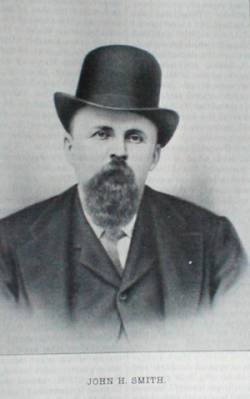
CAPTAIN JOSEPH F. SMITH
Captain Joseph F. Smith, who has been a vessel owner and master on the lakes for many years, was born in Dumfries, Scotland, January 18, 1847, and possesses many of the sturdy Scottish traits of thrift and industry. His parents were James and Jeanette (Larmont) Smith, whose marriage ceremony was performed in Dumfries. Grandfather Smith was a stockraiser in Galway, and Grandfather Larmont was a slave owner of Plymouth, Island of Tobago, where he died of yellow fever. After his death his wife returned to Scotland for the purpose of educating her children, leaving a valuable estate in Tobago, of which they were finally dispossessed in some mysterious way. Early in 1853 Captain Smith's parents decided to come to America, and went to Liverpool, taking passage out of that port in April, on the new full-rigged ship Clara Symes, of Quebec, Canada, and having good weather on the voyage. By boat they went up the St. Lawrence river to Hamilton, where they were supplied with teams to carry them to London, Ontario, making their home there for a time while the father worked at his trade as a ship carpenter. He also assisted in the construction of the Royal Exchange building in that town. In the meantime the mother and children were helpful, being enterprising and industrious, and soon paid for their homestead by engaging in the dairy business. Two years later they traded this property for 100 acres of land in the township of Nissouri (sic), on the river Thames, which they cleared and cultivated for some years. On selling this place they removed to the town of Huron, where another fine property was purchased and cleared up. It was in 1864 when the last farm was sold to Capt. John McKenzie, of the schooner Comet, that the father and son took passage on the Buffalo, under Captain McIntosh, for Chicago, followed by the rest of the family the next spring in the propeller Niagara. When off Bois Blanc island the Buffalo collided with a schooner and had a hole knocked in her starboard bow, through which she began to fill rapidly. The captain ran her ashore, and after some delay her seventy passengers were transferred to the propeller Antelope and taken to Chicago.
On reaching Chicago the father secured a contract for driving piles for docks from Ruch street to Clark street bridge, at which work Joseph helped. Before the completion of the contract, however, the son shipped on the propeller Montgomery as a deck hand, closing the season on the steamer Union.
During the season of 1865 Captain Smith gained experience as seaman in the D. O. Dickinson with Capt. Loudon; in the sloop Rowena with Captain J. McLean; in the schooner Dutton; brig Young America; schooner E. M. Peck; as wheelsman in the Fountain City with Capt. Welsh, closing the year in the steamer Barber as wheelsman. In the spring of 1866 the Captain and his brother James purchased the schooner Garibaldi, Joseph going as mate. He sold his interest to his father that fall and shipped in the Young America until the close of navigation. The next season he shipped in the schooner Traveler, closing the season in the scow L. Painter, before the mast with Capt. C.O. Inghram.
The Traveler was lost on Lake Michigan some years later with all hands. In 1868 he entered the employ of George Hannahs, at South Haven, Mich., and remained with him two seasons. In 1870 Captain Smith built the schooner O. Shaw, brought her out May 16, sailed her successfully two seasons then sold his interest. The next season (1871) he purchased an interest in the schooner Garibaldi, and went as master on her. Shortly after the great fire in Chicago he sailed her up the river in the wake of the schooner Ida Keith in tow of a tug, to above Lake street, the bridge at that crossing being burned. In the spring of 1872 he again entered the employ of Mr. Hannahs and shipped in the schooner Marvin Hanna, afterward in the scow South Haven, was soon advanced to the rank of mate, and that fall, when the captain retired, was appointed master. In the spring of 1879 Captain Smith bought the schooner Minnie Handy, and used her in the fruit trade on the east shore of Lake Michigan two seasons, after which he sold her and assumed command of his fathers schooner, the William Smith, one season. In 1882 he built the scow Charley J. Smith, brought her out new, and sailed her five seasons in the lumber and general merchandise trade. He sold her to H. W. Sweet, of South Haven, and the next season bought and sailed the schooner Lenn Higbee. In 1887, in partnership with D.R. McCrimman, he engaged in the grocery and lumber business, conducting that two years. In the fall of 1888 he sold the schooner Lenn Higbee to William Smith, and bought his partner's interest in the lumber business. In 1888 he built the schooner H.M. Avery, continued in the lumber business and that fall laid the keel of the steamer Myrtie M. Ross, taking Volney Ross as a partner. In the fall of 1890 he lengthened the steamer by twenty five feet, and has since sailed her in the lumber and fruit trade up to the present time, with the exception of the year 1897, when he purchased an interest in the passenger steamer City of Grand Rapids and sailed her. He bought his partner's interest in the Myrtie M. Ross, in 1896, and is now the sole owner. He is the founder of the Fruit Growers line, and made seventy-two trips in the fruit trade in 1896. He also founded the South Haven & Chicago line with the stock company of Grand Rapids, forming a stock company of which he was manager during 1897 and vice-president in 1898. The company was incorporated in Michigan and the stock holders are A.B. Richards, J.J. Coleman, W.G. Tait, A.W. Herman and Joseph F. Smith. Socially the Captain is a member of the Independent Order of Odd Fellows and of the Knights of the Maccabees.
In September, 1869, Captain Smith was married to Miss Margaret Swayles, of South Haven, Mich., and the children born to this union are: Annie, now the wife of A. W. Herman; Ida, wife of J.C. Williams; Frank, who was mate with his father when the Myrtie M. Ross was burned at the dock in South Haven, and who lost his life in his heroic efforts to extinguish the flames; and Clarence B., now wheelsman in the Myrtie M. Ross. For his second wife Captain Smith married Miss Alice, daughter of Robert Howard, of South Haven. Besides his vessel property, the Captain owns a beautiful home in South Haven.
CAPTAIN P. SMITH
Captain P. Smith was born in County Cavan, Ireland, in 1827, a son of John and Catherine R. Smith, and unites in his individuality the blood of the Osbornes and Sheridans. His parents emigrated to the United States in 1836, and on his arrival in this country the father purchased a number of horses and drays, and engaged in teaming. In 1840 he bought a farm a mile and a half southeast of Newburg, where the family remained six years, returning to Cleveland in 1846.
Patrick Smith’s opportunities for attending school were limited to a few years, but his innate shrewdness and faculty for good management have brought him a high degree of prosperity and the esteem of his friends and associates. On looking back over his boyhood days he finds that almost all of his schoolmates and early playfellows have passed to the grave. In 1847 Captain Smith bought a pile driver and embarked in business for himself. He purchased a dredge in 1848 and was then prepared to do contract work both for the city and government. In 1849 he extended his operations by purchasing stone quarry property at Independence and Amherst, which he worked with good results. In 1873 he started the tug line known as Smith’s tug line, now conducted by his sons, L.P. and J.A. Smith, put up an office at Main street bridge, and operated the tugs L.P. Smith, Belle King, Shoo Fly and Maggie Sanborn. In 1874 he occupied an office on Front street, overlooking the lake, and added the tugs James Amadeus, Mary Tuttle and S.S. Stone to his marine property. In 1878 he built the tug Peter Smith, and in 1879 added the H.N. Sprague, which was lost on Long Point; she split her stern post and when beached listed toward the sea and was torn to pieces by the waves. In 1880 Captain Smith built the Patrick Henry and in 1884 he purchased the Gates. The following year he retired from the active management of the business, transferring it to his sons, although he kept a fatherly supervision over it. Subsequent to the transfer, however, Captain Smith added the schooners Selkirk, Hinckley, the noted Colonel Cook (whose bones now lie on Avon Point), and the H.P. Baldwin, and the new steamers Margaret Olwill and J.H. Farnan to the vessel property of the line, and in 1896 the powerful tug Chauncey Morgan was purchased.
Captain Smith is particularly known for his sterling integrity and business qualifications. What he performed was always thoroughly done. While in active business he was always very tenacious of his reputation for fidelity to engagements of all kinds, suffering nothing to deter him from keeping an appointment or agreement. He is a strong believer in the duty and dignity of labor, and always sympathizes with the industrious poor, often helping them out of pecuniary difficulties, and his circumstances are such that he has also been enabled to help his Church with a free hand. He possesses a warm heart and a generous disposition, and is very careful never to wound the feelings of any one, and his counsel and advice are sought by many. Religiously he is opposed to dissipation in any shape.
Captain Smith was united in marriage to Miss Margaret Olwill, on October 26, 1850, and they had four children — Louis P., James A., Estelle G. (now Mrs. James Canalle), and Augusta S. (now Mrs. James Spankle). In 1888 Captain Smith married his second wife Miss Mary F. Burns. The family residence is at No. 224 Washington street, Cleveland, Ohio.
CAPTAIN P. C. SMITH
Captain P.C. Smith has evidently the energetic Scotch blood of his paternal ancestors in his veins, which combined with the fine qualities of mind inherited from an American mother has made him very successful in his business life. Captain Smith was born in St. Clair county, Mich., May 1, 1844, son of Peter and Sarah (Cross) Smith. The father, who was born in Glasgow, Scotland, was a millwright by trade and constructed various mills in and about his native city. In 1842 he brought his family to the United States, locating in Clair county, Mich. In 1852 he went to West Bay City, where he built a mill which was operated under the firm name of Moore, Post & Smith, and in 1857 he removed his family to that place. Prior to that time his son P. C. Smith, had acquired a liberal education in the public schools of St. Clair, and he commenced to work in the mill with his father, continuing thus about four years, during which time he accumulated funds sufficient to start in life on his own account.
Captain Smith first purchased an interest in a steam ferry plying on the Saginaw river, and after sailing in her two years, sold out and applied for an received master's papers, purchasing the steamer Wave, which he sailed about six years, engaged in towing logs on the lakes and rivers. She was destroyed by fire in 1874, and he then stopped ashore and engaged in looking after the interests of the mill until the spring of 1877, when he purchased the tug Sol S. Rumage, which he sailed. The large lake tugs Ella Smith and Peter Smith next came into his line by purchase and these he sailed in the raft-towing business. The Peter Smith has an interesting history; she was built in Scotland in 1863 and put into the commission as a blockade runner by the Confederates during our Civil war, making a successful run into Wilmington, N. C., but was captured by one of the Union gunboats in an attempt to run the blockade with a cargo of cotton. In 1866 her name was changed to little Ada and she was transferred to the lakes and used as a lake survey steamer. After some service in her new waters the Government sold her to Capt. Peter Smith, the father of our subject, and her name was again changed to honor her new owner.
In the fall of 1887 Captain Smith entered into partnership with Capt. Benjamin Boutell, and the next spring they engaged actively in the raft-towing business, each enjoying an equal interest in the enterprise now known as the Saginaw Bay Towing Company, which has a fleet of eighteen of the finest tugs in any waters; this association has continued up to the present time. Captain Smith also owns individually the steamer Minnie E. Kelton and the schooners Allegheny and Active. None but those conversant with the magnitude of the lumbering operations on the American lakes can comprehend the greatness of this enterprise, or the energy, force and daring necessary to conduct it successfully, as do Smith & Boutell. But his interests in this line claim only a portion of Captain Smith's time. In 1883 he established a general store and coal dock in West Bay City, in which branch he now has a large growing patronage and he is also largely interested in a match factory and a stave and heading mill at Goodwin, Mich., as well as numerous other industries.
As will be observed from the foregoing, Captain Smith ranks deservedly as one of the most enterprising and public-spirited citizens of West Bay City. Few men are more widely and favorably known through the Saginaw valley, for his integrity and character and courteous address have made him a prominent figure wherever the demands of business or calls of social life require his presence. While a strong partisan he is not an office seeker, and on the only occasions on which he has been before the public as a candidate he has had the rare pleasure of being nominated by both political parties, serving his constituents four years as trustee, and as alderman five years. He brought to the administration of municipal affairs that same determined will, sterling principle and shrewd appreciation of men and events which have so eminently characterized his conduct of private business matters, and he has rendered valuable service to West Bay City. The Captain is preeminently a successful man, and he has amassed considerable wealth in the conduct of extensive business interests to which he has always given his attention. Socially, he is a prominent thirty-second-degree Mason, a member of the Commandery, and a Noble of the Mystic Shrine.
In August, 1865, Captain Smith was united in marriage with Miss Sarah, daughter of Thomas and Nancy S. Orton, of New York State. They have one son, Capt. Charles O. Smith, who has always from boyhood been around the vessels owned by his father. He sailed the schooner yacht Hector two seasons, and in the spring of 1895 was appointed master of the schooner Allegheny, sailing her three successive seasons. In the spring of 1898 he applied for and received first-class pilot's papers, and has been assigned as mate to the steamer Traveler, of the Saginaw Bay Towing Company. The family residence is a handsome structure on Midland avenue, West Bay City, surrounded by spacious grounds.
SAMUEL SMITH
Samuel Smith, first mate of the Chicago, is the second of five sons born to James and Annie (Nelson) Smith, of County Down, Ireland. The other sons at present reside with the parents, who are farmers, in their native place.
Samuel was born November 9, 1866, attended school and did chores around the place of his birth until about fourteen years old, at which time he started to work in a tailor shop. He was thus engaged for two years, after which he had charge of a general store, resigning that position after three years and emigrating to the United States by way of Canada, settling in Buffalo, N. Y. In the fall of 1885 he commenced steamboating, firing on the Nyack, and he was subsequently on the China and India, in a like capacity, for a season each. In 1888 he was lookout on the Gordon Campbell and 1889 on the Annie Young. The following season, 1890, he wheeled on the Winslow, on which he continued part of the next year, leaving her after six years of service in the Anchor line to finish the season as lookout on the Chemung, one of the Erie railroad's fine new passenger boats. For the succeeding season he was lookout, wheels-man and second mate of the Vanderbilt, of the Western Transit line, in 1894 going onto the Mohawk as second mate, and holding that berth three seasons, until he was promoted to first mate's berth on the Chicago. Here he served for the season of 1897, thus rounding out six seasons of service in the Western line.
During the winter of 1890 Mr. Smith paid his parents a visit, spending four months on his native soil. He was married, January 9, 1895, to Miss Maggie Collins, of Ireland, and they have one son, William James, aged two years. Mr. Smith is a member of Branch No. 8, M.E.B.A., and of Division No. 1, A.O.H. The family reside at No. 393 Elk street, Buffalo, New York.
CAPTAIN WILLIAM H. SMITH
Captain William H. Smith, a master mariner of quiet and courteous demeanor, who gives one the impression that he is a man of great reserve force and energy in emergency, was born in Marine City, Mich., November 30, 1864. His parents A. C. and Martha (Bury) Smith, were both natives of Sombra, Ont., the grand-parents being early pioneers and farmers on the banks of the St. Clair river in that region.
Captain Smith received a liberal education in the public schools of Sombra, and in the spring of 1879 decided to change his mode of life from the farm to the lakes, getting a preliminary experience on the St. Clair river in the ferry steamer Scoville, plying between Sombra and Marine City. In 1880 he shipped as fireman on the passenger steamer Hattie, plying between Fairhaven and Detroit. The next spring he joined the tug W. B. Castle as watchman, and remained on her three years, the last two as watchman. In 1884 he shipped as wheelsman in the steamer Burlington. The next spring he came out as wheelsman in the Don M. Dickinson, but closed the season in the lake tug Admiral D. D. Porter. In the spring of 1886 he joined the tug W. B. Castle as wheelsman, but closed the season as mate of the tug Kittie Haight.
It was in 1887 that Captain Smith took out his first papers as pilot, and was appointed master of the tug O. W. Cheney. In 1888 he entered the employ of Captain Grummond as master of the lake tug Oswego, transferring to the Wm. A. Moore before the close of the season. The following spring he brought out the tug George N. Brady, but closed the season in the W. B. Castle, and in the 1890 he took command of the wrecking tug Henry Howard. This experience with large tugs proved of great value to the Captain, and after sailing a season as mate of the steamer Masabaa, he was appointed as master of the steamer S. C. Clark. She was destroyed by boiler explosion and fire near Sanilac, Lake Huron, the next year, the crew being rescued by the steamer Kaliska. In the spring of 1894 Captain Smith was appointed master of the steamer Wm. H. Barnum, closing the season as mate of the speedy little passenger steamer Unique, plying between Port Huron and Detroit. In the spring of 1895 he assumed command of the steamer Raleigh and sailed her two seasons. He then entered the employ of Capt William Mack as master of the steamer George W. Roby, transferring to the Pascal P. Pratt, and sailed her until the present writing. During these years the captain has proved himself an accomplished steamboat master, and has never found the bottom with any of these vessels, nor lost a man. He was instrumental, however, in rescuing a crew of twelve from the steamer Florida, which sunk in twelve minutes off Presque Isle. He has twelve issues of license.
Socially the Captain is a Royal Arch Mason of Sam Ward Chapter No. 128, and a Master Mason of No. 162, Marine City, Michigan.
On February 23, 1888, Capt. W. H. Smith was wedded to Miss Lily, daughter of Capt. Richard and Helen (Marsh) McDougall, of Detroit, Mich. The children born to this union are: Helen Florence, Lewis, Marie Catherine and Dorothy. Captain McDougall was an old-time master, and owner of vessels away back in the 'forties, among them the Jones and the Mary Amelia. The family homestead is in Marine City, Michigan.
CAPTAIN JAMES SNOW
One of the oldest shipmasters, whose life has been spent on the Great Lakes, is Capt. James Snow, whose name appears at the opening of this sketch. For many years he acted as builder, owner and master, and as soon as one vessel was sold, another took its place, so that he has remained constantly in the business in some way over sixty years. He was born September 25, 1823, in Erie county, Penn., and resided in his native place about twenty-one years. At the age of twelve years he went on the schooner Conneaut Packet, where he remained throughout the season as cabin boy. He then shipped on the Savannah, and later on the T. W. Morris as boy, and spent the season of 1837-38 on the brig Ruggles. When he left this boat he went to Boston and shipped on the John Redding, visiting the West Indies, and South America, remaining on her about two years. Upon returning to the lakes, in 1841, he shipped before the mast on the Brandy Wine. In 1842 he served in the same position on the Navigator, and then acted as mate, and finally as master of the same vessel. After being a short time on Big Z he bought the Navigator and sailed her until 1846, after which he built the Telegraph and sailed her until 1850. After sailing the schooner Henry Hazer and the steamer America, he bought the brig Bell, with Thomas Dyer, of Chicago, and commanded her until 1853, when he sailed the steamer Hendrick Hudson until October of that year. He then built the schooner Gem, and upon making a trip to Chicago in her, he sold her and obtained a contract to build two more of a like character.
The following winter he superintended the building of the Chapman and Maple Leaf, and in 1854 the Autocrat and Grand Trunk. He sailed the Autocrat two years and sold her, after which he built the Nightingale, which he sailed part of one season. He sold her in 1856 and sailed the Portsmouth, in the interest of the New York & Erie railroad, connecting with the Michigan Central, when he sailed the steamer Adriatic one season, and then built the tug Noah P. Sprague, and came to Detroit, engaging in the towing business until November 14, when the boiler blew up and killed all on board but himself. He then went back to the Adriatic for the season, when the Sprague was raised, and he rebuilt and sailed her. After but a short time on this boat, he left her and went into the grocery business in Detroit, and there remained until 1861, when he shipped on the Evergreen City, after which he was on the Cuyahoga and Equinox, leaving her to go in the insurance business in Buffalo. Upon returning to the lakes he sailed the B. F. Wade, T. D. Doyle, tug Winslow, Brady, Huron, Marine City, Dunlap, Monitor, Wood, Bennett and Alpena, being engaged in wrecking the schooner Consuelo in 1885. In 1886 he rebuilt the Eighth Ohio and sailed her three years, after which he came to Detroit and engaged in the coal business, which he continued until 1895, when he retired.
September 25, 1845, he was married to Miss Harriet Tubs, who died in 1850. Their children are James, who is a traveling man, and Charles, who is a yardmaster at Dayton, Ohio, for the Chesapeake & Ohio railroad. On August 13, 1873, Captain Snow was again married, this union being with Josephine Terrill, of Detroit, and he resides at No. 269 Twenty-first street, Detroit.
J.O. SNYDER
J.O. Snyder, of Detroit, Mich., at present employed in fitting out boats for the well-known vessel firm of Parker, Millen & Co., of that city, was born in Bavaria, Germany, in the year 1850. Mr. Snyder was raised and educated in his native place, and when he first started to work went to sea on the North German Lloyd steamer city of Bremen. He was firing on the Bremen for eighteen months, and then left the sea for the Great Lakes. He lived for several years in Clayton, N.Y., and while there became a naturalized citizen of the United States.
Mr. Snyder's first season on the lakes, that of 1870, was spent on the Lake Ontario tug Nelson Summer, on which he was employed as fireman. He then entered the government service, and for three years was firing on the United States survey boat Ada. Leaving government employ. He was engaged by the Detroit, Belle Isle & Windsor Ferry Co. as second engineer of their new ferryboat Excelsior. On her he remained two years, and then went on the steambarge Alpena as second engineer during the next season. He was also second engineer of the steambarge Alcona for two seasons, and left to be chief engineer of the steamer Germania, owned by McClaren & Co., of Toledo. He was on the Germania two years, and then returned to the Alcona as chief, in which capacity he served four consecutive years. He then entered the employ of Parker, Millen & Co., and has been with them the past nine years or so. During his first season with that firm he was chief engineer of the Iron Chief, and for the four following seasons was chief of the Iron King. During the last four years he has been engaged in repairing and fitting out boats.
Mr. Snyder is married, but has no children. He has been a resident of Detroit for the past nineteen years.
OLIVER J. SOLEAU
Oliver J. Soleau, a master mariner, who has had command of lake vessels, both steam and sail, for many years, is of French descent, and numbers in his immediate family a grandsire, sire and four brothers who took honorable part in the American wars.
A son of James J. and Emily (LaCroix) Soleau, he was born October 9, 1859, in Monroe, Mich., which was also the birthplace of his parents. His grandfather, Tousaint, came to the United States previous to the war of 1812, locating at Monroe, Mich., and saw active service in the ranks of the United States infantry during that stirring period. The father, James J., was first lieutenant of Company E, Eleventh Michigan Cavalry, and served throughout the Rebellion, being a portion of the time in General Stoneman's division. At the close of the war he returned home, but soon died from the effects of the hardship and exposure while in the service. His brother, Adrian C., who died at Knoxville, Tenn., was also in the Eleventh Michigan Cavalry, and was promoted to the rank of second lieutenant. They participated in sixty cavalry engagements, the most important being at Pound Gap, Ky., and several fights while on a raid under General Stoneman and Burbridge in Kentucky and West Virginia, at Mt. Sterling and Saltville, Piketon, Jonesboro, and on the Big Sandy river in Kentucky; also at Cobbs Ford, Bristol, Wytheville and Morristown, Va.; Boone, Salisbury and Sawanoa Gap, N.C.; Caesar's Head, Picksville, and Anderson, S.C. The Eleventh was consolidated with the Eighth Michigan Cavalry July 20, 1865, and were mustered out September 22, 1865. Two other brothers, Francis and Henry enlisted in the Fifteenth Michigan Infantry, the former being a major and the latter a sergeant. They first met the enemy at Pittsburg Landing, under Gen. U.S. Grant, April 6 and 7, 1862, the regiment losing two officers and thirty-one men killed, sixty-four wounded and seven missing. The other engagements in which they participated were Farmington, the sieges of Corinth, Iuka, Vicksburg, and Jackson, Miss.; Resaca, Big Shanty, Kenneshaw, Ga.; Decatur, Ala.; siege of Atlanta; Jonesboro, Lovejoy Station, Clinton, and Fort McAllister, Ga.; Orangeburg, Congaree river, Saluda creek, and Columbia, S.C.; Fayettville and Bentonville, N.C., having had the honor of marching with General Sherman to the sea. Francis was once wounded. Tousaint, another brother, was qualified as sutler of the regiment.
Capt. Oliver J. Soleau, the subject of this article, received a liberal education in the public schools of Monroe, Mich., which he attended until he reached the age of fifteen years, and during the winter months, even after he had begun his marine career, which took place on the schooner O.L. Frick, in the year 1875; and after coming out on the same schooner the next spring he transferred to the schooner Harriet Ross, known, in 1813, as one of Commodore Perry's war vessels, closing the season before the mast on the schooner Miami Belle; also sailed on the George S. Hazard, Elizabeth Jones, Melvin S. Bacon, E.A. Nicholson, Wabash, Mays, E.R. Williams, John Wesley, Columbia and Adventure.
In the spring of 1880 Captain Soleau was appointed mate of the schooner Walter A. Oades. While lying at anchor off Port Huron the Anchor line steamer Chicago ran into and sunk her, without loss of life, however. He closed that season on the schooner A. Boody, before the mast and as second mate. The next year he joined the schooner Brooklyn as mate, and in the spring of 1882 came out as second mate on the Reuben Dowd, closing the season on the S.V.R. Watson. In the spring of 1883 the Captain got his first vessel to sail, the bark Waverly, and since that time has had an uninterrupted run of success as master. His next command was the schooner Consuelo, after which he was in command of the Genesee Chief in 1885, the Fannie Neil in 1886, Genesee Chief again in 1887, and in the spring of 1888 he was appointed master of the schooner Bay City, sailing her two seasons. In 1890 he took command of the schooner Porter, and sailed her four consecutive seasons. Captain Soleau then turned his attention to steam, and after sailing the Raleigh one season, was appointed master of the steamer Veronica, which he has sailed with good business success for four seasons, including that of 1898.
On January 16, 1895, Capt. Oliver J. Soleau was wedded to Miss Cora E. Murdock, of Ypsilanti, Mich. The family homestead is No. 329 Locust street, Milwaukee, Wis., where the Captain has erected a new house.
CAPTAIN WILLIAM H. SOLMES
Captain William H. Solmes, master of the steamer Corona, one of the fine vessels belonging to the Niagara Navigation Company, of Toronto, is a sturdy lake sailor of the best type. He was born January 16, 1850, in the township of N. Marysburgh, Prince Edward County, Ontario, and he still resides at the old homestead in that country, that valuable holding having become his own.
The Captain secured a solid education in the public schools of his native country, and early took to the water, his first venture on the lakes being as cook in a Canadian schooner trading principally on Lake Ontario; this was in 1863. For three years he had charge of the galley, and it is a good voucher for his ability as a chef that neither the captain nor any of the crew during those years suffered any indigestion or dyspepsia. Later he shipped before the mast and eventually became mate on several schooners, sailing until 1873, when he abandoned the lakes for a couple of years. In the year 1866 he was with Captain Taylor, of Kingston, the present inspector. Until 1875 the Captain was in California and Nevada, where he held a position with Mr. John McKie in the Hale & Norcross mine; coming back to Canada, he resumed sailing in that year and continued for a time in different schooners, finally transferring to steam vessels in the Montreal trade. In 1876 he was on the steamer Alexander, succeeding which he was mate of the propeller Oswego Belle, and for eight years following he was mate of the steamer Empress of India, leaving her for his first command, the steamer Rothsay. He was next on the steamer Merritt, and subsequently he took charge of the steamer Empress of India, sailing between Port Dalhousie and Toronto in the passenger and fruit, carrying trade. Leaving her he went into the employ of the Niagara Navigation Company, in command of the Chicora, plying between Niagara Falls and Toronto. When this company built the new steamer Cobila he was put in command and sailed her two years, until she burned in Lewiston in 1894. The following season the company had the steamer Corona constructed and Captain Solmes has been captain ever since she was launched in 1895.
JOHN B. SOUTER
John B. Souter, who is of Canadian-French extraction, was born at Buffalo, November 27, 1847. His father, from whom he was named, was an engineer by trade, and died many years ago.
The subject of this sketch has always had a sort of a natural inclination for mechanics, and has substantially been an engineer all his life. He had no schooling whatever, and he has had to battle against poverty and ill-fortune from the time he was very young. He learned his trade by taking advantage of opportunities to observe and study machinery while on short trips with friends who were engineers on sailing crafts on the lakes, before he was old enough to commence the work of his practical life. He began as fireman on the Franklin, a small harbor tug, upon which he worked a couple of months, and then became an engineer, engaging in that capacity continuously on Buffalo harbor tugs for a period of thirty-six years, and he is now the third oldest tug man about Buffalo harbor, David Hazen being the oldest and Eli Schriver next. In 1883 he was made master and pilot, and since that time has alternated as master and engineer of various tugs and excursion boats in the harbor and on Niagara river. In 1885 he bought an interest in the tug Oneida, but sold it at the end of that season, the following season purchasing the tug J. F. Behn, of which he has been master and owner continuously until the present time, until 1897 when she was abandoned, and in 1897 he built the Queen. Mr. Souter has been master, engineer, and owner of tugs and excursion boats in and about Buffalo harbor for about thirty-six years, as above related. In addition to his many misfortunes resulting more from his unfavorable environment in his early life than from any lack of energy and pluck, for he has plenty of both, he lost his left arm about thirty years ago, while engineer of the tug Daniel Boone, later known as the Post Boy, and owned by Eli Schriver. The sleeve of his flannel shirt was caught in and suddenly drawn with his arm into the machinery, both being cut off about half-way between the shoulder and elbow. This accident has been the means of preventing him from filling important positions in the line of his trade as engineer, though he could always obtain a position on a harbor tug. When Robert Learmonth, chief engineer of the Anchor line, was local inspector of engineers in 1882, he withheld Mr. Souter's engineer's papers for thirty days, holding that Mr. Souter was not competent because of the loss of his arm; but the latter finally gained his point and resumed his former occupation. He became a member of the I. O. O. F. about 1892, of the K. of P. in the same year, and was a charter member of the Buffalo Harbor Tug Pilots Association, of which he was also the first treasurer.
Mr. Souter was married at Buffalo, in 1871, to Miss Kittie Columbus, a daughter of Alexis Columbus, now 108 years of age, of whom mention is made elsewhere. They have three children, viz.: Eli R., a marine engineer by trade, born in 1871; Clara, born in 1873, wife of Albert Rebadow, employed as a store-keeper for the firm of Dwyer & Huntington, stone dealers near Rockwood, Penn.; and Robert Fulton, born in December, 1890. This young gentleman was the hero of a liberty pole and flag raising event which took place under the auspices of his father on the 4th of July, 1894, on the Terrance in Buffalo. The old pole owned by the city had been struck by lighting, and Mr. Souter, at his own expense, raised another in its place; his son Robert raised a United States flag upon it that the father had made in New York City for that sole purpose. The young man has lately been made the owner of an admiral's uniform in miniature, which well becomes him, and he is recognized by the Grand Army all over the country. Mr. Souter had two uncles who served their time on the lakes as fireman and deck hands, and would undoubtedly have made their way up in their chosen occupation had they not enlisted in the Civil War, in which they lost their lives. As an evidence of his patriotism it may be mentioned that Mr. Souter sent bales upon bales of lint to the army at his own expense for the use of the wounded. It was in 1862 or '63 that he lost his arm, and had it not been for this he would have been in the service. He is one of the self-made men of the harbor men of Buffalo.
LOUIS SOUTER
Louis Souter was born in Buffalo December 24, 1853, and was educated in the public schools of that city. His mother died when he was about two weeks old, and his father, John B. Souter (who was a Frenchman by birth), having gone away when Louis was quite young, he was brought up by relatives; as a consequence he was compelled to earn his living the best way he could and with a very meager education to start with.
Mr. Souter's first employment was as a carpenter in David Sutton's shop, where he worked about five years. In 1867 he began his connection with marine work as fireman on harbor tugs, and was thus engaged for a period of about ten years, in the various tugs belonging to Maytham's and Hand's lines. From 1877 to 1889 he was employed as engineer on harbor tugs, and on March 15 of the last mentioned year he became engineer of the tug Arthur Woods, owned by Hingston & Woods, being still with her at the close of the season of 1896.
On January 15, 1874, at Buffalo, Mr. Souter married Angeline Columbus, and they have two children, viz.: Louis, Jr., and John E.
Angeline Columbus, above mentioned, is a daughter of Alexis Columbus. This gentleman was born in Quebec, Canada, November 2, 1789 and on January 8, 1897, he was still living, in his one hundred and eighth year, at the house of his son John, No. 102 South Park avenue, Buffalo.
He is a descendant of the famous discoverer of America, and was a visitor to the World's Fair at Chicago in 1893. While living in Canada he farmed for a living, and followed the same occupation after his removal to Buffalo in 1843. He was married in Quebec, to Parmelia Daire, who was his life companion until a few years ago, when she died, and it is only since her death that he has given up his farm life. When Mr. Columbus first came to Buffalo he bought woodlands in the vicinity of what is now known as Columbus Place, but was formerly White's Corners Plank Road. Columbus Place cuts through what was formerly his homestead. He speaks Canadian French more fluently than English, though he talks the latter very well. He has always smoked tobacco of his own raising. His hair has been white for many years, but is still abundant, and he has all of his teeth but one. His trip to the Fair was much more tedious than he expected, because, in addition to the fatigue caused by the tedium of the journey and the exertion of getting about, he was besieged by newspaper men for his history, and he was glad to return at the end of ten days, fearing that he might end his existence away from home.
Mr. Columbus reared a family of eleven children, four sons - two of whom are dead - and seven daughters. Those still living are named as follows: John, who keeps a saloon at No. 702 South Park avenue; Peter, a carpenter by trade, who lives at No. 704 South Park, avenue; Kittie Souter, wife of John B. Souter, No. 401 Massachusetts avenue; Angeline Souter, wife of Louis Souter, No. 170 Church street; Elizabeth Baker, Rosa Suor and Jennie Jones, all of whom live at Joliet; and Josephine Fleming, who resides at Ogdensburg.
JAMES A. SOUTHGATE
James A. Southgate, one of the prominent engineers sailing out of Port Huron, and an honored member of the association, was born at Penarth, Wales, in November, 1857, the son of Henry and Mary A. (Lewis) Southgate. His parents dying while he was but a small lad, he went to live with his uncle, James Lewis, who looked after his education, which was acquired at Bristol, England. He came to America with his uncle, landing at Quebec, where they remained a short time. Business affairs called Mr. Lewis to the West in 1871, and they took passage on the Chicago & Northwestern rail-road to Tip Top, which was then the terminus of that road. On their return, they located at Orrilla, Canada, where Mr. Southgate went to work with his uncle, to learn the plasterer's trade, serving an apprenticeship of three years. In 1875 he entered the employ of Tudhope Brothers, and learned the hardware business, remaining with that firm three years. In the winter of 1878-79 he went with a Canadian Government survey party on free grant lands in Northern Canada, their duties taking them as far north as Lake Nipissing, or Height of Land.
In the spring of 1879 Mr. Southgate came to the United States, locating at Port Huron, Mich., out of which port he shipped on the steamer Sanilac, as fireman; he remained on her two seasons. During the season of 1881 he fired on the steamer Maine, following with a season on the Henry Howard in the same capacity. In the spring of 1883 he took out a marine engineer's license, and was appointed second engineer of the laketug River Queen, the next season serving as second on the James Reed. During the two seasons he was on the large wrecking tugs William A. Moore and Martin Swain many difficult jobs of wrecking were performed successfully, among which was the release of the steamer Albany, ashore at Bois Blanc island. His next berth was that of second engineer on the steamer Nelson Mills, but in July he was promoted to the position of chief engineer, and continued in charge of her machinery for six consecutive seasons. In 1891 she struck a rock in Lake Michigan and sunk, the crew being picked up by the passenger steamer Hunter; the Mills was raised and repaired. During the seasons of 1894-95 Mr. Southgate was chief engineer of the steamer S. C. Hall, and in the spring of 1896 he shipped with Capt. William E. Rice as chief of the steamer Rhoda Stewart, on which he has since been retained. On May 23, 1896, one of the flues in the boiler of the Rhoda Stewart collapsed, scalding three men to death. Mr. Southgate had turned in off watch and the circumstance saved his life.
Socially, Mr. Southgate is a member of the Marine Engineers Beneficial Association, in which he has filled the office of recording secretary six years, and corresponding secretary one term. He is also a member of the beneficial orders of the Royal Arcanum and Maccabees. On April 14, 1880, he was united in marriage to Miss Mary E. Oag, daughter of James and Mary A. (Jordan) Oag, of Hamilton, Ontario. Their children are Albert E., James E., William R. and Blanche E. The family reside at No. 1911 Seventh street, Port Huron, Michigan.
GEORGE J. SPAULDING
George J. Spaulding, the well-known chief engineer of the Wells & French Car Works, at Blue Island avenue and Paulina street, Chicago, is a native of New York, born in Bath, Steuben county, October 15, 1847, and is a son of David and Paulina (Otto) Spaulding, the former a native of Massachusetts, the latter of Ontario county, N. Y. The father was a machinist by trade and owned a small shop, which he enlarged as his business increased. He died in the Empire State, but the mother passed away at the home of our subject in Grand Rapids, Michigan.
George J. Spaulding passed his boyhood and youth in New York, acquiring his education in the public schools of the State. Learning the machinist's trade, he went to Fitchburg, Mass., at the age of twelve years and entered the machine shops of S. C. Wright & Co., with whom he remained for three years. He was next with John Evans, of Philadelphia, for a time, and then entered the employ of the Baldwin Company, where he aided in building twelve engines and for whom he took three engines to Detroit. From there he went to Buffalo, N. Y., and after a time spent in the Buffalo Machine shops he became identified with the lakes.
In 1875 Mr. Spaulding accepted the position as engineer of the tug Indian Chief, owned by a Buffalo party, and when she was sold and conveyed to Detroit he remained on her for one season. He was then assistant engineer on the E. B. Ward, of the Ward line, for part of a season, but finished on the Flora, engaged in passenger service. That fall he entered the employ of the Dry Dock Engine Works of Detroit, where he remained for two seasons, and then went to Grand Haven, Mich., during the winter and fitted out the barge Shepherd, going as her chief engineer the following season. That fall he went to Kalamazoo, Mich., where he held the position of chief engineer of the Kalamazoo Spring and Axle Works until the following May, when he again sailed as chief on the Shepherd. When she was sold he returned to Kalamazoo, and after spending the winter in the employ of the spring and axle works, he returned to Detroit, where he accepted the position of chief engineer of the Sandusky, remaining on her two seasons. In the meantime, during the fall and winter months, he worked in Detroit as chief engineer for a manufacturing company, and on leaving the Sandusky went to Grand Haven, where he was appointed chief of the Gem, engaged in the passenger trade. In the fall he became chief engineer of the electric light and power plant at Grand Rapids, and after one year in that position, he went to Traverse City, where he fitted out the City of Traverse. He was extra chief for Hannah, Lay & Co., having charge of all their engines for two years, and on leaving that firm went to St. Louis, Mo., where he was engineer for the Diamond Joe line for many years, having charge of the shore work. He was next employed in shops at Providence, R. I., and in the Baldwin car shops for some time, but finally returned to Detroit and took charge of the wrecking floor of the Detroit Dry Dock Company. One winter he had charge of the Busse Machine Works, and as extra engineer was later in the employ of the Graham & Morton line at Benton Harbor, Mich., having charge of their shore works for three years. Coming to Chicago he fitted up different boats and tugs with machinery, and subsequently was employed for some time in refitting tugs and yachts, but in 1894 he accepted his present position as chief engineer of the Wells & French Car Works. He is an honored and trusted employee of the company, and has the confidence and respect of all who know him. Prior to coming to Chicago he was at one time chief engineer of a sawmill at Brainard, Minnesota.
Socially Mr. Spaulding is a member of Eureka Lodge No. 2, K. P., and Prudential Lodge No. 8, I. O. O. F. , both of Grand Rapids; is a charter member of Kalamazoo Lodge No. 8, A. O. U. W., and also belongs to the Improved Order of Red Men at Jackson, Michigan.
Mr. Spaulding was married in Kalamazoo, Mich., in 1873, to Miss Lucy Ball, who was born in that State, a daughter of John and Electa (Beals) Ball, natives of Michigan and Indiana respectively. The father was a well-known lake captain, sailing on the east shore of Lake Michigan in the lumber trade, and in the State of Michigan he died, while his widow still makes her home there. Mr. and Mrs. Spaulding have two children: Berdell C. and Myrtie.
CAPTAIN E. P. SPEAR
Captain E.P. Spear was in command of the Samuel P. Ely in the season of 1896, and is a sailor of long experience and good repute. He is a son of Isaac and Eunice (Smith) Spear, natives of Vermont, the former of whom died in Painesville, Ohio, in 1857, having spent his life as a merchant and also was a justice of the peace, at Fairport, Ohio; the latter died in 1878.
Captain Spear was born June 9, 1831, at Crown Point, N. Y., where he lived only one year,when the family removed to Perry, Ohio, and thence to Van Wert county, Ohio, where his father bought a tract of land, then a dense forest. At this place they lived five years when the father obtained the appointment of lighthouse keeper at Fairport, Ohio. At the age of sixteen Captain Spear began the marine life to which he has since devoted his time. He first shipped on the S. L. Noble as boy, and remained three years, afterward coming on the schooners Troy, Nile, Yankee Blade, Pilot, Mark Sibley, the scow Virago and many others. The following season was spent on the I. C. Pendleton as mate, and afterward he acted in the same capacity on the Ellen White and Industry. As mate he served on the E. C. Roberts, Ellen White and Edwin Harmon, afterward becoming master of the last boat, which he sailed four years. He came on the Presto the following year, and soon after was on the brig Iroquois, Sultan, Massillon, Narangassett, S. H. Kimball, Sandusky, and in 1896 came to the Samuel P. Ely. While mate of the brig Sultan she foundered about nine miles out of Cleveland, September 24, 1864, and all hands were lost with the exception of our subject, who after hanging to the spars for nineteen hours was rescued by Captain McKay, then sailing on the old City of Cleveland.
On December 17, 1856, Captain Spear was married to Miss Sarah Greenhalgh. Their children are: Mary, who is married to Charles Calloway, and resides in Cleveland; and James, who lives on a farm in Mentor, Ohio. The Captain is a member of the Ship Masters Association in Cleveland, and is well known to a large number of marine men, whose lives are connected with the industry of the five Great Lakes.
JAMES SPEARS
James Spears, whose death occurred March 5, 1898, was one of the well-known engineers sailing out of the port of Cleveland. He was a son of Adam and Marion (Sommerville) Spears, both of Scotch birth, and who came to the United States in their youth, locating in Niagara county, N. Y., where they were married. Their children are Robert, James, John, Oliver, Rachel, and Euphemia. Adam Spears, the father, died at the age of eighty years, but the mother, who is seventy-seven years of age, is still living.
James Spears, the subject of this biography, was born near Lewiston, Niagara Co., N. Y., May 24, 1848. During the summer months he worked on the farm with his father, and in the winter attended the district schools until 1860, when he went to Detroit and entered the locomotive works to learn the machinist's trade. In the spring of 1861 he shipped as oiler on the steamer Forest Queen, of the Ward line, and early in 1862 he fired a locomotive on the Flint & Pere Marquette railroad, but finished the year at Saginaw loading vessels. In 1863 he shipped with Engineer James Reed, as oiler, on the steamer Reindeer, which berth he held two seasons, thereby gaining a strong foothold for his engineering knowledge - which served him to such good purpose in later life - under the eyes of that accomplished officer, who so long engineered the fine side-wheel passenger steamers of the Detroit & Cleveland Steam Navigation Co. In 1865 he then shipped on the river tug Stranger, remaining to the close of the season. In the spring of 1866 he took out an engineer's license in Chicago, and was appointed to the tug Oriole, of the Brown-Prindiville line. He began the following season by firing on the Oriole, but finished the year as machinist in the shop of Murphy & Tarrant. In the spring of 1867 he entered the employ of Prindiville & Harmon, with whom he remained for six years.
In the spring of 1874 Mr. Speers went to Muskegon, Mich., as division master of Chicago & West Michigan railroad, and in 1875 entered the employ of Hackley & McGordon, and engineered the tugs Charles Hackley and James McGordon, alternately for five years. In 1880 he went to Fort Howard, Wis., and worked for McDonald & Billings as chief engineer on their tugs, the James McGordon, which he brought out new, and two others, also had charge of the machinery of their sawmill. In the spring of 1881 he went to South Chicago, and was appointed chief engineer of the steamer Massachusetts, of the Inter Ocan Transportation Company, remaining on her two years. In 1883 he went to Cleveland and worked one year in the Globe Iron Works. In 1884 he was appointed chief engineer of the propeller Progress, after which he worked eighteen months in the machine shops of the Cleveland Ship Building Company. In 1888 he was appointed chief engineer of the steamer Maurice B. Grover, and the following season was transferred to the Superior, then, in the spring of 1890, joined the steamer John B. Glidden, as chief engineer, remaining through the season. He passed the next four years in shop work in the Cleveland & Chase machine shops. In the spring of 1894 he was appointed chief engineer of the steamer Olympia. During that fall he contracted sciatic rheumatism, and was compelled to remain ashore the following season. In 1896 he was again appointed chief engineer of the steamer John N. Glidden, which he laid up at the close of navigation. He was the possessor of twenty-nine issues of marine engineer's license, and held a membership in the Marine Engineer's Beneficial Association.
In 1880 Mr. Spears was united in marriage to Miss Jennie De Witt, of Muskegon, Mich. Three children have been born to this union: Marian Rachel, Hazel Euphemia and Ethel Alberta. The family residence is in Cleveland, Ohio.
JAMES SPEIR
James Speir, who has a strong personality, evidences in a remarkable degree his sturdy Scotch ancestry, and has brought into his business, as a marine engineer, many of the peculiar qualities of that nation. He is a son of William T. and Agnes (Caranchael) Speir, and was born December 16, 1846, at Kilburnie, Scotland. His parents being natives of that country, came to the United States in the fall of 1850, locating in Detroit. His father was a licensed engineer who, after working in the Michigan Central railroad shops, shipped on lake steamers, his first boat being the Whitney, followed by the Elliott, Dart, Arrow, Forest Queen, and the boats of the Ward line, in which employ he remained a number of years as chief engineer, his last boat being the H.P. Clinton. Later in life he removed to Bay City and retired from active life on shipboard.
James Speir, the subject of this sketch, received his public-school education in the old Eighth ward of Detroit, attending school until he reached the age of fourteen years. After the family removed to Bay City he went to work in the McDowel machine shop, after-ward working for the McGregors. After working at his trade as a machinist a number of years he became second engineer of the John Ely, Annie Young, new at that time, and tugged some on the Detroit and St. Clair rivers on the Seeley, Ark, E.K. Collins, Despatch and Dart; after which he went to Cleveland and entered the employ of the Smith line as engineer of the tugs Belle King and Old Jack, and was also second engineer of the new steamer George W. Bissell. He then became chief engineer of the new barge Trader and the City of Madison, and was in charge of the tug Houghton at the time the government was cutting the Portage lake canal. At the close of his contract he stopped ashore as engineer of the Huron mines at the Portage. He then became engineer of the tug Alpena, this service being followed by two seasons in the steamer Ontonagon. In the spring of 1881 Mr. Speir was appointed chief engineer of the steamer Mayflower, a position he held three years. He then succeeded to the A.A. Turner, for two years, and was on the steamer D.W. Powers two years, which was followed by two seasons on the Schoolcraft, one on the Kittie M. Forbes, one on the Elfinmere; and in 1891 was appointed chief engineer of the steamer John Spry, an office he has held seven consecutive seasons, laying her up at the close of navigation in 1898.
On December 11, 1871, Mr. Speir was united in marriage to Miss Charlotte Crossey, of Bay City, her family being formerly of Seaforth, Ont. The children born to this union are William, Edward, Mabel, Fred, Burtran and Albert. His first wife died May 10, 1892, and on November 30, 1897, Mr. Speir chose for his second wife Mrs. Mary (Tobin) Neely, of Bay City, Mich. Fraternally he is a member of the Odd Fellows and of the Ancient Order of United Workmen.
C. E. STACY
C.E. Stacy, for many years a prominent marine engineer sailing out of Chicago, is now the efficient and popular engineer at the Lincoln avenue cable station of the North Chicago Street Railway Company, which responsible position he has held since 1889.
Mr. Stacy is a native of Michigan, having been born January 10, 1849, at Port Huron, a son of Benjamin and Christine (Stevens) Stacy, the former of whom was a native of Manchester, England, the latter of Pennsylvania. They were early pioneers of Michigan, where the father opened up and developed a good farm, making his home in that State until 1851 or '52, when he removed with his family to Canada, there passing the rest of his days. He and his wife both died near St. Thomas, Ontario, the father in 1886, the mother five years later. They were the parents of thirteen children, our subject being seventh in the order of birth.
Mr. Stacy, whose name introduces this sketch, was about two years old when the family moved into Canada, where he was reared and educated up to the age of fifteen years, at which time he was sent to Detroit, Mich. Having a burning desire for a life on the lakes, he, in 1867, went on the tug Kate Moffatt, of Port Huron, and sailed out of that port with her one season, then acted as wheelsman. Coming to Chiago in 1868, Mr. Stacy first worked in Robert Tarrant's machine shop, and the following year sailed as engineer from that port on the tug S. V. R. Watson, remaining on her three seasons, or until she capsized in Lake Michigan in 1871. Our subject became entangled in the tow line, but was fortunately soon picked up. For the following six years he was engineer of the tug M. Shields, belonging to A. Burton; was next in the employ of the Vessel Owners Tug line as engineer; later was in the employ of J. S. Dunham, and was afterward captain of the Uncle Sam. In 1889, however, he retired from the lakes and accepted his present responsible position, which he is now so ably filling.
Fraternally, Mr. Stacy is one of the original members of the Marine Engineers Beneficial Association, No. 4, and also belongs to the Tug Association, No. 68, of which he has been president. With the Independent Order of Foresters and Lincoln Park Lodge, No. 611, F. & A. M., he also holds membership.
Mr. Stacy was married in Chicago, in 1896, to Miss Rose Lawrence, of that city. They now live at No. 1318 Wellington avenue, Lake View.
ALICK J. STALEY
Alick J. Staley, who is one of the most prominent marine engineers shipping out of Milwaukee, was born on South Manitou island, Michigan, in 1857. He is a son of John and Margaret Staley, and a brother John J., who is chief engineer of the steamer City of London. His parents located in Milwaukee in the pioneer days of 1842, where they acquired some real estate.
Alick Staley, the subject of this sketch, attended school in Milwaukee until he reached the age of sixteen years. He then went as an apprentice to learn the machinist's trade, and after having thoroughly mastered the business in all its mechanical branches, he resolved to enter on a marine life. Therefore, in the spring of 1873, he shipped on the wrecking tug Leviathan, hailing from Milwaukee, remaining on her four years, when, in the spring of 1877, he joined the tug Welcome. In the spring of 1878 he entered the employ of the D. & M. line, going on the passenger steamer Amazon, which plied between Milwaukee and Grand Haven, retaining that berth two years, and in the spring of 1880 took out engineer's license, and was appointed first assistant of the steamer Amazon.
The next two years Mr. Staley sailed as first assistant engineer on the steamer Ballentine, and during the season of 1883 was serving in the same capacity on the steamer City of Ludington. In the spring of 1884 he was appointed chief engineer of the steamer G. C. Markham, holding that berth three seasons, and in 1887 accepted the same position on the steamer Josephine. His next berth was on the steamer Omaha as chief engineer, which he held nine years, when in the spring of 1896 he was selected to perform the same duties on the fine steamer Pueblo, which position he held for some time. He has seventeen issues of marine engineer's licenses, and socially affiliates with the Marine Engineers Beneficial Association at Milwaukee.
In 1888 Mr. Staley was united in marriage to Miss Lena Siphers, of Sheboygan, Wis. The family residence is located at South Milwaukee, Wisconsin.
CAPTAIN DANIEL H. STALKER
Captain Daniel H. Stalker was born at St. Mary's, Ontario, in 1843, and was a follower of the water, shipping before the mast in 1860, and for several seasons sailed on various vessels until 1871, in which year he became mate of the schooner J. H. Hartzell, with Captain Draper. In 1872 he was appointed mate of the George W. Holt, and in 1873 joined the William Raynor as mate, on which vessel he remained two seasons; and in 1875 and 1876 he shipped as mate on the schooner Atmosphere.
In 1877 Captain Stalker took out papers as master, and sailed the Harvey H. Bissell two seasons, then going in 1879 in a like office on the schooner William Shupe, remaining with her three seasons, and then took command of the schooner M. W. Page, which boat he sailed eight years. Leaving her in the fall of 1890 he became master of the schooner Charles Foster in 1891, remaining with her three years, and in 1894 was appointed master of the large schooner Golden Age, owned by Valentine Fries, of Milan, Ohio. During Captain Stalker's long career as master of vessels he has been unusually fortunate, and has never "fetched up on the bottom."
In 1880 Captain Stalker was married to Miss Annie Hamilton, of Marquette, Mich., and he owns a farm at De Pere, Wis., where they reside. Socially, he is a member of the Masonic fraternity, being a Knight Templar, and a member of St. Bernard Commandery, Chicago, Illinois.
CAPTAIN JOHN W. STALKER
Captain John W. Stalker was born at St. Mary's, Ontario, in 1855, the son of Donald and Bessie Stalker. He has four brothers who are officers on lake vessels - Captain Duncan, Captain Daniel (of the schooner Golden Age), Captain Andrew (of the schooner Masassoit), and Archie (chief engineer of the tug Thomas Maytham, at Buffalo, New York).
Captain John W. Stalker acquired his education at the district schools of his native place, working on his father's farm in the meanwhile. He commenced his life as a sailor on the fishing tugs out of Bayfield, Ontario, remaining in that business four years. In the spring of 1876 he shipped before the mast on the schooner Harvey Bissell, and in 1877 was on the schooner Marion W. Paige, finishing the season on the J. A. Bailey, on which he continued until the fall of 1879. The following season he was appointed mate of the steamer William Chisholm, and in 1881 second mate of the steamer Itasca, but finished the season on the William Shupe. In 1882 he was made master of the tug Mary Day, operating out of Cheboygan, Mich. His next boat was the fishing shack Telephone, which he sailed three years. In the spring of 1887 he was appointed second mate of the schooner Delaware, finishing the season on the large tug River Queen. The next season he sailed the tug Mary Day, and for the two succeeding seasons was on the tug Jessie Enos, as master. In 1891 he brought out new the tug Louisa, sailing her two years. In 1893 he took the tug Marguerita, which he sailed until in September, 1895, he was appointed master of the tug Helene, operating out of the port of Cleveland; he held the same berth in 1897.
In 1883, Captain Stalker was united in marriage to Miss Sarah Robb, of Gault, Ontario, and five children, Lola E., Everett D., Clarence A., Bessie and Charles, have been born to this union. The Captain is a member of the Independent Order of Foresters.
CAPTAIN FREDERICK C. STARKE
In the complicated activities of modern commercial and industrial life there is need for the employment of widely diversified talents, and any enterprise of magnitude calls to its service the practical business man, skilled in affairs as well as the man who works with his hands. The subject of this sketch, one of the substantial business men of Milwaukee, has shown marked ability in the management of large interests, and at present holds the office of vice-president in the Sheriff Manufacturing Company and the Milwaukee Dry Dock Company, while he is also a leading member of the Ship Masters Association.
Like many of our successful men, the Captain is of German blood, the home of his ancestors having been in the Kingdom of Hanover. Frederick Starke, the father of our subject, was born in Hanover and came to America in 1847, locating in Milwaukee, where he became prominently identified with marine interests. He was the founder of the Starke Dredge & Dock Co., of that city, and was the sole owner of its plant until his death in 1858, when his brothers succeeded him. The first dock built in the city was constructed by him, as were all the piers built along the beach from 1850 until 1858. A number of bridges were erected under his direction, and in 1858 he built the first tug constructed in Milwaukee, the vessel being also owned by him. His energy and executive ability seemed equal to any undertaking, and his name will always be associated with the development of the city in which he made his home.
Captain Starke was born in 1855, in Milwaukee, Wis., and was educated in that city, attending first the elementary schools, afterward spending three years in the German High School, and three years in what is now known as Concordia College, then an academic institution. On leaving school at the age of eighteen, he began to gain a practical knowledge of shipping by working upon the tugs in which his family had an interest, and on attaining his majority he was made captain of a tug, a position which he held for four years. In 1880 he was appointed manager of the Milwaukee tugboat line, and after continuing in this responsible post until 1891 he sold out all his shipping property and interests, and purchased stock in the Sheriff Manufacturing Company, of which he is now a vice-president, as above stated. In the same year he bought the plant of the Wolf & Davidson Dry Dock Company, and arranged for a consolidation with the Milwaukee Shipyard Company, and formed the Milwaukee Dry Dock Company, of which he has since been vice-president and general manager. This company owns the entire dry-dock system of Milwaukee, and is one of the leading corporations of the city. Captain Starke has always shown great interest in marine matters, and since the organization of the Ship Masters Association, in 1890, he has served as its treasurer. While he has apparently an inexhaustible fund of energy for his business enterprises, he has never diverted it to political activities, and notwithstanding the fact that he is a stanch Republican he does not seek official honors of any sort.
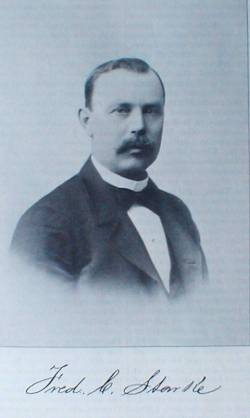
FRANK STEADLEY
Frank Steadley has been engaged in sailing on the Great Lakes for a number of years in the capacity of engineer. He is a single man, and makes his home in Detroit, in which city he was born, on December 9, 1865, and has always lived. He attended school until he reached his seventeenth year and then entering a machine shop served four years as an apprentice to the trade. For one year he served as oiler on the revenue cutter Fessenden and was later on the City of the Straits as electrician for one season, spending the following year on the S.F. Hodge as second engineer; he served two seasons in the same capacity on the tugs Gladiator and Gettysburg. In 1892, Mr. Steadley was appointed second engineer on the Andaste, and the following year was given the position of chief, which he still continues to hold to the entire satisfaction of all concerned. He is a member of the Marine Engineers Beneficial Association, No. 3, of Detroit.
John Steadley, father of Frank Steadley, is a native of Germany, and came to America at the age of fourteen years. He has spent the greater part of his life in Detroit, and was steward of many of the old passenger boats, including the Michigan, Illinois and Idlewild, then called the Grace McMillen, continuing for about thirty years in that employment. He married Miss Barbara Smith, of Detroit, who was also a native of Germany. One son, Martin Steadley, has been a marine engineer twelve years, having been on the Satellite, Crusader, A.J. Smith, W.B. Castle, H.L. Worthington, East Saginaw and Peter Smith.
CAPTAIN FRANCIS M. STENTON
Captain Francis M. Stenton, a steamboat master of good qualifications and success, was born in 1844 at Detroit, Mich. His school-days ended when he was eleven years of age. The majestic river flowing at the foot of his native city, bearing upon its broad and deep bosom the commerce of perhaps the most prolific section of this great country, probably influenced him in forming the resolution to become a sailor, which he did in 1859, joining the crew of the little steamer Gazelle in the humble capacity of porter. His berth was lost to him shortly after, however, as the Gazelle was wrecked and went to pieces near Eagle Harbor, the hands escaping in the yawl. He then found a berth on the City of Cleveland. In 1860 he shipped on the propeller Montgomery, plying between Buffalo and Chicago.
In December, 1861, Captain Stenton enlisted for service in the war of the Rebellion, and was assigned to the Fourteenth Mich. V.I. After participating in many of the engagements of the early part of the war he was captured, in October, 1862, by Forrest's cavalry, was paroled at Murfreesboro, and went to his home. At this time the Eighth Michigan Cavalry was being recruited, and, without considering the fact that he had not yet been exchanged, his enthusiasm led him to enlist in that regiment, with which he served until July 20, 1865. During this time the command was incorporated into the Army of the Cumberland and took part in General Sherman's campaign, starting with cavalry division from Lexington, Ky., and riding by way of Resaca, Big Shanty and Altoona Pass to Kenesaw Mountain, Marietta, Ga., and finally into Atlanta. Before the fall of the city, however, he rode with his regiment on the Stoneman raid, which proved disastrous to the troopers engaged in it. The principal object of this foray into the heart of the Confederacy was the rescue of Federal prisoners confined in the pen at Andersonville, but General Stoneman made Macon, Ga., his first objective point, and his supports failing to arrive he was forced to retire after a stubborn fight without entering that city, as there was a broad and swift-running river intervening. The small squad now with him soon ran up against greatly superior numbers of the Confederates, and General Stoneman was forced to surrender. Captain Stenton at this juncture realized the penalty of his recapture as a paroled prisoner, and led a stampede that deprived General Wheeler of many of his prisoners. He was wounded in an engagement at Nashville, Tenn., and his horse was killed under him at Florence, Ala. He was discharged at Pulaski, Tenn. He was promoted to the rank of orderly sergeant at the siege of Knoxville. During his service in Kentucky he had the honor of capturing the Confederate General Scott.
On his return to Detroit Captain Stenton shipped in the steamer Traveler, which burned alongside the dock at Eagle Harbor, thus closing the year 1865. It is now the province of the biographer, who participated with the Captain in the war episodes related above as sergeant of McLaughlin's Squadron O.V.V. Cavalry, to detail his after life on the lakes. In 1866 he shipped as deckhand on the tug Mayflower, but was soon promoted to wheelsman; in 1867 he shipped on the George W. Bissell; in 1868 on the steamer Marine City as wheelsman; in 1869 in the same capacity on the steamer City of Toledo, and in 1870 on the steamer W.R. Clinton. In 1871 he went on the steamer City of Sandusky as second mate, serving in that berth one year and as mate the following season, from that time to the present he has been engaged as follows: 1873 on the steamer Huron, finishing the season on the steamer John Sherman, as mate; 1874 on the steamer Colin Campbell, finishing the season on the St. Joe, as mate; 1875 on the steamer Benton until July 4, when he received his first papers as master, closing that season and remaining the two following in this command; 1879 on the steamer Oakland as mate one season, and as master the three following seasons; 1883 on the steamer Raleigh as mate; 1884 on the steamer Osceola as mate; 1885 on the steamer John N. Glidden as mate; 1886 on the steamer S.F. Hodge as mate, closing the season as master; 1887 on the James Fisk, Jr., as master; 1888 on the S.F. Hodge as master until July, closing on the steamer Eber Ward, which he brought out new, and continuing in command of her throughout the following season; 1890 on the steamer Toledo as master, with an interest bonus (the Toledo being burned and condemned he lost his interest); 1891 master of the Saginaw Valley, from which he was transferred to the steamer A.L. Hopkins, owned by the same firm; 1892 on the steamer Northerner as master, closing the season on the German, which he sailed the two following seasons. In 1895 Captain Stenton went to Chicago and brought down the steamer Superior to Cleveland, and then shipped as master of the Escanaba till September, when he was appointed master of the steamer Flint & Pere Marquette, No. 5, but not liking winter sailing he resigned. In 1896 he superintended the construction of the steamer Aragon, and brought her out new July 1, remaining in her until August, when he took command of the steel steamer John Ericsson, which he laid up at Cleveland at the close of navigation.
In 1868 Captain Stenton was united in marriage to Miss Lydia Houchen, of Milford, Mich., and one son has been born to them, Mowry E., who is now employed by the Globe Iron Works Company. Socially the Captain is a member of the Knights of Maccabees and of the Ship Masters Association, carrying Pennant No. 162.
CAPTAIN VERE S. STENTON
Captain Vere S. Stenton will be remembered by the older sailors on the lakes as a prominent and skillful master during the 'forties. He was born in 1822 at Leamington, England, and came to the United Statess(sic) with his family in 1831, in 1833 locating at Royal Oak, Mich., where he continued to reside up to the time of his death, which occurred in 1862. Captain Stenton was apprenticed to a barber, but as that trade did not prove sufficiently attractive for one of his eager spirits he ran away, and at the age of fifteen shipped as wheelsman on the steamer St. Clair. He then served on other vessels in various capacities until the spring of 1844, when he was appointed mate of the square-rigged brig Robert Burns. The following year he shipped as master of the top-sail scow Rocky Mountain, trading between Saugatuck and Chicago with piles for the construction of docks. After serving in the capacity of mate and master some time longer he purchased the schooner Tom Doland and sailed her two seasons, selling her in Chicago and accepting the appointment of master of the old brig S.C. Walbridge, which he sailed one season, trans-ferring from her to the brig Andes. At the time of his death he was captain of the brig Ocean, laden with a cargo of hoop poles, which was going through the Welland canal; while passing along the bulwarks he slipped and fell between the vessel and the dead wall of the canal and was killed instantly.
Captain Stenton was united in marriage to Miss Esther Collins, of Detroit, Mich., in 1843, and six children were born to their union, namely: Capt. Francis M. (master of the steamer John Ericsson in 1896), George W., who died in the service of the North during the Rebellion), Henry H., Charles E., Richard A. and Emily E.
A. STEPHENSON
A. Stephenson, the well-known and popular chief engineer of the Tacoma building, Chicago, was born in that city in 1851, a son of Peter and Caroline Stephenson. The father was born and reared in Sweden, and in 1850 became a resident of Chicago, where, as a machinist, he worked in the Illinois Central shops for over thirty years. He died in Chicago in 1893, at the ripe old age of eighty-three years, and his wife passed away in 1892.
The subject of this review grew to manhood and was educated in Chicago and learned the machinist's trade, serving his apprenticeship in the Vulcan Iron Works, and on the expiration of his apprenticeship entered the employ of the Babcock Manufacturing Company, on Des Plaines street, remaining with them five years, and for the next two years was engineer for the National Elevator Company. In 1871 he began sailing out of Chicago as engineer on the tug Alpha, which he fitted up and brought out new for the Chicago Docking and Dredging Company, and on which he went the entire season. The following three seasons he was engineer on the propeller Peerless, engaged in the Lake Superior trade, and then entered the employ of the McCormick estate, being chief engineer of their building for nine years. In 1889, on the completion of the Tacoma building, he accepted his present position, which he has since so satisfactorily filled. He is a prominent member of the Stationary Engineers Association, also of Scranton Lodge No. 8, K. P., and the Engineers Club, which meets in the Fisher building.
In 1875, in Chicago, Mr. Stephenson war married to Miss Josephine Roddy, a native of that city, and to them have been born eight children, only two of whom are now living, George R. and Thomas.
CAPTAIN WILLIAM LYMAN STEVENS
Captain William Lyman Stevens, keeper of the Life Saving Station at St. Joseph, is a son of James E. and Lucinda (Hastings) Stevens, and was born in St. Joseph, Mich., December 5, 1851. The father, a native of Brownsville, Jefferson County, N. Y., born within sight of Watertown, in 1823, came to St. Joseph in 1842. At that time the country about Benton Harbor was all in timber, there being but one house, and that a log one, which stood about where the pumping house now is, and was occupied by the grandfather of J. S. Morton, now of Benton Harbor. As time passed by J. E. Stevens became one of the most active, and probably was engaged more largely in business than any of the other citizens of the county who were contemporaneous with him during his active business career. In 1860 he commenced farming, cleared up the woods and improved 160 acres of land at Eastman Springs. For a period he farmed extensively and carried on a large general store at St. Joseph; also had a general store at Benton Harbor, and one at South Haven. He had commenced merchandising at St. Joseph in 1844, and was for twenty-eight years a merchant at that place. From 1864 to 1870, in addition to his large business interests, he was active in the lake trade, building and operating the schooners R. B. King and Belle Stevens; also was one of a company who built and ran the propeller Favorite; held interests in the steamer Benton, and the Lady Franklin; and in the propellers Van Raalte and Skylark, which plied on Lake Michigan between St. Joseph, Chicago, Milwaukee, Grand Haven and Muskegon. During the same period Mr. Stevens was engaged in the lumber business, and was represented in yards in Milwaukee and Chicago. He is now residing on a farm within a couple of miles of Benton Harbor, and is engaged in raising small fruits.
Capt. W. L. Stevens, the subject of this sketch, grew up and was educated in St. Joseph. He assisted his father in his different business enterprises, and farmed for several years. Later was employed for a number of years as foreman in the work about the docks in his native place, and for one year was similarly occupied at Chicago. In December, 1879, some six months after the establishing of a full crew at the life saving station at St. Joseph, Mr. Stevens was made the keeper of the station and captain of the crew, which relation he has ever since sustained with the U. S. Life Saving Service. During a service of nearly a score of years, which is of itself sufficient evidence of ability and efficiency, Captain Stevens and his noble crew have rescued many lives from wrecked vessels, and performed acts of heroism. In referring to the wreck of the steamer Protection, which occurred off Saugatuck, November 13, 1883, and to the St. Joseph crew, the report from the published records of the U. S. L. S. service at Washington set forth that:
In several marked respect, including the distance of sixty-four miles traveled by the life-saving crew to effect their magnanimous purpose, this case of rescue may be considered unparalleled in the annals of the service. But for the gallant aid rendered them it is more than probable the fifteen men aboard the Protection would have perished. It will be seen that the efforts made by the brave citizens of Saugatuck to get out to them in a boat were baffled by the terrible wind and sea. Adrift in an unmanageable vessel, their places of shelter breaking away under the shocks of gale and wave, they would in all likelihood have soon frozen to death, or become the prey of the surf, but for the action of the little corps of life savers.
When the steamer City of Duluth was wrecked off St. Joseph, January 26, Captain Stevens succeeded in getting his crew together, and six hours after receiving the information of the wreck had saved forty-one lives, which constituted the crew and passengers of the City of Duluth. This following was one of the most notable and important services rendered Captain Stevens and his crew. On November 10, 1898, when the schooner Lena M. Nielson was stranded at Lakeside, twenty miles south of St. Joe, the crew went down by fast train, and rescued the crew of four men of the ill-fated vessel, who were clinging to the rigging, a feat that required not only bravery, but great skill and generalship.
On June 30, 1878, Captain Stevens was married to Miss Ella Whitaker, of Royalton, Berrien County, Michigan.
ALEXANDER T. STEWART
Probably the youngest engineer in the Northern Steamship line, and the only one unmarried, is Alexander T. Stewart, whose name opens this sketch. He was born in Kinleith, near Edinburgh, Scotland, July 26, 1865, and at that place he lived until he reached his ninth year, when his father, George Stewart, a papermaker, came to America and with his family settled in Thorold, Ontario.
Here Alexander attended the public schools, adding to what knowledge he had already acquired in Scotland, until his sixteenth year, when he was apprenticed to the machinist's trade in Thorold. He also served in Buffalo, making five years in all, and after one year of actual work he began marine life. He first went as oiler on the Syracuse, of the New York Central and Hudson River line. After a season on the Albany he went to the Pennsylvania Oil Company, at Corry, Penn., and remained there six months, finishing the year in the shops at Buffalo. At this time he came in the Northern line as second engineer, and served one and a half seasons. From there he went to the R.A. Packer, of the Lehigh Valley line, and the second year became chief, in 1893, when only 28 years of age. After serving as chief upon the E.P. Wilbur and Fred Mercur, he went back to the Northern line in 1894 as second engineer on the North Wind, and then first assistant on the North West. The following year, 1895, he was chief of the Northern Queen, and has held that position ever since. His good fortune and well-merited reputation as an engineer has gained for Mr. Stewart the greatest confidence of his employers.
DAVID P. STEWART
David P. Stewart, deceased, was born December 24, 1838, in the city of Buffalo, a son of John Stewart, of Fincastle, Athol, Perthshire, Scotland, and Helen (Clark) Stewart, of Edinburgh, Scotland. The father, who was an architect and builder, was married in Buffalo. From the earliest recollection of his son David he was a naturalized American citizen, and he designed and built some of the most prominent buidings of the city in his day. He died in Buffalo in 1849.
The subject of this sketch commenced his education between the ages of six and seven years, but like most boys of that age thought more of play than of study; he managed, however, to keep up with his classes, though he was oftener at the foot than at the head. In 1849, during the prevalence of cholera, his father died, leaving the mother with a family of six children, he being next to the eldest. As the mother's only possessions were the house in which they lived, on Seneca street, the eldest brother and our subject were compelled to help support the family, and the latter started by working as parcel boy for a dry-goods house. Being of a mechanical turn of mind, he became dissatisfied with that kind of employment and at the age of fourteen years took the position of bell-ringer on a locomotive on the New York Central railroad which ran between Buffalo and Rochester. Under the laws of New York State in those days the bell of the locomotive was compelled to be rung from the time it started until it stopped. After giving about two years to that employment, Mr. Stewart was apprenticed to the Eagle Iron Works in order that he might learn the machinist's trade, and there served until he was twenty-one years old. On becoming a journeyman he found employment with George W. Tifft & Sons, and worked in the shops of the Buffalo Steam Engine Works a year, and then became foreman of a machine shop owned by A.A. Justin, who was a blacksmith, wagonmaker and machinist. While in this employ Mr. Stewart gained much valuable experience, and was able to fully realize the advantage a more complete school education would have been to him, for lack of which he was compelled to sit up late at night, or rather early in the morning, studying rules and working out problems, such as the size of shafts, diameter and width of pulleys, velocity of saws, strength of material, and many other similar matters. In the spring of 1869 Mr. Stewart resigned his position with Mr. Justin to go sailing, accepting the position of second engineer under Thomas P. Justin, of the propeller Alaska, a new iron steamer just finished for the Anchor line, of which Capt. Daniel Coughlin was master. He derived great benefit from the association with Mr. Justin, as he was a very careful man and possessed good judgment, and barring a few minor mishaps the season was a successful one, the Alaska being laid up at Erie in the early part of December. In 1870 Mr. Stewart was appointed chief engineer of the Alaska, in place of Mr. Justin, who was transferred to the Winslow, and he remained on her until August, 1876, when he was transferred to the Wissahickon (of which Captain Sisson was master), a new wooden steamer built by the Union Dry Dock Company for the Anchor line. He continued to serve as her chief until November 28, when she was laid up at Chicago after a very successful and uneventful season. The following spring Mr. Stewart went out of Chicago as chief of the Wissahickon under the former master, Captain Sisson, with the schooner Allegheny as consort. On the first trip down considerable ice was encountered, as it was early in the season, and some damage was sustained by the steamer because of the consort coming in collisioin with her, but with this exception the season was a favorable one and the Wissahickon was laid up at Buffalo December 1. In the spring of 1878 Mr. Stewart made three trips as chief of the Wissahicken(sic), and on May 20, by order of the chief engineer of the Anchor line, William Moses, Mr. Stewart went to Cleveland and there brought out, on June 12, the Delaware, built at Quayle's shipyard, her machinery being built by the old Cuyahoga Steam Furnace Company. He was her chief engineer until the end of the season, which was finished November 29. On his family's account Mr. Stewart concluded to remain on shore, and accepted employment on February 6, 1879, as chief engineer with Lee, Holland & Company, in their large planing-mill at Buffalo, where he remained until the close of 1882. At that time, he resigned to engage in business with George A. Otis in the manufacture of feed water heaters under the firm name of the Stewart Heater Company. They were located originally on Mechanic street, thence removing to Clinton street, where they remained two years; but at the end of that period, desiring more room, they established themselves on Norfolk avenue, Kensington, a suburb of Buffalo, their present location.
In 1880 Mr. Stewart was united in marriage with Miss Ellen Gollop. His children by a former wife were as follows: William, who for fifteen years was a stationary engineer, but is now a motorman with the Buffalo railway; John, who has been engineer for the American Palace laundry about ten years; and David, who died at the age of twenty-seven years. Mr. Stewart died December 7, 1897, loved and respected by all who knew him. He was an inventor of considerable ability, and a man of rare mechanical genius. He was of a most admirable disposition, highly esteemed for his quiet efficiency and uprightness of character.
DOUGLASS H. STEWART
Douglass H. Stewart, who for several years was the efficient marine reporter at Detroit, Mich., and of whom it has often been said, with truth, that no boat ever went too fast for him on the river, was born at Harsons Island, St. Clair River, August 14, 1862. He obtained his education at the common schools of the island, and at the age of sixteen years went sailing as lookout on the steamer Empire State, after a year's service on her changing to the steamer James Davidson, upon which he remained four years - in the capacity of lookout one year and as wheelsman three years. He now went to Detroit and applied to Captain Coyne, local inspector, for papers as pilot, but after the required examination they were withheld because of color blindness. Mr. Stewart then became marine reporter at Detroit River, being located in the office with Capt. J.W. Westcott, and while thus engaged he was also agent to the Marine Record, of Cleveland, Ohio, and the Cleveland Leader and Plain Dealer, and the Detroit Free Press and Tribune, and as correspondent for the Marine Record, Chicago Inter Ocean and many other morning papers in different cities upon the lake shores. Besides attending to these occupations he delivered messages changing the destination of vessels carrying cargoes to lower lake ports. In the fall of 1886 he entered the employ of the Globe Iron Works Company, as machinist, and remained with them three years. In 1890 he was appointed captain of the Superior street viaduct, at Cleveland, Ohio, under the Mayor Rose administration, holding that position two years to the satisfaction of all concerned. In 1893 he started in the electric business with J. S. Moses, and in April, 1895, in company with C.H. Estinghouse and E.L. Warner, became a member of the corporation known as the Electric Supplies & Construction Co., with which he has since been connected.
Mr. Stewart is a Chapter Mason, being a member of Bigelow Lodge; of the U.O.A.W., and of the I.O.O.F., at present serving as deputy grand master of the Odd Fellows of the district of Cleveland; he also belongs to the encampment and uniform rank. On August 25, 1886, he was married to Julia E. Guest, of Cleveland, Ohio, and they have one child, Earl. D. Stewart.
CAPTAIN JAMES P. STEWART
Captain James P. Stewart is the eldest son of Schuyler E. and Mary (Harsen) Stewart, and was born January 27, 1860, on Harsen's island in the St. Clair river. The father was born in Rome, N. Y., coming west while still a young man, and becoming a farmer, but in 1866 he, in company with Charles Owen, built the schooner Sailor Boy, with capacity of about 100,000 feet of lumber, and he traded with her on the lakes as supercargo. After making good money with her, he sold her out after two years. Later he owned a grocery store in Algonac, and attended to that up to the time of his death, which occurred in 1889, when he was aged sixty-three years. The mother was born on Harsen's island, and was a daughter of Francis Harsen, an Indian interpreter for General Cass while he was governor of Michigan. The Island known as Harsen's was named after him. L. D., another son of S. E. and Mary Stewart, followed the lakes about seven years, and was second mate on the steamer George Spencer. He then stopped ashore and assisted his father in conducting the store in Algonac. There is a great-uncle, Stewart by name, living in Howell, Mich., who is 105 years of age.
Captain Stewart, the subject of this sketch, after spending a number of terms in the public school, began sailing in 1879, on the tug I. U. Masters, as wheelsman, with Capt. Frank Danger, holding that berth three seasons. In the spring of 1880 he shipped on the tug George B. McClellan, followed by a season on the Bob Anderson as wheelsman. In the spring of 1882 he joined the lake tug W. B. Castle, closing the season on the M. F. Merrick as wheelsman. The next season he shipped with Capt. Allen Fick on the steamer Alcona as wheelsman, and during the spring of 1884 he applied for and received first-class papers as pilot, and shipped on the steamer Columbia, with Capt. J. D. Peterson; in 1885 on the steamer Selah Chamberlain, with Capt. L. Lawless; 1886, on the steamer E. B. Hale as wheelsman, two months after which he was made second mate. In the spring of 1887 he was appointed mate of the steamer J. W. Westcott, and on November 7, while coming out of South Chicago with a cargo of wheat she struck a sunken pile, which made a hole in her bottom, and she sunk in twenty-two feet of water. She was raised and put in dry dock, and after being discharged was partially destroyed by fire. In 1888 Captain Stewart came out on the new steamer Robert L. Freyer as mate, with Captain Parsons, transferring in August onto the steamer John M. Glidden as mate, with Captain Young. In 1889 he sailed as pilot of the steamer Kalkaska, with Capt. W. W. Stewart. This boat made forty-seven round trips between Oscoda and Cleveland that season, and carried 32,900,050 feet of lumber, the largest one season's business on record.
In the spring of 1890 he was appointed mate of the steamer Edward Smith No. 1, with Capt. Bernard Townsend, holding that office three seasons. In 1893 he joined the William H. Gratwick as mate with Capt. Richard Jackson. The next season he came out as mate with Capt. Charles Marsden, and in 1895 as mate of the steamer Australasia with Capt. William Patterson, closing the season on the Viking with Capt. A. Stewart. In the spring of 1896 he was appointed master of the steamer White and Friant, owned by Capt. James Davidson. The next season he sailed as mate with Capt. Ed Thorp in the steamer John Owen. During the winter months for a number of years Captain Stewart assisted in attending his father's grocery store, and on December 19, 1895, he purchased the stock and since that date has conducted it with the necessary help.
On January 12, 1894, Captain Stewart was united in marriage to Miss May, daughter of John and Margaret Ritchie, of Algonac. The Stewart family homestead is located in Algonac, Mich. Captain Stewart is a charter member of the Odd Fellows lodge in Algonac, and as a beneficial investment carries a Michigan Mutual Life Insurance Company's policy.
CAPTAIN JOHN STEWART
Captain John Stewart, of Ludington, Mich., and captain of the steamer City of Milwaukee, is a native of Canada, born in the city of Quebec in 1847, a son of Samuel and Ann (Gleeson) Stewart, natives of Ireland, the former of Scotch descent.
John Stewart's early years were passed at Amherstburg, and in 1863, at the age of sixteen years, he ran away from home and shipped as deck hand on the steamer Olive Branch, which ran between Gibraltar and Detroit, and there learned to be wheelsman. He was on the Olive Branch one season, and then went as fireman on the steamer Clara, which ran about Detroit. His next boat was the Pearl, running between Detroit and his native city, on which he served in the capacity of fireman. The following two seasons were passed in tugging between Lakes Huron and Erie. The next season he sailed for a time in the steamer Huron as wheelsman, and finished the year on the Evergreen City as lookout, the latter then running between Buffalo, Chicago and Green Bay. The following year year he passed on the Illinois, a side-wheel steamer running between Cleveland and Lake Superior, and then sailed as second mate on the steamer City of Toledo, which plied between Saginaw and Toledo. Next he sailed on the Huron in the capacity of second mate, the Huron then running from Saginaw to Alpena. He was made mate of this steamer, and in about a year was promoted to captain of the same. Following the Huron the Captain sailed the Metropolis on the same route, and when sold he sailed the City of Sandusky. He then sailed the side-wheel steamer George L. Dunlap, and the John Sherman, the latter running from Saginaw to Alpena and Mackinaw, which he sailed one year on that route, when, in 1875, she was removed to Lake Michigan, running from Ludington to Sheboygan, and was the first steamer the F. & B. W. R. R. Co. put across the lake. In 1876 Captain Stewart left the lakes and went to the Pacific coast, where for a year he was engaged in the lumber business. In 1877 he entered the ocean service as quartermaster in the Pacific Mail line, with which he remained a year and a half, and sailed to various foreign ports. Later he went with the Coast Steamship Company, with which he remained nearly two years, sailing both inland and outside steamers.
While in the West, Captain Stewart was married at San Francisco, to Miss Ida, daughter of Louis and Ida Stellar, of German extraction, and a sister of Mr. Stellar, of the business firm of Loury & Stellar, of that city. To this marriage have been born four children, as follows: Ida, Lewis, and John and James (twins).
In 1881, the Captain returned to the lakes and entered the services of Captain Cole, and sailed the steamer Dove, running on excursions. He then sailed the Arundel three years, and from her went into the service of the F.& R. W. R.R., and remained there eight years sailing between Ludington and Milwaukee. >From this service he went with the Grand Trunk railroad, and has since sailed the steamer City of Milwaukee. Captain Stewart is a member of the Ship Masters Association and of Blanchard Chapter of Bay City Masons. He is a most thorough seaman and one of the most popular captains on the lakes.
CAPTAIN JOHN A. STEWART
Captain John A. Stewart, master and captain of the steamer F. W. Fletcher, with residence at Algonac, St. Clair Co., Mich., is a native of that place, having been born there June 7, 1859. He is a son of Charles and Maria Stewart, the former of whom, a merchant by occupation, was born sixty-six years ago in New York State, the latter in Michigan; the mother died in 1865 at the age of twenty-eight years.
When sixteen years old, our subject commenced sailing on lakes as a deckhand on the steamer Allegheny; was then wheelsman on tugboats for two years, and of the steamers Belle P. Cross and J. P. Donaldson; then wheelsman on the steamers John N. Glidden and E. B. Hale, respectively. After that he was second mate of the steamer Rufus P. Ranney one year; captain of the barge Lady Franklin three and one-half years; captain of the steambarge Westford one-half year; mate of the steambarge Garden City three years; master of the steambarge O. O. Carpenter three years; of the steamer Norseman some eighteen months, and is now serving his third season as master and captain of the steamer F. W. Fletcher.
In 1885, at Algonac, Michigan, Captain Stewart was married to Miss Addie Higgins, daughter of Rev. T. C. Higgins, of Algonac, and two children have been born to them; Annie, now (1898) thirteen years old, and Carl, eight years old at this time. Captain and Mrs. Stewart are members of the Methodist Episcopal Church; in politics he is a Democrat. Socially he is a member of the Masonic fraternity, the I.O.O.F. and the A.O.U.W.
CAPTAIN JOHN N. STEWART
Captain John N. Stewart, who has been a resident of Saginaw, Mich., for about thirty-six years, and has sailed out of that port since 1862, will be remembered by the old-time lake mariners as a pleasant and companionable man, and a thorough seaman. He was born in Buffalo, N.Y., February 2, 1837, a son of Noridon and Mary (Lloyd) Stewart, the former of whom, a native of Pennsylvania, was a captain and owner of Lake vessels, and a wrecker and diver. He owned and sailed the schooner Sandusky, in which he carried the cobblestones for the first street paving in Buffalo; he was mate of the steamer Ellen Strong when she was destroyed by fire off Monroe, Mich.; he assisted in wrecking the steamer Erie, which was burned and sunk. Among the relics which he secured from the Erie were seven Mexican silver dollars which had been smelted and joined together by the heat; these passed into the hands of his son. Noridon Stewart had a ship repair yard in Detroit, where the Michigan Central depot now stands, and there repaired the schooner Dale (which he hauled out) and many others of that class of vessels; he also assisted in hauling over the Lake Superior portage the first steamer that passed into those waters before the canal was built. He died in 1840 at Hamburg, near Buffalo, N. Y. His wife, who was also well connected, died about a year previous. She was a native of New York City. They left two sons, Charles H., who is a marble cutter and dealer; and John N., whose name introduces this article. After the death of the father the two boys were taken to Detroit, where they lived with their mother's sister, Mrs. Campbell, whose son is now in charge of the Detroit & Windsor ferry boats.
It was in the spring of 1849 that Capt. John N. Stewart began sailing, as cook in the scow Brandywine, and following this service with two seasons in the schooner Dolphin, in the same capacity. In 1852 he shipped as wheelsman in the passenger steamer Telegraph, with Captain Pidgeon; the next season he was decksweep in the side-wheel passenger steamer Baltic, with Captain Lundy; in 1854 chief decksweep in the passenger steamer Southern Michigan, plying between Buffalo and Toledo; in 1855, mate in the fine side-wheel passenger steamer Bay City, Capt. James M. Lundy, plying between Detroit and Sandusky. During the two years he was in this steamer he was connected with what was known as the underground railway, whereby escaping slaves reached Canada, the Bay City touching at Amherstburg at night, and at different times he thus helped fourteen slaves to freedom, they occupying his room on the passage. On one occasion they had both a master and his slave aboard. The master recognized the runaway, but he slid down the sideguard and got away. On reaching Detroit the Southerner had both Captain Lundy and Mr. Stewart arrested, but he found public opinion against him and he did not prosecute. During the seasons of 1857-58 Captain Stewart was mate with Captain Lundy in the passenger steamer City of Cleveland, plying between Cleveland and Superior City. The next spring he was appointed master of the side-wheel steamer Olive Branch, owned by his uncle, William P. Campbell, and opened the route between Detroit and Trenton, holding this berth three seasons. During the fall of the last season he purchased a half-interest in the steamer Star, which he sailed two seasons, and on July 4, 1862, he went on her to Saginaw and located in that city. In 1864 he built the tug S. R. Kirby, of which he made a passenger boat, sailing her on the Saginaw river. He then built the tug Star No. 2, which he sailed two seasons, and after selling her he bought the side-wheel steamer Excelsior, which he soon disposed of. In 1869 he built and brought out the passenger propeller John N. Stewart, a fine boat, which he sailed three seasons between Saginaw and Sebewaing, she being the first steamer ever run into the latter port. She paid for herself the first season, but was destroyed by fire at Sebewaing on her last trip. Captain Stewart then built the tug W.S. Quinby, which he sailed in the passenger trade between Saginaw, Asheville and Port Austin for five seasons, the last two seasons working on a government contract at Port Austin reef, in the construction of a lighthouse. In 1877 he sold her and bought an interest in the barge Mary Birckhead, which he sailed four seasons; she was lost on the Lime Kiln Crossing the next year.
During 1881-82 Captain Stewart sailed the schooner Norway, and the next season stopped ashore as secretary for Capt. Harry Shaw. In the spring of 1884 he purchased an interest in the steamer H. C. Thatcher with Captain Shaw, and sailed her between Painesville and Cleveland, carrying brick for six seasons. He then took her to Toledo, out of which port he sailed her two seasons, until the hull was condemned by the government; the Captain took out the engines and boilers, which he still possesses. Proceeding to Buffalo he took command of the excursion steamer Periwinkle, sailing her in the excursion business out of Saginaw and Toledo for two seasons, and in the spring of 1896 he was appointed ot this present position -master of the fine pleasure steamyacht Fannie H., owned by L. C. Quinnin. During his long career as a sailor Captain Stewart has saved many lies - a man who fell overboard from the steamer Bay City; two men from a capsized boat in Saginaw bay; three men from the bottom of a capsized schooner yacht off Sebewaing; and a man he picked out of the Saginaw river, who abused him because he did not rescue his hat also.
Captain Stewart and his wife have had four children, only one of whom is now living, Frankie M., the wife of Walter Bliss. Arthur J. died February 22, 1898, aged twenty-one years; Charles H. died in infancy; Nellie died in Saginaw at the age eight years. The Captain has two grandchildren, Harold and Lena Bliss. The family residence is on Thompson street, Saginaw, Michigan.
CAPTAIN CHARLES H. STICKNEY
Captain Charles H. Stickney, who has perhaps been engaged in the tug business as master on the Cuyahoga River longer than any other man, was born in Black Rock, Erie Co., N. Y., on June 4, 1850, the son of Orrin and Emaline (Scott) Stickney. He attended the public schools of his native town until he reached the age of fourteen years.
In 1864 he first shipped as cook on the tug Medina, on which he remained six seasons, five of which he passed in the capacity of fireman. In the spring of 1870 the Captain was appointed engineer of the Medina, and held that berth till the tug was sold to Newburg, N. Y., owners. He took the tug to that port, out of which he operated the balance of the season. In 1871 he came to Cleveland and joined the tug Monitor, and sailed her the next two years. In the spring of 1874 he brought out new the tug R. K. Hawley, and in the fall he entered the employ of the Standard Oil Company, as master of the tugs E. P. Fish and Standard, remaining with that firm eight years. In the spring of 1882 he came out in the tug Forest City, and ran her until June, when he again took charge of the E. P. Fish, as part owner, sailing her until the fall of 1883. The next two seasons he sailed the tug Paddy Murphy, in which he was also interested.
In the fall of 1886 Captain Stickney went to Detroit after the tug Allie May, which had been purchased by himself and Cleveland parties, and took her down to that port and sailed her three seasons, during which period he also sailed the tug J. S. Blazier, and Gregory occasionally, closing the last season on the Gregory. In the spring of 1890 he again joined the Allie May as captain, and sailed her until the close of 1895. The next season he came out as master and part owner of the C. Castle. During the season of 1897 he sailed the tugs J. R. Sprankle, L. P. Smith and S. S. Stone. He has twenty-two issues of license, and is a careful and trustworthy master, giving universal satisfaction to those by whom he has been employed.
Socially, he is a member of the beneficial order of Royal Arcanum, Pearl Council, No. 515.
On July 27, 1874, Captain Stickney was united in marriage to Miss Kate P. Werntz, daughter of Jacob and Lucinda Werntz, of Akron, Ohio. Millie, their only child, is employed as stenographer for the Indemnity Savings & Loan Co. The family residence is at No. 99 Quimby Avenue, Cleveland, Ohio.
JOHN STOALDER
John Stoalder, of Cleveland, Ohio, was born in 1849 on board a vessel lying at anchor in New York harbor and began life as a sailor at the age of thirteen years, and he has seen his full share of nautical experiences. His father, Andrew Stoalder, who was a native of Switzerland, determined to migrate with his family to the western part of the United States and there end his days. While the vessel on which he came to this country was lying at anchor at New York, the subject of this sketch was born, and twenty-four hours later the entire family left the boat. They located in Lima, N. Y., where the father died three years later, of cholera, and the mother then removed with her family to Sandusky, Ohio, in 1869, taking up her residence in Cleveland.
John Stoalder began sailing as cook on the scow Mary Jane, serving in a similar capacity on the steamers Sheridan, Lottie Bernard, Eighth Ohio and Ella Lyon, and on the tugs Ella Lyon and Burnside, afterward becoming wheelsman for a brief period of the tug Goodnow. Later he was in the tugs B. B. Jones and B. B. Rose and the steamer Reindeer, in May, 1869, becoming fireman of the tug Belle King. The next season he was fireman of the tug L. P. Smith for four months, when he received his first issue of engineer's papers and became engineer of the tug Edwards, holding that berth also on the tugs Starkweather, Volunteer, Monitor and James Amadeus, after which he was employed three years as locomotive engineer on the Cleveland & Rocky River railroad. Following this he was engineer of the tugs Forest City and Sprague, second engineer of the steamer Superior, and chief of the propeller Mayflower, tugs Mary Virginia and Brady, steambarge Fred Kelley, and steamers Nahant, Everett, S. E. Sheldon and E. S. Pease. He served nearly three years in the last-named vessel in the fall of 1894, becoming engineer of the Northern Ohio Blanket Mills, in Cleveland, which position he has retained up to the present time.
During his boyhood Mr. Stoalder spent some time on the schooner Mystic, which went on the reef near Point Pelee and rolled over, and he remained one day and two nights in the rigging before the crew were rescued. He has also had a considerable experience with wrecking pumps; pumped out dry docks and milldams at Lowell; raised one schooner at Ashtabula; raised the schooner Reindeer at Fairport; the Harrison at Beaver Island; the E. B. Hale, at Point Pelee reef; had quite an experience up at Marquette with the Daniel Wallace, and raised the schooner Baldwin at Kelley's island. While he was employed in the tug Samson that craft sunk at Point au Pelee island, and the crew spent thirteen days in a deserted log hut on the island. It was intensely cold and at night two-hour watches were maintained so that the fire would not go out. Finally a relief seemed likely to be indefinitely postponed, Mr. Stoalder took a small boat, rowed to Kelley's island and there took a steamer to Sandusky, from which point he dispatched a tug to take off the stranded men.
In 1873 Mr. Stoalder married Miss S. E. Bedford, of Cleveland, and they have had children as follows: Adelaide, William Wesley, John, Edward, Cora, Charles, Vernie, Mable, Arthur and Cleo.
CAPTAIN HENRY W. STONE
Captain Henry W. Stone ranks among the most prominent and successful shipmasters on the Great Lakes, and it is safe to say he has not reached this exalted position by favoritism or money influence, but because of inherent sterling qualities, close application of his duties as man and master, superior business methods, and his genial and happy disposition.
Captain Stone was born April 9, 1847, at Vermilion, Ohio, where he resided until he was sixteen years of age. He attended the public schools at Vermilion and also those of Cleveland, during the winter months, finishing what may be termed a liberal education at Baldwin University, Berea, Ohio. In 1863 he removed with his parents to Cleveland, where he commenced his sailing career by shipping on the schooner David Wagstaff. For three years he applied himself diligently to the task of learning a seaman's duties, and in the spring of 1866 he shipped before the mast in the new schooner Escanaba. The following seasons, having obtained a thorough knowledge of the duties of a seaman by study and observation, united with practical experience, he was promoted to the office of second mate.
When but twenty-two years of age the Captain went on the new schooner Fayette Brown, on which he had appointed chief officer, and he exhibited so much seasmanship and superior business capacity to that position that he was given command of the schooner New London. He steadily attained to more responsible positions, and in the spring of 1872 he brought out the new schooner D.P. Rhodes, and which he remained for seven years, doing successful work each season and winning and retaining the entire confidence of his employers. He was next appointed master of the stanch schooner Thomas Quayle, sailing her for five seasons. His eminent qualifications up to this time as master of sailing vessels prompted his employer to place him in command of the steamer Superior, which boat he handled for two seasons with ability and success, transferring from her to the E.B. Hales, and thence to the steamer Henry Chisholm, on which he remained for two seasons. In 1887 the firm of M.A. Bradley built the steamer Gladstone, of which boat Captain Stone was appointed master, and he retained this new command three seasons, thus rounding up a period of twenty-six years in the Bradley employ, during which he had steadily worked his way upward from an ordinary seaman in a 560-ton schooner to master of the latest built and one of the largest lake steamers afloat at that time.
It may have been observed that up to this time Captain Stone had handled wooden vessels only. It is held that it requires a greater degree of skill and efficiency to navigate the lakes in iron and steel steamers. However that may be, Captain Stone, in 1890, was appointed to the command of the large new steamer La Salle, built by the Cleveland Ship Building Company to the order of the Lake Superior Iron Company, one of the strongest ship-owning firms on the lakes. Several years ago it was generally believed, and that belief still obtains in a great measure, that wind or weather could have no appreciable effect on the fine, powerful, three to four-thousand-ton steel steamers built on the lakes, hence that class of steamers were driven, loaded or light, in all weather, under all conditions, and at their full speed. For five seasons, under command of Captain Stone, the La Salle was kept well at the head of the list in point of carrying the largest cargoes, chiefly iron ore, and in making almost schedule time from port to port. In 1895 Captain Stone resigned his command with the Lake Superior Iron Company to take charge of the North Land, built by the Globe Ship Building Company, and universally known as the best ship on the lakes, she and her sister ship, the North West, Capt. G.A. Minor, being considered the two most elevated commands on the lakes. Thus Captain Stone, who, in sailors' parlance, crawled through the hawse-pipe of a small schooner, has attained to the best command on fresh water (for, being of later build, the North Land is generally considered slightly superior to her sister ship); that is, he has risen from a small boy on a small schooner to master of a twin-screw steel passenger steamer of 4,244 tons gross. He is a member of the Ship Masters Association, and carries Pennant No. 184.
Captain Stone was united in marriage to Miss Elizabeth E. Tracy, of Elyria, Ohio, in 1870, and has three children, namely: Lena G., Maurice F., and Theodore E. Stone.
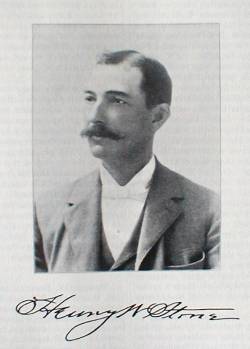
CAPTAIN JOHN STONE
Captain John Stone, who owns and commands the schooner William Stone at the present time, was born October 29, 1865, at Detroit, Mich. He attended the public schools of his native city until his sixteenth year, when he began marine work, to which he has since devoted his life. His first experience was on the Lillie Dale, running from Kelley's island to Detroit, of which he acted as steward two years, and he then commanded the F. B. Speck, on the same route, remaining in her three seasons. His next berth was that of mate in the J. M. Spaulding, on which he remained for two years, and when she was sold he shipped on the Jewett four seasons, after which he acted as quartermaster on the Bay City, Susquehanna, Milwaukee and New York, and on the Steriko as wheelsman. Returning to the schooner John Jewett, he acted as mate for part of a season, finishing on the schooner Irene as master and he served the four seasons following as master of the Jewett. After acting as master on the schooner Irene about six months he purchased the William Stone, which was built in July 1896, and became master of her. In August of the same year he began to sail her and throughout the year carried general merchandise.
Captain Stone is a single man. He is the son of Capt. Moses and Eliza (LeMere) Stone, both natives of Detroit, the former of whom was a vessel owner and master for about forty years.
CAPTAIN MARSHALL STONE
Captain Marshall Stone, shipmaster, sailing out of West Bay City, was born March, 15, 1849, in Froomfield, Ont., on the St. Clair River, the fourth son of William and Jane Stone, the former of whom was born near Hull, England, and the latter in Edinburgh, Scotland. He has a brother, Edward, living in West Bay City, who is also a lake sailor. The other children in the family are: William, Henry, Charles, Richard, Elizabeth and James.
The Captain commenced sailing in 1864, and sailed before the mast until the year 1868. Since the spring of 1869 he has followed steamboating for a livelihood.
In December, 1880, Captain Stone was wedded to Miss Margaret E., daughter of John Wallace, of Bay City. The children born to this union are: Charles M., Ruth A. and William S. The Captain is a Master Mason and a member of the Ancient Order of United Workmen.
DENNIS STRULB
Dennis Strulb was born in Monroe, Sussex Co., N. J., in 1864, a son of Peter and Susan (Bush) Strulb, and removed with his parents to Sayre, Penn., where he attended the public schools a number of years. In 1884 he came to Buffalo, and after four years, during which time he was engaged in various occupations, he shipped on the steamer Jewett as oiler, the following season serving in the same position on the Owego. In 1890 he was appointed first assistant engineer on the George H. Hadley; in the spring of 1891 he came out in the new steamer Pueblo as first assistant, and the following year went on the William H. Gratwick, closing the season on the John Duncan. In the spring of 1893 he shipped on the St. Louis, in 1894 on the Delaware, finishing the season on the Omaha, in 1895 again shipped on the St. Louis as first assistant, and also engaged on her during part of 1896, finishing the latter season on the Samuel Marshall as first assistant.
Mr. Strulb is a member of the Marine Engineers Beneficial Association at Buffalo, and of the Fraternity of Odd Fellows. He makes his home in Buffalo, where he was married in 1893 to Maggie Barry, of that city, and they have two children, named William and Mamie.
JOHN A. STYNINGER
John A. Styninger, who retired from active engineering on the lakes about a quarter of a century ago, was a noted chief in his younger days, and is now perhaps one of the best known dealers in engineers’ supplies and other goods that enter into the outfit of steamboats. At any rate, he is a popular, congenial and accommodating man. There is no question why he should not take naturally to a seafaring life, as he was born on the Atlantic Ocean on October 13, 1848, in a full-rigged ship hailing from Hamburg, Germany. The voyage to New York occupied two months, and the ship was in American waters, about a week’s sail from her destination, when the event here recorded transpired. His parents were John A. and Mary (Styninger) Styningner (not related). After landing in New York they continued their journey west, locating in Lower Saginaw, now Bay City, Mich., and John was the only young white boy in the valley, as his parents were among the first pioneers. His playmates were all Indian children and their playground on the banks of the Saginaw River was the site now occupied by his store. The father died in 1849, soon after reaching his new home, and John was thrown upon his own resources at a very tender age. His first employment was in the shop of C. E. Jennison & Brother, in Bay City, to whom he was apprenticed for five years, and there he thoroughly learned the machinist’s trade. He then went to Painesville, Ohio, where he remodeled the old brewery under the hill, the work occupying about three months.
In 1867 Mr. Styninger went to Cincinnati and shipped as oiler on the river steamer Twilight. The next year he took out engineer’s papers, serving in the same steamer another season, and in the fall he went to Cleveland and entered the employ of Parsons & Hokondobler, then located on Merwin Street, by whom he was engaged until 1873, especially during the winter months. He was fixing the pumps in the tug Old Jack when she exploded her boilers, on the Cuyahoga River, in 1870, and is the only survivor of that disaster. In the fall of 1873 Mr. Styninger was on the passenger steamer Idler, plying between Cincinnati and New Orleans, and the next year he engaged to take charge of the shop of C. E. Jennison, in Bay City, but before he reached there the place was destroyed by fire. The Jennisons started him in business the year following on his own account, and he has successfully continued in same up to the present time. He began in a small way, but by enterprise and industry he has built up a large business, carrying one of the most complete stocks of engineering and vessel supplies to be found along the lakes, oils for illuminating and lubricating, heating and cooking stoves, and in addition conducting a plumbing, steam and gas fitting branch. Mr. Styninger keeps his place open night and day to accommodate the trade and is assisted by a force of competent workmen. He has recently made an extensive addition to his storeroom, which is now 42 x 136 feet in dimensions.
Socially Mr. Styninger has been a member of many fraternities. He held Pennant No. 5 of the Excelsior Marine Beneficial Association, and is an honorary member of the Ship Masters Association, the American Association of Masters & Pilots of Steam Vessels, and of the Marine Engineers Beneficial Association, representing the latter body as delegate to Detroit, Buffalo, Cincinnati, Pittsburgh, Chicago, Mobile and Washington. He has eighteen issues of first-class engineer’s license.
On March 30, 1885, Mr. Styninger wedded Miss Hattie, daughter of William and Julia Harwood, and two children, Roy Augustus and Gracie Merila, have been born to this union. The family homestead is at No. 1115 Van Buren street, Bay City, Michigan.
LAFAYETTE S. SULLIVAN
Lafayette S. Sullivan is, perhaps, one of the best known men in marine circles. He was born in Holland, Lucas Co., Ohio, in 1858, in a log house, and his present prominent position has been obtained by his own energy and good business methods, and he may be correctly designated as a self-made man, as there was no money or influence to assist him. He is a son of Dennis and Hannah (Devine) Sullivan. His father was a ship carpenter by trade and removed to Toledo, Ohio, in 1863, where Lafayette acquired his public-school education, also attending the Jordan Business College.
His first employment was in the office of the Toledo Blade, in the mail and editorial rooms. In the spring of 1870 he shipped on a scow with his father, who was engaged in the sand trade between Amherstburg and Toledo, remaining in that berth two years. In the spring of 1872 he entered the employ of John Stevens & Co., in the ship brokerage and vessel agency business, remaining with that firm nine years, and laying the found-ation for his business life. In 1881 Mr. Sullivan established a ship brokerage business on his own account, which, together with his tug business, he has followed ever since. He soon commenced to purchase vessel property, his first venture being the steamyacht Sally, which he used as a ferry boat. As a nucleus for his tug business he purchased the tug William E. Rooney, and followed this by the purchase of the tugs Syracuse and Roy, the latter being crushed by ice December 16, 1895, between Monroe and Stony Point, and has not yet been located; the Doan, Birckhead, A. Andrews, Jr., and an interest in the powerful tug S.C. Schenck. He also has interests in outside steamboats and schooners - D.W. Ruse, C.C. Barnes, John Schuette, Chicago Board of Trade, and H.H. Badger. He lost the schooner Pulaski off Good Harbor, Lake Michigan, in 1888.
In 1882 Mr. Sullivan succeeded to the management of the Toledo Harbor Tug line on the retirement of M.T. Huntley. This tug line was established in 1870, and is now composed of his own and outside tugs. He is at the head of the coal shipping trade out of Toledo, is a stockholder in the Vulcan Iron Works, and is a member of its board of directors, vice-president of the Lake Carriers Association, and has been on the board of directors since it organization. He is also an honorary member of Toledo Lodge No. 9, of the Ship Masters Association. Mr. Sullivan opened the first branch shipping office of the Cleveland Vessel Owners Association, which, after the first year, turned enough on its books to enable it to pay its own way.
In 1883 he wedded Miss Alice Pallister, daughter of William and Hannah Pallister, of Detroit, Mich. Four children, Lafayette W., May Hannah, Alma Ruth and Alice Marguerite, have been born to this union, and they consider them the chief ornaments of their home. The family residence is at No. 1524 Huron street, Toledo, where Mr. Sullivan has resided thirty-one years.
CAPTAIN JOHN DEAN SULLIVAN
Captain John Dean Sullivan was born at Cape Vincent, N.Y., August 14, 1825. At this place he lived only a short time, however, when the family moved to Point Peninsula, and later to Sacket's Harbor, in the public and private schools of which places he received his education. In September, 1837, he came to Detroit, remaining there for some time, removing thence to Windsor, his present home.
At an early age he had a desire for the marine life to which he has since devoted his time and attention. When only twelve years old he went on a small vessel called the Swan, running from Point Peninsula to Sacket's Harbor. Soon after this time he entered a grocery store in Windsor and there remained during the "Patriot war," after which he again resumed marine work. He shipped on the brig John Dougall before the mast, and after a part of a season in that position returned to Point Peninsula and worked in Asa Wilcox's shipyard for some time. In the fall of the same year, however, he was in charge of the schooner Eclipse for a short time, and in the spring went on the schooner Asa Wilcox before the mast, and spent the season in that position. For two seasons he remained on shore, and then bought some land near Point Pelee, where he spent the winter, coming to Amherstburg in the spring of 1843, from where he shipped on the schooner Mariner, of Kingston, as able seaman. This vessel was engaged in taking the troops along the Canadian coast to their different destinations after the close of the rebellion in Canada. After leaving this vessel he returned to Sacket's Harbor and went on the schooner Cambridge, on which he remained one year, and in the fall entered the employ of J. W. Strong, of Monroe, Mich., who was engaged in dredging the channels to the lake. Upon the steamer General McComb as wheelsman, running between Detroit and Toledo, he was employed a short time. In the following year he sailed on the schooner Mohawk, Michael Dousman and Chapman as able seaman. Upon the brig Crispin he shipped as seaman; in the same year he became second mate; in 1847 took a position of mate, and was put in command the same season. The same year the Northwest Insurance Company sent him to Lake Huron to repair the brig Orleans and return her to her owners. In 1848 he sailed the brig Crispin, and in 1849 sailed the schooner Alvin Clark, both of Detroit. In 1850 kept a grocery and provision store in Detroit. In 1851 he was sent to Kingston by the insurance company to repair the brig Orleans, after which he sailed her for one season, and then sold her in Milwaukee. In the fall of 1851 he went to Cleveland as coal purchaser, and the following season took command of the schooner Alvin Clark, which he retained two years, and during that time brought the first locomotive running on the Great Western railroad of Canada, from Buffalo, N.Y. In 1854 he went on the brig Mohegan, which was engaged in carrying the first stone to build the Sault Ste. Marie canal. During the same season he spent some time on the brig Portland, and in 1855 bought an interest in the propeller Hercules, which he sailed for several years. Upon this boat, in 1850, he was engaged in carrying freight across the Detroit river. The same year he had a contract to carry the stone used in building the Grand Trunk railroad branch between Detroit and Port Huron.
In 1857 he did the ferrying work for the Great Western railroad. In 1858 he was in command of the steamer Gore, towing. The year after, in Detroit, he was given the position of stock agent for the Great Western railroad. In the winter of 1860 he took charge of the side-wheel steamer Transit, and remained until 1864, when he went on the steamer Union for two years. He looked after the repairs of this boat and building of the steamer Great Western, going upon the latter January 1, 1867, where he remained as master until 1871. He was then appointed superintendent of ferries and looked after the building of the steamer Saginaw in 1872; the Transit in 1873, and the Michigan in 1874. In this position he remained until 1881, when he was appointed superintendent of the D. B. I. & W. Ferry Co., a position he held until 1884. He then went to the steamer Lansdowne, a ferry operated by the Grand Trunk Railroad Company, and there acted as master until July 1, 1896.
Captain Sullivan has had a very wide experience in all marine affairs on the Great Lakes, and has a thorough knowledge of that work in its several departments. He now holds a certificate of the old Board of Lake Underwriters of Buffalo, dated 1856, and signed by Helphinstein, Daffins, Dorr and others; also the International Underwriters Certificate of 1859, presented to him by the board of underwriters before the licensed certificate for masters and engineers granted on the lakes. He is now the efficient agent for the following well-known English and Scotch insurance companies: The London Guarantee & Accident Co.; The Standard Life Assurance Company of Edinburgh, Scotland, and The Caledonian Insurance Company of Edinburgh Fire Risks. On December 22, 1847, Captain Sullivan was married to Miss Charlotte E. Westaway, a sister of John A. Westaway, who is at present superintendent of mechanical works of the Michigan Central ferry department. Five children have been born to them: Caroline Elizabeth, who was married to J. A. Johnston (deceased), and afterward married to Alex. Gillean, of London, Ont.; Mary A. (deceased), who was married to D. T. Smith, of Windsor (also deceased); J. William, who is a marine engineer; Charles A., who also spent several years of his life in this occupation; and Addie D. (deceased), who was married to A. Gillean, of London, Ontario.
CAPTAIN ROBERT H. SUNDERLAND
Captain Robert H. Sunderland, of Detroit, was born in Anderdon township, Essex county, Canada, in the year 1854, and lived with his parents on a farm, assisting with the work, and going to school whenever the opportunity afforded, till he was seventeen years of age, when he started out in life for himself as a sailor, beginning as deckhand on the barge Colorado, since which time sailing has been his chief occupation; he, in the meantime, when not otherwise employed, attended business college during the winter months.
His second season was put in on the Keweenaw, and the third was wheeling on the tug Balize. The fourth season of his sailing he shipped as wheelsman on the tug M.F. Merrick, and remained on her in that capacity for the succeeding five seasons, and the sixth served as mate on the same boat, leaving her to take the same position on the tug Vulcan, on which he remained four seasons. In the year 1880 he assisted in the rescue of the passengers and crew of the burning steamer Marine City on Lake Huron, for which act he was presented with an elegant gold watch and chain, by E. W. Voight, and a valuable gold medal by the Merchants and Manufacturers Exchange, and other citizens of Detroit.
In 1881 the Captain was placed in command of the tug Erie Belle, and later on a like honor was conferred upon him in the charge of the tug Kate William, since which time he has commanded the following named steamers: Isaac May, W. R. Stafford, and the Keystone; he also had the schooner S. V. R. Watson under his charge. During the fall of 1896 he was placed in command of the steamer D. C. Whitney, and officiated in the same capacity on her during the season of 1897.
In 1881, the Captain married and took up his residence at 718 Fort Street, East Detroit, where he has since lived. They were the parents of two children, who died from diphtheria, at the age of five and three years respectively.
CAPTAIN EDWARD W. SUTTON
Captain Edward W. Sutton is a son of Peter and Margaret (Singer) Sutton. The former, now deceased, was a member of the old firm of Sutton Brothers, composed of himself and Francis Sutton, each owning half-interest in a machine shop originally located on Lock street, Buffalo, but in 1858 removed to its present location on Le Couteulx street. The shop was established in 1856, and since that time has turned out machinery for use on the lakes, being known widely among lakefaring men. Francis Sutton is now sole owner.
Captain Sutton was born in 1861 at Buffalo, and attended St. Joseph's College. He learned his trade with Sutton Brothers, and afterward worked in the shops of the Buffalo Steam Engine Works, David Bell and Kerrand Duffy. Since abandoning shop work he has built and owned the steamyachts Lewis Miller and E. C. Shafer, Echo and Nettie Baker, and for other people he has built over five hundred steamyachts, tugs and excursion boats. In July, 1882, Captain Sutton shipped as oiler on the steamer Algonac, owned by the Canadian Pacific railroad, and plying between Owen Sound and Port Arthur; he left her in November, at the end of the trip, just before she became disabled and went to pieces on the rocks in Thunder Bay. The Captain has eleven issues of license papers for harbor tugs and steamyachts. For the three seasons ending with 1896 he was master of the steamyacht Hettie Baker, in which he has a half-interest with David Sutton.
Captain Sutton was married in 1887 to Miss Melissa Johnson, by whom he has two children, Ella and Edward. They reside at No. 53 Bird avenue, Buffalo.
JOSEPH F. SUTTON
Joseph F. Sutton is the son of Peter and Margaret (Singer) Sutton (both now deceased), for many years residents of Buffalo, the former being a member of the firm of Sutton Brothers, who carried on a machine shop on LeCouteulx street, which has long been a landmark in the lower part of the city of Buffalo.
The subject of this sketch was born at Buffalo, March 8, 1864, and attended school at St. Joseph's College, Buffalo, finishing at the age of eighteen. He learned his trade at Sutton Bros' shop, and later worked for the Buffalo Pump Works. In 1887 he was engineer of the steamyacht Corsair for one season. The next three seasons he was in the same capacity on the steamyacht Alexander Sloan, owned by Samuel Sloan, and in 1891 he was engineer of the excursion steamers Gazelle and Vision. During 1893-94 he was engineer of the steamyacht Riverside, and for 1895-96-97 was engineer of the excursion steamer Idle Hour. For [the] season of 1898 he was chief engineer of the Riverside. Mr. Sutton was married at Buffalo, in 1885, to Miss Addie Schneider, by whom he has two children, Loretta and LaRoy Consuela. The family reside at No. 294 Mulberry street, Buffalo. Mr. Sutton is a member of the Buffalo Harbor Tug Pilots Association.
WILLIAM SUTTON
William Sutton, who is well qualified for the position which he now holds as superin-tendent of the Globe shipyard, in Cleveland, was born in Milford, Pembrokeshire, South Wales, June 10, 1849, a son of James and Margaret (Simmons) Sutton. His parents removed to the United States in 1872, locating at Lockport, N. Y., to which city William had preceded them about one year. The father died in 1880, the mother following two years later.
William Sutton, the subject of this sketch, attended the public schools of Pembrokeshire until he was thirteen years of age, and then entered the shipyard of Allen & Warlaw as an apprentice, remaining with that firm six years. In 1868 he went to Chatham navy yard, in Kent, near London, and was employed on the general iron and steel ship work, notably for his work on the British warships Gladden, Sultan and Serapis, one year, after which he left the yard on account of a reduction in the force.
In the spring of 1869 he went to Cardiff, and joined the full-rigged ship Annie Combrey as carpenter, which was bound for Ancona, Italy, with coal, thence to Taganrog, Russia, a port on the Black Sea, where she took on a cargo of grain. On the return voyage, she was quarantined on the Bosporous for ten days, then passed on down to Constantinople, thence to Havre, France, arriving there soon after hostilities commenced between France and Prussia. The crew left the ship, and Mr. Sutton took passage on a channel steamer, and reached Milford, after an absence of nine months.
After recovering from the effects of rheumatism, which he had contracted during the voyage, he again went to work in the Chatham navy yards, remaining there until the spring of 1871, when he took passage on the steamer City of New York, bound for the United States. On arrival he went to Lockport, N. Y, and engaged in the construction of canal boats for use on the Erie Canal, afterward taking charge of a gang of men to plank the bottom and build locks on the new Welland Canal.
In 1882, after the completion of that work, Mr. Sutton went to Cleveland, and entered the employ of the Globe Iron Works Company, and worked on the great iron steamer Onoko, at that time the largest vessel afloat on the lakes, and the first iron steamer built in Cleveland. While on a visit to Lockport his mother died, and after the obsequies Mr. Sutton went to Jefferson, Ind., to work on government barges, which were being constructed for use on the Mississippi River. He was there during the flood of 1883, when the inhabitants passed from house to house in small boats, or vacated their premises entirely. The next spring he returned to Lockport, and engaged with the Pound Manufacturing Company, to go to the Isthmus of Panama to fit up the woodwork for dredges to be used on the proposed De Lesseps Canal. After six months he was disabled by an accident, and took passage for New York, going thence to Cleveland, where he again found employment in the Globe shipyard, assisting in the construction of the iron steamers William Chisholm, J. H. Devereux, Darius Cole, and the steel steamers of the Northern Mutual, Lehigh, Menominee, and the Minnesota lines, as general foreman. The steamers of these several lines are numbered among the best on the lakes, and Mr. Sutton's practical qualifications are recognized as being of a high order of merit.
In 1884 Mr. Sutton was wedded to Miss Ellen Nora Collins, the daughter of John and Nora Collins, of Lockport, N. Y. The children born to this union are as follows: Mary Margaret, John Francis (who died young), and Joseph Leo. The family homestead is located at No. 12 Woodbine Street, Cleveland, Ohio.
CAPTAIN DAVID SYLVESTER
Search the ports of the Great Lakes from Fort William to the seaboard, and no truer gentleman than Captain Sylvester, of Toronto, can be found. He is as honest as the daylight, and as kind-hearted as the famous good Samaritan. Scores of people claim him as a friend, and they are never disappointed in the goodness of his nature. He is a younger brother and partner of Capt. Solomon Sylvester. The two eldest children in the family are girls, followed by Solomon, David and another brother. Their father was Samuel Sylvester, a farmer, whose place was within nine miles of Toronto, and who died while his children were comparatively young.
David Sylvester was born in Scarborough, York county, in June 1839, the most delightful month in the year, which perhaps accounts for his genial disposition. His education was acquired in the public schools, and at an early age he began sailing. The first vessel on which he shipped was the schooner Clarissa, owned and sailed by his uncle, Capt. Archibald Taylor. This was in 1848, so that he was barely nine years of age at the time. His novice trip was made from the mouth of the Humber river to Oswego, N.Y., where the Clarissa was bound with a load of flour. After three seasons with his uncle, young David went on to the schooner Belvidere, belonging to Sherwood, as cook, which place he filled for two months, then returned to his uncle's vessel. His following season was spent on the schooner Hope, of Hamilton, succeeding which he was for four seasons on the schooner Atlantic. Afterward he went on the schooner Maid of the West, under Captain Brothers, and on leaving her joined the schooner Shickluna, under Captain O'Brien, and later shipped on the schooner Jolly Farmer. Having made several trips on the Jolly Farmer, Captain Sylvester was promoted and given charge of her in 1855. During 1856 he sailed her for part of the season, but left her because the owner's manager interfered with his mate. For some time he acted as mate in the schooner Eliza Wilson, under Captain Gordon part of the time, and with Captain Goodfellow subsequently.
Now came the time when Captain Sylvester was to strike out for himself. In 1857 he and his brother Solomon bought the schooner Atlantic, which they sailed as captain and mate until 1860. That year they bought the schooner Sweet Home, and our subject became captain of the Atlantic, while Solomon took charge of the Sweet Home. In 1865 they disposed of the schooner Atlantic, and bought the schooner Eureka, which Capt. David Sylvester sailed.
Throughout all his trips about that time he was strongly attracted toward Cleveland, Ohio, which finally culminated in the winter of 1866, when he married Miss Robertson, of that city. His wife died, however, in the winter of 1867, and an infant daughter soon followed her mother. This blow so distracted the Captain that he ceased sailing, and eventually went into the commission and brokerage business with his brother and his cousin, Mr. Hickman, on Front street. In 1869 they leased the Church street wharf and elevator, and carried on the vessel owning, wharfinger and grain storage trade, which they still pursue. Their schooner J.G. Worts was cast away near Georgian Bay in 1895, and they lost their propeller L. Shickluna in the spring of 1897. They now own the steamer Eurydice and the schooner St. Louis.
In 1871 Captain Sylvester was married a second time, his wife's maiden name being Miss Forbes. She is a daughter of Mr. Alex Forbes, of Aberdeen, Scotland. Everyone who knows Mrs. Sylvester finds her to be a comely, intelligent and fond wife, and she is the mother of four sons, and a finer quartette (sic) of young men cannot be found in the country. They are Henry S.P., of Winnipeg; and David Forbes, Samuel A. and William J., all of Toronto.
Politically, Captain Sylvester is a Liberal, and religiously is a Presbyterian, and attends old St. Andrews' church, on the corner of Jarvis and Carlton streets, Toronto. He is well liked by his minister and all the members of his church, but no one values him more than do his friends in business. In social organizations he is known as a member of the Order of Sons of Temperance, of the Independent Order of Odd Fellows, and the Ancient Order of United Workmen.
CAPTAIN SOLOMON SYLVESTER
Captain Solomon Sylvester is a thorough marine man, having been connected with the Great Lakes all his life. He was born in the township of Scarborough, York Co., Ont., June 16, 1837, his father, Samuel Sylvester, being a well-known farmer of that locality. His mother was Miss Janey Taylor, sister of Capt. Archibald Taylor, ex-deputy harbor master of Toronto port.
Captain Sylvester's parents were among the pioneers of Ontario, or Upper Canada, as it was then called, and their farm was situated about nine miles from Toronto, then known as York. The father died when Solomon, the third oldest in the family, was only eight years of age, or about the year 1845. Our subject has two brothers and two sisters, there being five children in the family, all of whom were educated in the public schools, the Captain proving an apt pupil. His one wish from childhood was to go sailing, and when he attained the age of thirteen he went on board a small coasting schooner on Lake Ontario. On different craft he worked his way up until, in 1857, he became a master, and took command of the schooner Atlantic. He owned and sailed different vessels until 1869, at which time he came off the water, and inaugurated a general wharfing and vessel owning and storage business in partnership with his brother David, and James H. Hickman. This firm traded under the name Sylvester Brothers & Hickman, on the Esplanade, at the foot of Church street, until 1879, when Mr. Hickman died. Then the firm name was changed to Sylvester Brothers as it yet remains. Some of the vessels which they own are the steamers L. Shickluna (wrecked) and the Eurydice, and the schooners J.G. Worts (wrecked) and the St. Louis.
When the Trent excitement occurred, Captain Sylvester entered in the naval brigade, under Capt. W.F. McMaster, and was stationed at Toronto. He held the office of master's mate, the highest that could be attained in the service. Notwithstanding his many secular duties, Captain Sylvester finds time to devote to Church and Lodge matters. He is a member of the Sons of Temperance, and the Ancient Order of United Workmen; and is a director and elder in the West Presbyterian Church, Toronto, in which he holds membership. In politics he is a Liberal, and is a strong advocate of liberal matters in the best sense of the term. He is also an active member of the Canadian Marine Association, in which he holds office, and looks carefully after inland marine matters. He has two sons who are energetically following in the footsteps of their father, and two daughters who are prototypes of their amiable mother, who was a Mrs. Janet Paterson, widow of Robert Paterson, of Kingston, Ontario, before her marriage with Captain Sylvester, which occurred in 1867.
CAPTAIN GEORGE A. SYMES
Captain George A. Symes is the youngest son of James B. and Margaret (Campbell) Symes, of Sarnia, situated at the head of the St. Clair river, the former of whom is known as a pioneer captain of Georgina Bay. There were four children in the family, those besides the subject being: (1) John C., who is master of the steamer Cadillac, owned by the Cleveland Cliffs Mining Company, was born October 13, 1862, and moved to Sarnia with his parents in 1872. He commenced his career in marine life in the spring of 1878, as lookout on the steamer Manitoba, and from that time on advanced until he held the position of first officer on the best passenger and freight steamers of the United States, plying between Buffalo, Chicago and Duluth. In the spring of 1888 he was appointed master of the steamer Nelson Mills, of Marysville, which steamer he commanded with the utmost satisfaction to her owner for three years, and then became master and part owner of the steamer H.D. Coffinberry, of Cleveland. After one season of successful service he was next found on the bridge of the steel steamer Cadillac, which he successfully commanded for the seasons 1893-94-95-96. On January 18, 1893, at Sarnia, Captain Symes was married to Miss Teney McMasters, and made his home at Port Huron, Mich., where he was respected by all who knew him. He died at his father's home in Sarnia, December 12, 1896. (2) Duncan J., a telegraph operator, and (3) Margaret J., unmarried, and living with her parents.
Capt. George A. Symes, the subject of this sketch, was born May 21, 1868, in Bruce, Ontario, and attended school in Collingwood. His first occupation in life was as clerk in a dry-goods store, where he remained for a couple of years. In 1885 he went before the mast on the schooner Sweepstakes, out of Courtright, Ontario, and remained on her that season. In 1886 he was porter and watchman on the propeller Arctic, out of Detroit. Until September 1, during the season of 1887, he was lookout on the propeller Portage, after which he was wheelsman on the Northern, of the Ward's line, until she ran on Kelley's Island reef, where she became a total loss from fire. During the season of 1888 Captain Symes acted as wheelsman on the Osceola, of Ward's line, and served in a like position on the Nyack, of the Union line. The next season he joined the propeller Avon as wheelsman, remaining on her until the middle of the season, when he became wheelsman of the Gogebic for the remainder of the season. She was brought out new at the time from the Bay City dry dock. In 1890 he was given second mate's berth on the propeller Edward Smith, owned by Grattvick, Smith & Fryan, of Buffalo; this office he held for three months, and closed the season as mate of the steambarge Lothair, owned by the Perry Sound Lumber Company.
In 1891 he was mate of the steambarge Mills, on which he remained until the fall of 1892, which season he filled out as mate of the H.D. Coffinberry. Captain Symes' first master's berth was in 1893 and on the steambarge Canada, owned by John Nesbit, of Sarnia. On October 18 of that year this boat was burned at the dock at Port Huron; and afterward made into a tow barge. During the season of 1894 he was not only master, but manager of the steamer City of Windsor, owned by S.T. Reeves, of Windsor, Canada, and for the season of 1895-96 he was master of the steambarge St. Louis, owned by the Niagara Falls Paper Company. During the season of 1897 Captain Symes was appointed master of the steel barge Cadillac, to succeed his brother John C., and in 1898 was serving in the same capacity on the same boat.
On January 11, 1893, Captain Symes was married to Miss Isabella Ross, of Brantford, Ontario.
CAPTAIN JAMES B. SYMES
One of the most popular and best known mariners on the Great Lakes is Capt. James B. Symes, who, after a period of two-score years or more of active life, through calm and storm, is still seeing service on the lakes as the efficient commander of the Seguin.
He was born, in 1837, in Leith, Scotland, a son of John Symes, who was engineer on the first Cunard steamer to cross the Atlantic in 1840. In 1856 our subject began his life as a sailor, making his first trip in the humble capacity of decksweep on the passenger steamer Western World, running between Detroit and Buffalo. He steadily worked himself upward, until 1860, when he went as mate on the Canadian steamer Kaloolah, which was lost near Southampton, Ont., in the summer of 1862. In 1863 he was mate of the propeller Niagara, running between Goderich and Chicago, and two years later he became master of the Naubune, running between Collingwood, Perry Sound and Sault Ste. Marie, and on this steamer he took S.J. Dawson and party to what is now called Port Arthur, to build the famous Dawson road through to Fort Garry. In 1866 Captain Symes was granted the first master's certificate issued by the Association of the Canadian Underwriters, a document the Captain highly prizes and always has with him. In 1868 he took charge of the side-wheel passenger steamer Algoma, between Collingwood and Fort Williams, and during the summer sailed her up the Nepigon river to the Hudson Bay post, a route never before taken by a steamer, and the Indians held a great powwow in his honor. In 1869 he opened the famous Symes channel through thousands of islands in the north channel of Georgian Bay, and in 1870 took the first load of government supplies to Fort William for the Red river expedition. He also moved many of the troops, for which he received a very kind letter from the Commandant Colonel (now General) Wolseley, for his kindness. That same fall he moved seventy ladies and children, together with a lot of machinery, from Houghton, Portage lake, to Silver islet. The residents were so pleased with the Captain's uniform kindness and courtesy that they presented him with a handsome gold watch, chain and charm. He had the honor of carrying the first and last barrel of silver ore ever taken out of Silver islet. In 1871 he took charge of the side-wheel passenger steamer Manitoba, and made five trips between Collingwood and Fort William and Port Arthur that fall, and on the opening up of navigation in the spring of 1872 he took her to Sarnia to form the Beatty line between Sarnia and Port Arthur and Duluth. In 1873 he sailed up the Kaministiquia river, and was rewarded with two town lots for sailing the first steamer on that river; and in 1875 he towed the dredge from Sarnia to Fort Williams to open up a channel through the bar at the entrance of the Kaministiquia river, and in 1876 towed a barge that carried the first two locomotives used by the Canadian Pacific railway between Sarnia and Fort Williams. He continued on the Manitoba until 1879, during which time he was the recipient of many presents from those who traveled with him. On September 3, 1879, occurred a terrific gale. Captain Symes was lying at breakwater at Chantry island, near Southampton, and saw the schooner Mary and Lucy going ashore. He at once called for volunteers to man the lifeboat to go to the rescue of the crew; his mate, now Capt. John Byers, and the mate of the steamer Quebec, which was also lying at breakwater, and three others of the crew at once responded. The sea was so heavy that as soon as they were clear of the island the boat capsized, and two of the crew were drowned, the rest clinging to the boat for two hours and a half until they drifted ashore. For the bravery he displayed on this occasion the Canadian Government gave the Captain a gold watch, and to the mothers of the boys that were drowned and to the rest of the crew, silver watches. That season Captain Symes severed his connection with the Beatty Company, and in 1880 he sailed with the propeller Northern Belle between Collingwood and Parry Sound, making daily trips: In 1881 he bought an interest in the company with the Parry Sound Lumber Company, in the steambarge Lothair and consort Corisand, and sailed her until the fall of 1883, when he sold out his interest, and in 1884 took charge of the passenger steamer Quebec for the Beatty line. This vessel was sunk in 1885 in the Sault river and abandoned to the underwriters.
In 1886 he sailed the Roanoke, between Fort Gratiot and Duluth, and in 1888 and 1889 the barge Lothair; in 1890 he superintended the building of the barge Seguin, in which he has a large interest.
On January 1, 1861, Capt. James B. Symes was married to Miss Margaret Campbell, of Bruce county, Ontario, and four children have blessed this union: John C., a successful steamship master, who died December 12, 1896, at the age of thirty-four years; Duncan J., a telegraph operator; George A., master mariner, a sketch of whom is found elsewhere in this volume; and Margaret J., at home.
Captain Symes has been closely connected with the rapid progress made in navigation on the Great Lakes, and has seen the little sailing vessels give way, first to the side-wheel steamers, and then to the speedy propellers; the little package freight boats to the mighty ships that carry thousands of tons. Many interesting tales of the early days he can tell, and of which he can truthfully say, "a great part of which I was." Though his days number three score and more, he is still as active as many a man much younger. In his political faith he is a stanch Liberalist, and did great service for Alexander McKenzie, and although his intense political partisanship has often placed him in peril of losing his positions, he nevertheless was always ready, and is yet, to enter the fray and enjoy a hot political contest. No one among the lake captains was ever more popular, more highly respected than this well-known master of the Seguin.
WILLIAM J. SWAIN
William J. Swain, chief engineer of the Codorus for the seasons of 1895-96-97, is a Canadian by birth, having first seen the light April 5, 1857, at Toronto, Ontario. He received his schooling at Collingwood, same Province, and began his first practical work in a machine shop at Collingwood, where he served the usual three-years' apprenticeship.
At the end of that time he went into the steamer Chicora, oiling one season and then transferred to the City of Winnipeg as second engineer to Mike Chalk, the present boiler inspector at Duluth. He was employed on her for two seasons, and then spent about a year each in the Frontier Iron Works shop at Detroit and the Bay State Iron Works, of Bradford, Penn. In the spring of 1882 he returned to steamboating, going as second engineer of the Juniata, and the two following seasons was in the Clarion in a like capacity. The season of 1885 he was promoted to chief of the Conemaugh, remaining in her two seasons, and then went to the Lehigh for the season of 1887. For the seven succeeding seasons, including 1894, he was chief of the Clarion, and since then has been chief of the Codorus, which is considered one of the finest boats of the Anchor line. Mr. Swain has seventeen issues of the chief's license, and it will be noted that for sixteen years of the time he has been in the employ of the Anchor line. He was one of the charter members of the Erie No. 39, M.E.B.A., was a member of the No. 3, Chicago Branch of that order, and is also an Odd Fellow and Mason in good standing. He makes his residence during the winter season at the "Wilcox House," Erie, Pennsylvania.
THE SWAIN WRECKING COMPANY
The Swain Wrecking Company operates the wrecking tug Favorite, which carries five steam pumps and twelve hydraulic jacks, capable of lifting from one to two hundred tons each, together with other wrecking implements and paraphernalia usually carried on such boats.
The company has done some remarkable work during the time it has been in existence, one of the most extensive jobs being on the Neosho, wrecked off Spectacle Reef in the fall of 1894. The vessel was badly damaged, and it cost some $12,000 to release her, the repairs to the boat afterward costing over $50,000.
The Alva, which sunk during a collision on the river Sault Ste. Marie, was raised after holes were drilled in her side by means of electric drills, and patches put on by a diver, and she was pumped out.
The Choctaw, a boat which was sunk in the same river in May, 1896, in a collision with the L.C. Waldo, was treated in the same way and raised.
During 1897 the company released the Henry Chisholm, one of the boats sunk in a collision off Grosse Pointe, and run aground near the twenty-foot channel.
The officers of the company for 1898 were L.C. Waldo, president; John S. Quinn, vice-president; A.A. Parker, secretary and general manager; J.W. Millen, treasurer. A general wrecking business is carried on, and during the season the Favorite and her well-drilled crew are generally employed.
The steel steamer Alva, light, bound for the Straits, and running full speed, ran on South Manitou island in a fog, and had to be raised with jacks eighty-four times to release her, costing about $10,000.
CAPTAIN CHARLES M. SWARTWOOD
Captain Charles M. Swartwood (deceased), formerly captain of the J.H. Wade, was the son of Earl and Sarah Cornell Swartwood, and was born April 29, 1850, at Lorain, Ohio. The father was also a native of Lorain, and was a vessel builder for about fifteen years of his life. He died in 1883, having survived his wife, who passed away in 1871.
Capt. Charles Swartwood spent his youth in Lorain attending the public schools. At this time, a desire for marine life being stronger than for any other calling, he decided to be a sailor, and to put this desire into practice he went on the scow Fairy, of Lorain, at the age of fourteen years, then put in a season on the J.U. Porter. >From this he came on the Lilly Fox as mate, and the following season on the Enright as master. He spent the following two seasons on the Oak Leaf as second mate, and then joined the D.P. Rhodes, as mate, on which he remained four seasons. From this boat he came to the Helvetia, as mate for one season, and afterward commanded the L.C. Butts for four seasons. The following seasons were spent on the W.D. Rust, H.B. Tuttle, Champion, Gladiator, Crusader, T.S. Christy and William Chisholm; coming to the J.H. Wade in 1891, upon which he remained until his death.
On November 8, 1871, he was married to Miss Agnes Dennison, of Lorain, a daughter of John Dennison, a native of Canada, and an old vessel master, and sister of John and Bert Dennison, who spent several years of their lives on the Great Lakes in different positions.
Captain Swartwood was a member of the Knights of Honor, Knights of the Maccabees, Knights of Pythias, and Protected Home Circle. On February 17, 1898, he passed away at his home in Cleveland. The funeral was largely attended, a large delegation from the Ship Masters Association, as well as representatives from the various orders, came to pay their last tribute of respect to their comrade. Honored and respected by all, his last voyage closed "a life well spent."