History of the Great Lakes
Vol. 2 by J.B. Mansfield
Published Chicago: J.H. Beers & Co. 1899
[ A ][ B ][ C ][ D ][ E ][ F ][ G ][ H ][ I ][ J ]
[ K ][ L ][ M ][ N ][ O ][ P ][ Q ]
[ R ][ S ][ T ][ U ][ V ][ W ][ X Y Z ]

CAPTAIN WILLIAM WADSWORTH
Captain William Wadsworth, was born June 17, 1830, at Sandusky, Ohio. He comes from an old family of many brilliant historical connections in Connecticut, being removed but four generations from Capt. Joseph Wadsworth, whose life was so closely connected with the Charter Oak. His father, Samuel Wadsworth, was for many years of his life a sailor on the Great Lakes, and prior to this career was a master on the salt water. He removed to Sandusky in 1828, and died on the schooner Ligure, at that place in 1832.
The subject of this sketch removed to Huron, Ohio, in 1832, when two years of age, and received a common-school education in that place, and afterward removed to Milan, Ohio. In his fourteenth year he left home and went as cabin boy on the Blue Bell, built at Huron. He remained on her two seasons, and then went before the mast on the Washington Irving, from her to the California, and then to the Buckeye. In 1849 he was on the six-oared government cutter, which was attending to the building of Point Waugoshance lighthouse in the Straits of Mackinac. The following winter he went to New York City and there spent three years in the carpenter’s business, after which he returned to his home in Ohio and went on the steamer Queen of the West, as carpenter. While on the Queen of the West, when she was in Cleveland one night, he saved the life of Philetus Francis, who had been thrown into the river at the railroad pier by frightened horses. This act showed great bravery, being done at the risk of his own life, and deserves mention as an example of well directed service.
In 1857 he sailed as captain of the Berlin, and remained on her three years. In 1860 he went on the Nonpareil; in 1861, 1862 and 1863 he was on the Ironsides, and for the next five years on the bark John P. March, of Vermilion. He then engaged in the lumber business in the firm of Richardson & Wadsworth, at Cleveland, where he remained five years. For a period of five years he was again engaged on the lakes, and then went to Wellsburgh, W. Va., and there carried on the lumber business. Since that time he has been employed the greater part of the time in Cleveland, where he has made his home since 1869. In the winter of 1848 the steamer Baltimore, belonging to Mr. Strong, of Monroe, Mich., but now of Detroit, was lying at the port of Huron. Four men, including Mr. Wadsworth, tried to take her to Monroe, and had nearly reached their destination when the ice prevented further progress, and they were compelled to return. The boat was one that generally required a crew of fifteen men.
Captain Wadsworth was married December 8, 1855, to Miss Nancy E. Balcom, an own cousin to Thomas A. Edison, the noted inventor. A daughter, Marietta, remains at the home of her father; a son, Charles C., born September 20, 1866, is married and resides at Cleveland. The youngest, Percival O., twenty-one years old, is a member of Troop A, First Ohio Volunteer Cavalry, and with that regiment started for the front during the Spanish-American war.
Captain Wadsworth was a pioneer in the Marquette and Escanaba trade, and is well known by all lakefaring men and in Cleveland, Ohio, has a large circle of friends. He has been a member of the Masonic fraternity for over forty years, and is of high standing in that order.
WILLIAM WAGNER
William Wagner, engineer of the fireboat J.M. Hutchinson, was born in Buffalo January 24, 1863, a son of Charles and Margaret (Dower) Wagner. He obtained his education in the public schools of his native city, and commenced his practical life as fireman on the tug W.H.Goodman, owned in Buffalo. He continued for four years in that capacity on various tugs.
In 1886 Mr. Wagner became second engineer on the steamer Moore, which place he held four months. The balance of the season he worked in Chicago, and remained in that city until the fall of 1889, when he returned to Buffalo. On April 19, 1890, he was appointed engineer on the fireboat G.R. Potter, and remained there until June 8, 1893, when he was transferred to his present position, where he has remained continuously up to the present time. Fraternally, Mr. Wagner has been a Mason for four years, and a member of the Firemen's Beneficial Association since January or February, 1891.
CAPTAIN WILLIAM R. WAKELY
Captain William R. Wakely, owner and master of the schooner Antelope, of Port Hope, Ontario, Canada, is one of the best navigators on the Great Lakes, and one of the most popular, being proverbial for his genial, affable and courteous manner.
Our subject is a Canadian by birth, having first seen the light in 1854, at the place known as Cranberry Marsh, in the suburbs of Port Hope, Ontario, in which town he received his education. At the early age of eleven years, in 1865, he commenced sailing the lakes in the capacity of cook's mate, shipping out of Port Hope on the schooner Enterprise, and for two seasons he had charge of the galley, his excellent cooking earning for him a wide reputation on the lakes; while it is even recorded that several of the crew during his incumbency as "chef" were thoroughly cured of chronic indigestion and dyspepsia, although he was three seasons on the Enterprise, during the last one serving before the mast, in other words as able seaman. In 1869 he shipped in the latter capacity on the schooner Otonabee, and remained thereon one season; next year he went before the mast on the brig Cavalier; following year shipped on the Annie Minnes, and was mate of her three seasons. On leaving the Minnes, he went next year as sailing master on the schooner Little Kate, of Oakville, Ontario; from her, next season, he went as mate of the schooner W.J. Suffell; then took charge as captain of the schooner Wave Crest for five seasons, having bought an interest in her, which, however, he afterwards sold, and then retired from the lakes for six years.
In the fall of 1888 Captain Wakely recommenced sailing, shipping on the schooner Delaware, remaining on her during the following spring, and sailed her for two seasons, then going on the schooner Jamieson, which he sailed three years. From the Jamieson he shipped on the schooner Flora Carveth, and sailed her four years in a good coarse freight business. Making an advantageous "deal," he in the spring of 1897 became owner of the schooner Antepole(sic), and is now sailing her as captain, trading principally on Lake Ontario.
During his long experience as a mariner on the Great Lakes, in various capacities, Captain Wakely has on the whole met with good fortune. His principal mishap was when his schooner, Little Kate, went ashore on Snake island, near Kingston, Ontario. As she was loaded with peas, they had little difficulty in lightening her and towing her off, without the loss of any one on board. In fact, only one man in our subject's employ lost his life, a sailor named William Foster, who fell overboard in Oswego harbor, near the drawbridge, while lowering a boat, and was lost in the darkness. On another occasion, a seaman was struck by a sail and knocked overboard while he was out on the boom furling a jib; there was a pretty heavy sea on, and the vessel was pitching terribly, so watching his opportunity, the man, swimming for dear life in the water, grabbed the bobstays as the vessel pitched downward and climbed on deck. On yet another occasion, while our subject was captain of the Flora Carveth, a sailor was struck by lightning, and remained insensible for some time. Captain Wakely put into the nearest port and secured a physician, his prompt and humane action no doubt saving the man's life.
In 1876 our subject married Miss Delilah Gertrude Mix, of Port Hope, daughter of I.N. Mix and Martha Mix, and five charming daughters, all bright, intelligent and well educated, grace this union, named respectively: Annie Maud, Lilian Gertrude, Mabel Vernon, Rose Edith and Tressia Gipsy Pearl. They are great companions to their parents, and in the hot days of the summer months they ofttimes accompany their mother on a short cruise on their father's vessel.
In his political preference Captain Wakely has always been a strong Liberal, and has worked and voted in the ranks of the Reform party ever since he first got his franchise. In religious faith the entire family belong to the Wesleyan Methodist Church, the young ladies being quite a power in the Port Hope church as well as social circles. The Captain owns one of the finest residences and other property in Port Hope, where the family are all held in the highest esteem.
JOSEPH S. WALDER
Joseph S. Walder, assistant engineer in the immense establishment of the Cleveland Electric Illuminating Company, spent several years in the boiler and engine rooms of lake steamers before he accepted his present responsible position on shore.
Mr. Walder was born near Toronto, Canada, in 1870, his father, Rudolph Walder who was a successful farmer, removing to Sanilac county, Mich., in 1874. Joseph attended school in Amadore, Mich., until he was seventeen years of age. He then spent one season before the mast on the towbarge Bay City, the next year going as watchman on the steambarge Simon Langell, of which he served as wheelsman and fireman, successively, during the two following seasons. In 1892 he became oiler on the steamer Specular; in 1893 and part of 1894 he was again on the Langell, as fireman, afterward making one trip on the steamer H. J. Jewett, as oiler. He now became water tender in the works of the Cleveland Electric Illuminating Company, holding that position until June 16, 1896, when he was made second engineer, with the entire supervision of the engine room, boiler room and basement of the establishment at night.
R. J. WALDER
R.J. Walder, of Cleveland, Ohio was born May 8, 1868 at Meaford, Ont., and lived at that place for three years. His father, Rudolph Walder, who is a native of Germany, came to America in his youth and settled in Meaford, where he now lives, engaged in farming. In 1871 the family removed to Port Huron, Mich., and there Mr. Walder received his education in the public schools, afterward removing to a farm near by, where he remained until his eighteenth year. At that time his strong inclination for marine life led him aboard the Ogemaw, on which he served one season as deckhand. The next year he spent on the Business and Oscoda as wheelsman, later shipping on the Samuel Angell as watchman, and after six months transferring to the Topeka as wheelsman, there steering with one of the first hydraulic gears in use on the Great Lakes. The following season he served on the Minneapolis as wheelsman, from that boat going on the Kitty M. Forbes and the Cayuga as second mate, and after a year's service in the same capacity upon the John Oades he went upon the Hiawatha and the J. W. Moore as mate. He then engaged as mate of the Andaste, and remained on her during the season of 1896. Mr. Walder is a single man. Fraternally he is a member of the Ship Masters Association, the Masonic Order and the Foresters.
Mr. Walder is a brother of Levi Walder, who is chief engineer of the J. W. Moore; J. S. Walder, second engineer, formerly on the lakes, but now in the employ of the Cleveland Electric Luminating Company, and W. Walder, who is on the lakes as oiler at the present time.
LEWIS C. WALDO
Among the men who have achieved prominence in the vessel business at the port of Detroit is Lewis C. Waldo, who was for several years associated with the late Capt. E.M. Peck.
Mr. Waldo was born in the State of New York, and when he was quite young his parents removed to Milwaukee, Wis., where he afterward attended school and acquired a good education. When old enough to strike out for himself he went to Ludington, Mich., and engaged in lumber business. While at Ludington he had built, at Wheeler's Bay City yards, the steamer George W. Roby, handling the boat from Ludington for some years, in connection with his lumber interests. Mr. Waldo came to Detroit in 1890, and has largely extended his vessel connection, being now manager of the Northwestern & Roby Transportation Companies, and president of the Swain Wrecking Company.
The Northwestern Transportation Company, of which Mr. Waldo is secretary, treasurer, and general manager, owns the steamers H.H. Brown, S.R. Kirby, Fayette Brown and E.M. Peck, and the barge George E. Hartnell. These boats are operated on Lakes Michigan, Superior, Huron, and Erie in the transportation of iron ore, coal and grain.
The Roby Transportation Company owns the steamer L.C. Waldo, built in 1896 at the Wheeler yards. This boat, although not so large as some of her competitors, is one of the finest freight boats on the lakes, being provided with every modern appliance for the rapid and easy handling of cargoes. Mr. Waldo expresses himself as highly pleased at the performance of this boat during her first season.
ALBERT H. WALKER
Albert H. Walker is the eldest of three sons of Captain Kingsbury and Elizabeth (Brown) Walker. He was born at Buffalo June 6, 1856, and attended Public Schools Nos. 2 and 8 of that city. He began his marine life at the age of sixteen in 1872, firing and decking on the tug Syracuse, which was owned by his father. In that capacity he served for two seasons, and the following one remained ashore; in 1876 he fitted and brought out the Ed. R. Vanburen, also owned by his father, which he ran during that season and the next one until she was sold. He then fitted and brought out the new Troy, of which he was a third-owner, and on which he was engineer for the seasons of 1878-79 and early part of 1880, at which time she was also sold and taken by him to Albany. Returning to Buffalo he began building the C.N. Armstrong, which he fitted and brought out, was a third owner of, and ran for about a month of that season, also the following five seasons, retaining his third-interest in her during that time. At the end of that period he sold it and bought a third interest in the Sam N. Sloan, which he still retains, and has run ever since. Mr. Walker has never suffered any serious mishaps, but while on the Armstrong, coming down Lake Erie, near Sturgeon Point, with a raft in tow, he was caught in a storm which laid them over as if the boats were mere feathers, everything being cleared off the deck, they finally reaching port minus their skiff, tow lines and other things that were on deck.
Mr. Walker was married, in 1878, to Ida Thorn, of Buffalo, and they have five children: Elburta H., now (1898) aged sixteen; Kingsbury, Jr., fourteen; Arthur C., nine; Martha, six; and Hazel H., three. Mr. Walker and his family reside in their own commodious dwelling at No. 50 Myrtle avenue, Buffalo, New York.
ABRAHAM WALKER
Abraham Walker, engineer of the Buffalo Gas Works, was born of Scotch parentage, February 8, 1863, his parents being James and Ann (Rothwell) Walker. He came early to this country, being educated in Buffalo at the public schools, after which he spent six years learning his trade, that of machinist, in several shops. The principal part of the time, however, he was in the employ of the Pitts Agricultural Works.
In the spring of 1882 Mr. Walker started upon the lakes as greaser of the steamer Delaware, of the Anchor line, but did not remain on her all of the season. His next employment in connection with the lakes was in Buffalo harbor, where he worked as engineer on various tugs from 1882 to 1886. In the latter year he went as second engineer of the steamer Passaic, remaining one season, after which he became chief of the D.M. Wilson, where he remained until 1889, at that time taking the position of second engineer of the John F. Eddy for a season. The next season he remained ashore in the employ of the Buffalo Gas Works for a year, and, beginning with 1891, he acted as chief engineer of the Erie County Alms House and County Hospital for three years, in 1894 returning to the Buffalo Gas Works. Mr. Walker has been a member of the I.O.O.F. for twelve years, and of the Royal Arcanum three years.
At Buffalo, April 19, 1892, Mr. Walker was married to Levina Lampshire, and they have had two children: Annie and James Raymond. Isaac Lampshire, the father of Mrs. Walker, was an old sailor, and in the early history of the lakes was mate and captain, respectively, of many sailing vessels.
CAPTAIN EDWIN C. WALKER
Captain Edwin C. Walker, second son of Kingsbury and Elizabeth (Brown) Walker, is a native of Buffalo, the date of his birth being March 14, 1859.
After attending Public Schools Nos. 8 and 6, our subject chose as his life occupation a seafaring career, in which it will be noted he has been most successful, becoming as well, the virtual successor of his father. The Captain, when fifteen years of age, began firing and decking on the tug Ed. R. Vanburen, which was owned by his father and which he remained for two seasons. The two succeeding seasons he worked in the same capacity on the Troy. In 1878 he went on the lakes on the propeller Passaic as second cook, and he remained on her four months at the end of that time shipping on the government supply boat Haze, finishing the season on her as second cook. The following season he remained ashore, fishing, etc., and in 1880 he built the two tugs Jessie P. Logie and John H. Westcott, which he sold, and also ran an engine on the Oscar Folsom, which was engaged in towing for the Cable Company between Tonawanda and Lockport. The next season he and his father built the tug Sam Darling, and ran her until the first of September, when she was taken through the Erie Canal to New York and sold to the government. During the winter of the same year, he built the Sam N. Sloan, and he ran her engines for the five seasons of 1882-83-84-85-86. He then sold his interest in the Sloan, and was master all of the next season of the tug George D. Gillison. In 1888 he built the David B. Hill, of which he was both master and owner for that and the following season, at the close of which he sold her and built the tug Albany, of which he has been master and owner the past seven years or so, up to the present writing.
In 1882 Captain Walker was married to Mary Schuster, of Buffalo, N. Y., and three children have blessed their union, namely: Elizabeth C., now (1898) aged fourteen years; Leroy N., twelve, and Edwin C., Jr., eight. The family resides at No. 46 Myrtle avenue, Buffalo, N. Y. Captain Walker is a membe rof the Buffalo Harbor Tug Pilots Association.
CAPTAIN GEORGE A. WALKER
Captain George A. Walker, third and youngest living son of Kingsbury and Elizabeth (Brown) Walker, was born at Buffalo, September 15, 1865. He attended Public School No. 6, during his boyhood, and at the age of sixteen chose as his occupation a marine life, as his fathers and brothers had done before him.
His first berth was firing and decking on his father's tug, the Sam Darling, where he remained about two-thirds of the season, until she was sold. He finished that season and part of the next on the C. N. Armstrong, in the same capacity, and then went on the Sam N. Sloan, remaining on her a year, and following with a four-months' stay on the steam canal-boat Neptune as engineer. The following season he went on the Delos Gardner as her chief, and was subsequently on the David B. Hill one season in the same capacity. Next season he was wheelsman on the tug Oneida, and the following one held the same position and also served as engineer of the John Howe, leaving her to take a position of master of the Sam N. Sloan, on which he has been on ever since.
In March 1892, Captain Walker was married to Miss Lottie Drake, at her home in Olcott, on Lake Ontario, and by her has one child, Victor Hubert. The family resides at No. 42 Myrtle avenue, Buffalo N. Y. The Captain is a member of the Buffalo harbor Tug Pilots Association.
JAMES L. WALKER
James L. Walker is a son of George and Elizabeth (Turnbull) Walker, both of whom were born in Scotland, the former in Selkirk. The father was a mason and road builder in his native country, and after coming to America in 1848 farmed for a time. He died in Buffalo in 1889, his wife passing away in 1882.
The subject of this sketch was born in Waupun, Wis., September 10, 1849. He obtained a common-school education at Thorold, Ontario, some years later, and learned his trade in the Archibald Dobbie Machine Shop in that place. In 1870 he became employed in the repair work, pile drivers, tugs and dredges at the St. Clair ship canal, thence removing to Erie, Penn., and entering the employ of the Erie City Iron Works, where he remained three years. He was next employed on the tugs James Griffin and Wadsworth on the Welland canal. During 1873-74 he was employed by the Baltimore & Ohio Railroad Company at Sandusky, Ohio, as a machinist in their shops, and in 1875-76 was an engineer on the steamyacht North Star at Mackinac island. In 1877 Mr. Walker became second engineer on the steamer Ohio for a season, and during the winter following was engaged in the shop of Knight, Sisson & Co., at Buffalo. In 1878 he was second engineer of the Delaware, of the Anchor line, and remained with her in that capacity until the close of the season of 1879. The next season he was second of the Wissahickon until August, and chief of the Juniata until the end of the season, continuing on her during the seasons of 1881-82. In 1883 he became chief of the Clarion, on which boat he served five seasons, until the close of 1887. During the winter following he worked for the Anchor line, repairing machinery, and in 1888 went to Cleveland to bring out the Scranton for the Delaware, Lackawanna & Western line, and was her chief engineer for two seasons. During 1890 he was ill until September, when he accepted chief engineer's berth of the Robert Mills for the rest of that season. Illness during the next season prevented him from sailing until October, when he was made chief of the George D. Hadley, remaining with her until the close of the season of 1893. In 1894 he remained ashore, and the following spring he was made chief of the Badger State, in which he remained until the close of the season of 1896. During the season of 1897 he was chief in the Montana, of the Western Transit Company's line (same line as the Badger State was in).
Mr. Walker has been a member of the Marine Engineers Beneficial Association since 1880. In January, 1898, he was elected a member of the M. E. B. A. No. 1, of Buffalo, for that year, and under his administration the association has been most prosperous. He is a single man, and resides with his brother at No. 115 West avenue, Buffalo, New York.
JOHN D. WALKER
John D. Walker is a native of Scotland, having been born in Aberdeenshire, August 5, 1868. At the age of sixteen, in May, 1884, he came to the United States and located at Detroit, Mich. He then completed his education in the night schools of Detroit, the elementary principles of which had been acquired in his native country. After his school year he apprenticed himself to the Detroit Dry Dock Engine Works for the purpose of learning the machinist's trade. His time at the shop covered a period of seven years, he thereby becoming a thorough machinist. At the age of twenty-one he went to Merced, Southern California, and worked on a canal, and shortly after was given a hoisting engine to run, which was used for the purpose of hoisting water to irrigate the land in that region. In 1890 he returned to Detroit and went to work in his old shop. During the season of 1891 he shipped on the steamer F. H. Prince, finishing that season and the one following in the capacity of oiler. The two following seasons he shipped in the same berth on the E.C. Pope and Selwyn Eddy. In the spring of 1895 he shipped on the steamer George King, as second engineer, finishing the season on the steamer Gladstone. In 1896 he was appointed second engineer, and with John Kirby on the steel steamer Alva, which positions he has held during the seasons of 1896-97-98. During the winter of 1897-98 Mr. Walker again visited his home, having an uncle who is captain of the Campania.
During the winter of 1896-97 Mr. Walker paid a visit to his old home at Crombie-Marnoch, Banffshire, Scotland, and enjoyed a sociable time with his friends and relatives. He is a member of the I.O. O.F., of the Order of the Knights of St. Andrews, and of the Marine Engineers Beneficial Association, Lodge No. 1, at Buffalo, New York.
CAPTAIN KINGSBURY WALKER
Captain Kingsbury Walker, one of the oldest and best known tug men of Buffalo harbor, was born at Ithaca, N. Y., October 6, 1829. His parents were Elias and Mary (Reddington) Walker, natives of Massachusetts, the former of whom was a carpenter and farmer, one of the old settlers. At the age of nine years Captain Walker began driving on the Erie canal, at which labor he was engaged until twelve years old, when he moved with his parents to Pittsfield, Mass., and there attended school for about two and one-half years; this was his first schooling and all he ever received. He has been a great reader, especially of Shakespeare's works, while his school has for the most part been the "school of experience"; in fact he is a typical self-educated, self-made man. After this short term of study, he again went on the Erie canal, this time as a master of the Kinnebec, where he remained three years. In 1863 he commenced his career as a tug man, as master and owner of the N. Britton for that and two months of the following season, when he sold her and built the Idaho, of which he was master and owner for about a year. He then built the C.N. Farrar, which he ran for two seasons, selling her and building the Ed. A. Vanburen, of which he was master for about two and a half years, at the end of which time she was also sold. He next built the Troy, of which he was master and owner the three succeeding seasons, when he sold her, and the next season built and ran the Jessie P. Logie and George H. Westcott. In 1881, the following season, he and his son Edwin built the Sam Darling, running her until September 1 of same year, when they took her to New York and sold her to the government. She was sent to Georgia. Returning to Buffalo, they built the Sam N. Sloan, he having a two-thirds and his son a one third ownership, and Captain Kingsbury Walker was master of her for nine succeeding years, being in the tug business for about twenty-seven years. At that time he sold his interest, and retired from that line to enter the bond, mortgage and general real estate business, in which he is now engaged.
Captain Walker was married September 12, 1855, to Miss Elizabeth Brown, a native of Buffalo, N. Y., born in 1833, and their union has been blessed with five children: Albert H., a prominent tug owner and engineer; Edwin C. and George A., both well known tug masters and owners; and Mary and Sam, who are both dead. The family residence is at No. 215 Swan street, Buffalo, N. Y. Captain Walker, during his career, has experienced and witnessed a number of interesting incidents. He never has had any serious mishaps out of the ordinary, excepting a collision, in which his tug, the N. Britton, was sunk; the tugs Britton and Sarah Swift were racing to catch a tow, and when the Britton was ready to turn and throw her tow line the engineer, for some unaccountable reason, failed to heed the Captain's signal, and as a consequence she plunged into the intended tow, stove a hole in herself and sank, the Swift picking up her crew. Captain Walker has had the pleasure and honor of saving two human lives. Fraternally, he is a member of Harmony Lodge, A.O. U. W., and No. 1, Central R. T. of T.
ROBERT E. WALKER
Robert E. Walker was born in London, England, November 20, 1846. He came to America when quite young and located in Buffalo, N.Y., where he obtained his common-school education, and commenced to learn his trade, that of machinist, at the old King Iron Works, where he was employed about three years. He also worked for five years at Rouseville, Penn., in the machine shop of his father, Samuel B. Walker, who was well known among machinists, having been in the employ of the Shepherd Iron Works fourteen consecutive years, and who now resides in Crawford county, Pennsylvania.
Robert E. Walker commenced life on the lakes as second engineer of the steamer Raleigh, and was with her in that capacity part of the seasons of 1871 and 1872. In the summer of 1873 he worked at his trade in the rolling-mill of P.P. Pratt, at Black Rock, and in October was enrolled in the ranks of the Buffalo police force, as patrolman No. 117, station No. 1. From here he was transferred six months later to station No. 5, where he served one year, and at the end of that time becoming dissatisfied with the work, he returned to his trade, obtaining employment in the Boston Iron Works, located at Franklin, Penn., as foreman.
Later returning to Buffalo, he worked for a time in Pratt's iron works under Robert Learmonth, the present chief engineer of the Anchor line, and was next with the King Iron Works for a while. He left then to take the position of chief engineer on the steamyacht Huntress, which he held part of the season of 1880, finishing as second engineer of the Lehigh, of the Anchor line. During the season of 1881 he was chief engineer of the small passenger steamer T.S. Faxton, which plied between Grand Traverse and Mackinac, and for the season of 1882 he was second engineer respectively of the Robert A. Packer, and Tacoma, and chief of the Oceanica, all of the Lehigh Valley line. In 1883, he was chief of the excursion steamer A.J. Wright for part of a season and of the steambarge D.M. Wilson for the remainder of the season following. During 1885-86 he was chief engineer of the Dean Richmond, his employment on that boat continuing during the winters of 1886-87, the steamer being in line between Grand Haven and Milwaukee. The following two seasons he was chief engineer of the Starrucca, which was lost on the morning of November 15, 1888, about seven miles east of Grand Marais, Lake Superior, in a snowstorm, the vessel grounding on a bar on the beach. With the exception of a small part of the machinery, she was a total loss, but the men were taken off by the crew of the Deer Park Life Saving Station. The cargo was composed of assorted merchandise. In 1889 Mr. Walker was chief engineer of the steamer Rochester, and, for the season following, of the H.J. Jewett, being thus in the employ of the Union Steam Boat Company continuously from 1885.
In 1891 Mr. Walker bought out the Virginia, of the Goodrich line, between Milwaukee and Chicago, and was her chief engineer all that season. The following season he was chief of the Wiley M. Egan, of the Fitzgerald line of Milwaukee, and for the season of 1893 he was chief respectively of the American, Egyptian and the Kitty M. Forbes. In 1894 he fitted out and engineered the E.B. Bartlett, of the American Steel Barge Company. For half of the following season he was chief engineer of the steamer Thomas Wilson, belonging to the same company, and for the remainder was chief of the Shenandoah, owned by James Davidson, of Bay City, and he occupied the same berth on the new passenger steamer North Land, of the Northern Steamship Company, and the full season of 1896.
In 1869, Mr. Walker was married at Buffalo, to Emeline Lathbury, and they have three children, viz.: Horace O., Grace Irene and Florence A., aged respectively twenty-eight, twenty-four and sixteen years. Horace O. and Grace Irene now have comfortable homes of their own while Florence A. attends the Buffalo High School.
ROBERT T. WALKER
Robert T. Walker was born in Waupaca, Wis., February 6, 1852. Two years later his parents removed to Hall's Corners, near Geneva, N. Y., and when he was four years of age they moved thence to Drummondsville, or as it is more familiarly known, Lundy's Lane, Canada. On the trip Mr. Walker crossed the suspension bridge at Niagara Falls, which was then uncompleted, upon a man's back, the man making his way across on a walk made of thirty-inch planks laid lengthwise, the whole width being 106 inches. The family remained at Drummondsville about four years and then moved to Thorold, on the Welland canal, where they lived until Robert T. was about sixteen years of age. George and Elizabeth (Turnbull) Walker, the parents, were both born in Scotland, and came to this country in 1845, locating at Geneva, N. Y.
Mr. Walker was what is known in the old country as a roadsman, and worked upon macadamized roads while there. In this country, however, he farmed for awhile at Waupaca, Wisconsin.
Robert T. Walker, the subject of this sketch, obtained most of his schooling while living at Thorold. In 1868 he entered the employ of John Brown, who had the contract for the building of the canal at the St. Clair flats, and was engaged there for two seasons as fireman of the tug J. H. Doyle. After that, and while fireman of the same tug, he was employed in connection with some dredging work at the mouth of the Saginaw river, later returning to the flats to finish some work there which took about a month. Then he went to Port Huron, where he remained until January, 1870, finishing some dredging work at Muir's dry dock. In the following spring he again went to Port Huron and worked as fireman on the same tug about two months, at the end of that time going to Detroit, where he took passage on the steamer Milwaukee for Chicago, and in that city he obtained employment as fireman on a derrick on the Chicago & Alton canal, near Blue river, about twenty miles from Chicago. After two months of this work he went to St. Catharine's, Ontario, and obtained employment on the Welland railroad, working there in the machine and carpenter shop, as fireman, and as brakeman (extra man on the road) for about three months. In September he went to Brantford, on the Grand Trunk railroad, and from there to Buffalo, in search of employment, finally locating at Erie, Penn., where he had the position of brakeman and flagman on the Erie & Pittsburg railroad. In February, 1871, he entered the Erie City Iron Works to learn the machinist's trade, remaining there until September, 1873, when he went to Toronto, Ontario and worked in the machine shops of Dickey, Neal & Co. until November following. He then went to Detroit and Toledo for a while, and later located at Sandusky, Ohio, where he worked in the Baltimore & Ohio railroad machine shops until August, 1874. At this time he engaged as engineer of the steamer North Star, owned by Captain Bennett, which was employed in the passenger, mail and coasting trade between Mackinaw and Cheboygan. In order to reach his boat he had to cross the Straits of Mackinac on the ice, a distance of eighteen miles, which he did in company with the mail carrier and his dog train. The season that year was very late, boats not getting through the straits until May.
In 1875 Mr. Walker became second engineer of the steambarge Yosemite, owned by Capt. John Estes and Ryan, Johnson & Co., of Sandusky, Ohio. The season of 1876 he was second on the barge Ohio, and in 1877 became chief on the Yosemite, remaining one season. In 1878 he was second on the Alaska, of the Anchor line, for a season, and in 1879 brought out the Delaware as chief, holding that position for four consecutive seasons. In 1883 he abandoned the lakes, in February of that year becoming chief engineer for Lee, Holland & Co.'s planing-mill, where he remained ten years steadily. Beginning with the month of February, 1893, he was chief engineer of the Erie County Bank building, and in February, 1895, he became a partner in the firm of King & Walker, which partnership was dissolved in June 1897.
Mr. Walker has been a member of the Marine Engineers Beneficial Association since the fall of 1879, and in 1890 joined the National Stationary Engineers Association, No. 16, of Buffalo. He was president of that association for a year, a delegate to the Omaha convention in 1892, and in 1893 doorkeeper of the national body at the Atlanta convention. In September, 1896, he was also a delegate, and on the executive committee for the fifteenth annual convention at Buffalo.
In January, 1879, Mr. Walker was married to Miss Annie Notter, and they have the following-named children: Bessie, now (1898) aged seventeen years; George, fifteen; Charles, eleven; and Harriet, nine. Mrs. Walker is the second daughter of George H. Notter, who for many years was a tug and canalboat builder at Buffalo. He commenced that line of business in 1846 as partner of the firm of Van Slack & Notter, but for the greater part of his life was alone in business. He died in 1889. He had three sons who are also boat builders, Thomas N. Notter being now with Grady & Maher, tug and boat builders; the other two now live in Chicago, George being in charge of the Delaware & Hudson Coal Co.'s dock there, and Charles, superintendent for Bogle, Notter & Co., who manage a machine shop and coal hoists.
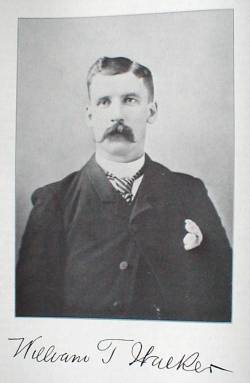
WILLIAM T. WALKER
William T. Walker, a well-known marine engineer, is a son of John and Eliza (Ferguson) Walker, both natives of Scotland, who are still living in Glasgow.
Our subject was born April 2, 1858, in Glasgow, and at that place lived until 1872, when he came to America and settled in Detroit, Mich. He served a four-years' apprenticeship to the machinist's trade in a shop in that city, and after being employed six years in the same line of work began sailing, to which he has since devoted his time. He first went on the tug William A. Moore at Detroit as second engineer, later acting in the same capacity on the Pearl for three years. The following season he spent on the Australasia as second, served as such one season on the Jesse Farwell and Smith Moore, and for four months of the next season on the Gladstone, after which he was given the position of chief on the Porter Chamberlin, on which he remained two years. From this boat he came on the F. H. Hodge for one season as chief, subsequently serving for some time in the C. B. Lockwood, one season on the Nipigon and Rhoda Stewart, and four months upon the City of Genoa; transferring to the Joliet, he remained throughout the season, and in 1896 went on the Griffin to fill the berth of chief.
Mr. Walker was married August 20, 1887, to Miss Julia Knox, of Detroit, a sister of William and Robert Knox, who have both been on the lakes for some time as stewards. Mr. Walker is a member of the Masonic Fraternity, Zion Lodge. No. 1; I. O. O. F., Riverside Lodge No. 303; A. O. U. W., Wolverine Lodge No. 10; and the M. E. B. A., of Detroit, of which he is past president, and by which he has been appointed delegate to two national conventions.
CHARLES W. WALL
Charles W. Wall was born May, 1, 1844, in the city of New York. When one year old his parents moved to Buffalo, where he received his early education. At fourteen he obtained employment in the distillery of George Truscott, and at sixteen he entered the Shepard Iron Works to learn the trade of machinist. Two years later, however, in 1862, Mr. Wall enlisted in Company C, 116th N.Y.V., serving with honor until the close of the war, being attached to the Army of the Gulf and the Army of Shenandoah, and was one of the four members of the company that were not wounded. Mr. Wall was one of the seventy-eight men from the 116th N.Y.V. Regiment (though there were a thousand men in the assault) who volunteered as a "forlorn hope" to assault Port Hudson, La., May 27, 1863. He also participated in the Red River campaign, and was with Sheridan in the Shenandoah Valley. At the close of the war he went first to Mobile, Ala., and thence to Fulton, Ill., where he shipped as second engineer on the John C. Gault, towing wood barges on the Mississippi river. Leaving the Mississippi in 1867, he shipped at Buffalo, as second engineer on the propeller Arctic. During the ensuing years he was alternately afloat and ashore, entering the government service as chief engineer of the lighthouse tender Haze, in 1875, in which position he remained some fourteen years, then going ashore to take charge of the Thompson Houston Electric Light & Power Co., at Buffalo, returning to the lakes a couple of years later, in 1891. For a while he was chief of the Cuba, America and Mariska. In the spring of 1892 he was made chief of the Owego, which position he held for the seasons of 1892-93-94-95-96-97, and on February 19, 1898, he was made superintendent of the Erie elevator of Buffalo, N.Y. Mr. Wall has been very successful in his work as engineer, and now holds one of the responsible positions with the Erie Railroad Company.
Mr. Wall was married in June, 1868, to Miss Mary A. Todd, of Buffalo. They have one daughter and reside in their own home, No. 39 Plymouth avenue, Buffalo, N.Y. Socially, our subject is a member of Hiram Lodge No. 105; F. & A.M., and of William Richardson Post No. 254, G.A.R., also of Camp 97, U.V.L. He is past commander of William Richardson Post. He is a member of the Marine Engineers Beneficial Association No. 1, of Buffalo.
CAPTAIN DANIEL WALL
Captain Daniel Wall, whose first United States license as mate and pilot dates back to 1888, received his first maritime experience on the Atlantic ocean, where he became a thorough seaman, and is well versed in all the mysteries of the craft. He was born in Richibucto, Province of New Brunswick, on May 10, 1858, and is a son of William and Jane (Beattie) Wall, natives of that Province also. Both the paternal and maternal grand-parents of the Captain were Scotch, James Beattie being an old resident of Lockmaben, Dumfriesshire, and both families came to America about the same time, locating in Richibucto, New Brunswick, but the Walls afterward removed to Marinette, Wis., where the father worked at his trade as a ship carpenter. He died in 1896, since which time his widow has resided in Marinette, Wisconsin.
After receiving a public-school education in his native town, Daniel Wall shipped, in 1872, as boy on the bark Annie McNairn, bound for Liverpool with a cargo of deals, and upon that vessel he made several voyages across the Atlantic, taking oil on the last passage and returning to Richibucto in ballast. The next year he joined the full-rigged ship Wacissa as seaman, spending almost a year on her. In 1874 he shipped on the bark Winona for Charleston, S. C., to load cotton for Liverpool, making two voyages on her. While on the second passage out the mate was murdered by one of the seamen, and Captain Wall was appointed second mate to fill the vacancy. His next berth was on the barkentine Erema, bound for Prince Edward Island with salt and iron.
On his arrival he crossed the straits of Northumberland, and paid a visit to his parents. He then shipped on the bark Tacoma, having been appointed second mate. On arriving in Liverpool he left his boat and went to Dublin, where he joined the bark Romanoff, bound for Philadelphia. He then sailed on the schooner Bell Russell as mate. After some months in the coasting trade, he shipped in the schooner Hattie Paige, of Bridgetown, N. J., going thence to his home in Richibucto.
In the year 1880 he was appointed mate on the new brigantine Wawbeck, bound for London, England, with canned lobsters. On the way out they had to put in at St. John's, Newfoundland, and discharge cargo on account of foul pumps, there being four feet of water in the hold. The return passage was very rough, the brigantine was disabled, lost her canvas, and was driven out of her course, fetching up on the island of Bermuda after a lapse of five months, the crew subsisting eight weeks on bread and water. Captain Wall then went to St. John's, Newfoundland, and was appointed master of the Alice, passing one season in fishing on the Banks. His next office was mate on the schooner Dasher. This vessel was wrecked on Magdalene island in the St. Lawrence river, and proved a total loss. The crew remained on the island three weeks, when they were taken off by a lighthouse tender. The Captain then passed some time on various small craft, after which he went west and assisted in constructing bridges on the line of the Milwaukee & Northern railroad.
In the spring of 1884 Captain Wall began sailing the lakes as seaman on the Butcher Boy, of the Marinette Barge line, going as wheelsman on the steamer Favorite the next season, and in 1886 as second mate of the same steamer. In 1887 he shipped on the schooner S. A. Wood, and in 1888 he received his license and shipped as second mate of the steamer Michael Groh, closing the season as mate on the S. K. Martin, coming out on the same vessel the following spring, but closing the season on the Ida M. Terrent. During the seasons of 1890-91 he sailed as mate of the steamer Joys. In the spring of 1892 he was appointed mate on the steamer Edward Buckley, holding that berth three seasons. In 1895 he was appointed master of the steamer Frances Hinton, and sailed her two seasons, when she was sold under him. His next boat was the steamer I. Watson Stephenson, of which he was mate. In the spring of 1898 he was again mate on the steamer Edward Buckley.
Socially, the Captain is a member of the Independent Order of Odd Fellows.
On August 14, 1880, Captain Wall was married to Miss Annie, daughter of Cornelius and Caroline (Ward) Turner, of Richibucto, New Brunswick. Their children are William Garfield, David Turner, Bertie Childs, Ruthie, and Harry. The family homestead is at No. 1446 Garfield avenue, Marinette, Wisconsin.
CAPTAIN C. H. WALLACE
Captain C.H. Wallace attained to the command of a steamboat when comparatively a young man, rising rapidly and filling every position on shipboard from that of second cook, and he has been master of many good vessels, giving universal satisfaction. Although he has but recently become a citizen of Chicago he has gained for himself many stanch friends in his new field of labor, as agent for the Youghiogheny & Lehigh Coal Company.
Captain Wallace is a native of Oswego, N.Y., born January 7, 1861, and is a son of Samuel E. and Maria (Palmer) Wallace, the former of whom was born in Scotland August 2, 1828, and on coming to the United States located in Oswego; the mother was born in Watertown, N.Y., a daughter Tyler Palmer, and sister of Capt. J.H. Palmer, a ship broker of Cleveland. Samuel E. Wallace, who was a reliable navigator, sailed on the ocean for many years and was also master and owner of several lake craft, among those he commanded being the schooners Grace Murray, Dolphin, George Steel, Saxon, J.B. Penfield, the bark Dreadnaught and the brig Seminole. At the commencement of hostilities between the North and South he enlisted in the navy, his ship doing duty on the coast with the blockading squadron. Soon after the close of the struggle he removed his family to Cleveland, Ohio, where he now lives, retired from active business.
C.H. Wallace accompanied his parents on their removal to Cleveland in 1868, acquiring his education in the public schools of that city. Like his father, he took to marine life when quite young, being only twelve years of age when given his first berth -second cook in the steamer Cormorant. It is thought that he did not possess the necessary qualifications demanded in the culinary department, as he made but one trip with the skipper of that boat. He is next found on the steamer Horace B. Tuttle, with Capt. Smith Moore, and in the spring of 1874 he shipped with Capt. Charles Hearness, before the mast in the schooner J.R. Pelton. The next spring he came out as boy in the schooner Emma C. Hutchinson with Captain Mullen, joining her again the year following, but closing the second season in the schooner Frank Perew, with Capt. John Lowe. In 1877 he shipped before the mast in the schooner William Grandy, and in 1878 in the Bolivia, of Oswego, but closed that season in the William Grandy. In the spring of 1879 he shipped in the schooner Bolivia, and leaving her in October entered the employ of the Lake Shore & Michigan Southern Railway Company as brakeman, following that occupation during the winter months for the next ten years. In the spring of 1880 Captain Wallace entered the employ of J.H. Palmer and remained with him fourteen seasons, his first berth being that of second mate with Captain Davis in the schooner John O'Neil, in which boat he went as mate the next season. In 1882 he was appointed mate of the schooner Lucerne, and in 1883 of the schooner John O'Neil. In the spring of 1884 he was promoted to the command of the schooner C.H. Johnson, sailing her two seasons, and in 1886 transferring to the schooner Brunette as master. Two years later he received his first steamboat appointment, the command of the W.L. Wetmore, which he sailed six consecutive seasons, always with good results. His next boat was the fine steamer George Presley, which he sailed two seasons. It was in the spring of 1896 that he went to Chicago as agent for the O.S. Richardson Fuel Company, and the following year he was made agent for the Independent Fuel Company, which discontinued business, however, on May 1. The Captain then accepted the appointment of master of the steamer F. & P.M. No. 2, sailing her until the close of the season. In the spring of 1898 he entered the employ of the Youghiogheny & Lehigh Coal Company, also doing business in Chicago, as agent.
On March 12, 1888, Captain Wallace married Miss Clara Cooper, daughter of F.W. and Dorothy Cooper, of Cleveland, and they have two children: Meta Gertrude and Kenneth Eugene, both attending school in Chicago. The family reside at No. 574 Fullerton avenue, that city. Socially the Captain is a member of Erie Lodge No. 27, I.O.O.F., Pearl Tent, K.O.T.M., and the Ship Masters Association (holding Pennant No. 294), all of Cleveland.
DAVID WALLACE
David Wallace was born at Loughreascouse, in North of Ireland, in 1833, and received his education at the public schools of the city of Newtownards. He came to the United States in 1852 and located at Black River, now Lorain, Ohio. Up to the time of his leaving home Mr. Wallace ad never earned a dollar; the legend does not say why, but upon his arrival in this country he immediately gave evidence of his indomitable energy and spirit of ambition. He went to work at once in a shipyard, and after a time associating himself with Messrs. W. S. Lyon and Thomas Gawn, they established a shipyard at Black River and commenced to build vessels. Mr. Wallace being a superintendent of quick comprehension, and an ambitious worker, the company launched a large number of vessels in a short time from the Black River shipyard, among them the schooner W. Scott, brig Queen of the Lakes, clipper Wing of the Morning, Leader, William Jones, Alice (which went to California), W. F. Allen, Rawson, Kate Lyons, Our Son, Grace Murray, Sumatra, and numerous others. Mr. Wallace occupied himself superintending government contact work at Buffalo, Detroit and Vermillion. He built the Daniel Clint, at Fremont, and the steamers J. H. Outhwaite and Robert Wallace, and schooner David Wallace, at Mr. Radcliffe’s shipyard, in Cleveland. At Sandusky he built the schooner Pierson, which made a voyage to Europe and was sold. He also built some vessels at Huron and Milan, Ohio.
Although long past sixty years of age Mr. Wallace does not look a year over fifty, owing in a great measure to his iron constitution. He is a man of great firmness and decision of character, and is shrewd, thrifty and prosperous. His discernment regarding the good qualities of a vessel appears to be intuitive, and mistakes are seldom recorded against him. He was instrumental more than any other man in prevailing upon the Cleveland Ship Building Company to remove their plant to Lorain, where space has been allotted for that purpose, together with ground sufficient to build a dry dock 500 x 100 feet, proving himself in this way to be public-spirited in the interests of the community which he represents. Mr. Wallace is manager of the Lorain Steamship Company, the Vega Steamship Company, and owner and manager of the Robert and David Wallace.
In 1859 Mr. Wallace was united in marriage to Miss Martha A. Gilmore, of Lorain. Their children are Capt. William H. Wallace, and Anna, now Mrs. James Hoye. The family residence is on a farm in Black River Township, one and one-half miles west of Lorain.
JOHN WALLACE
For a quarter of a century or more Mr. Wallace was identified with the history of the Great Lakes, and for quite the same length of time has his name been associated with some of the leading business enterprises of St. Joseph.
He was born March 7, 1835, in Dundee, Scotland. Mr. Wallace inherited and brought with him the characteristics which the Scotch seem to possess, and which makes everything they undertake a success. His parents, John and Mary (Reed) Wallace, were natives of Scotland, and when our subject was six years of age came to America and settled in Wayne county, Mich., where the father followed his trade, that of a molder. At the age of sixteen the son was apprenticed to learn the trade of a machinist, and for some years followed it. Later he sailed the propeller Montezuma as second engineer, under the command of Captain Titus, who was master of the steamer Erie when she foundered in Lake Erie. He became chief engineer of the same propeller, and was on her several seasons, when he put the machinery in the propeller Lady Franklin, commanded by Captain Hickie, and was with her several years as chief engineer. He next served in the same capacity on the propeller Ottawa, under Capt. John Warren. He then sailed on the Favorite, of which Nelson W. Napier was master. Mr. Wallace put the machinery in her, and worked on it through its construction in Chicago and at Howard, Wis., where the boat was built. He then went to Buffalo, and built the tug John T. Edwards, which was owned by himself and Mr. Edwards, and an interest in her was taken by Mr. Marion Barnes, and for some sixteen years the firm of Wallace & Barnes carried on the tug business about St. Joseph and Benton Harbor.
Engineer Wallace also embarked in other lines of business, and by carefully watching the details of each, and through good management and close application, he has become a successful business man, and one of the leading spirits of the city of St. Joseph, to whose growth he has contributed no small part of his energies. He had but limited educational advantages in his youth, but by self instruction and reading, and by coming in contact with the world, he has become a well informed man, and his opinions are highly respected.
He has served the people of St. Joseph creditably in different public capacities, having served as alderman of the city several times, and has been city collector, as well as city treasurer. He is a director in the Union Banking Company, and has other business connections, carrying on for many years an extensive lumber yard, and keeps builders' materials in stock, and a line of coal, wood, lath, etc. He is a most reliable man in all his business dealings.
In February of 1860 Mr. Wallace was married to Miss Alice, a native of Detroit, Mich., and daughter of James McMahon, of Irish nativity, and their union has been blessed with the following children: Lewis D., William G., Maud M., James, Alexis J., Edith A., Roy F., Dudley B., John, Jr., and Alice V. In politics Mr. Wallace is a Republican; socially he is a member of Occidental Lodge No. 56, A. F. & A. M.
CAPTAIN WILLIAM H. WALLACE
Captain William H. Wallace is a young steamboat master who has so far succeeded in keeping his vessel out of trouble and avoiding disasters, shipwrecks and other ills attendant on the shipmaster’s life. He was born in 1861 at Lorain, Ohio, and attended the public schools of that city, passing into the high school. He then spent one year at Oberlin College, leaving there to enter the Spencerian Business College, where he took a full course, and graduated at the age of nineteen. Considering himself now equipped with an education that would qualify him for his chosen profession, that of master mariner, as it might be, he directed his energies toward acquiring the practical experience necessary in any calling, and in the spring of 1880, shipped before the mast in the schooner Thomas Gawn, remaining on her one season. In 1881 he transferred to the steamer Robert Wallace, on which boat he remained eight years, as wheelsman, watchman and second mate, being on this vessel in the fall of 1887, when she and the David Wallace went ashore near Marquette, Mich. The vessels remained in a very perilous position for the crews, from Tuesday morning until Friday noon, before they were taken off by the life-saving crew, and, added to the uncomfortable condition of the boats in zero weather, they were without food. In 1889 the Captain shipped as mate of the steamer Vulcan, which berth he held four years, when he was advanced to the captaincy of the steamer. In the spring of 1896 he was appointed master of the steamer Vega, which he laid up at the close of navigation, and of which he resumed command the two following seasons.
Captain Wallace is a son of David and Martha Wallace, the former a prominent builder of lake vessels. In June, 1887, he married Miss Nellie Cunningham, of Clyde, Ohio. The home presided over by his charming wife is at No. 16 Duane Street, Lorain, Ohio.
C. E. WALSH
C.E. Walsh, of Cleveland, Ohio, was born October 23, 1861, at Douglastown, County of Gaspe, Quebec, son of Capt. James and Eliza H. Walsh, the former an old navigator. He attended the district schools in his native place until he reached the age of fourteen, when he commenced sailing with his father, who built, owned and commanded the Undaunted, 150 tons, out of Gaspe, trading between that port and Quebec, and the Island of Anticosti, with fish and oil. He then went on an expedition to Labrador, trading in oil, etc., with the Esquimaux, and during this trip built a boat about twenty-two feet long which he used in cruising along the Labrador coast, making one hundred miles alone, and learning to speak the Esquimaux language quite fluently. He described the habits and customs of that strange people in a very interesting manner, and may, in the near future, write a book setting forth his experiences among them. His little boat was driven ashore on one of the rocky points, but he managed to repair sufficiently to make his way to Esquimaux Point, where he joined his brother and thence they crossed to Gaspe the home port. This expedition was full of adventure, and Mr. Walsh being of an observing nature, profited much by it.
On October 3, 1885, he went as apprentice in a machine shop in Ottawa, Canada, where he remained two years and a half, and after sailing a tug one season he crossed over to the United States and worked in Duluth for about six months. He then went on the Yellowstone division of the Northern Pacific railroad, and was engaged in operating a derrick for bridge and pile work in 1888. This work being completed he returned to Duluth and commenced sailing, shipping as oiler on the steamers George T. Hope and Mariska, after which he served two seasons on the La Salle. In the spring of 1893 he took out engineer's license and shipped as second on the steamer Colonial; in 1894-95 he was second on the La Salle; in 1896 he engaged in the same capacity on the William Chisholm, laying her up at the close of the season, and in 1897 he held chief engineer's berth on the Choctaw.
Mr. Walsh was wedded to Miss Winifred Gaul, of Ottawa, Canada, on December 21, 1894. He is a member of the Marine Engineers Beneficial Association.
JOHN F. WALSH
John F. Walsh was born in Ogdensburg, N. Y., on February 2, 1855. He attended public schools of his native place until thirteen years of age, when he found employment as fireman of a locomotive on the Vermont Central railroad, remaining in that employ five years. He now took charge of a locomotive on the Cincinnati, Sandusky & Cleveland railroad, holding that position two years, when he began steamboating in the employ of the old Northern Transportation Line, out of Ogdensburg. In 1877 he shipped as wheelsman on the City of New York, and was next appointed second mate, serving as such two years, and transferring to the steamer Oswegatchie in the same capacity. His service as oiler in the steamer Gordon Campbell lasted during the season of 1880, and the following season he was appointed second engineer of the steamer Ontonagon, filling that berth off and on for four years. In 1884 Mr. Walsh took out chief's papers. He engineered the H. C. Schnoor two years, the propeller Newbury two years, fitted out the V. Swain, and brought out the steamer Caledonia, closing the season of 1889 on her. The following season he shipped as chief with Capt. Harry Mills in the steamer Bulgaria, remaining on her one year, and going with the Captain to the steamer Harper the following season, which he closed in the new steel steamer Gilcher. The next season he shipped as chief on the steamer R. E. Schuck, remaining on her and on the steamer G. F. Williams one year each. In 1895 he was appointed chief of the Nahant, continued as such one season, and then transferred to the steamer Britannic, which was lost by collision in the Detroit river. In 1896 he fitted out the Griffin, but finished the season in the steamer Sitka, laying her up at the close of navigation.
Mr. Walsh was united in marriage to Miss Annie L. Smith, of Ogdensburg, N. Y., on December 26, 1881. Five children have been born to them: Annie Lula, Mary Ellen, George P., Edward J. and Sarah E. Walsh.
CAPTAIN P. WALSH
Captain P. Walsh, chief officer of the steamer Modjeska, of the Hamilton Steamboat Company, under Commodore Crawford, is a sturdy specimen of the whole-souled mariner. He was born June 1, 1857, in Oakville, Ont., where his father was a prominent hotelkeeper, and was educated in the separate schools and in De la Salle Institute, in the city of Toronto, receiving a thorough training in all the ordinary branches. For the first years of his active life he was in the hotel business in Oakville with his father, who, with a view of bettering his circumstances, removed to Waterford, a small town near St. Thomas, Ont. Captain Walsh now launched into business for himself, starting a hotel in Burlington when he was about twenty years of age, and thence removing to Hamilton where he conducted a hotel from 1882 until 1886. Tiring of this business, he finally secured a position as timekeeper on the Toronto Street railway, which he held for one year, in 1887 entering the employ of the Hamilton Steamboat Company, with whom he has remained ever since, gradually working up to his present office.
Captain Walsh was married, in 1887, in Hamilton, to Miss Commerford, when he was in the hotel in Burlington. Three daughters have been born to them, Eva, Eulalia and Maggie, all of whom are receiving every advantage for education in the schools of Toronto. Captain Walsh's politics always savored strongly of Liberalism, and he takes an active part in the elections that occur while he is ashore. As a ward scrutineer he is in great demand. Municipal elections make a glorious field for him, and he invariably works and votes for the man whom he considers fitted for alderman or mayor of Toronto. He and his family are members of the Roman Catholic church.
CAPTAIN JOSEPH WALTMAN
Since 1892 Capt. Joseph Waltman has not been actively connected with marine work, but his interests are still in that line, and he is identified with the shipmasters of Detroit, where he resides at the present time. His retirement from sailing was of short duration, however, and he was soon following his favorite occupation again, as he had the greater part of his life.
Captain Waltman was born in Monroe, Mich., in 1847, and in that place he spent the days of his boyhood. Early he had a desire to be a sailor, and when ten years old shipped on a steamer running out of Monroe, as cabin boy. After five years' service in this capacity, he acted as decksweep for a time, then shipped on the tug B. F. Bruce as wheelsman. On this boat he remained two years in that position and then became her mate, after which he took command of the tug Gore. He held this position throughout the season, and the next year acted as mate on the tug John Martin, after which he became master. In 1863 he entered Winslow's employ, and brought out new the Maria Love. She was sold in the fall to the government, and he delivered her for the owners in the Brooklyn navy yard. On Winslow's line he was employed ten years, going on the Kate Williams, and the Winslow, after the Maria Love was sold. He then spent two years on the Gazelle, running between Sandusky, Put-in-Bay and Cleveland, and one season on the W. R. Clinton steamers, and five years in the Dunlap and the Metropolis, of the Bay City and the Alpena line. He spent the next season on the Salina, and then went on the St. Mary, running from Detroit to Toledo, there remaining one season. After one season spent on the J. E. Potts, and one on the yacht Lelia, and the I. U. Masters, he was engaged in the wrecking business on the Kate Williams.
In 1881, Captain Waltman was married to Mrs. Hattie M. Dewey, of Brattleboro, Vt. They reside at No. 56 Howard street, Detroit. He is a member of the Ship Masters Association; is a 32d-degree Freemason, member of Union Lodge, F. & A. M.; of Peninsular Chapter No. 16 , R. A. M.; is a Knight Templar, of Masters Commandery No. 12, and member of Moslem Temple, Mystic Shrine; is also a member of the A. O. U. W. of Detroit.
ANTHONY WARD
Anthony Ward, one of the prominent marine engineers living in West Bay City, Mich., has been exceedingly happy in the choice of his profession, to which he is particularly adapted, and he has advanced rapidly and retained his positions as long as he found them desirable. Mr. Ward was born in Marine City, Mich., September 12, 1860, a son of Hiram and Bridget (Mannion) Ward, the former a native of Dresden, Ontario, the latter of County Mayo, Ireland. The father, who was a farmer by occupation, came to the United States with his family about 1840, locating near Marine City, where he is still living. The mother passed away in 1876.
Anthony Ward received a liberal education in the Star school at Starville, which he attended until he reached the age of nineteen years, engaging in useful occupations during the vacation period. With the purpose of becoming a marine engineer he shipped in the steamer D. F. Rose as fireman, remaining with her until the spring of 1884, when he applied for and was granted an engineer's license at Detroit. He was then appointed second engineer in the same steamer, holding that office three seasons, and in the spring of 1887 he joined the steamer Music as second engineer, following with a season in the Sanilac in the same capacity. In 1889 Mr. Ward was appointed chief engineer of the Sanilac, which he ran for four consecutive seasons, always giving good account of his machinery. In the spring of 1893 he transferred to the steamer D. F. Rose as chief, and after three seasons of satisfactory work he was, in 1896, appointed to the berth he now holds - chief engineer of the steamer Arizona. He is a member of the Marine Engineers Beneficial Association of Bay City.
On January 12, 1887, Mr. Ward was married in Reese, Mich., to Miss Margaret Ryan, daughter of John Ryan, of Saginaw, Mich., and the children born to this union are Mary Amelia, Margaret Ellen and Agnes Rose. The family residence is at No. 209 Hart street, West Bay City, Michigan.
CAPTAIN JULIUS A. WARD
Captain Julius A. Ward, a prominent and public-spirited citizen of Marine City, Mich., is the son of Peter and Catherine (Esche) Ward, born in Columbia, Tenn., October 5, 1850. His parents were natives of Mauch Chunk, Penn., in which city they were married. The children born to them were: Edward, who married Miss Lucy Landfair, sister of Captain Landfair, master of the steamer Republic, in 1897; Marietta and Susan, who died at the ages sixteen and seventeen respectively; Charles Ezra, who died in Santa Rosa, Cal., in 1880; Ann, who became the wife of Alonzo Landfair, and died in June, 1863; Stephen, who passed away in 1884 at Leslie, Mich.; Julius A and his twin sister, Julia Alice (she united in marriage with Marshall S. Perry, and is now residing in Cuero, Texas); and Eugene J., who made Miss Marietta Williams his wife, and is now living in Red Land, Cal. In the year 1837 the family removed from Pennsylvania to Clinton, Lenawee County, Mich., where a tract of land was purchased and a clearing made; they next went to Leslie, Ingham County, Mich., where they purchased a farm and remained on it for a number of years. About the year 1847 the family went South, locating at Columbia, Tenn., where they acquired considerable city property. In 1863, during the progress of the Civil war, they suffered much damage by pillage and fire from the soldiers of both armies, and their father, Peter Ward, determined to return to Michigan, which he did, locating on his farm at Leslie. He had served throughout the Mexican war under General Scott, and with his regiment participated in many hotly contested battles, where courage was victorious over superior numbers of Mexicans; notable among the engagements were the pitched battles of Cerro Gordo, Chapultepec and City of Mexico.
On September 10, 1864, Julius Ward, then a well-grown lad of fifteen years, enlisted in the First Michigan Light Artillery as messenger boy, his battery being M, commanded by A. H. Emory, and was stationed at Cumberland Gap, under General Cox. [His two brothers, Ezra and Charles, were also Union soldiers, being members of Battery A, First Michigan Light Artillery.] While at the Gap, the battery was on several occasions engaged with the enemy. After serving until the close of the war Mr. Ward was honorably discharged and mustered out of service September 1, 1865, at Jackson, Michigan.
Previous to his enlistment, Julius had acquired a district-school education, but on his return home he went to Lansing, Michigan and attended the old Academy for three winters, and in 1868 he graduated from the high school at Leslie, and took a course in a private school at Flint, Michigan. That fall he entered the employ of the New York & Erie railroad (Eastern division) as fireman on a locomotive, remaining one year. In the summer of 1870 he purchased a stock of groceries and opened trade in Leslie, conducting the business successfully nearly two years. In the spring of 1872 he went to Columbia, Tennessee, to look after the city lots owned by his father, and in the interest of the Singer Sewing Machine Company, as collector. He remained there one year, when he went to Leslie and won his bride, Miss Hattie Rice, later returning to Columbia, where he resided until December 1, 1873, when he again went north, this time locating in Marine City. He then entered the employ of the Toledo & Saginaw Transportation Co. (in which he had purchased stock) as a steamboat painter, David Lester being superintendent of the yard. It was in the spring of 1874 that Captain Ward began his career as a sailor, shipping as watchman on the steamer V. H. Ketcham. The next two seasons he sailed as mate of the schooner Kittie Brainard, and in the spring of 1877 he was appointed mate of the steamer Troy, and held that berth until August, 1879, when he was made master of the A. Gebhardt. The next two seasons he sailed the Brainard and came out in her in the spring of 1882, but was transferred to the new steamer C. F. Curtis, in which he closed the season as master. This was followed by three seasons as master of the schooner Theodore S. Fassett. He then sailed the schooner Minnie E. Orton three years. In the meantime he purchased an interest in the steamer Buckeye State, but sold out in the spring of 1889 and bought the schooner Dayton, which he sailed three seasons. Captain Ward then purchased stock in the Miami Transportation Company, and became one of the directors, and in 1892 assumed command of the steamer Miami. The next season he sailed the schooner Mingo, which had been built that winter; he also owns an interest in the new steamer Mohegan, but did not sail her. In the spring of 1894 he again took command of the steamer City of Concord for the Mills Transportation Company. The next spring he brought out the steamer Miami, but sold his interest in her, and stopped ashore the balance of the season. He was appointed master of the steamer J. P. Donaldson in the spring of 1898.
By industry and good business methods the Captain had acquired considerable real and personal property, including a farm near Leslie, and one near Manistee, Michigan, and has a handsome homestead in Marine City, Michigan. Besides his vessel property he is a stockholder in the Marine Savings Bank. Fraternally he is a Royal Arch Mason and a member of the council, a charter member of the Knights of Pythias, and of the Odd Fellows, a charter member of the Maccabees, of the Newport Club, and carries Pennant No. 783 of the Ship Masters Association at Marine City, which he represented as delegate to Washington two terms and at Milwaukee in 1898.
Captain Ward was married to Miss Hattie Leona, daughter of S. P. and Harriet (Childs) Rice, of Leslie, Michigan. Two daughters, Florence Rice and Grace A., have been born to this union.
WILLIAM WARD
William Ward, senior, member of the firm Ward & Jackson, the leasing shipsmiths and iron forgers of Cleveland, Ohio, has been quite successful in his business, and has the distinction of having ironed the major part of the new vessels built in Cleveland at the various shipyards when wooden shipbuilding was carried on so extensively at that port. He has won the way to his present comfortable condition by unremitting industry and thrift. Mr. Ward was born in Toronto, Ont., January 19, 1842, and is a son of Christopher and Maria (Day) Ward, his father a native of Norwich, England, whose ancestors had for many generations been farmers. At the time of the father's birth the family was nearly extinct, and when a child he went to live with his grandfather, the only surviving member of their immediate family. In 1830 he crossed the Atlantic, and located on Prince Edward Island, but soon afterward removed to Toronto, Canada, where he made his home until January 24, 1868, going then to the Georgian Bay region, where he bought a farm near Owen sound. At an early age William Ward, the subject of this sketch, removed with his parents to Trafalgar, Ont., where he received a fair common-school education, and on leaving that place resided for a short time in Brampton, in the same Province. Later he lived in Streetsville, Ont., where he learned the blacksmith's trade, and on coming to the United States, in 1862, he located in Cleveland, where he soon obtained employment in the agricultural shop owned by Younglove, Massey & Co. Subsequently he worked in the Mahoning railroad shops, and in the marine works of Blish & Gerlack, and spent one year in Youngstown, Ohio, after which he returned to Cleveland. For a time he was also in the employ of the Cleveland & Pittsburg shops in Wellsville, as foreman, and the Lake Shore shops and the Cleveland, Columbus & Cincinnati shops in Cleveland. On leaving that position he established his present shipsmith and machine forging business, being in partnership with John Blatt for a year. That partnership being dissolved, he has since been connected in business with E.J. Jackson under the firm name of Ward & Jackson, who enjoy an excellent trade, which is certainly well deserved, for both are expert and skillful workmen. They have recently removed their works to more commodious quarters on the same street, a few doors from the old shop. Socially, Mr. Ward is an active and ardent Mason, holding veteran's certificate of Bigelow Lodge, F. & A.M., and fills the office of trustee; a veteran of Thatcher Chapter, of which he is also a trustee, and a veteran of Holyrood Commandery. He is also a Noble of the Mystic Shrine. He holds a certificate as a life member of the Ohio Masonic Home, of which he is also a trustee.
On February 15, 1870, Mr. Ward was united in marriage with Miss Catherine Ansable, of Cornwall, Ontario, and to them have been born four children: Adelbert V., now in the employ of the McIntosh Huntington Company, and who married Miss Hattie, daughter of Enos Jenkins, engineer of the Penobscot; Elizabeth, wife of Francis P. Martin, of Cleveland; William E., a civil engineer now in the employ of the city of Cleveland, and who, like his father, is an ardent Mason; and Catherine E., who became the wife of Dr. Robert C. Droege, a practicing physician of Cleveland, Ohio. The family homestead is pleasantly situated on Whitman street, Cleveland.
LIBERTY H. WARE
Among the men in public life who have had considerable nautical experience is Hon. Liberty H. Ware, of Cleveland. He is a grandson of John T. Ware, of Philadelphia, who spent his life in building sailing vessels, and who was for a long period head ship-builder in Stephen Guard's shipyard in Philadelphia; he also held a responsible position in the United States for some time.
Samuel Ware, the father of the subject of this sketch, was a farmer who lived at one time in Philadelphia, later removing to Columbiana County, Ohio, where his son Liberty H. was born in 1844. Twelve years later the family made their home at Avon Point, and five years after that they took up their abode in Cleveland. The early life of Liberty H. Ware was spent in school, his spare time being employed in boats for pleasure. After removing to Cleveland, he commenced the study of law in the Union Law College, remaining in that institution three terms. He had been reading law for some time previous in the office of R. E. Knight and H. H. Blackburn, and at the expiration of the third term in the Union Law College he received his diploma. Up to this time he had made many occasional trips with the lake vessels of that day, having sailed in the George H. Ely, as mate of the schooner Patton, in the William B. Ogden, the Black Rover, the Addie, the Geo. W. Holt, the scows-Leo, Dido, Comfort, Ann, Black Swan, and E. K. Kane, the square-rigged scow Gladiator, and the Free Mason. While he was in the Addie, that vessel was wrecked at the entrance to Cleveland harbor by running against the pier, and sunk. The crew took to the yawl boats, but that craft was upset and the men were washed on the beach by the waves.
When Mr. Ware received his diploma, he folded it up and placed it in his vest pocket for safe keeping, then walked directly to the dock where the schooner Yorktown was lying ready for a trip across the ocean. The Yorktown's cargo of oil was on board, and, when Mr. Ware offered to ship as able seaman, his services were at once accepted. His desire to see something of the world was granted, and during the next few months he met many varied experiences. The Yorktown was chased by a privateer on the way over, but being a speedy schooner had no difficulty in getting out of the way. The voyage from Cleveland to Liverpool lasted twenty-eight days, and after spending some time in England, Mr. Ware returned to the ship Damascus. Then he took up the practice of law in what was then West Cleveland, and he has lived ever since in the home formerly occupied by his parents. In the practice of his profession he has been successful, and his fellow citizens have repeatedly asked him to serve them in a public capacity. He was mayor of West Cleveland two terms, has been a justice of the peace, member of the council, postmaster and police justice. He has always sailed more or less. With Capt. J. W. Moore he purchased the fast sailyacht Minx, and later he and Captain Moore built the sailyacht L. H. Ware, which was afterward transformed into a steamyacht. He now owns the single-stick yacht Restless, a very speedy boat of forty feet over all.
Mr. Ware's first wife was Miss Mary Jane Wroath. In 1879 he married Miss Mary A. Cobb, of Stark County, Ohio; they have two children: Liberty Bernard and Frances Alice.
NORTON J. WARNER
Norton J. Warner was born at Medina, Orleans Co., N.Y., April 15, 1830, and there obtained his education. His parents, Charles and Adeline (Jerome) Warner, came from Hartford, Conn., and the father was a millwright by trade. The mother was an own cousin of Leonard Jerome, of Jerome Park fame, whose daughter married recently into the English nobility.
Mr. Warner, the subject of this sketch, worked about seven years during his early life in various machine shops previous to the fall of 1853, when he shipped as second engineer of the steamer Portsmouth. The seasons of 1855-56 he was second of the Adriatic and in 1857 fitted out the side-wheel steamer Empire, but she did not leave port because of the hard times. During that season he made trips as second engineer respectively on the side-wheel steamer Minnesota, propeller Ontonagon, Equator and Potomac, and toward the end was made chief of the Eclipse and later of the Marquette. After a couple of seasons in her he was chief of the Hunter for a season and then followed with seven years in the Government service, during which time he was first assistant engineer of the revenue cutters Commodore Perry, Fessenden and John A. Dix. His next employment was as chief engineer of the Thomas A. Scott, in which he remained for a couple of seasons, and finished his career upon the Great Lakes as chief engineer of the Winslow, continuing on her for seventeen consecutive seasons beginning with that of 1872. He left the lakes in October, 1889, and was variously employed as engineer from that time until July, 1894, when he was made chief engineer of the Fornes building, on the corner of Pearl and Swan streets, Buffalo.
Mr. Warner was married, February 12, 1858, to Margaret Ahren, and they have the following children: Charles J., Walter D., Mary Adeline, Thomas C., Ella Augusta and Margaret Letitia. Charles J. Warner has for seven years been deputy collector of internal revenue at Buffalo, still holding that position; Walter D. is an architect; Mary Adeline is the wife of John Emig, a commercial traveler for the Henry Huber Company of New York; Thomas C. is a ranchman in the northwestern part of Texas; Ella Augusta is the wife of Albert P. Scheu, whose father was an ex-mayer of Buffalo; Margaret Letitia is the wife of Oscar O. Cosack, a lithographic artist, who is a son of Newman Cosack, the founder of lithography in Buffalo.
CAPTAIN HENRY WARWICK
Captain Henry Warwick is a son of Thomas and Mary (Granger) Warwick, and was born in New Baltimore, Mich., February 14, 1848. Thomas Warwick was a millwright by trade, but also worked a farm and kept a hotel at Lakeport, Mich. He had five children, two of whom only are living - the subject of this sketch, and another son, Burt, who was master of the schooner W. K. Moore for the season of 1896; she was owned by A.W. Comstock and hailed from Alpena.
Captain Warwick had very little school education until he was grown up, and at the age of twelve he began sailing the lakes. He shipped first out of New Baltimore as boy with Capt. Thomas Donohue, on the schooner C. Reeves, and was in several vessels in the same capacity immediately succeeding that employment. He was employed on sail vessels about fifteen years, three years of that time as master. In March, 1863, he entered the army, and during his service was confined seven months in Libby prison, being released at the close of the war in 1865. From 1865 to 1883 he was before the mast, and as mate upon various sailing vessels. In the season of 1883 he first sailed steamboats. That season he was mate of the steamer Robert Holland, a passenger and freight boat, out of Cleveland to Mackinaw, in which he remained three seasons in the above position. In 1886 he was mate of the side-wheel steamer W.R. Clinton, in the trade between Sandusky and Mackinaw, and in 1887 he was given master's berth on the tug Ballentine, towing rafts in Lake Superior. The following season he held mate's berth on the steamer Steven C. Hall in the general trade, and in 1889 master's berth in the steambarge Westford. For the seasons of 1890-91-92 he was master of the propellers Araxes, Porter, Chamberlain and Artic, at the conclusion of which period he was compelled to retire from the lakes because of illness. In July, 1895, he was made master of the Buffalo harbor police tug Gov. Morton, and vacated that position in May, 1896, since which time he has remained on shore, and is with Howard H. Baker as solicitor in the boat trade. However, he has no intention of continuing on shore, but will resume the lake service when a favorable opportunity offers. He is a member of the Local Harbor No. 41, American Association of Master and Pilots.
In 1872 Captain Warwick was married at Port Huron to Miss Dora Mitchell, by whom he has two children, Earle, a clerk in New York City, and Sadie, living at home. The family residence is at No. 419 Glenwood avenue, Buffalo, New York.
GEORGE WATERBURY
George Waterbury was born in Hullsville, Walpole Co., Ontario, January 31, 1859, his parents being Canadians. His father was a ship-builder by trade, and built a number of vessels at St. Catharines and Burlington, Ontario. From the latter place he moved to Detroit in 1866, and then to Milwaukee, Wis., on the propeller Lac la Belle in 1868, after she had been raised from the St. Clair river, where she was sunk, and later rebuilt at Detroit. On reaching Milwaukee he engaged with the Engelmann Transportation Company as general superintendent, which position he held for twelve years, or until the line sold out, then removing to Dakota. He remained there a number of years, and then went to Pensacola, Fla., where he built a boat for himself, naming it the E.W. Menefee. Finally he removed to Memphis, Tenn. where he now resides.
At the age of fourteen years George Waterbury, the subject of this sketch, graduated from the public schools of Milwaukee, Wis., and, having a liking for the life of the sailor, he shipped as oiler on the steamer Flora, remaining on her until her machinery broke down, after which he learned the machinist's trade, serving nearly two years in the shop. He then went as oiler on the steamer J.A. Dix, and remained on her four years, the third year being second engineer. In 1879 he was appointed chief engineer of the steamer Cormorant, of Cleveland, following this with two years on the steamer William A. Barnum, finishing the season on the steamer Minneapolis. Both of these vessels now lie at the bottom of the Straits of Mackinac. The next year he went as engineer on the propeller Oneida, and was in her the winter the propeller Michigan was lost on Lake Michigan. He remained on the Oneida two seasons, and she was lost on Lake Erie by fire some time after he left her. He then served two winters on the propeller Roanoke plying between Milwaukee and Grand Haven; the Roanoke was burned on Lake Superior four years after he left her. He was second engineer in the propeller Garden City the last season she was owned by the old Northern Transportation Company, a line of fine boats now gone out of existence, with but a few relics left to distinguish the larger class of boats of those days. The following season he was on the propeller Oneida, and in 1887 brought out the steambarge Missoula, remaining on her one season. She foundered on Lake Michigan in 1895. In 1888 he brought out new the steamer E.P. Wilbur, and remained in her until fall, when he went home sick, but finished the season on the J.C. Pringle. He then went to Caryville, Fla., and assisted his father in the construction of the Menefee, which boat he engineered for eighteen months; later she foundered at Pensacola. Going north again in 1890, he took an appointment in the steamer Australasia, which foundered on Lake Michigan, in 1896, on account of fire. He remained in her part of the season, finishing with the steamer Philip Minch, and continuing in the Minch until June of the following season. He then went as engineer of the Marina, and in the summer of 1892 he brought out the steamer Maritana, in which he remained four years. Mr. Waterbury then went to work for the Cleveland Ship Building Company for some time, and later as chief engineer in charge of the machinery of the large new building in Cleveland, called the American Trust Building. While he has been at one time or another engineer of a number of steamers that have been burned or lost by collision or foundering -these disasters occurred after Mr. Waterbury had severed his connection with these vessels. At this writing Mr. Waterbury is chief engineer of the steamer Pontiac, owned by the Cleveland-Cliffs Iron Company.
In 1892 he was united in marriage to Miss Susie E. Goff, of Columbus, Wis. Mr. Waterbury is a Knight Templar, and is a member of the Royal Arcanum.
CAPTAIN L. H. WATERBURY
Captain L.H. Waterbury, who was a prominent steamboat master in the earlier years, but who was retired from active service on the lakes, was born in Middletown, Orange Co., N.Y., in 1831, son of Selick and Hester Waterbury. He attended the public schools of his native town until he reached the age of thirteen years. In the spring of 1843 he went as boy with Captain Waite on the old schooner Constitution, and the following season was on the brig Constellation with Captain Anderson. In 1845 he remained ashore and attended school during the year in order that he might better qualify himself for a master's berth. In the spring of 1846 he shipped as wheelsman on the steamer William Henry Harrison, with Captain Piatt. In 1847 his father purchased for him the schooner Temperance, which he sailed successfully for six years. The Captain received his first papers from C.L. Russell, a well-known Cleveland man, recently deceased. In the spring of 1853 he shipped as wheelsman on the propeller Oregon, of the New York & Erie Steamboat line; he passed the season of 1854 as master of the schooner Fredericks; in 1855 he was appointed mate of the propeller Granite State, of the Northern Transport-ation line; in 1856 mate of the Pacific, of the New York Central line; in 1857 second mate of the propeller Portsmouth. He then shipped on the Lady of the Lake, and was second mate of her when her broilers exploded, causing the death of two of her crew. After this disaster he went as second mate of the propeller Cushman, and in the spring of 1859 was made mate of the propeller Olean, with Capt. Thomas Holland; in 1860 he served as mate of the steamer Tioga with Captain Sisson, and in 1861 held the same berth on the Olean with Capt. Michael Driscoll.
In the spring of 1862 Captain Waterbury was appointed master of the steamer Tioga, 1863, master of the steamer Olean; 1864, mate of the steamer S.D. Caldwell, in the Lake Superior trade; 1865, mate with Captain Rawson on the propeller Brooklyn; 1866, master of the propeller Evergreen City; 1867, mate with Capt. Gil Traverse on the propeller Pacific. In 1868 he again entered the employ of the Northern Transportation Company, then under the management of George Eddy, as mate with Capt. John Brown on the propeller Young America. In 1869 he became mate with Capt. Robert Richardson on the propeller City of Toledo, remaining on her three seasons, when he was appointed master of the Young America; in the fall of 1873 she went through her cylinder, and thus being rendered helpless went on the beach. In 1874 he was appointed master of the City of New York. The following year the boats of the old Northern Transportation line were thrown into the hands of a receiver, but in August, when an accommodation had been made and the steamers released, he again assumed his old command. In the spring of 1876 he was appointed master of the propeller Milwaukee. During the year 1877 he stopped ashore, and the following season again commanded the Milwaukee. He is a member of the Ship Masters Association and hold Pennant No. 193.
In 1879 Captain Waterbury entered the employ of the Cleveland City Forge Company, and has remained in the office of that firm eighteen years as superintendent of weights and supplies. He has gained the reputation of being reliable and trustworthy in all the responsible positions he has held, and has well earned the confidence of the people by whom he has been engaged.
Captain Waterbury was married to Miss Maria Borne, of Cleveland, in 1852, and three children have been born to this union: L.H., who is captain in the Cleveland fire department of engine No. 17; John S., who is lieutenant in the Cleveland fire department of engine No. 8; and Fanny E., now Mrs. N. Clancey. The family residence is No. 62 Portland street, Cleveland, Ohio.
WILLIAM WALLACE WATTERSON
William Wallace Watterson, the efficient superintendent of the Cleveland Ship Building Company at Lorain, is one of the youngest shipbuilders that has ever attained to so important and responsible a position. He was born at Peel, Isle of Man, May 5, 1861, a son of John and Christian(sic) (Wallace) Watterson. His father was also born on the Isle of Man, and was a master mariner and owner of several schooners, among which were the Boomsang, Dart and Mona, the last named being christened in honor of the ancient name of the Isle of Man. The mother was born in Fifeshire, Scotland, a daughter of William Wallace, a lineal descendant of the great and patriotic warrior Sir William Wallace, and this name has been borne by the eldest son of all the descendants through all the generations since the death of that hero.
Mr. Watterson, our subject, was educated in the public schools of his native land, after which he became an apprentice to Thomas Watson, a shipbuilder at Peel, with whom he remained until he was nearly twenty years of age. In 1881 he went to Liverpool and joined the full-rigged ship Elwy, of that city, as carpenter on a voyage to the west coast of South America, touching at Valparaiso, Coquimbo, Chaural and Iquique, then returning to Falmouth, England, thence proceeding to Hamburg, Germany, the time occupied being one year and nine months. He left his ship at Hamburg and returned home where he engaged in shipyard work for two years.
In the year 1885 Mr. Watterson came to the United States, locating in Cleveland, where he found employment with the Cleveland Dry Dock Company as superintendent, and looked after the construction of the steamer Horace A. Tuttle. The next year he was appointed superintending builder in the yards of William Radcliff, the steamers Philip Minch, Maurice B. Grover, Gladstone, Pasadina and Hesper being built under his direction. He remained with Mr. Radcliff and the Ship Owners dry dock until September 1, 1898, on the 10th of which month he was appointed superintendent of the Cleveland Shipbuilding Company, at Lorain, a position he now holds. Since his appointment he has launched the steamers Clarence A. Black and Pennsylvania, and has under construction a large steamer for Capt. Thomas Wilson, one for W. Hawgood, and one for A.B. Wolvin. Mr. Watterson, as a naval expert, has been frequently in demand to act on wreck surveys, etc., but since he has accepted his present responsible position he generally declines these encroachments upon his time.
On October 23, 1893, Mr. Watterson was wedded to Miss Laura McGarvey, daughter of Patrick and Harriet (Crowe) McGarvey, and sister of Capt. William McGarvey. One son, William Wallace, has been born to this union. The family homestead is at No. 8 Watterson street, Cleveland, Ohio. Socially Mr. Watterson is a Master Mason, being a member of Bigelow Lodge in Cleveland.
CAPTAIN JAMES B. WATTS
Captain James B. Watts is a son of Matthew Watts, who died from exposure on Lake Winnepeg while a captain in the employ of the Canadian Government, having been lashed to the bottom of the yacht Keewatin for ten days and nights, in the month of September, 1890. The mother was Fairlina Brotchie, and her family were sailing men.
James was born in Collingwood, Ont., in 1861, and his first sailing was in 1876, before the mast on the schooner Kittie, in the lumber trade from Lake Huron to the Lake Erie Ports. The next season he was before the mast on the schooner Hannah Moore, and in 1878 was mate on the same schooner, going, in 1879, as mate on the schooner Seaman. In 1880 he was before the mast on the schooners Thomas Gawn, Riverside, Selkirk and other lake traders, until the close of 1884. During the season of 1885 he was wheelsman on the steamers Wm. A. Haskell and the Wm. J. Averill, from Ogdensburg to Chicago. In 1886 he shipped as second mate on the steamer India, and the next year, 1887, was made first mate on the steamer Vienna.
During the seasons of 1888-89 he was first mate on the steel steamer Cambria, until July 12, 1889. He then went on the steamer Havana as captain, and sailed her until the close of 1890, and in 1891 he went as master to the steel steamer Norman, and in 1892 joined the United States lighthouse tender Warrington, in the same capacity, but in July of that year he changed to the steamer City of London. The season of 1893 he passed ashore, excepting two months late in the season, when he sailed the steamer Briton. In 1894 he sailed the steamer R. P. Ranney. In 1895 he accepted the position of first mate on the steamer Briton, and during the season of 1896 filled the same berth on the large steel steamer Coralia. In 1897 he went as master on the steamer Briton, and now (1898) is holding the same position on the same steamer. He is still unmarried.
ROBERT WATTS
Robert Watts is a modest young man, but possesses the laudable ambition to be one of the best engineers on the lakes, and to gain this end he is studying hard. His father, Matthew Watts, was a sailor on the ocean and lakes for the Canadian Government, being a master at the time of his death, which was caused by exposure on Lake Winnipeg, he having been lashed to the bottom of the yacht Keewatin for ten days and nights in the month of September, 1890. The mother's maiden name was Fairlina Brotchie.
Robert was born in Port Franks, Ont., in 1873, and his first experience on the lakes was in 1890, as waiter on the United Empire, running from Sarnia to Duluth. In 1891 he was wheelsman on the lighthouse tender Warrington, and the next season he wheeled the City of London, and the following season was oiler on the S. R. Kirby.
In 1894 he became oiler on the Harvey H. Brown, and the next season again became oiler on the S. R. Kirby. In 1896 he had charge of the machinery of the George E. Hartnell. That fall he was given his papers, and the season of 1897 found him second engineer of the steamer E. M. Peck, and the following season, that of 1898, he served as second engineer of the steamer S. R. Kirby. His is unmarried.
WILLIAM WATTS
William Watts was born in Collingwood, Ont., March 11, 1859. His father, Matthew Watts, was a sailor before him, having been in the employ of the Canadian Government as master on the ocean and lakes until his death from exposure on Lake Winnepeg, he having been lashed to the bottom of the yacht Keewatin for ten days and nights during the month of September, 1890. The mother was formerly Fairlina Brotchie. His first experience as a sailor was on a dredge, filling any capacity upon which he was called to fill, and so worked for five years, when he took out papers licensing him to sail as second engineer. In 1879 he went to Detroit, and that season was on the tugs Sweepstakes, C. Champion, I. W. Masters and Stranger as second engineer, without losing a day, all of the tugs being owned by John R. Gillett. The next season he filled the same position on the tug Niagara, for Merrick & Esselton, and remained on her four years, towing six barges in the Lake Superior trade. In 1884 he went into the employ of the Northwestern Transportation Company, where he has been ever since; officiating as second engineer on the Forrest City two years; on the Fayette Brown one year; on the E. M. Peck two years; and of the S. R. Kirby six years. He is a member of the M. E. B. A. He is unmarried.
JOSEPH A. WEBER
Joseph A. Weber, a marine engineer who has come to the front in his profession very rapidly, is an ambitious young man, and has alrady attained to a position of responsibility as chief of the fine passenger steamer Georgia, owned by the Goodrich Steamship Company, of Chicago. Mr. Weber was born March 3, 1868, in Manitowoc, Wis., a son of Peter and Stephanie (Burkhart) Weber. His father, who is a native of Luxemburg, Germany, has sailed the lakes for many years in the capacity of marine engineer, and he is now in the employ of the Goodrich Steamship Company as chief of the steamer City of Racine.
Joseph A. Weber acquired a liberal education in the public schools of Manitowoc. He began at the foot of the ladder, as coal passer in the side-wheel steamer Chicago, of the Goodrich line, for two months, and after firing in the same steamer about three years, he secured his license as engineer, on May 27, 1889, and was appointed first assistant in the steamer Depere; he closed that season in the steamer Mary Mills. In the spring of 1890 he was appointed second engineer in the steamer Chicago, making three trips a week in the passenger trade between Manitowoc and Chicago, and the next season transferred to the steamer Indiana, of the same line, serving as second engineer of her until September, when he joined the wrecking tug Monarch. He finished the year in the steamer Menominee, which has since been rebuilt and named the Iowa, plying all winter. In 1892 Mr. Weber was appointed chief engineer of the tug Arctic, following with a season as second in the steamer Chicago. In 1894 he joined the fine steamer Virginia as first assistant, and the next spring was appointed chief engineer of the steamer Sheboygan, plying between Chicago and Green Bay ports, holding this berth three seasons; when the Georgia was rebuilt and came out in 1898 he was transferred as chief to that steamer, plying between Manistique and Chicago.
Mr. Weber is an honored member of the Marine Engineers Beneficial Association, and when the branch was organized in Manitowoc he was elected financial and corresponding secretary; he has also filled the office of vice-president, and was president for two terms, performing the duties of that incumbency with ability and discretion. He lives with his parents in Manitowoc.
WILLIAM L. WEBSTER
William L. Webster, who, for several years was prominently identified with the lake marine, but now chief engineer of the J. Q. Adams school on Townsend street, Chicago, was born in Chatham, Province of Ontario, Canada, in 1857, and is a son of James T. and Alice (Butler) Webster, natives of Scotland and Canada, respectively. In early life the father emigrated to Canada, and is now a resident of Florence, Ontario, where he is engaged in the undertaking business the mother is deceased, having died in Canada.
William L. Webster was reared at Florence, and at Chatham learned the machinist's trade, serving a four-years' apprenticeship. Early in life he also obtained a thorough knowledge of the workings of marine and stationary engines, and for eighteen years was identified with the lakes. In 1880 he sailed from Windsor, Canada, as engineer on the old tug Beaver, and the same season was also on the W. F. McRae, after which he was on the carboat Michigan, running her until the winter of 1881. He then filled the same position on the passenger boat running from Detroit, Mich., to Windsor, Ont., and was next chief engineer on the excursion boat Garland, running to Belle Isle and other points, going thence to the E. K. Roberts, plying between Detroit and Duck island, and the next season was chief engineer of the Chamberlin, engaged in the lumber trade out of Saginaw, Mich. He then brought out the steamer Gogebic, which was engaged in the iron and grain trade on Lake Superior, and the following season was chief engineer of the L. W. Palmer, in the coal and iron ore trade. The next season he was chief engineer on the Chemung, plying between Buffalo and Chicago in the grain and package freight business; accepting a position with the American Steel Barge Company, he was on various boats as chief engineer for some time, then joined the Columbia as chief for three years. During the winter of 1895-96 was chief engineer at Cairo, Ill., on the government dredge Beta, plying on the lower Mississippi, and one of the largest dredges in the service. Its machinery consisted of two engines of 1,500 horse power, triple expansion, and four cylinders, 20-1/2, 33, 38 and 38 x 24, and also an engine of 500 horse power, cross compound. On the third official test, this dredge took out 77.984 4-10 cubic yards of measured sand in one hour and ten minutes, and also cut a channel forty feet wide, six and a half feet deep and eight hundred and fifty feet long in one hour and fifty-seven minutes.
Mr. Webster came to Chicago in 1895, and is now chief engineer of the J. Q. Adams school on Townsend street, while his home is at No. 104, same street. Socially, he is a member of the M. E. B. A. No. 4, of which he is acting secretary pro tem, and also a member of the A. O. U. W., of Portland, Oregon, where he resided for three years while in the government employ. He holds an ocean chief engineer's license, besides those for lake marine and stationary engines.
Mr. Webster was married in Florence, Ontario, in 1878, to Miss Margaret Kerr Stewart, a native of Glasgow, Scotland, and they have one daughter, Elizabeth A.
LAWRENCE D. WEEKS
Lawrence D. Weeks, who was chief engineer of the steamer J.C. Lockwood during the season of 1896, was born in Vermilion, Ohio, in 1869, his father being Captain Leeds H. Weeks, a well known vessel master. He attended school in Vermilion until he was fourteen years of age, when he commenced sailing. From that time until twenty years of age, he studied in Cleveland every winter, first in the Spencerian Business College and then in the Case School of Applied Science. He continued to live in Vermilion until he was twenty-two years of age, when he removed to Cleveland.
The first vessel on which he sailed was the schooner B.F. Bruce, of which his father was master. Then he became wheelsman on the steamers Horace B. Tuttle, Oregon, and J.C. Gilchrist in turn, later going on the Gilchrist as oiler while his father was master of her. Then for two years he was oiler on the steamer John Craig, receiving his papers as first assistant engineer the winter he was twenty-one years of age. The following season he was second engineer of the Craig, serving during the ensuing winter as mechanical draughtsman for the Frontier Iron Works, of Detroit. During the season of 1892 he was second engineer of the Cumberland. While the World's Fair was in progress in Chicago, he was at the head of the mechanical department of the exhibit of Charles P. Willard & Co. This firm operated eight launches and yachts on the World's Fair grounds, and Mr. Weeks was responsible for the proper operation of all the machinery contained in them. After the close of the Fair, he became second engineer of the steamer A.P. Wright, holding this position through the season of 1894. He went as chief engineer of the steamer A.L. Hopkins, in the early part of the season of 1895, in July of that year becoming chief engineer of the steamer Olympia. That winter he was mechanical draughtsman for the Cleveland Ship Building Co., and in his leisure time he took up the study of electricity and theoretical mechanics. He was chief engineer of the J.C. Lockwood during 1896.
In January, 1896, Mr. Weeks was married to Miss Mary McAulay, of Cleveland.
LEEDS H. WEEKS
Leeds H. Weeks was born in Brownhelm, Lorain Co., Ohio, in 1843, son of Lawrence D. Weeks, a pioneer shipbuilder and owner. Captain Weeks commenced sailing at an early age and when he was twenty-one was in command of the schooner Idaho, which was owned by his father. Subsequently he sailed as mate and seaman in a number of vessels, being the master of the scow H.H. Hines, engaged in the lumber trade between Alpena and Cleveland, in 1880. During the next three seasons he was master of the schooners C.P. Minch, W.S. Crosthwaite, Crosby, and B.F. Bruce, respectively. During the winter of 1883 he rebuilt the Oregon in Buffalo, sailing her for two months of the next season. He sailed the Horace B. Tuttle for a time that year, and then went to Trenton, Michigan, to oversee the building of the steamer J.C. Gilchrist. Captain Weeks was in employ of the Gilchrist for many years, being commodore, captain, and in charge of all the building and extensive repairs. After the J.C. Gilchrist was completed, he took her out new and sailed her until the close of that season, 1890. In 1891, Captain Weeks brought out the new steamer W.H. Gilcher, sailed her all that season and until October 12, 1892, when she was lost with all hands in a storm on Lake Michigan. During his long and active connection with the lake marine, Captain Weeks became interested in a number of vessels. At the time of his death he owned shares in the Gilcher, Craig, Minch, Bruce, Oregon and Hiawatha.
In 1868, he was married to Miss Gertrude Lyman, of Sandusky, who was born in Germany and removed to the United States at the age of ten years. Their children were Hattie, who died at the age of five years; Sarah, now Mrs. W.E. Beely, of Vermilion; and Lawrence D., who is chief engineer of the steamer J.C. Lockwood.
CAPTAIN PAUL T. WEIMAR
Captain Paul T. Weimar, who has been master of the schooner Middlesex since the year 1892, has sailed since he was a boy of fifteen. He has been on the lakes for twenty-eight years, and before he began his work here he had had several years' experience on the ocean.
He was born in Mecklenburg, Germany, December 12, 1852, the son of George T. and Eliza (Gosebeck) Weimar, both natives of Germany. The father was a wood carver and an excellent workman, and in 1866 he emigrated to Chicago, all the family following in 1868, except our subject, who had already begun his career as a sailor. The parents are yet living in Chicago, and it is remarkable that both of their two sons became lake captains, and that both of their two daughters married lake captains. The children of George T. and Eliza Weimar are as follows: Fred T., a lake captain and vessel owner, of Chicago; Martha, now Mrs. Lovdall, widow of Capt. Henry Lovdall; Christina, Mrs. Fred Lovdall, wife of a well-known lake captain who sails and owns the schooner Magill; and Paul T., our subject.
Paul T. Weimar began sailing on the Baltic sea in 1867 on the full-rigged brig Dara, hailing from Wismar, Germany, and making the ports of the Baltic and the English ports. He then signed articles for a two-year cruise on a full-rigged bark, and for that length of time was on the Mediterranean and in the West Indies. Returning to Germany at the expiration of his contract, he followed his parents to Chicago, and in 1870 began sailing from that city, going before the mast on the schooner M. J. Wilcox, Capt. Lyman Miner. For five seasons he remained with Captain Miner. Our subject became mate of the schooner D. R. Martin in 1877, and again in 1879. During the winter of 1879 Captain Weimar purchased the schooner Glad Tidings, and sailed her as master for thirteen years, when in 1892 he sold the vessel, which is still in commission. In 1892 Captain Weimar became master of the schooner Middlesex, a three-mast vessel, owned by the Shores Lumber Co., of Chicago, and engaged in all kinds of carrying trade, but principally lumber. For the past six years, Captain Weimar has remained in command of this vessel.
In 1878 he was married at Chicago to Miss Anna Urban, a native of that city and the daughter of Michael Urban, one of the early business men of the city. Three children have been born to Captain and Mrs. Weimar namely: Martha and Anna, both attending the high school of Chicago, and Grace. In 1882 our subject moved to Lake View, and there on Racine avenue built a handsome residence. Later he sold this and, buying a lot, fifty by one hundred and twenty-five feet, on the corner of Roscoe and Seminary avenues, he erected a three-story brick building, fronting on Seminary avenue, the first floor for store purposes and the upper two for flats. Then on Roscoe avenue he erected a fine two-story flat building. Captain Weimar is a prominent member of the A. O. U. W., and one of the well known vessel men of the Great Lakes.
CAPTAIN FRANK WEINHEIMER
Captain Frank Weinheimer is in the prime of life, and with a good future before him if he is to be judged by his past record. He is a son of George B. and Caroline Weinheimer, the latter now deceased. George B. Weinheimer is a baker by trade, and now resides at Derby, New York. He was formerly a steward on the lakes. The other four children of his family are George, steward of the America for the seasons of 1896-97-98; Edward, mate of the Scranton for the seasons 1896-97-98; Frederick, second mate of the Lackawanna for 1896-97-98, and William, in the wholesale grocery establishment of Race & Kingsley, being all residents of Buffalo. The subject of this sketch was born September 11, 1857, at Buffalo, where he attended school about three years. He then, when about nine years of age, moved to Milwaukee with his parents, in which city he also attended school, leaving school when twelve years of age. He began his sailing career out of the latter city with the well-known Goodrich Transportation line, in the season of 1871, as third porter on the steamer St. Joe, in the passenger trade between Chicago and Green Bay. After three months on the St. Joe, he was transferred to the steamer G. J. Truesdale, of the same company, a passenger boat on the same route, on which he finished that season. During the early part of the following season he was in the Oconto, same line and route, plying also to St. Joe and Benton Harbor, and closed that season on the side-wheel steamer Manitowoc, running between Chicago and Manitowoc. He was next out of Milwaukee in the steamers ironside, Lac La Belle, Bertchy and Messenger for several seasons Ironside, Lac La Belle, Bertchy and Messenger for several seasons, and then went into the service of the Black line on the steamers Amazon and Minneapolis for one winter and part of the summer following. Succeeding that service he was wheelsman of the Argonaut, consort of the steambarge Inter Ocean, for part of a season, was then on the Inter Ocean in the same capacity, subsequently returning to the Argonaut. They were owned by the Detroit Dry Dock Company.
The next service rendered by Captain Weinheimer was in the employ of the Western Transit Co., as wheelsman and second mate of the Fountain City for seven consecutive seasons. He was then second mate, respectively, of the steamers Idaho, Badger State and Colorado, and mate of the Saginaw Valley, Lackawanna and America. In the spring of 1889 he began a period of three seasons as master of the steamer Russia, and in 1892 transferred to the Lackawanna, of which he has been master six consecutive seasons, including the season of 1897. The only accident of any importance that Captain Weinheimer has experienced occurred May 1, 1891, while he was on the Russia, she colliding with the Canadian passenger steamer Celtic in a very dense fog off Morpeth, which is located ten miles from Rondeau Point. The Celtic, which was bound down with a cargo of corn, becoming a total loss, one of the employees on her, the chambermaid, being drowned. The Russia was bound up laden with coal and package freight; her bow was so badly damaged that she was run on the beach and later towed to Buffalo for repairs.
Captain Weinheimer was married at Buffalo, to Miss Anna Black, by whom he has three children: Ethel, Edwin and Madge. The family reside at No. 452 Prospect avenue, Buffalo, N. Y. The Captain is a member of Erie Lodge No. 161, F. & A. M. of Buffalo, and of the Western New York Masonic Insurance. He has received his promotion on his own merits, and is one of the self-made men of the lakes.
ALFRED E. WELCH
Alfred E. Welch, engineer on the City of Rome, is a well-known and efficient marine engineer. He was born in Erie county, N.Y., September 1, 1846, and received the limited educational advantages afforded by the county district schools during the winter months.
In 1870 Mr. Welch shipped as engineer on the tug Mary E. Pierce, of Buffalo harbor, and for seven years thereafter was employed in a planing-mill ashore. In 1878 he returned to the lakes as engineer on the steamer Missouri, Capt. Lyman Hunt, engaged in the lumber trade between Buffalo and Bay City, Mich., remaining in that position for two years. In 1880 he entered the service of the Anchor line as chief engineer on the propeller Conemaugh, running from Buffalo to Chicago, and continued in that vessel for four years. During the season of 1884 he was engaged ashore as machinist, and in 1885 he became chief engineer of the steamer H.E. Packer, of the Lackawanna line, remaining one season. He then shipped as engineer on the steamer Wocoken, belonging to the Winslow line, of Cleveland, Ohio, and for one year afterward was employed in the same capacity by the Buffalo and Lake Superior line. In 1887 he became chief engineer of the steamer City of Rome, of Chicago, engaged in the coal trade between Buffalo and Chicago, which position he still holds.
Mr. Welch was married, in 1873, to Miss Elizabeth P. Harrison, of Buffalo, and they have one son. Mr. Welch is the efficient secretary of the Marine engineers Beneficial Society, which position he has filed with ability for four years. The family reside in Buffalo, New York.
CHARLES S. WELCH
Charles S. Welch is a well-known engineer of Chicago, who spent several years on the lakes, and is now chief engineer of the Occidental building. He was born in Buffalo, N.Y., in 1858, a son of Sylvester and Eliza (Hess) Welch. The father, a native of Vermont, was a tug owner in Buffalo, and for a number of years ran a line of tugs at that place, where he still makes his home, having retired from active business. The mother died in that city.
Charles S. Welch grew to manhood in Buffalo, and there obtained his education. When quite young he began sailing on tugs, and was a licensed engineer at the age of twenty-one. In 1876 he secured a position on a tug at Buffalo, and until 1879 served in different capacities on such boats. Receiving his first license in that latter year, he was appointed second engineer of the steamer Leland, running from Traverse bay to Chicago and Escanaba, in the iron ore trade, and was on her two years. In 1881 he accepted the position of engineer on the Monohansett, an ore barge, owned in Milwaukee, and was with her for one season. He was then chief engineer of the Emma Thompson, engaged in the lumber trade from Chicago, and was engineer for other lines until 1882, when he became interested in the wrecking business as engineer on a tug. After being employed thus for some time he was appointed second engineer in the fire department, a position he held for one year, when he was transferred to the fire boat as engineer, remaining on her until June, 1890. He was then appointed engineer of the H.J. Jewett, of the Union line, for the season of 1890, and until August of the following season was the engineer of the barge Massachusetts, of the Inter Ocean line. His next position was as chief engineer of the Armour elevator on Goose island, and for four years he remained in the employ of the Armour Company. Returning to the lakes, he was for a part of a season engineer of the steamer Massachusetts, running from Chicago to Escanaba, then joined the J.W. Moore, of the Lackawanna Railroad line; and closed the season on the Fred Kelley, engaged in the grain trade. As chief engineer he was then employed at the Electric Alley Plant; subsequently was chief engineer of the National Lead Works; and was next appointed to his present position as chief engineer of the Occidental and Ottawa buildings on Madison street, Chicago. He has made his home in that city since 1883, and is widely and favorably known, both on land and water, being held in high regard by all with whom he comes in contact, either in business or social life. He has nineteen issues of license.
Socially, he is an honored member of the M. E. B. A., No. 4, of which he was president in 1893, and also belongs to the National Stationary Engineers Association, No. 28, of Chicago.
Mr. Welch was married in that city, in 1884, to Miss Hattie Lane, and to them have been born two daughters: Ethel and Clara.
DAVID WELCH
David Welch was born at Grand Island, Erie Co., N.Y., September 23, 1850. Sylvester Welch, his father, was a Vermonter, and his mother, Sarah Eliza (Hess), was a Canadian by birth. From Canada they went to Ohio, in about 1842, moving to Grand Island, Erie Co., N.Y., where Sylvester Welch engaged in farming and lumbering, Grand Island being at that time a mere wilderness. He was a very successful man, and in 1868 he owned, along with Owen Bedell, the Buffalo harbor tug S.M. O'Brian, in addition to which Mr. Welch also owned the Oscar Folsom and Algie O. Thayer, the canal tug Robert J.L. Cooper and the ferryboat Mary, of the Buffalo and Grand Island Ferry Co. He furnished the Western line with all the wood it burned in early days when wood was used. He is now living in Buffalo.
The subject of this sketch was educated at Grand Island, and at the early age of seventeen became engineer on the ferryboat Mary, above mentioned, running on a ferry about two miles above Tonawanda. The following season he was engineer on the Cooper, and was captain of the latter the next season. During 1870-71 he was captain of the Folsom, and of the Thayer during the three seasons following, 1872-73-74. In 1875 he went to Montreal and acted as captain of the Thayer, which was sold during season 1876, and acted as captain, for three years following, of the tug Phillip Becker, which was afterward lost in a storm on Lake Ontario, while in charge of another captain, however. In 1879 Mr. Welch was chief engineer of the Emma Sutton, plying between Elk Rapids and Traverse City, on Lake Michigan, and in 1880 he became captain of the tug William Morse, after which he was captain of the Queen City for three years; he was then captain for four years of the steamyacht Clara McIntyre, owned by J.E. McIntyre. On November 2, 1887, he became master of the fireboat George R. Potter, of the Buffalo Fire Department, and is still retained in that service, presumably as the result of faithful service. Socially, Mr. Welch has been a member of the Ancient Order of United Workmen for eighteen years.
Mr. Welch was married, January 1, 1874, to Estella Thompson, and they have the following named children: Nettie V., Sylvester, James, Charles, Thompson and Norman F.
It seems but proper, and in justice to the inventive genius of David Welch, to mention in this connection something in regard to the hydraulic steering gear now in use upon the fireboat George R. Potter and several other tugs in Buffalo harbor, known as Welch's Patent Steering Gear, which was invented and patented by him. It is a perfect hydraulic steerer, taking the water from one end of the cylinder and forcing it into the other end, thus using the same water repeatedly. It is the first hydraulic gear ever invented, and can be used either with wheel or lever, and operated with the little finger. In 1890 Fire Chief Frederick Horning went west to see the Hale Tower, and on his return stopped at Chicago. While there, at the request of Mr. Welch, he examined the steering gear of the harbor tug O.B. Green, and upon his return to Buffalo reported the result of his investigation to the city authorities. They did not favor the use of the Chicago gear, however, because of its high price, which was fifteen hundred dollars. Mr. Welch's inventive genius began immediately to work and the idea of a gear came to his mind from observing the working of a hydraulic jack. He made numerous drawings and experiments, the most puzzling question to decide being whether to use one or two rolling valves. After a short study he formulated a gear, and with the consent of Captain Maytham placed a sample in one of the tugs of that line, which worked successfully from the start. The gear on the Potter is in the engine-room on the starboard side of the boat, but can be placed anywhere that there is space room(sic), and can be used on any steam tug or vessel. It is now in use on the tugs G.W. McGee and Excelsior, of the Maytham line at Buffalo, the William Kennedy, of the V.O.T. line, of Cleveland, the Medina and two tugs at Duluth, of the Singer line, and also on two new tugs on Lake Huron. The gear has been improved very materially since its first use, has been simplified to quite an extent, and will doubtless be in general use on the lakes in a very short time. [Captain Welch has the patent on this hydraulic steering gear, and has made some improvements since the above was written.]
HON. MARTIN WELKER
Hon. Martin Welker was born in Knox county, Ohio, April 25, 1819. His early education was received in one of the common schools of the day in a log house, and at the age of fourteen he began to clerk in a neighboring store. At the age of eighteen he entered upon the study of law at Millersburg, Holmes county, at the same time carrying on his studies in other directions. At the age of twenty-one he was admitted to the Bar and commenced practice in partnership with his preceptor. In 1846 he was appointed clerk of the common pleas court of Holmes county, but at the expiration of five of the seven years for which he was appointed he resigned and returned to his law practice. His life thenceforth was a conspicuous and a busy one. In 1848 he was the nominee of the Whigs of the district for Congress, but as the district was largely Democratic he was not elected. In October, 1851, he was elected common pleas judge of the sixth district of Ohio, under the new constitution of 1851, and served the full term of five years. In 1857 he was the nominee of the Ohio Republicans for lieutenant-governor upon the ticket with Salmon P. Chase, and was elected. He declined a renomination.
On the breaking out of the Rebellion he was commissioned major and served on the staff of Gen. J.D. Cox, and served with the three-months' volunteers. He was afterward appointed aid-de-camp to the Governor and acted as judge-advocate general of the State, and served until the close of Governor Denison's term. In 1862 he was appointed assistant adjutant-general of the State, and superintended the Ohio drafts for that year. While in this work he was nominated for Congress by the Republicans of that district, then the Fourteenth Ohio, composed of the counties of Holmes, Wayne, Ashland, Medina and Lorain, and was defeated by 36 votes, was again nominated in 1864 and elected, re-elected in 1866, and again in 1868. He served on some of the important committees, and was chairman of one, making an honorable record. In 1873 President Grant gave high recognition to Judge Welker's ability by appointing him district judge of the United States court for the Northern district of Ohio. He served as such judge until the summer of 1889, when he retired under the U.S. statute from the Bench, having arrived at the age of seventy years, and suffering from defective hearing. He made a record for purity and conscientious discharge of duty excelled by none. The degree of LL.D. was conferred on him a few years ago by the Wooster University. He now resides in Wooster, Ohio.
The Admiralty decisions rendered by Judge Welker were remarkably consistent with the character of the man. They showed careful consideration, and all have undisputable evidence of a determined effort to arrive at a just and honest decision. The first cause of Admiralty tried by Judge Welker was that of Mark English vs. the Webb, the libellant being the owner of the Webb. It was an ordinary collision case calling for damages of the libellant schooner in the amount of $3,500, and was very closely contested. As is usual in such cases, each party attached the blame of the collision to the other, and the Judge being unable to determine upon which side the fault mostly rested, found both at fault, dividing the damages, and referred the case to the clerk, the late Earl Bill, to ascertain the amount each sustained. The rule established in this case applied to all others of the same nature that were sub-sequently heard and decided. In cases where collisions occurred when schooners were in tow of tugs or steambarges, the usual rule was that the motive power was at fault, unless it was clearly shown in the evidence that the schooner was not properly navigated.
A very large number of decisions were rendered by Judge Welker, many more than by any or all of his predecessors or successors thus far, and the whole Admiralty practice of the court of which he was judge was revised and regenerated during his incumbency. This as brought about not only by his efforts, through his study of Admiralty law and practice, but by conference either in person or by letter with the Admiralty judges of the United States district courts at the various ports on the chain of lakes, and also by the reason of valuable assistance rendered him by his clerk, Earl Bill, who was considered by all the members of the Bar of Cleveland to be well posted in Admiralty law and practice. We cannot more appropriately emphasize the importance of his decisions than by a casual reference to a few of the most important of them which we have found in a scrap book of newspaper clippings kept by the clerk above mentioned.
The case of C.A. Barrett et al, vs. the schooner Wacousta was quite important from the fact that the question of "going rates" of freight was decided in the following language: "The only safe and true rule is, that rates of freight are fixed and established by actual contracts in the market, and can only be changed by contract in good faith made in the port for like services." In the case of Barney McCarty vs. the schooner Senator, the question whether stevedores have a lien for services rendered was raised, Judge Welker decided in favor of the libellant on the ground that the stevedores perform an indispensible part of the transportation and delivery of a cargo; begin and conclude it, and their services are in nature of skilled labor. Also that the contract for them was within the scope of the authority of the master of the schooner, for the reason that all maritime contracts made within the scope of the master's authority do, per se, hypothecate the ship.
The case of Samuel A. Provost et al, vs. the schooner Selkirk, was a memorable one for the reason that it established a new rule on the subject of the order of liens upon the proceeds of the sale of the vessel when brought into court for distribution. The judge confirmed the report of the commissioners to whom it was referred to construct a table of distribution of the proceeds of the schooner Selkirk. The commissioner, who was the late Earl Bill, clerk of the court as well, of long experience in such matters, made a report, presenting the following summary for the consideration of the court, showing the relative order to be observed in marshaling of liens and claims upon it. Salvage, general average, seamen's wages, bottomry bonds, in inverse order of dates, supplies, repairs, materials, towage, pilotage, wharfage, demurrage, contract of affreightment or passage, and stevedores service, damages by collision, unpaid premium on insurance, claims accruing after collision, brokerage service, mortgages, levy by execution against owner (the last two named are not maritime liens). This report was very exhaustive and was confirmation in full, and from the date of its confirmation was the established practice of the court.
Another notable decision was that of Charles Miller et al, vs. the barge W.B. Tuttle, in which the court decided that seamen were not entitled to their wages, unless they complete the contract, which was that they were to go to Marquette and return to "a port of discharge on Lake Erie." This port of discharge was not known to the master of the vessel at the time of the making of the contract, nor to anyone else. On the trip down the barge ran into the port of Cleveland to coal up, and the seamen jumped the boat and libeled her for wages. The court decided against them because of their failure to remain on the boat until their arrival at Ashtabula, the "port of discharge." This case was very closely contested, as the issue was considered an important one to vessel owners.
This sketch could go on almost indefinitely, enumerating Judge Welker's decisions rendered in the interest of marine circles, both of Cleveland and Toledo, but suffice to say that the work done by him while upon the Bench will stand as precedents in all the courts of Admiralty upon the Great Lakes for many years to come.
In 1889 Judge Welker, having retired from active service, an estimate of his inherent qualities cannot be better expressed than in the language of the resolutions offered by a committee of the Bar of Cleveland assembled in his honor at the time of his retirement, and unanimously adopted, part of which resolutions are here appended:
Whereas, Under the circumstances, we, the members of the bar who have attended Judge Welker's Court for years back, regard it proper to express our appreciation of his conduct as judge, his ability as a jurist, and his kindness and many good qualities.
Resolved, That we deem it a privilege to express our high appreciation of his valuable judicial services; our sense of obligation to him, who at all times has been courteous, upright and impartial judge; our great respect for his genial character and bearing and for his ability, industry and integrity as a man and a judge during the fifteen years he had performed the arduous and responsible duties of his position as judge in admiralty.
Resolved, That it is with regret that we part with Judge Welker in his official capacity, and that he take with him in his well earned retirement the genuine respect, and good wishes of every member of the bar.
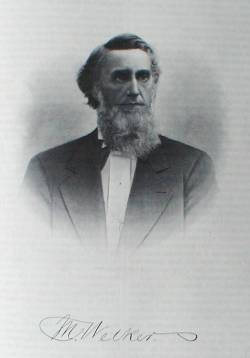
JAMES B. WELLMAN
James B. Wellman was born in Bayfield, Ontario, Canada, April 2, 1866, and is a son of D.M. and Elizabeth J. (Boyle) Wellman. The father, who became mate of vessels before he retired from the lakes, was born near Algonac, Mich., in 1828, and the mother was a native of Canada. Mr. Wellman's grandfather on the paternal side was a German, and his grandmother a native of England. On the maternal side the grandfather was a native of Ireland, and after coming to America he took part in the war of 1812, and soon after the close of that struggle met and married Miss Ligget, a young lady of good family connection in Canada.
After his marriage, the father, D.M. Wellman, returned to the United States in 1870, locating in Port Austin, and removing thence in 1884 to Bay City, Mich., where he still resides. Besides our subject the other children of his family are Richard, who is a farmer; George A., who after sailing for some years, went to Wyoming and was appointed United States marshal in 1892, and during the progress of the cattle war between the cowboys and cattle thieves, he was waylaid and shot and killed by the latter; Mary Jane, now the wife of Fred F. Snellgrove; Electa, wife of C.A. McDonald, of Cincinnati, Ohio; Josephine, wife of Charles T. Ryan, of Saginaw, Mich.; Margaret E., wife of John Rafferty, of Chicago, and David M., who is a sailor on the lakes.
James B. Wellman, to whom this sketch is more especially devoted, after attending school at Port Austin until he was fourteen years of age, ran away from home and, after reaching Au Sable, shipped before the mast on the yacht Georgia, with Captain Burrington, but at the end of two months he stopped ashore in Bay City, Mich., where he found employment in the grocery and ship-supply store of Shepard & McDonald. In 1881 he went to Cheboygan as shipping clerk, and that fall he joined the schooner Experiment, going before the mast. This was followed by like duties on the schooner Home, in 1882, closing the season as fireman on the steamer P.W. Jenness. The next season he fired on the passenger steamer St. John, trading between Bay City and Port Austin. He passed the year 1884 on the tugs Annie Moiles, Gland Belle(sic) and Willie Brown. In 1885, while on the barge Annie Vought, bad weather was experienced and she broke away from the steamer, but succeeded in reaching Buffalo, December 4, deeply waterlogged, with her canvas blown away and deckload washed overboard, the crew being in great peril at times.
In the spring of 1886 Mr. Wellman entered the employ of Buttman & Rust as engineer in a sawmill, and remained with that firm until the fall of 1891. The next year he went to Lumberton, Miss., and ran an engine in a sawmill owned by Camp & Hinton, holding this position eighteen months, when he returned to Bay City, Mich., and closed the navigation season as fireman on the steamer George H. Parker. During the year of 1894 he fired on the Gabella J. Boyce and steamer Saginaw, followed by a season as second engineer on the steamer Maine. In the spring of 1896 he was appointed chief engineer on the Maine, holding that berth two seasons, and in 1898 he was placed as chief engineer on the steamer George H. Parker.
On May 30, 1888, Mr. Wellman wedded Miss Sarah L., daughter of James and Mary Costello, of Cortland, N.Y., and the children born to this union are Charles T.F., James C., Georgianna Veronica and Evaline Frances. The family residence is at No. 501 Boardway, Bay City, Michigan.
SAMUEL A. WELLS
Samuel A. Wells was born October 16, 1828, in Cleveland, Ohio, to which city his father, Joseph Wells, had removed in 1818 from Middletown, Conn. Joseph Wells was a millwright by occupation and was employed as such for several years in the construction of mills in and about the city.
Samuel A. Wells received a common-school and academic education in Cleveland, and until 1851 was employed in the Cleveland City Foundry, which had previously been built by his father. He made his first trip on the lakes aboard the steamer Alabama, running from Cleveland to Dunkirk, on which he remained one year as second engineer, the following season shipping on the Granite State, which came out new at that time. The latter part of this year he was made chief engineer, and he subsequently served on the City of Concord, Wisconsin, J. W. Brooks, Buckeye and Granite State, all belonging to the Northern Transportation Company. In 1862 he was in the Alleghany, in 1863 in the New England, and in 1864 in the Cuyahoga, on which he remained until 1868. At this time he returned to the employ of the Northern Transportation Company, and was in the Buckeye and City of Concord, later engaging on the Dean Richmond and Hector, of the Winslow fleet. For some time he was employed by the Lake Superior line in the Northern Light, transferring from her to the propeller Antelope. For the three succeeding years he left the lakes and worked on the Rocky River railroad, but he eventually resumed his old calling, and for a time was employed by Bradley's line. He was in the William Edwards for ten years, and since 1891 has been engaged by the Menominee Transit Company. Mr. Wells was on the Granite State when she was wrecked at Cleveland, the sea being so high that the crew were all able to reach shore by means of poles and lines.
Mr. Wells was married, in 1853, to Miss Louisa A. Compton, now deceased. Her father, John W. Compton, was for many years a chief engineer on the lakes, and her brother David was on the lakes for over ten years. They are both deceased. In 1891 Mr. Wells was married to Emma L. Henricle. He is the father of three children: Harriet, who still resides at home; Marion, who is married and makes her home in Cleveland; and Jeanette, who is married and lives in the Indian Territory. Mr. Wells is a respected and well-known citizen of Cleveland, where he has always made his home, and he has a wide acquaintance among lakefaring men with whom he has been associated since 1851.
THOMAS H. WELSH
Thomas H. Welsh takes high rank among the chief engineers on the Great Lakes, than whom there is no better class of skilled mechanics afloat. He has in a remarkable degree, that evenness of temper, keenness of insight, good judgment and steady, even poise which enable him naturally and easily to carry out the duties of an engineer in charge of the complicated machinery of a modern steamboat like the Centurion, which he has engineered successfully for two seasons, and to which he has been assigned for the season of 1898. He is the son of Thomas and Mary (Burns) Welsh, and was born in New York City, January 29, 1852. His education was acquired in the common schools, after which he went to work in the shop with his father, who was a machinist and a blacksmith, and had followed the course of empire to the West, locating in Sarnia, Ontario.
It was in the spring of 1873 that Mr. Welsh, the subject of this sketch, began his career on the lakes, shipping as fireman on the Canadian steamer Ontario, of the Beatty Transportation Company, holding that berth two seasons, followed by a season as oiler on the same steamer. He then applied for and received engineer's license from the Canadian Government, and in the fall of 1877 was appointed second engineer on the Ontario. In 1878 he moved to Port Huron, and as he had been born in the United States, he took the examination and was granted a license by this government, and was appointed second engineer of the steamer Sanilac, retaining that berth three seasons. During the seasons of 1881-82 he was second engineer of the steamer Saginaw Valley. This was followed by a season on the steamer Walter L. Frost in the same capacity, and in the spring of 1885 he was advanced to the position of chief in the Walter L. Frost, and engineered her four seasons.
Mr. Welsh passed the season of 1890 as chief engineer of the James R. Langdon, and the next spring took charge of the machinery of the steamer Iosco, which office he held until the spring of 1896, when he was appointed chief engineer of the fine steamer Centurion, remaining in her until the close of the season of 1897 and laying her up. Mr. Welsh is an industrious and zealous worker, and during the winter months he is usually engaged in superintending repair work on the various steamers moored at Port Huron.
Fraternally he is a member of the Marine Engineers Beneficial Association, the Knights of Pythias and the Independent Order of Foresters.
WILLIAM P. WENNER
William P. Wenner is an engineer of good reputation on the lakes and one thoroughly acquainted with that branch of the marine industry. At the present time he resides at No. 664 Clinton avenue, Detroit, and during the season acts as engineer of the Gettysburg for Alger, Smith & Co., in whose employ he has been for many years.
Mr. Wenner was born June 13, 1854, at Marshall, Mich., but at that place lived only one year, his parents removing to Decatur, same State, where he received his education and resided for fifteen years. Having completed his schooling he came to Detroit and entered the Frontier Iron Works, where he served an apprenticeship of four years to the machinist's trade, and he has since been engaged in the engine rooms of various boats. He spent three seasons in the tug Torrent as second engineer and then went on the Manistique in the same position, remaining one and a half seasons and finishing his second season in the same position on the Kitty M. Forbes. After two years' service on the Merrimac, of the Inter Ocean line, and one season on the Volunteer, he came into the present employ, shipping on the Gettysburg at the very beginning. While on the Kitty M. Forbes he was shipwrecked on Outer island, Lake Superior, but otherwise he has been exceedingly fortunate as to accidents of a serious nature.
In 1875 Mr. Wenner was married to Miss Jessie Cronenweth, a daughter of John Cronenweth, a marine engineer of Detroit, and to their union have been born six children: John, William, Earl, Harold, Jessie and Isoria, all of whom reside at home. Mr. Wenner is a member of the Marine Engineers Beneficial Association and the Stationary Engineers Association, of Detroit.
CAPTAIN DAVID WEST
Captain David West spent the first seven years of his life in Belgium, where he was born August 15, 1843, and upon coming to America he settled with his parents in Detroit, where he has ever since resided. In 1861 he commenced sailing and since that time has devoted the greater part of his life to marine pursuits. He spent his first season as boy on the Starlight, and the following year built a scow which he called by the same name, sailing her five years. He sailed the scow Hummingbird for five seasons and then went on the steam barge Florence, where he remained two seasons. After serving two years in Ruelle's tug he shipped on the tug Folger, on which he continued for two seasons, thence changing to the Marion Teller, and remaining in her until 1891. He has since had command of the tug Reynolds.
Captain West was married to Miss Mary Rivarde, of Detroit, in 1865, and they had children as follows: Margaret, who is deceased; Kate, married to August King, of St. Clair; Maggie, deceased; Bert, who is master of the Detroiter; Dolly who still resides at home; Carrie, deceased; and Theodore and Charles, who are attending school at the present time. Mrs. West died in 1890, and on March 15, 1895, the Captain wedded Miss Adeline Prentice, of Detroit. Captain West is a member of the A. O. U. W., and being of a social nature has a large circle of friends in that fraternity as well as in marine society.
JOHN WESTAWAY
John Westaway was born November 11, 1837, at Sandwich, Ontario, son of William and Charity Westaway, natives of England, who came there and settled in 1832, when Sandwich was a thriving village, comparing favorably with its neighbor, Windsor. There they resided, on a farm, from that time until their death, which occurred in April, 1862, and November, 1879, respectively.
John Westaway received his early education at the schools of his native place and Windsor, which he attended for several years and he was later a student in the Albion College for some time. At the age of twenty-one he left school, and having a great desire for the life of a sailor he shipped in the propeller Hercules as second engineer, having previously spent time during the summer season in a machine shop in Detroit. He served as second engineer for one year and was then given the position of chief, which he held two seasons, afterward going on the steamer Gore, which ran on the Detroit river in the towing business. Upon the Magnet he acted as second engineer for two years and as chief for the same period and from that boat went as chief to the Forester, a large side-wheeler then running from Green Bay to Escanaba. In 1865 Mr. Westaway went on the Transit, remaining until 1867, when he transferred to the Great Western, the first car ferry on the lakes. The following years he spent in the Susan Ward and the steamers Ward and Dove, finally, in 1872, entering the employ of the Canada Southern Railroad Company, with which he has since remained. His first experience in their service was on the old Transfer, on which he spent seven years, and later he spent four years on the transport and one year on the Michigan Central. He then superintended the building of the new Transfer at Cleveland, having super-intended the building of all the boats, and in 1885 he was given the position he now holds, that of chief engineer of the line.
Mr. Westaway was married in November, 1861, to Miss Frances Buffin, of Rhode Island. They have had three children, Minnie, who is married to Beverley J. Walker and resides in Windsor; Emily, who resides in Amherstburg, Canada; and Albert I., a marine engineer, who has been in the employ of Dunbar Dredging Company eight years.
WILLIAM WESTBROOK
William Westbrook, chief engineer of the J.H. Pauly, and a resident of Detroit, was born on February 10, 1861, in Marine City, Mich., a son of James Westbrook, who was captain on the lakes for a number of years, and died in 1867. Our subject began his marine life at the early age of seven years, and since that time has been closely connected with that industry. Having previously been upon his father's boats, he obtained the position of fireman on the Thomas Coleman, when in his eleventh year, and in that capacity was on several tugs - the Mystic, R. N. Masters, Brockway and Erie Bell - after which he served as second engineer in the City of Dresden and C. N. Pratt.
In the following season, Mr. Westbrook was given the position of chief engineer on the International, where he remained for three years, and then served in the same capacity on the W. J. Averill, Spinner, Ira Chaffee, John E. Hall, Ballentine, Preston and Desmond. At one time he owned an interest in the steambarge Oswegatchie, which was foundered in Saginaw bay, after he had disposed of his interest, losing all on board. He also owned the H. C. Potter. For several months he was engineer on the tug Onaping, and later on the St. Leland; but since 1896 he has been chief on the J. H. Pauly. He also owned and was master of the schooner John Breden for three years.
In 1882 Mr. Westbrook was married to Miss Abbie Appleman, of St. Clair, Mich., and they now have a pleasant home at No. 12 Locust street, Detroit. Fraternally, he is a member of the Knights of Pythias and of Marine Engineers Beneficial Association.
CAPTAIN PETER WEX
Captain Peter Wex is a native of Germany, a son of Peter and Dorothea {Linn} Wex. There were three other children in the family: Lawrence, who is engaged in the wholesale wrapping paper business at Buffalo; Elizabeth, wife of Joseph Hern, of Buffalo; and Henry, a printer, who is now deceased. Peter Wex, the father, was a farmer in his native country, but was engaged in the hardware and coal business at Buffalo previous to his decease in 1891.
Captain Wex was born December 24, 1842, and attended school in his native place six years. He was twelve years of age when he emigrated to America; the family locating at Buffalo, N. Y., of which city he has been a resident forty-two years. In 1868 he purchased the schooner Resolute, of which he was captain, but she was substantially in charge of sailing masters until Captain Wex took active command. In 1871 he left her to engage in the coal business at Buffalo, and she was lost October 20, of that year, under Long Point, where she went ashore in a gale. She was insured with the Albany City and Security, of New York, but her owner received only a small percentage of her insurance because of the embarrassment of the respective companies caused by their losses at the great Chicago fire.
Captain Wex conducted a coal business four years and between 1871 and 1879 was the owner of several schooners navigating on the Great Lakes, in 1879 being master as well as owner of the schooner Mary Birckhead. The succeeding season he sold her and purchased the schooner Golden Rule, which he sailed two seasons. In 1882 he was master and owner of the schooner City of the Straits, and was later master and owner of the schooner Annie Vought and the steamer Potomac, sailing the latter two seasons as a steamer and three as a barge after she was dismantled. He was next master of the steamer St. Louis for a period of six seasons, during which time she had for her consorts the barges Annie Vought and Potomac, both of them owned by Captain Wex. In 1892 he was given master's berth on the steamer Inter Ocean, which had for her consort the barge Richard Winslow, owned by him, and he has sailed the Inter Ocean eight consecutive seasons. On November 27, 1896, Captain Wex was a victim of a vicious assault made upon him by two discharged watchmen, while his vessel was at the dock at Escanaba, where she had run in for shelter while on her way to Milwaukee. They had been discharged and paid off by Captain, the amount due them being small, as they had only shipped from Toledo. While he was returning to the vessel after purchasing a newspaper, the watchmen attacked him and he was so badly pounded and bruised that from the time he reached his home he was compelled to remain indoors substantially all of the succeeding winter, under the treatment of his physician, because of the severe shock to his nerves. His assailants were arrested and partly paid the penalty of their brutality by being locked up in jail several months. Captain Wex is a member of the Ship Masters Association, and carries Pennant No. 966. He is also a member of the local Harbor No. 41, of the American Association of Masters and Pilots.
He was married at Buffalo, in 1865 to Miss Louisa Domedion, who died October 3, 1893, and by whom he has had seven children: Louisa Regina, married to Charles Strout, of Rouseville, Penn.; Anna Dorothy; Elizabeth, married to Fred E. Allen, of Buffalo; Dorothy Barbara and Hattie L. They have a very comfortable home at No. 151 Morgan street, Buffalo.
CAPTAIN FRANK W. WHEELER
Captain Frank W. Wheeler is at the head of the most prolific shipbuilding plant on the lakes, and during the twenty-two years he have(sic) been engaged in the business there have been launched from his yard, or more definitely speaking, by the company of which he is president, one hundred and seventy-six vessels, many of them of the largest and most modern type, of both wood and steel. He has created a notable industry, which has not only prospered him but enhanced the prosperity of the locality in which his works are situated, through the employment of labor and stimulation of business, and added largely to the facilities of lake commerce. The work turned out under his direction stands the test of storms, living gales and dangers from ice, and he has a right to be proud of it.
Mr. Wheeler was born at Chaumont, near Clayton, N.Y., March 2, 1853, and is the son of Chesley and Eliza (Haselton) Wheeler. The father was a ship builder and carried on a shipyard in New York State, and in the fall of 1866 removed with his family to Saginaw, Mich., where he resumed business. It was in that city that F.W. Wheeler acquired his education, passing through the high school, after which he took an active working interest in the shipyard with his father, and gained much of the practical experience so necessary to his present business prosperity. He did not devote his entire time to the detail work of the shipyard, however, as he sailed some, and the knowledge of the proper handling of a steamboat thus acquired warranted him in applying for a license, which was granted, and he now holds his ninth issue of first-class master's papers, which recite that he is fully qualified to navigate steam vessels on all the lakes and their connecting waters. Although his ship-building industry prevents him from entertaining political aspirations, he is a public spirited citizen and represented his district, the Tenth Michigan, in the Fifty-first Congress, but declined renomination.
In 1875, about a year before he associated with his father in shipbuilding, F.W. Wheeler was united by marriage to Miss Eva, daughter of Joseph and Eliza Armstrong, of Saginaw, and to this union one daughter, May Frances, was born. The family homestead is situated at the corner of Van Buren and Center streets, Bay City, Michigan.
Captain Wheeler was about twenty-three years old when he entered the ship-building business on his own account. This was in 1876, and the site was near where the approach to the Third street bridge, spanning the Saginaw river, now stands. While his enterprise was quite modest at that time, consisting mostly in rebuilding and repair work, he built six small vessels the first three years, the first one launched being the passenger propeller Mary Martini, in 1877. In 1880 he commenced the construction of the larger class of vessels, which became so numerous as the years passed that they will be tabulated in this article.
In 1889 the firm of F.W. Wheeler & Co. was incorporated, with a capital stock of $500,000, the officers being F.W. Wheeler, president; H.T. Wickes, vice-president; John S. Porter, treasurer, and C.W. Stiver, secretary. Additional land was secured along the Saginaw river front to accommodate the enlarged enterprise, and a steel plant of the most modern machinery purchased and the keel laid for the steel passenger steamer City of Chicago, which was launched in June, 1890. The company then continued to build both wood and steel vessels until the summer of 1896, when the yard for the building of wooden ships was occupied by additional machinery and buildings to better facilitate the work on steel vessels, which gave the company a continuous front on the Saginaw river for the steel shipbuilding industry of 2,500 feet and running back to Washington street, thus enabling them to build seven 500 feet steel vessels simultaneously, and eight large ones have been on the stocks at one time, the register tonnage of which was 32,000. The yard is now equipped with two Brown hoists, each of 6,000 pounds capacity; one balanced cantilever Brown hoist, with a capacity of about 25,000 pounds; two Myler hoists, each of 20,000 pounds capacity; and one locomotive crane of the Brown type, with a capacity of 20,000 pounds, the speed of the track being 200 feet per minute, of the trolley 500 feet, and of the hoist 150 feet. In the fall of 1891 a fully equipped plant and tools were added to the works of the company for the construction of modern marine engines and machinery, since which time the company has built the engines for their steamers.
F.W. Wheeler & Co. was the first concern on the lakes to make an effort to secure work for the United States navy, and but for a certain clause in the treaty between the United States and Great Britain they would have been awarded the contract for the construction of the steamer Bancroft. The steamers built at this yard for ocean service comprise of the Mackinaw and Keweenaw, which were launched in sections and put together at Montreal; the Yula which went to Central American waters; four United States lightships; and the powerful tugs W.G. Wilmot, Robert W. Wilmot and the William H. Brown, all for service on the Gulf of Mexico. The fine steel steamer Centurion was thus named for the honor of being No. 100 on the builders' list, and the keel was laid on Captain Wheeler's fortieth birthday. She was a noble work for a birthday of less than half a century, being the largest vessel on the lakes at the time she was launched, in 1893. The table which follows will present to the reader evidence of the industry and enterprise of Captain Wheeler and the other members of the company.
List of Boats Constructed by F.W. Wheeler & Co.
1877 - stmr. Mary Martini; tug Luther Westover, 125 tons. 1878 - stmr. Christie Forbes, 51 tons. 1879 - bge. Hannah B.; Marian Teller, tug, 33 tons; C.W. Licken, tug, 36 tons. 1880 - stmr. Lycoming, 1609 tons; Conemaugh, stmr., 1609 tons; Charles Cuyler, tug. 1881 - tug Maud S., 45 tons; Saginaw Valley, stmr., 112 tons; Fred McBryer, stmr. 1882 - ferry Handy Boy, 25 tons; Galatea, schooner, 825 tons; Osceola, stmr., 980 tons. 1883 - stmr. Kittie M. Forbes, 958 tons; tug Sarah M. Smith, 45 tons. 1884 - schr. Frank W. Wheeler; schr. Alta, 936 tons; Tempens, tug, 14 tons; stmr. Waldo
A. Avery, 1294 tons. 1885 - stmr. Thomas S. Christie, 769 tons; stmr. A. Folsom, 841 tons; B.W. Arnold,
stmr., 944 tons. 1886 - schr. H.A. Hawgood, 1276 tons; Ossifrage, stmr., 432 tons; stmr. Wm. H. Stevens,
1332 tons; W.R. Stafford, stmr., 744 tons; schr. Mabel Wilson, 1224 tons. 1887 - stmr. Wm. H. Gratwick, 1688 tons; stmr. Frank W. Wheeler, 1688; Sitka, stmr.,
1790; Gogebic, stmr., 1620. 1888 - stmr. Mecosta, 1776; stmr. Elfin Mere, 1054; Thomas Adams, stmr., 1810; Geo. W.
Morley, stmr., 1054; schr. Moravia, 1067 tons; stmr. Robert L. Freyer, 1810 tons;
stmr. Soo City, 670 tons; Servia, stmr., 1425 tons; schr. Frank D. Ewen, 882 tons;
stmr. Eber Ward, 1843 tons; stmr. John V. Moran, 1350 tons. 1889 - stmr. Geo. W. Roby, 1843 tons; stmr. John M. Nicol, 2126 tons; John Mitchell,
stmr., 1865 tons; Fedora, stmr., 1848 tons; News Boy, stmr., 199 tons; stmr.
Romeo, 61 tons; tug Monarch, 95 tons; Juliet, stmr., 61 tons; John Plankington,
stmr., 1821 tons; Plow Boy, stmr., 114 tons; Post Boy, stmr., 123 tons; tug Lulu
Eddy, 19 tons; Fred B., tug, 16 tons; stmr. Geo. F. Williams, 1888 tons; stmr.
Geo. Houghton, 332 tons; schr. C.J. Fillmore, 410 tons; schr. John A. Francombe,
658 tons; dredge, Dredge No. 2. 1890 - stmr. Nyanza, 1888 tons; schr. C.A. Tuxbury, 680 tons; schr. C.E. Redfern, 680
tons; stmr. W.H. Sawyer, 747 tons; stmr. Edward Smith, 748 tons; stmr. City of
Chicago, (steel) 1164 tons; stmr. Emily P. Weed, (steel) 2362 tons; stmr.
Mackinaw, (steel) 2578 tons; schr. Newell A. Eddy, (steel) 1271 tons; schr.
Olive Jeanette, 1272 tons. 1891 - stmr. Keweenaw, (steel) 2511 tons; stmr. Tampa, 1972 tons; stmr. C.H. Bradley,
804 tons; car ferry Michigan, (steel); stmr, F. & P. M. No. 5, 1722 tons; stmr.
W.F. Sauber, 2053 tons; stmr. Sailor Boy, 162 tons; Tosco, stmr. 2051 tons;
scows, Two scows; tug Yula, (steel) 340 tons. 1892 - U.S. lightship (iron) No. 51; U.S. lightship, (iron) No. 52; U.S. Lightship,
(iron) NO. 53; U.S. lightship, (iron) No. 54; stmr. Uganda, 2054 tons; stmr.
W.H. Gilbert, (steel) 2856 tons; tug W.S. Wilmot, (steel) 150 tons; schr. J.C.
Fitzpatrick, 1270 tons, stmr. C.F. Bielman, 2056 tons. 1893 - stmr. Wm. H. Gratwick, (steel) 2878 tons; stmr. S.S. Curry, (steel) 3260 tons;
stmr. Merida, (steel) 3261 tons; schr. Mary McLachten, 1394 tons; stmr. S.R.
Doty, 2056 tons; stmr. George Stone, 1841 tons; schr. Edward McWilliams, 744 tons;
stmr. Centurion, (steel) 3401 tons; schr. Yukon, 1602 tons. 1893 - tug Fashion, 29 tons. 1894 - stmr. Minnie E. Helton, 632 tons; ferry Pleasure, 489 tons. 1895 - stmr. John J. McWilliams, (steel) 3400 tons; yacht Wapiti, (steel) 83 tons; stmr.
J. Watson Stephenson, 639 tons; stmr. Penobscot, 3402 tons; tug Silver Spray, 38
tons; stmr. Simon J. Murphy, (steel) 1381 tons; stmr. Katahdin, (steel) 1381 tons. 1896 - stmr. S.C. Waldo, (steel), 4244 tons; stmr, City of Bangor, (steel) 3690 tons;
stmr. E.W. Ogebay, (steel) 3666 tons; stmr. Lagonda, (steel) 3647 tons; stmr.
George Stevenson, (steel) 4584 tons; schr. James Nasmyth, (steel) 3422 tons;
Sir Isaac L. Bell, schr., (steel) 3419 tons; car ferry Pere Marquette, (steel)
5580 tons. 1897 - schr. W. Le Baron Jenny, (steel); stmr. Niagara, (steel); tug Robert W. Wilmot,
(steel); tug Wm. H. Brown, (steel). 1898 - stmr. Samuel F.B. Morse, (steel; schr. John Fritz, (steel); schr. John Roebling,
(steel).
The engine being constructed at F.W. Wheeler & Co.'s works for the new steamer Samuel F.B. Morse will be the largest on the lakes, and is quadruple compound, the cylinders being 26-1/2, 37, 54-1/2 and 80 by 42 inches stroke. The crank shafts are hollow, and the bed plate for this great machine has been cast in one piece - a notable departure from cast-iron.
FRED E. WHEELER
Fred E. Wheeler, a prominent marine engineer of Auburn, N.Y., was born at Ogdensburg, N.Y., May 4, 1844, a son of Elisha R. and Eleanor (Fowler) Wheeler. He acquired his education at the public schools, which he attended until the spring of 1869, when he decided to learn the machinist's trade, for which purpose he went to Oswego, N.Y., and entered the employ of the Vulcan Iron Works, serving an apprenticeship of four years.
In 1873 Mr. Wheeler took out a marine engineer's license, and was appointed to the tug Oneida, operating out of Oswego harbor. The following year he was made second engineer of the steamer Westford, and later he ran the engine at the mill of Farwell & Himes in Oswego. In the spring of 1877 he removed to St. Catherines, Ont., and ran the tug Kittie Hate on the Welland canal, remaining that season. After a season as second engineer on the steambarge Lothair, he was appointed chief and remained on her until the close of navigation, 1880. The next season he took charge of the machinery of the Alma Munro. In 1882 and 1883 he was in the employ of the Edge Tool Works at St. Catharines, and in 1884 he entered the employ of Muir Brothers, of Port Dalhousie, Ont., as chief engineer of the steamer Enterprise, and in 1885 became chief of the Albion, plying between Georgian Bay and Lake Erie ports, to Montreal, Quebec. In the spring of 1886 he shipped as chief of the steamer Van Allen, out of Port Hope, Ont.; and in 1887 as second on the passenger steamer Alberta, of the Canadian Pacific railroad, closing the season as chief of the steamer Niagara, of Toronto, Ont. His next steamboat was the Belle Wilson, which foundered in Thunder bay, Lake Huron, twelve miles off Harrisville, Mich., August 8. The crew took refuge in the yawlboat, and after being buffeted by the waves for six hours were picked up by the steamer M.M. Drake and taken to the Sault.
That winter Mr. Wheeler removed to Auburn, N.Y., and took charge of a stationary engine for the Auburn Manufacturing Company, holding that berth two years. In 1891 he took out an issue of American license, and fitted out the river tug Samson, owned by Bliss & Co., of Tonawanda, N.Y., on which he made one trip, being appointed chief of the steamer Ira Chaffee. This steamer was burned at the Sault in July, and he finished the season as chief on the passenger steamer City of New Baltimore. His next steamboat was the Sarah E. Sheldon. The seasons of 1893-94 were passed on the steamer Monteagle as chief engineer. Mr. Wheeler remained at Auburn during the following year in charge of the electric light plant of the Hemmingway Preserving Company, and of David Wadsworth & Son, manufactures of agricultural implements. In 1896 he went to Cleveland, and was made chief engineer of the steambarge Margaret Olwell, which position he holds at this writing. He has eleven issues of Canadian engineer's license, and eight of American issues.
On May 12, 1869, Fred E. Wheeler was wedded to Miss Mary Louisa Wilcox, of Clayville, Oneida county, N.Y. They have one daughter, Clara Augusta, now Mrs. John F. Walts.
CAPTAIN JOHN F. WHELAN
Captain John F. Whelan is one of the veteran tug men of Buffalo harbor. He is the son of Michael and Bridget (Fitzpatrick) Whelan, both of whom were born in Ireland, whence the father, who was a stonemason by trade, came to America about 1835, locating in Scoharie, New York.
Captain Whelan was born in Amsterdam, N. Y., December 22, 1842, and came to Buffalo to reside permanently in 1847. After four years spent in obtaining his common school education he began practical life, ferrying on Buffalo creek. This occupation he pursued until about fifteen years of age when he shipped out of Buffalo as cook on the brig Fox. Following that employment he served different capacities on different vessels until he became master of the schooner C. Y. Richmond, and later he was master of the Eliza Logan, A. Mowry and Matt Sherman. In 1868 he was made master of the tug Mildred, in Buffalo harbor, and during the seasons of 1869-70-71 was master of the tugs S.S. Coe and Old Jack, both of Cleveland, Ohio. From that time until the close of the season of 1896 he has been on Buffalo harbor tugs in the Maytham line for fourteen years, and in the Hand & Johnson line for eight years, except on special occasions when he made short trips outside, and during 1886, when he was appointed harbor master by the common council of the city. He was a charter member of the Harbor Tug Pilots Association.
In 1863 Captain Whelan was married in Buffalo to Bridget Ryan, a daughter of Timothy Ryan, a native of Ireland, but at that time a resident of Buffalo, and they have had the following children: William J., a marine engineer; Mary A., wife of C. H. Smith, a clerk in the employ of the Lehigh Valley Company; Jennie E., a stenographer for the Fertilizing Company at East Buffalo; Arthur, a plumber by trade, and on July 1, 1898, was appointed policeman for the City of Buffalo; Joseph, fireman with his father; John; Walter, who is also with the Lehigh Valley Company; and Loretta. Thomas Ryan, a brother of Mrs. Whelan, is a marine engineer and also holds master's papers.
William J. Whelan, eldest son of Captain Whelan, commenced his career as fireman with his father. he subsequently obtained the position as enginner on the tug Adams, and later was on the Alpha and on the Warren, the latter owned by Carroll Bros., in which he was engineer for 1896 and 1897. She was sold by the Carroll Bros. to the Buffalo Dredging Company, who retained Mr. Whelan in their employ. He was appointed chief engineer of the excursion steamer Gazelle for the season of 1898. He is unmarried and resides with his parents at No. 220 Efner Street, Buffalo, New York.
P. W. WHELAN
P.W. Whelan is a marine engineer of wide experience and one who, by faithful work and merited success, has won the greatest confidence of his employers. He was born March 10, 1846, at Cleveland, Ohio, and has resided there all his life. At the age of seventeen years he entered a machine and repair shop and served a three years' apprenticeship to the machinist's trade, after which he began his marine life, going as oiler on the Arctic, on which boat he remained one season. He then went on the revenue cutter Fessenden and acted as oiler three months, subsequently, for a period of four years, remaining ashore, employed at his trade. Next entering the employ of the Northern Transportation Company, he spent about six months as second engineer of the steamer Michigan, finishing the season on the propeller Maine, of the same line. He then spent about three months as second engineer of the Equinox, on which boat he afterward became chief engineer, continuing in that capacity two seasons. The winter following Mr. Whelan was employed in the Globe Machine Shops, and in the spring he shipped on the tug Clematis, remaining only a short time, however, as he returned to the Globe Iron Works, working there until the following spring. The next two seasons he spent on the H. D. Coffinberry, and for the seven years following he was engaged as engineer of the Worthington block, in Cleveland. He has since been on the boats Republic, St. Paul, Bessemer, Joseph Fay, R. P. Ranney, Corona, Frontenac and Escanaba, coming in 1896 to the Aragon, upon which he remained throughout the season.
Mr. Whelan was married November 27, 1873, to Miss Anna Marr, of Cleveland, and six children have been born to them, namely: Margaret, Grace and May, who reside at home at the present time; and Thomas, Gertrude and Edward, deceased.
CAPTAIN JOSEPH WHITE
Captain Joseph White, one of the prominent steamboat masters sailing out of Chicago, is quite popular with the public traveling between that port and Duluth by water. He was born in Sombra, Ont., April 18, 1854, and is a son of Jeremiah and Louise (Moselle) White, both of whom were of French parentage, his father's name, as written in that language, being La Blanc. The family moved from Quebec to Sombra, where the father owned a farm and engaged in the lumber business, and being a man of great energy he prospered in his undertakings.
The Captain remained at home assisting his father on the farm and in his business, getting out timber for the shipbuilders on the St. Clair river, attending school in the meantime during the winter months. In the spring of 1877 he shipped before the mast on the schooner Thomas Quayle, going home when she was laid up. The next spring he shipped on the tug William Livingston, Jr., and in 1879 was wheelsman on the steamer Lawrence, plying between Chicago and Point Edwards, and in 1880 was on the steamer Iron Age, with Captain Millan, James Carney being mate. In the summer of 1882, after remaining on the farm a short time he joined the steamer William H. Barnum, as wheelsman, remaining in this position till September 3, 1882, when he entered the employ of the Lake Michigan and Lake Superior Transportation Company, as wheelsman on the steamer Peerless, with Captain McIntyre, holding that berth until August, 1883, when he applied for and was granted pilot's license, and was appointed second mate of the same. He speaks with great praise of Captain McIntyre for the assistance kindly rendered at that time. After holding the office of second mate on the Peerless five seasons, he was appointed mate on the steamer J. L. Hurd, with Captain Twitchell, remaining one season. In 1889 he was transferred to the City of Traverse, as mate, and remained on her until the spring of 1891, when he was promoted to the office of master of the steamer Jay Gould, which he sailed for many seasons with good success, and has given eminent satisfaction to the officers of the company.
On October 13, 1893, the time that the steamer Dean Richmond and many other good vessels went to the bottom in a living fall gale attended by blinding snow, Captain White fully realized the terrible responsibility devolving upon the master of a passenger steamer. He stood off in Lake Superior, bound from Portage canal to Sault Ste. Marie, and rode out the tempest for forty-five hours, a period to test the nerve and resources of the most experienced master. The copper stowed in barrels between decks broke away and became so many demons; the gangways were broken in; there was water in the firehold to the depth of five feet; two of the lifeboats were borne from the davits and washed overboard; and the wheel and tiller chains parted; but during these long hours of peril the Captain and his officers labored unceasingly for the salvation of the steamer and the lives under their charge. Especially does he commend the chief engineer, A. P. Williams, who stood by the throttle until his face and hands were seriously burned, but he did not leave his post until the steamer had found comparative safety under Bay Mills Point.
On May 28, 1894, Captain White was united in marriage to Miss Rose, daughter of Alexander McAuley, of Chicago, formerly of Sombra, Ont. Two daughters, Genevieve E. and Eleanore Marie were born to this union. The family residence is at No. 6337 Langley avenue, Chicago, Ill. Socially the Captain is a member of the Ship Masters Association, and carries Pennant No. 440.
HON. WILLIAM J. WHITE
Hon. William J. White is a prominent and well-known business man of Cleveland, and while not an extensive owner of tonnage, has been closely identified with the commerce of the lakes, and has owned vessel property since 1888. He was born in Canada, October 7, 1850, and at the age of six years became a resident of Cleveland.
By good business methods he early attained a comfortable competency and acquired rank among the financiers, as well as among those whose knowledge and keen insight make them the leaders of men. In 1888 he was elected to the office of mayor of West Cleveland, serving two years, and was then elected representative from the 20th Ohio District of the Fifty-third Congress, refusing renomination in each case. During his term in Congress he introduced and piloted to successful passage the law known as the "White Bill," an Act to regulate navigation on the Great Lakes and their connecting and contributary waters. This was one of the most important and elaborate bills introduced during the session, and it was a very difficult matter owing to its details and scope to bring it to a successful issue; and it could not be brought before the House and Senate before the dying hours of the Fifty-third Congress. This law in its minute specifications regarding lights, signals, speed, and steering of vessels, has been recognized as international by England, France, and America, and has been incorporated in the Great Lakes Registers and Masters Manual, Bureau Veritas and International Register of Shipping. The rules and regulations defined in this Act are now well known, and followed by all lake masters and pilots.
In December, 1888, Mr. White purchased the steamer Britannic, which was valued at $95,000, and a year later he became the owner of the steamer Ballentine, taking the latter vessel off the hands of the underwriters to whom she had been abandoned. He rebuilt the Ballentine, cutting ten feet off her length, and putting in new boilers, and steeple compounding her engines. Mr. White then rechristened her the Quito, after the capital of Equador. After these changes were made the vessel carried 12,000 bushels of wheat more than before, made a knot and a half more speed per hour, and burned less than half as much coal as before. The Britannic was lost through a collision in the Detroit river in 1895. Mr. White also owns the steamyacht Say When, built by Herrshoff, which he purchased on the Atlantic coast in 1890. The yacht had been a failure on salt water, but Mr. White increased her draft from fifty-four to seventy-four inches by giving her a 6,000 pound steel shoe and 2,000 pounds of dead wood, an improvement noted as essential by Mr. White, and it is unnecessary to say that she is now one of the best and stanchest yachts in heavy weather afloat. The Say When is capable of making a speed of twenty miles an hour, and during the World's Fair she made the run from Chicago to Cleveland in forty-five hours and thirty-five minutes, actual running time.
Mr. White is one of the original stockholders in the Cleveland and Buffalo Transit Company, and he now holds 751 shares of the stock of the corporation, being the heaviest individual owner; he also has a large interest in Owen Transportation Company. He is a stockholder of the First National Bank, the Columbia Savings and Loan Company and the West Cleveland Banking Company, the last named of which he is president. He is an extensive owner of real estate in various parts of the country, has a large farm in Canada, business blocks and apartment houses in Chicago, Cleveland, Lorain and other cities. He is also the founder of the Yucatan Gum Factory, which gives employment to hundreds of people, and ships its product to almost every country on the face of the earth.
While yachting has been to him a pleasant recreation, he has also found much enjoyment in the breeding of fine trotting and racing stock. His Two Minute Stock Farm is located about eight miles from the Cleveland Public Square, and embraces 500 acres. Here at this time he has 125 blooded horses, at the head of which are the noted sire Gay Wilkes, record 2:15-1/4, and Star Pointer, record 1:59-1/4, the latter being the only two-minute horse in the world.
On April 23, 1873, Mr. White was married to Miss Ellen Marie Mansfield, of Cleveland, daughter of Orange and Marietta (Howard) Mansfield. Seven children born to this union are now living: William Benjamin and Harrie Walter, both of whom are now associated with their father in his business enterprises; Gloria Marie, Pearl Marietta, Miles Arthur, Adah Melora and Ralph Royden, the first named being (at this writing) twenty-four years of age, and the last named eight. The family homestead, "Thornwood," is a magnificent modern structure on Lake avenue, Cleveland, and bears evidence of the refinement and home love of its occupants.
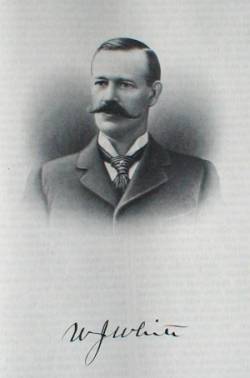
CAPTAIN NELSON J. WIGLE
Captain Nelson J. Wigle, commander of the steamer Lakeside, was born on the old homestead farm near the town of Kingsville, Essex Co., Ont., in the year 1859, attended school in his native place, and assisted in working the farm until he was twenty-one years of age. Having always been fond of the water, he had gained considerable experience in the various craft in the vicinity of Kingsville, so that when he attained his majority he gravitated quite naturally toward sailing. His first venture was on the steamer Reporter, running between Pelee island and Kingsville, and by natural ability, perseverance and faithfulness to duty, he gradually worked his way up on different vessels until at length he was appointed first officer of the J. W. Steinhoff, now known as the Queen City, on which he remained two seasons. Then he was offered and accepted the position captain of the fine passenger steamer City of Dresden, which ran between Detroit the Lake Shore and Sandusky, Ohio, and he was retained in command of her for nine seasons, during which time he had many trying experiences. In the frightful storm of September 4, 1882, the same in which the propeller Asia was lost with all on board save two, the City of Dresden had an exciting time. She was tossed at the mercy of the winds and waves, and for three days was supposed to be lost, but good seamanship prevailed, and Captain Wigle, though with much difficulty, ran his boat under the lee of Pelee island, where she lay until the weather moderated.
In the year 1888 the steamer Lakeside was built, and Captain Wigle was at once put in command of her, continuing as her master until 1891. In 1892 he was captain of the Garden City, a fine side-wheeler, and in the following year he was appointed Toronto manager of the Niagara Falls line of steamers, a pool of boats which comprises the Empress of India, Garden City and Lakeside. In 1893 he resumed command of the Lakeside, on which he still remains, and his ability as a master and hearty courteous manner to all with whom he comes in contact have made him one of the most popular commanders on the lakes. In 1889, shortly after the Lakeside made the first trip of the season, Captain Wigle ran her into Rondeau with a load of passengers, and all on board witnessed the foundering of the schooner Louis Ross, off Point aux Pins, Lake Erie. Captain Wigle at once manned his lifeboats and going in person with his men succeeded in rescuing every one on the ill-fated vessel. The Lakeside is a very popular boat with passengers and shippers; she is always the first to open the season and the last to give away to the rigors of winter and is noted for being at all seasons strictly on time.
Captain Wigle is married, and resides with his family on North Williams street, St. Catharines. Fraternally he is a Mason in good standing.
ANDEM J. WILCOX
Andem J. Wilcox, who is one of the best qualified engineers sailing out of Bay City, Mich., was born in Springfield, Oakland county, that State, May 25, 1847. His parents, Madison J. and Sarah (Andem) Wilcox, were natives of Rochester, N.Y., and New York City, respectively. As his mother died during his infancy our subject was left in the care of his aunt Harriet Powell until he reached the age of five years, when his father removed to Ovid, Mich., to locate on a farm which he owned, and took with him Andem, his two brothers, Smith M. and Louis H., and two sisters, Antoinette and Jeannette.
Andem J. Wilcox worked on the farm and attended the district schools until he was fifteen years old, when he made up his mind to go on the Great Lakes as fireman, with the object of becoming an engineer. The other members of the family tried to dissuade him, but all to no purpose, for he was lad of much persistence, and his distaste for a life on the farm had much to do with his decision, which was at once carried out. In 1862 he went to Bay City, but not finding a steamboat ready for him he engaged in loading lumber on vessels. Being of slight build he found that work too much for him and he shipped as deckhand in the steambarge East Saginaw at $30 per month. He remained on her four months, and when refused higher wages returned to the docks to load lumber, soon after, however, shipping in the steamer Harry Bissell, in which he closed the season. In the spring of 1863 Mr. Wilcox shipped as fireman in the tug Union, owned by Mitchell & Kelley, and fired her four seasons. In 1867 he passed his examination and received Government license as engineer on the Little Eastern with Capt. L. Deland, remaining two months, when he was appointed engineer of the tug Sealey, in which he closed the season. The next spring he brought out the tug Witch of the West as engineer, holding that berth until August, when he was made second engineer of the steamer Esterbrook, with Chief William Bates and Capt. George Lester; he retained this position until 1873, when the steamer, under command of Capt. Martin Brigham, was wrecked while trying to make Fairport harbor in a northeast gale, all hands reaching shore in the yawl after much peril and exposure. Mr. Wilcox then joined the steamer Michigan for the balance of the season as second engineer. In 1874 he became second in the propeller Phil Sheridan, with engineer William McKettrick, Captain Cummings being master, and continued in that berth until June 25, when he was promoted to the position of chief engineer on the steamer St. Clair, of Ward's Lake Superior line. Before the close of the season the St. Clair was laid up in ordinary and Mr. Wilcox was transferred to the steamer Phil Sheridan as chief. On November 28, at four P.M., while eighteen miles up Lake Erie out of Buffalo, the Sheridan took fire amidships, burning so fiercely that the crew were separated and could not fight the flames successfully, being obliged to abandon her; she burned to the water's edge. The steamer Turner, which had been in their company up the lake, ran alongside the Sheridan and took the men off the forward end of the boat. Chief Engineer Wilcox and his crew succeeding in launching the yawl aft, the Turner picking them up also, and landing them at Detroit.
In the spring of 1876 Mr. Wilcox was appointed chief engineer of the propeller City of Fremont, of the same line, but in July transferred as second to the large lake tug John Owen. Robert Armstrong being chief. The Owen was laid up before the close of the season and Mr. Wilcox was transferred to the tug Livingston; when she was laid up he went on the tug Champion, and from her on the Satellite, in which he closed the season. The next season he was appointed chief engineer of the steamer J.P. Clarke, finishing same as chief on the lake tug Champion. In 1878, many steamers being laid up for lack of business, Mr. Wilcox accepted the position of second engineer in the old propeller Cuyahoga, which had been cut down and transformed to a steambarge for the lumber trade, staying with her until August, when he was transferred to the steamer George L. Colwell, on which he remained until the fall of 1881. The next year he joined the side-wheel steamer Metropolis as chief. In 1883 he was appointed chief engineer of the propeller Saginaw Valley, transferring to the tug Johnson, of Duluth, and closing the season as chief of the steamer Bell Cross. The following year he was chief of the steamer George L. Colwell, and then for three seasons engaged on the steamer White & Friant. In 1889 he was chief of the Luella Worthington, and after laying her up of the tug Mocking Bird. His next boat was the steamer Servia, which he engineered three seasons. Mr. Wilcox stopped ashore in 1893 and engaged in writing insurance for the Metropolitan Life Insurance Company. He also opened a grocery store, but being tendered chief engineer's berth on the lake tug George W. Parker, he left the grocery business in charge of his wife and ran that boat. In the spring of 1894 he was appointed chief engineer of the steamer J.P. Donaldson, which position he has held five successive seasons. Socially he is a Master Mason.
On March 14, 1877, Mr. Wilcox married Miss Clara E., daughter of Richard and Abigail (Bennett) Bather, of Detroit, Mich., and one daughter, Gertrude May, has been born to this union. Mr. Bather is still living in Detroit and is possessed of large property in real estate. Mr. Wilcox's father died at the residence of our subject in Bay City, in 1891, at the advanced age of eighty-four years. The family home is at No. 310 Nebobish avenue, Bay City, Michigan.
CHARLES H. WILCOX
Charles H. Wilcox, one of the most prominent marine engineers of Milwaukee, and who has sailed the lakes for thirty-two years in different capacities, was born in Buffalo, N.Y., September 8, 1851, a son of Don C. and Nancy (Ramsey) Wilcox, who were natives of New York State.
The father was one of the most efficient stewards during the days of the elegant passenger steamers Western World, Plymouth Rock, and St. Lawrence, and officiated in that capacity of those steamers and on many others. He went to Milwaukee about 1861 as steward on the old side-wheel steamer Milwaukee, then plying in connection with the Detroit and Milwaukee Railroad Company. He was also a trusted express messenger on the Buffalo & Erie, Cleveland & Erie, and the Philadelphia & Erie railroads, and traveled many a time by a stage before railroads were built. He was killed in a railroad accident.
Charles H. Wilcox attended the old No. 14 School at Buffalo, until thirteen years of age, when he shipped as cabin boy on the steamer Winona, then plying in connection with the New York Central railroad, retaining that berth two seasons. His next berth as cabin boy was on the steamer Sheboygan, of the Goodrich line, when she came out in 1869. He then entered the employ of the Ingleman Transportation Company as fireman on the steamer Messenger, after which he transferred to the Ironsides, and was with her when she was wrecked, and twenty-three lives were lost; out of the engineer's crew of eight Mr. Wilcox, oiler, George Cowan, first engineer, and one fireman were all that were saved. After the loss of the Ironsides, he shipped on the propeller Bertchy as oiler, and was with her when she went on North Point, near Milwaukee. After receiving his first license as engineer, he was appointed second engineer on the steamer Manistee, plying between Duluth and Marquette, which berth he held for two seasons. It was on this boat that he had previously filled the position of oiler, and was on her when she was locked in the ice in Lake Michigan for sixty-four days, and suffered severely from the extreme cold, and from lack of food. He was on the side-wheel City of Toledo when she went on the beach at Manistee. He then went to Milwaukee and engaged in tugging out of that port, first with the Independent Tug line as engineer of the F.C. Maxon for two seasons, followed by four seasons on the tug Hagerman, of the Milwaukee Tug Boat Company, and in 1881 he brought out new the tug W.H. Wolf, running her five seasons in Chicago harbor, after which he again engineered the tug Hagerman three seasons.
In the spring of 1889 Mr. Wilcox was appointed chief engineer of the Goodrich steamer Menominee. That winter he entered the employ of the Flint & Pere Marquette Railroad Company as chief engineer of the F. & P.M. No. 2, and remained with that company until September, 1895, during which time he was chief of No. 2, and No. 5, respectively. The next year he was appointed chief engineer of the Ann Arbor car ferry steamer No. 2, plying between Frankfort, Menominee, Kewaunee and Gladstone, on which he remained until February, 1896, when he was appointed chief engineer of the steamer Frank L. Vance, remaining on her two seasons. In the spring of 1898 Mr. Wilcox was appointed chief of the steamer Fred Pabst, holding that office until he received the appointment he now holds, that of chief engineer of elevator E., owned by the Milwaukee Elevator Company.
He is the holder of twenty-six issues of licenses, including that of 1898. His residence is at No. 991 Orchard street, Milwaukee, Wisconsin.
DANIEL H. WILCOX
Daniel H. Wilcox has been intimately associated with affairs on the lakes for about fifteen years. He was born November 26, 1862, Savannah, Ga., his parents being Daniel H. and Frances (Ansley) Wilcox. The father was an extensive dealer in cotton and fertilizers, and the house he established has been conducted since his decease as a stock company under the name of the Wilcox & Gibbs Guano Co., operations being carried on in Savannah, Ga., and Charleston, South Carolina.
In 1865 the family came north, settling in New Haven, Conn., and the son was sent to Yale College, coming out in the class of 1882. He then spent nearly two years in Texas, on a cattle ranch, and entered fully into the peculiar style of border American life. Before the end of 1883 he went to Buffalo and took a position with the Anchor line, and since that time he has continued to engage in some active branch of marine business. He was soon transferred to the office of the Lake Superior Transit Company, which was in the Anchor line building, and of which the Anchor line formed a part, and in 1887 was sent to St. Paul as the northwestern agent of the transit company. In 1890 he was made general freight agent of the Lake Superior Transit Company, and in 1893, on the dissolution of that company, he was made general freight and passenger agent of the Western Transit Company, which position he retained three years. During this time he gained a knowledge of the freight business, not only on the lakes but on the rail lines, that showed his mind to be especially fitted for that branch of business. In 1896 he went into business on his own account, and established himself as a marine average adjuster, soon obtaining a large number of losses of very intricate character and great importance to settle. In this line he is at present engaged.
On June 3, 1892, Mr. Wilcox married Miss B. L. Hurd, daughter of H. D. Hurd, of Buffalo.
CAPTAIN THOMAS WILFORD
Captain Thomas Wilford, who is one of the most prominent of steamboat masters on the Great Lakes, and a supervisor of construction, was born at Clipston, Northampshire, England, in 1841. In his capacity as a steamboat master he is independent, self-reliant, and always ready for any emergency that may transpire in his chosen line of work. He removed to the United States in 1853 with his father's family, locating at Amherst, Ohio, where his father died the following year, thus giving him limited opportunities for acquiring an education, but by dint of perseverance he was enabled to attend the public schools for some time. He is another of those men who have worked their way to the front by integrity, the force of energy, and a keen knowledge of the requirements necessary to the successful handling of large steamboats.
The first four years of his residence in this country were passed in the monotonous routine of a farmer boy's life in Amherst township, Lorain Co, Ohio. In the spring of 1858, deciding to cast off the lines that held him to the farm, and make fast to those of the water, he shipped as seaman on the schooner John S, Reed; and the following year joined the schooner Planet, remaining on her two season; then shipped on the schooner Winona and the Exchange for one season each, serving on these vessels in the capacity of seaman. In the spring of 1866 he was appointed mate of the schooner H.G. Cleveland, which position he retained four seasons, giving great satisfaction to those employing him. In 1871 he went as mate on the schooner Charles Wall, and then to the schooner George Warmington for two seasons, but closing the season of 1874 on the schooner Pathfinder. In 1875 he was appointed master of the schooner Exile, owned by H. Kelly, and later by W.C. Richardson. He held this command eight years, and was then appointed master of the steamer J.M. Osborne, owned by Capt. J.C. Richardson, which was sunk in Lake Superior, in 1884, by the Alberta, sailing in the interests of the Canadian Passenger Streamer line. In 1885 he brought out new the iron steamer J.H. Devereux, remaining with her five years. In 1890 be brought out new the steel steamer J.H. Wade, retaining command of her two years, or until 1892, when he was again required to take command of a new steel steamer, the Samuel Mitchell, which boat he laid up at the close of navigation of 1896 at Chicago, and taking command of her again in the spring of 1897; thus rounding up a period of thirty-nine years on the lakes, twenty years of which were passed as master of vessels, both sail and steam. He has been eminently successful as master of steel steamers. For the J.H. Wade and Samuel Mitchell he made the contracts, and was superintendent of construction. Captain Wilford sailed the steel steamer Samuel Mitchell, 2,278 gross tons, and has sailed metal steamers longer than any other master out of port of Cleveland.
He has been fairly prosperous, and owns a money interest in the steamers J.H. Devereux, Wade and Mitchell, and is also the owner of other property. He is a member of the Royal Arcanum, and of the Ship Masters Association, carrying Pennant No. 196.
In 1870 Captain Wilford was wedded to Miss Fannie McQueen Gilmore of Lorain. Two children have been born to them, one dying young. Cora E., the daughter, is wedded to Charles f. Bartenfeld, or Lorain, Ohio.
CAPTAIN BENJAMIN WILKINS
Captain Benjamin Wilkins (deceased) was the first child born to Capt. Thomas and Anna (Henton) Wilkins, and will be remembered by older shipmasters as one of the most popular and skillful steamboat captains on the lakes. He was born at Gospel Hill, near the city of Erie, Penn., commenced his lake-faring life with his father, and was shipmate with Capt. John H. Richards, and many other masters who became notable in after years. After acquiring the necessary lore, he entered the employ of Gen. Reed as master of the steamer Missouri, having previously sailed in the Reed line in other capacities. His next commands were the steamers Illinois and Sandusky, and the first propeller of which he was master was the Ontonagon. He then associated himself with the Spencer line (headquarters at Chicago), as master of the steamers Ironsides, Planet and others.
In the winter of 1867-68, Captain Wilkins superintended the work of removing the machinery and cabin of the Planet to the steamer Northwest, which was new that year, and sailed her during the season of 1868 between Cleveland and Bayfield. She has since been christened Greyhound. The next season he purchased an interest in the steamer Cuyahoga, one of Captain Spencer's vessels, and sailed her two seasons. In the spring of 1871 the captain entered the employ of the Anchor line as pilot on the steamer Winslow until June, when he brought out new the iron propeller India for the Atlantic, Duluth and Pacific line, and commanded her until June, 1873, when that line discontinued business. He was then appointed master of the steamer Winslow, and continued to sail her until the fall of 1877. The next spring he was again made master of the India, then operated by the Lake Superior Transit Co., which was formed by the consolidation of the Anchor, Union and Western lines, and sailed her up to the time of his death, which occurred on October 6, 1880.
Capt. Benjamin Wilkins married Miss Anna Backus, of Gospel Hill. The children born to this union were Joseph H., Thomas E., Parks C., W.W., Clara L. (now Mrs. E.S. Mayloy), Jennie M. (now Mrs. G.M. Mitchell), and Miss Sarah Prescott, all the daughters now living in Chicago.
CAPTAIN THOMAS WILKINS
Captain Thomas Wilkins was born in Wales, and went to sea as a boy. At the age of fourteen he, with one other lad, deserted their ship, then lying at Quebec. They were captured and given the choice of going back on board their ship or joining the English navy, which country was then at war with the United States. Their brutal treatment by the mate of their former ship made them take up arms for the cause of England.
Peace was soon after declared and he remained in this country, locating near Niagara Falls, and later making his home at Erie, Penn. He sailed the lakes in the early days, and commanded some of the best sail vessels of that time. The night his oldest son (Captain Ben) was born, he lay under Frying Pan island (Detair) weathering out a southeast gale. That will give a rough idea of the size of the lake craft at those early days, about seventy-five years ago, for Frying Pan island is no larger than an ordinary city lot.
He entered General Reed's employ at an early day, and sailed several of his steamers. He was in command of the steamer Troy, of Reed's line, when she blew up at Black Rock.
When he left the lakes he bought a farm on the south side of Erie, afterward taken into the city. He was appointed collector of the port, and served in that capacity several years, or until his death in 1870.
He had two children by his first wife: Capt. Ben and Mrs. Jane Burton; and two children by his second wife: George and Mrs. Anna Sterrett. He left his second wife and all his children to mourn his loss, but all have since passed away.
CAPTAIN THOMAS WILKINS
In the city of Erie particularly, and at all ports of the Great Lakes in general, Capt. Thomas Wilkins a half century ago was one of the best known masters of the lakes. He has left a record which is both interesting and memorable. He was born in or near the town of Langharne, county of Carmarthen, South Wales, in March 1794. At the age of about eleven years he went aboard a small sloop of about twelve tons, owned and commanded by one Harry Thomas, engaged in carrying coal from Kidlevelley to Langharne, Carmarthen and other small towns in Carmarthen bay. Two years after this maritime career began, the mother of our subject, to whom he, the youngest child of the family, was very closely attached, died.
Thomas then shipped aboard a larger sloop, which traded up as far as Bristol, a distance of 100 miles. Here the boy first saw some larger ships that traded to the West Indies. He sailed between Langharne and Bristol for a year and then attended school one winter. A war prize, built galiot, was about this time driven ashore at Langharne and was purchased by Mr. Waters, and made a full-rigged brig of about 250 tons burden. On board this vessel Thomas Wilkins, at the age of fourteen years, was bound as apprentice for three years. She loaded with coal and oak bark for Cork Island and here for the first time the boy witnessed the desecration of the Sabbath by dancing and drunkenness. In a boisterous passage to London with provisions the brig lost both anchors but finally made the port of Dover. Procuring new anchors and making needed repairs, Captain Randall proceeded to London. The Captain was a man of great deliberation and after the next trip to Dublin he was ordered home and discharged. Loading a little later for Oporto under Captain George with staves the brig sailed with a small fleet of merchantmen under the convoy of a frigate, for French privateers made sailing dangerous. The brig hove to the first night out, waiting for the fleet, which she had outrun, to approach and a galiot-rigged vessel ran into her broadside and took off the bowsprit. She put back, made repairs and ran alone to Oporto, arriving safely. The hostile French and English armies were then encamped within a few miles of that city. A little later the brig sailed to Quebec for timber. After loading at that port, she waited for a few days to sail with a fleet under the convoy of man-of-war and the vessels kept together until they reached the banks of Newfoundland, when during a fog they separated. After a boisterous voyage they reached Cardigan bay, their destination.
When Captain Wilkins was about seventeen years of age the brig was boarded by a French privateer, and the entire crew, except three boys, were taken off. As the oldest of the three apprentices, young Wilkins took command of the brig and was bringing her into port, when five men came off shore in a boat and induced him, after some delay, to give them control of the vessel. They demanded salvage, but the consignee employed Robert Peel, afterward a famous lawyer, to defend the suit, which was afterward compromised by paying the five men a small sum each.
Our subject soon after deserted, on account of the brutality of the new captain, but he was arrested and put into jail. He enlisted in the 104th Regiment of infantry, known as the New Brunswickers, raised in the Province. He received twelve guineas bounty for enlisting. The regimental headquarters were then at Frederickton. Mr. Wilkins was in this regiment when the war of 1812 opened. He was made the captain of a small schooner, running between St. John and Frederickton, and, when the regiment was a little later ordered to Quebec, Captain Wilkins had to leave his schooner and take up arms as a soldier. He remained with the regiment six years and ten months, but in all this time did actual soldier duty little over one year, being employed usually on some vessel. During the last three years of his service he had the rank of corporal. After his discharge Captain Wilkins settled a short time upon a tract of 100 acres of land in Upper Canada, which had been granted to him on condition of this settlement; but tiring of the land, he left, crossed the St. Lawrence to the American side in 1818, and shipped aboard the schooner Niagara at $18 per month. He was at Niagara when there was only one building, a shanty, on the Canadian side and none on the American side. After serving in various ways on several small schooners, Captain Wilkins became mate of the Superior. She was frozen in the ice, and he and William Tooley remained aboard all winter keeping ship. Captain Wilkins later sailed aboard the schooners Diligence and Decatur and then shipped as mate of the General Wayne, but as she was not fitted out he shipped on board the revenue cutter Porcupine, which had been one of Commodore Perry’s fleet in the battle of Lake Erie. For six years he then sailed as master of a schooner in the Green Bay trade. She was built by Rufus S. Reed, but as Captain Wilkins had not yet received his naturalization papers his name did not appear on her papers. In 1826 he sailed the schooner Pontiac for Mr. Reed; in 1827, the steamer William Penn; in 1828, the schooner Prudence, of Buffalo; in 1829, the schooner Columbus, of Ashtabula. In 1830 he was mate of a small schooner called the William Peacock, and in 1831 became master of the S.B Peacock, which he sailed until the fall of 1834, closing the season in the steamboat Pennsylvania.
In 1835 Captain Wilkins became master of the steamboat Thomas Jefferson, and sailed her until 1840, when Mr. Reed transferred him to the Missouri. He remained master of the Missouri until the middle of the season of 1847. He remained on shore until October, that season, when he took charge of the steamer Troy, having purchased a one-eighth interest in the vessel. Captain Wilkins held command of the Troy until 1852, when he sold his interest at a loss of $300 and left the boat. This terminated the active career of our subject on the Great Lakes. He had sailed for over thirty-four years, beginning in October 1818, when he went aboard the Superior. The Walk-in-the-Water was then the only steamcraft on the lakes, and the largest sail vessel, the schooner Michigan, was a fraction under 100 tons. Captain Wilkins was aboard three steamers when their boilers exploded, the William Peacock, near Buffalo, the S.B. Gray, near Black Rock, and the Bay City, near Cleveland. He has had occasion many times to praise God for His care and protection. Including his ocean service, Captain Wilkins sailed about forty-seven years continuously.
He was appointed collector of the port of Erie July 23, 1861. His commission was signed by A. Lincoln and S. Chase. This position Captain Wilkins held through the administrations of President Lincoln and Johnson, resigning in May, 1869, in favor of R.F. Gaggin, but continued as special deputy collector until his death, which occurred October 2, 1870. When he left the lakes he purchased a farm on the south side of Erie, which has since been taken within the limits of the city.
Captain Wilkins was married May 4, 1821, to Anne Henton by Myron Backus, J.P. She died October 30, 1833, aged thirty years. For his second wife he married Mary Backus, December 5, 1834. By his first wife he had two children, Capt. Ben Wilkins and Mrs. Jane Burton. By his second wife he also left two children, George and Mrs. Anna Sterrett. His second wife and all his children have since passed also to the great beyond, but grandchildren remain at Erie to hold in reverence his memory.
CAPTAIN W. W. WILKINS
Captain W.W. Wilkins, the fourth son of Captain Benjamin and Anna (Backus) Wilkins, was born in Erie, Penn., on September 22, 1859, and received a liberal education in that city, passing one term in the high schools, sailing during vacations with his father, thus learning the elementary duties of the sailor's life, and in the spring of 1877 he shipped on the steamer Winslow, of the Anchor line, his father being in command. The following season he joined the India as lookout, being advance to the berth of wheelsman. In 1880 he received his license and was appointed second mate of the Arizona, with Capt. Ed. Mooney, in 1881 going as second mate with Capt. M.H. Murch in the Winslow, but closing the year as car recorder in the Lake Shore railroad yard at Erie. In the spring of 1882 Capt. W.W. Wilkins became second mate of the steamer Annie Young, with Capt. W.D. Waite; in 1883 was mate of the steamer China; 1884 mate of the steamer Idaho, of the Lake Superior Transit Co., remaining until the close of the next season with Capt. Alex Clark, and in 1886 he entered the employ of the Lake Michigan & Lake Superior Transit Co., as mate of the steamer City of Fremont, which plied between Duluth and the Portage, on Lake Superior, touching at other south shore ports. That fall he left the lakes for a time, and, after attending the funeral of his mother, he went to Minneapolis in a business capacity.
In the spring of 1889, however, Captain Wilkins returned to the lakes, shipping as mate on the steamer Samuel F. Hodge, but closing the season on the Lehigh Valley line steamer Henry Packer, with Capt. W.D. Waite. In 1890 he was mate of the Badger State, with Capt. J.H. Smith, until October, when he transferred to the steamer William H. Stevens, making two round trips, Duluth to Ogdensburg, laying up the steamer in Duluth on December 6. During the seasons of 1891-92 he sailed as mate on the steamer of John M. Nicol, with Capt. Albert Stewart; 1893-94 as mate of the Badger State, with Capt. James Kennedy; 1895-96 as mate of the steamer Boston, with Capt. Dugal Buie, taking command of the steamer the last trip on account of the illness of Capt. D. Buie. In the spring of 1897 Captain Wilkins entered the employ of James McBrier, of Erie, as master of the steamer Nyanza, of which he is still (1899) in command.
On August 22, 1891, Capt. W.W. Wilkins was wedded to Miss Hattie Saulsbury, daughter of Schuyler and Miranda (Force) Saulsbury, and the children born to this union are Anna Louise and Cameron Merle. The family home is at No. 1824 Myrtle street, Erie, Penn. The captain is a member of the Ship Masters Association, Buffalo branch, No. 1, his Pennant being No. 1045, and of the I.O.O.F.
ARCHIE M. WILLIAMS
Archie M. Williams came with his parents to the United States from Belfast, Ireland, where he was born in 1866. He was but three months old when they landed on American soil and took up their home at Gloucester, Mass., at which place he attended the public schools until he rached the age of fourteen years, when he went to work in the office of a commission merchant engaged in the fishing business. After graduating from office work Mr. Williams shipped on a coaster, the schooner Sarah C. Pyle, out of Gloucester in the fish trade, and was also on various other vessels in the same line of business. In the fall of 1886 he sailed out of New York, as quartermaster, on the steamer Barracuta, of the Atlantic & West Indies line, in the passenger and general merchandise trade, and remained in that employ five months. In 1887 he went to Buffalo and shipped as watchman on the steamer Wallula, continuing on her for one season, and the following season went as wheelsman on the steamer Sitka for three months, finishing on the steamer Yakima. During the year 1888 he stopped ashore and engaged in newspaper work on the Cleveland World, part of the time in the advertising department and as collector. In the spring of 1889 he shipped as wheelsman on the steamer J. C. Lockwood, which berth he held two seasons, being then appointed second mate of the steamer Yakima, where he also remained two seasons. The following season he went as mate on the Yuma and in 1894 fitted her out and remained on her one month, shipping as mate on the steaamer Bulgaria until the close of the season. In 1895 he went as mate of the Nyanza, and in 1896 held the same berth on the Sitka with Capt. Charles A. Benham, laying up the steamer at the close of the season. Mr. Williams is a young officer, but he has the reputation of being efficient and zealous in the line of his duties. In fraternal affiliations he is a member of the Knights of Pythias, the Knights of the Maccabees and the American Association of Ship Masters & Pilots. Mr. Williams was united in marriage to Miss Carrie E. Peacock, of Cleveland.
CAPTAIN B. F. WILLIAMS
Captain B.F. Williams is a descendant of Rachel Nugent, who was captured by the Huron Indians when they were in force in the counties of Lucas, Ottawa and Sandusky, Ohio, and the history of his ancestors is filled with such incidents and adventures as we find in Cooper's Leather Stocking Tales. The Indians also captured others of the Williams family, and after a time became so much attached to them that they removed, with the course of empire, west, the captives received a deed of their reservation on buckskin parchment, which is said to be on file in Washington. This deed conveyed to the Williams, Nugent and Stewart families a tract of land comprising twenty square miles.
Captain Williams is a son of Capt. Lewis D. and Betsey A. (Lomez) Williams, and was born in Fremont, Ohio, June 12, 1851. He attended the public schools of his native town, graduated from the Sandusky high school, and for two winters was a student at a school of navigation in New York. At the age of eighteen years he left home and shipped on the old barque Pearson, Capt. John S. Parsons, out of Sandusky, loaded with lumber and staves and bound for Liverpool. She made a good passage and return, but some time afterward was lost on the banks of Newfoundland. The following spring he shipped with Capt. P. H. Findlay, on the brig Eliza R. Turner, remaining on her three seasons, and in the spring of 1872 he sailed as wheelsman on the schooner General McClellan. For five years afterward he held the berth of mate on the O. Wilcox, transferring to the J. Emery Owen, on which he remained two years in the same capacity. Dr. Warner, of Alexandria Bay, then appointed Mr. Williams master of the yacht Olive, which he sailed about two years, until she was destroyed by fire at Perrysburg, Ohio. He then went to Lake Superior and for one season sailed the yacht Romona for Messrs. Hall and Buell, of Phisky Bay, the next season serving as master of the steamer Transfer. On one trip he had a cargo of sixty railroad cars, two switch engines and two locomotives, the latter weighing 125 tons each, from L'Anse to Huron Bay for the Huron Bay & Iron Mountain railroad; this is a cargo considered by all masters as very hard to handle. Subsequently he sailed in different capacities in various tugs and steamboats until 1893, when he shipped as mate with Captain Fitts in the powerful tug Schenck, from her going to the sidewheel pleasure steamer Pastime, as mate. In the spring of 1895 Captain Williams entered the employ of Homegardner & Son, of Sandusky, and was appointed master of the steamer Nicolet, in 1896 becoming mate of the steamer Frank E. Kirby. He then took his old berth as mate on the pleasure steamer Pastime with Captain Fitts. He has fourteen issues of master's papers. Captain Williams has been instrumental in saving several lives from the water, among them that of a little girl, during a high freshet at Fremont.
Captain Williams was united in marriage to Miss Sarah Buck, and three children have been born to them: Burt E., who is engineer on a naphtha launch, on which he made a trip to New Orleans by way of the Ohio and Mississippi rivers; Irissie D. and Ida E., both attending school. The family residence is at No. 214 Oak street, East Toledo, Ohio. The Captain is a member of the Ship Masters Association and holds Pennant No. 1036. He also belongs to Harbor No. 43, American Association of Masters & Pilots, the Odd Fellows Fraternity, and the Junior Order of American Mechanics.
CASSIUS M. WILLIAMS
Cassius M. Williams, who was named in honor of Cassius M. Clay, is a native of Mackinac Island, Mich., having been born there in 1855. He is a descendent of Roger Williams, and is the son of Stephen and Nancy (Brookes) Williams, who removed to Cheboygan, Mich., where “Cash” (as the subject of this sketch is familiarly known) attended the public schools and made good progress in acquiring the rudiments of knowledge. In 1871, Mr. Williams entered the employ of the Benton Iron Works at Cheboygan, and by close application and industry for four years became a first-class mechanic and engineer. In the spring of 1875 he took out his first papers and sailed as chief engineer of the big tug Saugatuck, working in the Benton Iron Works during the winter. In the spring of 1876 he shipped as oiler on the excursion steamer Metropolis, out of Ashtabula, Ohio, remaining on her until September, when he went to work in the machine shop of Warren & Jones in Alpena. Later he was engaged in a machine shop in Duncan City, Mich., where he remained until, in the spring of 1878, he shipped as chief of the rivertug, Crusader. In 1879 he went to East Saginaw, where he was employed in Mr. Wick’s machine shop, and was sent out by the firm to set up a new engine in a mill in Montcalm county, Mich., where everything being satisfactory, he was engaged to run the engine, remaining eighteen months. He then went to Point St. Ignace, Mich., and ran the engine in Colonel Stockbridge’s mill until June, when he again shipped on the tug Saugatuck, at the close of the season going into the machine shop at Duncan City.
In the spring of 1882 Mr. Williams came out in the tug George Wood, and in 1883 he brought out the new tug Duncan City, running her until late in the season, when he went south. On returning in the winter he went to work in the boiler shop of W. M. Hess, and the following spring joined the tug Seymour, on the Sault river, after running her until September, he shipped as chief engineer of the passenger steamer Van Raalte, plying between Cheboygan and Sault Ste. Marie. In 1885-86 he also ran the Van Raalte, on the mail and passenger route between Petoskey and Manistee, Mich., for C. W. Caskey, and in the spring of 1887 he shipped as second engineer on the steamer Vernon, serving from August until the close of the season on the tug Sumner, of which he went as chief the next year. In the spring of 1889 Mr. Williams was appointed chief engineer of the steamer Stephen C. Hall, and in 1890 chief of the Chenango, owned by P.J. Ralph, of Detroit. The Chenango caught fire on her first trip, between Long Point and Erie, Penn., about 11 A.M., and the crew fought the flames until 5 P. M., when they were taken off by the Eber Ward and Majestic; the hulk was towed to Erie, where it was scuttled. Mr. Williams then went to Cleveland, and was appointed chief engineer of the steamer Henry J. Johnson, which berth he held until the close of the season of 1891, the following spring transferring to the steamer George Presley. This season he fitted out the E. B. Hale and made two trips on her. In 1893 he came out as chief engineer of the new steamer George Stone, on which he served until August, when he took his wife for a trip to England and South Wales, visiting all points of interest. On his return to Cleveland, in the spring of 1895, Mr. Williams joined the steamer John B. Lyon as chief engineer, and the following season was chief on the steamer John W. Moore, remaining on her but three months. He left the Moore in Chicago, and after returning to Cleveland took passage for New Orleans and shipped on the ocean-going steamer tug Elmer E. Wood, engaged in towing ships on the Gulf of Mexico, in the trade to and from New Orleans. He remained in that employ until February, 1897, when he came back to Cleveland and shipped on the steamer Superior.
Mr. Williams was united in marriage to Miss Annie Williams, daughter of Edmund and Sarah (Lewis) Williams, of Monmouthshire, Wales. The family residence is at No. 97 Allen street, Cleveland, Ohio. Socially, Mr. Williams is a Master Mason, belonging to Lodge No. 397, Harbor Springs, Mich., a member of the Knights of Pythias, of Red Cross No. 51, at Sault Ste. Marie, and of the Marine Engineers Beneficial Association.
CAPTAIN EDWARD WILLIAMS
Captain Edward Williams, who has been in command of the Lawrence since March, 1897, is one of the younger masters on the Great Lakes, but he well deserves the confidence reposed in him by his employers all the more because he is a self-made man, having risen to his present responsible position by efficient and faithful service in the humbler capacities on board ship.
Mr. Williams is a native of Michigan, born in Quincy, November 15, 1871, and is a son of Robert Williams, who is a blacksmith by occupation. The father was born in Conneaut, Penn., and located in Michigan many years ago, and in 1879 removed from Quincy to St. Joseph. Edward received his education in the public schools of Onekama, Mich., which he attended until he was sixteen or seventeen years of age, but the greater part of his education has been acquired by reading and in the school of practical experience. He commenced sailing as cook on small schooners, and worked on that class of boats for seven years, during which time he advanced steadily until he became mate. Following this he went on the Petoskey as watchman for one season, and the succeeding season he served on the same boat as wheelsman. His next berth was on the John D. Dewar, running between Frankfort and Manistee, which he commanded for a season of ten months, and on leaving her he became second mate of the P.J. Ralph, of St. Clair, remaining with that boat all of one season and part of another. He now returned to the Petoskey, on which he acted as mate for one year, and in March, 1897, he became captain of the Lawrence, in which position he has since been retained.
Captain Williams has been remarkably fortunate during his experience on the water, and he is regarded as a thoroughly reliable man by all who know him. He is a member of the Ship Masters Association No. 6, of Milwaukee, Wis., and carries Pennant No. 1044. Fraternally he unites with Frankfort Lodge No. 173, K. of P.
On March 15, 1898, Captain Williams was married to Miss Addie V. Smith, of Frankfort.
FRANCIS F. WILLIAMS
Francis F. Williams, son of Francis and Margaret (Johnson) Williams, inherits his love for sailing from his father, who is one of the best and most widely known masters now sailing the Great Lakes.
Our subject was born May 25, 1868, at Buffalo, N. Y., and there attended Public School No. 1. He began the practical work of his life as watchman on the Fountain City for the season of 1880, and the following season was on the Empire State in a similar capacity. In 1882 he was lookout on the Vanderbilt, and the three succeeding seasons was wheelsman of the Idaho, Fountain City and Empire State, respectively. In 1886 he entered the service of the Anchor line, as wheelsman of the Alaska, retaining that berth four consecutive seasons, and in 1890 was promoted to the position of second mate on the same boat. In 1892 he became her first mate, holding the latter position three seasons, when, in 1895, he was assigned to the India, one of the three passenger boats of that line. He has been first mate of this boat to Captain O'Neil ever since, including the season of 1897, having thus rounded out twelve consecutive seasons of service with the Anchor line. Mr. Williams is an unmarried man, and resides with his parents at No. 542 Seventh street, Buffalo, New York.
GEORGE F. WILLIAMS
George F. Williams, a well-known shipbuilder whose experience extends over forty years of active mechanical work, and who may be termed the mechanical father of many of the young shipbuilders of the day, is a son of Joseph and Mary (Tripp) Williams, natives of Cazenovia, N. Y., of Welsh descent, numbering among their ancestors Roger Williams, of pioneer fame. He was born in Cazenovia, Madison Co., N. Y., in September, 1835, and had but very limited educational advantages on account of being left an orphan at an early age. In November, 1851, he commenced work as an apprentice in Buffalo, N. Y., for F. N. Jones, whose shipyard was located in Ohio street, on the property now owned and occupied by the New York, Lake Erie and Western R. R. Company, more familiarly known as the Erie. The first craft he was employed on was the steamer Iowa, a side-wheeler which was afterward converted into a screw, or, as that description of vessel is more commonly called, a propeller. After serving an apprenticeship for four years, he was employed in other yards until the spring of 1860, when he went to Cincinnati and was engaged in building river steamers until the fall of that year, when he shipped on the steamer Queen of the West as carpenter, which position he occupied until the following May, when the breaking out of the civil war put an end to his steamboating career. The steamer Queen of the West was purchased by the government and converted into a ram, one of the most famous of the Mississippi fleet. About the middle of May, 1861, he returned to Buffalo, N. Y., bringing with him what he believes to be the first Rebel flag brought north. The story of the flag is a short one. On her last trip up the Mississippi river the steamer Queen of the West was seized at Helena, Ark.; the soldiers, on boarding her, hoisted the stars and bars on her flagstaff; she was released about two o'clock in the morning, but in the meantime, Mr. Williams, being a young man of patriotic principles, had hauled down the flag and neglected to return it to the Confederates. After arriving in Buffalo he entered into business with his brother, H. J. Williams, then building canalboats and vessels. Their yard was located at the foot of Virginia street, on the Erie canal. He remained in that business until the fall of 1862, when he went to New York City on the large tug Governor, via the river and Gulf of St. Lawrence. On his arrival at New York the tug was purchased by the government and added to the United States navy. He then went at his trade again, and assisted in building several ships and steamers, among them the famous little steamer Chauncey Vibard, still (1898) in commission, he believes. Among the ships for the government he assisted in building were the large monitors Dictator and Puritan; the former was built by the Delamater, and the latter by the Continental Iron Works.
Mr. Williams was in New York at the time of the great draft riots (so called) in 1863, and for half an hour (very much against his will) was in a mob on Eighth avenue, but made a very hasty retreat at the very first opportunity. In 1864 he returned to Buffalo, and in the spring of 1865 was employed by his brother to draft and oversee the building of the revenue cutter Andrew Jackson. In September, 1867, he was employed by F. N. Jones as general foreman in his shipyaerd in Tonawanda, N. Y., where he had charge of the building of the schooners Mockingbird, W. D. Sawyer, F. L. Danforth, Helvetia, George S. Hazard, Red Wing and F. A. Georger. In the fall of 1878 he entered the employ of the Union Dry Dock Company, and in 1879 was appointed assistant superintendent, having charge of the construction and repairs for the company until November, 1885. In January, 1886, went to West Bay City, and took charge of the shipyard of F. W. Wheeler, as general superintendent, and remained in that capacity until the formation of the stock company of F. W. Wheeler & Co., of which he became vice-president and general superintendent. He remained with that company until January, 1892, when overwork had so undermined his constitution that he was compelled to resign his position, and in the following May he sold his stock and retired from active business life. In conclusion he says that in American shipbuilding there are grand possibilities, but that he would advise young men of talent to work more for their own advancement in the great science, and less for the reputation, and the accumulation of wealth for men with no mechanical genius. Should such a course be adopted, we may again see, in the front ranks of the shipbuilders of the world, men like George Steers, William H. Webb. Henry Steers, Westervelt, and Foulks, of the seaboard, and, for the Great Lakes, men like Jacob Banty, F. N. Jones, and many other famous men of their day; men noted for building the fastest and stanchest ships that sailed the ocean and the Great Lakes, men who, if a great problem presented itself, went to work and accomplished its solution instead of sending abroad to secure the services of men educated in foreign schools with un-American ideas.
Fraternally, Mr. Williams is a Master Mason of DeMolay Lodge, Buffalo; and was master of Tonawanda Lodge No. 247, two years. In November, 1863, he was united in marriage to Miss Jane Tripp, of Rochester, N. Y., a distant kinswoman of his mother. One son, George F., Jr., was born of this union, who is engaged in the bicycle business at Watertown, N. Y., and prospering. The family homestead is at No. 291 Swanstreet, Buffalo, New York.
CAPTAIN THOMAS WILLIAMS
Captain Thomas Williams has seen more and more varied service than almost any man he meets. He has been keeper of the Buffalo Life-Saving Station since 1880, and rose to that position after a long apprenticeship afloat.
Born in Philadelphia, March 17, 1844, he is a son of John and Clara (Winifred) Williams, natives of the North of Ireland. The family came to New York, later, moving to Philadelphia, where they lived. Our subject went to sea at the age of twelve, and before he was a year older was at Calcutta in the Sepoy War, on his way to the siege of Delhi. He was eleven months in the British service, and ended it with a "close call" from jungle fever. He had gone out from Boston in the ship Masonic, and came back to New York in the Whirlwind from Calcutta. In 1858, when only fourteen, he enlisted in the United States Navy, and was for some time stationed off Aspinwall, Greytown and Vera Cruz. The War of the Rebellion found him fully prepared to enter it, and he went through the whole struggle, being under Farragut in Mobile Bay (in which squadrons were Admirals Dewey and Porter) as a member of the crew of the frigate Potomac under Captain Gibson. He was in the sloop-of-war St. Louis, one of the first vessels in the blockade, and was in the United States Navy something over six years. He came north on the same steamer, the Fort Morgan, that brought the captured Admiral Buchanan to New York.
Soon after his discharge from the Navy he located in Buffalo, and sailed on the lakes during the seasons of 1867-68, sailing before the mast, also as second mate and mate, respectively, of the schooner Hippogriffe under Captain Nobles.
It was about 1872, on the establishment of the Buffalo Life Saving Station, that Captain Williams became a surfman in the crew. He was placed under Capt. James M. Carroll, who was made the keeper, and on the latter's retirement, in 1880, was appointed his successor, retaining that position ever since. This long service in a position so trying shows the good stuff the Captain is made of, and he will no doubt hold the place as long as he is physically capable of performing the duties required. No one outside of the life-saving service has or can have much idea of the hardships connected with it, and the drudging labor it also involves. Captain Williams has seen his share of peril in the service, though Buffalo is not a specially stormy port. He has been to practically every wreck that could be reached from the station, and he has done an amount of watchful patrol duty that cannot be computed. These are days when the careless landsman is given to going out in a small boat and getting capsized in a squall. The lookout up aloft at the station is obliged to keep a sharp watch for such small disasters, both day and night in warm weather. More than sixty such accidents in which the crew at the station has saved life are recorded, and as many bodies of the drowned have been recovered. In addition to this, something like seventy people have been taken from the water in the inner harbor, after falling off the dock in the night on account of the darkness or from some other reason. The Captain came near drowning while on the way to the stranded steamer Avon, which went on the beach at the foot of Michigan Street about 1887. The life-saving crew went to the steamer in tow of the tug, Ash, Capt. Thomas Doyle, but the tug got a line in her wheel and came near foundering. On the way a big wave struck the lifeboat and washed Captain Williams overboard, but he was able to cling to the after part of the boat before she got out of reach. The weather was cold, and only a practical seaman could have saved himself.
Among the rescues of crews made by the Captain and his crew was that of the schooner Dan Doane, which went to pieces on the Erie basin breakwater in the fall of 1882. They also took the crew off the schooner Groton, with the breeches-buoy after firing the line on board from the shore. The Groton went ashore in the South Bay, but was released after wintering there. Many are the stranded vessels that the lifesavers have assisted, heavily-loaded excursion boats being among others. The station has now two English lifeboats, a regulation Dobbins boat and a lighter surf boat. The Captain lives comfortably at the cozy station, where he has a wife and two daughters, Clara Winifred and Martha Gertrude.
CAPTAIN WILLIAM A. WILLIAMS
A three-years' cruise, commencing when he was four years old, gave our subject an early acquaintance with salt water and a seafaring life. He was born in Yarmouth, Nova Scotia, August 30, 1860. His father was master of an ocean vessel, the bark Juno, and at the age of four years our subject was taken on board with his mother and brother for a cruise which lasted three years and four months, during all of which time the family did not return to their home. The Juno was then engaged in the South America and East India trade.
When the Captain was fifteen years old he embarked on a fishing schooner, where he remained during the season. During the following winter he attended school, and the next September he left Annapolis, Nova Scotia, as cook in the schooner Gleanmire. On December 5, the boat was lost in a collision forty miles off Cape Hatteras. The crew, consisting of six men, put off from the sinking vessel in an open boat and six days later were picked up in a starving condition by the German bark Jessonda. The men were landed in Bremerhaven, from which port young Williams made his way to Liverpool, where he shipped on the Livingstone, remaining on this vessel until he was twenty years of age, and then won the position of second mate, when he joined the American ship Ringleader and made several East India voyages. The Ringleader was sold in Hong Kong, and he then joined the Scotch steamer Glancone, engaged in the China trade. In 1885 he came to the Great Lakes, serving as mate and second mate on the steamers Wallula, Charlemagne Tower, J. C. Lockwood, Frontenac, Sitka, E. B. Bartlett, Briton and Marina, and as master of the Missoula and the Olympia. The first steamer he commanded was the Missoula, which broke her shaft and rolled to pieces on Lake Superior, November 3, 1895. Captain Williams left the vessel in a boat and was given up for lost, being missing for nine days. During the season of 1896 he was in command of the Olympia.
On January 1, 1884, Captain Williams was married to Miss Susan Kilgour, of Limerick, Ireland. Four children, all of them girls, have been born to them, namely: Fannie, Mabel, Pearl and Ruth. They live in a cosy home on Davis avenue, in the West End, Cleveland, Ohio.
CAPTAIN WILLIAM R. WILLIAMS
Captain William R. Williams, whose marine life began in 1851, may be considered as one of the veteran masters now active on shipboard, his remarkable vigor, however, making him seem tireless in the performance of his duties. He is a son of David and Eleanor (Williams) Williams, both natives of Conway, North Wales, where he also was born, on March 12, 1835. They came to the United States in 1845, locating first in Cincinnati, Ohio, remaining in that city but one year, going thence to Waukesha, Wis., where the father purchased a farm. He did not enjoy this new home a great while, as he crossed the dark river in 1847, his widow surviving until 1891.
At Waukesha and Milwaukee, William acquired a public-school education, attending until he was sixteen years of age, when he shipped before the mast in the schooner Traveler. The next spring he joined the schooner Daniel Newhall with Capt. Charles Lewis, and in the spring of 1854 came out in the D.O. Dickinson, closing in the Milwaukee Belle with the same skipper, and shipped in the same schooner the next season with Capt. Thomas Davis. In 1856 Captain Williams went to New Orleans and shipped in the schooner William Pratt, plying on the Gulf of Mexico between Galveston and New Orleans and Havana; he closed the year in the bark William A. Alden out of New York. Returning to the lakes in 1857, he was appointed mate of the schooner Walrus, closing the season in the Falcon, both commanded by Capt. J. Fitzgerald, and remaining on her until 1861, when he was appointed master of the smart brig Racine, of Racine, and sailed her three seasons. The next vessel of which he became master was the schooner, Glenbulah, which he bought out in 1867, and sailed successfully until she was destroyed by the great fire at Chicago in 1871. He then transferred to the bark St. Lawrence, on which he closed that season. The next year he was appointed master of the bark Parana. In the spring of 1873 Captain Williams entered the employ of R.P. Fitzgerald as master of the schooner Joseph Paige, which he sailed twenty successive seasons, the vessel having changed owners in the meantime. It is unnecessary to say that good business success attended the captain while making this notable record. In 1893 he was appointed master of the schooner M.R. Warner. The next year he went to Yellowstone Park and took command of the steamer Cella. In the spring of 1895 he entered the employ of the Milwaukee Tug Boat Company, as master of the schooner Amboy, and has sailed her four consecutive seasons, thus rounding out forty-seven years of active service as mariner, being master thirty-seven years. Socially, the Captain is a veteran Royal Arch Mason, of Wisconsin Chapter No. 7, and a Master Mason, of Wisconsin Lodge No. 13.
In January, 1861, Captain Williams was wedded to Miss Ellen H. Williams, of Milwaukee. The children born to this union are: Mary and Alice, the former being the wife of George Anderson. The Captain has four grandchildren. The family homestead is at No. 260 Twentieth street, Milwaukee, Wisconsin.
LORENZO WILLIX
Lorenzo Willix is the fifth son of George and Caroline (Brower) Willix, and a highly respected marine engineer. His four brothers were also marine engineers, and all held responsible positions, excepting Obadiah, who died in October, 1885, after having served on many good steamboats. George W., the eldest brother, is chief engineer of Mr. Drexel's large and well-appointed yacht Alcedo, out of New York; Wellington is chief of Mr. Merrell's private yacht Mindora, out of Boston; Daniel B., after sailing a number of years, retired from the lakes and went to work in a machine shop in Watertown, N. Y.; and Lorenzo, the subject of this sketch, is first assistant of the steamer Governor Smith, of the Ogdensburg Transportation Company.
The father of this family of marine engineers was a patriot of the Civil war, he having enlisted in a New York regiment. While on Staten Island he was injured so severely as to necessitate an honorable discharge. He and his wife were born in Canada, and removed to the United States in the year 1852, locating at Alexandria Bay, where Lorenzo attended the public schools, and later on attended the Ives Seminary at Antwerp, N. Y., and the Rockford, Ill., thus acquiring a very liberal education, which fitted him to assume charge of the school near Theresa, N. Y. , about fourteen miles from Alexandria Bay.
His boyhood having been passed in yachts on the water about the Thousand Islands, the desire for the life of a sailor soon gained the ascendancy, and in 1881, after the necessary preparations he accepted the position of engineer on the steamyacht Clarence; this being followed by three years in a like position on the steamyacht General Franklin. He passed the season of 1885 as engineer on the yacht Victorino, and that of 1886 on the yacht Sirius.
In the spring of 1887 Mr. Willix shipped as engineer on the tug John Martin, out of Ogdensburg, followed by a season on the tug G. D. Seymour. His next berth was on the steamer Newburgh, of the Lackawanna line, as first assistant engineer. He then entered the employ of the Ogdensburg Transportation Company as first assistant engineer of the James R. Langdon, transferring in the spring of 1896 to the Governor Smith.
Socially, Mr. Willix is a Knight Templar Mason, of the Ogdensburg Commandery, a member of the Order of the Eastern Star, an Odd Fellow of What Cheer, Iowa, and of the Marine Engineers Beneficial Association. His residence is at Alexandria Bay, New York.
CAPTAIN W. J. WILLOUGHBY
Captain W. J. Willoughby, although a young man, has by right living and close application to business and a good knowledge of business methods and seamanship, advanced rapidly in his marine career. He was born in Goderich, Ont., July 8, 1865, and he attended the public schools of his native town until he reached the age of sixteen years, after which he was connected for two and a half years with a firm engaged in the boot and shoe business. In the spring of 1884, at the age of nineteen years, he began his career as a sailor, shipping as steward on the small schooner Heather Bell. The vessel was commanded by Capt. William McKay, of Goderich, and on the first trip was wrecked in a southwest gale on Lake Huron, twenty miles above Southampton, by dragging her anchors and going ashore on May 2, 1884. This was his first experience in sailing, and he received no remuneration for his services, as the Captain lost everything. After leaving the vessel on the beach, he returned to Southampton with the Captain, and engaged with Captain John Quinn to help wreck the side-wheel steamer Manitoba, then on Chantry island, and returned with him to Detroit. Being still anxious to sail and finding shipping very dull, he shipped on the new steamer Schoolcraft as deckhand, owned by Alger, Smith & Co., of Detroit, and commanded by Capt. Thomas Hackett. Here he remained four seasons, the last three of which he served as wheelsman, and then was appointed second mate and transferred to their new steamer Volunteer, which boat he helped to fit out on the stocks. He remained on her three years, and in the year 1891 was appointed mate of the steamer Gettysburg, of the same line, remaining there about two months and finishing the season in the steamer Norman, of the Menominee line. The following season, 1892, he shipped as first mate of the steamer Sachem, and finished the season as mate of the steamer Fred Kelley, of M. A. Bradley's line. In the spring of 1893 he again shipped as mate on the steamer Schoolcraft, remaining on her in this position until 1895, when he was appointed master of the barge Keweenaw, of the same line, and owned by the Thomas Nester estate, of Detroit.
In the year 1894 he took out master's papers and the following season after laying up the Keweenaw was through his own exertions appointed master of the steamer Birckhead, owned by Mr. William Warren, of Tonawanda, which berth he later resigned on account of illness and death in his family which for a time threatened to ruin his own health. He, however, recovered sufficiently to take command of the steamer Quito, owned by the Hon. W. J. White, of Cleveland, which steamer he sailed two years very successfully, and was then appointed master of the side-wheel passenger steamer State of Ohio, of the Cleveland & Buffalo line, which steamer he laid up at Lorain, Ohio, closing the season of 1898.
Captain Willoughby is a member of the Cleveland Branch of the Ship Masters Association, Lodge No. 4, and also belongs to Bigelow Lodge No. 243, and to Detroit Lodge No. 6, A. O. U. W., and is a third-degree Mason. He resides at the corner of Beech street and Scovill avenue, Cleveland, Ohio.
ANDREW J. WILSON
Andrew J. Wilson, chief engineer of the steamship Chili, was born in Port Huron, Mich., November 15, 1864. His father, Lewis Wilson, was a butcher, and is now president of the Port Huron Live Stock Association, being in charge of a ranch at Chinook, Mont., with 5,000 head of sheep.
Andrew J. Wilson was educated in Port Huron, and at the age of seventeen entered the machine shop of the Phoenix Iron Works, where he remained three years. Shipping on the lakes he served as fireman successively in the Ira Chaffee, Evening Star and the City of Concord. On February 16, 1888, he received his first papers as engineer, and during that year went as second engineer on the City of Concord and the Rhoda Stewart, at different times. The next year he was second of the steam Idlewild and chief of the tug Mystic, and during the entire season of 1890 he was second of the Wocoken. The entire season of 1891 he was second of the Brazil, and in 1892 he became chief on the tug A.J. Wright. On June 16, 1892, he transferred to the Wocoken as chief, and the following season was given the same berth on the Norwalk, of whose engine room he was in charge four years, or until the spring of 1897. In 1894 the Norwalk laid up on July 4, and during the remainder of the season he was chief of the Monohansett. In 1897 and 1898 he was chief of the steamship Chili.
Mr. Wilson has been blessed with a scarcity of hair-breadth escapes and dangerous experiences during his sailing career. The only accident of any consequence in which he was concerned was when the Brazil ran into and sunk the Samuel Mather, near Point Iroquois, Lake Superior, November 22, 1891. The Brazil on this occasion rescued the crew of the wrecked vessel. Mr. Wilson has commenced taking a complete mechanical course in marine engineering of the International Correspondence School of Scranton, Penn., with the intention of mastering every detail of his profession.
On Christmas Eve, 1885, Mr. Wilson was married to Miss Lizzie Beatham, of Port Huron, and their children are: Harry Beatham and Oscar James. Our subject is quite active in fraternal circles, being a member of the Knights of the Maccabees of the World, Tunnel City Tent No. 761, and also the Supreme Tent of Michigan; of the Independent Order of Forresters, Court Tunnel No. 159; of the F. & A.M., Pine Grove Lodge No. 11; of the M.E.B.A. No. 43; and of the United Home Protectors Fraternity of Port Huron, Michigan.
GEORGE B. WILSON
George B. Wilson, one of the most prominent and popular engineers on the lakes, and who has had charge of the machinery of many of the finest steamers, was born in Sacket's Harbor, N.Y., a port associated with the earliest history of lake navigation, on December 23, 1857. He is the son of John S. and Emeline (Chapman) Wilson, both of whom were natives of New York City, his father having been born there in 1804 and his mother in 1812, their marriage ceremony, however, having been performed in Sacket's Harbor. His parental grandparents came to the United States from Liverpool, England, early in the eighteenth century, settling in New York City.
Mr. Wilson, the subject of this sketch, attended the public schools first in Sacket's Harbor, and having removed with his parents to Bay City, Mich., in 1869, he there finished his education, graduating from the high school. After leaving school he went to work for the Ray Iron Works, of Bay City, and in 1875 he received engineer's license, and became chief of the tug Witch of the West. He also owned the Nellie Booth. He was then appointed first assistant on the steamer B.W. Jenness; and ran the tug I.U. Masters. He also became first assistant on the steamer Iron Age, and was on the steamer Rube Richards two seasons. He then entered the employ of R.P. Fitzgerald & Co., as chief engineer of the steamer Barnum, transferring to the Valentine and Frank L. Vance in the order named. After working in Chicago the next winter for A.A. Bigelow & Co., he became chief engineer of the steamer Robert Holland. He then entered the employ of the Lehigh Valley Transportation Co. as chief engineer of the steamer Tacoma, and the next season brought out new the steamer Saranac.
In the spring of 1890 Mr. Wilson brought out the new ferry steamers Superior and Duluth, plying between those ports, becoming chief engineer of the elevator "D" that fall. After passing a season as chief engineer of the steamer Passadena he joined the steamer Charles Eddy as chief. In the spring of 1894 he was appointed chief engineer of the Soo City, and in 1895 of the Charles Stewart Parnell, holding that office two years. In 1897 he became chief engineer of the tug Dennis Bros., taking up his lake life the next season as chief engineer of the steamer Selwyn Eddy, in which he experienced some pretty rough weather during the December gales of that year.
Socially, he is an honored member of the Marine Engineers Beneficial Association, has been vice-president and corresponding secretary of the Detroit branch, but now belongs to Cleveland No. 2. He also belongs to the Order of Foresters, and to the Ancient Order of United Workmen.
Mr. Wilson chose Miss Annie, daughter of William and Annie Stander, of Detroit, Mich., to be his wife, and the marriage ceremony was performed on January 1, 1882. The children born to this union are John S., now attending high school, and George B., also in school. Mr. Wilson has acquired some Chicago real estate, the family homestead being No. 2917 South Throop street.
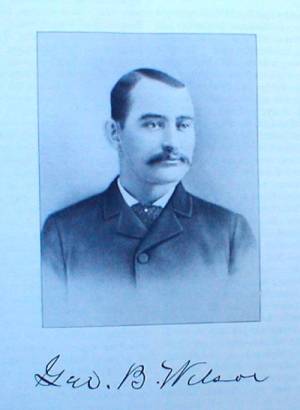
CAPTAIN GEORGE U. WILSON
Captain George U. Wilson, the only surviving son of William H. Wilson, was born March 13, 1834, in Hull, Yorkshire, England. His education was acquired in his native town, and he also took a three-years' course in navigation in the Trinity House Schools in Hull, and in September, 1848, he was bound out to serve an apprenticeship of five years, for the sum thirty-five pounds sterling. At the end of three years his ship arriving in New York, he ran away, and found employment in this country. During the time he was serving as an apprentice, he was three times at Kronstadt, Russia, twice at Archangel, on the White Sea, and was also around the north cape of Lapland, where he saw the sun shine for six weeks. During 1851-52, his first in America, he served as a sailor, and at the close of the season in 1852 he went to New Orleans, from there going to Liverpool on the ship St. Petersburg, of Boston. From 1853 to 1859 he sailed on the Great Lakes, and then went to Hamburg, Germany, on the schooner Grand Forks, of Detroit, Captain Starkweather in command. On arriving in the Old World he determined to visit his old home at Hull, and, as he allows no obstacles in his path to be insurmountable, he accordingly visited among the friends and acquaintances of his boyhood. From Hull he shipped on the Rainbow for Shields, England, and thence to Marseilles, France and Leghorn, Italy, and back to Portsmouth, England. A brief visit to Hull, and then aboard the bark Perthshire, bound once more for the New World. They landed in New York in July, 1860 and Captain Wilson at once returned to Detroit, where he went as second mate on the schooner R. H. Harmon, under Capt. Thomas Barker. In 1862-63 he was mate of the schooner Wyandotte, Capt. H. E. McGow, and the following two seasons sailed a brig for John P. Clark, of Detroit.
In 1866 Captain Wilson sailed the schooner Patrick Henry, in 1867, the W. H. Winslow, and in 1868 he purchased a one-fourth interest in the schooner Mary Martin, which he sailed for three years. He then purchased an interest in the propeller Dubuque, and sailed her three years. In 1876 he bought an interest in the A. A. Turner, and acted as her captain for ten years. For two years he was captain of the E. K. Roberts, since which he has been in the United States custom house at Detroit.
In 1861 Captain Wilson was united in marriage with Miss Charlotte E. Keith, of Detroit, and two daughters - Sadie A. and Georgia U. - blessed their union, and aid in brightening the family home at No. 412 Baker street, Detroit. Politically our subject is a firm adherent to Republican principles. Fraternally he belongs to Ashler Lodge No. 91, F. & A. M.; Peninsular Chapter No. 16, R. A. M.; Detroit Commandery No. 1, K. T.; and Detroit Lodge No. 7, Ship Masters Association.
PETER A. WILSON
Peter A. Wilson is the son of James and Jessie (Lithgo) Wilson, and the youngest son in a family of eight children, seven sons and one daughter. The parents were both born in Scotland.
Mr. Wilson was born January 29, 1866, in Welland county, Canada, in which section he obtained his schooling. When about twelve years of age he removed with his parents to Armstrong county, Penn., where he began his first practical work in a flourmill in that vicinity, being so occupied for about a year. In 1881, at the early age of fifteen, he commenced to learn the machinist's trade at the Dubois Iron Works, in Clearfield county, Penn., where he served the necessary apprenticeship of three years, and worked as a journeyman for two years, when he went to Erie, Penn., where he worked in some of the leading shops until the spring of 1893, when he took to steamboating. He shipped as oiler on the Schuylkill, belonging to the Anchor line, which position he held part of that season, and then went on the Philadelphia, being on her when she was wrecked off Point aux Barques, November 7, 1893, after which he entered the Anchor line machine shops, remaining until the spring of 1984, when he went as oiler on the Codorus, and on the 17th of September was promoted to the position of second engineer, which berth he held for some time, including the season of 1897.
In 1890, Mr. Wilson was married to Miss Sarah Goodill, of Erie, Penn., and they have one son. Socially, he is an Odd Fellow, being a member of the Philallelia Lodge No. 299, of Erie, and is also a member of the Woodmen of the World. The family reside at No. 223 Peach street, Erie, Pennsylvania.
CAPTAIN THOMAS WILSON
Captain Thomas Wilson was born in Fifeshire, Scotland, about 1840, and began sailing along the coast at an early age. He came to the lakes in 1855, and in 1856, during the one season, he had worked his way up from wheelsman of the Manhattan to second officer of that craft. The following season he shipped on the steamer Mineral Rock, where he remained until he became chief officer, and in 1863 he served as pilot and mate of the side-wheeler Illinois, in 1864 resuming command of the passenger and freight steamer Mineral Rock. For eight years Captain Wilson was in command of the passenger and freight steamer Meteor, on the route from Buffalo to Lake Superior, and for four years he did all the carrying trade of the Minnesota Iron Company; the first cargoes of rails had to be handled on the beach, this being at a time before docks and railroads were constructed. In 1873 Captain Wilson had built at St. Clair, Mich., the first boat of his present large line, and named her D. M. Wilson, after his only son, then a small boy. The Hiawatha and Minnehaha were shortly afterward built at Gibraltar, Mich., and the following large vessels, built to the order of the Wilson Transit Company, Capt. Thomas Wilson managing owner, have been constructed in sequence here given: Tacoma, Wallula, Kasota, George Spencer, Tower, Spokane, Missoula, Sitka, Yakima, Wadena, Olympia, Yukon, Yuma and W. D. Rees; a large steel steamer was completed for the season of 1897. Since 1875 Captain Wilson has remained on shore looking after his large vessel interests and controlling the movements of the Wilson Transit line fleet.
In 1872 the Captain married Miss Mary Morris, daughter of David Morris, who was the first man to ship coal out of Cleveland, and to them have been born three children: David, who died at the age of fourteen years; and Annabel and Mabel, who are now finishing their education.
WILLIAM WILSON
William Wilson (deceased). Closely connected with the commerce of the Great Lakes is the family of which the subject of this sketch is a member. There were few more conscientious men in the vessel business than the late William Wilson, of the Wilson Transit Company, brother of the general manager, Capt. Thomas Wilson. He stood high in the esteem of all with whom he was brought in contact.
He is the son of Thomas and Ann (Ried) Wilson, and was born in Pathead, Fifeshire, Scotland, August 7, 1837. At the age of five years he moved with his family to the North of Ireland, on account of a transfer of situations in the Custom House Department to which his father belonged. In 1855 William crossed the Atlantic to Philadelphia, Penn., and sailed some years in the New England coast trade, chiefly between New York and his adopted home. About 1860 he crossed the country to California, and for several years engaged in a flourishing river trade at that time carried on between San Francisco and Sacramento. By leading a careful, upright life, Mr. Wilson was enabled to accumulate quite a sum of money during his stay in California, most of which he lost through the failure of a bank in which he was a heavy depositor, and he was therefore compelled to begin anew.
About the time his family had decided to move to northern Michigan, he returned to Philadelphia and joined them in locating on Sugar island, St. Mary's river, near Sault Ste. Marie, where they occupied fertile and valuable farming property. In 1881 Mr. Wilson came to Cleveland to enter the office of the Wilson Transit Company, assisting his brother, Capt. Thomas Wilson, who was and still is president and general manager. Mr. Wilson was also owner of considerable stock in the Wilson company. In 1892 he made a trip to Europe with some of his best friends. Part of the winter of 1894 he spent in California, and soon after his return he was seized with a serious illness from which he suffered until April 24, 1895, when he died at his home in Cleveland, Ohio.
Shortly after his removal to Sugar island, Mr. Wilson was married to Miss Mary McKewin, of Detroit, who survives him. To bless their union came three children: William R., Thomas H. and Jenny E. Many worthy traits were to be found in Mr. Wilson, he was modest and retiring, but generous to a fault, willing to be deprived for the happiness of others.
WILLIAM WILSON
William Wilson has been in the employ of the Anchor line for seventeen years consecutively, which is sufficient evidence of his capability as an engineer. He was born March 4, 1860 at Buffalo, a son of William and Mary (Donnelly) Wilson, the former of whom was a native of Scotland, the latter of Ireland. William Wilson, Sr., who was a ship carpenter in trade, died at Buffalo in October, 1890, while his wife passed away in February, 1893.
The subject of this sketch attended school in his native city, and commended his life work as messenger or errand boy for Theodore M. Moore, then superintendent of repairs for the Anchor line. Following that employment he went into the employ of Farrar & Trefts to learn the machinist trade, remaining the usual period of four years, and the winter succeeding was in the employ of the Buffalo Engine Works. In 1879 Mr. Wilson entered the lake service, beginning in the spring as oiler on the steamer Chicago, of the Western Transportation line, on which he remained until July 2, when he left her work in the same capacity on the steamer of China, of the Anchor line, for the rest of the season. Beginning with 1880 Mr. Wilson was second engineer of the Chigaco for three successive seasons, transferring from her to the India as chief, on which he remained seven consecutive seasons, and with the season of 1898 he closed a period of nine seasons as chief of the steamer Japan. During his time on the lakes, undoubtedly due to his carefulness and foresight, Besides the work above set forth Mr. Wilson has been steadily employed in shop work for the twelve winters ending with that of 1896-97.
Mr. Wilson was married, April 17, 1882, to Miss Julia McCarthy, by whom he has three children, two of whom are now living, Charles and Irene. Socially he is a member of the Ancient Order of Foresters.
CAPTAIN WILLIAM H. WILSON
Captain William H. Wilson, one of the oldest sea captains now living, was born March 4, 1805, in Hull, Yorkshire, England, and was a son of John Wilson. He was given the educational privileges common to boys of that time, and early determined to follow the sea as his life occupation. In 1823 he found himself out on the Baltic Sea, and for a year and a half remained with his first employer. During this time he visited Belgium, Spain, France, Portugal, Sicily. In 1827 he came to New York to bring over some passengers, but made the return trip with the vessel, and in 1831 he joined a whaling expedition to the Arctic Ocean; the expedition was quite successful, capturing nine whales, and each of the next two years our subject was similarly employed. Captain Wilson has been far enough north that in June, July and August he has seen the sun shine for twenty-four consecutive hours. In 1833 he sailed on the Black Sea, touching at Odessa, and then visiting Alexandria, Egypt, on the Mediterranean. The following year he visited Africa, Ceylon and Sweden, and in 1835, France, Spain, Holland and Belgium. In 1836 he made but one long trip, that being to St. Petersburg, Russia, and the next year was passed near the home coast. In 1838 he sailed on the Baltic Sea. For eighteen years he was mate on British vessels, and for ten or twelve years before crossing the Atlantic to found a new home in the New World his time was spent mostly on the Baltic. In 1851 he left the Old World for the New and located in Detroit, Mich., which has ever since been his home. His first venture here was the purchase of a scow which he ran for one year and then sold her. The next year he was in command of the Oliver H. Perry, which was owned by his brother, Henry Wilson. His next berth was as mate of the Ocean Wave, on which he remained but a short time. After working on several other boats he entered the employ of John Bloom as sail maker, with whom he remained for eight to ten years, and then worked at the same business for James Donaldson, remaining until the death of his employer. For some time he sailed yachts running to Cleveland and Toledo, and with this he closed his long career on the water.
In 1830 Captain Wilson was wedded to his first wife, Miss Mary Ann Hutting, by whom he had five children, only one of whom - Capt. George U. Wilson - is yet living. In 1855 Captain William H. Wilson was again married, his choice being Miss Ann Morris, now deceased. No children were born of this second union. In his political affiliations Captain Wilson is a stanch Republican, and in his religious faith adheres to the Church of England.
RICHARD WINKLER
Richard Winkler is esteemed as one of the best qualified engineers sailing out of Manistee, Mich. He has proved himself reliable and trustworthy, and has been honored by the Marine Engineers Beneficial Association, of Manistee, of which he has been chosen treasurer four or five years.
Mr. Winkler was born at Fort Washington, Wis., April 7, 1860, a son of Gotthelf and Lottie Winkler, natives of Saxony, Germany, who came to the United States in 1854 and located at Fort Washington, Wis., where they purchased and improved a farm. They had a family of twelve children, all of whom were made useful in that work. The father died in 1880, but the mother is still living, at the age of seventy-eight years, making her home with her daughter, Mrs. Bertha Getter, in Omaha, Neb. Three of the sons became volunteers during the Civil war and served with honor, Maurice enlisting in the 26th Wis. V.I.; he was wounded at the battle of Gettysburg, the ball striking his forehead and passing round the skull, and he participated in the battles of Bull Run, Spottsylvania, Fredericksburg, the seven-days' fight in the Wilderness, Fairfax Court House, Petersburg and Richmond, besides several smaller engagements; at the close of the war he was honorably discharged, and after his return home followed the lakes for many years, being drowned in 1882 off the piers at Manistee, from the tug Irma Wheeler, when forty-two years old. Henry took part in many of the battles of the Army of the Potomac; he died of pneumonia, in 1893, at Juniata, Neb., leaving his family a fine farm of 640 acres. Herman, the third son, who became a Union soldier during the Rebellion, participating in many hotly contested engagements, and was wounded, but not dangerously; he is now chief engineer on the steamer Robert C. West. Edward is a farmer and cattle dealer at Omaha, Neb. Robert, who was born on the Atlantic Ocean while his parents were coming from Saxony to this country, followed the lakes as an engineer, and was for a long time in the employ of the Canfield Tug line, at Manistee, Mich., running the Maggie Marshall and Joy, and owning an interest in the last-named boat; he died of heart disease in 1895, while engineer of the steamer Robert Holland, on Lake Superior, about four miles from Sault Ste. Marie. Louis owns a large farm near Juniata, Neb., and is a dealer in pine lands near Florence, Wis. Lydia, the eldest daughter, is married. Bertha married a Mr. Getter, of Omaha, Neb. Emma became the wife of John Zanther, a real-estate dealer, of Omaha, where she died in 1889. Oscar is cultivating a large farm near Juniata, Nebraska.
In 1868 the family removed to Grafton, Wis., where they purchased another farm, and it was there Richard Winkler received his primary education, working on the farm in the meantime. In the spring of 1876 he shipped as fireman in the steamer J. C. Osgood, with the purpose of becoming an engineer, and remained in this berth two seasons, transferring to the steamer Caroline Williams, in which he also spent two seasons. As he was a thrifty young man he had saved up $750 of his earnings, which he deposited in a bank, and that institution failing, his hard-earned money went with the rest, but the misfortune did not greatly discourage him. In the spring of 1880 he took out engineer's license and shipped as second with his brother Robert, in the Maggie Marshall, advancing the next season to the office of chief of the tug J. C. Osgood. In the spring of 1882 he joined the steamer R. A. Seymour as chief, running her two seasons in the lumber trade between Milwaukee and Manistee. The next four years he passed as chief in the steamer Rand, and in 1888 he was appointed chief of the George C. Markham, which he ran two seasons, in 1890 taking chief's berth in the Gen. U. S. Williams. In the spring of 1891 Mr. Winkler became chief engineer of the new steamer Edward Buckley, which position he heolds at this writing. She plies to the salt and lumber trade, principally between Manistee and Chicago.
Mr. Winkler chose for his wife Miss Ida L. Irwin, daughter of Thomas and Annie Irwin, of Grafton, Wis., and they were married February 28, 1884. The children born to this union are Willie R., Irwin, Mildred, Ida Bessie and Robert E. The family homestead is situated at No. 381 Fourth street, Manistee, Mich. Fraternally Mr. Winkler is a member of the Royal Arcanum.
JOHN G. WINTER
John G. Winter was born October 11, 1844, at Chatham, Ont., the son of William Winter, a merchant of that place. He attended the public schools of his native town up to his sixteenth year when he came to the United States and settled at Detroit, Mich., there serving three years at the machinists's trade. He then went to New York City, where he was employed in a marine engine shop one and a half years, in 1870 returning to Detroit, at which place he made his home until 1890. Mr. Winter is now a resident of Cleveland. In 1863 he went as assistant engineer on the Quinabog, running between New York City and Georgetown, and after serving on this boat for half a season he transferred to the Nightingale, as greaser. In 1870 he came to the lakes as chief on the Canadian boats City of Montreal, J. W. Steinbold and City of Chatham, and later engaged for three years on the Detroit ferryboats, Excelsior, Fortune and Crusader. Leaving the water for a time he was engaged in the lumber business in Northern Michigan, but he returned to his old occupation and shipped on the Northern King, subsequently serving on the E. P. Wilbur and the German, and in 1896 on the George Farwell. Mr. Winter is a member of the Masonic fraternity. He is unmarried.
D. W. WISE
D.W. Wise, who, since March, 1881, has been engineer for the Chicago Terminal Railway Company's elevator Iowa, Fourteenth and Lumber streets, began sailing when but a young lad. He has held positions for long terms of service with large companies, and is highly esteemed by his employers.
He was born in New York City in 1848, son of Martin A. and Della (Sydney) Wise. The father was born in Wethersfield, Conn., and the mother in Virginia. Martin A. Wise was a printer, and was employed all his life in the office of the New York Tribune. Both he and his wife died in that city and are buried in Greenwood cemetery, New York. Daniel was reared in New York and New Brunswick, N. J., by his grandparents. Going to Albany, N. Y., he attended school and learned engineering and about 1863, or when a lad of fifteen, went to Oswego and commenced firing on a tug, doing harbor work; then on the tug Winslow, on the Detroit river, for one year. His next employment was on a tug in the Chicago river, after which he entered the employ of the Chicago & Northwestern railroad, going on the tug Escanaba, which boat was doing tugging at Escanaba and Fort Howard. He remained in the service of this company for three and a half years, and then for a year was engineer on the passenger boat Saginaw, of Chicago, and for the same period engineer of the propeller Jacob Barclay, from Milwaukee.
In 1873 Mr. Wise came to Chicago, and for years was engineer on tugs owned by Donaldson Bros., doing all kinds of lake tugging on the tug now known as the Judge Field. In 1876 he entered the employ of the Michigan Transportation Company, controlled by Leopold & Austrian, and was engineer on the Joseph L. Hurd, a passenger steamer plying between Chicago and Duluth, and all intermediate points. He remained with that company until he accepted his present position in 1881.
Socially, Mr. Wise is a prominent member of the M. E. B. A., Chicago Branch No. 4, and is at present financial secretary of the association, and is regarded as one of its most substantial and trustworthy members.
In 1876, in Chicago, Mr. Wise was married to Miss Mary E. Todd, who was born in Napoleon, Ark. To this union have been born two children: Sydney S. and Sarah Agnes.
GEORGE M. WISE
George M. Wise, another one of the prominent engineers on the lakes who makes Buffalo his home, is a son of George and Maria (Rogers) Wise, natives of England, and was born at Buffalo December 13, 1845. He attended Public School No. 6, and started work at the age of fifteen, learning the trade of machinist at the Vulcan Iron Works, where he remained about five years. Subsequently he took to steam-boating, which he has followed ever since. His first berth was that of second engineer on the Dictator, which he held for two seasons, and he followed this with four seasons in the same capacity on the Merchant, the next season being promoted to the chief of that boat. The seasons of 1873-74-75-76 he was chief of the Alaska; in 1878 he fitted and brought out new the Leigh, remaining her chief for four consecutive seasons, and leaving her to accept the position of chief engineer of the Buffalo branch of the American Glucose Company, with whom he was engaged for over a year. The season of 1883 again found the fascination of a seafaring life upon him, and he went on the Siberia as her chief for that and the following season. In 1885 he fitted and brought out new the Wiley M. Eagan, running her two seasons, and the following season brought out new the John Pankerton, running her half that season, and for the balance being employed on the E. P. Wilbur. He then went on the Wallula for one season, and the next was back again as chief of the E. P. Wilbur. Since that time he has been chief of the Florida. He has twenty-eight issues of license. Mr. Wise's brother William is chief engineer of the Ogdensburg Transportation Company, and another brother, John, is chief on the China.
Mr. Wise was married, at Buffalo, in July, 1868, to Miss Martha M. Moore, of Canada, by whom he has nine children, four now living, namely: Margaret, wife of George Hallett; Sarah Jane, wife of William Hartz; George R., aged sixteen, and Joseph Burton, aged twelve. The family reside at No. 126 Babcock street, Buffalo, New York.
CAPTAIN ALFRED M. WOLF
Captain Alfred M. Wolf, whose life came to a tragic end in January, 1896, was one of the well-known lake navigators of the earlier days. He was born in Dover, Ohio, a small place near Cleveland, in 1828, a son of John Wolf, a cooper, whose birthplace is Norfolk, Va. He commenced sailing in the early 'forties, rising rapidly to the position of master, and later owning shares in various vessels, one of them being the C. Y. Richmond. He served in the 151st O. V. I., during the greater part of the Civil war, in company with his brother, Michael Wolf, of the regular army, who died three months after he left the army, from a wound he received in battle.
Captain Wolf married Miss Caroline Rentchler, of Cleveland. Their children were: Alfred, now deceased; George S., a marine engineer and inventor; Albert H., who is the inventor of a method of raising sunken vessels; and Arthur H. J., who is a farmer. Captain Wolf met a tragic death on Rocky river, January 4, 1896, being assaulted and robbed of a large sum of money he was carrying, and was killed. His body was found under a trestle of the New York, Chicago & St. Louis railroad.
GEORGE S. WOLF
A young marine engineer who has distinguished himself in the field of mechanical invention is George S. Wolf, of Cleveland, a son of the late Capt. Alfred Wolf and his wife Caroline (Rentchler) Wolf. He was born in West Dover, Ohio, near Cleveland, January 24, 1868, and his sailing experience began when he was fourteen years of age. He spent two seasons on board of the steamer Smith Moore, and part of another on the steamer James Pickands. Then he took a fancy to join the United States Navy as means of gaining useful experience and seeing something of the world.
On the cruisers Saratoga, Jamestown and Minnesota he cruised entirely around the world, his position on board being that of an apprentice. He also spent a period on board the Boston in the West Indies, after which he left the service, with an honorable discharge and continuous service certificate, having been connected with it over three years, and being then twenty-one years of age. He received his first papers as engineer after returning to the lakes. In 1890 he shipped as oiler on the steamer James Pickands, the following season becoming master of the scow Modock. After leaving the Modock he purchased an interest in a fish tug. In 1894 he retired from active sailing, and has since devoted himself to mechanical engineering, doing machine shop work and setting up machinery. Mr. Wolf is the inventor of two high speed and compound marine engines for which are claimed many points of merit. One set of valves does duty for both the high and the low pressure cylinders, thus effecting great economy, and also increasing the operating facilities and accessibility, and tending to produce high speed, smoothness of running, durability and strength. These engines are lighter and more compact than the usual forms; they have balanced valves, and rotation parts, and have from twenty to eighty per cent, less port clearance to waste steam than other engines. Mr. Wolf has had a long experience in machine shop practice, and is prepared to build and furnish these engines complete. He is also the inventor of a balance slide valve which removes the pressure from the back of the valve. Another invention is an automatic siphon to be placed in the hull of vessels. It starts automatically as soon as any water appears in the bilge and stops working when all the water is out.
On January 31, 1894, Mr. Wolf was married to Miss Ida I. Sharp, of Cheshire, Mich. They have two children: Aletha Marina and Norman Adelbert.
HERMAN WOLFE
Herman Wolfe, engineer of the Troy Steam Laundry at Port Huron, Mich., was born January 17, 1847, in New York City, a son of Ferdinand and Theodora (Trisch) Wolfe, the former of whom was a native of New York, the latter of Germany.
During the Civil war Herman Wolfe was one of the youngest patriots of the Northern army. He first enlisted in September, 1861, in the Forty-first N. Y. V. I., but when he came up to be mustered into service it was discovered that he was too young to stop a cannon ball and the officer directed him to go home and get a trifle more age. He obeyed and just one year later he again enlisted, this time in the One Hundred and Twenty-seventh New York, and was accepted. His regiment was assigned to the Army of the Potomac and was at Yorktown during the Peninsular campaign. It was ordered to Gettysburg, but when it reached that historic field the battle had been fought and won, so they were sent South by transport, under Gen. Q. A. Gilmour, and took an honorable part in the Black Water raid and the battle of Suffolk, the siege of Charleston and the Island campaign; they were also at Devaux Neck, on the Charleston & Savannah railroad. They were incorporated in the Coast Division Corps, and co-operated with General Sherman's army when it appeared in that locality. In February, 1865, after Sherman's army had passed on to Raleigh, the regiment returned to Charleston, and protected that city from further destruction, remaining there until June 30, when they were marched out of the city. On July 4, they boarded transports, on July 7, reaching New York City, where they were mustered out of service seven days later. The regiment was tendered a great reception by the citizens.
In September, 1865, Mr. Wolfe shipped as fireman on the Hudson river steamer Mary Powell, and in 1867 he joined the Quaker City as oiler, plying between New York and Charleston in the coasting trade. In 1870 he shipped as fireman in the New York harbor tug Only Son, following with a year in the George Burtbeck. In 1872 he entered the Coast Wrecking Company and came up on the lakes, locating in Port Huron and joining the steamer Rescue, on which he remained two years. In 1874 he took out a marine engineer's license and was appointed chief of the ferry boat John Pringle, the next year becoming chief of the side-wheel steamer Young America. He then stopped ashore and entered the employ of the Phoenix Iron Works Company, as machinists, and also working in the Chicago & Lake Huron railroad shops. In the spring of 1882 Mr. Wolfe again took up his lakefaring life as chief engineer of the lake tug Frank Moffat, running her two seasons, and then for four seasons engaged as chief of the ferry steamer Grace Dormer, of the Port Huron & Sarnia Ferry line. In the spring of 1888 he shipped as second engineer of the steamer Burlington, being advanced to the position of chief of the same steamer the next season and after leaving her served as chief of the steamer William Cowie. In the spring of 1891 he joined the steamer Leland as second engineer, closing the season as chief on the passenger steamer John Morley. His next boat was the steamer Empire, on which he remained one season as second and the next as chief. During the season of 1894 he was second on the steamer Cleveland, running her as chief the next year. In 1896 he was engineer on the tug Ella Smith, towing rafts. During the year of 1897 he was engaged to run the engine and plant of the Troy Steam Laundry in Port Huron.
On August 30, 1873, Mr. Wolfe was united in marriage to Miss Minnie E., daughter of August and Annie Drewing, of Port Huron. Their children are Charles R., Clara L, Lilly A., Harry O., Rudolph and Myrtle. The only society with which Mr. Wolfe is affiliated is the Woodmen of the World.
CAPTAIN WILLIAM WOOD
Captain William Wood, of Cleveland, Ohio, is a young man who has followed the water for a very large portion of his life. He was born in the Orkney Isles, Scotland, in 1871, the son of Capt. John Wood, who was a lifelong sailor and fisherman on salt water. At the age of eight years William commenced sailing on his father's fishing smack, a vessel about 140 feet long, where he learned to steer in good weather and to catch codfish with a hand line. He remained on this vessel, and on others sailed by his father, for seven years, in 1890 coming to the United States with a brother, David Wood, who is now a resident of Cleveland and is a mariner on the lakes. Since that time his experience has included service on board the schooner Jennie White, on the tugs Mascot, R. T. Roy, Barnhurst, Sea Wing, Enterprise and Harrow, and on the tugs Inglesbee and North Star as commander. He has also been watchman and wheelsman on the steamer La Salle, and lookout on the passenger steamer State of Ohio.
Captain Wood's forefathers have been ocean sailors as far back as the line can be traced. His grandfather and great-grandfather were sailors, and all of his brothers followed that calling. His father at one time sailed the schooner Sea Foam from England to Australia and return, and he made many other long voyages.
CAPTAIN Z. L. WOOD
Captain Z.L. Wood is a pioneer and patriarch of Conneaut, Ohio, whose early life was passed as a lake mariner, from boy to master. Although he has reached the good old age of seventy-eight years none of his faculties have been noticeably impaired, and he bears himself with the deliberation and dignity of a man who has lived an upright life. Captain Wood was born October 25, 1820, son of Silas and Olive (Kennedy) Wood, of Connecticut and Vermont respectively, who were among the earliest settlers of Conneaut township. The Captain's wife, who is a daughter of William and Deborah (Thompson) Harper, is a remarkable woman and as cheerful a housewife as in her youthful days. They were united in marriage on January 1, 1845, and, celebrated their golden wedding on New Year's day, 1895, the happy event being attended by their children, grandchildren and friends for miles around. Both families, the Woods and Harpers, acquired large tracts of land in and about Conneaut, much of which is still retained by their descendants. Captain Wood and his wife are now enjoying the old homestead of the Harpers, on the east side of the Conneaut river at the harbor. Their children have all established themselves in homes of their own: William Silas, the eldest son, is carrying on a grocery business in Conneaut: Henry Z. is in the drug business in Forest, Ind.; Ida M. is the wife of Thomas Foran, a conductor on the Nickel Plate railroad, residing in Buffalo. There are five grandchildren.
Captain Wood began his career on the lakes away back in 1837, as cook in the scow Free Trader, which was wrecked and rebuilt the same year and renamed the Commercial. The next spring he shipped in the schooner William G. Buckner, with Capt. Jacob Imsen, as cook. In 1839 he advanced to the dignity of sailor before the mast in the Benjamin Barton, and changed into the schooners Joliet, H.H. Kenney and others until the spring of 1842, when he was appointed second mate of the schooner Benjamin Barton, later receiving promotion to first mate's berth, and finally taking command of her. In 1848 he joined the schooner Big Z, as mate, closing the season on the steamer Benjamin Franklin, as wheelsman and second mate, and the next spring he was appointed master of the schooner Albany, which he sailed two seasons. In the spring of 1846 Captain Wood brought out the brig Lucy A. Blossom, but after one round trip she was sold and he assumed command on the brig Saginaw, sailing on her the balance of the season. His next vessel was the schooner Stambach. She was caught by a gale off Conneaut and capsized, the mate, cook and one seaman drowning; the other members of the crew clung to her bottom until rescued. One of the number, who had never been known to perpetrate a joke, remarked that "this would be a good opportunity to caulk her bottom." In the spring of 1848 Captain Wood was appointed master of the schooner Harriet Ross, following with a season in the brig Sultana, which hailed from Chicago. In 1850 he joined the schooner Grand Turk, which nine years later went down to the sea on a voyage from Detroit to Hamburg with a cargo of ship plank. Captain Wood says she also made a voyage to Constantinople. After sailing various vessels the Captain purchased the scow Times, which he commanded, and in the spring of 1870 he bought the schooner John Fretter, which he sold after sailing her with good results for four seasons, retiring to the ease and comfort of farm life. He is now occupied for the most part in looking after his real estate. It is safe to say that he and his good wife enjoy life as fully as the youngest mariners, with a comfortable competency and the consciousness that their work has been well done.
CAPTAIN C. H. WOODFORD
Captain C.H. Woodford is a son of Homer H. and Rosetta M. Woodford, who were at one time residents of Kelley’s Island, Lake Erie, Ohio, and afterward lived on Catawba Island. The Captain was born on Kelley’s Island in 1861, and attended the public schools until his nineteenth year, the last three years only during the winter season. He commenced sailing summers when he was seventeen years old as cook on the schooner Gilmore, going before the mast the last two months of the season. He then shipped on the scow S. B. Conklin before the mast for a season, and advancing rapidly was in 1880 appointed mate of the schooner H. D. Root. In 1881 he shipped as seaman on the schooners Theodore Voges, C. H. Johnson and J. F. Card, in turn, and the following season on the schooners Fayette Brown, Niagara and City of Green Bay. In the spring of 1883 he was appointed second mate of the Fayette Brown and remained in that position two years. In 1885 he became mate of the passenger steamer Louise, but finished that season as master of the tug Mystic. In 1886 he sailed the tug Bennett, on which he also commenced the following season, closing same on the tug Buffalo, which he continued to sail throughout 1888. The next spring he was appointed master of the steambarge Lowell, but closed the season in the same capacity on the Welcome. His next command was the schooner D. K. Clint, from which he again transferred to the Welcome, closing the season as her master, and resuming that command the following season, remaining on the Welcome until the close of navigation. In 1893 he sailed the tug Harris; in 1894 the steam barge Leland; in 1895 the steam barge Desmond; and in 1896 the steamer Argonaut, laying her up at Marysville at the close of navigation.
Captain Woodford was married in 1885, to Miss Elva Tulison, of North Bass Island, Lake Erie, and they have two children: Roy Fayette and Ruth Genevrea. Socially he is an Odd Fellow and a member of the Ship Masters Association, carrying Pennant No. 761.
CAPTAIN CHARLES WOODGRIFT
Captain Charles Woodgrift is one of those hardy Danes who are noted as good sailors. He was born in Schleswig, Denmark, in 1841, and began a life on salt water when but fourteen years of age. In 1861 he came to the United States, and went sailing from Philadelphia to the West Indies and Brazil.
In 1865 he went to Chicago and shipped before the mast of the Chenango, sailing from Chicago to Buffalo, and during the next year, in 1866, he again sailed on salt water out of Philadelphia. In 1867 he went back to the lakes, shipping on the William Crosthwaite. That fall he changed to the schooner Willaim Grandy, and in 1868 went as second mate of her. In 1869 he filled the position of second mate on the Sweetheart, running from Chicago to Buffalo, and in 1870 bought a half-interest in the schooner Rosa Ann; selling out his interest in the fall of 1871, he went back to the Sweetheart as first mate, where he remained until 1874, when he went as second mate of the steamer Superior. In 1875 he bought a half-interest in the schooner Hathaway, and sailed her until the fall of 1881, when she was lost on the beach at Springport. During the seasons of 1882 and 1883 he was captain of the Louisa, then entered the employ of the Tonawanda barge line, where he has since remained. He was captain of the schooner Alva four years; of the steamer Canisteo two years; and since then of the steamer F.R. Buell. During these years he has never grounded nor had any trouble; the line carried no insurance, claiming that it thus saved money.
In 1867, at Buffalo, Captain Woodgrift was married to Miss S.J. Brady, and they have four children; Alice; Jennie; Charles, who is a sailor; and Willie.
Captain Woodgrift is a member of the Detroit Harbor No. 47, Masters and Pilots Association, and expects to remain "on deck" some years yet.
CAPTAIN LYMAN B. WOODRUFF
Captain Lyman B. Woodruff, a pleasant and courteous gentleman, who has lived a life of integrity and honor, may still look forward, to all appearances, to a score or more years in the locker. He was born February 12, 1840, in Sheffield, Lorain Co., Ohio, and has filled every berth on the lakes from cook to master and owner. He is the son of Capt. Horace and Nancy (Lewis) Woodruff, natives of Stateline, Mass., who moved west soon after their marriage, locating at Sheffield, three miles from the shore of Lake Erie. Here Lyman Woodruff was reared and educated, and he still lives on the old homestead. The father was a vessel owner and master, his last boat being the scow Berkshire, which he sailed several years. She was wrecked near the Sand Hills above Long Point, out on the north shore of Lake Erie. Capt. Horace Woodruff died in 1845, his wife passing away some years later. The sons of the family who followed the lakes were Edwin, whose last command was the schooner Redwing (he went to Los Angeles, Cal., where he died); Frederick, who was master of the schooner P. S. Marsh for several years (he died in Elyria, Ohio); and Harvey, whose last commands were the schooner F. L. Danforth and tug Relief.
In 1850, when he was very young, Lyman B. Woodruff became a sailor, shipping as cook on the schooner Black Swan, with Capt. Henry Moore. The next season he went on the schooner Prince of Peace, with Captain Sheldon, and in 1852 in the scow Cousin Mary, with Capt. Henry Root. The following year nothing would serve his ambition but a 22,000 bushel vessel, and he shipped in the big schooner Marquette, trading between Chicago and Oswego. In the spring of 1854 he decided to become a sailor in earnest, and engaged before the mast in the William H. Craig, owned by the Bradley Brothers, receiving $18 per month. His next vessel was the schooner Game Cock, which was quite a smart craft, as some of the old-timers will know. In 1856 he was appointed mate in the schooner Sunbury, in the lumber trade between Saginaw and Buffalo, holding that office two seasons, and following with a season in the schooner Soo, as mate, with his brother, Edwin. He then spent some time in the fishing business out of Mackinaw. After this digression the Captain became master of the schooner W. S. Lyons, and after leaving her spent two seasons in the Ann Maria, of Conneaut, also as master, subsequently sailing the schooners Selkirk and Mocking Bird a season each. He now entered the employ of Capt. Alva Bradley as master of the schooner Exchange, and finding a warm personal friend in the Captain, continued in his vessels for thirteen years, sailing the schooner S. H. Kimball four seasons and the D. P. Rhodes eight seasons. While master of the last-named vessel he was severely injured, by the line tearing a chock from the rail and striking him; he was taken home on a lounge, put to bed and did not recover for eight months, during which period of enforced idleness Captain Bradley continued his salary as master. Later he joined the Phineas H. Marsh as mate.
Captain Woodruff finally purchased the schooner E. R. Williams, which he sailed successfully for five seasons, and selling her purchased a third-interest in the steamer Otego and consorts Monticello and Montmorenci, sailing the steamer one season, after which he sold his share. The Captain then turned his attention to steam, receiving the appointment of mate in the steamer Oscar Townsend, and as the years passed he held the office of mate in the steamers Specular, Britannic, C. W. Elphicke, Specular, Marquette, T. S. Christie, James Pickands, Sarah E. Sheldon, Britannic, a second time with Captain Mansfield., serving on these boats until 1896, when he was appointed second mate of the large new steel steamer Zenith City. In the spring of 1897 he joined the steamer Corona as mate. In 1898 he came out as mate of the steamer Vega, but closed the season on the Corona as mate with Capt. Samuel Murphy.
Socially, the Captain is a member of the Ship Masters Association and holds Pennant No. 622.
Captain Woodruff was united in marriage on March 22, 1861 to Miss Diana A. Miller, daughter of Alexis and Caroline Miller of Avon, Ohio. Of the children born to this union Addie is now the wife of George Blake, of Brownhelm, Ohio; Frederick L. was drowned while master of the schooner Monticello, in 1892; Alice is the wife of Burke Farragher, of Lorain, Ohio; Alva is employed in the machine shop of the Cleveland Shipbuilding Company at Lorain, Ohio; Walter is second engineer in the steamer P. J. Ralph; Nellie is a graduate of Sheffield and Lorain schools; George has remained on the farm; Elmer is porter on the large new steamer Presque Isle. They reside in the old homestead farm at Sheffield, Ohio, but the Captain owns another farm of 137 acres, near Oberlin, to which he expects to retire when the frosts of the winter of life come upon him.
CAPTAIN HENRY J. WOODS
Captain Henry J. Woods, keeper of the United States Life Saving Station at Muskegon, Mich., is not only experienced in his line of duties as a life saver, but has given close attention to the mechanical appliances in use in the service, and has invented several ingenious additions thereto, the most important of which is his system of carriages for transporting and launching the large lifeboats in use at all stations, patent oar locks and steering oar locks. He has at his own cost a machine shop fitted up, adjacent to the station, and supplied it with $1,000 worth of tools at his own cost, and so well do the officials of the life-saving service regard his appliances that they have authorized him to construct for government use several sets of launching carriages and oar locks. He is not only an expert boat man but an engineer, and perhaps contracted his love for machines while running a stationary engine in the oil country near Erie, Pennsylvania.
Capt. Henry J. Woods was born near Oneida, Cattaraugus County, N.Y., on May 29, 1850, and is a son of Henry J. and Harriet J. (Starkweather) Woods, both being born near Brandon, Vt., and descendants of a long line of reputable ancestors in the Green Mountain State. After attending the district schools until he was fourteen years of age, he went with a brother-in-law, Capt. Frank Jackson, who commanded the Twelfth Ohio Independent Battery of Artillery, stationed at Murfreesboro, Tenn., and after the battle of that place the battery was transferred to Chattanooga, where is remained until the close of the war, and, although Henry was not an enlisted soldier, he enjoyed the discharge of the artillery just as well as any of the volunteers. He then went to Fond du Lac, which place his mother had made her home after the death of the father in 1851. In the spring he went to Erie, Penn., where he acquired his first experience as a boatman, as he engaged as a fisherman for two seasons. In 1868, he started in business for himself, owning two boats, and fishing along the shore out of Erie, Conneaut, Ashtabula and Fairport until 1875, when he went to St. Joseph, Mich. The next year he went to Edenburg, Penn., where he engaged for three years in the oil fields. At the expiration of that time he returned to St. Joseph and took a contract for hopping pails in the factory of A. H. Morrison, but before the close of the year the factory was destroyed by fire.
In the spring of 1880 Captain Woods entered the life-saving station at St. Joseph, and was appointed surfman No. 1. He remained at that station two seasons, and took a prominent part in rendering assistance to all vessels in distress. In 1882 he was appointed keeper of the Muskegon station, and the first vessel requiring assistance in his new office was the schooner S. B. Pomeroy, taking off the crew on March 29, and later assisting in getting the schooner out of trouble. It would occupy too much space in this work to give in detail the lives saved and the vessels assisted by Captain Woods with his crew of veterans during the sixteen years he has been keeper at Muskegon, but the following are among the most notable instances of rescue: Barge Burton, scow Miami, schooner Trial and three men, steamer Michael Groh and fourteen men, Emma L. Nelson, Pilot, Harkins and nine men, John Bean, Naiad, Penobscot, R. B. King (which struck the pier and capsized, two men being saved and two lost), steamer Henry Johnson, schooners Ada, Alvin Bronson, Blue Wave, Novina, Magnolia, Triad, Cheney Ames, Nellie Hammond, S. P. Ely, Mischicott, Condor, steamer Charles Retz and consorts, John Mark, and Agnes Potter and Waukesha, which did not signal for aid and foundered during the night, but one man being saved. In addition many lives were saved from small boats in Muskego lake, among them two sailboats with six people, yacht Viking and four men, sailboat and three men, three from a fishing boat, and several capsized boats with from one to four men, also the life of a boy whom the Captain discovered floating under water. One of the most thrilling episodes experienced by the Captain and his crew was on November 28, 1882, when the schooner Donaldson, dismasted, was sighted by the lookout. They could not get a tug, so pulled out a lifeboat through a blinding snowstorm with a heavy sea on. The crew lashed themselves to the thwarts to prevent being washed overboard, and after a noble struggle with the elements reached the distressed vessel, seven miles out in the lake and sixteen miles north of the station, and after twelve hours exposure to death they reached the shore drenched to the skin and covered with ice. The crew of the Muskegon station, as constituted at this writing, consist of George I. Van Burt, John Edlund, Henry Walker (detailed as surfman at the Omaha exhibit), Henry Berg, Guy Patterson, Fred W. Cramer and George McKinzie, numbered in the order named. Capt. Henry J. Wood was honored by being appointed keeper of the station at the exhibition at New Orleans in 1885-86, during the Cotton Centennial Exposition, and filled the office with ability.
Capt. Henry J. Wood was united by marriage to Miss Hulda A., daughter of James L. and Lucinda L. (Bartlet) Wells, of Marietta, Ohio, the ceremony being performed at Grand Rapids, Mich., on February 6, 1881. The children born to this union are: Hattie H., who died January 23, 1898, and Gracie B. The home at the station evidences the intelligence and refinement of the wife and daughter.
The Captain is quite popular with many of the social orders of the day, being a Master and Royal Arch Mason, a charter member of Knox Lodge of Odd Fellows, of Edinburgh, and Knights of Pythias, Elks and Foresters.
CAPTAIN EDWARD J. WYLIE
Captain Edward J. Wylie, a well-known master of tugs operating out of Ashtabula Harbor, was born in Ashtabula, Ohio, in 1856, a son of William and Elizabeth, (Cook) Wylie. The father was a Scotchman by birth, and on coming to America located in Montreal, Canada, where he remained until 1854, when he removed to the United States, settling in Ashtabula, Ohio. At the breaking out of the Civil war he enlisted in the Fiftieth O. V. I., under Colonel Strickland and Capt. Thomas Gwinn. He was killed by a minie ball at the battle of Snake Creek Gap, Ga., May 31, 1864.
Edward J. Wylie attended the public schools in his native town until he reached the age of fifteen, and in the spring of 1871 he engaged in fishing out of Ashtabula Harbor. He had made a few trips on the lakes previous to this, however, on the schooner Zouave and Abe Lincoln, as cook, with Capt. Thomas Booth. He also fished out of Fairport and Erie until 1875. While returning from Erie to Ashtabula, in October, 1873, alone in his fishing boat, it capsized; he clung to the bottom of the boat until picked up six hours later by William Clark in a fishboat. Mr. Clark was afterward captain of the Erie life saving station, and was drowned while in discharge of his duties. In 1875 our subject went sailing with Captain Lampole on the schooner Ahira Cobb before the mast until July. He then shipped as fireman on the iron tug Dexter, operating at Ashtabula, closing the season on the tug Ingram. In the spring of 1876 he joined the schooner Goshawk, Capt. Ed Morton, until July, when seaman's wages running low, he returned to his old berth on the tug Dexter.
The next year he went to Edenburg, Clarion Co., Penn., and engaged in building oil tanks. In July he returned to Ashtabula and passed sometime on the tug Dexter, but closed the season on the steamer Jarvis Lord as wheelsman with Captain Drake, laying the boat up in Chicago. During the entire season of 1878 he fired on the tug Dexter. After laying up his boat he went to the Bradford, Penn., oil regions and was employed in building oil tanks. During the next four seasons he was employed on the tug Dexter, taking out pilot's papers in June, 1881, and sailing her two years.
In the spring of 1883, Captain Wylie entered the employ of the Ashtabula Towing Company, as master of the tug Red Cloud, and sailed her four seasons. In the winter of 1885-86 he went to Warsaw, N. Y., to build salt blocks; in 1887 was appointed master of the tug John Gordon, and sailed her until the fall of 1891. Next spring he brought out new the tug William D., and sailed her five consecutive years to this writing. During the twenty years he has been engaged exclusively in the tugging business, Captain Wylie has given the best of satisfaction, his boats having all been free from mishaps. He has made some notable rescues, among them the saving of two men from a capsized small boat, a third man being drowned before he could get to him. He took the crew off the schooner Parker while at anchor off Ashtabula during a fall gale and in danger of going ashore. He also, with a volunteer crew of six tug men in a lifeboat, took the crew off the schooner Nevada, which soon afterward went to pieces in a furious storm. On another occasion he jumped overboard from his tug and saved the life of a young man named Charles Huff.
Socially Captain Wylie is a Royal Arch Mason, having passed the degree of Master many years ago. He is in possession of a Masonic heirloom which has been handed down over a hundred years through several generations, and is a relic of great interest. It is composed of polished bone, squared and beveled on two edges, with a square and compasses engraved and colored apparently with red India ink, and in each of the beveled surfaces is engraved an arrow, each pointing in different directions and also colored red. It is not known how long the original possessor (a Mr. Wood) had it. Mr. Wood lived in York, England, and when his son, Erastus Wood, came to America in 1805 he gave it to his son; at his death it was passed into the hands of his wife, and when she died in 1871 it was received by her daughter, while in 1872 it was given to the great-granddaughter of Mr. Wood, who is now Mrs. Terry, and she in turn passed it down to her daughter's husband, Capt. E. J. Wylie, as a Christmas present with a gold plate on the reverse side bearing the dates "1776-1897."
Captain Wylie was married in 1881, to Miss Hattie M. Cosgrove, daughter of John and Sarah Cosgrove of Ashtabula. Two sons, John E. and Lionel W., have been born to them. The family residence is at No. 37 Spruce street, Ashtabula, Ohio.
Capt. James T. Wylie, a younger brother of our subject, was also a master of tugs operating out of Ashtabula Harbor, having been appointed master of the Tug Dragon in 1886. He also sailed the Red Cloud, Kunkle Brothers, and brought out the tug Sunol new. He was washed overboard and drowned November 24, 1894, while towing out the steamer Pontiac, Capt. James Lowe, in the teeth of a fierce gale. Five days later his body was recovered near Conneaut, about thirteen miles distant from the scene of the disaster. He was thiry-one years of age, and his bravery was proverbial, as he had saved the lives of many persons at the peril of his own. During the season 1892 he was instrumental in saving eight lives. When his death was announced the flags at the Harbor were placed at half-mast.
The other members of the family are Eliza, now the wife of John Sterns; Emma, wife of C. Todd, and William, a railroad engineer on the Ashtabula & Pittsburg road.
CAPTAIN JOHN H. WYSOON
Captain John H. Wysoon, one of the prominent steamboat masters sailing out of the port of Cleveland, is a typical mariner, and one who has lived to be over forty-five years of age without gaining the luxury of a personal enemy. He is a son of Martin S. and Martha (Hopkins) Wysoon, and was born in Buffalo, N. Y., September 29, 1852. His father was sailor and master of sailing vessels for a number of years, and he had four brothers, James, Henry, Cyrenus and Peter, all of whom were lake masters.
After attending the public schools in Buffalo for some years, John H. Wysoon gave way to the hereditary tendency of his family, and being a well-grown youth he shipped, in the spring of 1863, as porter on the propeller Hunter, but finished the season in the same capacity on the propeller Buffalo, where he remained until 1864. He then enlisted in the One Hundred and Fifteenth N.Y.V.I., serving until the close of the war. His regiment was under the command of Generals Terry and Schofield, and was with the former on his expedition for the capture of Fort Fisher. The Captain was in all other engagements in which his regiment participated during his term of service. He was at Raleigh at the time President Lincoln was assass-inated. He was honorably discharged in August 1865, and after returning home made two trips during the fall on the old propeller Saginaw, as lookout. In the spring of 1866 Captain Wysoon entered the employ of George R. Hand as lineman on the tug George W. Gardner, finishing that season on the tug J. C. Harrison, to which he returned the following season, serving in various capacities. In the spring of 1868 he was appointed captain of the J. C. Harrison, and sailed her two seasons. In 1870 he was made master of the tug George W. Gardner, and in 1871 of the tug Compound, on which he remained until May 10, 1872, when she blew up, causing the death of the cook and a deckhand. He was then transferred to the tug C. W. Jones, as master, continuing on her until fall, when he took the George W. Gardner as the winter boat.
In 1873 Captain Wysoon entered the employ of Thomas Maytham, as master of the tug George R. Maytham, remaining on her until June, 1874, when she was sold. He finished that season on the tug Orient. He opened the season of 1875 on the Frank Perew, on which he served until June, finishing on the propeller Empire State, of the Western line. In 1876 he was appointed master of the tug Maytham; 1877, of the tug Siskiwitt; 1878, of the tug Orient; 1879, of the tug Knowlton; 1880, of the tug Maytham; 1881, of the tug O. W. Cheney, which he bought out new and sailed until he came to Cleveland and entered the employ of Capt. Alva Bradley. He took command of the tug Forest City, sailing her until August, 1888, when he was appointed master of the schooner Alva Bradley, from which he was transferred the middle of the following season to the command of the steamer Superior. In 1890 he sailed the Superior; in 1891-92 the steamer Henry Chisholm; in 1893 the steamer R.P. Ranney; in 1894 the Henry Chisholm; in the spring of 1895 he brought out the steamer Gladstone, but finished the season on the Alva, remaining on her during the seasons of 1896-97. The Alva is the finest boat in the Bradley fleet, and as Captain Wysoon has steadily advanced from the birth(sic) of master of a tug to that of master of the Alva, after sixteen years in the one employ, he may be judged to be a most capable steamboatman, and one who has deservedly won the confidence and esteem of the management. He has received his twenty-fifth issue of license as steamboat master, and might with truth be called a jolly tar, in the literal meaning of the term.
In 1889 the Thirtieth ward of Cleveland, in which Captain Wysoon lived, honored him by electing him a member of the city council, and it is a pleasure to say that he discharged the duties of his office with honor to himself and profit to his constituents.
In 1878 Captain Wysoon was united in marriage with Miss Elizabeth Walden, of Mount Forest, Canada. The family homestead is at No. 18 Mather street, Cleveland, where the Captain has recently completed a new residence. Fraternally, he is a member of the Elks, the Knights of the Maccabees, and the Ship Masters Association, carrying Pennant No. 248.